

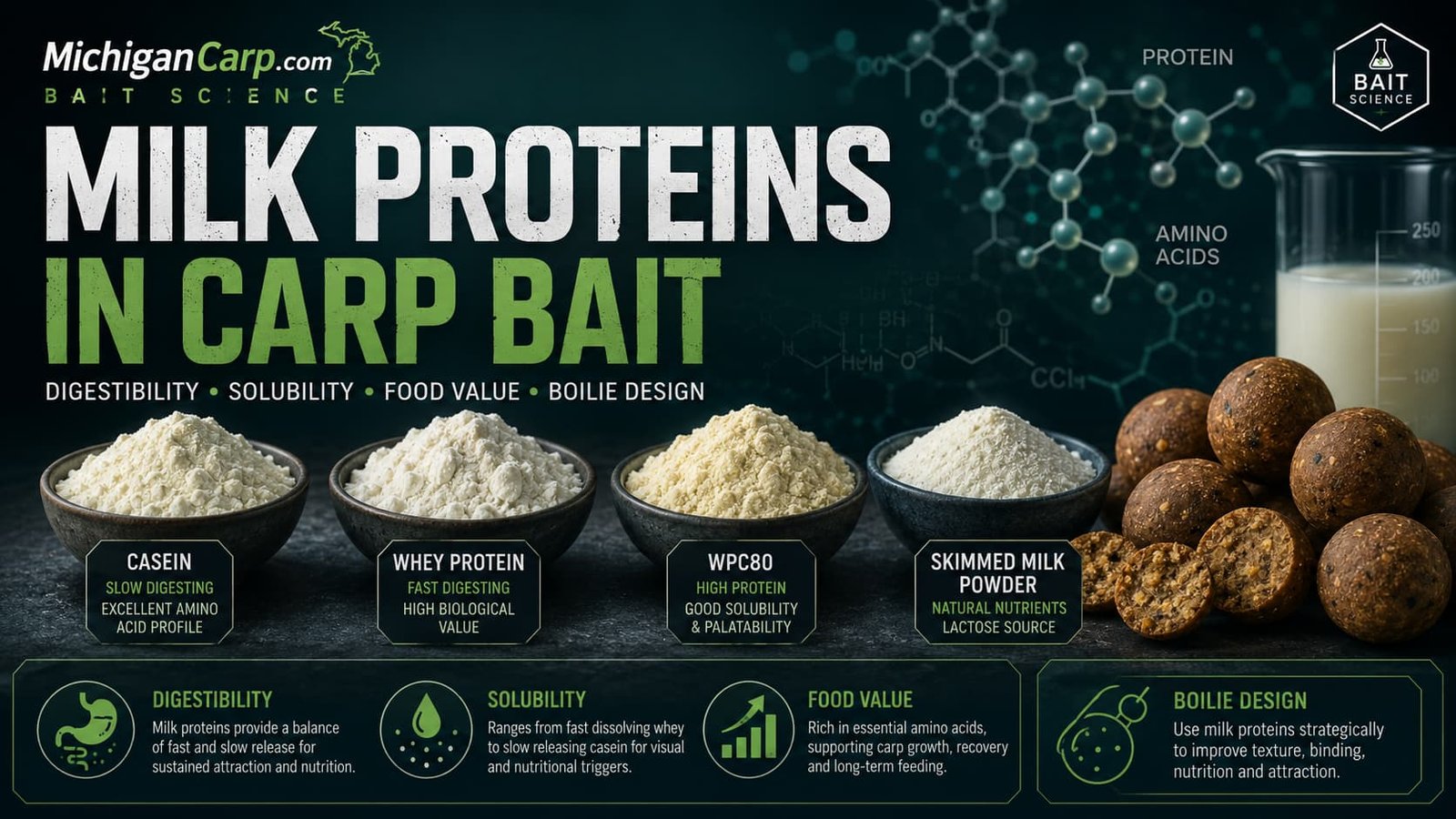
Milk proteins in carp bait are often misunderstood because anglers use words like protein, digestibility, amino acids, solubility and food value as if they all mean the same thing.
They do not.
A milk protein can be highly nutritious but not very soluble.
A soluble ingredient can leak well but contribute little long-term structure.
A bait can be high in protein but still roll badly, digest poorly, leak too slowly, or fail to match the feeding situation.
A milk powder can help a boilie feel creamy without being a specialist milk protein.
A hydrolyzed whey powder can contribute a faster soluble signal without replacing the structure of casein.
A casein-heavy hookbait can last well but may be too hard and slow if copied blindly into free bait.
That is why milk proteins need to be understood as a bait system, not just a protein percentage.
This article explains the science and the practical bait-making logic behind milk proteins in carp bait: what they do, what they do not do, how they affect digestibility and solubility, why casein and whey behave differently, and how North American bait makers can use available ingredients intelligently.
For the broad ingredient-buying guide, read Milk Powders in Boilie Making.
For the direct ingredient comparison, read Casein vs WPC for Boilies.
For the deep casein guide, use Milk Caseins for Boilie Making.
For base mix design, read How to Formulate a Milk, Nut and Birdfood Boilie Base Mix.
The important rule is simple:
MILK PROTEINS ARE NOT MAGIC.
THEY ARE FUNCTIONAL INGREDIENTS THAT MUST BE USED FOR THE RIGHT JOB.
Table of Contents
Quick Start: What Milk Proteins Do in Carp Bait
Milk proteins can help a bait in several different ways.
| Function | What It Means in Bait | Main Ingredients |
|---|---|---|
| Food value | Adds real protein and amino acid nutrition | Casein, WPC80, MPC, caseinate |
| Structure | Helps bait bind, firm, toughen or hold shape | Casein, caseinate, albumen, egg |
| Solubility | Helps signals move from bait into water | WPC80, sodium caseinate, hydrolyzed whey |
| Leakage | Controls how quickly soluble material escapes | WPC80, hydrolysates, lactose, milk powders |
| Creaminess | Gives soft dairy profile and rounded bait character | Skimmed milk powder, whole milk powder, WPC80 |
| Hardness | Helps hookbaits and long-session baits last | Acid casein, rennet casein, calcium caseinate |
| Palatability | Supports taste, texture and feeding confidence | Milk powders, WPC80, caseinate, yeast, liquids |
| Bait identity | Creates a consistent milk/nut or cream food signal | Blended dairy ingredients |
Milk proteins are most valuable when they help the bait do something specific.
Do not add them just to increase the protein number.
Use them to control:
- how the bait rolls;
- how it boils;
- how it dries;
- how hard it becomes;
- how it leaks;
- how it fishes after soaking;
- how it fits the water temperature;
- how it supports the hookbait;
- how it fits your feeding strategy.
What Are Milk Proteins?
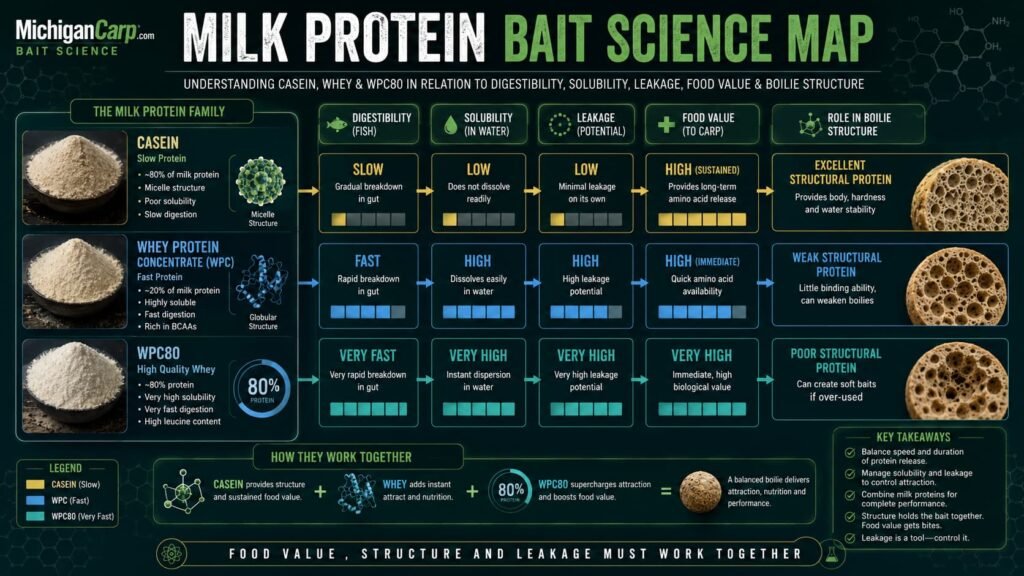
Milk protein is not one ingredient.
Milk contains several protein fractions, mainly casein and whey proteins.
Bovine milk protein is commonly described as roughly casein-dominant, with a natural casein-to-whey protein balance around 80:20 in milk protein concentrate products. ADPI Milk Protein Concentrate.
In bait-making language, the main milk-protein ingredients are:
- acid casein;
- rennet casein;
- micellar casein;
- sodium caseinate;
- calcium caseinate;
- WPC80;
- whey protein isolate;
- milk protein concentrate;
- milk protein isolate;
- skimmed milk powder;
- whole milk powder;
- hydrolyzed whey;
- calf milk replacer.
These are not interchangeable.
They differ in:
- protein level;
- lactose level;
- fat level;
- solubility;
- water absorption;
- heat behavior;
- paste texture;
- hardness;
- price;
- availability;
- value in free bait vs hookbait.
A bait maker who understands those differences can build better boilies than someone simply chasing “high protein.”
Why Carp Bait Makers Use Milk Proteins
Milk proteins have been used in carp bait for decades because they can support both nutrition and function.
They are useful because they can provide:
- high-quality protein;
- amino acid contribution;
- creamy bait identity;
- binding and structure;
- hookbait toughness;
- soluble dairy signal;
- slow-release food value;
- support for milk/nut and fruit/cream profiles.
But the bait still has to be practical.
A good carp bait is not judged only by a laboratory protein number.
It must also:
- roll properly;
- boil properly;
- dry properly;
- survive casting;
- release signal in water;
- be eaten confidently;
- fit the session length;
- match the feed level;
- suit the water temperature.
That is where milk proteins become useful tools rather than expensive decoration.
What Carp Actually Need From Protein
Carp are omnivorous fish. FAO describes common carp as omnivorous with a strong tendency to consume animal food such as insect larvae, worms, molluscs and zooplankton. FAO Common Carp Species Profile.
That matters because carp are not designed to feed only on sugar, starch or simple bait attractors.
They encounter and process a wide range of natural foods containing:
- protein;
- amino acids;
- fats;
- minerals;
- carbohydrates;
- chitin;
- plant matter;
- detritus;
- microorganisms.
Protein requirements in carp are affected by size, water temperature, natural food availability, dietary energy, protein quality and other factors, rather than a single universal number. FAO Carp Nutritional Requirements and Digestive Physiology.
For bait making, that means protein should be viewed practically.
The bait does not need to be a complete aquaculture diet to catch carp.
But if you want a serious food bait, especially for repeated use, the quality and usability of the protein matters.
Food Value vs Attraction
This is one of the most important distinctions in carp bait.
Food Value
Food value means the bait provides usable nutrition.
That may include:
- digestible protein;
- essential amino acids;
- energy;
- fats;
- minerals;
- vitamins;
- other useful nutrients.
Attraction
Attraction means the bait creates signals that help fish find, investigate or accept it.
That may include:
- soluble amino acids;
- peptides;
- organic acids;
- sugars;
- salts;
- nucleotides;
- aromas;
- fermentation compounds;
- physical leakage.
A bait can be attractive without being very nutritious.
A bait can be nutritious without leaking much attraction.
The best food baits often combine both.
Milk proteins are useful because they can contribute food value while also helping with bait texture, solubility and identity.
Digestibility: What It Means in Carp Bait
Digestibility means how well an animal can break down and use nutrients after eating the bait.
In aquafeed, digestibility is measured through controlled feeding studies.
In carp fishing, most anglers do not have that data for their homemade boilies.
So we need to be honest.
We can use digestibility as a practical concept, but we should not pretend we can precisely measure the digestibility of every homemade bait without testing.
For bait makers, digestibility means asking:
- can the fish process the ingredient?
- is the protein usable?
- is the bait too hard or dense?
- is the protein bound in a way that makes it slow?
- does the bait contain enough energy to spare protein?
- does the bait contain too much indigestible filler?
- does the bait fit the water temperature and feeding level?
High protein is not enough.
Usable protein matters.
Solubility: What It Means in Carp Bait
Solubility means how readily material dissolves or disperses from the bait into the water.
In bait terms, solubility controls how quickly the bait can send signals into the swim.
Highly soluble ingredients may help short-session attraction.
Less soluble ingredients may support long-term structure and food value.
Milk proteins vary greatly in solubility.
| Ingredient | Practical Solubility Role |
|---|---|
| Acid casein | Low solubility, structural |
| Rennet casein | Low solubility, tough structure |
| Micellar casein | Low to moderate, slower dairy profile |
| Sodium caseinate | More dispersible, functional |
| Calcium caseinate | Moderate, firmer than sodium caseinate |
| WPC80 | Moderate to high, whey-protein signal |
| Hydrolyzed whey | Higher, faster soluble signal |
| Skimmed milk powder | Moderate, broad milk solids |
| Lactose | Soluble milk sugar |
The key is balance.
A bait that leaks too little can be slow.
A bait that leaks too much can wash out or collapse.
A proper boilie needs controlled leakage, not uncontrolled breakdown.
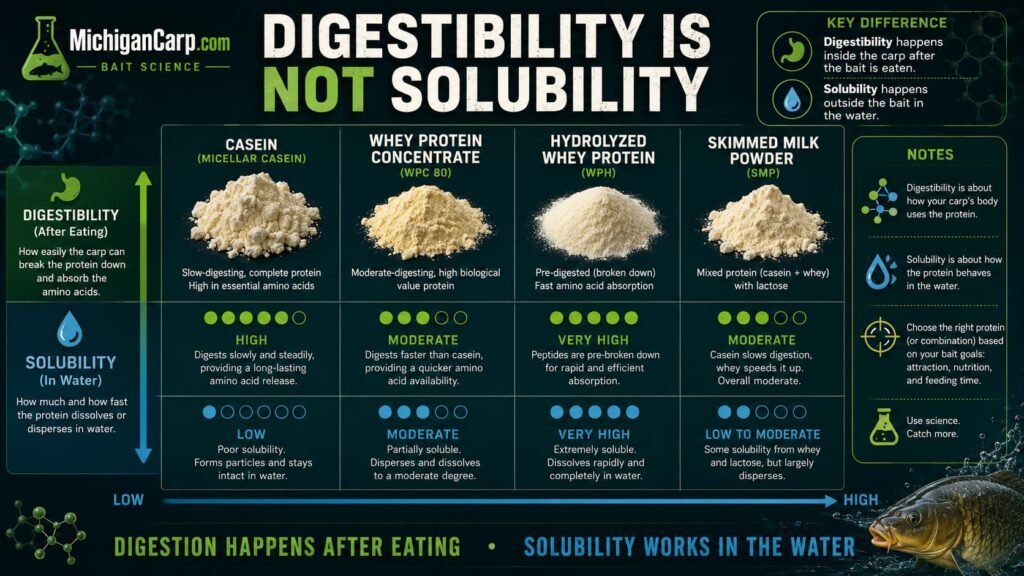
Digestibility vs Solubility: They Are Not the Same
This is where many bait discussions go wrong.
A soluble ingredient is not automatically more digestible.
A digestible ingredient is not automatically fast-leaking.
A hard ingredient is not automatically bad.
A soft ingredient is not automatically good.
Digestibility Is About Use After Eating
Digestibility matters after the carp eats the bait.
Solubility Is About Signal Before and During Feeding
Solubility matters as water interacts with the bait.
Leakage Is the Practical Bridge
Leakage is how soluble compounds leave the bait and enter the water.
That is why bait makers need to think in layers:
- attraction before feeding;
- taste during investigation;
- texture during mouth handling;
- digestibility after eating;
- confidence over repeated feeding.
Casein: Slow, Structural Milk Protein
Casein is the classic milk-protein bait ingredient.
Caseins in milk are naturally organized in micelle structures with calcium phosphate and other milk components, which is part of why casein behaves differently from whey proteins. Caseins and Casein Micelles Review.
In boilies, casein is valuable because it can help provide:
- structure;
- hardness;
- durability;
- dense milk-protein identity;
- slow breakdown;
- hookbait toughness;
- long-session food bait character.
Casein Is Not a Fast Leak Ingredient
Acid casein and rennet casein are generally not chosen because they dissolve quickly.
They are chosen because they help build structure.
That makes them useful in:
- hard hookbaits;
- long-session baits;
- milk-protein boilies;
- baits exposed to nuisance fish;
- boilies that need to remain intact.
Casein Can Be Overused
Too much casein can make bait:
- expensive;
- dense;
- hard;
- slow;
- difficult to roll;
- less responsive in short sessions.
Casein is powerful when used for the right reason.
It is wasteful when used as a prestige ingredient.
Whey Protein: More Soluble Dairy Protein
Whey proteins behave differently from casein.
WPC80 is a concentrated whey protein ingredient and is often one of the most practical milk proteins available to USA bait makers.
The U.S. Dairy Export Council describes WPC80 as whey protein concentrate made by removing non-protein components from pasteurized whey so the dry product contains more than 80% protein. U.S. Dairy Export Council WPC80.
In bait, WPC80 can help provide:
- whey protein;
- smoother dairy profile;
- soluble milk signal;
- protein lift;
- cream bait support;
- milk/nut bait depth;
- better availability than some caseins.
WPC80 Is Not Casein
WPC80 does not provide the same hardness as acid casein or rennet casein.
It is better viewed as a whey-protein tool.
Use it when you want more soluble dairy protein and food value without making the bait excessively hard.
WPC80 Can Still Affect Texture
WPC80 is not just a soluble attractor.
It can tighten paste, change rolling and alter how the bait sets during boiling.
That is why it should be tested in real mixes, not just added by theory.
Caseinate: Functional Casein-Derived Protein
Caseinate sits between raw casein and more soluble milk proteins in practical bait making.
Sodium caseinate and calcium caseinate are made from casein, but they behave differently from acid or rennet casein.
They are often smoother, more functional and more dispersible.
ADPI describes edible caseinates as high-protein milk ingredients with at least 90% milk protein on a dry basis. ADPI Edible Caseinates.
Sodium Caseinate
Sodium caseinate is useful when you want:
- smoother paste;
- better dispersion;
- creamy spread;
- emulsifying support;
- soluble casein-derived behavior;
- hookbait or paste function.
Calcium Caseinate
Calcium caseinate is useful when you want:
- high milk protein;
- firmer behavior;
- smoother structure than raw casein;
- hookbait support;
- balanced milk-protein bait.
Practical View
Caseinate is not just “another casein.”
It is a functional ingredient.
Use it where dispersion, smoothness and milk-protein functionality matter.
Skimmed Milk Powder Is Not Specialist Milk Protein
Skimmed milk powder, or nonfat dry milk in the USA, is a broad milk-solid ingredient.
It contains milk protein, lactose and minerals, but it is not the same thing as casein, WPC80 or caseinate.
USDA defines nonfat dry milk as a product made by removing water from pasteurized skim milk, with limits on moisture and milkfat. USDA Nonfat Dry Milk Standards.
What It Does Well
Skimmed milk powder can help:
- create milk background;
- smooth paste;
- add lactose;
- add mild dairy protein;
- improve cream profile;
- support milk/nut boilies;
- make USA bait making easier.
What It Does Not Do
It does not replace:
- acid casein for hardness;
- WPC80 for whey protein;
- caseinate for function;
- hydrolyzed whey for fast soluble signal.
Skimmed milk powder is valuable because it is practical, not because it is specialist.
Milk Protein Concentrate and Milk Protein Isolate
Milk protein concentrate and milk protein isolate can be useful because they contain both casein and whey proteins.
ADPI describes MPC80 as a milk protein concentrate that captures essentially all casein and whey proteins from the milk stream, retaining the milk-like casein-to-whey ratio. ADPI Milk Protein Concentrate.
Why MPC Can Be Useful
MPC can provide:
- balanced milk protein;
- casein and whey together;
- strong dairy profile;
- good protein value;
- smoother bait identity than hard casein alone.
Practical USA Note
MPC is sometimes easier to find through dairy ingredient suppliers than traditional bait suppliers.
For home bait makers, it can be a useful option, but it is not required.
A practical bait maker can often build a similar working profile by combining:
- skimmed milk powder;
- WPC80;
- casein or caseinate;
- whole milk powder or Nido.
Hydrolyzed Whey and Hydrolyzed Milk Proteins
Hydrolyzed proteins are partly broken down proteins.
In bait terms, they can provide a more soluble protein/peptide signal than intact proteins.
Hydrolyzed whey can be useful, but it should not be treated as a bulk base ingredient.
What Hydrolyzed Whey Can Do
It may help:
- increase soluble dairy signal;
- support short-session attraction;
- add peptide/amino-style character;
- improve hookbait leakage;
- support glugs and pastes;
- work alongside WPC80 and milk powders.
What It Cannot Do
It cannot replace:
- casein structure;
- base mix bulk;
- egg binding;
- complete bait design;
- good rolling mechanics.
Practical Range
For most boilie mixes:
1–5%
For hookbaits, pastes or special mixes:
2–8%
More is not automatically better.
Hydrolyzed ingredients can become bitter, sharp or unbalanced.
Amino Acids: Useful, But Not Magic
Milk proteins matter partly because proteins are built from amino acids.
Amino acids are central to fish nutrition, and some free amino acids can act as feeding-related chemical cues in fish.
Research on fish feed attractants shows that amino acids, nucleotides, quaternary ammonium compounds and organic acids are among the studied attractant classes in aquaculture. UF/IFAS Feed Attractants Review.
Carp have also been studied for sensitivity to free amino acids and taste substances, with amino acids shown to be effective stimuli in the carp gustatory system.
What This Means for Bait
It means amino acids matter.
It does not mean you can sprinkle one amino acid into a bad bait and make it unbeatable.
In bait making, amino acids should be understood as part of the total signal system:
- proteins;
- hydrolysates;
- yeast;
- liver;
- milk powders;
- fishmeals;
- nut meals;
- fermentation products;
- natural liquids;
- soluble carbohydrates;
- salts;
- nucleotides.
Practical View
Do not build bait around magic amino acid claims.
Build a good food bait first.
Then use soluble protein ingredients, hydrolysates and amino-rich liquids to improve the signal.
Essential Amino Acids and Protein Quality
Protein quality is not just the percentage of crude protein.
It also depends on amino acid balance and usability.
A protein source that lacks key amino acids may have less nutritional value than the protein number suggests.
Fish nutrition work has long emphasized that dietary protein quality, energy balance and amino acid supply matter in addition to crude protein level. FAO Carp Nutritional Requirements.
Why Milk Proteins Are Useful
Milk proteins are useful because they provide high-quality animal-derived protein fractions.
In bait terms, that gives them a strong role in:
- food bait design;
- milk/nut boilies;
- hookbaits;
- balanced protein packages;
- high-confidence repeat feeding.
Why Protein Quality Still Does Not Guarantee Catches
A carp does not read a label.
A bait still has to:
- be found;
- be investigated;
- be accepted;
- feel right in the mouth;
- be digestible in context;
- match the venue;
- match the season;
- be presented correctly.
Protein quality helps the bait.
It does not replace angling.
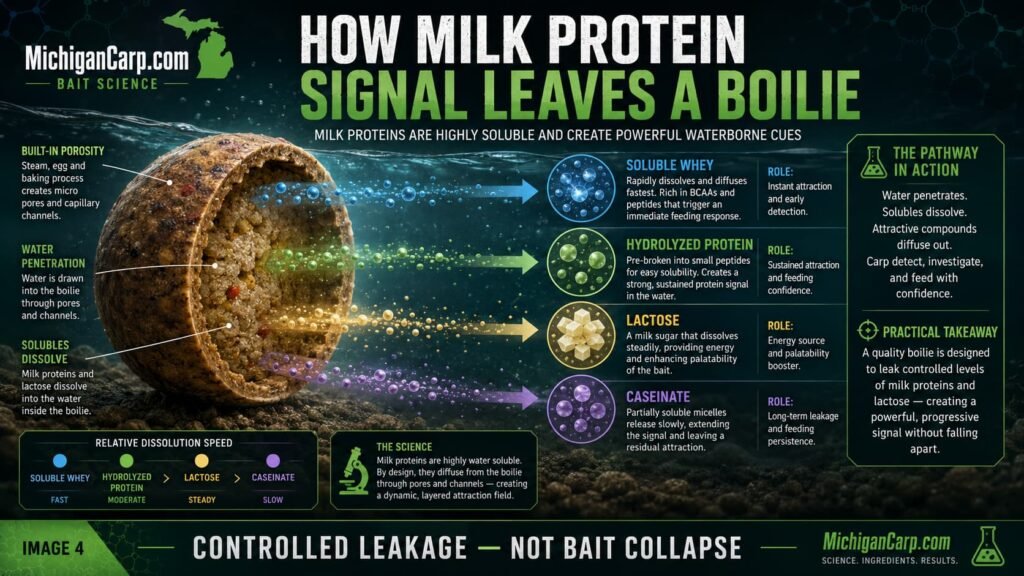
Leakage: How Milk Protein Signal Leaves a Boilie
Leakage is the movement of soluble material from the bait into the surrounding water.
For milk-protein boilies, leakage may come from:
- whey proteins;
- hydrolyzed whey;
- lactose;
- skimmed milk powder;
- caseinate;
- yeast solubles;
- liquid foods;
- salts;
- sweeteners;
- organic acids;
- hydrolysates;
- bait surface breakdown.
Slow Leakage
Slow leakage is useful when:
- fishing longer sessions;
- baiting over time;
- avoiding instant washout;
- using food bait strategy;
- fishing warm water;
- using larger baits.
Fast Leakage
Fast leakage is useful when:
- fishing short sessions;
- fishing cold water;
- using hookbait-only tactics;
- fishing singles or small traps;
- needing quicker investigation.
Balanced Leakage
Most good boilies need balanced leakage.
They should release enough to matter but remain intact long enough to fish properly.
[IMAGE 4 — MILK PROTEIN LEAKAGE PATHWAY HERE]
Boiling, Heat and Milk Proteins
Boiling changes the bait.
Milk proteins do not behave the same in dry powder, paste, boiled bait and soaked bait.
Boiling affects:
- bait skin;
- protein setting;
- starch gelatinization from cereals;
- soluble loss;
- hardness;
- surface texture;
- internal moisture;
- drying behavior;
- leakage pattern.
Casein After Boiling
Casein-heavy baits can become firm and durable.
That can be valuable for hookbaits and long sessions.
But over-boiling or over-drying can make them too hard and slow.
WPC80 After Boiling
WPC80 can affect protein setting and paste tightening.
High levels need testing because the finished bait may behave differently than the raw paste suggests.
Skimmed Milk Powder After Boiling
Skimmed milk powder contributes milk solids and lactose.
Some soluble components may be lost or altered during boiling and drying.
Practical Rule
Judge the bait after:
- rolling;
- boiling;
- 24-hour drying;
- 48-hour drying;
- soaking;
- fishing.
Do not judge a milk-protein bait only by dry-mix smell.
Rolling Mechanics Matter More Than Theory
A technically impressive recipe is useless if it rolls badly.
Milk proteins can cause:
- stiffness;
- stickiness;
- cracking;
- rubbery paste;
- soft bait;
- dense bait;
- slow drying;
- excessive hardness.
If the Dough Is Too Sticky
Reduce:
- sodium caseinate;
- high milk powder levels;
- wet liquids;
- sweet syrups;
- high-fat powders.
Add or increase:
- semolina;
- maize meal;
- birdfood;
- albumen;
- dry cereal structure.
If the Dough Is Too Stiff
Reduce:
- acid casein;
- rennet casein;
- albumen;
- dry binders.
Add or increase:
- egg;
- small oil level;
- skimmed milk powder;
- whole milk powder;
- softer birdfood structure.
If the Bait Cracks
Check:
- egg level;
- drying speed;
- coarse ingredients;
- casein level;
- binder level;
- boil time;
- rolling moisture.
A bait must roll, boil and fish properly before it deserves to be called a good bait.
Milk Proteins and Bait Hardness
Hardness is not always good.
It depends on purpose.
Hardness Is Useful For
- hookbaits;
- long sessions;
- nuisance fish;
- crayfish pressure;
- warm-water feeding;
- baiting campaigns;
- durable bottom baits.
Hardness Can Be Bad For
- cold water;
- short sessions;
- wary fish;
- low-stock venues;
- singles;
- quick-bite tactics;
- over-dense free bait.
Ingredients That Increase Hardness
- acid casein;
- rennet casein;
- calcium caseinate;
- albumen;
- longer drying;
- longer boiling;
- lower moisture.
Ingredients That Soften or Round the Bait
- skimmed milk powder;
- whole milk powder;
- cream powder;
- buttermilk powder;
- oils;
- milk replacer;
- some birdfoods.
Hardness should be designed, not accidental.
Milk Proteins and Water Temperature
Water temperature changes bait logic.
FAO notes best growth for common carp occurs in warm conditions, while carp can also survive cold winter periods. FAO Common Carp Species Profile.
For anglers, the important point is not to copy aquaculture feeding exactly.
The point is to recognize that carp behavior, digestion and bait response change with temperature.
Cold Water Milk Protein Bait
In colder water, consider:
- smaller baits;
- lower feed levels;
- more soluble support;
- less hard casein dominance;
- WPC80 rather than excessive casein;
- hydrolyzed whey in small amounts;
- yeast or liquid food support;
- more open texture;
- careful use of fats.
Warm Water Milk Protein Bait
In warmer water, you can usually use:
- richer food bait;
- more milk/nut structure;
- higher feed volume;
- stronger casein contribution;
- larger baits;
- longer prebaiting;
- more durable boilies.
Michigan Practical View
In Michigan, milk-protein bait design should change through the season.
Spring and cold-water periods often reward a more careful, soluble, lower-feed approach.
Summer and early fall allow stronger food bait logic if the carp are feeding and you are on fish.
Milk Proteins in Free Baits vs Hookbaits
Free bait and hookbait are not the same job.
Free Bait
Free bait should be:
- edible;
- digestible enough for repeat feeding;
- not too hard;
- not too rich for the situation;
- affordable;
- consistent;
- usable in quantity.
Hookbait
Hookbait should be:
- durable;
- attractive;
- balanced or buoyant if needed;
- hair-rig safe;
- resistant to nuisance fish;
- matched to free bait;
- strong enough to stay fishing.
That is why hookbaits can justify higher levels of:
- casein;
- caseinate;
- WPC80;
- albumen;
- cork dust;
- cream powder;
- hydrolysate.
Do not let hookbait logic ruin your free bait.
Milk Proteins in Milk/Nut Boilies
Milk proteins are especially useful in milk/nut boilies.
A good milk/nut boilie can combine:
- tiger nut flour;
- peanut protein;
- nut meals;
- skimmed milk powder;
- whole milk powder or Nido;
- WPC80;
- casein or caseinate;
- birdfood;
- yeast;
- small hydrolysate support;
- controlled sweetener;
- careful oil level.
The milk side gives cream, protein and structure.
The nut side gives natural food character, oil, texture and bait identity.
The birdfood side helps open the bait and improve texture.
For the full formulation system, use How to Formulate a Milk, Nut and Birdfood Boilie Base Mix.
Milk Proteins in Fruit-and-Cream Boilies
Fruit-and-cream baits usually need less hard casein than milk-protein hookbaits.
Good choices include:
- skimmed milk powder;
- WPC80;
- whole milk powder;
- buttermilk powder;
- cream powder;
- sodium caseinate in small amounts;
- hydrolyzed whey in small amounts.
The goal is to round the fruit flavor and create a food signal without making the bait too dense.
Good profiles include:
- plum and cream;
- peach and cream;
- orange cream;
- pineapple coconut cream;
- strawberry cream;
- maple vanilla cream.
A fruit-and-cream bait should not become candy paste.
It still needs food value and bait mechanics.
Milk Proteins in Birdfood Boilies
Birdfood and milk proteins work well together.
Birdfood can give:
- texture;
- openness;
- rolling character;
- visual speckling;
- mechanical breakdown;
- digestible seed and egg-food ingredients.
Milk proteins can add:
- creaminess;
- food value;
- protein structure;
- dairy identity;
- better hookbait matching.
Good choices include:
- skimmed milk powder;
- WPC80;
- buttermilk powder;
- whole milk powder;
- small caseinate addition;
- modest casein if hardness is needed.
Do not overload dense casein in a birdfood bait unless you have a reason.
The birdfood’s open texture is part of its value.
For birdfood design, read Birdfood for Carp Boilies.
Milk Proteins in Packbait and Method Mix
Milk proteins are not only for boilies.
They can also support packbait and method mix.
Useful additions include:
- skimmed milk powder;
- whole milk powder;
- milk replacer;
- WPC80 in small amounts;
- hydrolyzed whey in small amounts;
- boilie crumb;
- blended tiger nuts;
- peanut meal;
- oats;
- panko;
- hemp;
- tinned milk-style liquids.
This matters when fishing milk/nut boilies.
A packbait built from oats, panko, particles, boilie crumb, milk powder and nut ingredients can support the hookbait instead of competing with it.
For the full system, read Packbait for Carp Fishing.
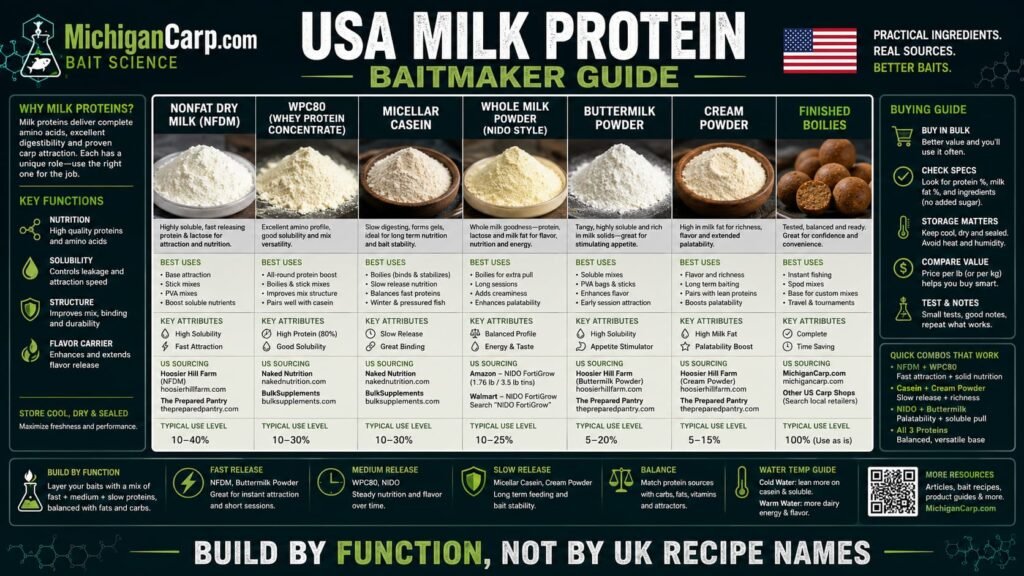
USA Availability: Building Milk Protein Baits in North America
USA bait makers often have a different problem from UK bait makers.
The issue is not whether milk proteins work.
The issue is what you can actually buy reliably.
Easier USA Ingredients
- nonfat dry milk;
- Nido or whole milk powder;
- unflavored WPC80;
- unflavored micellar casein;
- whey protein isolate;
- buttermilk powder;
- cream powder;
- lactose;
- non-medicated calf milk replacer;
- online dairy ingredients.
Harder USA Ingredients
- bait-grade acid casein;
- rennet casein;
- sodium caseinate in small amounts;
- calcium caseinate in small amounts;
- specialist milk-protein bait blends.
Practical USA Milk Protein Kit
A serious USA bait maker can build a lot from:
Nonfat dry milk
Nido or whole milk powder
Unflavored WPC80
Unflavored micellar casein
Buttermilk powder
Cream powder
Hydrolyzed whey
A small amount of caseinate if available
That is enough to build strong milk/nut boilies without chasing every UK bait ingredient.
[IMAGE 5 — USA MILK PROTEIN BAITMAKER GUIDE HERE]
What to Avoid When Buying Milk Proteins
Avoid:
- flavored protein shakes;
- chocolate whey powders;
- mass gainers;
- protein powders with caffeine;
- pre-workout blends;
- creatine-heavy mixes;
- gum-heavy shake powders;
- heavily sweetened human supplements;
- medicated milk replacers;
- rancid dairy powders;
- unclear animal-feed blends;
- powders with strong artificial flavor systems.
Use plain ingredients where possible.
A clean unflavored WPC80 is more useful than a complicated human supplement blend.
A non-medicated milk replacer with a clear label is more useful than a mystery feed powder.
A bait maker should read labels like a formulator, not a shopper.
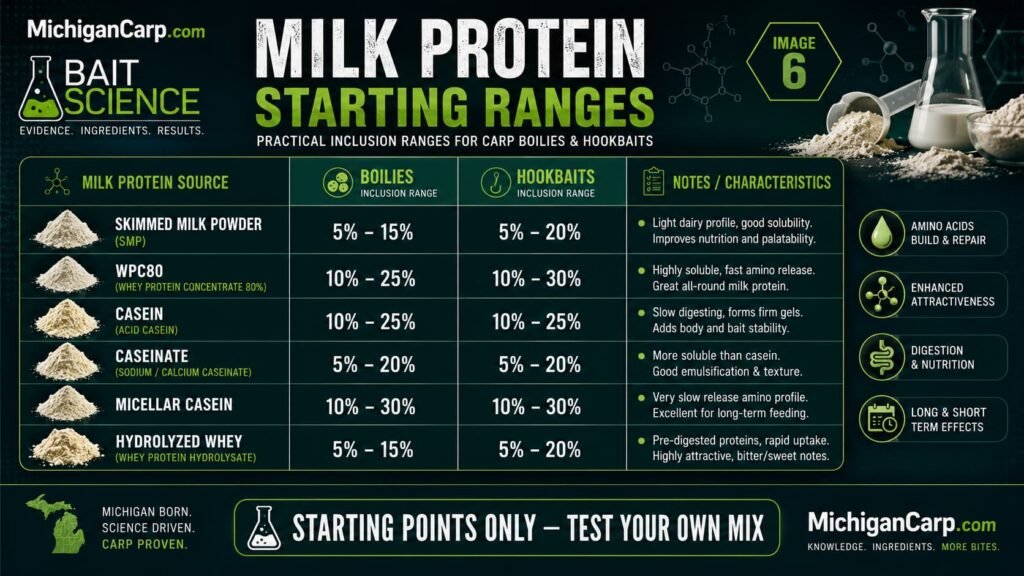
Inclusion Ranges for Milk Proteins
These are starting ranges for home bait making.
They are not fixed rules.
Free Baits
| Ingredient | Starting Range |
|---|---|
| Skimmed milk powder / nonfat dry milk | 5–20% |
| WPC80 | 3–10% |
| Micellar casein | 3–10% |
| Acid casein | 3–8% |
| Rennet casein | 3–8% |
| Sodium caseinate | 2–8% |
| Calcium caseinate | 2–8% |
| Hydrolyzed whey | 1–5% |
| Milk protein concentrate | 3–10% |
Strong Milk/Nut Food Baits
| Ingredient | Starting Range |
|---|---|
| Skimmed milk powder / nonfat dry milk | 5–15% |
| WPC80 | 5–12% |
| Whole milk powder / Nido | 5–12% |
| Casein or caseinate | 3–10% |
| Buttermilk powder | 3–8% |
| Hydrolyzed whey | 1–4% |
Hookbaits
| Ingredient | Starting Range |
|---|---|
| Acid casein | 10–25% |
| Rennet casein | 10–25% |
| Caseinate | 8–20% |
| WPC80 | 10–20% |
| Micellar casein | 10–25% |
| Skimmed milk powder | 5–12% |
| Hydrolyzed whey | 2–8% |
Practical Warning
Higher is not always better.
Use the ingredient for its function.
Example Milk Protein Packages
These are not full recipes.
They are formulation packages you can build into a complete base mix.
Practical USA Milk/Nut Package
For 1 kg dry mix:
75 g nonfat dry milk
60 g WPC80
50 g Nido or whole milk powder
30 g buttermilk powder
25 g sodium or calcium caseinate
Use when you want a strong but practical USA milk/nut bait.
Stronger Casein-Based Package
For 1 kg dry mix:
70 g WPC80
50 g acid or rennet casein
40 g skimmed milk powder
30 g sodium caseinate
30 g whole milk powder
Use when you want more structure and milk-protein depth.
Short-Session Soluble Milk Package
For 1 kg dry mix:
70 g skimmed milk powder
50 g WPC80
25 g hydrolyzed whey
25 g sodium caseinate
30 g buttermilk powder
Use when you want a more active milk signal without building a rock-hard bait.
Hookbait Protein Package
For 1 kg dry mix:
120 g acid or rennet casein
80 g WPC80
70 g caseinate
50 g skimmed milk powder
30 g hydrolyzed whey
Use only after testing hardness, buoyancy, rolling and soak time.
Milk Proteins and Shelf-Life Baits
Milk proteins can work in shelf-life boilies, but you need to think carefully about storage.
The risk is not simply protein.
The risk is the whole bait system:
- moisture;
- fat;
- sugars;
- egg content;
- drying;
- preservatives;
- packaging;
- storage temperature;
- mold risk;
- rancidity risk.
High-fat dairy powders, whole milk powder, cream powder and milk replacers need more care than low-fat dry milk or WPC80.
For shelf-life bait, test small batches first.
Do not scale an untested dairy-heavy formula into a large batch.
Milk Proteins and Freezer Baits
Freezer baits give more freedom.
You can use richer milk powders and softer protein systems because room-temperature shelf life is not the goal.
Freezer baits can use:
- WPC80;
- skimmed milk powder;
- whole milk powder;
- casein;
- caseinate;
- buttermilk powder;
- cream powder;
- hydrolyzed whey;
- milk replacer.
But freezer bait still needs to dry enough to handle, bag and fish.
A freezer bait that goes soft, cracks or molds too quickly still needs adjustment.
Evidence vs Angler Interpretation
This matters.
There is strong evidence from aquaculture and fish physiology that protein quality, amino acids, digestibility and feed composition matter to fish nutrition.
There is also research showing that amino acids and other compounds can act as feeding-related chemical cues in aquatic animals.
But that does not mean every carp bait claim is proven.
Controlled aquaculture feeding is not the same as catching wild carp in a Michigan lake.
A bait ingredient can be nutritionally useful without automatically improving catch rate.
A soluble signal can stimulate investigation without guaranteeing a pickup.
A high-protein bait can still fail if it is used in the wrong place, season or amount.
The honest position is:
milk proteins are scientifically credible bait ingredients, but carp fishing results still depend on formulation, presentation, timing and watercraft.
That is the MichiganCarp approach.
Common Mistakes With Milk Proteins
Mistake 1: Chasing Protein Percentage Only
A high protein number does not guarantee a good boilie.
Mistake 2: Confusing Solubility With Digestibility
Soluble does not always mean digestible, and digestible does not always mean fast-leaking.
Mistake 3: Using Too Much Casein
Casein is useful, but too much can make bait hard, dense and slow.
Mistake 4: Treating WPC80 Like Casein
WPC80 is whey protein, not a structural casein.
Mistake 5: Ignoring Skimmed Milk Powder
Nonfat dry milk is not glamorous, but it is practical and useful.
Mistake 6: Using Flavored Gym Powders
Flavored human protein powders often contain ingredients that do not belong in careful bait formulation.
Mistake 7: Ignoring Water Temperature
Cold water and warm water often need different bait behavior.
Mistake 8: Making Free Bait Too Much Like Hookbait
Hookbaits can be harder and more concentrated than free bait.
Mistake 9: Ignoring Rolling
A bait that does not roll properly is not a good formula.
Mistake 10: Copying UK Recipes Without USA Ingredient Logic
North American bait makers need practical substitutions by function, not blind copying.
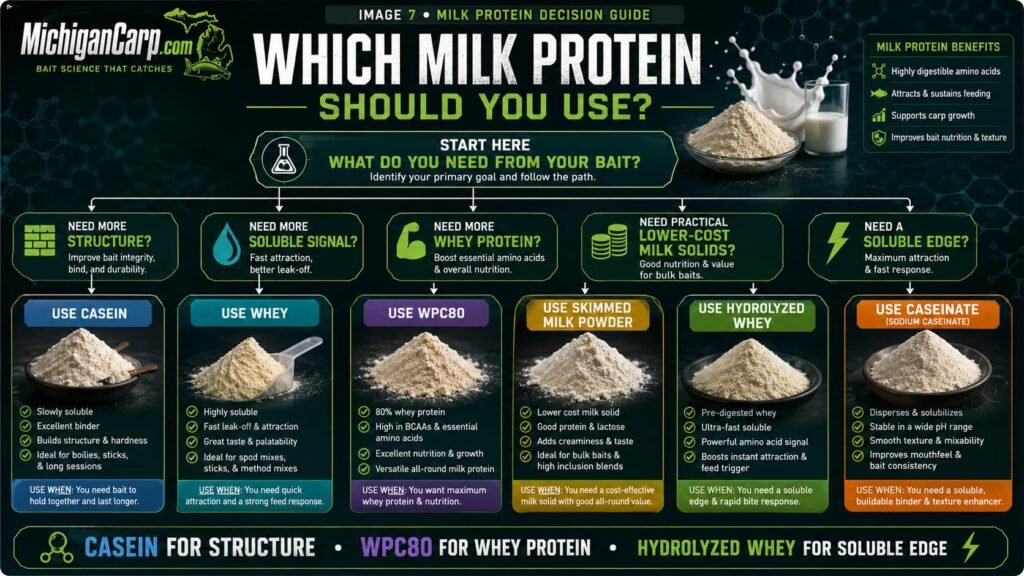
Practical Decision Guide
I Want Better Food Value
Use:
- WPC80;
- milk protein concentrate;
- casein;
- caseinate;
- skimmed milk powder;
- whole milk powder.
I Want More Soluble Milk Signal
Use:
- WPC80;
- hydrolyzed whey;
- sodium caseinate;
- skimmed milk powder;
- lactose;
- yeast or liquid foods.
I Want a Harder Hookbait
Use:
- acid casein;
- rennet casein;
- calcium caseinate;
- WPC80;
- albumen.
I Want a Practical USA Milk/Nut Bait
Use:
- nonfat dry milk;
- Nido;
- WPC80;
- micellar casein;
- buttermilk powder;
- small caseinate addition if available.
I Want a Softer Cream Bait
Use:
- skimmed milk powder;
- whole milk powder;
- WPC80;
- buttermilk powder;
- cream powder;
- sodium caseinate in small amounts.
I Want a Lower-Cost Milk Protein System
Use:
- nonfat dry milk;
- moderate WPC80;
- milk replacer with a clean label;
- buttermilk powder;
- small specialist casein levels only where needed.
My Practical View
Milk proteins are one of the best ingredient families for serious boilie making, but they are often overcomplicated.
The best bait makers do not use milk proteins because they sound advanced.
They use them because they solve problems.
Use casein when you need structure.
Use caseinate when you need function and dispersion.
Use WPC80 when you need whey protein and a stronger milk signal.
Use skimmed milk powder when you need broad milk solids and practical dairy background.
Use hydrolyzed whey when you need a sharper soluble edge.
Use whole milk powder, Nido, buttermilk and cream powders when you want the bait to feel creamy, rounded and food-like.
For my own Michigan bait thinking, milk proteins make the most sense when they support a real food bait: milk/nut, milk/birdfood, fruit/cream or a carefully built hookbait.
They should not replace watercraft.
They should not replace testing.
They should not turn every bait into a rock-hard protein brick.
The goal is not to make the highest-protein boilie possible.
The goal is to make a bait carp will find, accept, eat confidently and keep eating.
That is where milk proteins are valuable.
FAQ
Are milk proteins good in carp bait?
Yes. Milk proteins can add food value, structure, solubility, creaminess and bait identity. They are especially useful in boilies, hookbaits and milk/nut food baits.
Are milk proteins magic carp attractors?
No. Milk proteins are useful ingredients, but they do not replace location, presentation, bait design or feeding strategy.
What is the difference between digestibility and solubility?
Digestibility is about how well a fish can use nutrients after eating the bait. Solubility is about how readily material leaves the bait and enters the water.
Is casein digestible for carp?
Casein is a high-quality milk protein, but in bait making its practical value is often structure, hardness and slow food value. Actual digestibility depends on the full bait formula and feeding conditions.
Is WPC80 good in carp bait?
Yes. WPC80 is a useful whey protein concentrate that can add protein value and a more soluble dairy signal than hard casein.
Is skimmed milk powder a milk protein?
Skimmed milk powder contains milk protein, but it is not a specialist milk-protein ingredient like casein, caseinate or WPC80. It is a broad milk-solid ingredient.
Is hydrolyzed whey worth using?
Hydrolyzed whey can be useful in small amounts when you want a more soluble milk-protein signal, especially in hookbaits, pastes, glugs and short-session bait.
Should I use casein or WPC80?
Use casein when you need structure and hardness. Use WPC80 when you want whey protein and a more soluble milk signal. Many good baits can use both.
Can too much milk protein ruin a bait?
Yes. Too much milk protein can make bait expensive, hard, dense, sticky, slow, or difficult to roll.
What is the best milk protein for USA bait makers?
A practical USA starting point is nonfat dry milk, unflavored WPC80, Nido or whole milk powder, unflavored micellar casein, buttermilk powder and small amounts of caseinate if available.
Are amino acids important in carp bait?
Yes, amino acids are important in fish nutrition and some free amino acids can act as feeding-related cues. But single amino acids should not be treated as magic additives.
Do milk proteins work in cold water?
They can, but the bait should usually be smaller, more soluble, less dense and used in lower feed levels than heavy warm-water food bait.
Are milk proteins better than fishmeal?
Not automatically. Milk proteins and fishmeal do different jobs. Milk proteins are excellent in milk/nut, cream and hookbait systems, while fishmeal brings a different marine/savory food profile.
Can milk proteins be used in packbait?
Yes. Skimmed milk powder, WPC80, milk replacer and boilie crumb can all support packbait, especially when fishing milk/nut boilies.
What matters more: protein percentage or bait design?
Bait design matters more. Protein percentage is only one part of a complete boilie.
Next Steps
Use these supporting guides next:
- Milk Powders in Boilie Making
- Casein vs WPC for Boilies
- Milk Caseins for Boilie Making
- Boilie Ingredients Explained
- Boilie Base Mix Families
- How to Formulate a Milk, Nut and Birdfood Boilie Base Mix
- Nut Boilie Base Mix Recipes
- Birdfood for Carp Boilies
- Packbait for Carp Fishing
- The Bait Shed
- Boilie School
- Michigan Carp Guide Library