

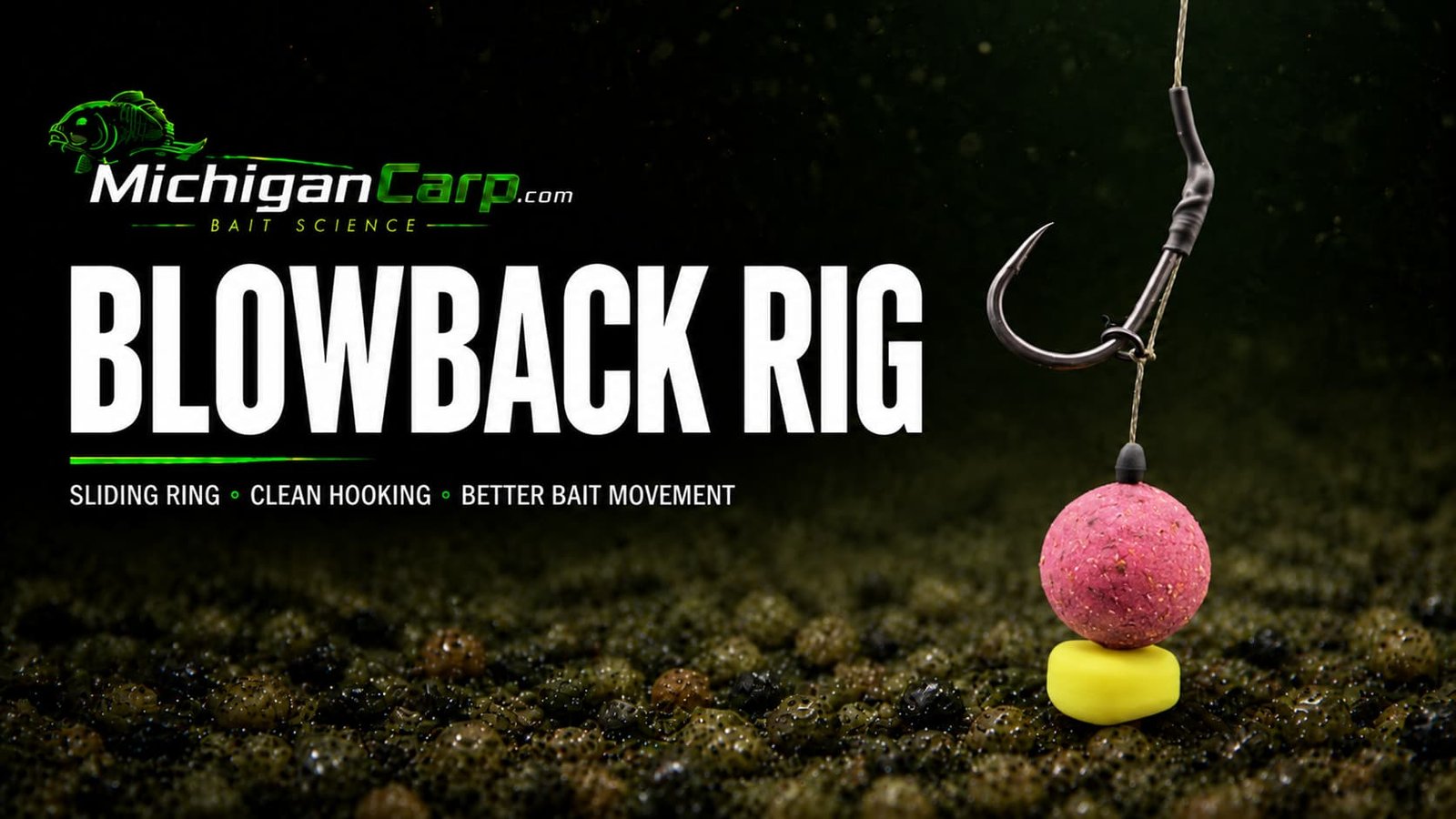
The Blowback Rig is a development of the basic Hair Rig that allows the hookbait attachment to move along the hook shank. Instead of the bait being connected only to a fixed hair leaving the knotless knot, a small rig ring slides on the shank and is connected to the hair. When the bait moves away from the hook, the ring can move with it while the hook remains comparatively free to turn and take hold.
That moving connection is the defining feature of a true Blowback Rig. It is not simply a Hair Rig with a longer hair, and it should not be confused with silicone-mounted hairs, D-rigs or the KD Rig. Each solves the hookbait-movement problem differently.
For Michigan carp fishing, I see the Blowback as a useful step beyond the standard Hair Rig when fishing bottom baits, wafters or snowman hookbaits over reasonably clean ground. It gives you controlled bait movement without turning the end tackle into something unnecessarily complicated.
Blowback Rig Quick Answer
A practical Blowback Rig starts with a strong wide-gape or suitable curve-style carp hook, coated braid and a small rig ring. Tie the hook with a normal knotless knot, place the rig ring on the hook shank and connect the hair to the ring so that, at rest, the ring sits roughly around the shank opposite the barb. Mount the hookbait on the hair, leave enough separation for the bait to move naturally, and test the finished rig in water before fishing it.
For a general Michigan starting point, a size 4 or 6 hook, 20- to 25-pound coated braid and a hooklink of roughly 7–9 inches covers a lot of clean-bottom fishing. Those figures are starting points rather than rules. Hook size, hooklink strength and overall scale should increase when large hookbaits, weed, timber, rocks or zebra mussels demand stronger tackle.
Table of Contents
Blowback Rig Quick Start
| Part | Practical Starting Point |
|---|---|
| Hook | Strong wide-gape or suitable curve-style carp hook, commonly size 4–6 |
| Hooklink | 20–25 lb coated braid for general use; scale up where the swim demands it |
| Hooklink length | About 7–9 inches over clean gravel, sand or clay |
| Supple section | Strip enough coating near the hook to let the rig articulate naturally while retaining anti-tangle stiffness farther back |
| Moving part | Small rig ring running freely on the hook shank |
| Ring position | Start with the ring resting around the area opposite the barb |
| Hookbait | Bottom boilie, wafter or snowman |
| Lead system | Fish-safe lead clip or inline system on suitable clean ground |
| Best starting bottom | Sand, clay, gravel or a reasonably firm clean spot |
Do not treat those measurements as a formula. Hook patterns are not standardized between manufacturers, bait buoyancy changes the way the rig settles and a 24 mm snowman asks different questions from a small single wafter. The finished rig matters more than the numbers on the packet.
What Is a Blowback Rig?
The Blowback Rig belongs to the Hair Rig family, but the hair is connected to a moving component on the hook shank. In the classic version, that component is a small rig ring. Micro swivels and other modern hardware can produce similar moving-hookbait arrangements, but the traditional rig-ring version remains one of the simplest ways to understand how the system works.
The ring is fitted over the hook and allowed to move along part of the shank. The hair is attached to the ring, so movement of the hookbait can pull the ring away from its normal resting position without immediately dragging the hook through exactly the same movement.
That is the idea behind the name “blowback.” If the carp moves the bait away from the hook during an attempted rejection, the bait attachment can travel up the shank. The design is intended to leave the hook with some independence from that movement rather than having the bait act as direct leverage against it.
This does not make the rig impossible to eject and it does not guarantee a hook hold. Carp rigs are mechanical presentations, not traps with guaranteed outcomes. Hook sharpness, bait balance, feeding angle, hook pattern, lead arrangement and the way the fish moves all influence what happens after a pickup.
Korda’s current explanation of the rig describes the ring, swivel or bait attachment as being free to move on the hook shank while remaining connected to the hair. Their traditional build places the ring around the area opposite the barb. Their full guide is useful additional reading: Korda — How to Tie the Blowback Rig.
Why the Blowback Rig Works
The attraction of the Blowback Rig is not that it creates some magical hooking action. Its advantage is that it separates two jobs that are partly linked on a plain Hair Rig: the bait needs freedom to move, while the hook needs enough independence to turn and take hold.
The Hookbait Can Move Along the Shank
On a normal Hair Rig, the hair normally exits from a fixed point around the knotless-knot whipping. On the Blowback, the hookbait is connected to the sliding ring. When that ring moves, the effective relationship between bait and hook changes temporarily.
This is particularly useful with larger bottom baits and snowman presentations. A large hookbait has more mass and creates more leverage than a small grain of corn or miniature boilie. Giving the bait some controlled movement helps prevent the entire hook assembly behaving like one rigid lump.
The Ring Returns Toward Its Fishing Position
Once the rig settles, the weight and position of the hookbait normally bring the ring back toward the bend and its resting area. That gives you a repeatable presentation rather than a loose ring with no relationship to the bait.
The exact resting point matters. Too far toward the eye and you lose much of the movement that makes the rig useful. Too far around the bend and the hair geometry can become awkward or the bait may interfere with the hook point and gape.
Hook Rotation Still Matters
The moving ring does not replace good hook geometry. You still need a hook that turns properly, an unobstructed point and a hookbait that does not overpower the pattern. A kicker or short piece of shrink tube can be used when you want a more aggressive exit angle from the eye, but it is optional rather than compulsory.
For a deeper look at hook shape, gape, eye angle and strength, use the MichiganCarp Carp Hooks guide.
Blowback Rig Components and Setup
Hook
A strong wide-gape hook is the easiest starting point. A suitable curve-style pattern can also work well, particularly when its eye and shank already encourage rotation without a long extension.
I would generally start around size 4 or 6 for typical boilie and wafter fishing. Larger baits or rough-water fishing may justify a stronger or larger hook, while a small hookbait may balance better with a smaller pattern. Do not assume that one manufacturer’s size 4 is identical to another’s.
Rig Ring
The ring needs to slide freely on the hook without being excessively large. Its job is movement, not weight. Fit the ring over the point and bring it around the bend onto the shank before tying the hair to it.
At rest, a useful starting position is around the part of the shank opposite the barb. That gives the ring room to travel toward the eye during movement while keeping the hookbait connection close enough to the bend for a compact presentation.
Hooklink
Coated braid suits this rig very well because it combines a supple section around the hook with a stiffer outer section that helps control tangles. Twenty- to twenty-five-pound material covers much ordinary carp fishing, but the actual swim decides the strength. Rocks, timber, weed and zebra mussels can justify substantially tougher material.
Strip enough coating near the hook to let the rig articulate naturally. Leaving the entire hooklink completely supple is possible, but it gives up some of the anti-tangle control that makes coated braid useful in the first place.
Hair and Bait Stop
The tag end from the hooklink forms the hair. After the rig ring is positioned on the shank, the hair is tied to that ring and then finished with a small hair loop for the bait stop.
There is no universal perfect hair length. For many single-boilie arrangements I want a small, obvious gap between hookbait and hook rather than either having the bait jammed against the bend or hanging an unnecessary distance away. Around 5–10 mm is a useful test range for many conventional setups, but larger snowmen and double baits can require greater separation.
Always set the hair using the actual hookbait you intend to fish. A rig tied around a 15 mm boilie may behave very differently once a 24 mm boilie or snowman is mounted.
Kicker or Shrink Tube
A short kicker or carefully formed piece of shrink tube can help turn the hook, particularly with a conventional wide-gape pattern. Keep it proportionate. An extreme extension can close the effective gape or make the rig more cumbersome without giving you anything useful in return.
How to Tie a Blowback Rig Step by Step
- Cut the hooklink. Start with enough coated braid to form the finished rig plus the hair and knots.
- Strip the hook end. Remove enough coating to create the supple hook section you want while leaving most of the hooklink coated.
- Form the hair. Leave sufficient tag end to accommodate the actual hookbait and the ring connection.
- Tie the hook. Pass the hooklink through the eye and form a neat knotless knot. Keep the turns tight and orderly.
- Add the rig ring. Carefully pass a small rig ring over the hook point and around the bend onto the shank.
- Position the ring. Start with it sitting approximately opposite the barb when the rig is at rest.
- Connect the hair to the ring. Pass the hair through the ring and secure it with a small, tidy overhand knot.
- Set the hair length. Mount the actual hookbait temporarily and adjust the separation before finishing the hair loop.
- Tie the bait loop. Form a small loop large enough to accept the bait stop securely.
- Add a kicker if required. Fit a short kicker or shrink tube over the hook eye only if it improves the geometry of the chosen hook.
- Finish the other end. Tie or crimp the hooklink according to the connector and material you are using.
- Test it in water. Check that the bait settles correctly, the ring moves freely, the hook point remains clear and the rig does not twist or collapse awkwardly.
The important part of this build is not the number of wraps in the knotless knot or copying somebody else’s exact measurement. It is the relationship between the ring, hair, bait and hook. Once those four parts are proportioned correctly, the rig is simple.
Rig Ring Position and Hair Length
Ring position is one of the easiest areas to get wrong. The ring needs enough travel to make the Blowback principle meaningful, but its resting position must still keep the hookbait in a sensible relationship with the bend.
A useful starting point is to have the ring rest around the shank opposite the barb. That is also the position used in the classic Korda Blowback build. From there, test how far the ring can travel and what happens when you pull the bait gently away from the hook.
If the ring begins too close to the eye, the bait may spend too much time separated from the bend and the rig starts losing the compact geometry that makes it practical. If it sits too far down the bend, the hookbait can interfere with the point or the hair can leave the ring at an awkward angle.
Hair length should be set separately. A snowman generally needs more room than a single 15 mm wafter. A large 20–24 mm bottom bait may also need a longer hair than a smaller bait simply because the physical scale of the presentation is different.
This is another reason I prefer testing rigs with the real bait rather than tying ten identical hooklinks on the kitchen table and hoping they all suit whatever ends up on the hair.
Bottom Baits, Wafters and Snowman Hookbaits
Bottom Boilies
A conventional bottom boilie is the simplest Blowback presentation. The bait sits naturally on the lakebed while the ring gives the hair controlled movement on the shank.
Match bait size to hook size rather than chasing a particular number. A strong size 6 can be ideal with a modest bait, while larger 20–24 mm baits often sit more naturally beside a size 4 or another sufficiently strong pattern.
Wafters
Wafters can work very well on the Blowback Rig, but “wafter” does not mean automatically balanced. Test the bait with the exact hook, ring, stop and hair. Ideally the hookbait should reduce the effective weight of the presentation without holding the hook upright unnaturally.
A strongly buoyant bait can change the rig from a bottom presentation into something closer to a low pop-up. At that point another rig may do the job more predictably.
Snowman Presentations
The Blowback Rig is especially well suited to snowman hookbaits because the larger combined bait benefits from having some controlled movement relative to the hook. A bottom bait with a smaller buoyant topper can also reduce the apparent weight of the hookbait.
Do not assume that a snowman automatically becomes critically balanced. Different pop-ups and bottom baits have very different buoyancies. Test the finished combination in water and trim the buoyant bait only when necessary.
Matching the Blowback Rig to the Lakebed
The Blowback Rig is primarily a clean-to-cleanish-bottom presentation. Gravel, sand, clay and firm areas are the easiest places to use it because the bait and hook can settle naturally without disappearing into debris.
That agrees with the broader advice in the MichiganCarp Bottom-Bait Rigs guide and the Complete Carp Rig Guide: choose the presentation after you understand what the rig is landing on.
Gravel, Sand and Clay
These are the straightforward situations. Use enough hooklink length to let the rig settle naturally, keep the hook point protected during the cast and check the point after winding back over hard or abrasive ground.
Light Silt
A Blowback Rig can still work over light silt if the hookbait remains visible and the lead does not drag the entire presentation deeply into the bottom. A slightly longer hooklink, lighter lead arrangement or balanced hookbait may help, but test the actual spot rather than assuming the word “silt” requires an automatic rig change.
Deep Silt, Weed and Debris
This is where I stop trying to make the Blowback do every job. If the hook can disappear into deep silt, dying weed or leaf debris, a presentation designed to stay cleaner above the bottom often makes more sense.
The MichiganCarp Rigs Hub is the better starting point when you are deciding between bottom-bait and elevated presentations.
Lead Systems, Casting and PVA
On clean ground, a properly configured lead clip or inline arrangement pairs naturally with a Blowback Rig. The lead system should remain fish-safe if the main line breaks or the fish reaches weed, timber or another obstruction.
Long hairs and larger snowmen can tangle more easily than a compact single bottom bait. Before casting, separate the hookbait from the hook and make sure the ring is in its normal starting position. A small PVA mesh stick, stringer or dissolving foam nugget can help control the hook and bait during the cast.
A Blowback can be used in a solid PVA bag if tied specifically for that job, but I would not choose it merely because the rig fits inside the bag. A short, simple Hair Rig is often easier to pack and predict. Use the specialist PVA Bag Fishing guide when the bag itself is the main presentation.
Blowback Rig Compared With Other Carp Rigs
| Rig | Defining Feature | Best Starting Use |
|---|---|---|
| Blowback Rig | Hair connects to a ring that moves along the hook shank | Bottom baits, wafters and snowmen on clean ground |
| Hair Rig | Fixed hair exits the knotless knot | Simple bottom baits, particles and general-purpose fishing |
| KD Rig | Hair exits high on the shank after a distinctive knotless-knot sequence | Balanced hookbaits and wafters when that geometry is wanted |
| Slipped D Rig | Hookbait moves on a D behind the hook | Balanced baits and mobile D-style presentations |
Blowback Rig vs Hair Rig
The Hair Rig is simpler. The hair exits from a fixed point on the knotless knot and there is no moving hardware on the hook. That makes it extremely dependable and easy to inspect.
The Blowback adds controlled movement between bait and hook by attaching the hair to the sliding ring. Use it when that movement solves a real presentation problem, especially with larger bottom baits or snowmen. Do not add the ring merely because a more complicated rig feels more advanced.
For the foundation setup, see Hair Rig for Carp Fishing.
Blowback Rig vs KD Rig
The KD Rig does not use a sliding bait attachment on the hook. Its defining feature is the high hair exit created by releasing the hair after the first part of the knotless-knot whipping. That altered exit works particularly well with carefully balanced hookbaits.
The Blowback instead relies on movement of the ring along the shank. For a wafter either can work, but they solve the problem differently. Choose the KD when you specifically want its high hair exit and point-down balance; choose the Blowback when controlled bait movement on the shank is the reason for the rig.
Compare the complete build in KD Rig for Carp Fishing.
Blowback Rig vs Slipped D Rig
Both presentations give the hookbait movement relative to the hook, but the mechanics are different. The Blowback uses a ring moving along the shank. The Slipped D places the bait attachment on a D behind the hook. The latter generally gives the bait a different range and direction of movement and is commonly paired with wafters or balanced hookbaits.
Slipped D Rig remains a separate specialist presentation rather than another name for the Blowback.
Common Blowback Rig Mistakes
The Ring Cannot Move Freely
If the ring catches on an oversized knot, damaged hook coating, tubing or other hardware, the defining feature of the rig has effectively disappeared. Before every cast, move the ring along the shank by hand and make sure it travels cleanly.
The Ring Starts in the Wrong Position
Positioning the ring too close to the eye or too far around the bend changes the relationship between bait and hook. Start around the shank opposite the barb and make changes only after testing the exact bait and hook.
The Hair Is Too Short
If the bait is jammed against the bend, it can restrict movement and partially block the hook’s working space. Give the hookbait enough separation to move without creating an unnecessarily long, floppy presentation.
The Hair Is Too Long for the Hookbait
A long hair can work deliberately with large baits, but accidental excess length makes the rig harder to control and easier to tangle. Set the hair around the bait you are actually fishing.
Using an Overly Aggressive Kicker
More angle is not automatically better. A long extension can close the hook’s effective gape or make the whole hook section cumbersome. Use enough to improve the chosen hook pattern, not enough to make the rig look dramatic.
Forcing the Rig Onto the Wrong Bottom
A beautifully tied Blowback dropped into deep debris is still a poor presentation. Rig choice comes after lakebed choice. If the bottom is unsuitable, change the presentation rather than repeatedly modifying the hook.
Ignoring Hook Sharpness
The ring can work perfectly while a turned-over hook point ruins the entire system. Check the point before fishing, after every fish and after dragging the rig across gravel, rock or mussels.
A Practical Blowback Rig Setup for Michigan Carp
If I wanted one Blowback Rig as a general Michigan starting point, I would keep it straightforward: a strong size 4 or 6 hook, 20- to 25-pound coated braid, a small rig ring and a bottom boilie, wafter or snowman. I would fish it on a clean or reasonably clean spot with a safe lead system and scale the hooklink up rather than down when weed, rock, timber or zebra mussels made abrasion and control the bigger concern.
I would not choose the rig because I believed Michigan carp needed an elaborate anti-eject setup. Many of the fish we target are wild public-water carp where location, a clean presentation, a sharp hook and dependable tackle usually matter more than rig fashion.
The Blowback earns its place because it gives me a specific mechanical option. If I want a larger bottom bait or snowman but still want the bait connection to move along the shank, the rig makes sense. If a plain Hair Rig already presents perfectly, I have no problem using the simpler rig instead.
That philosophy is the same throughout the MichiganCarp Rigs section: use fewer rigs well and choose each one because the bait and lakebed give you a reason.
Frequently Asked Questions
What is the main advantage of a Blowback Rig?
Its defining advantage is controlled movement between the hookbait and hook. The hair connects to a ring that can travel along the hook shank, giving the bait some freedom to move without forcing the hook through exactly the same path.
Where should the ring sit on a Blowback Rig?
A good starting position is around the hook shank opposite the barb. From there, test the actual hook and hookbait to make sure the ring can move freely and the bait sits naturally.
Can I use a wafter on a Blowback Rig?
Yes. Wafters can work very well, but test the finished presentation with the actual hook. A wafter should lighten the bait presentation without lifting the hook into an awkward position unless that is specifically what you intend.
Is the Blowback Rig good for snowman hookbaits?
Yes. Snowman presentations are one of the classic uses for the rig because a larger combined hookbait benefits from some controlled movement relative to the hook.
Is the Blowback Rig better than a Hair Rig?
No rig is automatically better. A standard Hair Rig is simpler and extremely dependable. The Blowback becomes useful when you specifically want the hookbait attachment to move on the hook shank.
Can I use the Blowback Rig over silt?
Light silt can be fine when the bait and hook remain presented cleanly. Deep silt, weed or debris may justify an elevated presentation and a different lead arrangement rather than trying to force a bottom-bait rig to work.
Do I need shrink tube on a Blowback Rig?
No. A kicker or shrink tube is an optional way to alter the hooklink exit angle. Some hook patterns work perfectly well without it. Test the hook rather than adding components automatically.
Final Blowback Rig Checklist
- Hook is strong, undamaged and extremely sharp.
- Rig ring moves freely on the shank.
- Ring rests in a sensible starting position around the area opposite the barb.
- Hair length matches the actual hookbait.
- Hookbait does not obstruct the point or gape.
- Wafter or snowman balance has been tested in water.
- Coated hooklink has enough supple section for movement without becoming unnecessarily floppy.
- Hooklink strength matches weed, rocks, timber and mussel risk.
- Lead system remains fish-safe.
- The rig has been tested in the edge before casting.
Technical References
For an established commercial reference showing the classic rig-ring arrangement, ring position, coated-braid construction and snowman presentation, see Korda — How to Tie the Blowback DF Rig.
Korda also places the Blowback within its wider rig-selection guidance and describes it as a clean-bottom presentation suitable for bottom baits, wafters and buoyant bottom-bait combinations: Korda — Complete Guide to Carp Rigs.
Next Steps
If you want the simplest possible bottom-bait setup first, read Hair Rig for Carp Fishing.
If you want a balanced-bait rig based around a different hair-exit geometry, read KD Rig for Carp Fishing.
For choosing between the wider rig families, use the Bottom-Bait Rigs guide, the Complete Carp Rig Guide and the MichiganCarp Rigs Hub.
The Blowback Rig is worth learning because the mechanism is easy to understand and easy to test. Keep the ring free, match the hair to the bait, use a sharp strong hook and put the rig on a bottom where it can actually work.