

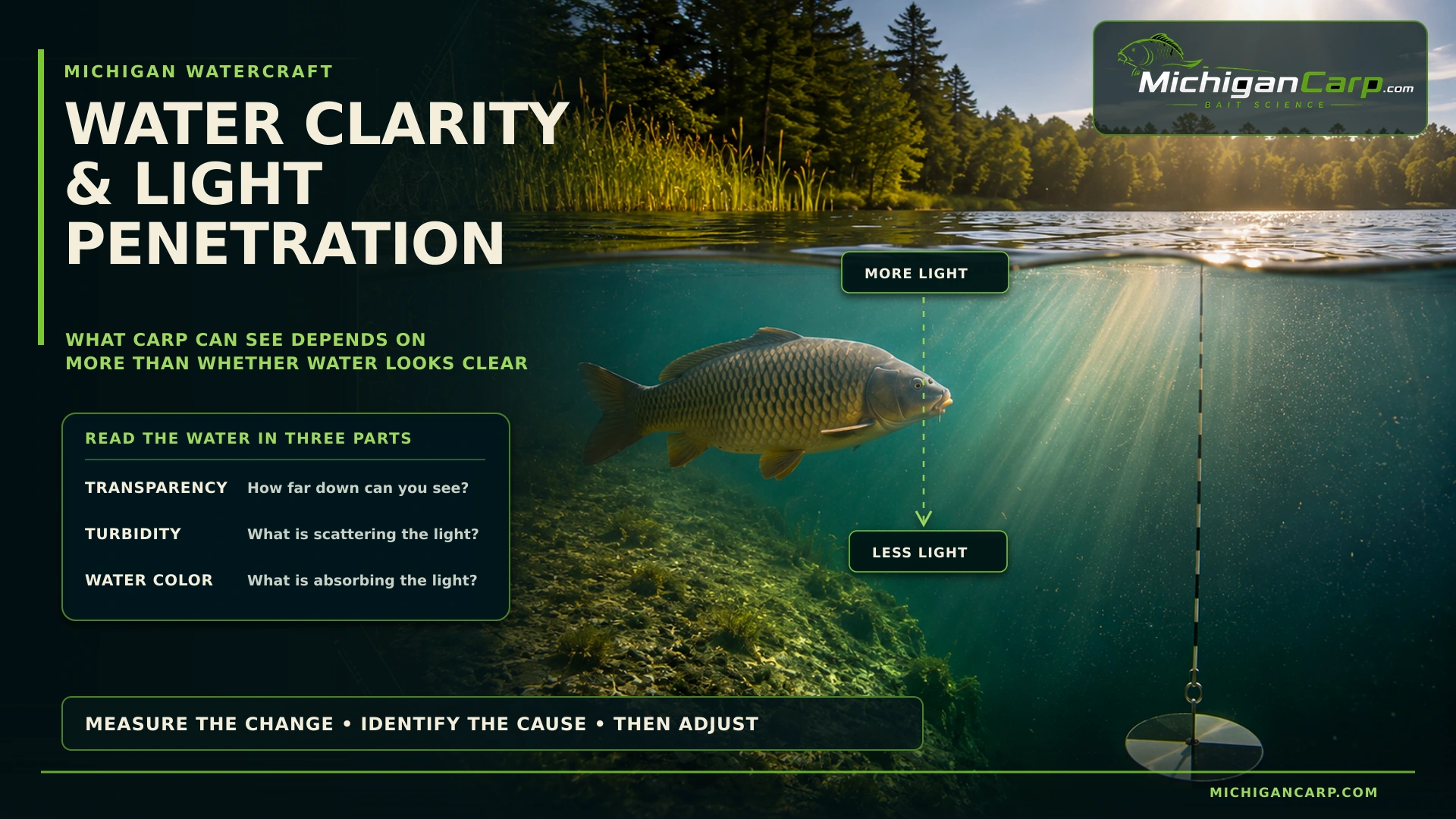
Water clarity and carp fishing are connected, but clarity is not a feeding switch. It changes how light travels through a swim, how far an angler can see, how easily disturbance may be exposed and where submerged weed can grow. It can also reveal something about wind, runoff, plankton, wetland drainage, invasive mussels or carp feeding on the bottom. The useful question is not simply, “Is the lake clear or dirty?” It is, “What changed the optics, and what are the carp doing in response?”
A clear Michigan lake is not automatically difficult. A colored pond is not automatically easy. Clear water with wind ripple, deep shade and feeding fish can be straightforward. Brown water caused by cold runoff, heavy suspended silt or a harmful algal bloom can be a poor or unsafe choice. Clarity must be read with location, temperature, wind, dissolved oxygen, food, depth, season and actual carp evidence.
This guide explains the difference between transparency, turbidity, dissolved color and light attenuation; shows how to take repeatable measurements; separates established science from angling interpretation; and turns those observations into controlled changes in location, timing, disturbance and presentation. For the larger location system, begin with Reading a Lake Like a Carp Angler.
Measure the change. Identify what is coloring the water. Observe the fish. Then change one variable for a reason.
Table of Contents
Quick Answer: How Water Clarity Affects Carp Fishing
Water clarity affects the light environment, but its practical value comes from context. Use it first as a diagnostic clue, not as permission to make a predetermined “clear-water” or “dirty-water” change. The same Secchi depth can arise from different optical causes, and those causes can point toward very different fishing decisions.
| What You See | First Question | Best First Response |
|---|---|---|
| Water is clearer than your normal baseline | Did wind fall, algae decline, runoff stop, weed change or filter-feeding mussels alter the water? | Watch longer; check depth, shade, routes and fish signs before changing bait |
| Water has a fresh brown or gray cast | Is this suspended mineral sediment from wind, current or runoff? | Find the edge, settling zone or cleaner connected water; check temperature and inflow strength |
| Water is green and visibility is falling | Is this a normal plankton change or a visible bloom? | Check oxygen, smell, surface signs and official advisories before treating it as a fishing opportunity |
| Water is tea-brown but still transparent | Is dissolved wetland color absorbing light rather than mud scattering it? | Use the water’s long-term baseline; do not label it “dirty” from color alone |
| A tight cloud moves or reforms over one spot | Are carp disturbing bottom while feeding? | Look for bubbles, tails, movement and repeatability; present beside the activity without crashing through it |
| Bottom is visible but no carp are present | Does the area offer food, cover, temperature, oxygen or a route? | Move or keep searching; clarity cannot compensate for wrong location |
The most important comparison is usually today versus the normal condition of the same water. A six-foot visibility reading may be unusually clear on one pond and unusually colored on another lake. Universal labels hide that difference.
What Water Clarity Actually Means
EPA defines water clarity as a measure of how far light penetrates through the water column. That broad definition is useful, but anglers often combine several different optical properties under the word “clarity.” Separating them prevents a brown, green or dark-looking lake from being misread.
| Term | What It Describes | Angling Use | Main Limitation |
|---|---|---|---|
| Transparency | How far an object can be seen through the water | Secchi depth or a repeatable bank-side visibility reference | Changes with light, surface glare, observer and object |
| Turbidity | Light scattered by material in the water | Helps identify suspended sediment, algae or fine organic matter | A visual label does not produce an NTU measurement |
| Water color | Light absorbed by dissolved substances or reflected by material | Can reveal tannin-stained water or biological change | Color alone does not say how many particles are suspended |
| Light attenuation | The total reduction of light with depth through absorption and scattering | Explains why the underwater light field changes vertically | Needs instruments for rigorous wavelength-specific measurement |
| Bottom visibility | Whether you can see the lakebed at that depth and angle | Useful for spotting weed, hard areas, feeding clouds and fish | It is not a standardized clarity measurement |
Transparency Is Not the Same as Turbidity
A Secchi disk records the depth at which a standard black-and-white target disappears from view. A turbidity meter shines light into a water sample and measures scattering, commonly reported in nephelometric turbidity units. Those measurements are related, but they are not interchangeable. A shore angler who can see a pale stone at three feet has a useful local reference, not an NTU value.
Dark Water Can Be Transparent
Dissolved organic material from wetlands can create transparent tea-brown water. That color absorbs parts of the light spectrum even when relatively few mineral particles are suspended. Conversely, pale clay can scatter large amounts of light and make water opaque. Both may look “colored,” but they do not create the same underwater optical environment.
Secchi Depth Is a Repeatable Index, Not a Carp Threshold
A Secchi reading is valuable because it converts an impression into a number that can be compared. It does not establish the depth at which carp become confident, stop seeing line or prefer a particular bait color. No credible carp-specific study supplies a universal biological breakpoint such as “clear above X feet” or “stained below Y feet.” Use the number to track change on the venue, not to manufacture a universal rule.
What Is Coloring the Water?
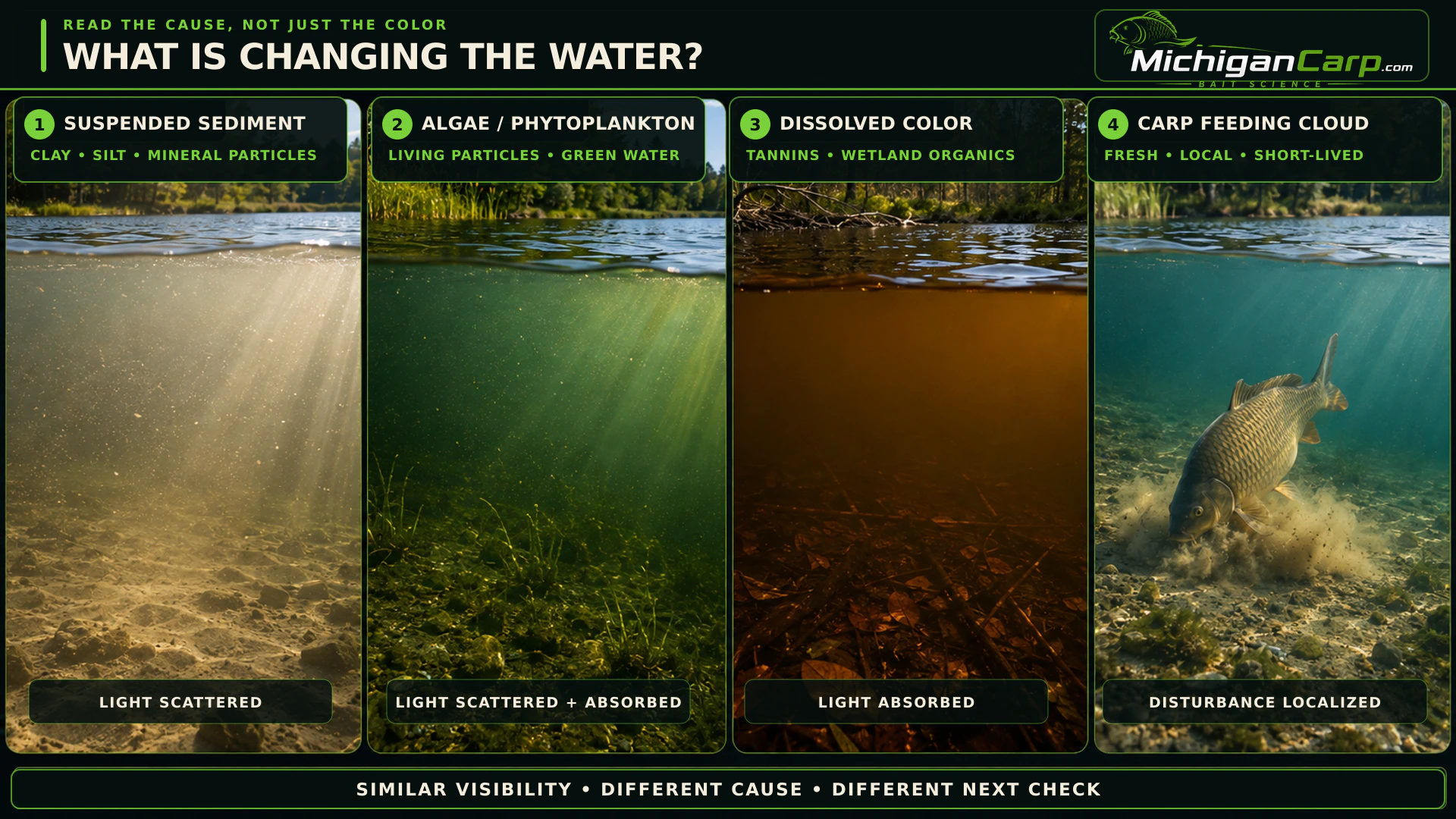
Similar visibility can be produced by very different physical and biological processes. The USGS turbidity guide lists clay, silt, very small inorganic and organic matter, algae, colored organic compounds, plankton and other microscopic organisms among the materials that affect water’s optical appearance. For a carp angler, the cause matters because it changes the next question.
| Cause | Typical Clues | What It Can Mean | Next Check |
|---|---|---|---|
| Suspended sediment | Brown, gray or tan water; particles settle in a jar; follows wind, flow or runoff | Light scattering and possible bottom disturbance | Wind history, inflow temperature, current edge, settling rate |
| Algae or phytoplankton | Green cast, fine suspension, surface accumulation or changing visibility | Biological productivity and possibly changing oxygen conditions | Surface scum, smell, temperature, oxygen clues, HAB advisory |
| Dissolved organic color | Clear tea, amber or dark brown water; little material settles | Light absorption from wetland or forest-derived organic compounds | Source water, long-term baseline, depth and sun angle |
| Plant and detrital material | Small fragments, pollen, decaying weed, organic film | Seasonal production, decay or wind collection | Weed health, odor, oxygen and current |
| Carp feeding activity | Tight moving cloud, pin bubbles, tails, repeated disturbance | Fish may be disturbing soft bottom while foraging | Does the plume move, reform and coincide with other carp signs? |
| Watershed runoff | Rapid change after rain, inflow plume, debris or colder/warmer seam | New water, suspended material, nutrients and temperature change | Fish the usable edge only after checking comfort and safety |
| Filter-feeding invasive mussels | Long-term increase in clarity rather than a one-day event | Food-web and habitat change, not simply “better water” | Weed expansion, bottom food, depth use and the venue’s new baseline |
Carp Can Create the Cloud
A cloud is not always water arriving from elsewhere. In shallow experimental systems, adult common carp increased turbidity and suspended solids, with the suspended material primarily inorganic. The 2003 common-carp mesocosm study shows that carp can materially alter clarity through their activity. On the bank, a tight plume that moves, fades and reforms with bubbles or tails can therefore be evidence worth investigating. It is not proof by itself; wind, crayfish, waterfowl and other bottom-feeding fish can also disturb sediment.
Clearer Does Not Automatically Mean Healthier
A sudden clear-water event can look attractive, but clarity is not a complete water-quality score. Nutrient loss, changes in plankton, invasive-mussel filtration and altered food webs can all increase transparency. Great Lakes research archived by NOAA links post-Dreissena conditions with increased water clarity and major ecosystem changes. Treat “clear” as a description, not a guarantee of a healthy or easy fishery.
How to Measure Water Clarity Without Guessing
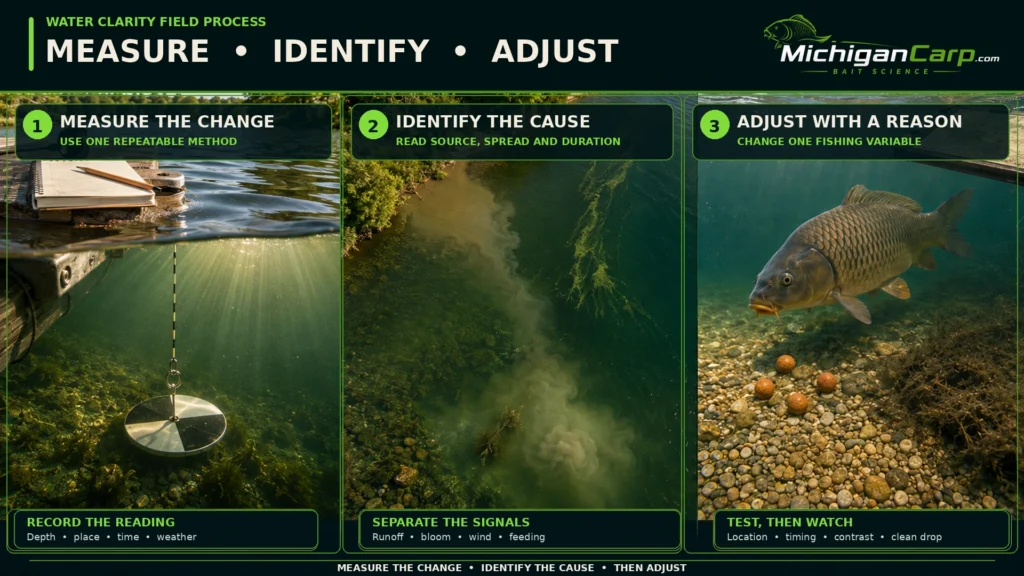
You do not need laboratory equipment to stop guessing. You need a method you can repeat. Michigan’s Cooperative Lakes Monitoring Program uses Secchi-disk observations as part of long-term inland-lake monitoring. An angler’s record will not replace a monitoring protocol, but it can still become much more useful than “looked murky.”
Option 1: Use a Secchi Disk
Lower the disk on the shaded side of a stable boat or platform, away from prop wash and recently disturbed bottom. Record the depth at which it disappears, then raise it slowly and record where it reappears. Many formal methods average those two depths. Use the same disk, marked line, observation position and procedure each time. Follow the safety requirements and method of any official monitoring program if you are contributing data.
Option 2: Use One Bank-Side Reference
From shore, choose an object and viewing position you can repeat: a pale marker lowered vertically, a marked landing-net handle or a fixed shallow step. Record the visible depth and the conditions. This is not a scientific Secchi measurement, but it can reveal whether your usual swim has changed since the previous visit. Do not compare a shore reference with an open-water Secchi reading as though they were the same measurement.
Option 3: Take a Clear-Sided Sample
Fill a clean transparent jar from below the surface without scraping the bank. Photograph it against the same light and background. Let it stand. Mineral sediment often settles; algae may remain distributed; dissolved tea color can remain transparent with little deposit. A jar cannot identify every organism or toxin, but it can stop “brown water” from being treated as one category. Never taste or deliberately contact suspect water.
| Record | Why It Matters |
|---|---|
| Exact reading or repeatable reference depth | Creates a number that can be compared |
| Location and water depth | Clarity can differ between basin, bay, inflow and margin |
| Date, time and sky | Sun angle and cloud change what the observer sees |
| Wind direction, strength and duration | Wind can resuspend bottom material and alter surface glare |
| Recent rain and inflow condition | Runoff can change sediment, temperature and current |
| Water color and what settles in a jar | Helps separate particles from dissolved color |
| Weed, surface scum, odor and debris | Adds biological and safety context |
| Carp signs and rod-hours | Connects the optical record to fish evidence and effort |
Compare the Same Water, Place and Method
Precision is less important than consistency. A reading taken in a sheltered bay at dawn should not be treated as directly equivalent to one taken in the main basin at midday. Record conditions honestly. Over time, a modest repeatable method can reveal useful changes that a collection of labels cannot.
Why Light Changes With Depth, Surface and Time
The light available to a carp is not the brightness you feel on the bank. Light is reflected at the surface, scattered by particles and absorbed by water and dissolved material. The remaining light continues to weaken with depth. Surface ripple, cloud, sun angle, shade, water color, particles and depth all change the underwater scene.
Surface Conditions Change the Entry Point
A flat surface can create glare for the observer yet still allow strong directional light into the water. Ripple breaks reflections into moving patterns and can reduce the clean visual connection between bank and fish. This is one reason clear water under wind may fish differently from clear water under a flat bright sky, even when the Secchi depth is unchanged.
Depth Changes Brightness and Spectrum
Light does not simply switch off at a fixed depth. It declines progressively, and different wavelengths are absorbed and scattered at different rates. The exact pattern depends on the water. That makes universal claims such as “red disappears at exactly X feet” unreliable without specifying the light source and optical properties. For bait decisions, background contrast and short-range detection are often more defensible concepts than a fixed color-depth chart.
Color and Turbidity Can Break a Simple Secchi Conversion
A study of 58 Alaskan lakes compared Secchi transparency with instrument measurements of underwater light. The relationship changed with the balance between color-driven absorption and turbidity-driven scattering. The practical lesson from the Koenings and Edmundson light-regime study is not that anglers need a photometer. It is that one Secchi number does not completely describe the underwater light field when the optical causes differ.
Shade Can Matter More Than the Lake-Wide Label
A clear lake still contains darker microhabitats: weed shade, reed shadows, undercut banks, deeper shelves, overcast wind lanes and the shaded side of structure. A colored lake still contains bright shallow water at midday. Read the exact route and depth the fish are using rather than assigning one light condition to the entire waterbody.
What Science Establishes About Carp and Turbidity
The scientific evidence supports several parts of the water-clarity picture. It does not support a universal rule that clear water makes carp “inspect everything” or that colored water makes them feed confidently. Those are plausible field interpretations in some settings, not established common-carp laws.
Common Carp Are Not Sight-Only Feeders
FAO’s common-carp species profile describes carp as mainly bottom dwellers that also search for food through the middle and upper layers. They consume a broad diet. Carp also use chemical, gustatory, tactile and mechanosensory information. That means reduced visibility does not leave them unable to locate food, and excellent visibility does not force them to rely on sight alone. For the full sensory system, use Carp Senses Explained.
Carp Activity Can Change Turbidity
The mesocosm evidence establishes that common carp can increase suspended material and turbidity while foraging and moving in shallow systems. It does not mean every mud cloud is carp, every carp requires soft sediment or every turbid lake was made turbid by fish. The bank-side value is narrower: a fresh, localized disturbance can be a fish clue when it agrees with bubbles, movement, tails or repeated captures.
What Direct Carp Evidence Is Missing
I have not found a controlled field study demonstrating that wild common carp feed at a higher rate at a particular Secchi depth, prefer one universal hookbait color as turbidity rises or become automatically less cautious in colored water. Therefore, this article treats those responses as hypotheses to test on a venue. It does not present them as settled science.
The Defensible Angling Interpretation
Clarity changes the sensory balance and the visibility of disturbance. On a bright clear shallow water, heavy line movement, repeated casting and bank silhouettes may be easier to expose. In colored water, the visual range may be shorter, but sound, vibration, line pressure and poor presentation still exist. The safest practical interpretation is: reduce avoidable disturbance everywhere, then adjust only when the fish or the comparison gives you a reason.
Read the Cause Before Changing the Tactic
A tactic should follow a diagnosis. If visibility falls because wind is stirring a soft margin, the useful response may be to fish the settling edge. If it falls because a warm green bloom is developing, the first response may be to check oxygen and safety. If the water becomes clearer after a week of calm, the carp may still be in the same area but use it at a different time or depth.
| Diagnosis | Do First | Possible Tactical Change | Stop or Move When |
|---|---|---|---|
| Wind-suspended bottom sediment | Map the plume edge and depth; look for food and carp signs | Fish the seam or settling zone with a clean presentation | Rigs foul, the water is dangerously rough or no fish use the feature |
| Runoff plume | Check temperature, debris, current and connection to fish routes | Try the usable edge or nearby slack, not automatically the muddiest water | Water is contaminated, unsafe, too cold/hot or lifeless |
| Transparent tannin stain | Compare with the venue’s normal color and depth | Use local light and bottom contrast rather than “dirty-water” assumptions | Other conditions—not color—make the area poor |
| Localized carp feeding cloud | Confirm movement, bubbles, tails or repetition | Place quietly beside or just ahead of activity | Casting would break up or endanger visible feeding fish |
| Long-term increase in clarity | Re-map weed, depth use, natural food and quiet periods | Shift timing, routes or shade before abandoning the water | Evidence repeatedly points elsewhere |
| Green water or surface accumulation | Check bloom warnings, oxygen clues, odor and fish behavior | Fish only unaffected, safe water if guidance permits | An advisory applies or a large suspected HAB affects the waterbody |
Change Location Before Changing Everything
If fish are absent, a brighter hookbait will not repair the location. Use visibility to help find edges, shade, feeding clouds, weed and routes. Then use Signs Carp Are Feeding to decide whether the area contains active fish.
Use Timing as a Low-Disturbance Adjustment
A clear shallow spot that appears empty at noon may become useful under cloud, wind, dusk, darkness or early morning quiet. Timing can preserve a known food area without forcing carp to tolerate your presence during the most exposed period. It is often a cleaner test than changing the rig, bait, range and feeding level together.
Clear-Water Carp Fishing: Reduce Avoidable Disturbance
The purpose of a clear-water approach is not to make every component invisible. It is to remove disturbance that does not help you catch or land fish. Carp can detect the line, rig or angler through more than one sense, and the safest setup is still the one that presents properly and lands fish responsibly.
Watch Before Casting
Clear water gives the angler information. Use polarized glasses where appropriate, observe from back from the edge, scan weed lines and shadows, and look for individual routes. A moving carp seen at fifty yards is more useful than a perfect-looking patch of bottom with no fish.
Use Depth, Shade and Surface Cover
Look for overlap: a drop beside a clear shelf, the shaded side of weed, ripple over a route, an overcast window, or a quiet margin after boat traffic. Clear water can expose fish, but it also lets weed grow deeper and can make subsurface structure easier to map. Use both sides of that equation.
Control Bank and Line Disturbance
Keep unnecessary movement back from shallow margins. Avoid repeated lead impacts. Sink or position line only when doing so is safe and compatible with the bottom. Do not chase “invisibility” by using tackle too light for weed, snags, range or fish size. Fish care outranks camouflage.
Bait Accurately, Then Let the Swim Work
In a clear, pressured area, a small accurate food signal may be easier to test than a wide noisy baiting pattern. That does not mean clear water always requires little bait. If a large group is feeding confidently and clearing food, the evidence may justify more. Quantity should follow fish response, not water color alone.
Use a Clean, Suitable Presentation
Confirm that the rig can reset or remain fishing over the actual bottom. Clear gravel, low weed, soft silt and zebra-mussel-covered structure are not interchangeable. A visually subtle rig that is buried, tangled or unsafe is not superior to a slightly more obvious rig that presents and lands fish correctly.
Stained and Turbid Water: Do Not Treat All Color the Same
“Stained,” “colored,” “cloudy” and “turbid” are often used as though they describe one condition. They do not. The first task is to decide whether light is being scattered by particles, absorbed by dissolved color or changed by biological growth.
Fresh Mud After Rain
A rain-fed inflow can bring current, drifting food and a defined edge. It can also bring cold water, excessive sediment, debris, contamination and an abrupt temperature change. Fish the connection and seam only if the water remains comfortable and safe. The dirtiest center of the plume is not automatically the best part.
Wind Color on a Soft Bank
Sustained wind can resuspend fine bottom material and move food. Carp may use the windward feature, a side edge, the calmer water behind a point or the place where material settles. Connect clarity with the actual wind pattern using Wind, Waves and Current.
Tea-Brown Wetland Water
Transparent tannin color can reduce and alter underwater light without behaving like suspended mud. If it is the water’s stable baseline, the resident carp are not experiencing a new event. Compare changes within that lake rather than importing expectations from a clear gravel pit.
Green Water and Algal Risk
Green water may simply reflect phytoplankton, but appearance cannot tell you whether cyanobacteria or toxins are present. Do not treat surface scum, paint-like material or an official warning as a tactical advantage. Follow local signs and advisories. Michigan EGLE advises avoiding water contact where harmful algae may be present and avoiding fishing and boating entirely when a large HAB is spread across the waterbody.
Do Not Add More Noise Just Because Visibility Is Shorter
Colored water may shorten visual range, but carp still detect vibration, pressure, sound and chemical cues. Heavy footsteps, repeated casting and unsafe line angles do not become harmless. Good watercraft remains good watercraft.
Hookbait Visibility, Color and Contrast
Hookbait color is one of the first things anglers change when visibility changes. It is also one of the easiest variables to overinterpret. A capture on bright yellow in colored water proves that one carp accepted that bait in that situation. It does not establish a universal color law.
Think in Contrast, Not Magic Colors
Contrast is the difference between the hookbait and its local background under the light that actually reaches the bottom. A pale bait over dark silt may contrast strongly. The same bait over pale sand may blend. A dark bait can create a silhouette in one position and disappear into detritus in another. Depth, particles, dissolved color, cloud and sun angle all change the result.
Visibility Is Not the Same as Attraction
A bait can be visible without being attractive, and carp can locate an attractive food through nonvisual senses at short range. Brightness may help a fish encounter a single hookbait, but it can also make the presentation more conspicuous to cautious fish. Neither outcome should be assumed. Test it.
Run a Controlled Two- or Three-Rod Comparison
Where rules and swim geometry allow, keep rig mechanics, bait flavor, size, depth, range and feed equal. Change only visual contrast: for example, a matching bottom bait, a pale high-contrast bait and a darker bait. Rotate positions fairly if one rod controls a better route. Record rod-hours, recasts, liners, aborted indications and captures. A small honest comparison is more useful than remembering only the winning color.
Scent Does Not Replace Location
Strong flavor, liquid or attractor is not a cure for fish being elsewhere. Chemical signals move with water and may help a carp find food locally, but they do not summon fish across a lake on command. Locate carp and choose a usable route before debating hookbait color or attraction level.
When Water Clarity Becomes a Secondary Factor
Clarity can be useful and still be secondary. Its influence may be overwhelmed when another variable controls whether carp can use the area at all. This is not a reason to ignore clarity; it is a reason to rank the evidence correctly.
| Stronger Condition | Why It Can Override Clarity | Practical Response |
|---|---|---|
| Carp are not present | No optical adjustment can catch fish that are elsewhere | Search, move or wait for a known route |
| Temperature change | Rapid warming or cooling can relocate fish and natural food | Compare water, not air; use the temperature guide |
| Low dissolved oxygen | An optically attractive area can still be uncomfortable | Find moving, cooler or better-oxygenated water |
| Spawning behavior | Feeding and normal routes may become unreliable | Do not target actively spawning fish; wait for normal behavior |
| Severe wind or current | Safety and presentation can fail before clarity matters | Move to a controllable angle or safer water |
| Dense weed or snags | Landing risk and rig mechanics become the main limits | Fish safe edges, holes or routes with suitable tackle |
| Heavy boat or bank pressure | Disturbance can set the usable time window | Shift timing, distance or area |
| Abundant natural food | Carp may focus tightly on a hatch, mussel bed or food patch | Match location and feeding behavior before presentation |
| HAB warning or contamination | Human, pet and fish safety supersede tactics | Leave or use only an unaffected area if official guidance permits |
Oxygen Can Make Clear Water Irrelevant
A clear deep basin may look safe but offer poor oxygen in a stratified summer lake. A colored wind-rippled edge may be more usable. The reverse can also occur. Use Dissolved Oxygen and Carp Fishing when warmth, algae, decay or still water becomes part of the picture.
Temperature Sets the Seasonal Stage
The same clarity can produce different carp positions in early spring, midsummer and late fall. Measured water temperature helps explain whether fish are seeking warmth, avoiding excessive heat, using weed or moving toward stable depth. Continue with the Carp Water Temperature Guide.
Fish Evidence Beats a Clean Theory
If carp are visibly feeding in clear shallow water at midday, do not abandon them because a rule says clear-water fish feed only at dawn. If a colored bay is lifeless, do not keep baiting it because a rule says stained water creates confidence. Observation can falsify the neat story—and that is valuable.
A Michigan Field Plan: Measure, Identify, Adjust
Michigan offers clear northern lakes, dark wetland waters, shallow fertile ponds, reservoirs, rivers, drowned channels and Great Lakes-connected systems. One clarity category cannot represent all of them. Use a short repeatable process that starts with the venue’s own baseline.
Step 1: Measure the Change
Record a Secchi depth or one bank-side reference. Note water depth, location, light, wind, recent rain and time. Avoid inventing a label if you can record a number.
Step 2: Identify the Optical Cause
Ask what is scattering or absorbing the light. Use a clear sample where safe. Look for sediment settling, green suspended material, transparent amber color, weed decay or a localized feeding plume. Connect the observation to wind, inflow, season and recent events.
Step 3: Confirm Carp Use
Watch for fish, bubbles, tails, bow waves, liners and repeated movement. Check whether the spot connects food, cover, depth and safety. The clarity diagnosis becomes useful only when it helps explain a carp location or eliminates a poor one.
Step 4: Make the Smallest Useful Change
Choose one: change location, depth, timing, disturbance level, presentation or visual contrast. Keep the rest stable long enough to learn. If the change fails, record it rather than adding three more changes and losing the comparison.
Step 5: Log Effort, Not Just Captures
| Field | Example Entry |
|---|---|
| Clarity | Secchi 5.2 ft at main-basin point; 3.4 ft in windward bay |
| Optical cause | Fine tan particles settling; likely wind-suspended sediment |
| Conditions | Southwest wind 14 mph for 18 hours; overcast; no recent rain |
| Carp evidence | Two rolls on plume edge; pin bubbles at 7 ft |
| Test | Same rig and bait; edge rod versus clear-water rod |
| Effort | 4.0 rod-hours each; one recast each |
| Result | Edge rod: two liners, one carp; clear rod: no signs |
| Next visit | Repeat under similar wind before calling it a pattern |
Michigan HAB Safety
If water looks like spilled paint, pea soup, foam or scum, do not diagnose it from appearance and continue fishing through it. Michigan EGLE’s harmful-algal-bloom guidance states that people should avoid touching suspect water, can use an unaffected part of a lake when a bloom is limited, and should avoid the water entirely—including fishing and boating—when a large HAB is spread across the waterbody. Follow posted advisories, keep pets away and report suspicious blooms.
Robert’s Practical View
My practical MichiganCarp rule is to treat clarity as a reason to look closer, not a reason to reach for a preset rig box. If the water changed, I want to know why. If the fish changed position, I want to know what moved with the clarity—wind, temperature, food, light, oxygen or pressure. If carp are still using the same route, I reduce disturbance before rebuilding everything. The aim is not to fish “clear-water tactics.” It is to understand the actual swim.
Frequently Asked Questions
Does clear water make carp harder to catch?
Sometimes, especially where shallow fish can see disturbance and experience heavy pressure. But clear water can also make carp, weed, bottom transitions and feeding routes easier to locate. Fish presence, timing, depth and disturbance matter more than the label.
What Secchi depth counts as clear for carp fishing?
There is no evidence-based universal carp threshold. Record the actual depth and compare it with the normal range for the same water, place and method.
Is stained water better for carp fishing?
Not automatically. Stain may reduce direct light, but the cause could be harmless dissolved color, useful wind-driven sediment, cold runoff, algae or unsafe contamination. Identify the cause and confirm fish use.
Can carp find bait in muddy water?
Yes. Common carp use several senses, including chemical, gustatory, tactile and mechanosensory information. Reduced visual range does not prevent them from locating food at close range, but location and water movement still matter.
What hookbait color is best in colored water?
No universal color is proven. Test contrast against the local bottom while holding flavor, size, rig and location constant. A visible bait is not automatically an accepted bait.
Does a mud cloud prove carp are feeding?
No. Carp can disturb bottom and increase turbidity, but wind, current, waterfowl and other fish can create clouds. Look for movement, bubbles, tails and a plume that reforms or travels.
Can I measure clarity from the bank?
You can create a useful repeatable local reference, but it is not the same as a standardized open-water Secchi reading. Use the same object, position, method and conditions, and label the measurement honestly.
Why did my lake suddenly become clearer?
Possible causes include calmer weather, settling sediment, reduced runoff, changes in plankton, seasonal turnover, plant growth or filter-feeding mussels. Re-map weed, food, depth and fish use rather than assuming the lake simply improved.
Should I use fluorocarbon in clear water?
Material choice should fit abrasion, sinking behavior, knot strength, rig mechanics, weed, mussels, snags and fish safety. Do not choose a weaker or unsuitable setup solely because a material is marketed as less visible.
Is green water dangerous?
Green water is not proof of a harmful bloom, and a harmful bloom cannot be confirmed safe by appearance. Avoid contact with suspect scum or paint-like water, follow Michigan advisories and use unaffected water only when official guidance permits.
How often should I record clarity?
Record it whenever the water appears to have changed and at intervals that capture seasonal trends. Extra readings after sustained wind, heavy rain, an algal change or a major weed transition are especially useful.
Next Steps
Use this article to diagnose the optical condition. Then connect it to the part of watercraft that actually controls the decision:
- Reading a Lake Like a Carp Angler — establish food, comfort, safety and movement before choosing the swim.
- Signs Carp Are Feeding — distinguish active fish from attractive-looking water.
- Wind, Waves and Current — interpret suspended sediment, surface cover, inflows and plume edges.
- Carp Water Temperature Guide — place the clarity observation inside the seasonal stage.
- Dissolved Oxygen and Carp Fishing — check algae, weed, heat and still-water comfort.
- Advanced Big-Lake Carp Tactics — apply clarity information across larger Michigan waters.
Final rule: do not turn a visibility reading into a feeding prediction. Measure it, explain it, connect it to carp evidence and make the smallest useful adjustment.