

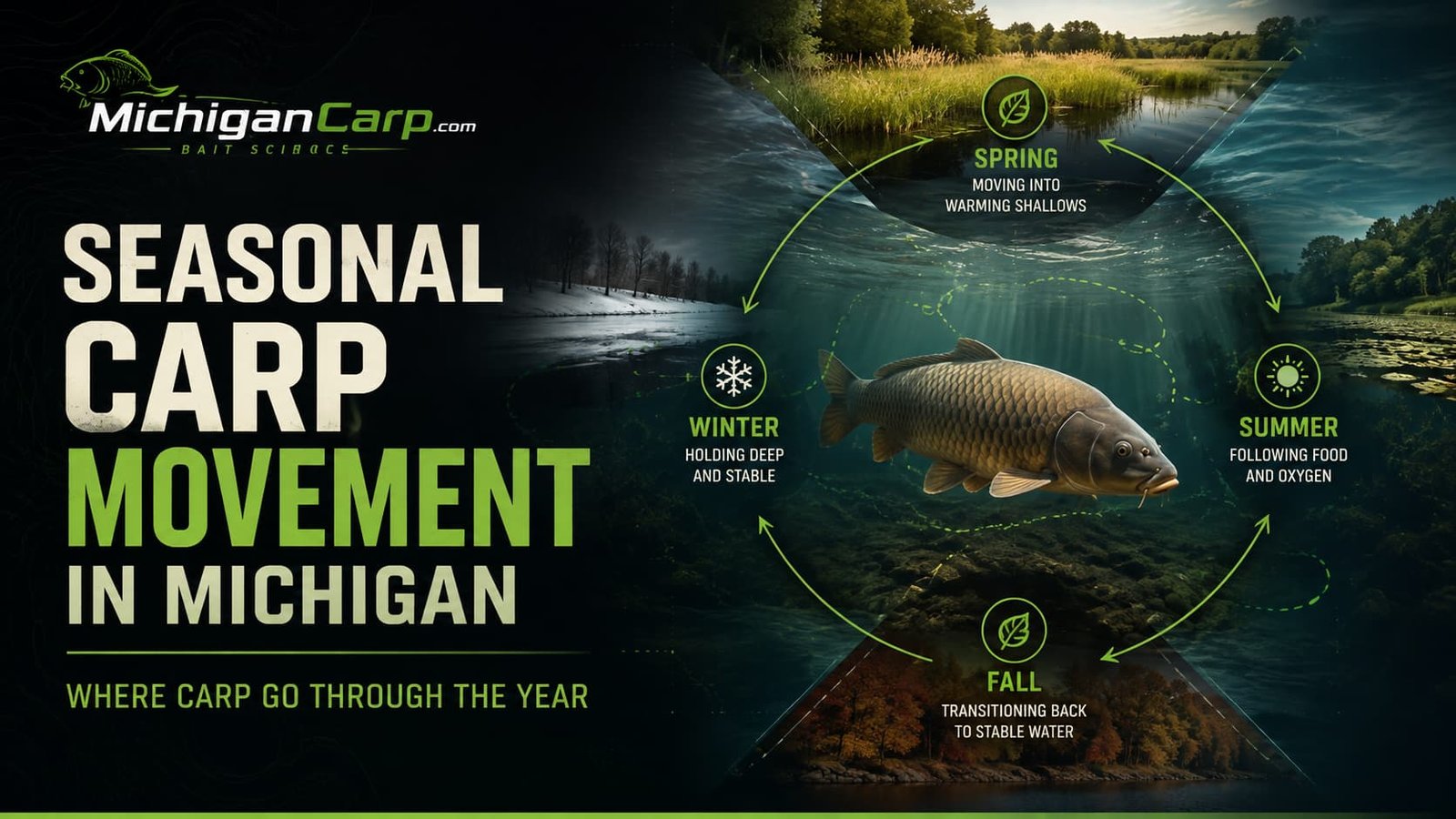
Where do carp go?
It sounds like one of the simplest questions in carp fishing, but on a big Michigan lake it can be one of the hardest to answer.
A bay that looks empty in April can suddenly fill with carp in May. A shallow area that produces all spring can become almost useless in July. Fish that seemed spread across half the lake in September can become much harder to find as late fall arrives.
The mistake is thinking of the lake as a fixed map.
Carp redistribute themselves through the year as the balance between water temperature, food, dissolved oxygen, spawning, weed, light, wind, safety and disturbance changes.
That is what seasonal carp movement in Michigan is really about.
It is not simply:
WINTER = DEEP.
SPRING = SHALLOW.
SUMMER = EVERYWHERE.
FALL = DEEP AGAIN.
Real movement is more useful — and more complicated — than those four rules.
Telemetry research on common carp in temperate North American lakes has recorded strong seasonal redistribution. Adult carp can form substantial late-fall and winter aggregations, move toward shallow vegetated habitat during spring and spawning, disperse more widely during the open-water period, and later consolidate again toward winter habitat.
The same research also explains why simple rules fail. Carp can remain active during winter. They can abandon deeper winter water when oxygen becomes poor. Summer fish may use deeper offshore water in one lake while continuing to exploit weed, margins or shallow feeding zones in another.
The purpose of this guide is therefore not to give you four seasonal coordinates.
It is to understand which part of the lake is becoming more useful, why carp are moving there, and where you can intercept that movement.
For the wider seasonal system, use Michigan Carp Fishing Seasons. For the temperature side, read Carp Water Temperature Guide for Michigan Lakes.
RANK
Table of Contents
Quick Start: Where Carp Go Through the Year
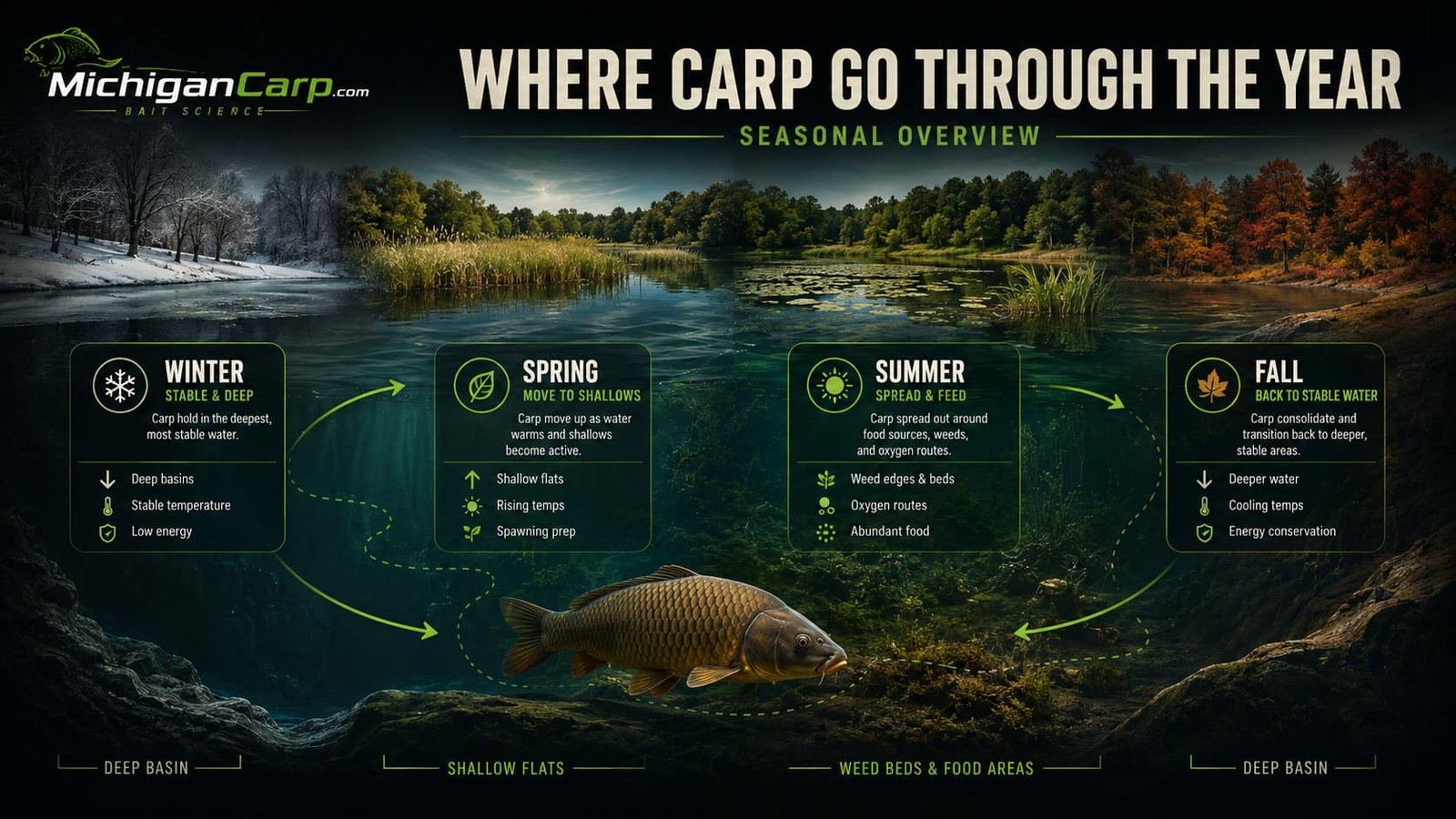
| Seasonal stage | Where carp often use | Main reason | Best question to ask |
|---|---|---|---|
| Winter | Stable holding areas, basins, channels, offshore water or oxygen refuges | Stability, safety, oxygen and reduced energy cost | Where can carp hold comfortably for long periods? |
| Ice-out / early spring | Routes toward warming bays, dark bottoms, reeds and sheltered shallows | Improving temperature and increasing biological activity | Which part of the lake is improving first? |
| Pre-spawn | Staging areas near shallow vegetation, bays and spawning habitat | Spawning preparation | Are these carp feeding or preparing to spawn? |
| Post-spawn | Recovery water, nearby food and routes back toward the main lake | Recovery and return to normal feeding | Where can fish recover close to food and safety? |
| Summer | Weed, food zones, windward areas, inflows, margins, open-water routes and deeper comfort water | Food, oxygen, temperature, light and pressure | Where do food and comfortable water overlap today? |
| Early fall | Productive summer food plus increasingly stable routes | Cooling water while feeding remains strong | Which summer areas are still productive? |
| Late fall | Depth transitions, channels, basin edges and emerging winter holding areas | Cooling and seasonal consolidation | Where are carp beginning to group? |
The simplest useful model is:
WINTER CONSOLIDATION → SPRING EXPANSION → SPAWNING CONCENTRATION → SUMMER DISPERSAL → FALL CONSOLIDATION → WINTER HOLDING.
But that is a framework, not a calendar.
The timing changes with latitude, lake size, depth, water clarity, weather, wind exposure, connected wetlands, weed growth, water level and oxygen.
Seasonal Movement Is Different From Daily Carp Movement
One reason carp location becomes confusing is that anglers often mix seasonal movement and daily movement together.
Seasonal movement is the redistribution of carp across the lake over weeks and months.
Daily movement happens inside that seasonal range.
A summer carp may spend daylight around weed or deeper cover, move onto a shallow feeding area at dusk and return before morning. That is daily movement.
The same carp leaving a spring spawning bay and spending July around completely different summer food and cover is seasonal movement.
You therefore need to solve two maps:
THE SEASONAL MAP — WHICH PART OF THE LAKE IS CURRENTLY USEFUL?
THE DAILY MAP — WHERE ARE THE CARP INSIDE THAT RANGE RIGHT NOW?
For holding behavior, use Where Carp Hold During the Day. For the complete location process, use How to Find Carp in Lakes.
What Research Tells Us About Seasonal Carp Movement
Anglers have observed seasonal carp movements for generations, but telemetry research allows individual fish to be followed for months or years.
One particularly useful Midwestern study tracked common carp in Clear Lake, Iowa. Adult fish showed strong seasonal habitat changes, including offshore aggregation during late fall and winter and much greater use of shallow vegetated areas before and during spring spawning.
See Seasonal Distribution, Aggregation and Habitat Selection of Common Carp — USGS.
Research from a South Dakota glacial-lake system also recorded seasonal redistribution. Carp aggregated in shallow nearshore water around the spawning period, moved farther offshore during part of summer, and later showed additional shallow-water use.
That is important because it demonstrates that seasonal movement is not necessarily one smooth journey from shallow spring water toward deep winter water.
Carp can expand, contract and reposition several times within the same season.
Lake Winnipeg telemetry has also documented predictable annual movement between lake and marsh habitat, followed by return toward overwintering areas and aggregation later in the year.
These studies do not tell us exactly which Michigan swim to fish.
They tell us something more useful:
SEASONAL CARP MOVEMENT IS REAL, OFTEN REPEATABLE AND STRONGLY CONNECTED TO SPAWNING HABITAT, TEMPERATURE, FOOD, OXYGEN, SAFETY AND OVERWINTERING REQUIREMENTS.
What Actually Drives Seasonal Carp Movement in Michigan?
No single factor controls the year.
Understanding seasonal carp movement in Michigan means looking for overlap between several changing conditions.
Water Temperature
Carp are ectothermic, so their physiology and activity are strongly influenced by water temperature.
Temperature becomes especially useful in spring because different parts of a lake can warm at very different rates.
A shallow dark-bottom bay receiving afternoon sun can behave very differently from the exposed main basin.
Do not read temperature as one lake-wide number.
Think in terms of relative temperature, rate of change and whether a zone is improving or deteriorating.
Use Carp Water Temperature Guide for Michigan Lakes for the dedicated temperature system.
Spawning
Spawning creates one of the strongest seasonal concentrations of the year.
Common carp move toward shallow areas suitable for spawning, particularly protected water with vegetation or other suitable structure.
This is why shallow bays, marshes, reeds, flooded margins and connected wetlands can suddenly become extremely active in spring.
But visible fish are not automatically feeding fish.
Use The Carp Spawning Cycle in Michigan before interpreting heavy spring movement as a normal feeding pattern.
Natural Food
Comfort alone does not explain where carp spend their time.
Food matters enormously.
Depending on the water, seasonal food can include:
- chironomid and other insect larvae;
- worms;
- snails;
- mussels;
- crustaceans;
- invertebrates living in weed;
- seeds and plant material;
- detritus and other available natural foods.
Food can make a shallow area important in spring, a weed line important in summer, and a mussel or deeper food area important during fall.
Dissolved Oxygen
Dissolved oxygen can override otherwise attractive temperature or depth.
This becomes especially important during hot weather, heavy weed growth, algae problems, decomposition and under difficult winter conditions.
Winter telemetry research has shown common carp moving away from deeper water when oxygen conditions became unsuitable and using shallower areas associated with better oxygen.
That is why the rule “winter carp always want the deepest water” is unreliable.
A better rule is:
CARP NEED WATER THAT IS STABLE AND PHYSIOLOGICALLY USABLE — NOT SIMPLY DEEP.
Use Dissolved Oxygen and Carp Fishing for the complete oxygen framework.
Weed and Cover
Weed changes the seasonal map dramatically.
Emerging spring weed can become a route, spawning feature and source of natural food.
Healthy summer weed can provide:
- food;
- cover;
- shade;
- edges;
- travel routes;
- feeding opportunities.
As weed deteriorates later in the year, carp may move toward cleaner edges, firmer bottom or entirely different areas.
Use Weed Beds and Carp Fishing.
Wind and Current
Wind can change temperature, oxygen, food distribution, turbidity and security.
A warm spring wind may improve a shallow bank.
A cold spring wind may push the useful water elsewhere.
During summer, moving water or a windward bank can remain attractive when sheltered water becomes hot or stagnant.
Inflowing water and current can also create distinct travel corridors.
Use Wind, Waves and Current Carp Fishing.
Light, Safety and Human Pressure
Season controls the broad area carp can use.
Light and disturbance often decide when they are comfortable using it.
Boat traffic, swimmers, repeated casting and bank activity can all change carp movement, especially on busy Michigan lakes during summer.
Fish may remain in the same general section but become much more dependent on darkness, low light or quieter routes.
Where Do Carp Go in Winter?
Winter creates some of the strongest misconceptions in carp fishing.
The usual answer is that carp simply move into the deepest hole and become inactive.
Sometimes deeper water is extremely important.
But “deepest” and “best” are not the same thing.
Telemetry studies from temperate lakes have documented strong winter aggregations, particularly among adult carp.
This suggests a useful winter model:
- stable water;
- reduced unnecessary movement;
- sufficient oxygen;
- safety;
- access to limited feeding opportunities;
- areas where groups can hold for long periods.
Carp do not actually hibernate.
Research has recorded winter movement and feeding activity at very low water temperatures.
The correct winter question is therefore not:
WHERE IS THE DEEPEST WATER?
Ask:
WHERE CAN A GROUP OF CARP HOLD WITH STABILITY, OXYGEN AND MINIMAL ENERGY COST?
Depending on the lake, that may be:
- a deeper basin;
- a channel;
- a steep edge;
- a sheltered offshore area;
- slow current;
- water influenced by an oxygenated inflow;
- a stable intermediate depth rather than the deepest point.
Because winter movement is often more restricted, location becomes even more important than bait quantity.
Ice-Out: The First Seasonal Expansion
Ice-out does not instantly transform the whole lake.
The first improvement is uneven.
A protected bay may receive sun and warm faster.
A dark silty bottom may absorb heat.
A reed margin may create a protected microclimate.
A shallow connected wetland may begin changing while the main basin still behaves like winter.
This is when winter concentration begins to loosen.
Research on Great Lakes-connected carp has recorded movement into wetlands beginning after ice-out as the spring spawning period develops.
That supports something experienced anglers often see:
THE FIRST SPRING MOVEMENT CAN BEGIN LONG BEFORE THE WATER FEELS WARM TO US.
The carp do not need summer water.
They need water that has become better than the surrounding water.
Spring Carp Movement: Follow the Improving Water
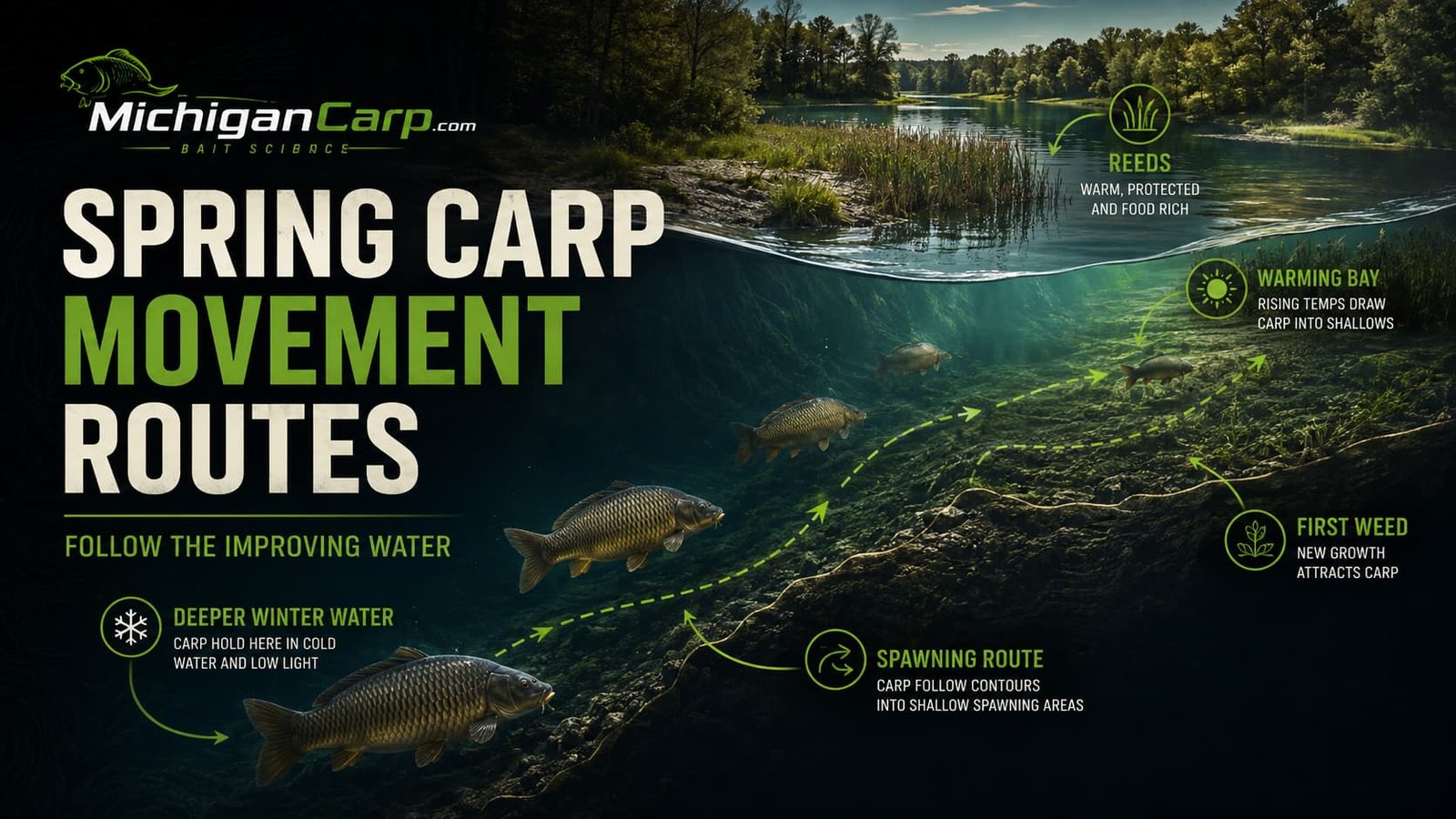
Spring is often the easiest seasonal movement to visualize.
Some parts of the lake improve before others.
Carp begin investigating them.
Good spring areas commonly combine:
- relative warmth;
- natural food;
- shallow water;
- cover;
- sun;
- easy access back to deeper water.
That can make:
- sheltered bays;
- dark-bottom margins;
- reed lines;
- soft silty areas;
- first weed;
- shallow shelves;
- bay mouths;
- channels connecting shallow and deeper water
very important.
Do not simply search for the shallowest water.
Search for shallow water that is improving and connected to a useful route.
Pre-Spawn: Carp Concentrate Again
Spring movement does not remain a simple outward expansion.
As spawning approaches, carp increasingly concentrate around suitable spawning habitat.
Typical areas include:
- vegetated bays;
- marshes;
- reed beds;
- flooded vegetation;
- protected margins;
- connected shallow water;
- routes leading into spawning habitat.
This can make carp far more visible.
But visibility and feeding are not the same thing.
Fish may be staging, grouping and moving for reproductive reasons rather than because they are settled over food.
This is why the spawning article remains separate from this one.
Use The Carp Spawning Cycle in Michigan before assuming visible spring carp should simply be heavily baited.
During the Spawn: Movement Does Not Mean Feeding
During actual spawning, carp may move aggressively through very shallow water.
Fish can group tightly, crash through vegetation, repeatedly cross small areas and become easier to see than at almost any other time of year.
This is one of the strongest concentrations in the seasonal cycle.
It is also a poor time to interpret their movements as normal feeding behavior.
If carp are clearly spawning, the responsible approach is simple:
LET THEM SPAWN.
Use the opportunity to learn.
Watch:
- which route they used;
- where they staged;
- which bay or vegetation they selected;
- which deeper water connects to that spawning area.
Those observations become useful again once normal feeding resumes.
Post-Spawn: Where Do Carp Go Next?
Post-spawn movement is another stage where anglers often expect a single rule.
There is not one.
Some carp leave spawning water quickly.
Others remain nearby where shallow water, cover and food still make sense.
Some fish appear to spend time recovering before developing a more normal summer pattern.
A useful model is:
SPAWNING CONCENTRATION → RECOVERY → REDISTRIBUTION.
Areas worth checking include:
- bay mouths;
- weed edges near spawning water;
- quiet shelves;
- nearby natural-food zones;
- routes back toward the main lake;
- deeper water close to the spawning area.
Look for normal feeding behavior before deciding the post-spawn transition has finished.
Where Do Carp Go in Summer?
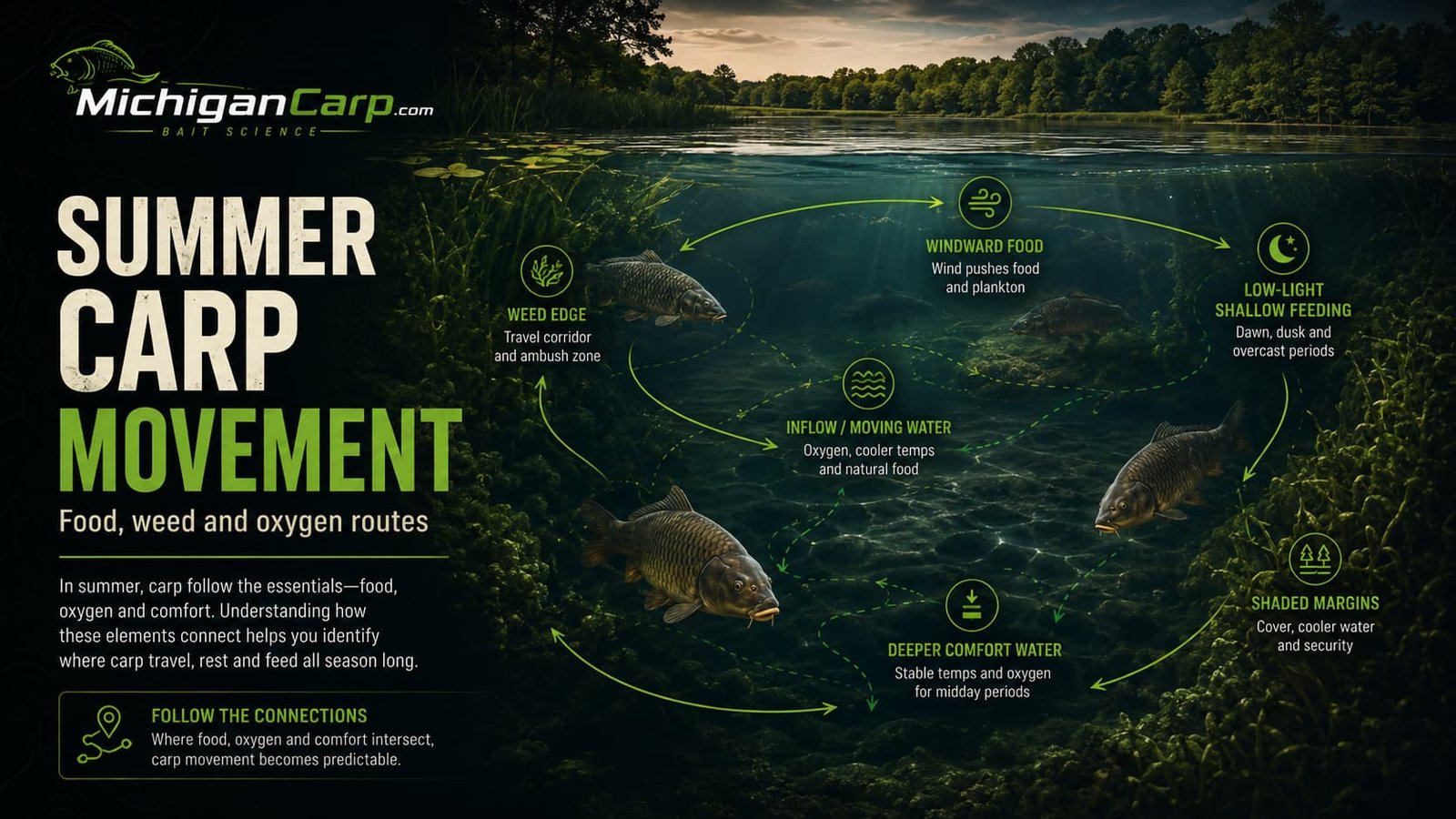
Summer is often the most confusing part of seasonal carp movement in Michigan.
The reason is simple:
MORE OF THE LAKE BECOMES USABLE.
Spring carp may have been concentrated around just a few warming areas.
By summer:
- weed is established;
- natural food is widespread;
- the open lake has warmed;
- daylight is long;
- fish may feed at several depths;
- wind and oxygen can change useful water from day to day.
Summer carp may use:
- weed beds;
- outside weed edges;
- clean channels through weed;
- soft food-rich bottom;
- mussel and snail areas;
- windward banks;
- inflows;
- shaded margins;
- open-water travel routes;
- deeper comfort water;
- shallow low-light feeding areas.
Summer movement is therefore broader.
It is not random.
The best question becomes:
WHERE DO FOOD, OXYGEN, COMFORT AND SAFETY OVERLAP TODAY?
Summer Weed Edges Become Carp Highways
Healthy summer weed can become one of the most important structures in the lake.
It can provide food, shade, cover and a complex network of edges.
Carp may move:
- along the outside weed edge;
- through channels;
- between weed and deeper water;
- onto nearby feeding patches;
- into shallows during low light;
- back toward safer cover as light increases.
This is why “carp are in the weed” is often too vague to be useful.
The fishable edge can be more valuable than the thickest weed.
Use Weed Beds and Carp Fishing for the dedicated guide.
Summer Oxygen Can Override Depth and Temperature
On warm summer water, oxygen needs to be considered alongside temperature.
Hot sheltered water can become less attractive even when it looks perfect from the bank.
Moving water, wind, healthy vegetation and inflows can change that picture.
This is particularly important on lakes that stratify or develop large differences between surface and deeper water.
Do not assume deeper is automatically cooler and therefore better.
Cool water with poor oxygen may be biologically unusable.
This is where the protected **Dissolved Oxygen and Carp Fishing** article becomes essential rather than optional.
Late Summer: Why Carp Seem to Disappear
Late summer can make carp appear to vanish even when they have not moved very far.
By this stage:
- boat traffic may have been heavy for months;
- popular banks have been repeatedly disturbed;
- weed may have become very thick;
- some vegetation may begin deteriorating;
- natural food has changed;
- carp may have shifted their feeding times.
The seasonal range may still be broadly “summer,” but daily movement inside that range can become very different.
Carp may increasingly use:
- early morning;
- late evening;
- night;
- quiet banks;
- deeper edges by day;
- cover;
- less obvious routes.
The fish have not necessarily disappeared.
Your old observation window may have disappeared.
Where Do Carp Go in Early Fall?
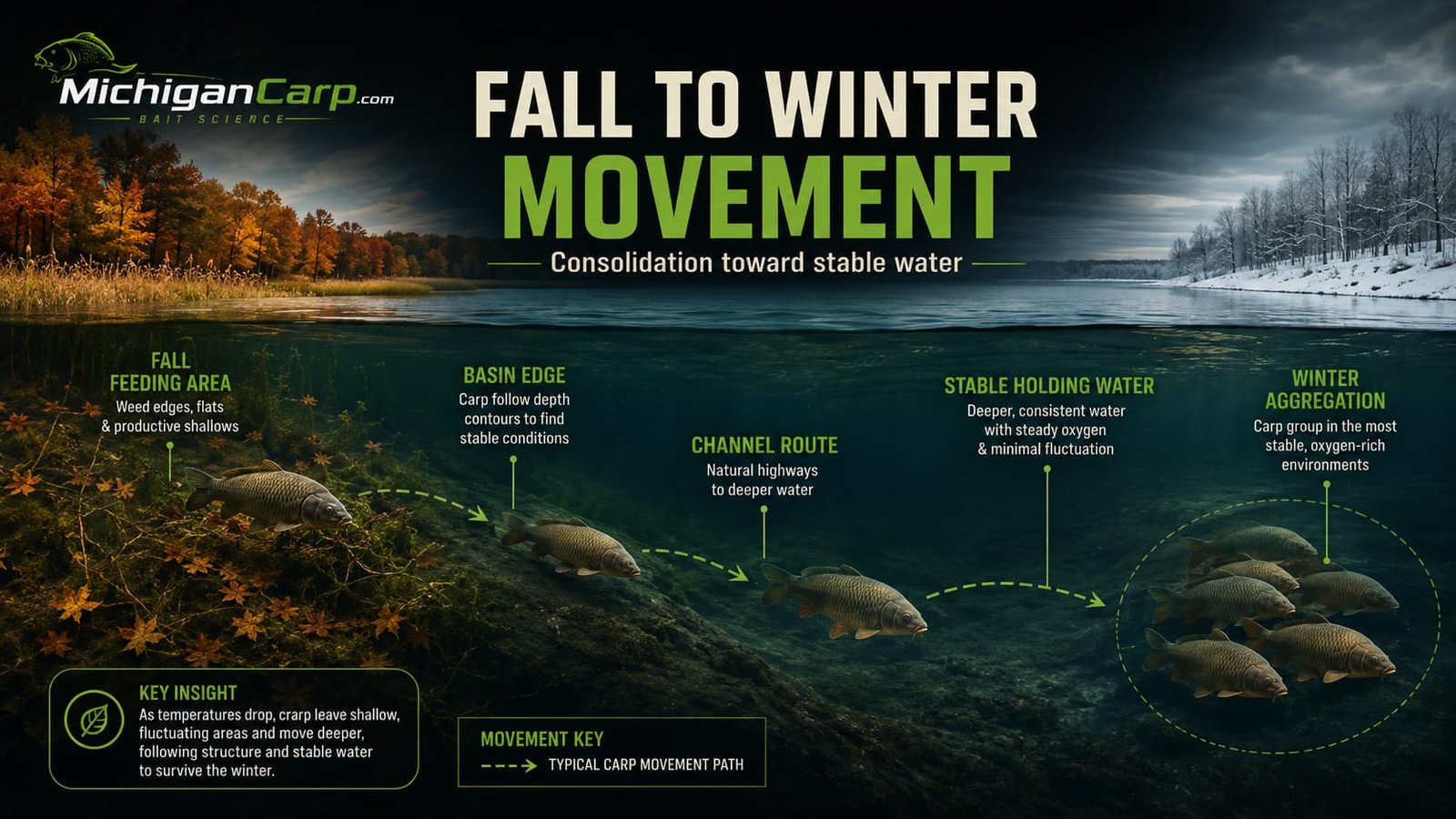
Early fall is often fished too much like late fall.
A few cool nights do not immediately send every carp toward winter water.
Productive summer areas can remain excellent while:
- the food remains available;
- weed remains healthy;
- oxygen remains good;
- the water is still comfortable.
The difference is that the broad seasonal direction has started to change.
Think of early fall as:
SUMMER RANGE + INCREASING VALUE OF STABLE WATER.
This can be an excellent time to fish:
- productive weed edges;
- mussel areas;
- deeper shelves;
- reliable feeding routes;
- areas with easy access to greater depth;
- wind-influenced food zones.
Late Fall: Carp Begin to Consolidate
Late fall is when the lake can begin simplifying again.
Telemetry studies have recorded carp returning toward overwintering habitat and forming increasingly strong aggregations.
That does not mean every fish reaches its winter area on the same date.
It means stable group-holding water becomes progressively more important.
Clues that this transition is underway include:
- fewer shallow signs;
- fish repeatedly showing near one basin or channel edge;
- movement away from dying weed;
- shorter feeding windows;
- groups becoming more localized;
- increasing importance of stable depth.
This is where anglers get caught fishing memories.
A September swim may still look perfect in November.
The carp may simply no longer have a reason to use it.
Weather Can Speed Up or Reverse Seasonal Movement
The season tells you the general direction.
Current weather tells you how far the fish have moved along that path.
A stable warm spell in spring can accelerate movement into shallower water.
A cold front can stall or partly reverse that shift.
A warm October can extend productive shallow and weed-based patterns.
A sharp late-fall cooling event may tighten carp around stable water rapidly.
This is why copying last year’s dates is unreliable.
Use the calendar to tell you what seasonal transition is possible.
Use the lake to tell you whether it has actually happened.
Large Michigan Lakes Can Have Several Seasons at Once
One of the biggest differences between a small pond and a large Michigan lake is the speed and uniformity of seasonal change.
A small shallow dark-bottom lake can respond very quickly.
A large clear lake with substantial depth may respond much more slowly.
On large water, different sections can effectively be at different seasonal stages.
For example:
- a protected bay may behave like spring while the main lake is still winter-like;
- a shallow windward summer area may be productive while a sheltered back bay is stagnant;
- a river-influenced arm may cool or warm differently from the main basin;
- a deep open-water section may remain stable while margins change quickly.
This is why big-lake carp anglers should think in zones rather than one lake-wide temperature or one seasonal rule.
Use Advanced Big-Lake Carp Tactics for Michigan Waters for the deeper big-water system.
The Bank Angler’s Seasonal Interception System
Understanding seasonal movement only matters if it changes where you put the rods.
Step 1: Decide the Seasonal Stage
Ask whether the fish are:
- consolidated in winter water;
- expanding toward spring water;
- staging for spawning;
- recovering post-spawn;
- spread through summer habitat;
- beginning fall consolidation.
Step 2: Identify Two Competing Zones
Do not try to solve the whole lake.
Compare two logical areas:
- spring bay versus deeper main-lake edge;
- weed line versus offshore shelf;
- fall food area versus basin route;
- winter basin versus oxygen-influenced inflow.
Step 3: Watch Before You Bait
Look for repeated evidence:
- rolling;
- fizzing;
- liners;
- clouded water;
- weed movement;
- fish entering or leaving an area;
- repeat low-light activity.
Use Signs Carp Are Feeding to distinguish feeding evidence from simple presence.
Step 4: Fish the Route, Not Only the Destination
The obvious destination is not always the best fishing spot.
A bay mouth, point, weed edge, channel lip or depth transition can intercept carp moving between two seasonal zones.
Step 5: Move When the Story Stops Making Sense
Do not defend yesterday’s swim.
If a spring shallow has gone cold and lifeless, the fish may have pulled back.
If summer weed has collapsed, the carp may already be shifting onto cleaner fall water.
If the shallow fall route has stopped producing signs, look toward the next stable transition.
Common Seasonal Movement Mistakes
Fishing the Calendar Instead of the Water
“It is May, so the carp must be shallow” is not enough.
Check actual water conditions.
Assuming Winter Means the Deepest Hole
Stable water matters, but oxygen and lake structure can change where winter aggregations form.
Assuming Visible Spring Carp Are Feeding
Spawning preparation can produce intense shallow-water movement without normal feeding behavior.
Believing Summer Movement Is Random
Summer range is broader, but movement still follows food, weed, oxygen, safety, wind and light.
Abandoning Shallow Water Too Early in Fall
Early fall can continue to fish like summer while conditions remain suitable.
Staying on Summer Water Too Long
Eventually cooling, food changes and weed deterioration shift the seasonal balance.
Treating Research as a Rulebook
Telemetry shows us repeatable patterns.
Your lake still decides how those patterns are expressed.
My Practical MichiganCarp View
The simplest way I can explain seasonal carp movement in Michigan is this:
CARP SPEND THE YEAR EXPANDING AND CONTRACTING THEIR USABLE WORLD.
Winter usually contracts it.
Spring expands it toward improving shallow water.
Spawning concentrates fish again around specific habitat.
Summer expands the range as weed, natural food and usable temperatures become widespread.
Fall gradually contracts that range as water cools and stable winter habitat becomes increasingly important.
Inside each seasonal range, carp continue moving every day.
That is why the subject can feel confusing.
Once you separate seasonal distribution from daily movement, it becomes much easier.
I would rather know carp are leaving a winter basin for one warming bay than own the best bait in the world.
I would rather know July fish have shifted onto an oxygenated weed edge than continue fishing the shallow spring swim because it produced two months ago.
I would rather recognize late-fall consolidation than continue prebaiting an area the carp no longer use.
The rule is:
FOLLOW THE SEASONAL DIRECTION. CHECK THE CURRENT WATER. CONFIRM IT WITH CARP SIGNS. THEN FISH THE ROUTE THEY ARE ACTUALLY USING.
Research Note: Evidence vs Practical Interpretation
This article separates published movement research from practical fishing interpretation.
Published telemetry studies support several broad conclusions:
- adult common carp can form strong late-fall and winter aggregations;
- spring movement can concentrate fish in shallow vegetated spawning habitat;
- repeat seasonal migration into connected wetlands and marshes can occur;
- summer distribution can become considerably broader;
- carp remain capable of winter movement and feeding;
- poor dissolved oxygen can override a simple preference for deeper winter water.
Useful background research includes:
- Seasonal Distribution, Aggregation and Habitat Selection of Common Carp in Clear Lake, Iowa
- Movement and Spatial Distribution of Common Carp in a South Dakota Glacial Lake System
- Spatial Ecology of Common Carp in Lake Winnipeg
- Environmental Cues of Spawning Migration in Lake Erie Common Carp
- Overwintering of Common Carp — Radio Telemetry Study
- Michigan DNR — Common Carp
My recommendations about which banks, routes and transitions to investigate are practical interpretation based on those biological patterns and long-term carp fishing experience. They are not claims that every Michigan lake or every carp follows the same route on the same date.
FAQ
Where do carp go in winter?
Carp often consolidate into stable holding areas during late fall and winter. These can include deeper basins, channels and offshore areas, but sufficient dissolved oxygen and usable habitat matter more than simply finding the deepest point.
Do carp move shallow immediately after ice-out?
Some movement can begin surprisingly early where shallow bays, wetlands or dark-bottom areas improve faster than the main lake. The whole population does not necessarily move at once.
Where do carp go before spawning?
Carp often move toward shallow vegetated water and staging areas connected to suitable spawning habitat. Bay mouths, reed lines, marshes and routes from deeper water can become particularly important.
Where do carp go after spawning?
Post-spawn fish may recover close to the spawning area or begin moving back toward normal summer food and holding areas. Routes leaving spawning habitat can be particularly useful places to investigate.
Do carp go deep in summer?
Some populations use deeper or more offshore water during summer, but carp may also remain closely associated with weed, margins, inflows, natural-food areas and shallow low-light feeding routes. Food, oxygen, safety and temperature need to be considered together.
Where do carp go in fall?
Early fall carp may continue using productive summer water. As cooling progresses, movement often becomes more concentrated around stable routes, deeper transitions and eventual overwintering areas.
Do carp use the same seasonal areas every year?
They often use similar broad areas because lake structure and spawning habitat change slowly. Weather, weed growth, water levels, oxygen and fishing pressure can alter the exact timing and routes from year to year.
What is the biggest mistake when following seasonal carp movement?
Fishing where the carp were last month instead of asking which part of the lake is becoming more useful now.
Next Steps
- Michigan Carp Fishing Seasons — return to the main seasonal hub.
- Carp Water Temperature Guide for Michigan Lakes — judge how far the seasonal transition has progressed.
- The Carp Spawning Cycle in Michigan — understand spring concentration and post-spawn redistribution.
- How to Find Carp in Lakes — turn seasonal direction into an actual fishing location.
- Where Carp Hold During the Day — understand holding water inside the current seasonal range.
- Best Depth for Carp Fishing — use depth as a route and comfort clue rather than a fixed answer.
- Dissolved Oxygen and Carp Fishing — essential in hot summer and difficult winter conditions.
- Wind, Waves and Current Carp Fishing — understand short-term movement inside the seasonal pattern.
- Carp Bite Windows in Michigan — decide when carp in the correct area are most likely to feed.
- Advanced Big-Lake Carp Tactics for Michigan Waters — apply seasonal movement to large and difficult water.
Final Word
Where do carp go?
They go where the lake gives them the best current combination of comfort, food, oxygen, safety and biological purpose.
In winter, that often means consolidation.
In spring, expansion toward improving water.
Around spawning, concentration around suitable shallow habitat.
In summer, a broader network of food, weed, oxygen and safety routes.
In fall, a gradual return toward stability.
The best anglers do not memorize one seasonal map.
They understand why the map is changing.
FOLLOW THE SEASON. READ THE WATER. CONFIRM THE FISH. THEN INTERCEPT THE ROUTE THEY ARE ACTUALLY USING.