

Carp session planning is where watercraft becomes a practical fishing plan rather than a collection of separate clues.
Water temperature, wind, depth, weed, oxygen, natural food, bite windows, fishing pressure and access all matter. The difficult part is deciding what those clues mean together, then arriving at the lake with a sensible starting plan without pretending you can predict exactly what the carp will do.
A good plan should answer a few important questions before you leave home:
Where is the most promising type of water likely to be? When is it most likely to improve? How much time do you have? What conditions could change the plan? What baiting approach makes sense initially? What tackle or presentation problems should you prepare for? And what is Plan B if the first theory fails?
The plan is a working hypothesis, not a promise.
Once you actually arrive and begin reading the lake, fresh evidence can override anything decided at home.
That distinction is important. This article explains how to build the session plan before fishing. Once the trip begins, use The Complete Michigan Carp Session Checklist to work through arrival, location confirmation, presentation, baiting, adjustments and what to record afterwards.
For the wider conditions framework, use Watercraft and Conditions for Michigan Carp Fishing.
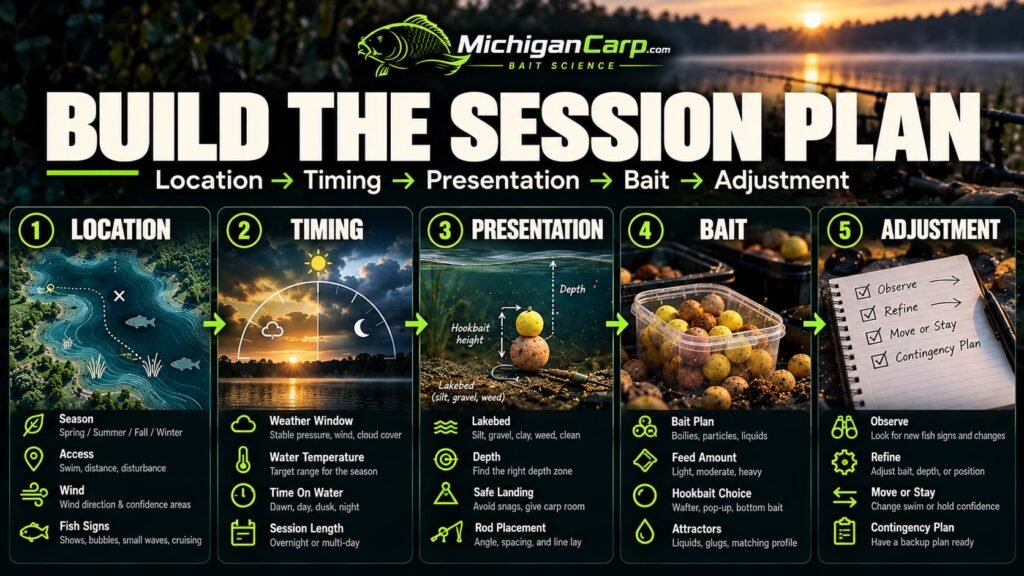
Table of Contents
Quick Start: Build the Session Plan
A useful carp session plan can be built in eight stages.
| Stage | Main Question | Planning Decision |
|---|---|---|
| Session objective | What type of session am I actually fishing? | Short opportunity, overnight, multi-day or exploratory trip |
| Recent conditions | What has the water been experiencing? | Warming, cooling, stable weather, wind, rain, heat or fronts |
| Location shortlist | What areas have the strongest reason to hold carp? | Create Plan A and at least one alternative |
| Timing | When is each area most likely to improve? | Dawn, daytime warming, dusk, night or weather-related window |
| Access and safety | Can I legally and safely fish the useful water? | Eliminate unrealistic or unsafe options before traveling |
| Presentation preparation | What lakebed or snag problems might I encounter? | Take suitable rig and line options without choosing the exact rig yet |
| Baiting plan | What job should the bait initially perform? | One-bite trap, controlled attraction or longer feeding situation |
| Contingency | What evidence would make me change the plan? | Decide what would justify switching areas or strategy |
The central rule is simple:
Plan around the water you expect to find, not the tackle or bait you happen to want to use.
Start With the Recent Pattern, Not Just the Calendar
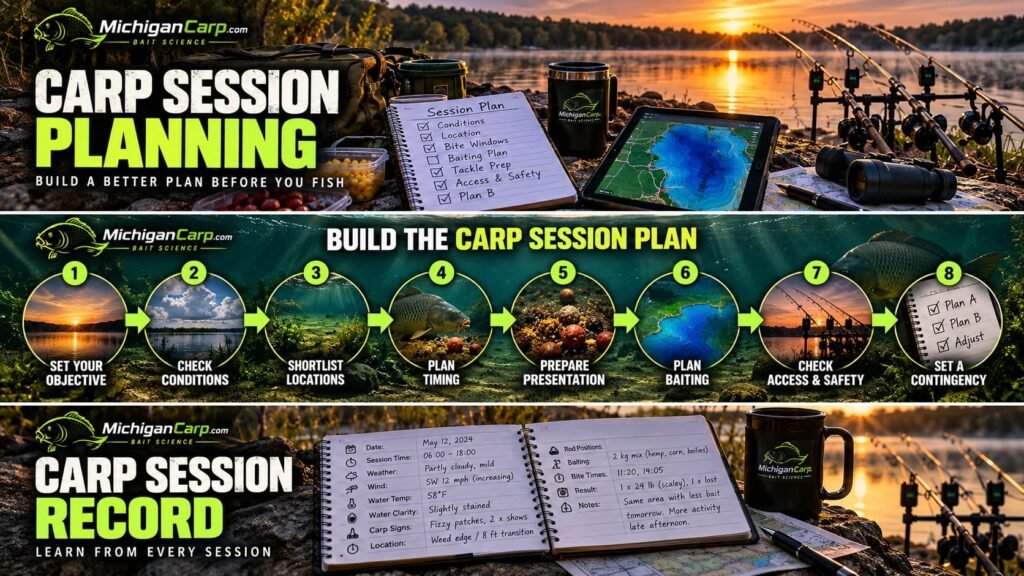
Season gives useful context, but it should not become a rigid rule.
Two Michigan lakes can behave very differently on the same date. A shallow dark-bottom lake can respond quickly to several mild spring afternoons, while a large deep lake nearby may still be cold. Likewise, a warm October afternoon does not mean much if several nights of cooling have already changed the water.
The better starting question is:
What has happened to this water during the last few days, and what is likely to happen during my session?
The calendar gives you the broad seasonal story. The recent weather and water trend refine it.
| Seasonal Context | Useful Starting Questions |
|---|---|
| Early spring | Is protected shallow water actually warming? Are there darker bottoms, reeds or nearby deeper routes? |
| Late spring / pre-spawn | Are carp moving more widely? Are margins, bays, shelves and weed becoming important? |
| Summer | Where are oxygen, shade, healthy weed and quieter periods? How much does boat traffic change the lake? |
| Fall | Which feeding areas still connect easily to deeper or more stable water? Is the temperature falling gradually or sharply? |
| Cold water | Where are carp likely to conserve movement? Which stable areas still offer food and a realistic feeding window? |
This approach avoids one of the easiest mistakes in carp fishing: treating a seasonal rule as more important than the water in front of you.
Use Water Temperature as a Trend
Water temperature is one of the best planning clues available, but the trend is usually more useful than a single number.
A lake warming steadily can create very different opportunities from a slightly warmer lake that has just suffered a sharp temperature drop.
Before a trip, ask whether the water is probably:
- warming
- cooling
- relatively stable
Then ask where that trend may matter most.
In spring, protected shallow areas can respond faster than the main lake. In summer, very shallow water can become uncomfortable if heat combines with poor oxygen or heavy weed decay. In fall, cooling can gradually increase the value of stable routes and deeper water.
Do not try to calculate one universally correct depth from temperature alone. Temperature should narrow the search, not make the final decision.
Use Carp Water Temperature Guide for Michigan Lakes for the full temperature framework.
Add Wind, Oxygen, Light and Water Movement
The next step is to ask what moving water and changing conditions may do to the areas already on your shortlist.
Wind can influence temperature, surface movement, turbidity, floating material and confidence. It can also make a bank difficult or unsafe.
The common shortcut—always fish into the wind—is too simple.
A mild spring wind entering a warming bay can support the case for fishing there. A cold wind suddenly hitting the same shallow area may weaken it. Summer ripple can improve cover and sometimes coincide with better mixing, while severe wave action can make line control or landing unsafe.
Similarly, oxygen should be treated as part of the overall comfort picture rather than as an isolated number.
Healthy weed, inflows, moving water and cooler periods can all help identify potentially useful areas. Stagnant water, decaying vegetation and extreme heat deserve more caution.
For the detailed guides, use Wind, Waves and Current for Michigan Carp Fishing and Dissolved Oxygen and Carp Fishing.
Shortlist Areas Before You Leave — Not Exact Swims
Planning from home is useful. Choosing an exact swim from home is much more dangerous.
Maps, satellite imagery, previous notes and venue knowledge can help identify areas worth investigating. They cannot tell you where the carp will definitely be when you arrive.
Instead of deciding:
“I am fishing Swim 6.”
build the plan as:
“My first area to investigate is the sheltered bay mouth because it connects shallow feeding water with deeper access. If that fails, I will check the windward point and adjacent weed edge.”
That keeps the planning useful without letting it become stubbornness.
Useful pre-trip features can include bay mouths, points, channel edges, weed systems, shallow-to-deep transitions, inflows, reed lines, known natural-food areas and quiet banks with good access.
For the broader location process, use How to Find Carp in Lakes.
Build a Plan A and Plan B
Every session should begin with at least two plausible options.
Plan A
Plan A is the water that currently has the strongest combination of season, recent conditions, food, comfort, timing and fishable access.
It does not need to be one exact casting spot.
It may simply be:
protected shallow bay → late-afternoon warming → reed and weed edges → light initial baiting
or:
main-lake channel edge → fall cooling → evening route → boilie-led feeding plan
Plan B
Plan B should be genuinely different enough to help if the original idea is wrong.
If Plan A relies on shallow warming water, Plan B might be a deeper connecting route.
If Plan A relies on a windward bank, Plan B might be a sheltered area that becomes useful if the wind becomes too cold or strong.
If Plan A is a heavily used campground bank, Plan B may be quieter water that becomes more attractive when daytime disturbance increases.
A backup plan is not pessimistic. It prevents you becoming emotionally committed to the first idea.
Plan the Bite Window Before Planning the Bait
A good location can appear lifeless for much of the day and still produce during a predictable period.
That is why session planning should include when, not just where.
Before traveling, consider whether the opportunity is most likely to be:
| Likely Window | Planning Implication |
|---|---|
| Spring afternoon warming | Arrive early enough to watch the shallow water develop |
| Dawn | Be set up before first light rather than arriving during the window |
| Dusk | Complete unnecessary disturbance beforehand |
| Summer night | Prepare landing, lighting and fish-care equipment before dark |
| Wind change | Keep enough flexibility to react if the useful bank changes |
| Cooling after hot weather | Watch for improved comfort as light and temperature fall |
| Fall feeding spell | Be ready on routes between food and more stable water |
Do not mistake these for guarantees.
The purpose is to be ready before the likely opportunity rather than realizing afterwards that the best period has passed.
Use Carp Bite Windows in Michigan for the dedicated timing guide.
Plan Access Before Tactics
Some apparently excellent fishing plans fail before a rod is cast because the useful water cannot actually be reached, fished or landed safely.
Before leaving home, check:
- legal public access
- parking and walking distance
- campground or site rules
- night access where relevant
- shoreline angle
- likely boat traffic
- casting room
- landing access
- known snags or mussel-covered structure
- whether a safer nearby position can still reach the same feature
For longer camping sessions, access deserves as much thought as tackle.
A swim is not useful simply because carp use it. You also need a safe way to hook, control, net and release them.
Check current rules through the Michigan DNR Fishing Regulations and use the National Weather Service for current forecasts and weather warnings.
Plan Rod Jobs, Not Fixed Rod Positions
Before arriving, you can decide what each rod may need to test, but avoid assigning an exact spot until you have read the water.
A three-rod approach might investigate:
Feeding Water
A rod placed where carp have a credible feeding reason: weed edge, silt, reeds, a firm patch, natural-food area or established baited zone.
Travel Water
A rod testing a route between holding and feeding water: channel lip, shelf, point, bay entrance, weed edge or depth transition.
Alternative Water
A rod testing a different part of the same theory—for example a slightly deeper edge, quieter margin or nearby comfort area.
That is an example, not a rule.
If repeated evidence shows that all the carp are feeding on one compact feature, putting all three rods sensibly around that productive area can be better than forcing three different theories.
The important principle is:
Every rod should have a reason.
Do not spread rods around simply because you have several rods available.
Prepare for the Likely Lakebed — But Choose the Rig at the Lake
Planning should help you take appropriate tackle, not lock you into a rig before you know what the bottom is actually like.
If the venue is known for weed, take presentations capable of fishing effectively around weed.
If zebra mussels, rock or abrasive structure are likely, line and leader preparation may matter more than hookbait flavor.
If soft silt dominates, have presentations that can settle without burying the hookbait.
But the final rig choice should follow what you actually find.
Use Reading the Bottom for Carp once substrate, depth and presentation become the main question.
Plan Bait by Its Job, Not by a Fixed Quantity
The first baiting question should not be:
How many pounds or gallons should I put in?
Ask:
What do I need this bait to do?
A short session where carp are already present may need a compact attraction point or even a single hookbait.
A multi-day campaign on a water holding a substantial carp population may justify much more food.
A spring reconnaissance session may call for a very cautious start.
A known feeding area during stable fall conditions may support substantially more bait.
This is why universal rules such as always start light or always bait heavily on long sessions are both unreliable.
A better planning framework is:
| Situation | Initial Planning Direction |
|---|---|
| Fish location uncertain | Keep commitment controlled until the area proves itself |
| Short session | Prioritize attraction and accuracy over building a large feeding campaign |
| Known feeding area | Match bait to expected fish numbers and feeding activity |
| Multi-day session | Bring enough bait to respond, but do not assume it all needs to go in immediately |
| Cold or rapidly cooling water | Reduce feed commitment and prioritize accurate presentation |
| Strong sustained feeding | Be prepared to top up rather than sticking rigidly to the original quantity |
| Heavy nuisance pressure | Plan bait and hookbait durability accordingly |
The useful principle is:
Bring enough bait to respond to the fish, but let actual activity decide how much of it enters the lake.
For bait selection, use the Carp Bait Guide for Michigan Lakes.
Match the Plan to Session Length
A three-hour evening session and a four-day camping trip should not be planned in the same way.
Short Sessions
The plan should emphasize current opportunity.
You have less time to wait for carp to discover you, so recent observations, known fish-holding water and likely bite windows become especially valuable.
Mobility may be more useful than bringing everything you own.
Overnight Sessions
Timing becomes more important.
The plan should account for dusk, darkness and dawn, with rigs, landing equipment, lighting and fish-care equipment organized before the useful period begins.
Night fishing also magnifies small safety problems, so access and landing routes should be decided in daylight whenever possible.
Multi-Day Sessions
Long sessions provide more time to learn the water, but they also make it easier to become overcommitted.
Do not assume that because you have booked four days, carp will eventually arrive in the swim you chose on Day 1.
A long session should provide more opportunities to test and refine the plan, not more reasons to defend a failed one.
Weather changes, fish movement and bait response may all require the original strategy to evolve.
Decide What Would Make You Abandon the Original Plan
A contingency plan becomes much more useful if you decide in advance what evidence would challenge Plan A.
Examples might include:
- repeated carp activity developing somewhere else
- a cold wind reversing the value of a shallow area
- unexpected weed making the planned presentation unreliable
- unsafe waves or line control
- heavy boat traffic disrupting the intended water
- water clarity changing substantially
- access becoming unsuitable
- the predicted bite window passing without fish signs while another area becomes active
This prevents two opposite mistakes.
The first is changing plans constantly because nothing has happened for an hour.
The second is refusing to change because you invested time carrying and setting up equipment.
Once the rods are fishing, the detailed move-or-stay process belongs in The Complete Michigan Carp Session Checklist.
What Not to Decide Before You Arrive
Some decisions are better left open.
Do not rigidly decide from home:
- the exact swim
- the exact casting spot
- the exact rig
- the exact depth
- the exact bait quantity that must go in
- which rod will catch
- that one weather factor guarantees success
Those decisions need current information.
Good planning should narrow the possibilities without removing your ability to observe.
Build the Next Plan From Real Session Notes
Planning improves when each trip produces useful information for the next one.
You do not need a scientific laboratory notebook, but useful records can reveal patterns that memory easily loses.
Water temperature, wind, actual fish signs, rod locations, depth, baiting, liners, bite times and major condition changes can gradually show which ideas deserve repeating.
A blank is worth recording too.
Repeated blanks under similar conditions can weaken a theory just as repeated captures can strengthen one.
The aim is not to find a magic formula. Wild lakes change too much for that.
The aim is to begin each new trip with more useful information than you had before the previous one.
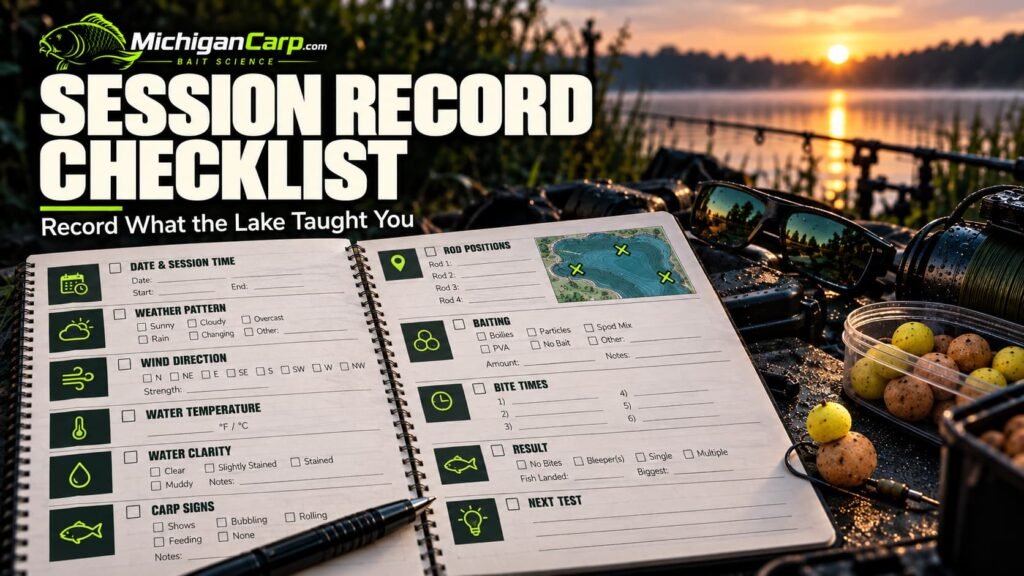
[IMAGE 3 — SESSION RECORD CHECKLIST]
Placement: Immediately after this section.
Filename: carp-session-record-checklist.jpg
Alt text: Carp session record checklist for logging weather, wind, water temperature, carp signs, rod positions, baiting and bite times.
The full operational recording process is covered in The Complete Michigan Carp Session Checklist.
Common Carp Session Planning Mistakes
Planning Around the Swim You Want
A comfortable campsite, good parking or favorite bank does not give carp a reason to use the water.
Start with the fishable water, then choose the most practical access to it.
Treating a Forecast as a Result
A forecast tells you what may happen.
When you arrive, check what the lake is actually doing.
Planning Around One Factor
Warm water, wind, moon phase, pressure or depth should not become the entire theory.
The strongest plans usually come from several clues pointing in the same direction.
Taking Too Much Confidence From One Previous Capture
A carp caught from one spot proves that fish used that water at that time.
It does not mean the spot is permanently productive.
Fixing the Bait Quantity Before Seeing Fish Activity
Bring enough to respond to the situation, but avoid making the feeding decision irreversible before the lake has given you evidence.
Having No Backup
A plan with no alternative can quickly become stubbornness.
Overcomplicating the Plan
You do not need twenty possible swims and twelve bait changes.
A strong Plan A, sensible Plan B and clear reason for each are usually more useful.
The MichiganCarp Practical View
The best session plans I use are not complicated.
I want to know what the water has been doing, what it is likely to do next, where that may put the carp, when the area may become useful, whether I can fish it safely and what alternative I have if the first theory fails.
That is particularly important on large Michigan waters.
On a small venue, being slightly wrong may still leave fish close enough to encounter the bait. On a large lake or impoundment, a poor location decision can put enormous amounts of empty water between the rigs and the carp.
At the same time, I do not want the plan to become so rigid that I ignore what happens after arriving.
If carp repeatedly show somewhere I had not expected, that is stronger evidence than the map I studied at home.
If a predicted wind never arrives, the plan changes.
If fish are clearly feeding harder than expected, baiting can change.
If access, waves or snags make the planned water unsafe, the plan changes.
That is what planning is supposed to do: give the session direction without preventing you from learning.
Frequently Asked Questions
What is carp session planning?
Carp session planning means building a practical fishing strategy before a trip using recent conditions, likely fish location, seasonal context, timing, access, presentation requirements, baiting and backup options.
What should I decide first?
Start with the water and recent conditions. Work out what types of areas are most likely to offer food, comfort, safety or a useful travel route before thinking about specific rigs or hookbaits.
Should I choose the swim before leaving home?
Usually no. Shortlist areas rather than committing to an exact swim. Fish signs and current conditions on arrival should have the final say.
How important is water temperature?
Very useful, especially as a trend. Rising, falling or stable water often tells you more than one isolated temperature reading.
How much bait should I plan to use?
Take enough to cover the realistic possibilities of the session, but let carp numbers, feeding activity, temperature, nuisance species and session length determine how much actually goes in.
Should I plan different spots for every rod?
Not automatically. Each rod should test a sensible part of the overall theory. If all the strongest evidence points to one feeding area, several rods can sensibly cover that area without forcing artificial differences.
What is the difference between this article and the Session Checklist?
This page helps you build the plan before fishing. The Complete Michigan Carp Session Checklist helps you test and manage that plan once the session begins.
How detailed should Plan B be?
Simple is fine. Plan B only needs to identify the next most credible option and the conditions that would make you use it.
What is the biggest session-planning mistake?
Deciding what you want to do and then trying to make the lake fit that decision. The better approach is to understand the lake first and build the session around it.
Next Steps
Once the plan is built, continue with the specialist guide that owns the next decision:
- The Complete Michigan Carp Session Checklist — use the plan on the bank and adjust it using real evidence.
- How to Find Carp in Lakes — narrow down likely fish location.
- Carp Water Temperature Guide — interpret warming, cooling and stable water.
- Wind, Waves and Current — understand how moving water may change location.
- Dissolved Oxygen and Carp Fishing — add oxygen and comfort to the location picture.
- Best Depth for Carp Fishing — connect depth with season, food and movement.
- Carp Bite Windows in Michigan — plan when the useful water may become active.
- Watercraft and Conditions — return to the main conditions hub.
- Michigan Carp Guide Library — browse the complete MichiganCarp guide structure.
The final planning rule is simple:
Study the recent pattern. Shortlist the right type of water. Arrive before the likely opportunity. Have a backup. Then let the lake decide whether the plan survives first contact.