

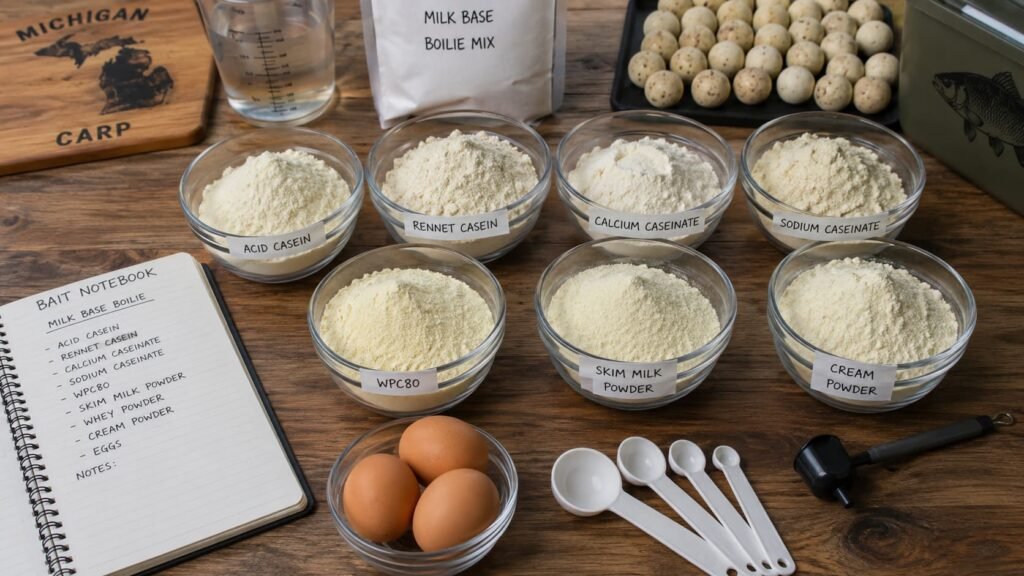
Milk Protein Stacking in Boilies: How to Use Casein, WPC and Milk Powder Without Overdoing It
Milk proteins can make outstanding carp boilies.
They can add food value, structure, creamy attraction, controlled leakage, hookbait strength, cold-water activity and a clean non-marine bait profile that suits many Michigan waters.
But there is a trap.
Once an angler starts learning about milk proteins, it becomes very easy to add too many of them.
A little acid casein sounds good.
Then WPC80 sounds good.
Then skim milk powder sounds good.
Then sodium caseinate sounds clever.
Then calcium caseinate sounds safer.
Then buttermilk powder, cream powder, whey powder, milk replacer and micellar casein all start looking tempting.
Before long, the bait is not a balanced boilie anymore. It is a dairy ingredient collection.
That is where problems start.
The dough becomes sticky.
The bait rolls badly.
The boilies stay soft.
The hookbaits become too buoyant.
The bait dries slowly.
The finished boilie becomes expensive, dense, confused or unstable.
Milk protein stacking is not about using every dairy ingredient you can find. It is about combining the right milk ingredients for clear jobs.
This guide explains how to stack casein, WPC80, whey powder, skim milk powder and caseinates in boilies without overdoing it.
For the main milk-protein foundation, read Milk Proteins in Carp Bait: Digestibility, Solubility, and Food Value. For the casein-specific article, read Milk Caseins for Boilie Making. For whey ingredients, read Whey Powders in Boilie Mixes.
Quick Answer
Milk protein stacking means using different dairy ingredients together because each one has a different job.
A good milk-protein stack usually has:
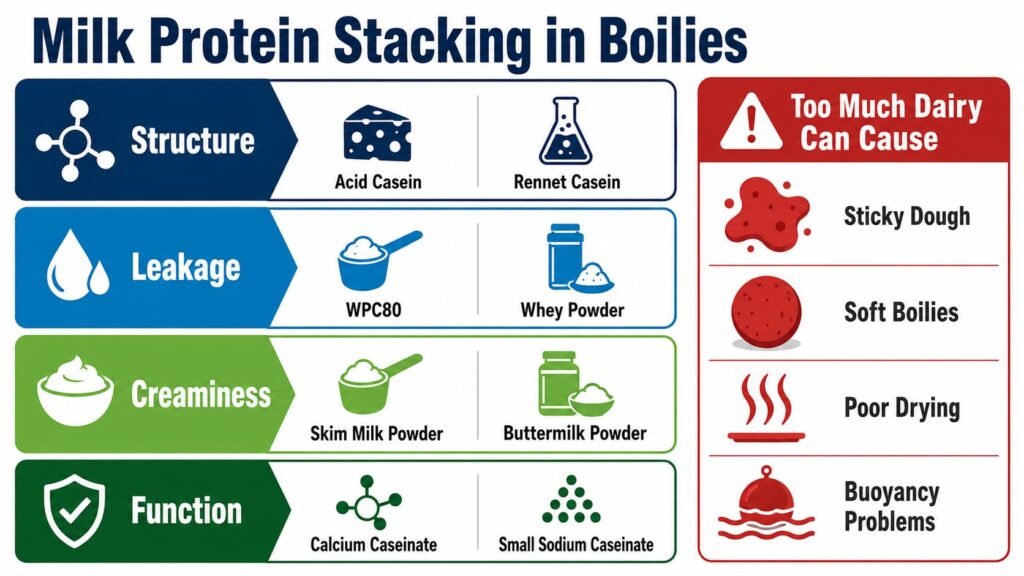
- one ingredient for structure
- one ingredient for leakage
- one ingredient for creamy dairy support
- one optional ingredient for function
A simple practical stack is:
acid casein + WPC80 + skim milk powder
That gives structure, soluble dairy activity and creamy food value without making the bait too complicated.
A more advanced stack might add calcium caseinate for controlled function or a small amount of sodium caseinate for activity and lift.
The mistake is using acid casein, rennet casein, sodium caseinate, calcium caseinate, WPC80, whey powder, skim milk powder, cream powder, buttermilk powder and milk replacer all in the same bait without a clear purpose.
The best milk-protein boilies are balanced, not overloaded.
Milk Protein Stacking Table
| Stack Layer | Main Job | Best Ingredients | Watch Out For |
|---|---|---|---|
| Structure | Gives firmness, body and water life | Acid casein, rennet casein, egg albumen | Too much can make bait dense or closed |
| Leakage | Helps bait release soluble food signal | WPC80, sweet whey powder, WPH, skim milk powder | Too much can make bait sticky or soft |
| Creaminess | Adds dairy background, smoothness and attraction | Skim milk powder, buttermilk powder, cream powder | Too much can soften bait or add excess fat |
| Function | Adjusts buoyancy, texture and controlled activity | Calcium caseinate, sodium caseinate | Can change sink rate, softness and water life |
| Budget support | Adds practical dairy value without high cost | Skim milk powder, milk replacer, sweet whey powder | Product quality varies and must be tested |
This is the key idea:
Do not stack milk proteins by name.
Stack them by job.
Why Stacking Works
Stacking works because milk ingredients do different things.
A single milk ingredient rarely solves every bait problem.
Acid casein can give structure, but it does not create fast leakage by itself.
WPC80 can add soluble dairy activity, but too much can make bait sticky.
Skim milk powder adds creamy dairy support, but it does not replace casein.
Sodium caseinate can increase activity and lift, but it can make the bait behave unpredictably.
Calcium caseinate can be more controlled, but it still changes the bait.
Rennet casein can toughen a bait, but too much can make it closed and slow.
A good milk bait uses these ingredients in a sensible order.
The aim is to build a bait that:
- rolls cleanly
- boils properly
- dries properly
- leaks attraction
- stays on the rig
- has food value
- fits the season
- remains practical to make again
That is why stacking is useful.
It gives you control.
But only if each ingredient has a purpose.
The Four-Part Milk Protein Stack
The easiest way to build a milk-protein bait is to think in four parts.
1. Structure
The structure layer gives the bait its body.
This is where hard casein ingredients are useful.
Good structure ingredients include:
- acid casein
- rennet casein
- egg albumen
- semolina
- maize meal
- birdfood
- wheatgerm
- cereal binders
In a milk-protein bait, acid casein is usually the most practical structural milk ingredient.
Rennet casein is useful when you need extra toughness, especially in hookbaits, summer baits or nuisance fish situations.
But too much hard casein can make a bait dense and slow.
Structure is important, but structure alone does not catch carp.
The bait still has to leak, soften and be eaten.
2. Leakage
The leakage layer helps the bait work in the water.
This is where WPC80, whey powder and soluble dairy ingredients are useful.
Good leakage ingredients include:
- WPC80
- sweet whey powder
- WPH
- skim milk powder
- buttermilk powder
- sodium caseinate
- yeast products
- soluble liquids
WPC80 is the most practical whey-protein ingredient for most Michigan bait makers.
It can help a bait release soluble dairy protein and become active without relying on heavy oils.
But leakage must be controlled.
Too much WPC80 or whey powder can create sticky dough, soft boilies and poor drying.
For more on whey ingredients, read Whey Powders in Boilie Mixes.
3. Creaminess
The creaminess layer gives the bait a smooth dairy profile.
Good creaminess ingredients include:
- skim milk powder
- buttermilk powder
- cream powder
- whole milk powder
- coconut milk powder
- milk replacer
These ingredients are useful because they help the bait feel like a real milk bait rather than just a technical protein bait.
They work well with:
- maple
- vanilla
- butter
- peach
- plum
- banana
- almond
- tiger nut
- peanut
- coconut
- cereal
- birdfood
Skim milk powder is the best starting point.
Buttermilk powder adds a slightly tangy dairy note.
Cream powder adds richness, but it should be used carefully because it may add fat and softness.
For more on these ingredients, read Milk Powders in Boilie Making.
4. Function
The function layer changes how the bait behaves.
This is where caseinates become useful.
Good functional milk ingredients include:
- calcium caseinate
- sodium caseinate
- whey gel
- egg albumen
- cork dust when buoyancy is needed
Calcium caseinate is generally more controlled.
Sodium caseinate is more active and can affect lift.
This makes sodium caseinate useful in wafters, pop-ups and active milk baits, but it can cause problems in bottom baits if used without testing.
A small amount can help.
Too much can change the bait completely.
This is why every caseinate bait should be tested in water with the actual hook and rig.
For caseinate details, read Milk Caseins for Boilie Making.
Simple Stacking Rule
A practical rule is:
acid casein builds the bait, WPC80 wakes it up, skim milk powder smooths it out, calcium caseinate controls it, sodium caseinate activates it, and rennet casein toughens it.
That one sentence explains most milk-protein stacking.
If you remember that, your bait making becomes easier.
You stop asking:
“How many milk ingredients can I add?”
And start asking:
“What job does this ingredient do?”
That is the difference between good stacking and overloading.
How Much Milk Protein Is Too Much?
There is no single perfect number, but total dairy level matters.
A bait with 5% WPC80 is easy to control.
A bait with 5% WPC80, 10% skim milk powder, 8% acid casein, 5% calcium caseinate, 5% buttermilk powder and 4% cream powder is a very different bait.
The problem is not one ingredient.
The problem is the total dairy load.
A sensible guide:
| Total Dairy Level | Use Case | Notes |
|---|---|---|
| 5–10% | Light dairy support | Easy to control, good for simple bait |
| 10–20% | Practical milk bait | Good working range for most homemade boilies |
| 20–30% | Strong milk-protein bait | Needs better structure and testing |
| 30–40% | Advanced milk bait | Can work, but dough and drying problems become more likely |
| 40%+ | Specialist bait | Usually hookbait or advanced formula territory |
For most Michigan carp anglers, the best working area is usually 15–30% total dairy ingredients.
That is enough to create a clear milk bait without making the mix too difficult.
Higher levels can work, but only if the recipe is built properly.
Beginner Milk Protein Stack
A beginner stack should be simple.
Use:
- skim milk powder
- WPC80
- acid casein
Example section:
| Ingredient | Level |
|---|---|
| Skim milk powder | 8–12% |
| WPC80 | 4–6% |
| Acid casein | 5–8% |
This gives a total dairy section of roughly 17–26%.
That is enough to create a real milk bait without becoming too technical.
Why it works:
skim milk powder gives creamy dairy background.
WPC80 gives soluble leakage.
acid casein gives structure.
This is the basic stack I would recommend before adding caseinates, micellar casein, WPH or specialist ingredients.
Practical All-Round Milk Stack
For a more complete all-round bait, add calcium caseinate.
Example section:
| Ingredient | Level |
|---|---|
| Acid casein | 6–8% |
| WPC80 | 4–6% |
| Skim milk powder | 8–10% |
| Calcium caseinate | 3–5% |
This gives structure, leakage, creaminess and controlled function.
It is more advanced than the beginner stack, but still practical.
This style of stack fits:
- milk and nut baits
- cereal baits
- birdfood baits
- maple baits
- vanilla baits
- peach or plum baits
- spring to fall fishing
- public-water Michigan carp
It is a strong everyday milk-protein direction.
Active Cold-Water Stack
Cold water often needs a bait that leaks without being heavy.
Example section:
| Ingredient | Level |
|---|---|
| Acid casein | 5–6% |
| WPC80 | 6–7% |
| Skim milk powder | 8–10% |
| Sodium caseinate | 2–3% |
| Buttermilk powder | 2–4% |
Why it works:
WPC80 helps the bait wake up.
sodium caseinate adds activity and lift at low level.
skim milk powder and buttermilk powder keep the bait creamy and attractive.
acid casein stops the bait becoming too soft.
Use this style carefully. It should be active, not unstable.
If the bait becomes sticky or too buoyant, reduce sodium caseinate and WPC80 slightly.
For cold-water bait guidance, read Best Liquids for Carp Fishing in Cold Water.
Durable Summer Stack
Summer bait often needs more water life.
Warm water can mean more nuisance fish, turtles, gobies, panfish, crayfish and bait interference.
Example section:
| Ingredient | Level |
|---|---|
| Acid casein | 7–10% |
| Rennet casein | 3–6% |
| Calcium caseinate | 3–5% |
| WPC80 | 3–5% |
| Skim milk powder | 5–8% |
Why it works:
acid casein gives structure.
rennet casein adds toughness.
calcium caseinate gives controlled milk-protein function.
WPC80 keeps some leakage in the bait.
skim milk powder keeps the creamy dairy signal.
This is not as fast as the cold-water stack, but it is more durable.
That is often what summer requires.
Fall Food-Value Stack
Fall is a good time for steady food-value bait.
The bait should not be too fast or too soft, but it should still offer attraction and nutrition.
Example section:
| Ingredient | Level |
|---|---|
| Acid casein | 6–9% |
| Calcium caseinate | 4–6% |
| WPC80 | 4–6% |
| Skim milk powder | 8–12% |
| Optional micellar casein | 3–5% |
Why it works:
acid casein gives structure and food value.
calcium caseinate adds controlled function.
WPC80 keeps soluble activity.
skim milk powder gives creamy food signal.
micellar casein, if used, adds a slower milk-protein angle, but it is optional.
This stack works well in longer sessions and pre-winter feeding periods.
Do not add micellar casein just to sound advanced. Use it only if it solves a real bait goal.
Hookbait Stack
Hookbaits need more control than free baits.
A hookbait must stay on the hair, resist nuisance fish and keep fishing.
Example section:
| Ingredient | Level |
|---|---|
| Acid casein | 8–10% |
| Rennet casein | 4–8% |
| Calcium caseinate | 4–6% |
| WPC80 | 2–4% |
| Egg albumen | 3–6% |
Why it works:
acid casein gives structure.
rennet casein gives toughness.
calcium caseinate gives controlled function.
WPC80 adds enough leakage without making the hookbait weak.
egg albumen helps firmness.
For wafters, a small amount of sodium caseinate may help, but test carefully.
Hookbaits should not be judged from the recipe alone. They must be tested in water with the actual rig.
Wafter Stack
Wafters are where milk protein stacking can get tricky.
A wafter needs balance.
Too heavy and it behaves like a bottom bait.
Too light and it behaves like a pop-up.
Example section:
| Ingredient | Level |
|---|---|
| Calcium caseinate | 4–6% |
| Sodium caseinate | 2–3% |
| Acid casein | 4–6% |
| WPC80 | 3–5% |
| Skim milk powder | 5–8% |
This section is only a starting point.
Buoyancy will also depend on:
- cork dust
- base mix density
- egg level
- drying time
- bait size
- hook size
- glugging
- storage
- added liquids
Always test wafters after drying and again after glugging.
Sodium caseinate can help, but it can also push the bait too far.
What Not to Stack
Some combinations create more problems than benefits.
Be careful stacking too many of these together:
- high WPC80
- high sweet whey powder
- high sodium caseinate
- high skim milk powder
- high cream powder
- high syrup or liquid food
- high milk replacer
That kind of stack can become sticky, soft and unstable.
Also be careful stacking too many hard ingredients:
- high acid casein
- high rennet casein
- high egg albumen
- high semolina
- over-boiling
- over-drying
That kind of bait can become hard, dense and poor at leaking.
The goal is balance between open and closed.
Too open and the bait collapses.
Too closed and the bait does nothing.
Milk Protein Stacking for Michigan Waters
Michigan carp fishing often involves wild public-water fish.
Many of these carp are not conditioned to boilies in the same way as carp on heavily baited European fisheries. That makes practical bait acceptance important.
A milk, nut, cereal or birdfood bait can be a very good choice because it fits naturally with:
- corn
- tiger nuts
- hemp
- birdseed
- oats
- peanuts
- method mix
- packbait
- chopped boilies
- sweet creamy liquids
Milk protein stacking helps you turn that bait direction into a proper boilie system.
For Michigan waters, I would usually avoid over-technical bait unless there is a clear reason.
A practical stack should be repeatable.
It should use ingredients you can buy again.
It should not rely on rare specialist items.
It should work with your baiting style.
It should be easy enough to adjust by season.
For the broader Michigan bait argument, read Fishmeal Boilies vs Milk Baits for Michigan Carp.
Common Milk Protein Stacking Mistakes
Mistake 1: Adding Every Dairy Ingredient
More ingredients does not always mean better bait.
A bait with ten dairy ingredients may be less effective than a bait with three well-chosen ones.
Mistake 2: No Structural Backbone
If the bait has WPC80, whey powder, skim milk powder, sodium caseinate and liquids, but no structure, it may go soft or sticky.
Use acid casein, birdfood, cereals, egg albumen or other structure.
Mistake 3: Too Much Hard Casein
Hard casein is useful, but too much can make bait dense and closed.
A bait needs food value and leakage.
Mistake 4: Overusing Sodium Caseinate
Sodium caseinate can help with activity and lift, but it can also make baits soft or unexpectedly buoyant.
Use low levels and test.
Mistake 5: Treating WPC80 Like Filler
WPC80 is not just filler.
It is active and soluble. Too much can change the dough.
Mistake 6: Ignoring the Total Dairy Level
A recipe may look fine ingredient by ingredient, but the total dairy section may be too high.
Look at the whole stack.
Mistake 7: Not Testing the Finished Bait
Milk-protein baits need water testing.
Test sinking, leakage, softening, water life and hookbait balance.
For testing guidance, read How to Test Boilies Before Fishing.
If the Stack Goes Wrong
Milk protein stacking problems usually show up quickly.
Sticky dough means the bait is too soluble, too wet or lacking structure.
Soft boilies mean the dairy stack is too open or under-finished.
Cracking means the bait may be too dry, too hard or poorly bound.
Unexpected buoyancy often means caseinate, trapped air or drying has changed the bait.
Poor leakage means the stack may be too hard or closed.
The answer is not to abandon milk proteins.
The answer is to adjust the stack.
For a full troubleshooting guide, read Fixing Milk-Protein Boilie Dough Problems.
Practical Stacking Formula
When building a milk-protein bait, use this order:
Step 1: Choose the Bait Job
Ask what the bait must do.
Is it for spring?
Summer?
Fall?
Hookbait?
Free bait?
Wafter?
Short session?
Long campaign?
Step 2: Choose the Structure Ingredient
Usually start with acid casein.
Add rennet casein only if you need toughness.
Step 3: Choose the Leakage Ingredient
Usually WPC80.
Use sweet whey powder for budget support.
Use WPH only if you know why.
Step 4: Choose the Creaminess Ingredient
Usually skim milk powder.
Add buttermilk or cream powder if the flavor profile needs it.
Step 5: Choose the Function Ingredient
Calcium caseinate for controlled function.
Sodium caseinate for activity and lift.
Use sparingly.
Step 6: Check the Total Dairy Level
Do not let the dairy stack take over the whole mix unless you have designed for it.
Step 7: Balance the Base
Use cereals, birdfood, nut meals, wheatgerm, semolina and binders to keep the bait practical.
Step 8: Test the Finished Bait
Do not trust the recipe until the finished bait works in water.
Simple Working Milk Protein Stack
If you want one simple starting point, use this:
| Ingredient | Level |
|---|---|
| Acid casein | 6% |
| WPC80 | 5% |
| Skim milk powder | 10% |
| Calcium caseinate | 4% |
That gives a 25% dairy stack.
It is strong enough to be a real milk-protein bait but still practical.
Build the rest of the bait around:
- semolina
- maize meal
- birdfood
- wheatgerm
- nut meal
- yeast
- egg
- suitable liquids
This is the kind of milk stack that makes sense for Michigan carp fishing because it is practical, repeatable and not overcomplicated.
FAQ
What is milk protein stacking in boilies?
Milk protein stacking means combining different dairy ingredients such as casein, WPC80, milk powder and caseinates because each one does a different job in the bait.
What is the best simple milk protein stack?
A simple and practical stack is acid casein, WPC80 and skim milk powder. This gives structure, leakage and creamy dairy support.
Can you use too much milk protein in boilies?
Yes. Too much dairy can make boilies sticky, soft, expensive, dense, too buoyant or hard to dry.
Is WPC80 better than skim milk powder?
They do different jobs. WPC80 adds soluble whey protein and leakage. Skim milk powder adds creamy dairy support and mild sweetness.
Should I use sodium or calcium caseinate?
Use calcium caseinate when you want more controlled function. Use sodium caseinate when you want more activity or lift, but test carefully.
How much total dairy should be in a milk boilie?
For most practical homemade boilies, 15–30% total dairy ingredients is a good working area. Higher levels can work, but they need more testing.
What is the best milk protein stack for cold water?
Acid casein, WPC80, skim milk powder and a small amount of sodium caseinate can work well because it gives structure and active leakage.
What is the best milk protein stack for summer?
Acid casein, rennet casein, calcium caseinate and moderate WPC80 can work well because it gives more toughness and water life.
Should hookbaits use the same stack as free baits?
Not always. Hookbaits usually need more toughness, structure and water life. Free baits can be more open and active.
Do milk protein boilies work for Michigan carp?
Yes. Milk, nut, cereal and birdfood-style boilies can be very logical for wild Michigan carp, especially when fished with corn, tiger nuts, hemp, oats, birdseed and other particle-friendly baiting.
Final Takeaway
Milk protein stacking is useful, but only when each ingredient has a job.
Use acid casein for structure.
Use rennet casein for toughness.
Use WPC80 for leakage.
Use skim milk powder for creamy support.
Use calcium caseinate for controlled function.
Use sodium caseinate for activity and lift, but carefully.
Do not add every milk ingredient just because it sounds good.
A good milk-protein boilie is not built from the longest ingredient list.
It is built from balance.
For most Michigan carp anglers, a sensible milk stack is better than a complicated one.
Start with acid casein + WPC80 + skim milk powder.
Add calcium caseinate when you want more control.
Add rennet casein when you need toughness.
Add sodium caseinate only when you need activity or lift.
Then test the bait in water.
That is how you use milk proteins properly without overdoing it.
For the main milk-protein article, read Milk Proteins in Carp Bait.
For casein details, read Milk Caseins for Boilie Making.
For whey details, read Whey Powders in Boilie Mixes.
For milk powder choices, read Milk Powders in Boilie Making.
For milk-protein troubleshooting, read Fixing Milk-Protein Boilie Dough Problems.
For broader bait direction, read Milk Proteins vs Fishmeal in Carp Bait and Fishmeal Boilies vs Milk Baits for Michigan Carp.
For all bait and boilie guides organized by topic, visit the Michigan Carp Guide Library.