

Essential oils in carp bait can be useful, but their most defensible role is smaller than much of the old bait folklore suggests. A drop or two can change flavour identity, add a spicy or herbal edge and help an angler build a repeatable bait. That does not make the oil a proven long-range attractant.
The practical problem is concentration. Essential oils are not ordinary liquid flavours. They are concentrated volatile fractions of plants, and products sold under similar names may contain different dominant compounds. Black-pepper essential oil is not a dose of piperine. Garlic oil is not the same material as garlic powder or freshly crushed garlic. Cinnamon bark and cinnamon leaf oils are chemically different. Aniseed and star-anise oils may share a dominant aroma but are not automatically interchangeable.
This guide explains what essential oils can realistically contribute, how common oils differ, how to measure fractional-drop doses, how heat and the boilie matrix affect them, and how to test one without rebuilding an otherwise successful bait.
Treat an essential oil as concentrated seasoning and a test variable—not as the food signal, the preservative system or the reason carp must eat the bait.
Table of Contents
Quick Answer: Do Essential Oils Work in Carp Bait?
| Claim | Practical verdict | Why |
|---|---|---|
| They create a strong smell in air | Yes | They contain volatile aromatic compounds that readily reach the human nose. |
| They automatically create a strong dissolved trail underwater | No | Most components have limited water solubility and partition differently from amino acids, organic acids and other soluble food compounds. |
| They can give a bait a consistent flavour identity | Yes | A very small measured amount can change the complete sensory profile. |
| They are proven long-range carp attractants | Not established | Common-carp feeding research does not show that pure essential oils reliably draw wild carp from distance. |
| They can have biological effects after repeated ingestion | Yes, for some oils and doses | Controlled aquaculture trials report digestive, immune, antioxidant or microbial effects after weeks of feeding. |
| They can make a weak bait nutritionally complete | No | They do not replace protein quality, digestibility, soluble food material, texture or appropriate energy. |
| More is better | No | Concentration can move quickly from distinctive to harsh, medicinal or potentially harmful. |
| They can preserve shelf-life boilies by themselves | No | Laboratory antimicrobial activity does not validate a finished bait’s shelf life. |
The balanced answer is therefore yes, essential oils can work as controlled flavour and formulation tools. The evidence is much weaker for the claim that they function as primary carp attractants. Use them to refine a bait that already makes sense—not to rescue one that does not.
What Essential Oils in Carp Bait Are—and Are Not
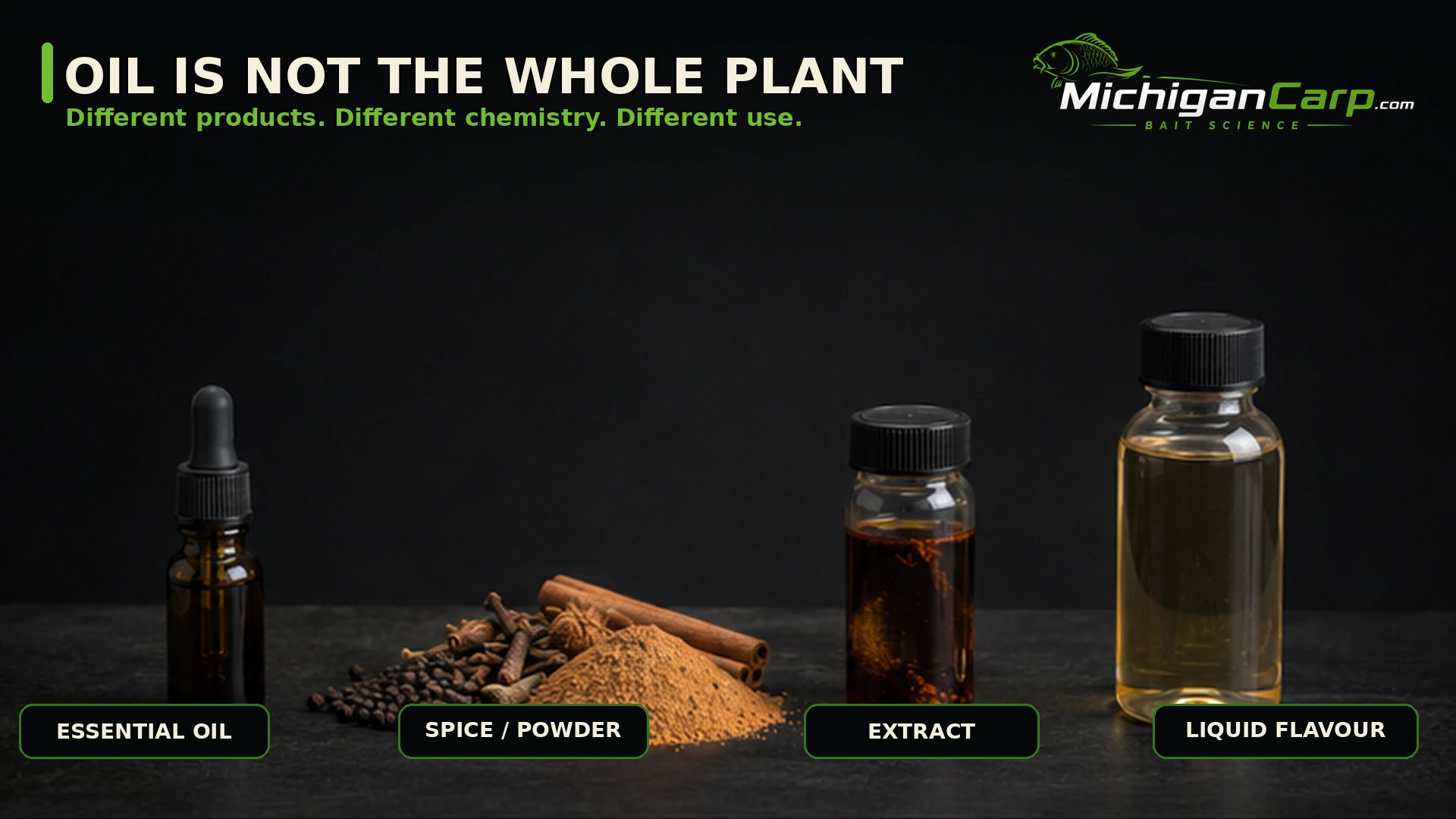
An essential oil is the concentrated volatile fraction collected from plant material, commonly by steam distillation or expression. It may contain dozens of compounds, but it does not contain every useful chemical found in the whole seed, leaf, bulb, bark or fruit.
| Product | What it contains | What that means in bait |
|---|---|---|
| Essential oil | Concentrated volatile compounds | Very potent aroma; tiny dose; limited representation of the whole plant. |
| Whole spice or powder | Volatiles plus fibre, starch, protein, minerals and non-volatile compounds | Easier to distribute by weight; contributes solids and behaves differently in the matrix. |
| Oleoresin or solvent extract | Volatile and non-volatile extracted material, depending on process | May carry pungent compounds absent from distilled oil; use the supplier’s declared concentration. |
| Commercial liquid flavour | A formulated blend in a carrier, which may include natural and synthetic flavour compounds | Usually easier to dose and distribute, but it is not necessarily an essential oil. |
| Hydrosol | The water phase left from distillation with small amounts of water-compatible aromatic material | Far weaker and chemically different from the essential oil. |
This is why names alone are unreliable. The volatile profile of black pepper fruit is dominated by compounds such as beta-caryophyllene, limonene and pinenes. Piperine—the pungent alkaloid associated with ground pepper—is largely non-volatile and is not the defining component of steam-distilled black-pepper essential oil.
Garlic creates a similar trap. Crushing fresh garlic forms unstable allicin through an enzyme reaction. Distilled garlic oils are instead dominated by allyl sulphides; the chemical analysis of garlic volatile oils found large differences with plant source and distillation method. Garlic powder, fresh garlic, garlic extract and garlic essential oil therefore should not be treated as four strengths of the same ingredient.
Cinnamon bark oil is commonly rich in cinnamaldehyde, while cinnamon leaf oil is usually much more eugenol-led. Aniseed and star-anise oils are often rich in trans-anethole, but the plants, secondary compounds and batches differ. Read the botanical name, plant part and product specification rather than relying on the word on the front label.
Why a Strong Smell in Air Is Not the Same Signal in Water
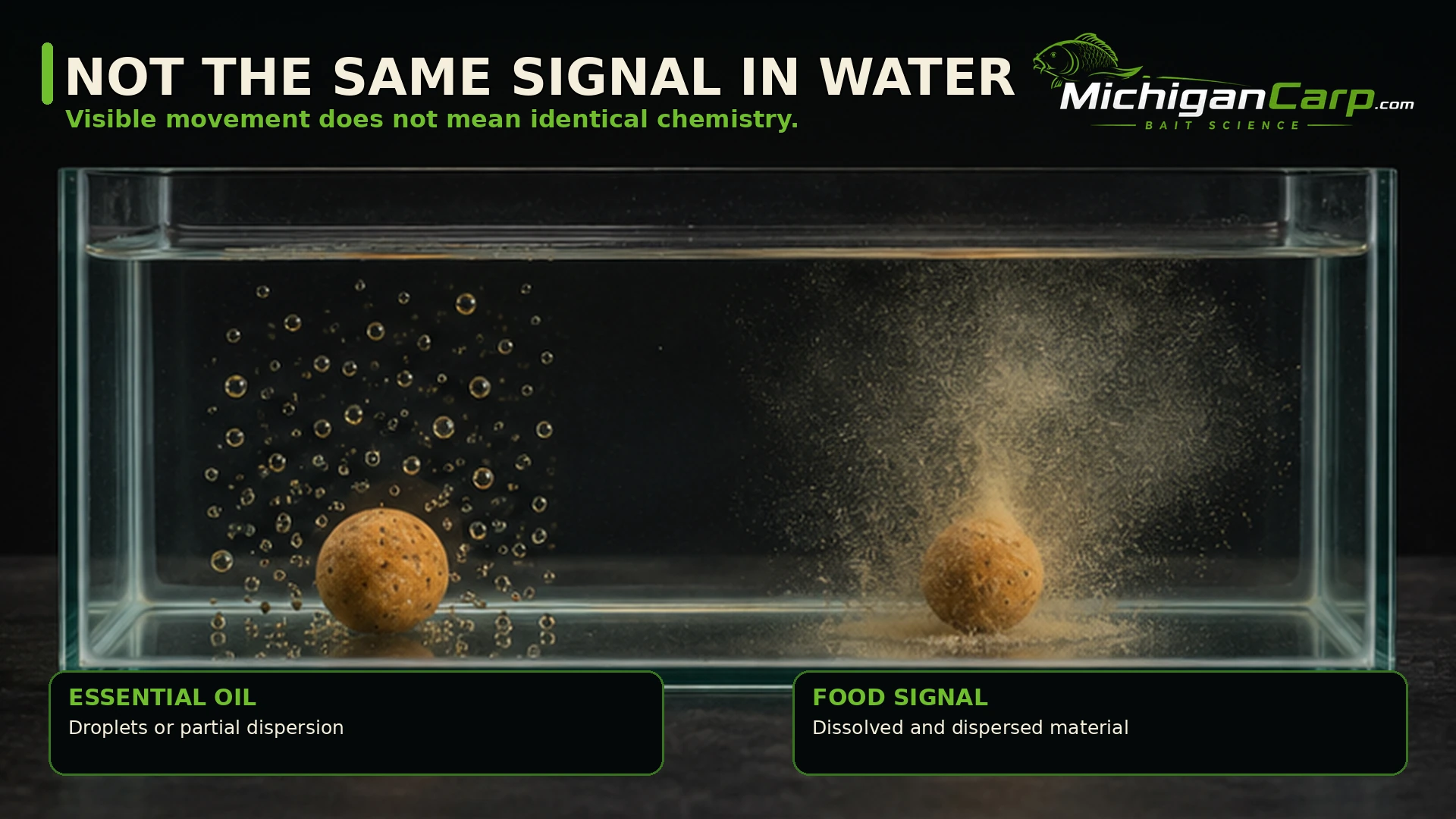
Essential oils smell powerful because volatile molecules move readily from the bottle into air. Underwater, those same molecules must leave the bait matrix, contact the water and either dissolve, remain as fine droplets or travel on particles. Each path behaves differently.
It is too simple to say essential oils do not move through water. Some components have measurable water solubility, and physical dispersion can spread small droplets. The correct point is that they do not behave like fully water-soluble food compounds. Their release depends on:
- the chemistry of the individual oil;
- the amount of fat and emulsifier in the bait;
- whether the oil is trapped in a dense, heavily cooked matrix;
- surface area, pores, cracks and water entry;
- water temperature, movement and contact time;
- whether the bait releases particles as well as dissolved material.
Lecithin can help distribute oil through the wet mix and stabilize small droplets, but it does not turn every essential-oil compound into a truly water-soluble molecule. A neutral oil carrier will dissolve the essential oil but may keep it associated with the fat phase. Propylene glycol mixes well with many flavour compounds, but not every essential oil remains completely dissolved in it. Watch the actual blend rather than assuming the carrier has solved the problem.
For a dependable water-active food signal, build the bait around genuinely soluble or dispersible materials. The functions of free amino acids are covered in Amino Acids in Carp Bait; peptide-rich liquids belong in How to Use Hydrolysates in Carp Bait. Essential oil can sit behind that system as flavour identity.
What Common-Carp Research Actually Shows
There is credible research on essential oils in carp diets, but most of it asks aquaculture questions: does repeated dietary inclusion affect growth, digestive enzymes, gut microbes, antioxidant status, immune markers or resistance to a disease challenge? That is not the same experiment as asking whether a wild carp will locate and choose one hookbait.
In one 12-week common-carp feeding trial, diets containing 0.2% aniseed, thyme or basil essential oil did not significantly change growth, although several biochemical and health measures changed. A 60-day common-carp thyme-oil trial used 0.5%, 1% and 2% dietary inclusion and reported changes in growth, digestive enzymes, immunity and disease resistance. A separate koi-carp oregano-oil study tested 500, 1,500 and 4,500 mg per kg of feed and reported effects on immune measures, digestive enzymes and intestinal microbiota.
Those trials show that selected oils can be biologically active after sustained ingestion. They do not establish an optimum boilie flavour dose, prove a long-range olfactory effect or show that a carp prefers an oil-treated bait. Aquaculture fish repeatedly eating a controlled ration for 60 to 84 days are experiencing something very different from a wild fish encountering one hookbait.
Concentration also changes the job. Clove oil, rich in eugenol, has been tested as an anaesthetic for common carp at measured water concentrations. That does not mean a microdosed clove bait will anaesthetize a fish, but the common-carp clove-oil study is a useful reminder that “natural” and “strong-smelling” do not mean biologically trivial.
Field evidence is more complicated because carp learn and conditions change. A 79-day field study of wild common carp found that catches on different flavoured boilies changed through the summer and appeared to track the wider baiting context. It supports the importance of chemoreception and learned food context, but it does not isolate essential oils or prove that one aroma is universally attractive.
The responsible conclusion is narrow: essential oils can alter bait identity and can have dietary effects at some sustained inclusion levels. Direct essential-oil attraction in wild carp remains poorly established.
Practical Guide to Common Essential Oils
| Oil | Important identity point | Sensible bait role | Main caution |
|---|---|---|---|
| Black pepper | Volatile terpenes; not a meaningful source of piperine | Dry, warm, spicy edge behind creamy, nutty, maple or fruit flavours | Easy to confuse aroma with the pungency of ground pepper |
| Aniseed or star anise | Often trans-anethole-led, but from different plants | Strong traditional liquorice-like identity | Dominates quickly; long angling history is not controlled proof |
| Garlic | Distilled allyl sulphides; not the same as allicin-rich fresh garlic or garlic powder | Very strong savoury-sulphur accent | Hard to dose evenly; powder is often easier to control |
| Peppermint | Menthol- and menthone-type profile, depending on source | Sharp, cool top note in a small test | Can turn medicinal and harsh very quickly |
| Sweet orange or citrus | Limonene-rich volatile oil from peel | Light top note behind cream, nut or fruit systems | Oxidizes with air, light and age; not a water-soluble fruit signal |
| Clove | Eugenol-rich and biologically potent | Specialist trace accent only | Not a routine starting oil; excessive concentration is inappropriate |
| Cinnamon bark | Usually cinnamaldehyde-led | Specialist warm-spice trace | Different from leaf oil and easily becomes aggressive |
| Cinnamon leaf | Usually more eugenol-led than bark oil | Specialist clove-like spice trace | Do not substitute one-for-one for bark oil |
| Oregano or thyme | Often rich in carvacrol and/or thymol, depending on chemotype | Experimental functional-feed ingredient, not a default attractor | Aquaculture health data do not establish a hookbait dose or preference |
Black Pepper Essential Oil
Black pepper is one of the more useful oils for a restrained test because it can add a dry spicy edge without turning the whole bait into a conventional sweet flavour. It fits behind maple, vanilla, butter, cream, nut and some fruit profiles.
My own approach has been to treat it as a one-variable experiment, not an established edge: one drop in a 500 g test batch, with an otherwise identical control. That level is a controlled starting point, not a claim that black pepper has produced better catches or that every supplier’s oil has the same strength.
Aniseed and Star Anise
Anise-type oils have one of the longest traditions in coarse-fishing bait. They create an unmistakable identity at very low inclusion. That tradition is useful practical history, but it should not be converted into a claim that trans-anethole is a proven long-range carp attractant.
Buy by botanical name and specification. Pimpinella anisum is aniseed; Illicium verum is star anise. Both may be anethole-rich, but the complete profiles are not identical. Do not replace a known dose with an unknown bottle purely because both smell of liquorice.
Garlic Oil, Powder and Extract
Garlic is better treated as a family of ingredients than one flavour. Powder is easy to weigh and distributes through the dry mix. Fresh crushed garlic changes chemically after crushing and brings water and solids. Oil is a concentrated volatile sulphur fraction. Extracts vary with the manufacturing process.
If the job is a broad garlic-food profile, powder is often the more controllable first choice. Use pure garlic essential oil only when the concentrated sulphur note itself is the intended test variable.
Clove, Cinnamon, Oregano and Thyme
These are not sensible beginner oils to free-pour into bait. Their dominant phenolic or aldehydic compounds are potent, product chemistry varies and several are researched precisely because they have strong biological activity. If there is no defined reason to test one, leaving it out is a valid formulation decision.
Conservative Starting Levels for Boilie Tests
There is no scientifically validated universal essential-oil dose for angling boilies. The following are deliberately low MichiganCarp bench-test starting levels for a single experimental batch. They are not optimums, proven attraction rates, safe upper limits or substitutes for the supplier’s declared food-use rate.
| Oil group | 500 g dry-mix first test | Approximate 1 kg equivalent | Testing rule |
|---|---|---|---|
| Black pepper | 1 drop | 2 drops | Compare with the identical base and flavour system without the oil. |
| Aniseed, star anise or sweet orange | 1 drop | 2 drops | Use one oil only; do not combine them in the first test. |
| Peppermint | 0.5-drop equivalent from a dilution | 1-drop equivalent | Reject the increase if the finished bait becomes medicinal. |
| Garlic essential oil | 0.25–0.5-drop equivalent from a dilution | 0.5–1-drop equivalent | Consider weighed garlic powder instead when a broader garlic profile is wanted. |
| Clove, cinnamon bark, cinnamon leaf, oregano or thyme | 0.25-drop equivalent from a dilution, or omit | 0.5-drop equivalent, or omit | Specialist trace test only; do not free-pour or build a first flavour around it. |
A drop is not a scientific unit. Dropper tips and oil viscosity vary, and a normal drop may be roughly 0.03–0.05 ml. Record the bottle, batch, dropper and amount. For repeat work, measure a dilution with a small graduated syringe rather than assuming the next drop is identical.
Do not jump from one drop to five because the cooked bait smells faint. Smell loss may reflect volatility, matrix binding or human adaptation while working with the aroma. It does not prove the bait needs a stronger dose.
How to Measure and Mix Essential Oils Evenly
Use a Dilution for Less Than One Drop
For a very strong oil, make a small 10% test dilution: 1 part essential oil to 9 parts of a compatible food-grade flavour carrier. At that concentration, 0.10 ml of the dilution contains 0.01 ml of essential oil. This makes a fractional-drop experiment measurable.
Compatibility matters. Propylene glycol works with many flavour compounds but may not hold every essential oil completely. A neutral food oil will dissolve an essential oil but keeps it in the oil phase. If the blend separates, do not pretend it is a stable solution—shake immediately before measuring or use a supplier-approved carrier. Make only the small quantity required, label it and keep it away from heat and light.
Distribute It Through the Wet Phase
Never place one concentrated drop directly onto a pile of dry mix. Add it to a small measured part of the liquid phase, stir thoroughly, then blend that into the remaining eggs and liquids. Lecithin can help distribute the oil phase through the paste, but it should be included for a formulation reason rather than added as a claim that the oil has become water-soluble.
Do Not Add Pure Oil Directly to Water
Pure essential oil placed into a water-based glug can float, separate and create concentrated contact spots. Use an appropriately formulated flavour liquid or a stable, tested dispersion. Shake-before-use is not a substitute for safe formulation when a concentrated oil can contact skin, hookbait or fish in an uneven dose.
Boiling, Drying, Storage and Flavour Loss
Essential-oil compounds can be lost or changed by heat, steam, oxygen and storage. The amount retained depends on the compound, the boilie matrix, cooking time, diameter, surface area, drying conditions and packaging. “Essential oils evaporate during boiling” is directionally useful but too absolute; some fraction can remain trapped in the bait while some is lost.
- Mixing: keep the bottle closed until needed and distribute the measured amount promptly.
- Boiling or steaming: cook only as long as needed to set the bait; do not extend heat solely to harden it.
- Drying: expect the surface aroma to soften as volatile compounds leave; do not chase that loss by repeatedly adding neat oil.
- Storage: protect the oil and treated bait from heat, light and unnecessary air exposure.
- Post-cook treatment: if tested, use a measured diluted coating on a separate batch and verify texture, buoyancy, PVA compatibility and storage.
A post-drying coating may preserve more top-note aroma than putting the entire amount through the cooking stage, but it also changes concentration at the bait surface. It can soften or seal the exterior, affect PVA and create a very different experiment. Record it as a separate treatment rather than calling it the same recipe.
The broader interaction between flavour strength, carriers, layering and heat belongs in the protected draft How to Flavor Boilies Properly: Strength, Carriers, Layering and Heat. This page stays focused on the special concentration and evidence problems created by essential oils.
Build Essential Oils Around the Bait—not the Other Way Around
A strong base mix should already have a reason to be eaten. Essential oil belongs behind the ingredients that supply structure, digestible food, texture and water-active material.
Use One Defined Flavour Job
Decide whether the oil is adding a spicy edge, a liquorice identity, a sulphur accent or a light citrus top note. If you cannot describe the job in one sentence, the oil is probably being added because the bottle is available rather than because the bait needs it.
Keep the Soluble System Independent
Do not reduce amino-acid, yeast, hydrolysate or other useful water-active material merely because the finished bait smells strong. The roles of betaine, organic acids and soluble protein-derived material remain separate from aroma.
Cold Water Does Not Create a Special Oil Rule
It is reasonable to favour water-compatible signals in cold water, when the bait may release material more slowly and fish may feed less. That does not prove all essential oils stop working below a particular temperature. Keep the oil in the background and let soluble material, small bait size, crumb, paste and surface area do the more dependable work.
Hookbait and Free Bait Can Have Different Jobs
A slightly stronger hookbait identity may help it remain distinctive among particles or crumb, but stronger should mean a measured difference—not a neat-oil soak. Keep enough connection to the surrounding feed that the hookbait does not become a chemically unrelated object.
A Controlled MichiganCarp Testing Method
The cleanest essential-oil test changes one variable and keeps everything else the same.
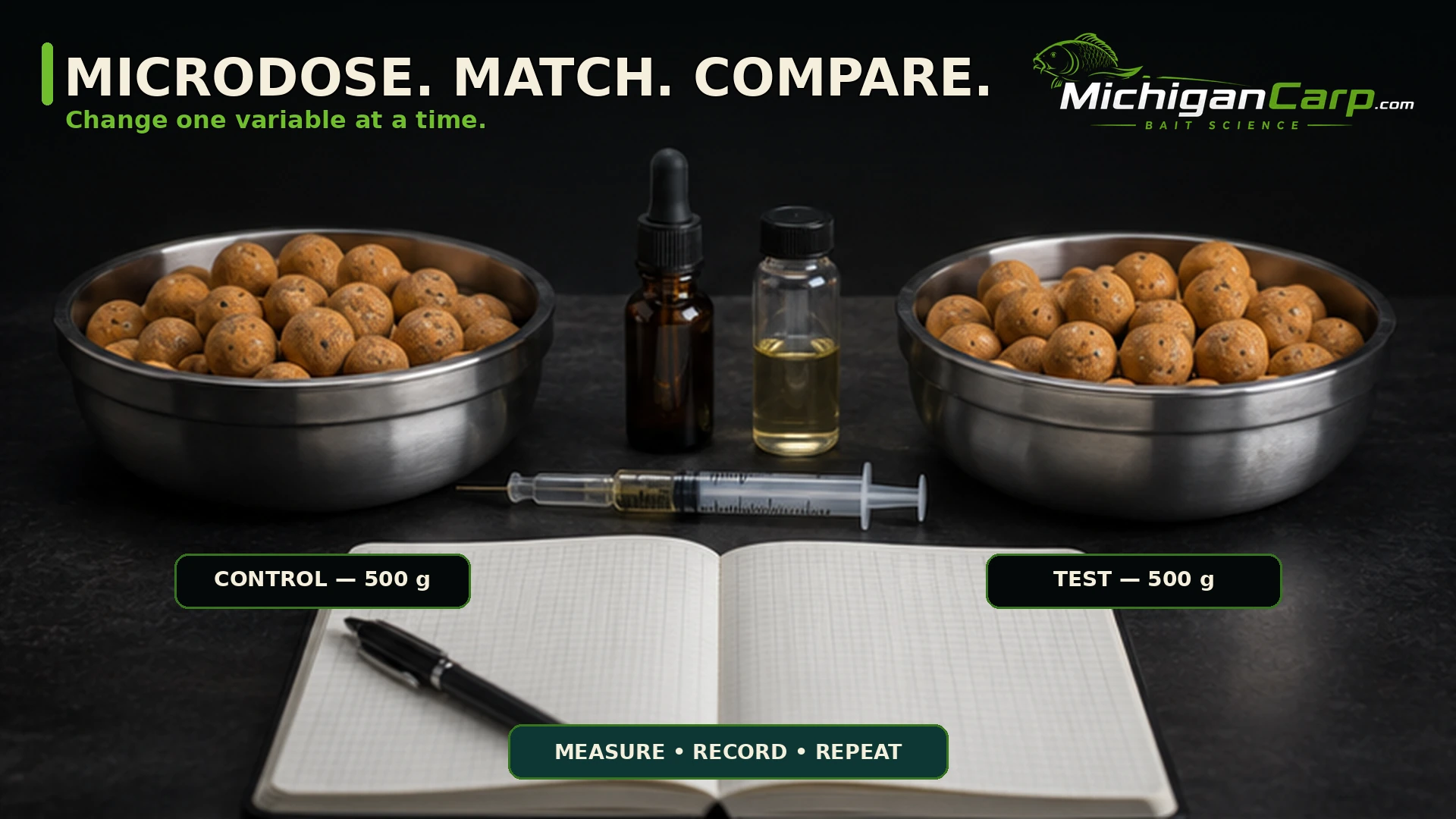
- Make one complete wet mix and divide it accurately before adding the test flavour.
- Keep dry mix, eggs, liquids, colour, rolling size, cooking time and drying time identical.
- Leave batch A unchanged. Add the measured essential-oil treatment only to batch B.
- Label both batches with the oil, supplier, botanical name, dose, date and carrier.
- Compare paste smell, cooked smell, firmness, cracking, water entry, leakage, buoyancy and hook hold.
- Fish matched rods or alternate positions and time periods so the favoured spot is not always paired with the treated bait.
- Record casts, bites, landed fish, nuisance activity, recast condition and session context.
- Repeat before declaring a result. One fish proves the bait can catch a carp; it does not isolate the essential oil as the cause.
For Robert’s milk/nut flavour tests, a clean example is the same maple/vanilla/butter base with and without one drop of black-pepper essential oil in a 500 g batch. Do not compare a black-pepper hookbait against a different recipe, colour, buoyancy and texture and then credit every difference to the oil.
Home water tests show physical behaviour, not attraction. The wider testing principle is built into the MichiganCarp Bait Science system: test bait behaviour at home and fish response at the lake.
Safety, Quality and Preservation Limits
Use only a product clearly identified for food flavouring or ingestion under its stated conditions. “Therapeutic grade,” “aromatherapy grade” and “100% natural” are marketing descriptions, not substitutes for food-use documentation. Avoid diffuser blends, fragrance oils, massage blends and bottles labelled for external use only.
The United States regulation at 21 CFR 182.20 lists many essential oils and natural extractives as generally recognized as safe for their intended use. That phrase matters. It does not mean unlimited use, every product under the same common name, or every use in aquatic bait is automatically appropriate.
- Wear gloves when handling concentrated garlic, clove, cinnamon, oregano, thyme or peppermint oils.
- Avoid eyes, skin, children, pets, flames and food-preparation surfaces.
- Use labelled glassware or syringes dedicated to bait work.
- Store tightly closed, cool and dark; discard oxidized or contaminated material.
- Do not pour leftovers into the lake or use neat oil as a bank-side dip.
Essential oils also are not a validated shelf-life system. Antimicrobial effects observed in a laboratory, aquaculture diet or food coating do not prove that a moist boilie is protected from mold, yeast or pathogenic spoilage. Shelf life still depends on water activity, pH where relevant, preservative chemistry, hygiene, packaging and retained-sample testing.
Common Mistakes
- Assuming the strongest-smelling bait creates the strongest underwater food signal.
- Calling every product with the same plant name chemically equivalent.
- Treating black-pepper essential oil as piperine or garlic oil as allicin-rich fresh garlic.
- Adding one neat drop to dry powder and creating a concentrated hotspot.
- Using a whole-drop dose when the oil requires a fractional-drop test.
- Copying a long-term aquaculture feed percentage into a boilie recipe.
- Increasing the dose to compensate blindly for boiling or drying loss.
- Changing colour, texture, flavour, buoyancy and oil at the same time.
- Claiming that one capture proves the oil caused the bite.
- Using aromatherapy or external-use-only products in bait.
- Treating essential oil as a preservative without water-activity and storage validation.
FAQ
Do essential oils attract carp?
They may contribute to bait identity and learned association, but strong direct attraction has not been established for common carp in the way anglers often claim. Their best-supported scientific effects are mainly dietary effects after repeated ingestion.
What is the best essential oil for carp bait?
There is no proven universal best oil. Black pepper and anise-type oils are reasonable low-dose flavour tests because they have distinct identities and long bait-making histories. Choose by the job in the complete flavour system, not by a claim that one oil is irresistible.
How much black-pepper essential oil should I use in boilies?
A conservative MichiganCarp test is one drop in 500 g of dry mix, compared with an otherwise identical control. That is a trial level, not a scientifically proven optimum or a reason to ignore the supplier’s intended-use guidance.
Is black-pepper essential oil a source of piperine?
Not in the practical sense bait makers often assume. Piperine is a non-volatile alkaloid associated with pepper’s pungency. Distilled black-pepper oil is mainly a mixture of volatile terpenes.
Is garlic oil better than garlic powder?
They are different ingredients. Powder provides broader garlic solids and is easy to weigh; essential oil is a concentrated volatile sulphur fraction. Powder is usually the easier first choice when the goal is a general garlic profile.
Can I add essential oil directly to eggs?
Pre-mix the measured oil or dilution into a small part of the liquid phase first, then blend it through the remaining eggs and liquids. This reduces the risk of a concentrated hotspot.
Do essential oils work in cold water?
There is no useful universal cut-off temperature. Release will depend on the compound and bait matrix. In cold water, keep essential oil restrained and rely on water-compatible food signal, crumb, paste and surface area for the main communication job.
Can essential oils preserve homemade boilies?
Do not rely on them for that job. Antimicrobial activity in another product or laboratory system does not validate the shelf life of a finished boilie.
Should I use essential oils in both free bait and hookbaits?
Start by testing the same low level through a small matched batch. If a stronger hookbait is later tested, keep it connected to the free-bait profile and record the surface treatment as a separate variable.
Next Steps
Use these guides to put essential oils back into the complete bait system:
- Carp Bait Science
- Amino Acids in Carp Bait
- How to Use Hydrolysates in Carp Bait
- Betaine in Carp Bait
- Organic Acids in Carp Bait
The practical rule is simple: build a bait worth eating, give every additive one defined job, and let controlled fishing—not the smell of the bottle—decide whether the essential oil earns a permanent place.