
The best carp bait for beginners is not the most expensive bait.
It is not the strongest-smelling bait, the brightest bait, or the bait with the longest ingredient list.
The best carp bait for beginners is the bait that helps you catch carp while learning the important things properly: location, baiting amount, presentation, timing, and fish behaviour.
That usually means starting simple.
Corn, pellets, small boilies, particles, and tiger nuts can all catch carp. But if you are just getting started, you do not need to carry every bait under the sun. You need a small, reliable bait system that works on real waters and teaches you what is happening.
On Michigan lakes, that matters. Many carp are caught from public access waters, inland lakes, weedy margins, river-connected areas, campgrounds, park lakes, and mixed-use waters. Some fish are lightly pressured. Some are cautious. Some waters have nuisance fish, turtles, birds, and crayfish. Some fish respond quickly to corn. Others need a tougher hookbait or a more controlled approach.
This guide keeps it practical.
It explains the best carp bait for beginners, how to use each bait, when to keep it simple, and when to move on to boilies, particles, tiger nuts, and more selective baiting.
Quick Start
- Start with canned sweet corn because it is simple, cheap, and reliable.
- Add small pellets when you want quick attraction.
- Use small boilies when you need more durability and control.
- Use particles when carp are feeding confidently and you want to hold them.
- Use tiger nuts when corn is being cleared too quickly or you want a tougher hookbait.
- Do not overbait just because the bait is cheap.
- Fish small, tight baited areas while learning.
- Focus on location before bait choice.
- Use simple bait well before making things complicated.
What beginner bait needs to do
Beginner bait should make fishing easier, not harder.
A good beginner carp bait should be easy to buy, easy to prepare, easy to fish, and easy to understand. It should let you focus on finding carp and presenting a bait properly rather than worrying about complicated mixes and expensive bait systems.
The bait should also give clear feedback.
If you fish corn and get liners, bubbling, or bites, you can understand what is happening. If you throw in a bucket of mixed bait with ten ingredients, it becomes much harder to learn what actually worked.
That is why simple bait matters.
Good beginner bait should:
- catch carp reliably
- be affordable
- be easy to use in small amounts
- work as hookbait or loose feed
- avoid unnecessary preparation problems
- help you learn baiting control
- not create a mess on public waters
Michigan Notes: The best beginner bait is usually the bait you can use accurately and confidently. Simple bait in the right place beats complicated bait in the wrong place.
Start with corn
Canned sweet corn is the best starting bait for most beginner carp anglers.
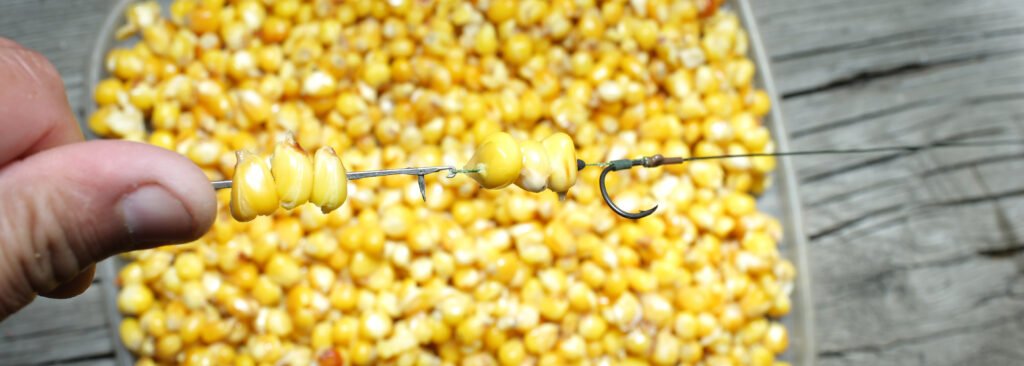
It is easy to buy, ready to use, soft enough for carp to eat, visible on the bottom, and widely accepted. You can fish it on a hair rig, use a few grains around the hookbait, or mix it with pellets or particles later.
Corn is also forgiving. You do not need special preparation. You do not need to soak or boil it. You do not need to understand bait preservation. You can open a can and fish.
Corn works well when:
- you are fishing short sessions
- you are learning a new water
- the water is cold or cool
- carp are used to simple bait
- you want a low-cost option
- you want bait and hookbait to match
The main weakness is that corn is soft and not very selective. Small fish, turtles, birds, and crayfish may all show interest. If corn keeps disappearing, do not just use more. Use less loose feed, try artificial corn, or move to tiger nuts or boilies.
For the full corn guide, read Corn for Carp in Michigan.
Add pellets for attraction
Pellets are the next simple bait to add.
They are useful because they soften, break down, and release attraction around the hookbait. This makes them good for short sessions and small baited areas.
For beginners, pellets are best used in small amounts.
Do not treat pellets as filler. Use them when you want a quick signal near the rig.
Good beginner uses for pellets include:
- small PVA bags
- a pinch around corn
- mixing with a few crushed boilies
- adding attraction to a small baited spot
- supporting a boilie or wafter hookbait
Small pellets are usually more useful than large pellets when you are learning. They break down faster and help create a small feeding signal without needing a lot of bait.
Pellets work best in warm water and when carp are likely to be nearby. In cold water, they should be used lightly.
For more detail, read Pellets for Carp.
Use boilies when you need control
Boilies are useful, but beginners often misunderstand them.
They are not magic bait.
Boilies work because they give you control, durability, and selectivity. They last longer than corn, resist nuisance activity better than soft bait, and allow you to fish a stronger hookbait.
For beginners, small boilies are usually better than large ones. A 10mm, 12mm, or 15mm boilie is often easier for Michigan carp to accept than a large bait, especially on waters where fish are not used to boilies.
Boilies are useful when:
- corn is getting cleared too quickly
- nuisance fish are a problem
- you want a bait that lasts longer
- you are fishing a longer session
- you want to target better carp
- you need a more controlled baiting approach
The beginner mistake is using too many boilies. You do not need to throw in a lot. A single boilie hookbait with a few broken freebies can be enough.
Boilies are strongest in summer and early fall when carp are feeding more confidently. In cold water, use them lightly.
For more guidance, read When to Use Boilies for Carp in Michigan.
Particles are useful, but learn preparation first
Particles can be excellent carp bait, but beginners need to be careful.
Corn, hemp, tiger nuts, maize, maples, chickpeas, and mixed seeds all fall into the particle world. Some are ready to use, like canned corn. Others must be soaked and boiled properly before fishing.
Do not guess with dry particles.
If you are just starting, begin with canned corn. Then learn one particle at a time. Hemp, maize, and tiger nuts all have their place, but they need proper preparation.
Particles work best when carp are feeding confidently and you want to hold them in an area. They are strongest in warm water, summer sessions, weed edges, margins, and natural feeding areas.
Particles are weaker when:
- water is cold
- the session is very short
- nuisance fish are heavy
- you do not know if carp are present
- you are not prepared to make them safely
For the full guide, read Particles for Carp Fishing Guide.
Tiger nuts for beginners
Tiger nuts are not always the first bait a beginner should use, but they are worth learning.
They are tougher than corn, more durable on the hair, and often more selective. They can be very useful when corn is being cleared too quickly.
Tiger nuts are good when:
- nuisance fish are active
- corn is too soft
- you want a tougher hookbait
- carp already recognise them
- you are fishing longer sessions
- you want something more selective than corn
The important point is preparation. Tiger nuts must be prepared correctly. They are not a bait to throw in dry or guess with.
Use them sparingly. A few tiger nuts can be enough. You do not need to pile them in.
Michigan Notes: Tiger nuts have accounted for some very good Michigan carp, but they are best used carefully. Treat them as a serious hookbait option, not bulk filler.
Cheap bait can be very good bait
Beginners often worry that they need expensive bait to catch carp.
You do not.
Cheap bait can be very effective when used properly. Corn, oats, bread, pellets, and properly prepared particles can all catch carp. The important thing is not price. It is placement, amount, and timing.
A small amount of cheap bait in the right place can outfish expensive bait in the wrong place.
Cheap bait becomes a problem only when anglers use too much because it did not cost much.
A beginner with a can of corn, a small bag of pellets, and good location is in a far better position than someone with a bucket full of expensive bait and no idea where the carp are.
For more budget options, read Cheap Carp Baits That Actually Work.
Hookbait and freebait
Beginners should understand this early.
The hookbait is the bait attached to your rig. The freebait is the bait you feed around it.
The freebait should help carp find and accept the hookbait. It should not distract from it.
A common beginner mistake is feeding too much freebait. Carp may feed around the area and never pick up the hookbait. Or they may get full before they make a mistake.
Simple beginner examples:
- corn hookbait with a few grains of corn
- boilie hookbait with two or three broken boilies
- tiger nut hookbait with a few particles
- wafter hookbait with a small pellet bag
The hookbait should be easy for the carp to find and pick up.
How much bait should beginners use?
Less than you think.
Most beginners overbait because baiting feels active and reassuring. It feels like you are doing something useful. Sometimes you are. Often you are just feeding the swim too much.
Start small.
For a short session, you might only need:
- a few grains of corn
- a small PVA bag
- a pinch of pellets
- two or three broken boilies
- a tiny particle trap
In cold water, use even less.
In summer, you can use more if carp are feeding, but still build slowly.
The best rule is simple: start with a small amount and increase only when fish show they are feeding.
For a full bait amount guide, read How Much Bait to Use for Carp.
Beginner bait for cold water
Cold water is where simple bait really matters.
When the water is cold, carp feed less and move less. They are not usually looking for big meals. They may only take one or two easy food items.
The best beginner cold-water baits are:
- corn
- small boilies
- tiny pellet bags
- light crumb
- near-single hookbaits
Avoid heavy particles and big bait beds in cold water. You are fishing for one bite first.
Corn is often the safest starting point.
For more detail, read Best Carp Bait for Cold Water.
Beginner bait for summer
Summer gives beginners more bait options.
Carp feed more, digest better, and may respond to baited areas more confidently. That makes corn, pellets, particles, boilies, and tiger nuts all useful.
A simple summer beginner setup might be:
- corn hookbait
- a small amount of pellets
- a few grains of corn
- optional small boilie or tiger nut if nuisance fish are active
For longer summer sessions, you can add particles or boilies slowly if fish are feeding.
But do not overbait just because it is warm.
Hot, still, low-oxygen water may require less bait, not more.
For summer baiting, read Best Carp Bait for Summer Fishing.
Beginner bait for public waters
Many beginners start on public lakes, and that is fine.
Public waters can be excellent, but they require clean, responsible baiting.
Good beginner bait choices for public waters include:
- corn
- small pellets
- small boilies
- tiger nuts if nuisance fish are active
- very light particles
Avoid messy baiting. Do not throw bread, corn, or particles all over public access areas. Do not feed birds. Do not leave bait or rubbish behind.
Michigan Notes: A quiet, tidy angler using a small amount of corn in the right spot will often catch more than someone making a big mess with a bucket of bait.
Beginner bait for weedy lakes
Weedy lakes can be very good carp waters.
Carp often feed around weed because weed holds natural food. Snails, larvae, insects, and small food items can all be found near vegetation.
Good beginner baits for weedy lakes include:
- corn on clean spots
- tiger nuts for tougher hookbaits
- small boilies
- pellets in small amounts
- light particles near weed edges
Do not throw bait into thick weed where your rig cannot fish properly. Look for clean holes, weed edges, margin shelves, and open patches beside vegetation.
The bait should sit where the carp can find it and where your rig can work.
Beginner bait for pressured carp
Pressured carp need more care.
If a water gets fished regularly, carp may become cautious around obvious baiting and repeated disturbance.
Beginner bait for pressured waters should be simple and controlled.
Use:
- less bait
- smaller baited areas
- natural colours
- subtle hookbaits
- quiet bankside behaviour
- accurate casting
Corn can still work, but use it sparingly. Small boilies, tiger nuts, and wafters can also be useful.
The beginner mistake is trying to force pressured carp with more bait. Often, less bait is better.
Simple beginner bait kit
A good beginner bait kit does not need much.
Start with:
- canned sweet corn
- small pellets
- small boilies
- tiger nuts once you learn preparation
- a few PVA bags or mesh if suitable
- a small bait tub
- a bait spoon or cup
- towel and clean storage
That is enough to cover most situations.
You do not need ten flavours, five liquids, and a bucket full of mixes.
Learn simple bait first.
When to move beyond corn
Corn is a great starting bait, but there are times to move beyond it.
Move beyond corn when:
- nuisance fish keep clearing it
- you need a bait to last longer
- you want more selectivity
- you are fishing longer sessions
- carp are feeding heavily
- you want to build a more controlled baiting approach
That is when boilies, tiger nuts, particles, and pellets become more important.
The point is not to abandon corn. The point is to add the right bait for the right problem.
For the wider comparison, read Boilies vs Corn vs Particles for Carp.
A simple beginner bait plan
Here is a practical plan for a beginner Michigan carp session.
Start with corn. Fish one or two grains on the hair. Add only a small pinch of corn around the rig. If the water is warm, add a few small pellets. If nuisance fish are a problem, try a small boilie, tiger nut, or artificial corn as the hookbait.
Keep the bait tight.
Watch the water.
If fish show or you get liners, stay patient. If you get a bite, recast accurately and do not automatically throw in a pile of bait.
If nothing happens, do not assume bait is the problem. Think about location first.
Common Mistakes
Buying too much bait too soon
Start simple. Learn what carp are doing before building a big bait collection.
Using too much bait
This is the biggest beginner mistake. More bait does not automatically mean more carp.
Changing bait constantly
If you change bait every hour, you never learn what is happening.
Ignoring location
Bait does not fix empty water.
Using particles without preparation knowledge
Dry particles must be prepared safely. Do not guess.
Treating corn as too basic
Corn is simple, but it catches carp.
Making bait mixes too complicated
Simple bait used well is better than complicated bait used badly.
FAQ
What is the best carp bait for beginners?
The best carp bait for beginners is canned sweet corn. It is cheap, simple, visible, easy to use, and widely accepted by carp.
Should beginners use boilies?
Yes, but not as the first and only bait. Small boilies are useful when you need durability, control, or a more selective hookbait.
Are pellets good for beginners?
Yes. Pellets are useful in small amounts for quick attraction, especially in warm water and short sessions.
Are particles good for beginner carp anglers?
Particles can be good, but beginners should start with canned corn first. Dry particles need proper preparation.
How much bait should a beginner use?
Use less than you think. A few grains of corn, a small PVA bag, or a few broken boilies can be enough.
Can beginners catch big carp on cheap bait?
Yes. Big carp can be caught on corn, pellets, particles, and simple bait when location and presentation are right.
Next Steps
Start with Corn for Carp in Michigan because corn is the simplest reliable beginner bait.
Then read Cheap Carp Baits That Actually Work for low-cost bait options.
For the bigger bait picture, read Best Carp Bait for Michigan Lakes and Boilies vs Corn vs Particles for Carp.
For baiting control, read How Much Bait to Use for Carp and How Often Should You Bait for Carp.
Then connect this page back to the main Carp Bait Guide.