

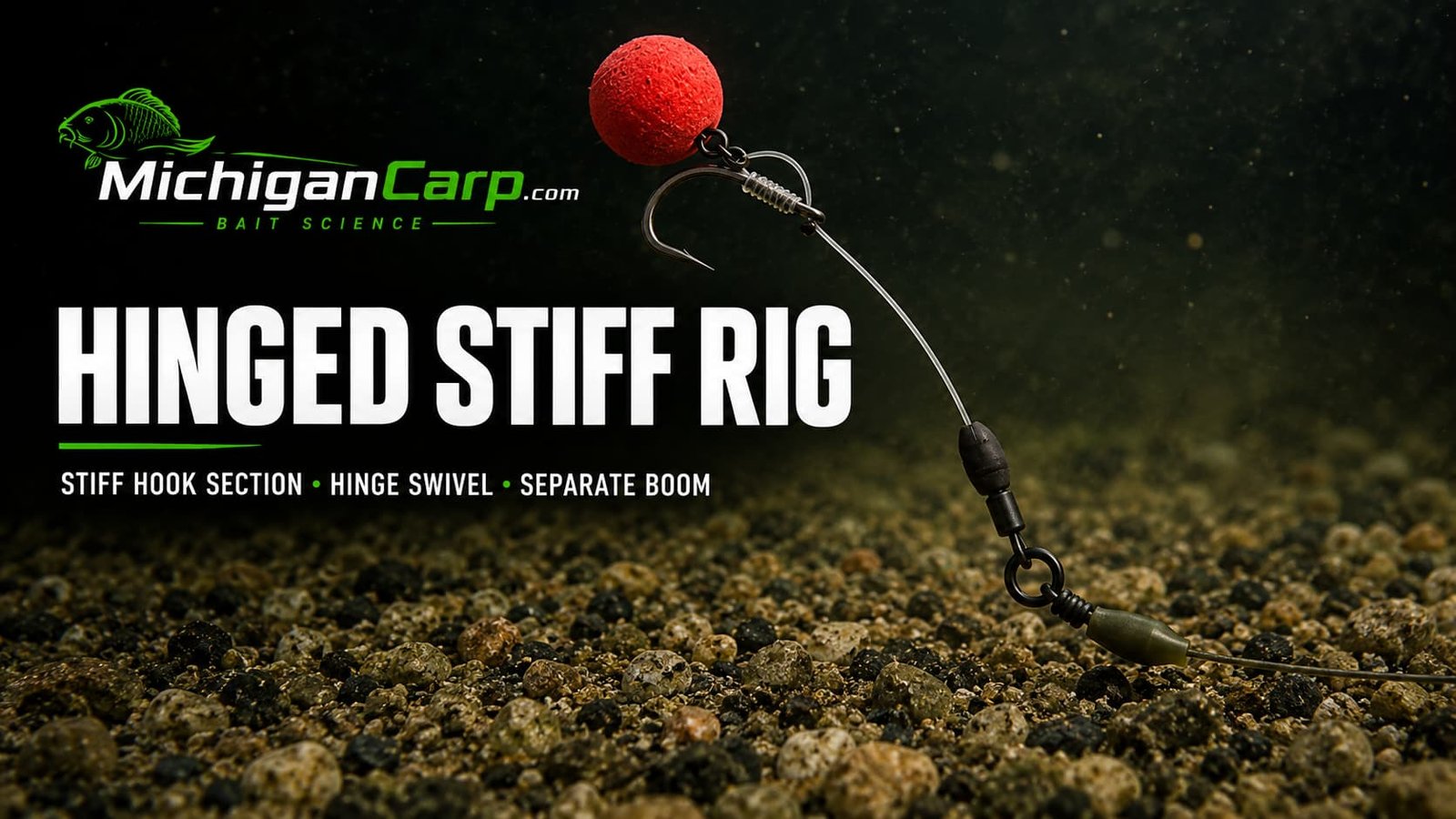
The Hinged Stiff Rig is a specialist pop-up rig built from two distinct sections: a short, stiff Chod-style hook section and a longer boom that controls how the rig settles on the lakebed.
The small swivel between those sections creates the hinge that gives the rig its name.
That hinge allows the hook section to rotate and turn freely while the boom pushes the hookbait away from the lead and keeps the presentation controlled.
For me, the Hinged Stiff Rig sits between two other important pop-up presentations.
A Chod Rig is more specialized for very soft silt, weed and debris because its short hook section moves directly on a helicopter setup. A Ronnie Rig normally presents a pop-up much lower and is strongest where its boom can settle cleanly.
The Hinged Stiff Rig gives you a higher pop-up with the aggressive stiff-section mechanics of a Chod but adds a separate boom to control the distance between the hookbait and the lead.
That makes it particularly useful on gravel, clay, sand, firm silt and lightly messy lakebeds where I want the pop-up standing clearly above the bottom rather than sitting extremely low.
For the wider rig-selection picture, start with the Complete Carp Rigs Guide or the MichiganCarp Rigs Hub.
The Hinged Stiff Rig combines a stiff, curved pop-up hook section with a separate boom. The hinge gives the hook freedom to turn while the boom controls how the rig lands and resets.
Quick Answer
A dependable Hinged Stiff Rig starts with a strong out-turned-eye Chod-style hook, a short 2- to 3-inch stiff hook section, a small swivel forming the hinge and a boom of roughly 6–10 inches.
Use a genuinely buoyant pop-up and counterbalance it so the stiff hook section only just sinks into position.
Use a stiff boom on gravel, clay, sand or clean firm silt. Move toward a coated-braid or semi-stiff boom when the lakebed contains light debris and you need the rig to settle more naturally.
The rig can be used with either a lead clip on cleaner ground or a correctly constructed helicopter system where soft silt or light debris makes that more appropriate.
Table of Contents
Hinged Stiff Rig Quick Start
| Part | Dependable Starting Point | What to Check |
|---|---|---|
| Hook | Strong size 4 or 6 out-turned-eye Chod/stiff-rig pattern | Sharp point, open gape, eye suited to stiff filament |
| Stiff hook section | 20–25 lb Chod filament or stiff mono | Holds a smooth curve without kinking |
| Hook-section length | About 2–3 inches | Enough height without becoming unstable |
| Bait attachment | Micro ring swivel or rig ring running on a D | Moves freely and stays secure |
| Hinge | Small ring swivel or suitable swivel connection | Hook section rotates freely |
| Boom | About 6–10 inches as a starting point | Material matches the lakebed |
| Hookbait | 12–16 mm buoyant pop-up | Remains buoyant after prolonged immersion |
| Counterbalance | Small amount of putty around hinge/swivel knot | Hook section sinks slowly, not heavily |
| Lead system | Lead clip on clean ground; helicopter where conditions justify it | Complete system remains fish-safe |
| Best lakebeds | Gravel, sand, clay, firm silt, light debris | Boom must be able to settle correctly |
What Is a Hinged Stiff Rig?
The Hinged Stiff Rig is a two-part pop-up rig.
- The upper section is a short stiff Chod-style hook section.
- The lower section is a longer boom.
- A swivel or ring connection between them creates the hinge.
The hook section is responsible for the aggressive turning mechanics around the hook.
The boom controls how far the hookbait is pushed away from the lead, how the complete rig settles and how easily it can reset after being disturbed.
Korda describes the modern Hinged Stiff Rig in essentially the same way: a short stiff pop-up section connected to a longer boom through a free-moving hinge. Their wider rig guide is useful additional reading: Korda Guide to Carp Rigs.
Why the Hinged Stiff Rig Works
The Hook Section Can Rotate Independently
The hinge is the key.
The short stiff section is not locked rigidly to the boom. It can rotate around the swivel and approach the carp’s mouth from different directions.
That freedom of movement helps the hook turn while the stiff curved section encourages the hook point toward the lower lip.
The Boom Pushes the Hookbait Away From the Lead
A stiff or semi-stiff boom resists folding back on itself during the cast.
When the lead lands, the boom helps kick the pop-up away from the lead and leaves the hook section separated rather than piled beside the lead system.
That controlled separation is one of the reasons the rig has such a strong reputation as a single-hookbait and spread-boilie presentation.
The Pop-Up Sits Higher Than a Ronnie
The Hinged Stiff Rig is normally used when I want a pop-up several inches off the lakebed rather than sitting extremely low.
That gives it more visual separation and makes it useful over slightly uneven ground, light debris and softer silt where a low spinner-style presentation might sit too close to the bottom.
It Can Reset Well
The stiff boom and hinged hook section can help the presentation return to a usable position if it is moved by small fish or investigated and rejected.
That does not mean every badly landed cast will magically repair itself. The rig still needs to be matched to the lakebed.
Hinged Stiff Rig Components
Out-Turned-Eye Hook
A dedicated Chod or stiff-rig hook with an out-turned eye is the classic starting point.
The out-turned eye allows the stiff hooklink to leave the hook without creating an awkward angle that fights against the material.
A size 4 or 6 is a practical starting range. Bigger fish, heavier hookbaits, weed and snag pressure can justify a stronger or larger pattern.
The MichiganCarp Carp Hooks Explained guide covers the geometry differences in more detail.
Stiff Hook Section
The short upper section should be made from material that holds a controlled curve.
Dedicated Chod filament or another suitably stiff monofilament-style material is normally the best choice.
A soft braid removes the characteristic mechanics of the rig and turns it into a different presentation.
The D
The pop-up is normally mounted on a small ring or micro ring swivel running on a D behind the hook shank.
The D gives the bait freedom to move independently from the hook and helps the hook remain free to turn.
Keep it neat rather than making it unnecessarily large.
Hinge Swivel
The hinge is normally formed with a small ring swivel or another suitable free-moving swivel connection between the hook section and boom.
The hook section should rotate freely without the boom wrapping around or restricting it.
Boom Material
The boom is where the Hinged Stiff Rig becomes much more adaptable than a standard Chod.
On clean gravel, clay, sand and firm silt, a stiff fluorocarbon-style boom or purpose-designed boom material gives excellent separation and anti-tangle performance.
On slightly more broken ground, low weed or light debris, a stiff coated braid can settle more naturally.
Korda’s current rig guidance makes the same distinction: the classic stiff boom is strongest on cleaner lakebeds, while softer or coated-braid variants are better where the bottom contains light debris.
Choosing the Boom: Stiff vs Coated Braid
| Boom Type | Best Over | Main Advantage | Main Risk |
|---|---|---|---|
| Stiff boom / fluorocarbon-style material | Gravel, clay, sand, firm silt | Excellent separation and anti-tangle properties | Can sit awkwardly on debris |
| Stiff coated braid | Firm silt, light weed, broken lakebeds | Good control with more ability to follow contours | Less rigid separation than a true stiff boom |
| Semi-stiff coated braid | Light debris and uneven bottoms | Settles more naturally | More prone to folding if badly cast |
Do not choose a boom because one material is fashionable.
Choose it according to what you expect the boom to land on.
If a completely rigid boom lands across twigs, stones or small strands of weed, it can remain visibly propped up.
A coated braid has more ability to follow those contours.
How Long Should a Hinged Stiff Rig Be?
There are two lengths to think about: the stiff hook section and the boom.
Hook Section Length
Around 2–3 inches is a useful starting range for the stiff upper section.
Shorter sections keep the bait closer to the bottom. Longer sections raise the pop-up higher.
I would not lengthen it just for the sake of making the rig look more dramatic.
The section needs to remain controlled, balanced and proportionate to the pop-up and hook.
Boom Length
Five to twelve inches is a realistic working range, with around 6–10 inches being a useful starting point for many situations.
A shorter boom keeps the presentation compact and maintains more direct connection to the lead.
A longer boom gives more separation and can be useful where you want the pop-up farther away from the lead or when the fish are feeding over a wider spread of bait.
Do not assume longer is automatically better.
How to Tie the Stiff Hook Section
The upper section is essentially a Chod-style hook section.
- Cut the stiff filament. Start longer than the final length so you have enough material for the hook and swivel knots.
- Thread the hook. Use a strong out-turned-eye Chod/stiff-rig pattern.
- Whip the hook shank. Around five or six neat turns is a practical starting point.
- Secure the hook connection. Use the knot recommended for your stiff filament.
- Add the bait attachment. Slide a micro ring swivel or suitable rig ring onto the tag.
- Form the D. Bring the tag back through the hook eye to create a compact D behind the shank.
- Secure the D. If the material is intended to be blobbed, trim and carefully create a stop without damaging the hook or main section.
- Set the section length. Measure roughly 2–3 inches from the hook to the hinge swivel.
- Attach the hinge swivel. Tie the chosen stiff-material knot and bed it down firmly.
- Shape the section. Put a smooth progressive curve into the filament.
- Pull-test it. Test every knot before the hook section goes anywhere near the water.
Do not exaggerate the curve.
I want a smooth continuation of the hook shape rather than a tight half-circle.
Korda’s Hinged Stiff Rig guidance also emphasizes that a controlled curve helps the hook turn toward the lower lip. Darrell Peck’s Hinged Stiff Rig Guide gives a useful visual reference.
How to Build the Boom Section
The boom connects the hinge to the lead system.
With a stiff boom material, the cleanest construction is usually either a suitable knot or a correctly matched crimp system.
- Cut more boom material than the intended finished length.
- Attach the hinge end to the ring swivel using the knot or crimp system approved for the material.
- Measure the boom to the required finished length.
- Add the lead-system connection at the opposite end.
- Add an anti-tangle sleeve where appropriate.
- Straighten stiff boom material carefully with steam if the manufacturer allows it.
- Pull-test both connections firmly.
Only crimp material specifically designed to be crimped, and match the crimp size to the exact material diameter.
An incorrect crimp can create a hidden weak point that looks neat until a large carp loads it.
How to Balance the Pop-Up Correctly
A high pop-up rig still needs controlled buoyancy.
The pop-up should be buoyant enough to lift the entire hook section and keep it upright.
Add only enough tungsten putty or another suitable counterbalance around the hinge swivel or lower hook-section knot to make the rig settle slowly.
The bait should not drag the boom upward.
Equally, the counterweight should not pull the hook section down so hard that the rig loses its upright presentation.
Test the Actual Hookbait
Different pop-ups of the same diameter can have very different buoyancy.
A 15 mm cork-dust pop-up may behave very differently from a dense 15 mm food-based pop-up.
Balance the rig with the actual bait you intend to fish.
Check It Again After Soaking
Some pop-ups lose buoyancy after several hours.
If you are planning an overnight or 24-hour cast, test the bait after prolonged immersion rather than assuming its first five minutes tell the whole story.
Best Lead Systems for the Hinged Stiff Rig
Unlike the Chod Rig, the Hinged Stiff Rig does not require one single lead arrangement.
Lead Clip
A lead clip is a very practical choice on clean gravel, clay, sand and firmer silt.
The boom leaves the lead in a controlled direction and the clip can be configured to release the lead when weed or snag pressure makes that desirable.
Helicopter System
A helicopter arrangement becomes useful when the lead is likely to enter soft silt or light debris.
The hooklink can settle higher on the system rather than being dragged into the same depth as the lead.
As with any helicopter arrangement, the hooklink must be able to escape safely from the main line or leader after a break-off.
For the full safety comparison, use Lead Clip vs Inline vs Helicopter.
Where the Hinged Stiff Rig Works Best
Gravel
This is classic Hinged Stiff Rig territory.
A stiff boom can settle cleanly, kick the pop-up away from the lead and remain difficult for carp to eject.
Clay and Sand
Both provide enough consistency for a stiff boom to lie correctly.
If the surface is very clean, there is little reason to soften the boom unnecessarily.
Firm Silt
The rig works very well over firm silt when the lead is not disappearing deeply and the boom can settle without standing up.
A slightly more forgiving coated boom can be useful if the silt surface is uneven.
Light Weed and Debris
This is where I would normally move away from a completely rigid boom.
A stiff coated braid can follow small contours and strands of weed more naturally while retaining enough structure to push the rig away from the lead.
Deep Silt or Heavy Chod
This is where the Chod Rig becomes the more specialized tool.
If the boom itself is likely to disappear into deep debris, the Hinged Stiff Rig loses one of its main advantages.
The rebuilt **Chod Rig for Carp Fishing: How to Tie It and Fish It Safely** should be the reference when the lakebed is genuinely too messy for a conventional boom.
Hinged Stiff Rig vs Chod, Ronnie and Multi Rig
| Rig | Presentation | Best Use |
|---|---|---|
| Hinged Stiff Rig | Higher pop-up on a short stiff section plus separate boom | Clean to lightly messy bottoms |
| Chod Rig | Short stiff hook section moving directly on a helicopter system | Deep silt, weed and debris |
| Ronnie Rig | Low pop-up with rotating hook on spinner swivel | Clean ground, firm silt and light debris |
| Multi Rig | Movable D with quick hook changes | Versatile pop-up and balanced-bait work |
Hinged Stiff Rig vs Chod Rig
The hook-section mechanics are closely related.
The difference is the boom.
The Chod section moves directly on a helicopter arrangement and is designed to settle above deeper debris.
The Hinged Stiff Rig attaches that stiff section to a dedicated boom, giving more controlled separation on cleaner ground.
Hinged Stiff Rig vs Ronnie Rig
The Ronnie normally presents a pop-up much lower.
Its hook rotates directly on a spinner swivel and the bait sits close to the hook.
I would choose the Ronnie when I want a low, compact pop-up over a clean or lightly silty bottom.
I would choose the Hinged Stiff Rig when I deliberately want the hookbait sitting higher and a more defined stiff hook section.
See Ronnie Rig for Carp Fishing.
Hinged Stiff Rig vs Multi Rig
The Multi Rig is simpler to change hooks on and is extremely adaptable.
The Hinged Stiff Rig gives a more specialized, high pop-up presentation with a separate stiff hook section and hinge.
See Multi Rig for Carp Fishing.
A Practical Hinged Stiff Rig for Michigan Carp
On the large natural lakes and impoundments I fish in Michigan, I would use the Hinged Stiff Rig as a deliberate high pop-up tool rather than a default presentation.
A dependable starting setup would be:
- strong size 4 out-turned-eye Chod/stiff-rig hook;
- 20- to 25-pound stiff hook-section material;
- around 2–3 inches of stiff hook section;
- small ring swivel forming the hinge;
- 6–10 inch boom;
- stiff boom on clean ground or coated braid where light debris requires more flexibility;
- 14–16 mm buoyant pop-up;
- small amount of putty around the hinge to critically balance the hook section;
- lead clip on firm ground or safe helicopter arrangement when the lakebed justifies it.
I would increase hook strength before I worried about making the rig mechanically more complicated.
Large wild carp, weed, timber, rocks and zebra mussels can put far more pressure on the complete tackle than a neat rig-board test suggests.
The hooklink, main line, leader, knots and lead-release system all need to match the swim.
Casting and Tangle Prevention
The stiff boom makes the Hinged Stiff Rig naturally resistant to tangles, but good casting practice still matters.
- Use an anti-tangle sleeve where appropriate.
- Check that the hinge swivel rotates freely.
- Make sure the D and bait attachment cannot catch around the hook point.
- Use dissolving foam around the hook when weed or debris could mask the point.
- Feather the cast before the rig hits the water.
- Check every stiff section for kinks after retrieving.
- Inspect the hook point after gravel, mussels or weed.
A stiff hook section that has been badly kinked should be replaced rather than bent back repeatedly and trusted indefinitely.
Common Hinged Stiff Rig Mistakes
Using the Wrong Hook Eye
A strongly in-turned eye fights against the stiff hook section.
Use a suitable out-turned-eye stiff-rig or Chod pattern.
Making the Hook Section Too Long
The stiff section is supposed to remain compact and controlled.
If you need far more height, make sure the rig still balances and rotates correctly rather than simply adding inches.
Over-Curving the Stiff Section
A smooth progressive curve is enough.
An exaggerated half-circle can make the presentation awkward and bring the hooklink too close to the point.
Using a Rigid Boom on Debris
A perfectly straight stiff boom can bridge across twigs, weed or uneven debris.
Change the boom material rather than expecting the lakebed to cooperate.
Over-Weighting the Pop-Up
The hook section should settle slowly.
A large lump of tungsten defeats the point of using a buoyant presentation.
Using a Weak or Incorrect Crimp
Only crimp materials designed for crimping.
Use the correct crimp diameter and pull-test every connection.
Using It Over Deep Chod
If the boom is likely to disappear completely into weed, deep silt or debris, use a presentation designed for that problem rather than forcing the Hinged Stiff Rig to do the Chod Rig’s job.
Never Testing the Rig in Water
Every finished rig should be checked in the edge before casting.
Watch the pop-up lift the hook section, add the counterbalance and confirm that the hinge and boom behave the way you expect.
Final Hinged Stiff Rig Checklist
- Out-turned-eye hook is sharp and strong.
- Stiff hook section is free from kinks.
- D is neat and bait attachment moves freely.
- Hook section holds a smooth curve.
- Hinge swivel rotates freely.
- Boom material suits the lakebed.
- All crimps and knots have been pull-tested.
- Pop-up remains buoyant long enough for the intended cast.
- Counterbalance only just sinks the hook section.
- Lead system is configured safely.
- Hook point is checked after every retrieval.
- The complete rig settles correctly in a margin test.
Frequently Asked Questions
What is a Hinged Stiff Rig used for?
It is a high pop-up rig best suited to clean or moderately tidy lakebeds such as gravel, clay, sand, firm silt and light debris.
How long should the stiff hook section be?
Around 2–3 inches is a practical starting range. Adjust according to hookbait height, hook size and presentation requirements.
How long should the boom be?
Five to twelve inches is a useful working range. Around 6–10 inches is a sensible starting point for many situations.
What hook should I use?
Use a strong out-turned-eye Chod or stiff-rig hook. Size 4 or 6 is a useful starting point for typical carp pop-ups.
Can I use coated braid for the boom?
Yes. A stiff or semi-stiff coated braid is often a better choice over light weed, uneven silt or minor debris because it can follow the contours of the bottom more naturally.
Does the Hinged Stiff Rig need a helicopter lead system?
No. It can be used with a lead clip on clean ground or with a safe helicopter arrangement when softer silt or light debris makes that more appropriate.
Is it better than a Ronnie Rig?
No. The Hinged Stiff Rig is a higher pop-up presentation with a separate stiff hook section. The Ronnie normally sits much lower and is excellent where its boom can settle cleanly. Choose according to the bottom and presentation you want.
Is it the same as a Chod Rig?
No. Both use similar stiff hook-section mechanics, but the Hinged Stiff Rig attaches that section to a separate boom. A Chod section normally travels directly on a helicopter system.
Next Steps
For a lower pop-up presentation on cleaner ground, read Ronnie Rig for Carp Fishing.
For a more versatile pop-up and balanced-bait rig with quick hook changes, use Multi Rig for Carp Fishing.
For hook-pattern selection, see Carp Hooks Explained.
For lead-system choice and fish safety, use Lead Clip vs Inline vs Helicopter.
If the lakebed is too soft or littered for a conventional boom, move to the specialist **Chod Rig for Carp Fishing: How to Tie It and Fish It Safely**.
The Hinged Stiff Rig is at its best when you deliberately want a higher pop-up, aggressive stiff-hook-section mechanics and the controlled separation of a separate boom. Match that boom to the lakebed, balance the pop-up properly and keep the complete system simple enough to trust on every cast.