

Carp fishing around man-made structures is not about casting at concrete simply because it looks obvious. Harbors, marinas, seawalls, riprap, pilings, docks, bridge supports and dredged channels become valuable only when they create something carp can use: food, depth, shelter, shade, current, safety or a natural travel route.
That distinction matters. An impressive wall can be empty, while an ordinary harbor entrance repeatedly produces because depth, natural food, moving water and a safe route overlap within a small area.
Michigan offers built structure on Great Lakes harbors, inland lakes, rivers, reservoirs and urban channels. These features can make a large water easier to read, but they also introduce boat traffic, private property, mooring ropes, sharp zebra mussels, steep banks and difficult landing positions.
Use this as a supporting guide to How to Find Carp in Lakes. For the wider condition-reading system, return to Watercraft and Conditions for Michigan Carp Fishing.
Table of Contents
Quick Start: Where to Look First
The best built-structure swim normally combines four things: a route into the area, a reason for carp to slow down, food or comfortable water, and a place where you can present a rig and land the fish safely.
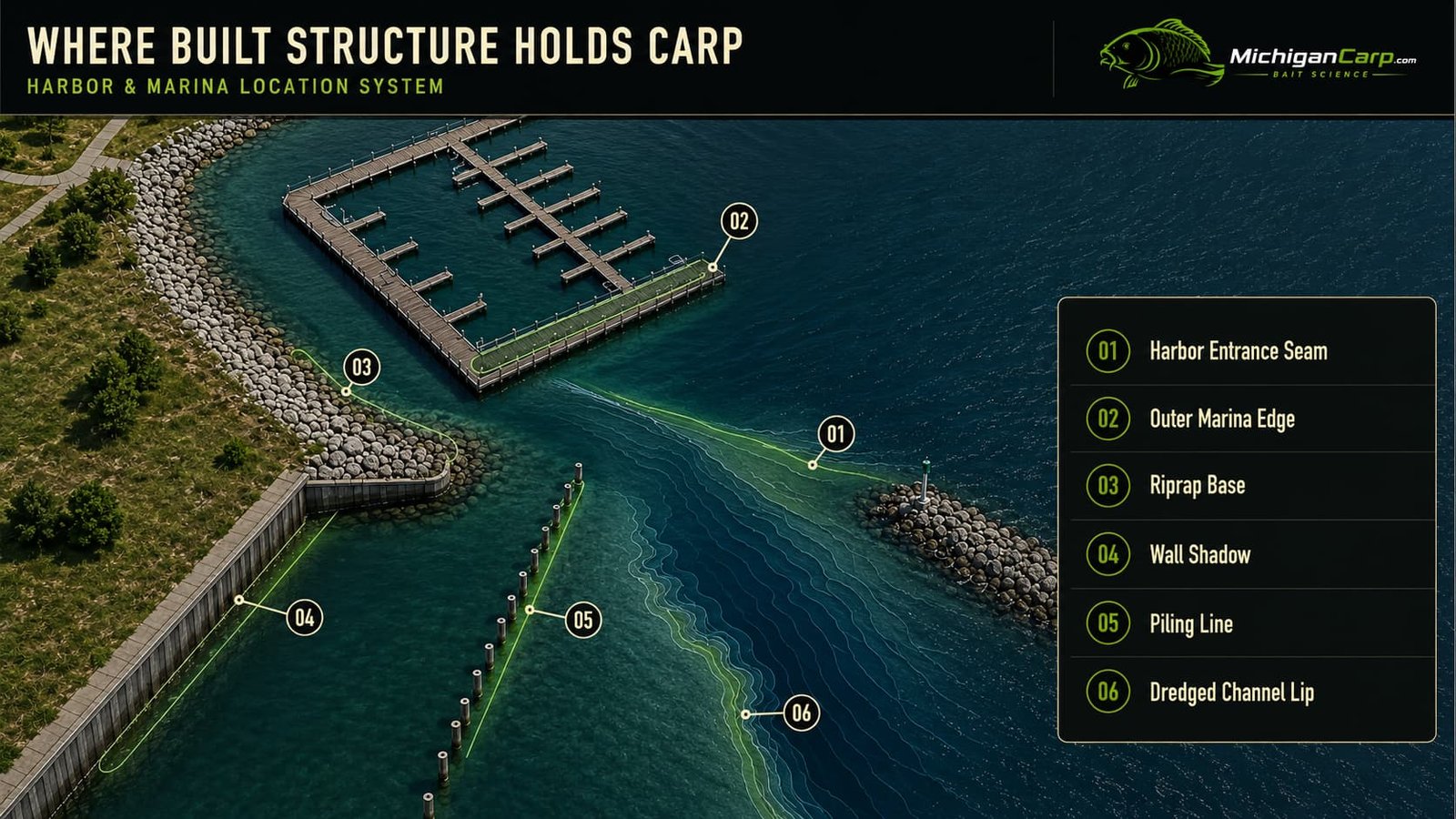
Do not automatically cast into the deepest corner or tightest cover. Start with the usable edge: the base of a wall, outside of a marina, softer seam beside a harbor entrance, foot of riprap, end of a piling line or lip of a dredged channel.
| Feature | First area to inspect | Why it may produce | Main danger |
|---|---|---|---|
| Harbor entrance | Inside seam, corner or depth transition | Route, current change, food movement and nearby depth | Waves, boats and inaccessible edges |
| Marina | Mouth, outer edge, dock-line end or shade boundary | Shelter, shade, vertical cover and patrol routes | Private access, ropes and boats |
| Riprap | Base of the rock or transition into silt, sand or gravel | Natural food, depth change and a defined edge | Sharp rock, mussels and steep footing |
| Seawall | Base, corner, shadow line or scour | Depth close to shore, shade and a reference line | Line damage and difficult netting |
| Pilings | Outside edge, gap or downstream slack | Shade, current break and compressed movement | Snags, debris and limited fish control |
| Dredged channel | Lip, inside edge, slack or junction | Depth and movement between connected areas | Boat traffic, flow and debris |
Fish the useful influence of the structure, not the structure merely because it is there.
Why Man-Made Structures Attract Carp
Carp respond to what a structure changes around them. A wall can create shade and deep water close to shore. Riprap provides a hard transition and surfaces that can hold algae, mussels and invertebrates. Pilings break current and form a reference line. A harbor mouth connects sheltered water to a larger lake. A marina can compress shade, depth, quiet water and travel routes into a relatively small area.
Productive structure normally performs several jobs:
- Food: Cracks, hard edges, silt pockets and current traps can collect natural food.
- Movement: Walls, channels, entrances and piling lines can guide carp between areas.
- Comfort: Shade, stable depth, shelter or moving water can improve conditions.
- Confidence: Depth, cover, reduced light and quiet periods can encourage movement.
- Presentation: A defined edge can give you a precise, repeatable place to fish.
A wall offering none of those advantages is scenery. A plain marina mouth with a clean bottom transition, comfortable water and repeated carp signs is a real location.
Use the Five-Part Structure Test
1. Find the Entrance and Exit
Look for the harbor mouth, channel, wall line, bridge opening, point, gap or outer marina edge that connects the feature to other water. Carp are easier to intercept where a route is obvious.
2. Find Where Fish Can Slow Down
Moving carp often pause where a channel widens, current softens, a wall ends or an entrance opens into a protected basin. These transition points can be better than the most enclosed corner.
3. Identify the Food or Comfort Reason
Look for mussels, algae, silt, weed, insects, shade, warmer spring water, cooler summer depth, wind-blown food or oxygenated movement. Never assume the concrete alone provides the attraction.
4. Read the Bottom Beside the Feature
The base of a wall may meet rock, gravel, sand, silt or weed. Riprap may finish in a narrow hard strip before dropping onto softer sediment. A marina may contain a dredged trough, silted corner or clean outer edge. These changes often matter more than the structure visible above water.
Use Reading the Bottom for Carp to map depth, substrate and safe presentation after choosing the promising part of the water.
5. Plan the Fight Before Casting
If a hooked carp can immediately reach mooring ropes, propellers, inaccessible pilings, heavy debris or a wall with nowhere to net it, the spot fails the test. Move to the safer outer edge or leave it alone. Strong tackle cannot make an impossible swim responsible.
How to Fish Each Type of Structure
Harbors and Breakwalls
Harbors connect exposed lake water with deeper, calmer or warmer protected water. Start at the softer seam near the entrance, the end or corner of a wall, the transition at its base, or a sheltered pocket still connected to the main route.
The roughest water is not automatically best. Wind and waves can improve oxygen, food movement, color and cover, but they can also move debris, prevent a rig from settling and make the bank unsafe. Great Lakes harbors can change quickly, so reassess wind, current, water color and boat traffic rather than fishing yesterday’s conditions.
Marinas and Dock Systems
Treat a marina as a system of entrances, outside edges, shade lines, dock ends, dredged troughs and quieter corners. The outer boundary is often safer and more useful than the middle: carp can patrol it without entering the tightest maze of boats and ropes.
Timing matters. Heavy daytime traffic may suppress activity, while dawn, evening or the period after boats stop can produce a short window. On pressured water, carp may change when they use the feature rather than abandon it. See Fishing Pressure: How Carp Learn and How to Beat It.
Riprap, Seawalls and Retaining Walls
The productive line is often where the rock ends and another bottom begins. Check points, corners, the end of the riprap, changes in stone size, deeper sections and places where rock meets weed or softer sediment.
Along a seawall, carp may use the base, shadow line, scour or calmer side of a corner. They do not need to touch the concrete for it to influence them. Inspect line and leader after every fish or suspicious scrape; zebra mussels and sharp rock can cause damage quickly.
Pilings, Bridge Supports and Channels
Pilings create shade, gaps, current breaks and lines that carp can follow. In moving water, the useful area is often beside the main flow or in the softer water behind a support. Fish far enough away to retain control of a hooked carp.
Dredged channels and connecting cuts act as routes between basins, rivers, bays and deeper water. Look at the lip, inside bend, mouth, junction or place where the channel opens and carp can slow down. For seams, undertow and changing water movement, use Wind, Waves and Current for Michigan Carp Fishing.
How Structure Use Changes Through the Year
Spring
Protected harbor corners, dark-bottom marina pockets and sheltered channels can warm before exposed water. Favor places that combine warmth with a route back to deeper water.
Summer
Shade, depth, current, oxygen and quiet periods become more important. Carp may patrol an outer marina edge, use a wall’s shadow or enter a harbor after traffic fades. Hot, stagnant dead ends can look good while offering poor comfort.
Fall and Cold Water
Hard-edge natural food, remaining green weed, stable depth and channel routes can keep structures productive. In colder water, deep harbors and protected basins may hold carp, but holding does not guarantee feeding. Start with restrained bait and look for short windows.
For the broader annual pattern, use Seasonal Carp Movement in Michigan.
A Practical Scouting and Rod Plan
Watch before setting up. Check entrances, wall lines, shaded edges, boat lanes and connections to open water. Repeated bubbles, rolling fish, clouded water or liners along the same route mean more than one random show.
Walk the accessible bank and decide where a fish can be landed. Then make only enough casts to understand the bottom at the base, the transition away from it and the route toward open water. Repeatedly thrashing a small harbor corner with a marker lead can destroy the very opportunity you found.
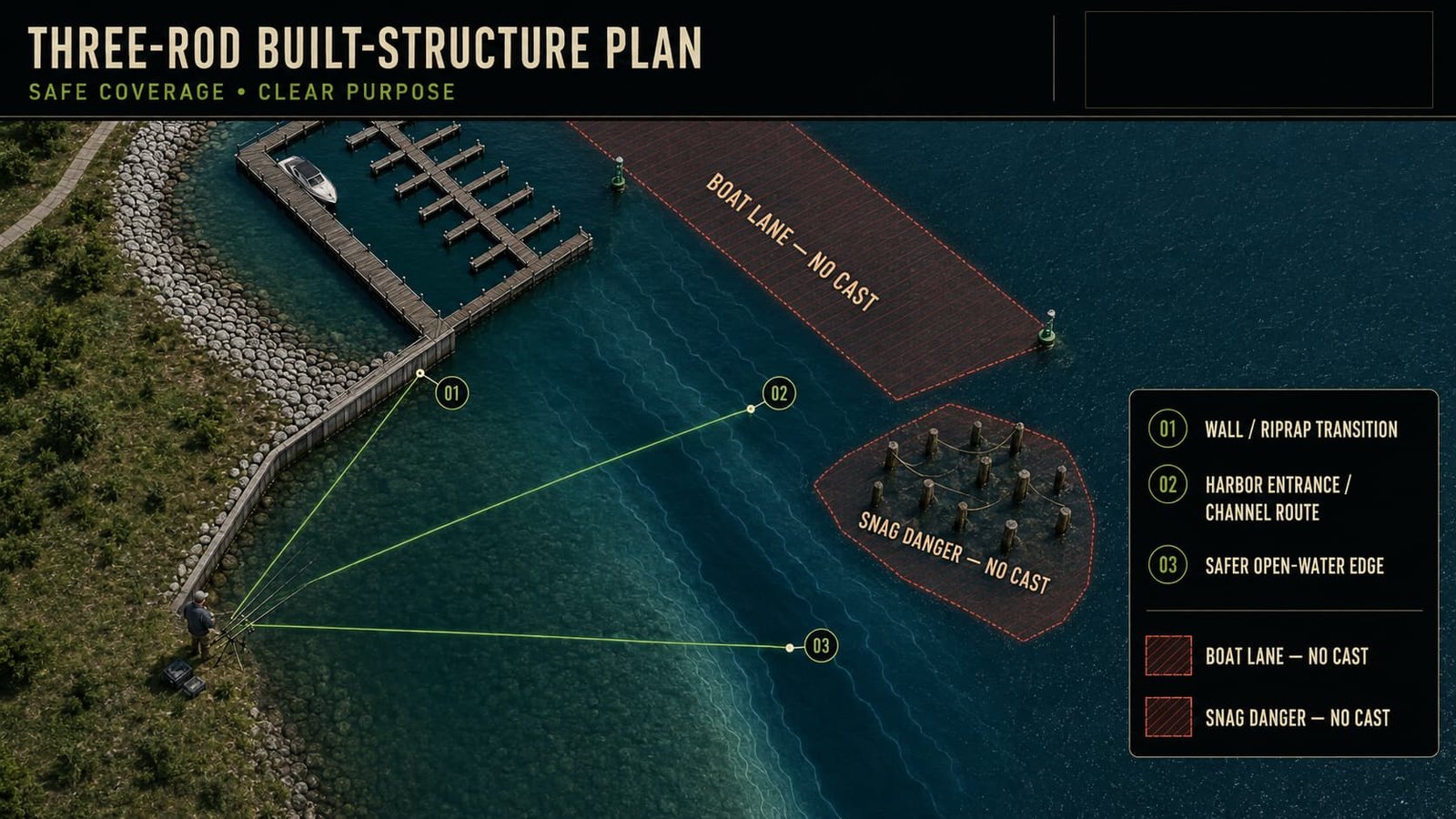
Where to Put Three Rods
Three rods should test three jobs rather than three random distances.
| Rod | Position | Question it tests |
|---|---|---|
| Rod 1 | Wall base, riprap transition or outer marina edge | Are carp feeding beside the structure? |
| Rod 2 | Harbor mouth, channel lip or route away from the feature | Are carp traveling through? |
| Rod 3 | Safer open-water side, alternate depth or sheltered seam | Are conditions positioning them off the obvious edge? |
Keep the spread manageable. Never cross an active marina entrance, launch lane or navigation route. Fish fewer rods when that gives you safer line angles and faster control.
Tackle, Presentation and Baiting
Use tackle that matches the real hazard, not the urban appearance of the swim. Priorities include abrasion-resistant line, an appropriate leader, a strong sharp hook, a simple rig that resets reliably, and a lead system that will not leave a fish towing unnecessary tackle. Use enough lead to hold in the actual flow, keep rods within immediate reach and check every line-contact point.
Do not fish locked up beside severe snags and then sit away from the rods. Use The Complete Michigan Carp Rig Guide for safe lead-system and rig choices.
Location still comes before bait. Begin with an accurate hookbait and a small PVA stick or bag on a clean edge, or a light spread of particles and chopped boilie where current will not remove it. In moving water, estimate where feed will settle rather than where it enters. Around riprap, avoid filling cracks where carp can eat without approaching the hookbait.
The aim is to hold carp on the safe side of the structure, not draw them deeper into ropes, pilings or inaccessible cover.
Michigan Notes: Access, Boat Traffic and Fish Care
Public water does not make every bank public. Harbors and marinas may include municipal land, state facilities, private slips, commercial areas and restricted breakwalls. Confirm that fishing is allowed from the exact bank, obey posted hours, keep launches and walkways clear, and never put lines across marked boat routes.
Michigan DNR states that most state-sponsored boating access sites are posted closed from 11 p.m. to 4 a.m. unless otherwise posted. Check the current Michigan boating rules and access-site information and Michigan fishing regulations before traveling.
Before casting, identify a safe netting point, room for a padded unhooking mat and a route from water to mat without dragging or dangerously lifting the fish. Long drops, algae-covered rocks, heavy boat wash and narrow ladders can make a promising swim unsuitable. For the complete handling standard, use Carp Fish Care and Safety.
Common Mistakes
- Casting at the most obvious wall without identifying why carp would use it
- Fishing too tightly to ropes, pilings or rock when the outer edge intercepts the same fish
- Ignoring the bottom where the visible structure ends
- Treating every marina corner as a feeding area
- Assuming the strongest wind or current must be best
- Leaving rods unattended beside immediate snags
- Overbaiting before confirming activity
- Blocking docks, paths, launches or navigation routes
- Assuming public water means public bank access
- Choosing a spot before deciding how a large carp will be netted and released
Robert’s Practical MichiganCarp View
My experience on Michigan harbor and channel water has taught me to treat man-made structure as compressed watercraft. It can put depth, moving water, food, shade and a travel route close together, making a large water easier to understand.
But the visible structure is only the starting point. The useful spot is more often the seam beside the entrance, the bottom transition at the wall, the route outside the marina or the quiet period after boat traffic falls away.
I would rather fish a simple rig on a safe, confirmed edge than force a bait into the tightest cover because it looks carpy. Fish care and control remain part of the location decision.
This is not just theory. I have caught multiple carp over 30 pounds around Michigan marinas and harbors, and those fish reinforced the same lesson: the visible structure alone is not enough. The better locations were where depth, food, shelter, moving water and a reliable travel route came together.
FAQ
Do Carp Live in Harbors and Marinas All Year?
Some carp may use them for long periods, but use changes with temperature, oxygen, food, traffic and seasonal movement. A harbor may be holding water in one season and mainly a travel route in another.
What Is the Best Part of a Marina for Carp Fishing?
The mouth, outer edge, dock-line end, shade boundary or transition into open water is often more practical than the tight center. Choose the area combining fish movement with a safe presentation and landing route.
Does Riprap Hold Carp?
It can, especially where the base meets silt, sand, gravel, weed or deeper water. Look for natural food, a depth change and a route rather than assuming every rock bank will produce.
Should I Cast Tight to a Wall or Piling?
Only when the line angle and landing situation are safe. Carp often use the influence of the structure without touching it, so a bait slightly away may intercept the same fish with much better control.
What Bait Works Best in Harbors and Marinas?
There is no special harbor bait. Use a proven bait in a small, accurate presentation after finding the route or feeding zone. Location, bottom and timing matter more than changing flavor because the bank is man-made.
Is Night Fishing Allowed at Michigan Harbors and Boat Launches?
Rules vary by facility. Most state-sponsored boating access sites are posted closed from 11 p.m. to 4 a.m. unless otherwise posted, and municipal or harbor rules may differ. Check the exact site’s signs and current official information.
Do I Need Very Heavy Tackle Around Man-Made Structures?
Use tackle strong enough for the rocks, mussels, flow and snags you actually face. Heavy line cannot make an impossible swim safe; you still need immediate rod control, a safe line angle and a realistic landing route.