

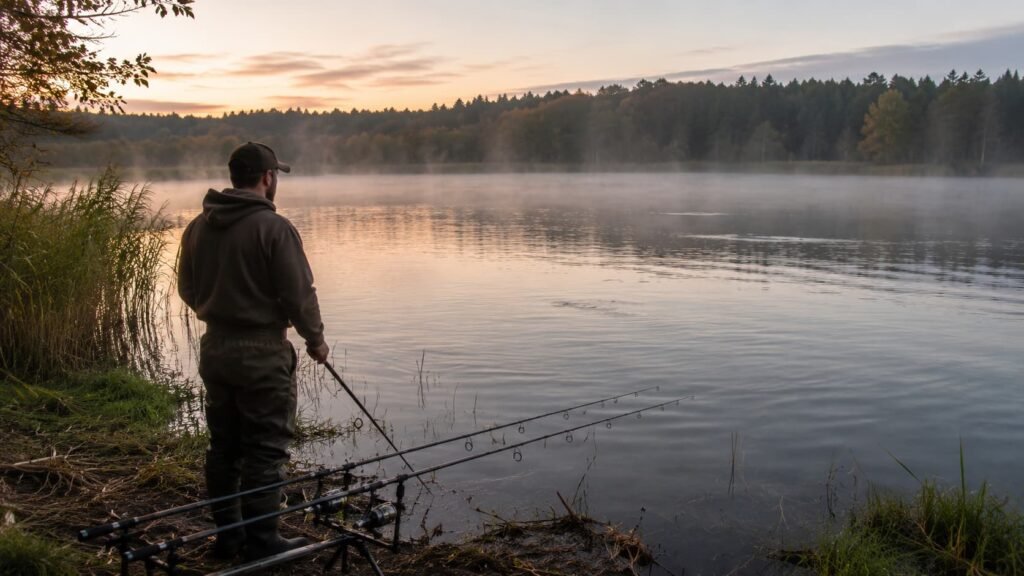
Carp anglers often talk about feeding windows, but rarely mention oxygen windows carp fishing.
A lake can seem dead for hours, then suddenly carp begin rolling, fizzing, showing, and feeding as if someone flicked a switch. Two hours later, it can all go quiet again.
It is easy to blame this on luck, bait, moon phases, or carp being carp.
Sometimes those things play a part.
But very often, the missing piece is oxygen.
Oxygen window are a period when dissolved oxygen, temperature, light, water movement, and food availability line up well enough for carp to feed confidently. It does not mean oxygen alone magically turns carp on. It means the water becomes comfortable enough for carp to move, graze, digest, and take advantage of food.
That distinction matters.
Carp are not random creatures. They are constantly balancing comfort, safety, food, and energy. Oxygen sits underneath all of that.
Understanding oxygen windows helps explain why:
- carp sometimes feed hard for short periods
- dawn is not always the best time
- wind can switch a lake on
- shallow bays can be good one hour and poor the next
- summer carp may avoid impressive-looking deep water
- current areas can be reliable when still water is difficult
- careful baiting often beats heavy baiting in marginal conditions
This article builds on the main dissolved oxygen article and turns that knowledge into practical fishing decisions.
If you have not already read it, start with Dissolved Oxygen and Carp Fishing. This article takes the next step: how to use oxygen to understand carp feeding spells.
Quick Start
An oxygen window is a period when conditions become comfortable enough for carp to feed actively.
These windows often happen when:
- wind mixes oxygen into the water
- current brings fresher water into an area
- daylight increases oxygen around healthy weed
- cooling weather improves oxygen after heat
- carp move above low-oxygen deep water
- baitfish and natural food concentrate in active water
- oxygen, temperature, and food all overlap
The important point is this:
Carp do not feed just because food is present.
They feed best when the water allows them to feed efficiently.
A good bait in poor water is still fighting the conditions. A simple bait in the right oxygen window can be far more effective.
What Is an Oxygen Window?
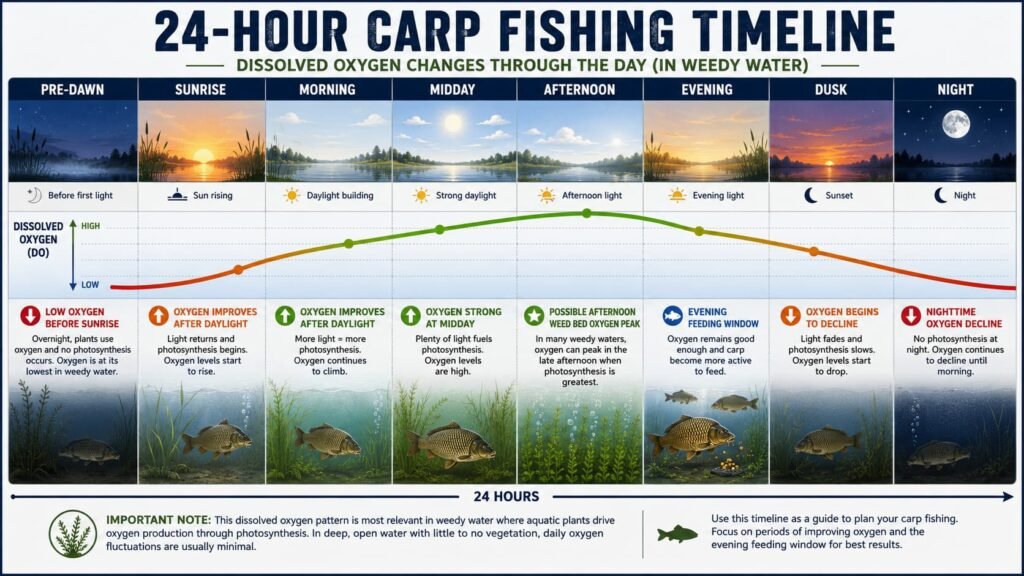
An oxygen window is not a formal scientific term. It is a practical angling way to describe a period when dissolved oxygen becomes favorable enough to improve carp activity.
Think of it as a temporary opening.
For a while, the lake gives carp what they need:
- enough oxygen to move and digest properly
- a suitable temperature range
- natural food movement
- safety or cover
- a reason to patrol
When those factors come together, carp are more likely to feed.
When they separate, feeding can slow or stop.
This is why carp fishing often feels inconsistent. The fish may still be in the lake, and sometimes they may still be near your area, but the conditions are not always right for proper feeding.
A carp sitting in low-comfort water may ignore bait. The same carp, two hours later, may feed confidently if wind, current, light, and oxygen improve.
That is the heart of oxygen window fishing.
You are not only trying to find carp.
You are trying to find the periods when carp are comfortable enough to make mistakes.
Oxygen Does Not Work Alone
It is important not to treat oxygen as a magic switch.
Carp feeding is controlled by several things at once.
The main ones are:
- dissolved oxygen
- water temperature
- food availability
- safety
- light levels
- pressure
- current
- wind
- seasonal need
- angling pressure
Oxygen is one of the foundations. If oxygen is poor, other attractive factors may not matter as much.
For example, a bay may contain natural food, warm water, and good cover. On paper, it looks excellent. But if it is shallow, weedy, stagnant, and oxygen-poor after a hot calm night, carp may leave it or feed weakly.
Another area may look less obvious. It may be a windswept bank, a creek inflow, or a shelf near deeper water. But if oxygen is better there and food is moving through it, carp may feed much more confidently.
This is why oxygen should always be connected to Water Temperature and Carp Fishing.
Temperature affects how active carp can become. Oxygen affects whether that activity can be supported.
Warm water can increase metabolism, but warm water also holds less oxygen. That is why summer fishing can be both excellent and difficult. Carp may want to feed, but only in the parts of the lake where oxygen, temperature, and food are balanced.
Why Feeding Windows Can Be Short
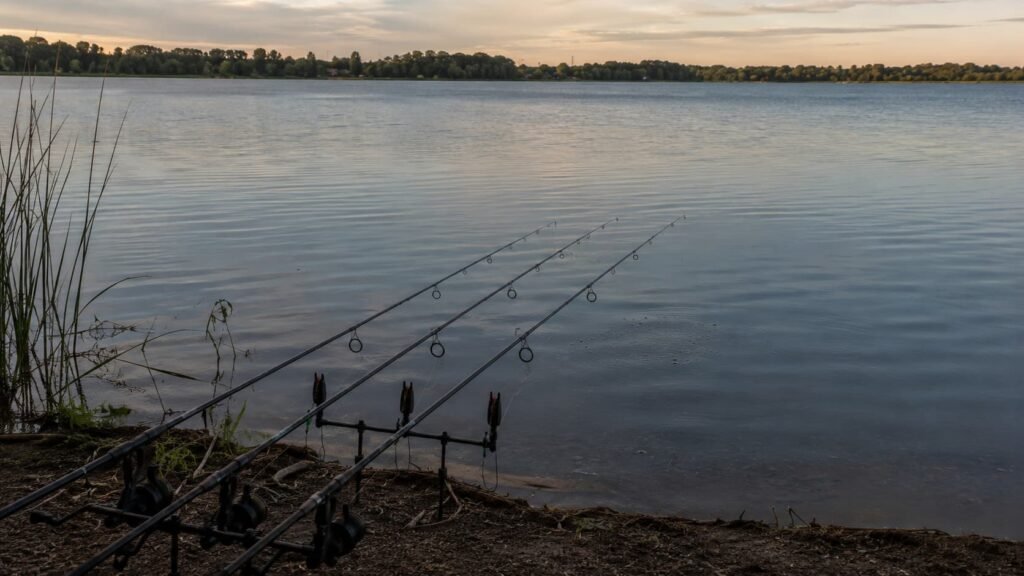
Many carp anglers have seen this pattern.
Nothing happens for hours.
Then suddenly:
- fish roll
- bubbles appear
- liners start
- birds begin working
- baitfish show
- a rod goes
- another rod goes
Then the swim dies again.
This can happen because the fish moved through, but it can also happen because the conditions were only right for a short period.
A small oxygen improvement can be enough to change carp behavior. Wind may push into a bank. A breeze may ripple a flat surface. A current seam may strengthen. Sunlight may wake up a weed bed. Cooler evening water may improve comfort. A storm front may mix the upper layer. A shallow area may become usable again.
During that window, carp may move in and feed.
When the window closes, they may drift away, rise off bottom, slide back to safer water, or stop feeding.
This is one reason carp anglers should keep notes. If a venue produces bites at similar times under similar conditions, those are not accidents. They may be oxygen and movement patterns repeating.
A feeding window is often the lake showing you its rhythm.
Dawn Is Not Always the Best Time
Many anglers automatically think dawn is the best time to fish.
Sometimes it is.
Dawn can be excellent because light levels are low, banks are quiet, and carp may feel safe. In clear water or pressured areas, that can matter a lot.
But from an oxygen point of view, dawn can also be complicated.
In weedy or algae-rich water, oxygen may be lowest just before sunrise. That is because plants and algae produce oxygen during daylight but use oxygen through the night. By early morning, a shallow weedy bay may be less comfortable than it was the previous afternoon.
This does not mean dawn is bad.
It means dawn is not automatically best everywhere.
In some Michigan waters, early morning can be excellent on:
- open wind-mixed shorelines
- current-influenced banks
- deeper edges with stable oxygen
- low-pressure quiet areas
- natural patrol routes
But in shallow, stagnant, weed-heavy water during hot weather, late morning, afternoon, or evening may sometimes be better because sunlight and wind have improved oxygen and food movement.
This is a major watercraft point.
Do not fish the clock blindly.
Fish the conditions.
This connects closely with Carp Daily Activity Patterns. Carp have daily rhythms, but those rhythms are shaped by water quality, oxygen, light, temperature, and pressure.
The Daytime Weed Bed Window
Healthy weed can create one of the most interesting oxygen windows in carp fishing.
During daylight, green aquatic plants produce oxygen. They also hold snails, insects, larvae, tiny crustaceans, and other natural food. Carp know this.
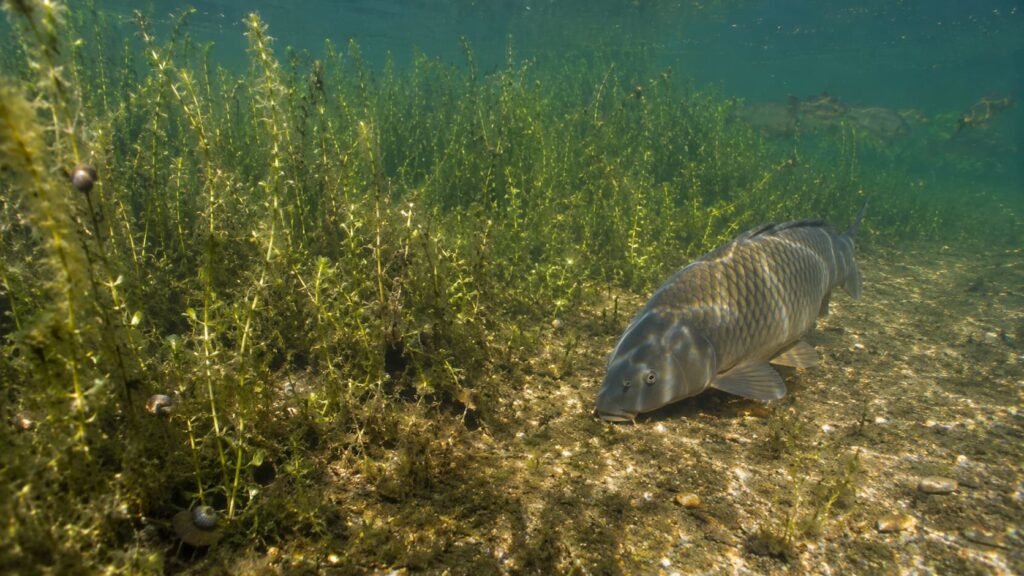
A healthy weed edge can therefore become a daytime feeding zone, especially when sunlight, warmth, and water movement are all favorable.
The best areas are rarely the thickest weed. Carp often prefer edges, holes, channels, and clean spots near the weed. These areas let them feed without burying themselves in heavy vegetation.
A good weed bed oxygen window might happen when:
- the sun has been up for several hours
- oxygen production has improved
- small food items are active
- carp feel safe near cover
- wind is lightly pushing into the area
- the weed is healthy rather than dying
This is why a weedline can seem poor at first light but become more active later in the day.
It is also why dying weed can be the opposite. When weed decays, bacteria break it down and oxygen gets used. A rotting weed bed can become unattractive even if it looks like good cover.
Look for healthy life.
Green weed, snails, small fish, insect activity, and clean gaps are encouraging signs. Black weed, foul smells, and lifeless silt are warnings.
This links directly to Natural Carp Food Sources because oxygen and food often overlap around healthy vegetation.
The Wind Window
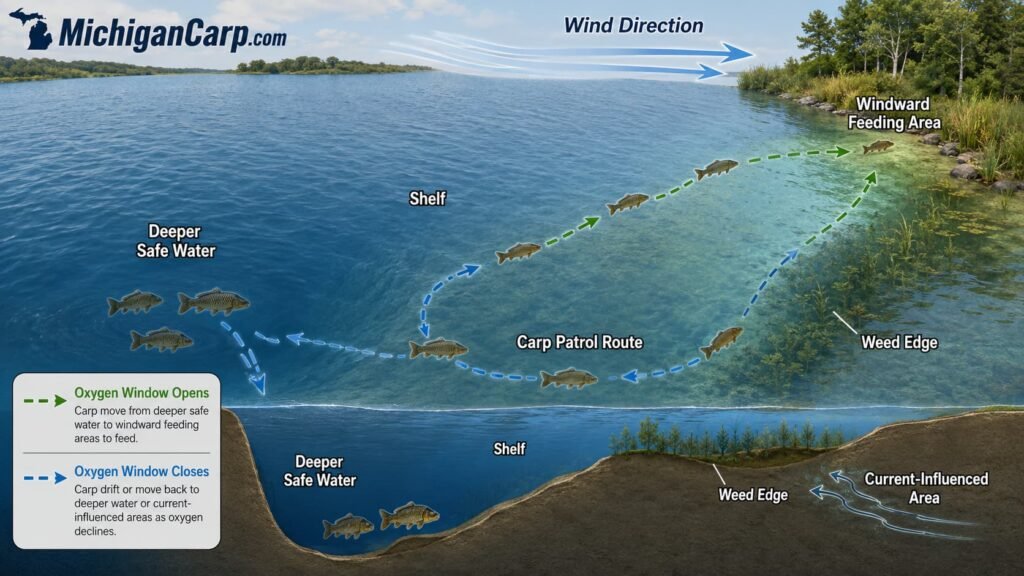
Wind can create one of the most reliable oxygen windows in lake fishing.
When wind blows across a lake, it does several things at once.
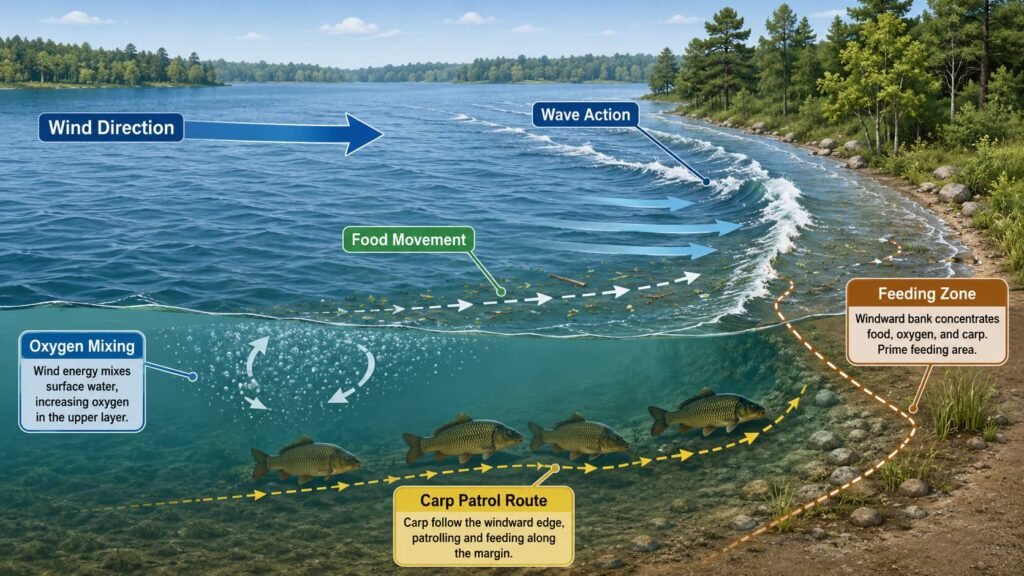
It mixes oxygen into the water. It breaks the surface. It pushes suspended food. It creates undertow. It can warm or cool areas depending on season and wind direction. It often makes carp feel safer because the surface is broken and visibility is reduced.
This is why a windward bank can come alive.
The important detail is duration.
A light breeze for ten minutes may not change much. A steady wind pushing into the same bank for several hours, or better still a day or two, can transform an area.
Food accumulates. Oxygen improves. The bank becomes more active. Carp may start patrolling it because several advantages are lining up together.
That is an oxygen window.
But wind must be judged by season.
In spring, a cold wind may push fish away from shallow water if it chills the margins. In summer, a warm or moderate wind may improve oxygen and feeding. In autumn, wind can again be excellent if it mixes water and concentrates food.
The best wind is not always the strongest wind. Sometimes a steady comfortable ripple is better than rough, dirty water that makes presentation difficult.
For bank anglers, wind is one of the most useful oxygen clues available. You may not be able to move around the lake easily, but you can choose shorelines where wind, depth, food, and access come together.
For more detail, read How Wind Affects Carp Location.
The Current Window
Current is even more powerful than wind in some waters.
Moving water usually carries oxygen, food, scent, temperature changes, and direction. Carp can use it like a travel lane.
This is especially important in Michigan because many good carp waters are influenced by:
- rivers
- creek mouths
- dam ponds
- narrows
- culverts
- channels
- Great Lakes-connected harbors
- marina entrances
- outflows
Current does not have to be strong. In fact, carp often prefer softer edges rather than the hardest push.
A current window can occur when fresh water enters an area and improves comfort. This might happen after rain, during dam flow changes, after wind-driven movement, or where a creek steadily feeds a lake.
The best areas are often:
- current seams
- slack water beside flow
- inside bends
- edges of inflows
- soft water behind points
- shelves beside moving water
- areas where food drifts naturally
Carp can sit near these areas and pick off food without wasting too much energy.
This is the energy equation again.
Good oxygen plus food movement plus manageable effort equals efficient feeding.
That is why current-influenced swims can produce when still areas struggle.
The Storm and Pressure Window
Storms can confuse carp anglers because they can help or hurt.
Before a storm, wind often increases, cloud cover builds, light levels drop, and pressure may change. The water can become more active. Carp may move and feed confidently before the worst weather arrives.
After a storm, rain and wind can cool surface water, increase oxygen, stir food, and bring fresh water into inflows.
But storms can also create problems.
A violent cold rain can shock shallow water. Heavy runoff can bring mud, chemicals, road wash, or sudden temperature changes. Strong winds can make presentation difficult. A major algae crash after unstable weather can reduce oxygen.
So the storm window is not automatic.
The key is to ask what the storm did to the water.
Did it improve oxygen?
Did it push food into a bank?
Did it cool overheated shallows?
Did it activate inflows?
Did it make carp feel safer?
Or did it muddy, chill, disturb, or destabilize the area?
In Michigan, summer thunderstorms can sometimes create strong short windows, especially after hot calm weather. A lake that felt flat and stale may suddenly breathe again.
Those can be excellent moments to fish windward edges, inflows, current seams, and nearby shelves.
The Thermocline Window
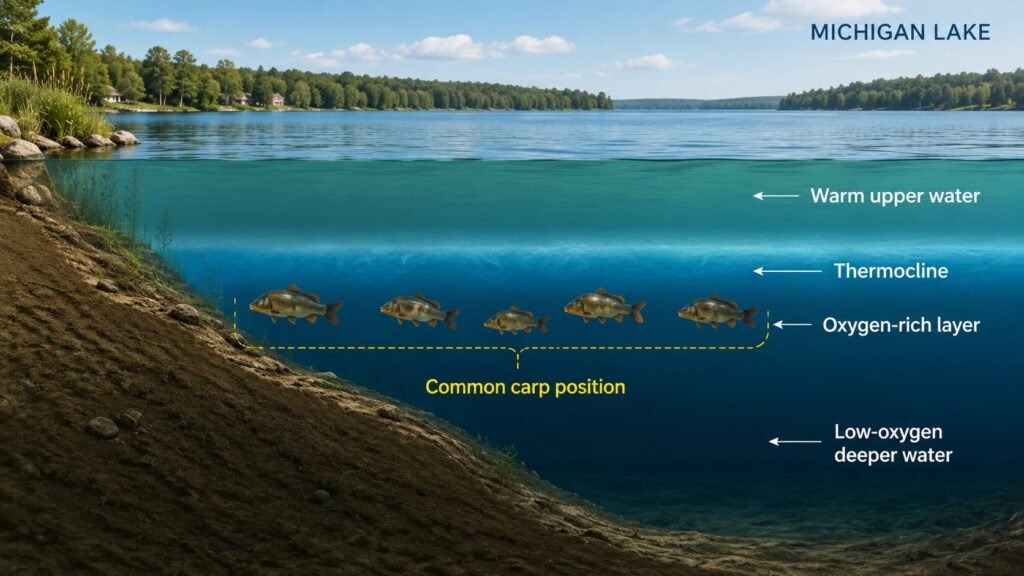
In summer, many lakes separate into layers.
The upper warm layer may be oxygenated by wind and surface mixing. The deeper layer may become colder but oxygen poor if it is cut off from mixing. Between them sits the thermocline, where temperature changes quickly with depth.
Carp often respond to this layering.
They may not want to spend long periods in low-oxygen deep water, but they may still use depth for safety, shade, and movement. As a result, they often relate to the upper edge of usable deep water, shelves above the thermocline, or transitions where oxygen and temperature are still comfortable.
A thermocline window can happen when carp patrol just above the poor water, using a depth band rather than the bottom itself.
This is important because anglers often cast to the deepest water available and assume it is the best place.
Sometimes the better area is:
- the shelf above the deep water
- the slope leading down
- the weedline near the break
- the current edge crossing the depth change
- the oxygen-rich layer above the basin
This is where a fish finder, Deeper-style sonar, underwater camera, or temperature profiling can be useful. You are not just looking for depth. You are looking for the usable layer.
For more detail, read Understanding Thermoclines in Michigan Lakes and Reading the Bottom for Carp Fishing.
Oxygen Windows and Baiting
Baiting should match the oxygen window.
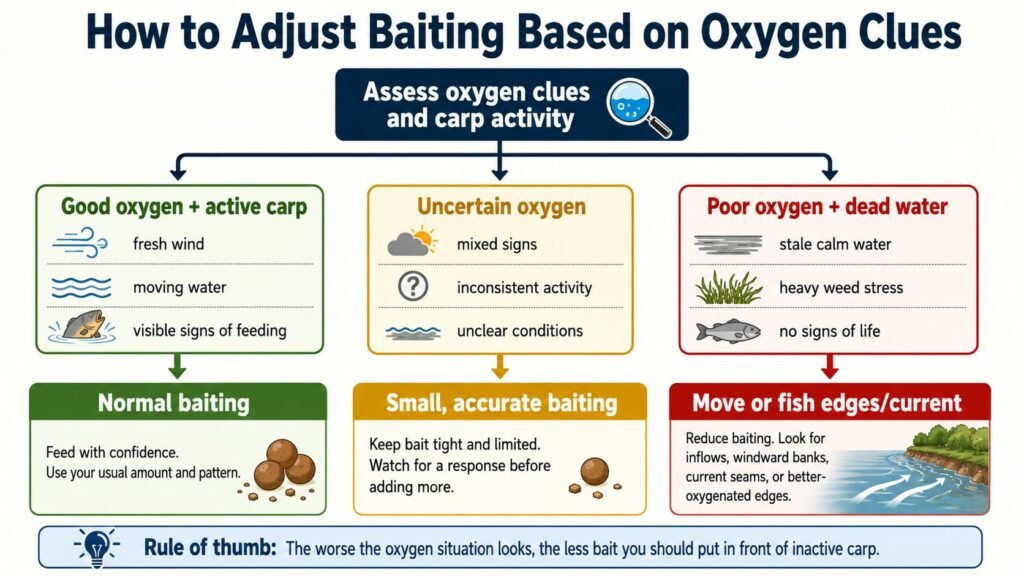
When oxygen is good and carp are active, they can feed harder, move more, and digest better. In those conditions, a larger baiting approach may work, especially if fish are already present and competing.
When oxygen is uncertain, small accurate baiting is usually safer.
When oxygen is poor, heavy baiting is often a mistake.
This is because carp in marginal oxygen may only feed briefly, lightly, or not at all. A big bed of bait may simply sit there. In warm, silty, low-flow water, uneaten bait can sour and add to local breakdown activity.
For oxygen window fishing, think in terms of matching bait to opportunity.
If the window is short, make the bait easy to find and easy to eat.
Good options include:
- small PVA bags
- short PVA sticks
- crumb
- small pellets
- a few boilies
- maize or corn in modest amounts
- accurate hookbait placement
- fishing clean edges rather than dead silt
If the window opens wider and fish are clearly feeding, you can increase bait carefully.
The key is not to feed based on hope.
Feed based on fish activity, oxygen clues, and how long you expect the window to last.
This fits well with a location-first carp strategy. Find living water first. Then bait with purpose.
Three-Rod Thinking During Oxygen Windows
If you fish multiple rods, oxygen windows can help you assign jobs to each rod.
A simple three-rod approach might look like this:
Rod one goes on the most reliable travel route. This might be a shelf, edge, or current seam where carp are likely to pass even outside the strongest feeding window.
Rod two goes on the likely feeding area. This might be the windward edge, clean weed hole, or natural food spot where carp may settle when the window opens.
Rod three explores the edge of the conditions. This could be slightly shallower, slightly deeper, closer to current, or closer to cover.
This approach is more useful than simply spreading rods randomly.
You are asking:
- where will carp travel?
- where will they feed if the window opens?
- where will they move if oxygen changes?
That is practical oxygen watercraft.
For shore anglers, this is especially valuable because you may not be able to chase fish with a boat. Your rods need to cover the most likely movement and feeding options from the bank.
How to Recognize an Opening Window
You will not always see carp before a window opens.
Sometimes the clues are more subtle.
Positive signs include:
- wind increasing into your bank
- surface ripple after flat calm
- baitfish moving shallow
- birds working a shoreline
- bubbles or fizzing beginning
- carp rolling or showing
- insects hatching
- current strengthening
- cooler water entering after heat
- weed edges looking alive
- sonar showing fish at a consistent layer
These signs do not guarantee a bite, but they suggest the lake is becoming more active.
When that happens, be ready.
Check rigs.
Freshen hookbaits.
Recast accurately.
Avoid heavy disturbance.
Keep bait tight.
Watch the water carefully.
Many oxygen windows are short. If you spend the first half of the window retying rigs, moving gear, or spodding heavily, you may miss the best part.
How to Recognize a Closing Window
Just as windows open, they also close.
Signs may include:
- wind dropping completely
- surface going flat and stale
- fizzing stopping
- baitfish disappearing
- carp rolling farther away
- water becoming cloudy or sour
- weed debris drifting in
- strong sun pushing fish off shallow water
- a cold wind chilling the area
- bites and liners suddenly stopping
When a window closes, you have three choices.
Stay and wait for it to reopen.
Adjust within the same swim.
Move to better water if possible.
The right decision depends on the venue, time available, and whether carp are likely to return.
If you are fishing a known patrol route, patience may be right. If you are fishing a shallow bay that has clearly gone stale, moving may be better.
Good anglers do not move randomly. They move because the water tells them something has changed.
Michigan Notes
Michigan carp anglers deal with very different types of water.
A shallow weedy inland lake does not behave like a deep northern glacial lake. A river-connected dam pond does not behave like an isolated farm pond. A Lake Michigan harbor does not behave like a small back bay.
This is why oxygen windows vary by venue.
On northern Michigan lakes, cooler water and wind exposure may help maintain better oxygen for longer periods. On fertile inland lakes, weed and algae can create stronger day-night swings. On river systems and dam ponds, current may create more consistent feeding routes. In Great Lakes-connected water, wind direction and water exchange can change conditions quickly.
For bank anglers, this matters because access is limited.
You may not be able to reach every part of the lake, so you need to choose banks that give you the best chance of intercepting oxygen-related movement.
Good shore-access areas often include:
- windward banks
- points
- narrows
- creek mouths
- marina edges
- bridge areas
- dam pond current edges
- shelves within casting range
- weed edges near clean bottom
- shorelines with both shallow and deeper access
The best bank is not always the most comfortable bank.
It is the bank where carp have a reason to pass when the oxygen window opens.
Seasonal Oxygen Windows
Spring
In spring, oxygen is usually fairly good across much of the lake because water has recently mixed. The bigger limiting factor is often temperature.
Spring windows often form when sunlight warms shallow water, dark bottom areas heat up, and carp begin moving into comfortable margins. Inflows can also be useful, especially if they bring slightly warmer or food-rich water.
At this time of year, look for:
- warming shallows
- protected bays
- dark bottom
- early weed growth
- nearby deeper water
- sun-exposed banks
- light wind pushing warmer water
Do not overbait early. Carp may feed, but digestion is still slower in cold water.
Early Summer
Early summer can produce some of the best oxygen windows.
Water temperatures are rising, weed is healthy, natural food is increasing, and oxygen is often still good in many areas.
Carp may feed strongly around:
- weed edges
- windward banks
- shallow shelves
- natural food beds
- spawning-adjacent areas after recovery
- current seams
This is a good time to watch for repeated daily movement patterns.
Midsummer
Midsummer is the most complex period.
Warm water increases carp metabolism, but oxygen can become limiting in some areas. Hot calm weather, algae blooms, dying weed, and stratification can all change the picture.
The best midsummer windows often involve:
- wind after calm weather
- current or inflow
- night cooling in open water
- daylight oxygen around healthy weed
- deeper edges above poor oxygen
- storm-related mixing
- shade and safety combined with food
Avoid assuming all shallow water is good or all deep water is safe. Read each area properly.
Autumn
Autumn often brings improving oxygen as water cools and mixing increases.
Carp may feed hard because conditions are comfortable and they are building energy before winter.
Autumn windows may last longer than summer windows because oxygen stress is often reduced. Wind can still be very important, especially when it pushes food into accessible banks.
This can be an excellent time to fish:
- windward shores
- deeper shelves
- natural food areas
- dam pond edges
- current-influenced zones
- areas that were poor during hot summer
Winter
Winter carp fishing is slower, but oxygen still matters.
Cold water holds oxygen well, but ice, snow cover, and decomposition can reduce oxygen in shallow or enclosed waters.
Winter windows are often short and subtle.
Look for:
- stable weather
- slightly warmer periods
- deeper comfortable water
- low disturbance
- safe oxygen areas
- small accurate baiting
In winter, the goal is not to create a big feeding response. It is to place a small amount of attractive food where carp are already comfortable.
Practical Session Plan
Here is a simple way to apply oxygen window thinking during a session.
Before choosing a swim, ask:
- where is the wind going?
- is there current nearby?
- are there inflows or outflows?
- is the water shallow, deep, or mixed?
- is there healthy weed or dying weed?
- where is natural food likely to collect?
- can carp move safely through this area?
- does the spot feel alive?
Once fishing, watch for change.
If the wind increases into your bank, be ready.
If the sun wakes up a healthy weed edge, watch for fizzing and rolling.
If a creek begins pushing colored water after rain, check the softer edges.
If a deep basin feels lifeless, look for the shelf above it.
If a shallow bay goes flat and stale, do not be afraid to reposition.
The main lesson is simple.
Do not fish yesterday’s conditions.
Fish what the water is doing now.
Common Mistakes
Treating Feeding Windows as Luck
Short feeding spells often have causes. Wind, oxygen, light, current, temperature, and food movement may be lining up. Keep notes and look for patterns.
Assuming Dawn Is Always Best
Dawn can be excellent, but oxygen may be lowest before sunrise in weedy or algae-rich water. Some areas may fish better after sunlight and wind improve conditions.
Overbaiting a Short Window
If carp only feed briefly, heavy baiting can be wasteful. Small accurate baiting often suits short oxygen windows better.
Ignoring Wind Changes
A wind shift can completely change which bank is alive. Watch wind direction and duration, not just speed.
Fishing Below the Productive Layer
In summer, deep water below the thermocline may be oxygen poor. Carp may be above it, along the edge, or on nearby shelves instead.
Staying in Dead Water Too Long
If a spot feels lifeless and gives no signs of movement, oxygen may be part of the problem. Sometimes the best adjustment is to move to living water.
FAQ
What is an oxygen window in carp fishing?
An oxygen window is a period when dissolved oxygen, temperature, water movement, and food availability line up well enough for carp to feed more confidently.
Does dissolved oxygen trigger carp feeding?
Oxygen does not magically trigger feeding by itself. It enables feeding by making the water comfortable enough for carp to move, digest, and feed efficiently.
Why do carp sometimes feed for only a short time?
Short feeding spells can happen when conditions are only briefly favorable. Wind, current, daylight, temperature, and oxygen may create a temporary window that later closes.
Is dawn always the best time for carp fishing?
No. Dawn can be excellent, but in weedy or algae-rich water oxygen may be lowest just before sunrise. Some venues may fish better later when sunlight and wind improve oxygen.
Why does wind create carp feeding windows?
Wind mixes oxygen into the water, pushes food, breaks up light penetration, and can make carp feel safer. A sustained wind into a bank can create strong feeding conditions.
Are current areas good for oxygen windows?
Yes. Current often carries oxygen and food, making inflows, seams, narrows, and softer edges reliable carp movement and feeding areas.
Should I bait heavily during an oxygen window?
Only if carp are clearly active and the water is well oxygenated. In uncertain or short windows, small accurate baiting is usually safer.
How can I tell if an oxygen window is opening?
Watch for wind increase, surface ripple, baitfish activity, bird activity, carp showing, fizzing, current changes, insect hatches, or fish appearing at a consistent depth layer.
Final Thoughts
Oxygen windows explain a lot of what carp anglers see on the bank.
They explain why a dead lake can suddenly come alive.
They explain why carp may feed hard for a short spell and then vanish.
They explain why wind, current, weed, temperature, and depth all matter together.
The important lesson is that carp are not simply looking for food.
They are looking for places where feeding makes sense.
A good oxygen window gives carp the comfort and efficiency they need to move and feed. When that window opens, your bait has a much better chance of being accepted.
When it closes, even good bait and good rigs may struggle.
So instead of only asking, “What bait should I use?” or “How deep should I fish?”
Start asking:
- when is this area most alive?
- when does oxygen improve here?
- when do carp naturally pass through?
- when does food movement peak?
- when is this swim comfortable enough for feeding?
That is the thinking that turns dissolved oxygen from a science topic into real carp fishing watercraft.
Fish the window.
Fish the living water.
Next Steps
Read these next:
- Dissolved Oxygen and Carp Fishing
- Water Temperature and Carp Fishing
- How Wind Affects Carp Location
- Understanding Thermoclines in Michigan Lakes
- Reading the Bottom for Carp Fishing
- Natural Carp Food Sources
- Carp Daily Activity Patterns