

Michigan carp fishing regulations are not something to guess at.
Carp fishing in Michigan is generally straightforward when you are fishing with normal rod-and-line methods, but several rules matter directly to the way specialist carp anglers fish.
Rod limits matter.
Bait and chumming rules matter.
Public access matters.
Campground and state-park hours matter.
Moving live fish matters.
And the exact water can matter just as much as the statewide rule.
This guide is written specifically for anglers targeting common carp by rod and line, especially anglers using boilies, corn, particles, tiger nuts, alarms, multiple rods and longer sessions on Michigan public waters.
It is not legal advice and it should never replace the current official regulations.
The Michigan DNR Fishing Regulations are the primary source to check before fishing, and the current regulation summary should always be checked again before a trip because Fisheries Orders and water-specific rules can change.
As of this update, the 2026 Michigan Fishing Regulations are in effect through March 31, 2027.
For the broader process of researching a new lake or reservoir before fishing it, use How to Research New Carp Waters in Michigan Using Public Tools.
For the difference between the common carp targeted by this site and prohibited invasive carp species, read Common Carp vs Invasive Carp in Michigan.
Table of Contents
Quick Start: Michigan Carp Fishing Rules That Matter Most
| Question | Practical Answer |
|---|---|
| Do I need a fishing license? | Anglers age 17 and older generally need a valid Michigan fishing license when fishing public waters. |
| How many rods can I use? | General hook-and-line regulations allow no more than three lines per person. |
| How many hooks can I use? | Under the general rule, no more than six hooks or lures may be used across those lines. Special waters can differ. |
| Can I leave rods fishing while I walk away? | No. Fishing lines must remain under immediate control. |
| Can I chum a Michigan stream with corn or particles? | The 2026 regulations prohibit chumming with organic material in all stream Types. |
| Does that automatically ban prebaiting every inland lake? | Do not generalize the stream rule to every lake. Check the exact water and property rules before baiting. |
| Can live carp be used as bait? | No. The regulations specifically exclude live carp and goldfish from lawful baitfish use. |
| Can I move a carp to another lake? | Do not move live carp between waters. Michigan restricts planting or transplanting live fish and the DNR advises against moving live fish between waterbodies. |
| Can I fish at night from a state park? | Maybe, but access rules matter. State-park day-use areas normally close at 10 p.m.; registered campers may remain in campgrounds after 10 p.m. That does not make every bank legal for night fishing. |
| Are common carp the same as invasive carp? | No. Common carp are different from silver, bighead, black and grass carp. |
| Should I check rules again before every trip? | Yes. Check statewide regulations, water-specific exceptions and the rules for the exact access property. |
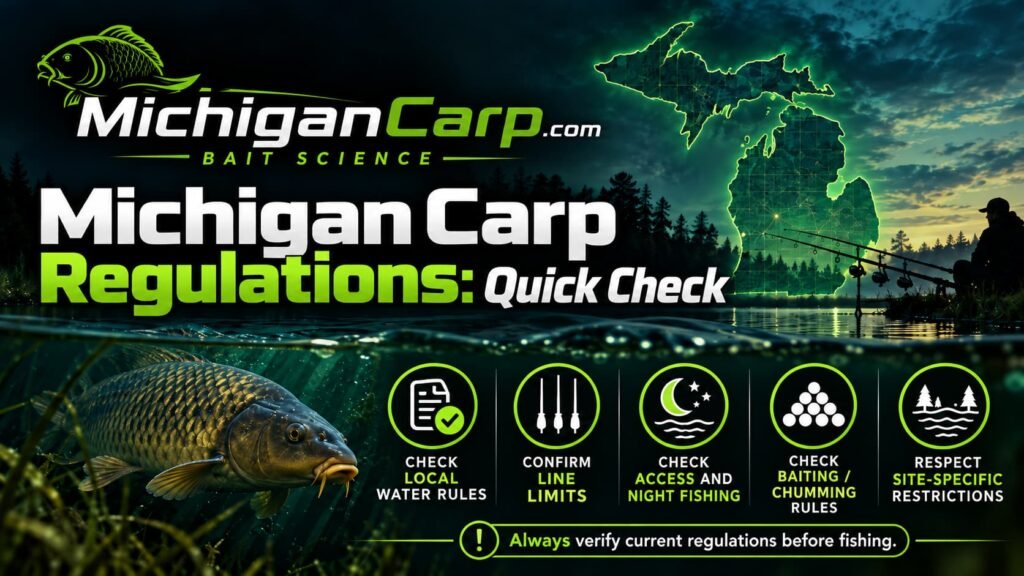
Start With the Current Michigan DNR Regulations
The safest habit is simple:
Check the rules for the water you are actually going to fish, not the rules you remember from last year or from another lake.
The main official resource is the Michigan DNR Fishing Regulations page.
That page links to the current regulation summary and Fisheries Orders.
The current 2026 Michigan Fishing Regulations are in effect through March 31, 2027.
That annual booklet is important, but it is not the end of the research.
Michigan waters can also be affected by:
- county exceptions;
- designated trout-water rules;
- special artificial-lure regulations;
- seasonal closures;
- Great Lakes and connecting-water rules;
- Michigan-Wisconsin boundary-water rules;
- individual Fisheries Orders;
- state-park or recreation-area rules;
- campground rules;
- boating-access rules;
- municipal or local access restrictions.
That is why the question should never be simply:
“Is carp fishing legal in Michigan?”
The better question is:
“What rules apply to the exact water, exact access point and exact method I intend to use?”
Do You Need a Michigan Fishing License for Carp?
For most carp anglers, yes.
Michigan requires anglers 17 years of age and older to hold the appropriate fishing license when fishing public waters.
Carp do not create an exemption from normal licensing requirements.
That applies whether you are fishing:
- corn;
- boilies;
- tiger nuts;
- particles;
- packbait;
- bread;
- worms;
- conventional bottom rigs;
- hair rigs;
- pop-ups;
- wafters.
The bait does not remove the requirement to be legally licensed.
Before fishing, check the current licensing information through the Michigan DNR Fishing Regulations page.
For state parks and recreation areas, the DNR also specifically states that anglers age 17 and older must have a fishing license when fishing in areas lawfully open to fishing.
How Many Rods Can You Use for Carp in Michigan?
This is one of the most useful regulations for specialist carp anglers to know.
Under Michigan’s general hook-and-line fishing rules:
No more than three lines per person may be used.
That is why a three-rod carp setup fits normal Michigan hook-and-line regulations.
The general rule also limits anglers to six hooks or lures across those lines.
For a normal carp setup using one hook on each rig, that is uncomplicated.
Three rods.
One hook per rod.
Three hooks total.
Well within the general statewide maximum.
But there is another important requirement:
All lines must remain under immediate control.
That matters particularly during overnight and multi-day carp sessions.
A bite alarm does not turn an unattended rod into an attended rod.
Your fishing setup should allow you to reach the rods immediately when a take develops.
Two Anglers Do Not Automatically Mean One Six-Rod Setup
If two properly licensed anglers are fishing together under regulations that allow three lines each, six lines may be in use between them.
But each angler remains responsible for his own lawful fishing activity and the lines still need to remain under immediate control.
Do not use another angler’s presence as a reason to leave active rods unattended while both people walk away from the swim.
Special Waters Can Have Different Hook Rules
Do not assume every boundary or specially regulated water follows exactly the same hook total as the general statewide provision.
For example, Michigan-Wisconsin boundary-water regulations use their own line-and-hook provisions.
The lesson is not to memorize every exception.
The lesson is:
Check the exact water when it falls into a special regulatory category.
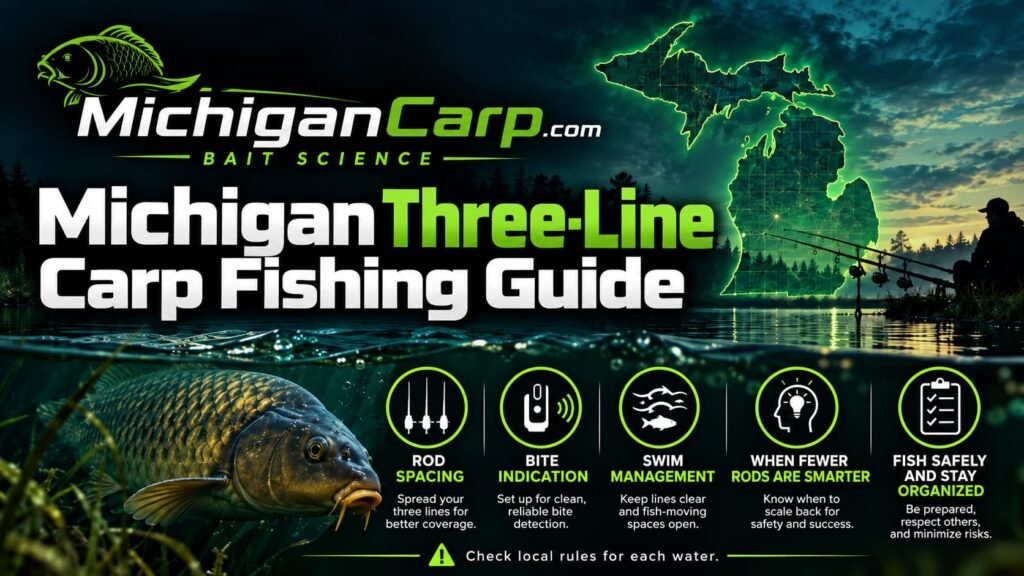
Hooks, Rigs and Immediate Control
Michigan’s regulations require fish taken by hook and line to be hooked lawfully.
The current regulations also state that a fish not hooked in the mouth must be returned to the water immediately.
For ordinary specialist carp fishing, this should reinforce what we should already be trying to achieve:
- a rig that is intended to be taken into the mouth;
- a sharp single hook;
- a safe lead arrangement;
- strong enough line for the water;
- direct control of the rods;
- prompt response to a take.
MichiganCarp.com is not interested in exploiting technical loopholes around rigs.
The aim is straightforward, safe hook-and-line carp fishing.
For rig safety, use Complete Carp Rig Guide for Michigan.
For mainline, leaders, abrasion and snag safety, use Carp Fishing Line and Leaders for Michigan.
Bait Rules: Carp Bait Is Not the Same as Live Bait
The word bait covers very different things in fishing regulations.
A carp angler may think of bait as:
- boilies;
- corn;
- maize;
- tiger nuts;
- hemp;
- pellets;
- crumb;
- packbait.
Fishing regulations also deal heavily with baitfish, crayfish, aquatic larvae and other live or naturally collected bait.
Those rules should not be confused.
Michigan’s current bait rules state that baitfish collected by anglers may only be used in the water where they were collected.
The regulations also specifically exclude live carp and goldfish from lawful use as bait.
That means you should never catch a small carp and use it as live bait.
For ordinary prepared carp bait, the bigger legal issue is often not the hookbait itself.
It is:
where, how and how much loose bait you introduce into the water.
That brings us to chumming.
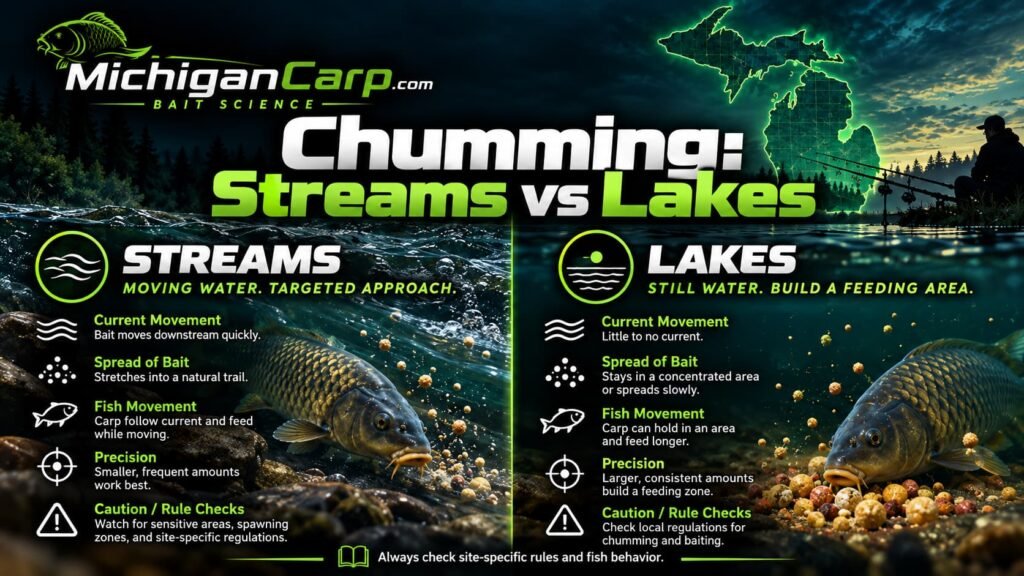
Chumming and Prebaiting: The Important Stream Rule
This is one of the most important corrections to the old version of this article.
Michigan’s 2026 regulations explicitly list the following as unlawful:
Chumming with organic material in all stream Types.
That matters to carp anglers.
Do not assume that because you can use corn, boilies or another food on a hook that you can automatically introduce quantities of that food into a Michigan stream as chum.
If you are fishing water classified under the stream regulations, treat the chumming restriction seriously.
That includes avoiding assumptions about loose feeding with:
- corn;
- maize;
- particles;
- boilies;
- pellets;
- bread;
- crumb;
- other organic food material.
Lakes and Streams Need to Be Treated Differently
Do not turn the stream rule into another inaccurate blanket claim and say:
“Chumming is illegal everywhere in Michigan.”
The regulation specifically addresses chumming with organic material in stream Types.
For inland lakes, reservoirs and other stillwaters, you should instead check:
- the current statewide fishing regulations;
- water-specific exceptions;
- Fisheries Orders;
- park or campground rules;
- local property rules;
- posted restrictions at the access site.
That distinction is particularly important for specialist carp anglers because prebaiting is common in carp fishing.
A five-gallon bucket of maize on a lake and a handful of corn in a regulated stream should not be treated as though they automatically fall under exactly the same rule.
When in doubt, check before baiting.
For bait choice and practical feeding strategy after you know the method is lawful, use Carp Bait Guide.
Special Trout Waters and Prepared Bait Restrictions
Carp anglers sometimes fish rivers, creeks and connected waters where trout regulations also apply.
That can change the rules considerably.
Some Michigan waters have:
- artificial-lure-only regulations;
- restrictions on possessing live bait;
- restrictions on prepared bait or organic food;
- closed seasons;
- special hook rules.
Do not assume that the presence of carp overrides the classification of the water.
If a stream section is regulated as a trout water, gear-restricted stream or another special category, those rules still matter even if the fish you intend to catch is a common carp.
Check the exact section of water, not merely the river name.
Can You Move Carp From One Michigan Lake to Another?
Do not move live carp between waters.
The DNR advises anglers not to move live fish from one body of water to another, and Michigan regulations restrict importing, planting or transplanting live fish without the required authority.
For a catch-and-release carp angler, the practical rule is simple:
Return the carp to the water from which you caught it.
Do not:
- move a large carp to another lake;
- transfer small carp as future stock;
- relocate carp because another venue seems suitable;
- release leftover live bait into another water;
- transport fish between waters for informal stocking.
Moving fish can spread disease and unwanted organisms as well as create an illegal introduction.
This is also one reason fish-care equipment should be cleaned and dried between waters.
For the full handling standard, use Carp Fish Care and Safety and Carp Weighing, Photos and Release.
Fishing State Parks, Campgrounds and Public Access Areas
A fishing license does not automatically give you unrestricted access to every shoreline.
This is particularly important for Michigan carp anglers because many productive waters are accessed through:
- state parks;
- state recreation areas;
- campgrounds;
- boating-access sites;
- public fishing piers;
- city parks;
- county parks.
The fish may be legal to target while the place you want to stand may have its own restrictions.
Michigan State-Park Hours
The Michigan DNR currently lists normal state-park and recreation-area day-use hours as 8 a.m. to 10 p.m.
Only registered campers are normally allowed to remain inside state-park campgrounds after 10 p.m.
State-park campground quiet hours are generally 10 p.m. to 8 a.m.
That creates an important distinction.
Being a registered camper after 10 p.m. does not automatically mean that every shoreline, beach, launch, pier or day-use area is open to fishing all night.
Check the exact property.
Check posted signs.
Check whether the fishing frontage is part of the campground or a day-use zone.
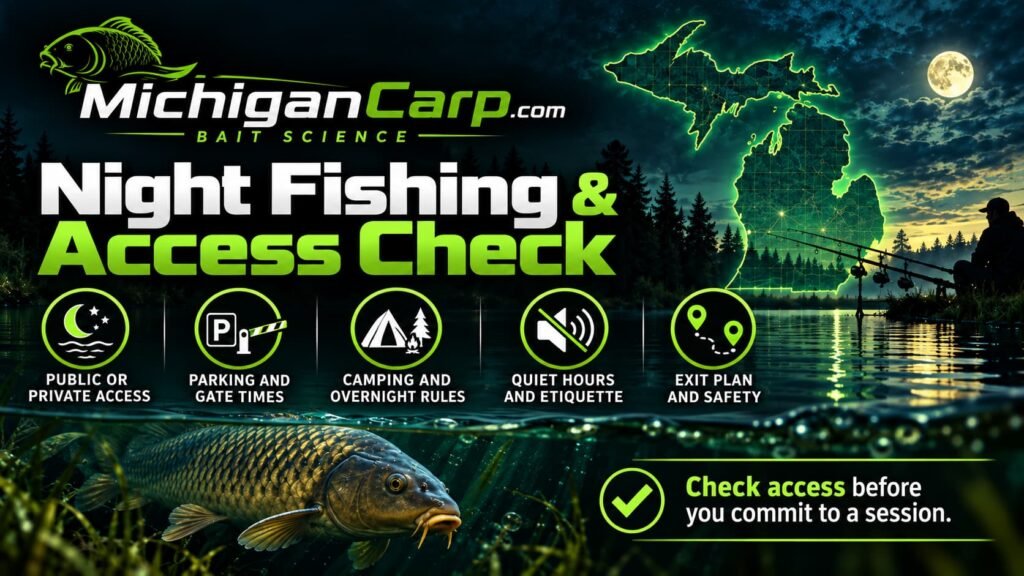
Night Fishing Needs Two Answers
Before planning an overnight session, answer both questions:
Is fishing permitted on this water at night?
and:
Am I legally allowed to remain at this access point at night?
Those are not always the same question.
A lake can be open to fishing while the park gate, beach, day-use area or public access closes at a particular time.
Camping Beside the Rods Does Not Remove the Rules
Long-session carp fishing is one of the reasons campgrounds are attractive.
A registered campsite can give you legal overnight presence close to the water, but it still does not override:
- fishing regulations;
- quiet hours;
- campground boundaries;
- swimming areas;
- launch rules;
- restricted shoreline;
- local rules;
- safe public access.
Keep alarms and general activity considerate during quiet hours.
Keep lines out of paths used by other campers.
Do not block launches or docks.
Do not assume a campsite advertised as “waterfront” automatically includes fishing rights from every part of that frontage.
The separate draft Carp Fishing from Michigan Campgrounds: How to Choose a Fishable Campsite covers that subject in detail and should remain separate from this regulations page.
Public Water Does Not Mean Unlimited Shore Access
Another common mistake is assuming that because a lake is public water, every bank is public.
It is not.
The water may be public while much of the shoreline is private property.
Use lawful access.
That may include:
- public boat launches;
- public fishing access sites;
- state parks;
- campgrounds;
- county parks;
- city parks;
- public piers;
- other clearly designated public land.
Do not cross private land simply because the fish are showing on the other side of the lake.
Do not block private docks.
Do not anchor or place gear where a local rule prohibits it.
And never assume a path through private land becomes public because other anglers have used it before.
For access research, use How to Research New Carp Waters in Michigan Using Public Tools.
Common Carp Are Not the Same as Invasive Carp
This distinction matters both legally and publicly.
MichiganCarp.com is primarily about common carp — Cyprinus carpio.
The Michigan DNR describes common carp separately from the invasive carp species currently of major Great Lakes concern.
Those invasive carp include:
- silver carp;
- bighead carp;
- black carp;
- grass carp.
Do not use the terms interchangeably.
If you catch an ordinary common carp while rod-and-line fishing, that is not the same thing as detecting a silver or bighead carp.
If you believe you have caught or observed a prohibited invasive carp, follow the current Michigan DNR Invasive Carp reporting guidance.
For identification and the wider explanation, use Common Carp vs Invasive Carp in Michigan rather than duplicating that whole subject here.
Bowfishing and Spearing Are Separate Regulatory Questions
MichiganCarp.com is built primarily around specialist rod-and-line carp fishing.
Michigan also has regulations governing bowfishing, spearing and certain forms of netting for carp and other species.
Those rules are different.
Do not assume that a rule applying to normal hook-and-line angling also defines where or when another method is lawful.
The current regulations contain specific tables covering:
- bow and arrow;
- crossbows;
- spearing;
- underwater spearfishing;
- hand nets;
- dip nets.
If you intend to use anything other than normal rod-and-line carp fishing, read the appropriate section of the current DNR regulations rather than relying on this article.
Keep the Rods Under Control
For practical carp fishing, one regulation deserves repeating:
All lines must be under immediate control.
This fits good carp fishing anyway.
You should be close enough to respond immediately when a carp takes.
That matters around:
- weed;
- timber;
- zebra mussels;
- rocks;
- docks;
- mooring lines;
- steep shelves;
- current.
The longer a hooked carp runs without control, the greater the chance of snagging or line failure.
Good legal practice and good fish care point in the same direction.
Stay with the rods.
For tackle strength and snag management, use Carp Fishing Line and Leaders for Michigan.
Clean, Drain, Dry and Do Not Release Leftover Bait
Rules designed to protect Michigan waters matter even when carp are not the reason they were created.
Do not release unwanted live bait into the lake.
Do not transfer water, live fish or aquatic organisms unnecessarily between venues.
Remove weed and other aquatic material from equipment.
Clean and dry boats, nets, mats, waders and other equipment appropriately between waters.
For a carp angler moving between Michigan lakes during the season, this is basic venue responsibility.
You may be targeting the same species at both waters, but unwanted organisms and fish disease can travel with equipment and water.
A Simple Pre-Session Regulations Check
Before travelling to a new Michigan carp water, run through this sequence.
1. Check the Current Statewide Regulations
Start with the Michigan DNR Fishing Regulations.
2. Identify the Exact Water
Do not stop at the lake or river name.
Check the section, county and access point.
3. Check for Special Regulations
Look for trout classifications, county exceptions, boundary-water rules, seasonal closures and Fisheries Orders.
4. Check the Property Rules
If you are using a state park, campground, city park, county park or boat launch, verify the hours and fishing rules for that property.
5. Check the Baiting Method
If you intend to chum, prebait or introduce significant loose feed, verify that the method is legal on that type of water.
The stream chumming restriction is particularly important.
6. Check Overnight Access
Do not assume fishing legality equals overnight access.
7. Check Your Rod Setup
For normal Michigan hook-and-line fishing, stay within the applicable line and hook limits and keep every line under immediate control.
8. Return Carp to the Same Water
Do not relocate fish between lakes.
This eight-step check takes very little time and can prevent a poor decision before the rods ever leave the truck.
Practical MichiganCarp View
Most responsible hook-and-line carp fishing in Michigan is not complicated.
The problems usually come from assumptions.
Assuming the same rules apply everywhere.
Assuming public water means public shoreline.
Assuming campground access means night fishing.
Assuming three rods can be left fishing while you walk away.
Assuming loose feeding is allowed simply because the hookbait is legal.
Assuming all fish called “carp” are regulated or managed in the same way.
The better approach is straightforward.
Check the current regulations.
Check the exact water.
Check the access site.
Keep the rods under control.
Use sensible baiting.
Do not move fish.
Handle carp properly.
Leave the bank clean.
And if anything is unclear, verify it with the Michigan DNR or the authority managing the property before fishing.
That approach protects the angler, the fish and the access we rely on.
FAQ
Do I need a fishing license to catch carp in Michigan?
Anglers age 17 and older generally need a valid Michigan fishing license when fishing public waters. Always check the current Michigan DNR licensing requirements before fishing.
How many rods can I use for carp fishing in Michigan?
Under the general Michigan hook-and-line rules, no more than three lines per person may be used. Specially regulated and boundary waters can have additional provisions, so check the exact water.
Can two carp anglers fish six rods in Michigan?
Under general rules allowing three lines per person, two licensed anglers may normally account for six lines between them. Each angler’s lines still need to comply with applicable hook limits and remain under immediate control.
Can I chum for carp in Michigan?
The 2026 regulations specifically prohibit chumming with organic material in all stream Types. Do not assume the same wording applies automatically to every inland lake. Check the exact water and property rules before prebaiting or chumming.
Can I use corn for carp in Michigan?
Corn is widely used as a carp hookbait, but the legal question changes when bait is introduced as chum or prebait. Stream chumming restrictions and local or water-specific rules must still be checked.
Can I use a live carp as bait in Michigan?
No. Michigan’s bait regulations specifically exclude live carp and goldfish from lawful bait use.
Can I move a carp from one Michigan lake to another?
Do not move live carp between waters. Michigan restricts planting or transplanting live fish, and moving fish can spread disease and unwanted organisms.
Can I fish for carp at night in a Michigan state park?
Possibly, but access rules matter. State-park day-use areas normally operate from 8 a.m. to 10 p.m., while registered campers may remain in campgrounds after 10 p.m. That does not mean every shoreline or fishing area is automatically open all night. Check the exact property.
Are common carp the same as invasive carp?
No. Common carp are different from invasive carp species such as silver, bighead, black and grass carp. If you suspect an invasive carp, follow Michigan DNR identification and reporting guidance.
Where should I check Michigan carp fishing regulations?
Start with the official Michigan DNR Fishing Regulations page and then check water-specific regulations, Fisheries Orders and the rules for the access property you intend to use.
Next Steps
Use these guides alongside the regulations page:
How to Research New Carp Waters in Michigan Using Public Tools — research public water, access and lake information before travelling.
Common Carp vs Invasive Carp in Michigan — understand the important species distinction.
Carp Fish Care and Safety — organize tackle, landing and handling around safe release.
Carp Weighing, Photos and Release — follow a controlled post-capture routine.
Carp Fishing Line and Leaders for Michigan — match tackle strength to weed, timber, rock and zebra mussels.
Carp Bait Guide — choose bait and feeding strategy after confirming the method is lawful.
Carp Fishing from Michigan Campgrounds: How to Choose a Fishable Campsite — use this upcoming guide when planning multi-day campground sessions.
The final rule is simple:
Check the current law, check the exact water, check the access property, and never rely on assumptions from another venue or another season.