

Public catch records can be useful for carp anglers, but only if you know how to read them.
A big carp entry on a public record list does not automatically mean you have found an easy venue. It does not tell you exactly where the fish was caught, how many carp live there, whether the water is still productive, whether access is practical, or whether the same area can be fished safely from the bank.
Michigan Master Angler carp records can be a useful research tool for anglers who want to understand trophy carp potential without simply chasing pins on a map.
But it can still tell you something important.
How Michigan Master Angler Carp Records Help Carp Anglers
Michigan Master Angler records can help you understand water types, trophy potential, county patterns, connected systems, repeat captures, and the kinds of places that are capable of producing larger common carp. Used properly, they can become part of a wider research system alongside lake maps, access checks, satellite imagery, fishery reports, and real watercraft.
This article explains how to use Michigan DNR Master Angler Program records sensibly for carp fishing research, without turning public data into careless spot exposure.
If you have not read it yet, start with How to Research New Carp Waters in Michigan Using Public Tools. That guide gives the wider research process. This article focuses specifically on how to interpret Master Angler carp records.
What the Michigan Master Angler Program Is
The Michigan Master Angler Program is a public recognition program for anglers who catch qualifying fish that meet species-specific minimum requirements. The DNR also provides public tools connected to Master Angler and state-record information.
For carp anglers, the useful starting points are:
Michigan DNR Master Angler Program
The main program page.
Michigan DNR Master Angler Map
The interactive map showing Master Angler and state-record catches.
Michigan DNR Minimum Entry Lengths, Weights and State Records
The current species-specific entry requirements and record information.
Michigan DNR State Record Fish
The state record list.
For common carp, these records are useful because they show that Michigan does produce large fish. They also help anglers think beyond familiar ponds and obvious shoreline spots.
But the key word is “research.”
Master Angler records should not be treated as a simple list of places to go and copy. They are better used as clues that help you understand which water types, counties, and connected systems may have the right ingredients for bigger carp.
What Master Angler Records Can Tell You
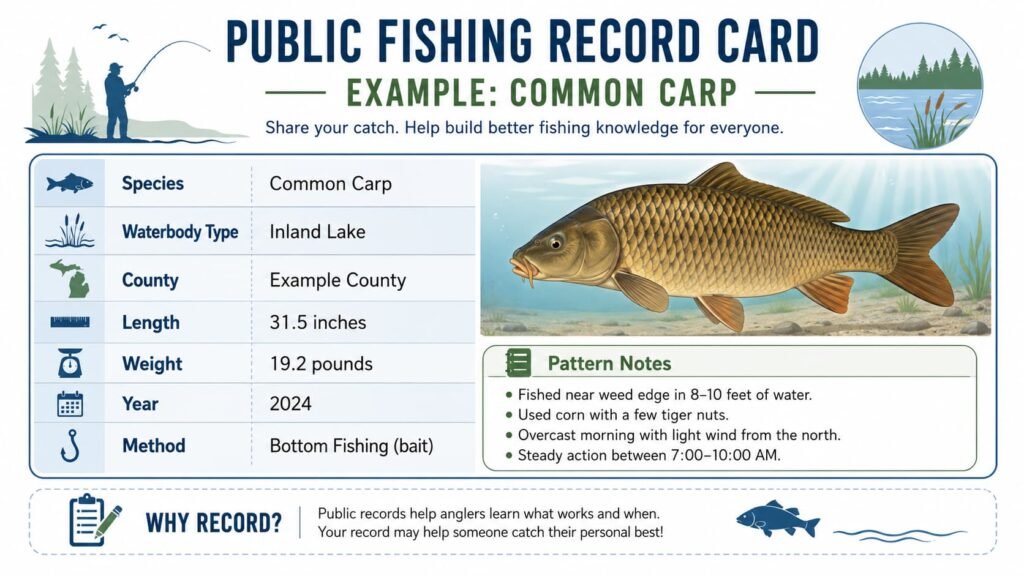
A Master Angler record can give you several useful clues.
It may tell you:
- the species
- the reported waterbody
- the county
- the year
- the size
- the general method or capture category
- whether similar fish have appeared from the same water
- whether a county or region has a pattern of larger fish
- whether certain water types keep producing
That information is useful because carp fishing is often about probability.
You are not trying to prove that a lake is easy. You are trying to decide whether it is worth investigating.
A single large carp from a water tells you that the water was capable of producing at least one large fish at one point in time. Repeated large carp from similar water types tell you more. Repeated records across several years tell you more again. Records from connected systems, large fertile waters, reservoirs, drowned river mouths, or productive inland lakes may suggest genuine trophy potential.
This is where Master Angler records become valuable.
They help you build questions.
Not “Where exactly was this fish caught?”
But:
- What type of water produced it?
- Is the water large or small?
- Is it connected to other water?
- Is it shallow, deep, weedy, fertile, or river-influenced?
- Does it have public access?
- Could it support old fish?
- Are there repeat records?
- Is there a pattern in the county or region?
- Does the water match the season I want to fish?
Good research starts with better questions.
What Master Angler Records Cannot Tell You
This is just as important.
Master Angler records cannot tell you everything you need to know.
They do not prove that a water has a large carp population. They do not prove that fish are easy to catch. They do not guarantee current conditions. They do not show every big carp in Michigan. They do not always reflect catch-and-release carp angling effort. They may include fish taken by different legal methods. They may also leave out many large carp that were never submitted.
Many specialist carp anglers do not submit every fish they catch. Some people avoid publicity. Some waters are deliberately kept quiet. Some big carp are seen, lost, photographed privately, or never recorded at all.
So public records are incomplete by nature.
That does not make them useless. It just means they should be used carefully.
A Master Angler entry is a clue, not a conclusion.
If you treat it as a final answer, you will waste time. If you treat it as one piece of a bigger puzzle, it can help you choose better waters to study.
For actual on-the-bank location work, combine records with How to Locate Carp Before You Cast and Reading a Lake Like a Carp Angler.
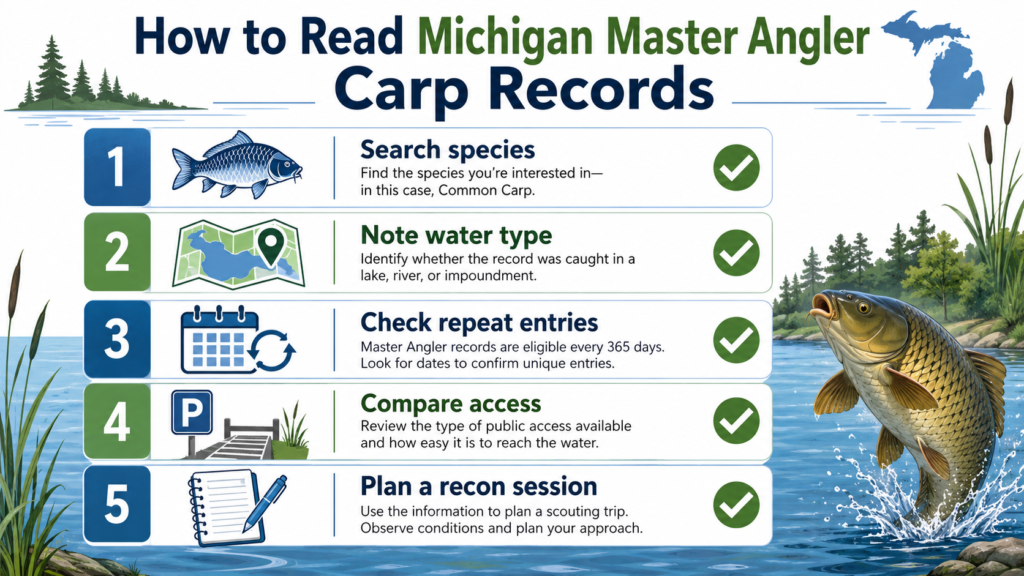
Search by Species First
When using the Master Angler map or report tools, start by narrowing your research to common carp.
This matters because the word “carp” can cause confusion. Common carp are not the same as invasive bighead, silver, black, or grass carp. Michigan anglers, conservation agencies, bowfishers, casual anglers, and the general public often use the word “carp” loosely.
For MichiganCarp.com, the focus is common carp caught by responsible catch-and-release carp anglers.
Use the DNR species information page, Michigan DNR Common Carp and Suckers, as a public reference point when needed. It explains where common carp occur and gives useful background on habitat and behavior.
Once you are looking at common carp records, begin sorting the data by location and water type.
Do not start by picking the nearest pin and driving there. Start by looking at the broader pattern.
Look for Repeat Entries
One record is interesting.
Repeated records are more useful.
If a water has produced several qualifying common carp over multiple years, that may suggest a more reliable carp population or at least a repeated chance of bigger fish. It does not guarantee easy fishing, but it deserves more attention than a single isolated record from decades ago.
Look for:
- multiple entries from the same water
- entries over several years
- entries from connected waterbodies nearby
- similar-size fish appearing repeatedly
- records from different parts of the same system
- nearby waters with similar habitat
A water with one old carp record may still be worth checking, especially if the habitat looks good. But a water with repeated records gives you stronger evidence that carp can reach size there.
Still, be careful.
A repeated public record water may also be pressured, awkward to fish, or dominated by non-catch-and-release harvest activity. You still need to check access, habitat, practical bank fishing, and seasonal logic.
Use How to Research New Carp Waters in Michigan Using Public Tools to build the rest of the picture.
Look for Water-Type Patterns
The most important lesson from public records may not be the names of waters.
It may be the types of waters.
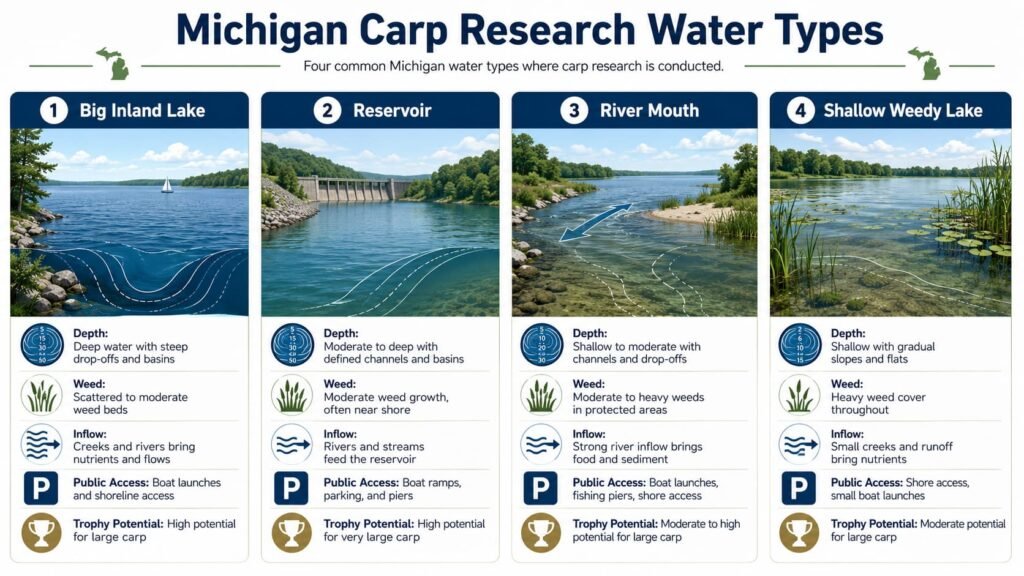
Big common carp are usually not random. They tend to come from places that allow them to survive, feed, grow, and avoid being removed too quickly. That often means a mixture of food, space, age structure, cover, depth, and lower effective angling pressure.
In Michigan, the following water types are worth studying closely when they show up in public records:
- big inland lakes
- productive shallow lakes
- reservoirs and impoundments
- drowned river mouths
- Great Lakes bays and connected water
- river systems with slow sections
- marinas and protected harbors
- weedy lakes with soft-bottom feeding areas
- waters with good public access but low specialist carp pressure
- waters with campgrounds or long-session potential
Do not assume every large lake is a good carp water. Some large waters are too clear, too cold, too sterile, too pressured, or too awkward from the bank. Do not assume every shallow weedy lake is good either. Some may have carp but poor access, low oxygen issues, or heavy weed that makes fishing difficult.
The pattern matters more than the label.
A productive 300-acre lake with soft bays, weed edges, inflows, and safe public access may be more interesting than a massive lake with no practical bank fishing. A reservoir with old channels, timber, quiet bays, and known carp evidence may be better than an easy public pier where carp only pass occasionally.
Use records to find water types that deserve investigation.
Then use watercraft to decide whether you can actually fish them.
Compare Records with Lake Maps
After you find a record that interests you, check the lake shape and depth.
Use Michigan DNR Inland Lake Maps where available. These maps are not perfect, and not every lake has one, but they can help you understand the structure of a water before visiting.
Look for:
- shallow bays
- deeper basins
- shelves
- narrow necks
- points
- creek inlets
- outlets
- old channels
- weed-friendly flats
- soft-bottom zones
- public access near useful features
A Master Angler record becomes more useful when the map explains why the water may produce good carp.
For example, if a lake has a shallow feeding bay connected to deeper safety water, that is useful. If a reservoir has an old river channel near flats and timber, that is useful. If a river mouth connects a lake to a larger system, that is useful. If a marina sits near a productive bay and public access, that may also be worth noting.
This is where the existing MichiganCarp.com guides connect together.
Use Best Depth for Carp Fishing in Michigan Lakes to interpret depth properly. Use Finding Carp in Big Michigan Lakes if the water is large and intimidating. Use Watercraft & Conditions to think through wind, food, weed, clarity, oxygen, and seasonal movement.
The public record tells you the water has potential.
The map helps you understand where that potential might be expressed.
Compare Records with Access
Access can make or break a carp venue.
A record from a water with no practical bank access may not help you much unless you have a boat, kayak, or legal way to reach fishable water. A record from a lake with several public shore options may be much more useful to a bank angler.
Check Michigan DNR Where to Fish and other public access resources. Look for boat launches, state parks, state forest campgrounds, county parks, public fishing areas, road ends, shoreline paths, and legal access points.
Then ask practical questions:
- Can I park legally?
- Can I fish without blocking a launch?
- Is there room for rods?
- Is the bank safe?
- Can I land a large carp?
- Are there trees behind me?
- Is there room to cast?
- Is night fishing allowed?
- Is the area too busy for quiet fishing?
- Is the best feature within casting range?
- Can I get a fish back safely?
This is where many promising records fall apart.
A water may hold good carp, but if the only public access is a busy launch, a swimming beach, a steep riprap wall, or a tiny roadside gap with no landing space, it may not suit your style of fishing.
The best research finds the overlap between carp potential and practical access.
Check the Year of the Record
The age of a record matters.
A recent record may suggest that the water still produces good carp. An older record may still be useful, but it needs more caution. Lakes change. Access changes. Weed changes. Water clarity changes. Fish populations change. Public pressure changes. Carp can be removed, and habitat can improve or decline.
Do not dismiss old records automatically. A large old record may still tell you the water has the biological potential to grow big carp. But do not treat an old record as proof that the current fishery is strong.
Use the year as one layer of evidence.
A good pattern might look like this:
- one old large record
- several more recent qualifying records
- similar nearby waters producing fish
- good habitat on the map
- practical public access
- visible carp signs during recon
A weaker pattern might look like this:
- one old record
- no recent evidence
- poor access
- no obvious carp habitat
- no visual signs
- no practical swim options
Both waters may hold carp. But one is much more worth your time.
Understand Method and Context
When looking at public records, pay attention to capture method and context where available.
A carp taken by rod and line tells you something different from a carp taken by spear or bow. Both may prove that large carp exist in the water, but they do not tell you the same thing about angling opportunity.
A bowfishing or spearing record may suggest that large carp use shallow areas at certain times. That can still be useful information. It may point toward spring movement, spawning zones, shallow bays, night visibility, or shoreline routes. But it does not mean those fish are easy to catch on a rig and bait.
A rod-and-line record is closer to what a catch-and-release carp angler wants to know, but it still needs context. Was the fish caught by someone targeting carp, or accidentally while fishing for another species? Was it caught from a public bank, a boat, a marina, or private frontage? Was it a one-off capture or part of a known population?
Public records rarely answer all of that.
So use method as a clue, not a final answer.
Think in Counties and Regions
Sometimes the county pattern is more useful than the single water.
If multiple waters in one region produce large common carp, that may suggest useful conditions across the area: productive lakes, connected waters, suitable climate, strong food sources, low specialist pressure, or many underfished public options.
This can help you find similar waters that are not obvious public record waters.
For example, if one productive lake in a county has records, look at nearby lakes with similar size, depth, fertility, access, and habitat. If a reservoir system shows carp potential, study connected waters and similar impoundments. If a river mouth or bay produces, look for similar river-mouth environments.
This is how you use public data without simply chasing pins.
You identify a pattern, then apply it elsewhere.
That is far more valuable than copying one spot.
Do Not Ignore Small Clues
Not every useful record is a giant.
A qualifying common carp that is not a state-record-class fish can still matter. If a water repeatedly produces solid fish, it may have the food and age structure to produce larger ones. Many trophy carp waters are first noticed through repeated mid-20s, 30s, or long fish before someone eventually sees or catches a true giant.
Look for consistency.
A water that produces several good fish over time may be a better campaign target than a water with one enormous outlier and no other evidence.
Also look for waters that are connected to larger systems. A lake, bay, channel, river mouth, or reservoir may not show many records by itself, but if nearby connected water has evidence of big carp, the whole system may deserve attention.
Carp move where they can. Connected water matters.
Protect Sensitive Information
This is important.
Public records are public, but that does not mean carp anglers should carelessly expose every small water, exact bank, campsite, or access point.
Michigan has many waters, but some carp populations are vulnerable to pressure, harvest, poor handling, and social-media attention. A small lake with a few old big commons can be damaged quickly if exact information is shared without thought.
MichiganCarp.com should teach people how to research, not just where to go.
A good rule is:
Share the method. Protect the exact spot.
You can discuss water types, public tools, responsible research, and general patterns without naming sensitive swims. You can teach people how to use Master Angler records without turning the article into a hotspot list.
That approach helps the sport grow while still respecting the fish and the waters.
Turn Public Records into a Recon Plan
Once a water looks promising, build a first-visit plan.
Do not immediately plan a heavy prebaiting campaign. Do not turn up with buckets of bait and sit in the nearest access point. Treat the first visit as investigation.
Before going, write down:
- why the water interests you
- what record or pattern caught your attention
- what type of water it is
- what access points look legal and practical
- what features you want to inspect
- what season should suit the water
- what signs you hope to see
- what backup areas you will check
When you arrive, walk first.
Look for:
- rolling fish
- bubbling
- mud clouds
- cruising carp
- feeding birds
- disturbed weed
- soft-bottom areas
- shallow bays
- reed edges
- creek mouths
- safe landing areas
- snag risks
- casting restrictions
- human pressure
Do not be afraid to leave without fishing. A recon session that saves you three bad trips is a success.
If the water looks right, then plan a proper session.
That might mean a short evening, a dawn session, a light-bait approach, a careful prebaiting plan, or a longer campaign. Let the water decide.
How to Score a Master Angler Lead
Here is a simple way to score a potential water after checking the records.
Give each item a score from 0 to 3:
- Master Angler evidence
- repeat entries
- recent evidence
- water size and growth potential
- food and habitat
- depth variety
- connected water
- public access
- practical bank fishing
- safe landing area
- low specialist pressure
- seasonal fit
A high score does not guarantee success. It simply helps you compare waters.
For example, a water with a great record but terrible access may score lower than a water with fewer records but better habitat, better bank options, and less pressure.
The best carp waters often have a combination of evidence, access, food, depth, and privacy.
Example Research Thought Process
Imagine you find a common carp record from a large inland lake.
Instead of saying, “That is where I am fishing,” slow down.
First, check whether there are repeated records. Then check the lake map. Look for shallow bays, deeper basins, shelves, creek mouths, and public access. Use satellite imagery to check weed growth, docks, shoreline shape, and whether there are realistic bank swims. Check the season. A shallow bay may be best in spring. A deeper edge may be better in late summer or fall. A windward bank may come alive during the right weather.
Then ask whether the water suits your actual fishing.
Can you fish it from the bank? Can you land a big fish? Can you bait accurately? Are there snags? Is night fishing practical? Are there too many boats? Is the access safe?
Only after that should you choose a first-session plan.
This is how public data becomes useful.
It moves you from “someone caught a big carp somewhere” to “this water type, at this time of year, with this access and these features, is worth investigating.”
That is real research.
Common Mistakes When Using Master Angler Records
The first mistake is chasing a single pin.
A single record can be exciting, but it is not enough. Always look for context.
The second mistake is ignoring access. Many anglers find a promising water online, then discover that the only public area is unfishable.
The third mistake is confusing presence with catchability. Carp may live in a water but spend most of their time out of range, in private areas, in heavy weed, or in areas that are unsafe to fish.
The fourth mistake is ignoring method. A fish seen or taken shallow during one season may not represent normal rod-and-line opportunity.
The fifth mistake is overbaiting too early. Until you know carp are using a spot, keep baiting light and accurate.
The sixth mistake is publishing too much. Public tools should help anglers learn, not expose every sensitive bank.
Final Thoughts
Michigan Master Angler carp records are valuable, but not because they give you a shortcut.
They are valuable because they help you think better.
They show what is possible. They highlight productive water types. They reveal patterns across counties, connected systems, and lake styles. They help you choose waters worth studying. They give you starting points for map work, access checks, satellite research, and recon sessions.
But they do not replace watercraft.
The best approach is to use public records as one layer of evidence. Combine them with lake maps, access research, seasonal timing, visual observation, safe bank choice, and proper fish care.
Use the record to ask better questions.
Then use your eyes, your notes, and your time on the bank to answer them.
For the full research process, read How to Research New Carp Waters in Michigan Using Public Tools. For practical location work once you reach the water, read How to Locate Carp Before You Cast and Reading a Lake Like a Carp Angler.
FAQ
Are Michigan Master Angler records useful for carp fishing?
Yes, but they should be used as clues rather than guarantees. They can show trophy potential, water-type patterns, repeat captures, and regions worth researching.
Do Master Angler records prove a lake has lots of carp?
No. A record proves that a qualifying fish was reported. It does not prove population size, current access, catchability, or repeatable fishing.
Should I fish exactly where a Master Angler carp was reported?
Not necessarily. Use the record to study the water type and surrounding features. Exact spot-chasing is less useful than understanding why the fish may have been there.
What should I check after finding a carp record?
Check the lake map, satellite imagery, public access, shoreline practicality, depth, weed, inflows, season, and whether the water has repeat evidence.
Are old carp records still useful?
Yes, but use caution. Old records can show biological potential, but they do not guarantee that the current fishery is the same.
Should exact carp locations be shared online?
Be careful. Public education is good, but exact small-water spots, sensitive banks, and low-pressure carp locations should be protected. Share the research system, not every swim.
Are Michigan Master Angler carp records useful for finding trophy carp?
Yes. Michigan Master Angler carp records can help anglers identify water types, regions, repeat entries, and public-access clues that may point toward trophy carp potential. They should be used as research clues, not as guaranteed fishing spots.