

Cheap carp bait liquids can work perfectly well when they add something useful to the bait. The useful part may be water-soluble food material, moisture, taste, binding, fine particles or a controlled coating. None of those jobs requires an expensive bottle.
The mistake is treating cheap as a guarantee of attraction. Molasses is inexpensive, but sweetness alone does not prove a feeding response. Condensed milk can help the wet side of a method mix, but it can also make the mix sticky and perishable. Corn steep liquor can be economical by volume, but different products vary in concentration, salt, acidity and preservation.
This page has one narrow job: identify inexpensive liquids that can earn a place in practical Michigan carp bait, explain what they actually contribute and give conservative starting amounts. For the broader decision between fermented liquids, yeast extracts, hydrolysates, sweet liquids, oils and carriers, use When to Use Each Type of Carp Bait Liquid.
Do not ask whether a liquid is cheap or expensive first. Ask what it changes, how much the bait needs and whether the finished presentation still works.
Table of Contents
Quick Start: Six Low-Cost Options Worth Considering
| Low-cost liquid | What it can contribute | Best first use | Main limitation |
|---|---|---|---|
| Cooked particle liquor | Moisture and soluble material already released from the feed | Crumb, method mix or correctly prepared particles | Fresh and perishable; never rescues unsafe particles |
| Commercial CSL | Water-soluble corn-derived material, organic acids and variable nitrogenous compounds | Particles, crumb and wider free bait | Products vary; not every brown corn liquid is true CSL |
| Yeast extract | Savoury soluble material used effectively at low levels | Small crumb batches, hookbait treatments and non-marine bait | Dense consumer pastes can be salty and dominant |
| Molasses | Sugars, minerals, viscosity and binding | Particles, packbait and method mix | Sweetness is not proof of attraction; too much makes bait sticky |
| Canned corn liquid or creamed corn | Moisture, corn solids, fine particles and binding | Packbait and method-style mixes | Perishable after opening and easy to over-wet |
| Condensed or evaporated milk | Milk solids, moisture, cloud and binding | Milk/nut crumb, packbait and method mix | Perishable and mechanically heavy when overused |
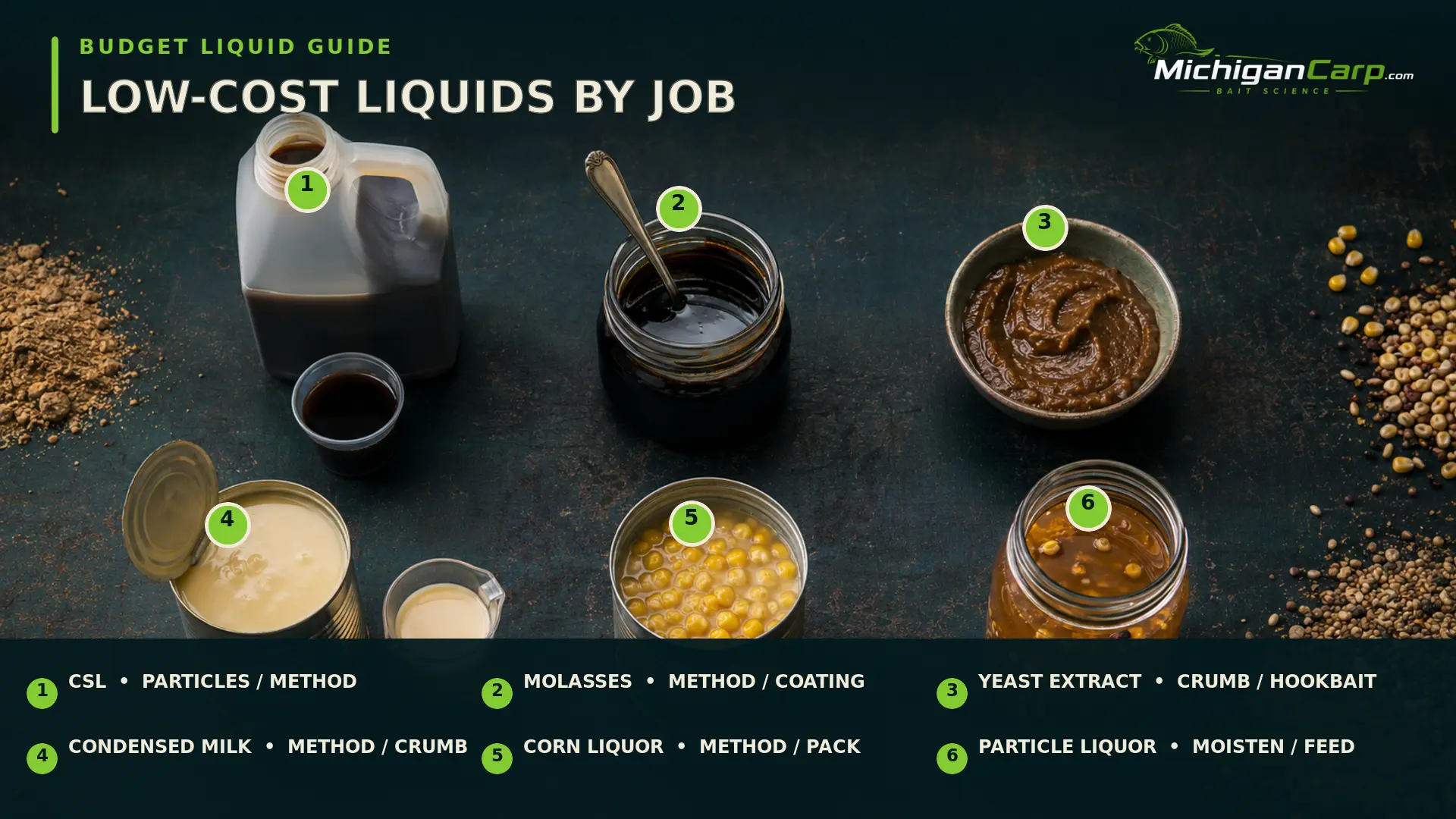
If you want one simple rule, start with the liquid that already belongs with the bait. Prepared particle liquor fits particles and crumb. Creamed corn fits corn-based packbait. Yeast extract fits a savoury milk, nut or seed approach. The job should be obvious before the bottle is opened.
Judge Value by the Job, Not the Bottle Price
The cheapest bottle is not always the cheapest treatment. A concentrated yeast paste may cost more per ounce than molasses but treat many more small batches. A gallon of feed liquid may look inexpensive until most of it spoils or gets poured into free bait that never needed it.
Judge value by four questions:
- How much liquid is needed per kilogram of finished bait?
- Does it add a useful food, taste or mechanical contribution?
- Can the opened product be stored without wasting half of it?
- Does the treated bait still cast, break down and present the rig correctly?
This is where the specialist-carp premium can become misleading. A plain feed or food ingredient may perform the same physical job for less money. But the reverse can also be true: a properly preserved specialist liquid with a known inclusion rate may be better value than repeatedly throwing away perishable grocery mixtures.
The sensible position is neither brand worship nor automatic suspicion. Read the label, measure the dose and judge the finished bait.
What Cheap Liquids Can and Cannot Prove
There is a reasonable scientific basis for paying attention to soluble food compounds. In controlled electrophysiological work, the external gustatory system of common carp responded strongly and selectively to several amino acids. The carp gustatory study by Marui, Harada and Kasahara helps explain why soluble chemistry matters.
It does not prove that a particular bottle will catch carp, that more liquid is better or that a bait can compensate for poor location. A receptor response in controlled research is not the same as a wild fish choosing a hookbait in a Michigan lake.
Ingredients also need to be described accurately. The USDA technical review of corn steep liquor describes CSL as a variable mixture containing soluble protein, amino acids, carbohydrates, organic acids, vitamins and minerals. That supports CSL as a genuine soluble corn-processing material. It also explains why two CSL products may not be identical.
Practical bait testing must therefore sit between chemistry and sales claims. Ask whether the liquid disperses, whether the bait remains mechanically sound and whether a measured treatment performs better than an untreated control over repeated sessions.
Six Useful Cheap Carp Bait Liquids
1. Cooked Particle Liquor
The liquid surrounding correctly soaked, cooked and cooled maize, pigeon feed, hemp or mixed particles is the cheapest useful liquid because it is already part of the prepared bait. It can moisten crumb, carry fine suspended material and keep the feed profile connected.
This does not mean raw soak water or a forgotten bucket is safe. Use liquor only from particles that were prepared correctly and cooled cleanly. A sour smell, low pH or active fermentation does not by itself prove that old particles are suitable. The complete preparation sequence is in How to Prepare Particles for Carp Fishing.
2. Commercial Corn Steep Liquor
Commercial CSL can be an economical treatment for particles, pellets, crumb and larger amounts of free bait. It is water-mixable and usually easier to distribute through a feed than a thick syrup.
Do not assume that every corn-colored fermentation product has the same composition. Compare solids, salt, acidity, preservatives and recommended storage where the supplier provides them. True industrial CSL and a home-fermented corn liquid are related ideas, not interchangeable materials.
3. Yeast Extract
Yeast extract is one of the strongest low-dose options for a non-marine milk, nut, seed or cereal bait. A small amount can add a deeper savoury background to crumb, paste, hookbaits or a method mix without buying a dedicated glug.
Consumer yeast spreads are not pure bait ingredients. They can contain substantial salt and other flavoring components, so use the label and count the rest of the formula. For a dedicated home process and its storage limits, use Homemade Yeast Extract for Carp Bait. For the wider mineral question, use Salt and Minerals in Carp Bait.
4. Molasses
Molasses is cheap, concentrated and easy to find. It adds sugars, minerals, color, viscosity and binding. Those are real properties. They do not make molasses a complete food signal or prove that carp prefer a sweeter bait.
Dilute it before adding it to a large batch. Neat molasses can create dark sticky patches that coat some bait heavily while leaving the rest untreated. It fits particles and method-style mixes better than presentations that need fast water penetration or dependable PVA.
5. Canned Corn Liquid and Creamed Corn
The liquid from canned sweetcorn is already part of a proven, ready-to-use bait. Creamed corn goes further by supplying moisture, fine corn particles, sweetness and binding. Both are especially useful in oats, panko and corn packbait.
Their main value is mechanical as well as chemical. They help a dry mix compress and carry small food particles to the bottom. Too much can produce paste that stays closed around the rig. Use Packbait for Carp Fishing for the squeeze test and edge-water breakdown test, and Sweetcorn for Carp for the wider corn system.
6. Condensed or Evaporated Milk
Tinned milk can support a creamy, milk/nut or birdfood-style bait without a specialist liquid. Condensed milk adds more sugar and viscosity; evaporated milk is thinner and usually easier to distribute. Both can contribute milk solids, moisture and a visible cloud from fine feed.
Neither should be treated as shelf-stable after opening or after mixing with other ingredients. Keep the session portion cold, add it gradually and judge the finished breakdown rather than the smell in the bucket.
Starting Amounts: Measure First
The following are conservative field starting points, not scientifically validated optimum doses. Product concentration and bait absorption vary. Begin low, mix thoroughly, let the bait rest and reassess the complete presentation.
| Liquid | Conservative starting point | How to add it | Stop or reduce when |
|---|---|---|---|
| Cooked particle liquor | Replace 25–50% of the water needed by a dry crumb or method mix | Strain if necessary and add in stages | The mix becomes heavy, sour or slow to open |
| Commercial CSL | 10–30 ml per kg of bait | Distribute through the batch, then rest | The feed is wet enough or the CSL begins to dominate |
| Yeast extract paste | 3–8 g per kg of bait | Dissolve in 20–40 ml of warm water first | Salt, dark color or savoury taste overwhelms the base |
| Molasses | 5–15 ml per kg of bait | Dilute in 20–40 ml of water or particle liquor | The bait becomes sticky, sealed or unevenly coated |
| Creamed corn | 100–200 g per kg of dry packbait | Add gradually, rest 10 minutes and squeeze-test | The mix turns pasty or stays closed in water |
| Condensed or evaporated milk | 15–30 ml per kg of dry crumb or method mix | Thin if needed and mix through the wet side | The bait becomes tacky, slow or difficult to store |
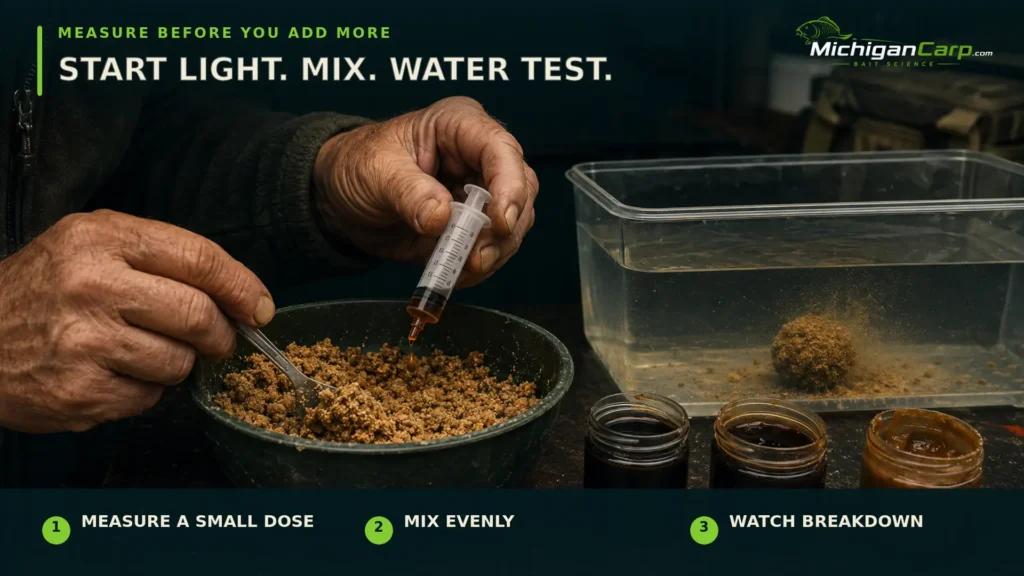
For a 100 g hookbait or crumb test, scale the amount down to one tenth rather than using the full kilogram dose. For air-dried or freezer boilies, absorption and safe treatment amounts are covered in How to Prepare Boilies for Carp Fishing.
Three Simple Low-Cost Systems
A Free Particle-Liquor Crumb
- Take a small portion of crumb, panko or ground pellets.
- Add fresh liquor from the correctly cooked particles you are already fishing.
- Mix until damp rather than wet.
- Rest for 10 minutes and test how it opens in water.
This costs nothing extra and keeps the rig-area bait connected to the wider feed. Make only what the session needs.
A Grocery-Store Method Mix
- Begin with 500 g of dry oats, panko, breadcrumb or a tested combination.
- Add 50–100 g of creamed corn.
- Add 5–15 ml of condensed or evaporated milk if it suits the hookbait.
- Mix, rest and add more wet material only if the squeeze test requires it.
- Water-test the finished ball around the actual lead or feeder.
The mix is finished when it casts, sinks and opens correctly—not when the tin is empty.
A Small Savoury Hookbait-and-Crumb Test
- Dissolve 0.5 g of yeast extract paste in 10–15 ml of warm water.
- Use part of the liquid to dampen 100 g of crumb.
- Roll a few hookbaits through the remainder rather than soaking the whole bait supply.
- Keep untreated hookbaits and crumb as the control.
These are fresh session mixes. They are not preserved glugs and should not be bottled at room temperature for future trips.
Robert’s Michigan Method-Mix Experience
In my own Michigan fishing, I have used creamed corn, condensed milk and molasses as part of the wet side of an oats, panko, seed and boilie-crumb method mix. That system has caught carp for me on large public water, including the Muskegon Channel.
I would not claim that one grocery liquid caused those captures. Location, timing, the rig, the hookbait and the complete method mix all contributed. The practical lesson is simpler: inexpensive ingredients can bind the mix, carry fine food around the lead and support the hookbait without paying for a shelf of specialist bottles.
I still test the mechanics first. A method ball that stays intact like putty or hides the rig is not improved by smelling stronger. My priority is a mix that reaches the bottom, opens around the hookbait and can be repeated accurately.
Keep Fresh Liquids Safe and Usable
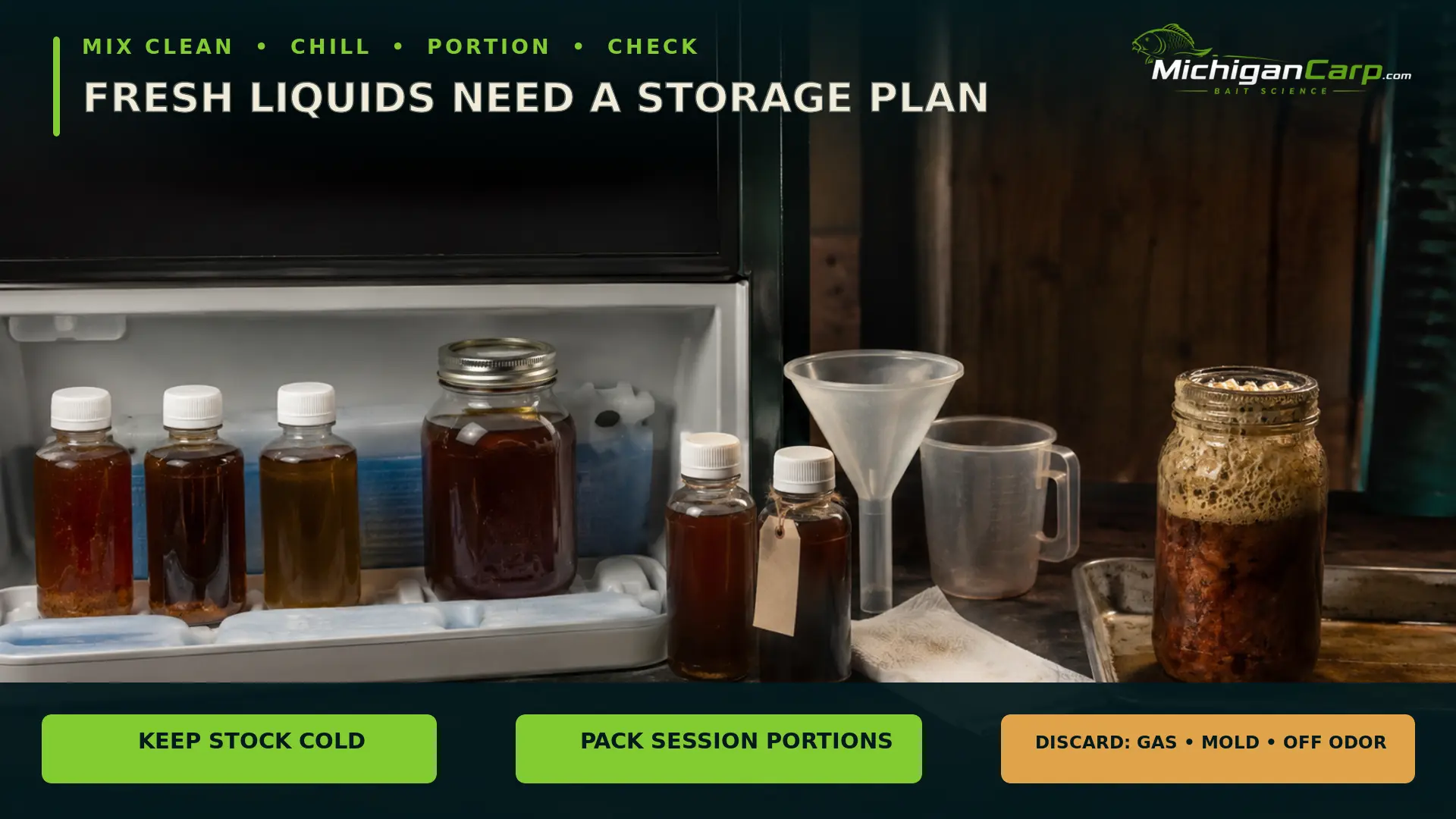
Commercial shelf life belongs to the unopened product and the manufacturer’s storage instructions. Once products are opened, diluted, mixed with particle liquor or combined with milk and corn, the storage problem changes.
- Make fresh grocery-based mixes in session-sized quantities.
- Keep opened milk, creamed corn and prepared mixtures cold.
- Use clean containers and utensils.
- Do not return lake-contaminated leftovers to the original container.
- Discard mold, putrid or rancid odors, abnormal slime, swollen containers or uncontrolled gas production.
- Do not use pH alone as proof that an old bait liquid is fit for use.
Freezing small measured portions is often more sensible than trying to preserve a large homemade liquid. Unless pH, water activity, preservation, packaging and retained samples have been validated, do not assign a long shelf life to a home blend.
Protect PVA, Breakdown and Hookbait Mechanics
Most of the liquids on this page contain water. That means they may weaken or melt PVA before the cast. Thick syrup is not automatically PVA-safe just because it looks dense.
- Prepare the exact finished liquid or treated bait.
- Place a small amount against a scrap of the PVA mesh, bag, tape or string you intend to use.
- Wait at least as long as the rig will be prepared before casting.
- Check for softening, holes, stickiness or premature failure.
- Repeat the test when the recipe or weather changes.
Also test the bait itself. A coating can soften a hookbait, slow the opening of crumb, make pellets mushy or seal an air-dried boilie unevenly. Use How to Test Boilies Before Fishing when the treatment is being applied to boilies or hookbaits.
Common Mistakes
- Buying by smell: a powerful odor in air does not tell you how the liquid disperses or tastes in water.
- Mixing everything together: molasses, CSL, yeast, milk and flavor in one bucket make it impossible to learn what helped or hurt.
- Ignoring salt: yeast spreads and savoury grocery liquids may add much more salt than expected.
- Drowning wet bait: prepared particles and fresh boilies may need very little extra liquid.
- Calling old corn liquor CSL: a home bucket is not the same controlled material as industrial corn steep liquor.
- Chasing sweetness: sugar can change taste and mechanics, but sweet does not automatically mean attractive.
- Ignoring storage: a cheap liquid that spoils half the bait is not economical.
- Trying to fix location: no treatment compensates for fishing where carp are absent or unwilling to feed.
FAQ
What is the best cheap carp bait liquid?
There is no universal best. Fresh cooked-particle liquor is the best-value match for particles and crumb, CSL is economical for wider feed, yeast extract is efficient at low doses, and creamed corn is hard to beat as a grocery-store packbait binder.
Is molasses a proven carp attractor?
Molasses is a useful sugar-rich, mineral-containing syrup that changes taste, color, viscosity and binding. Those properties justify testing it. They do not prove that carp will prefer every molasses-treated bait, so use a measured treatment and compare it with an untreated control.
Is homemade corn liquid the same as CSL?
No. Industrial CSL is a concentrated byproduct of controlled corn wet-milling. Home-prepared or fermented corn liquor can be useful, but its raw material, process, solids, acidity, microbiology and storage are not automatically equivalent.
Can I use condensed milk in carp bait?
Yes, in controlled amounts. It can add milk solids, sweetness and binding to crumb or method mix, particularly alongside milk/nut bait. Treat it as perishable after opening and reduce it if the mix becomes sticky or slow to break down.
Can I use the liquid from canned sweetcorn?
Yes. It can wet crumb or support a corn-based method mix. Add it gradually because the amount and sugar or salt content vary by product, and keep the opened can and finished mixture cold.
Are cheap bait liquids safe with PVA?
Do not assume so. Most cheap food and feed liquids contain water. Test the exact finished treatment against the exact PVA product for the full preparation time before casting.
Should I mix several cheap liquids together?
Start with one. A simple test teaches you more, protects bait mechanics and makes waste easier to control. Combine liquids only when each one has a clear, non-duplicated job.
Do I need any specialist carp bait liquids?
Not necessarily, but specialist products can still be good value when they provide a concentrated ingredient, known dose, reliable preservation or PVA-compatible carrier that grocery liquids cannot. Judge the result, not the label.
Next Steps
- When to Use Each Type of Carp Bait Liquid — choose the wider liquid category by bait, quantity and purpose.
- Packbait for Carp Fishing — build and test oats, panko, corn and method-style mixes.
- How to Prepare Particles for Carp Fishing — prepare the feed safely before using its cooking liquor.
- How to Prepare Boilies for Carp Fishing — treat freezer and air-dried boilies without losing control.
- The Bait Shed — continue through the practical bait-preparation guides.