

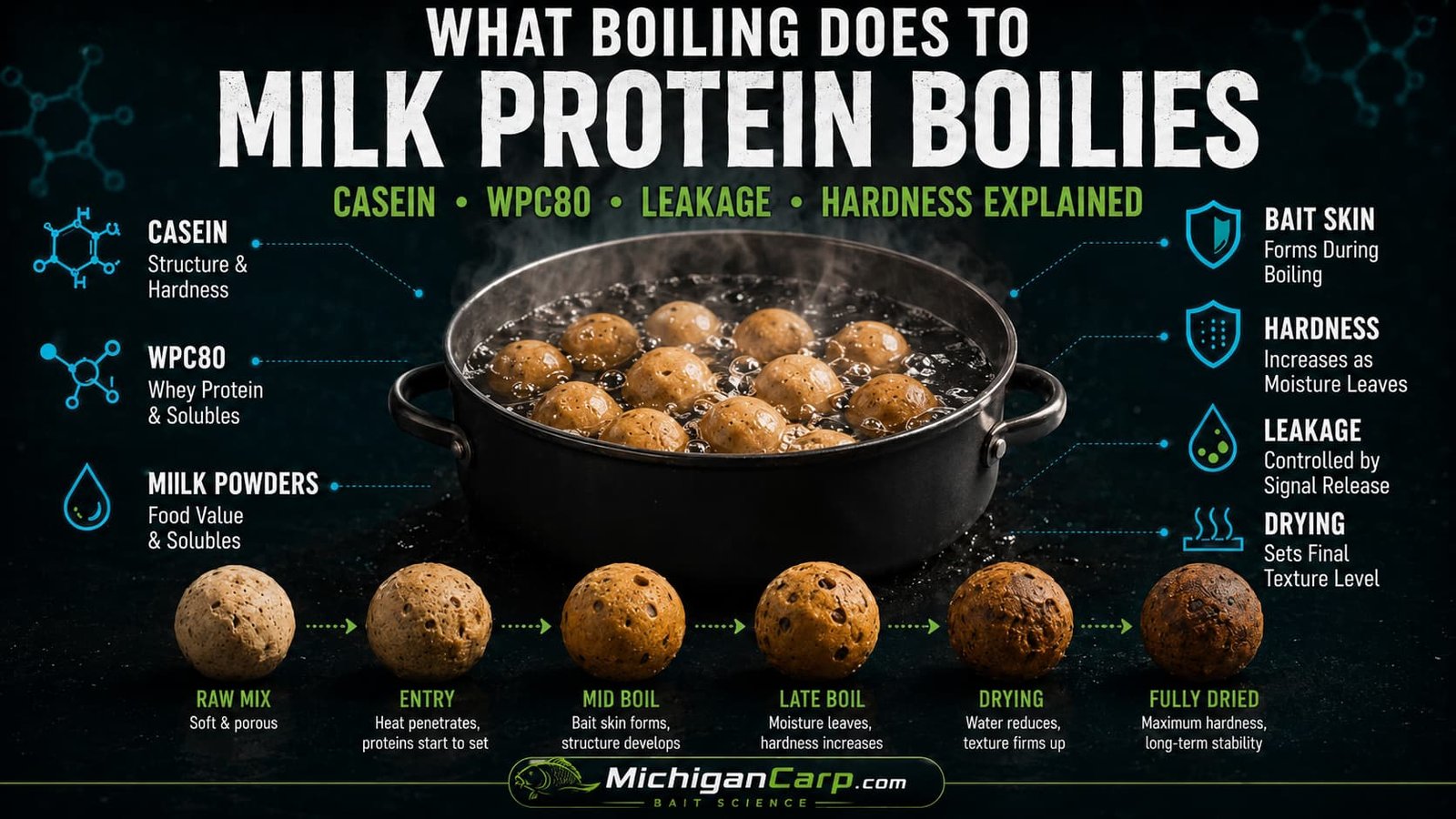
Boiling milk protein boilies is not just a cooking step.
It changes the bait.
It changes the surface.
It changes the paste.
It changes how the bait hardens, dries, leaks, soaks and fishes.
That matters even more when the mix contains casein, caseinate, WPC80, skimmed milk powder, milk replacer, whey protein, albumen, milk powders, birdfood, cereals and nut meals.
A milk protein boilie does not behave the same before boiling as it does after boiling.
Raw paste can feel soft and creamy.
After boiling, the outside may form a skin.
After drying, the bait may become much firmer.
After soaking, the same bait may leak quickly, slowly, or barely at all depending on how it was boiled and dried.
That is why boil time is not a minor detail.
It is part of bait design.
A milk/nut boilie with WPC80 and skimmed milk powder may need a different approach from a hard casein hookbait.
A 14 mm freezer bait does not need the same boil time as a 24 mm long-session bottom bait.
A free bait should not always be treated like a hookbait.
A bait for cold water should not automatically be boiled and dried like a dense summer food bait.
This article explains what boiling does to milk protein boilies: bait skin, hardness, casein behavior, WPC80 behavior, starch gelatinization, egg setting, leakage, drying, boil times, hookbaits, freezer baits, shelf-life baits and practical testing.
For the ingredient background, read Milk Proteins in Carp Bait.
For casein, caseinate and WPC80 differences, read Casein vs WPC for Boilies.
For the deep casein guide, read Casein in Boilies.
For milk powders and USA availability, read Milk Powders in Boilie Making.
For the full boilie-making process, use Boilie School BS-05: Making Boilies Step by Step.
The simple rule is:
BOILING DOES NOT JUST MAKE A BOILIE SAFE TO HANDLE.
BOILING BUILDS THE FINISHED BAIT.
Table of Contents
Quick Start: What Boiling Changes
Use this table as the fast guide.
| Boiling Changes | What Happens | Why It Matters |
|---|---|---|
| Bait skin | Outer surface firms and seals to some degree | Controls leakage, durability and soak behavior |
| Egg proteins | Egg begins setting and binding the bait | Helps the bait hold together |
| Milk proteins | Casein, WPC80 and caseinate respond differently to heat and water | Affects hardness, structure and solubility |
| Starches | Cereal starches hydrate and gelatinize | Helps texture, firmness and digestibility |
| Solubles | Some soluble material may move into the boil water | Over-boiling can reduce attraction |
| Hardness | Bait usually firms during boiling and further during drying | Controls hookbait strength and free-bait texture |
| Leakage | Boiling changes how water later moves through the bait | Controls how fast the bait works in water |
| Drying behavior | Boiled bait dries differently than raw paste | Affects storage, skin, cracking and shelf-life |
| Buoyancy | Hookbait buoyancy can change after boiling and drying | Critical for wafters and pop-ups |
| Finished identity | The bait after boiling is the real bait | Raw paste tells only part of the story |
Boiling should be matched to:
- bait size;
- bait type;
- ingredient profile;
- hookbait vs free bait;
- freezer bait vs shelf-life bait;
- water temperature;
- desired leakage;
- desired hardness;
- drying plan;
- fishing situation.
Do not boil every bait the same way.
What Boiling Really Does
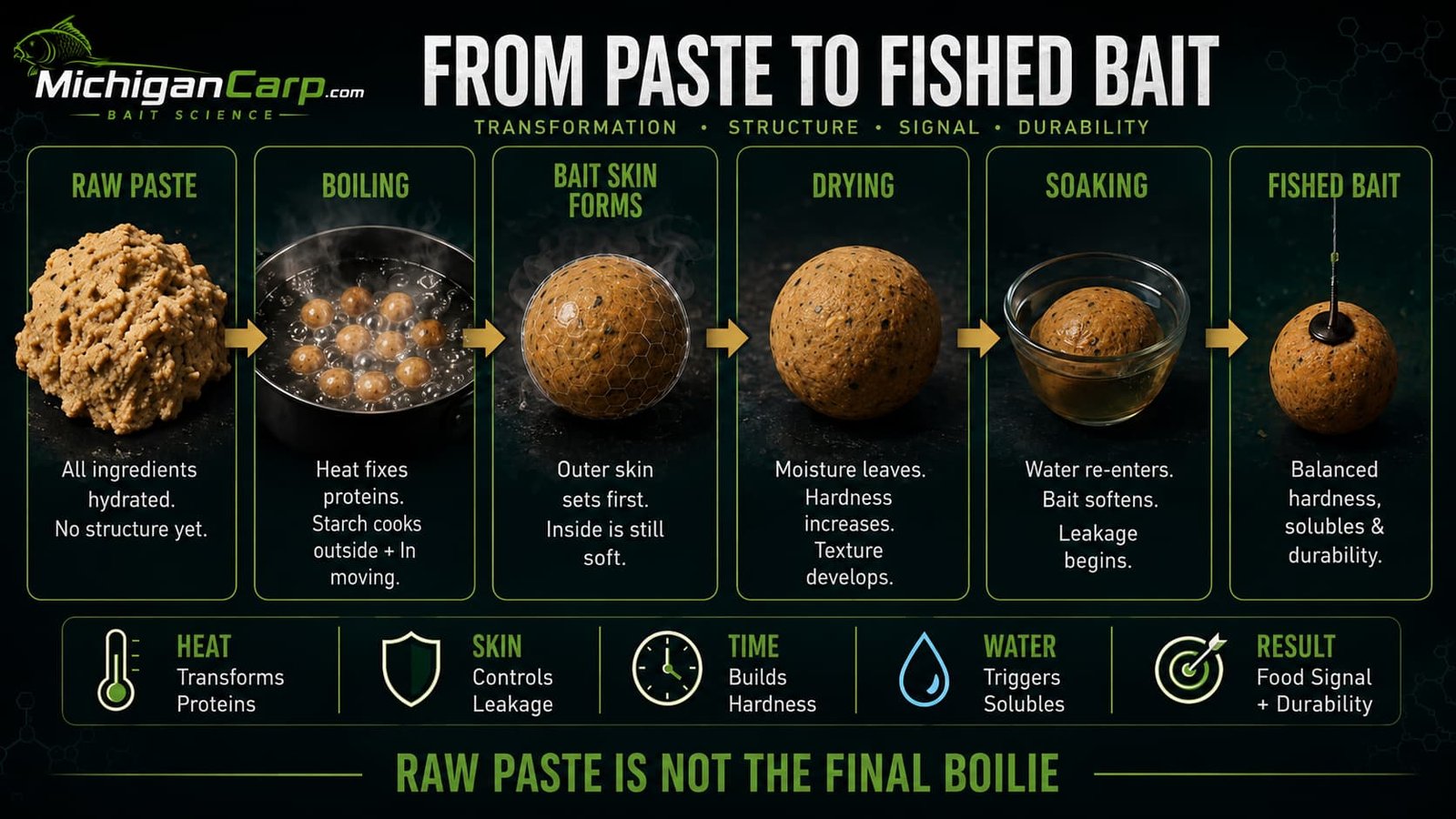
Boiling turns a soft paste into a finished bait by combining heat, water, protein setting, starch changes and surface formation.
A boilie mix usually contains several ingredient families:
- eggs;
- cereals;
- milk proteins;
- milk powders;
- birdfood;
- nut meals;
- binders;
- solubles;
- fats;
- liquids;
- attractors;
- preservatives if used.
When the bait goes into boiling water, all of those ingredients respond differently.
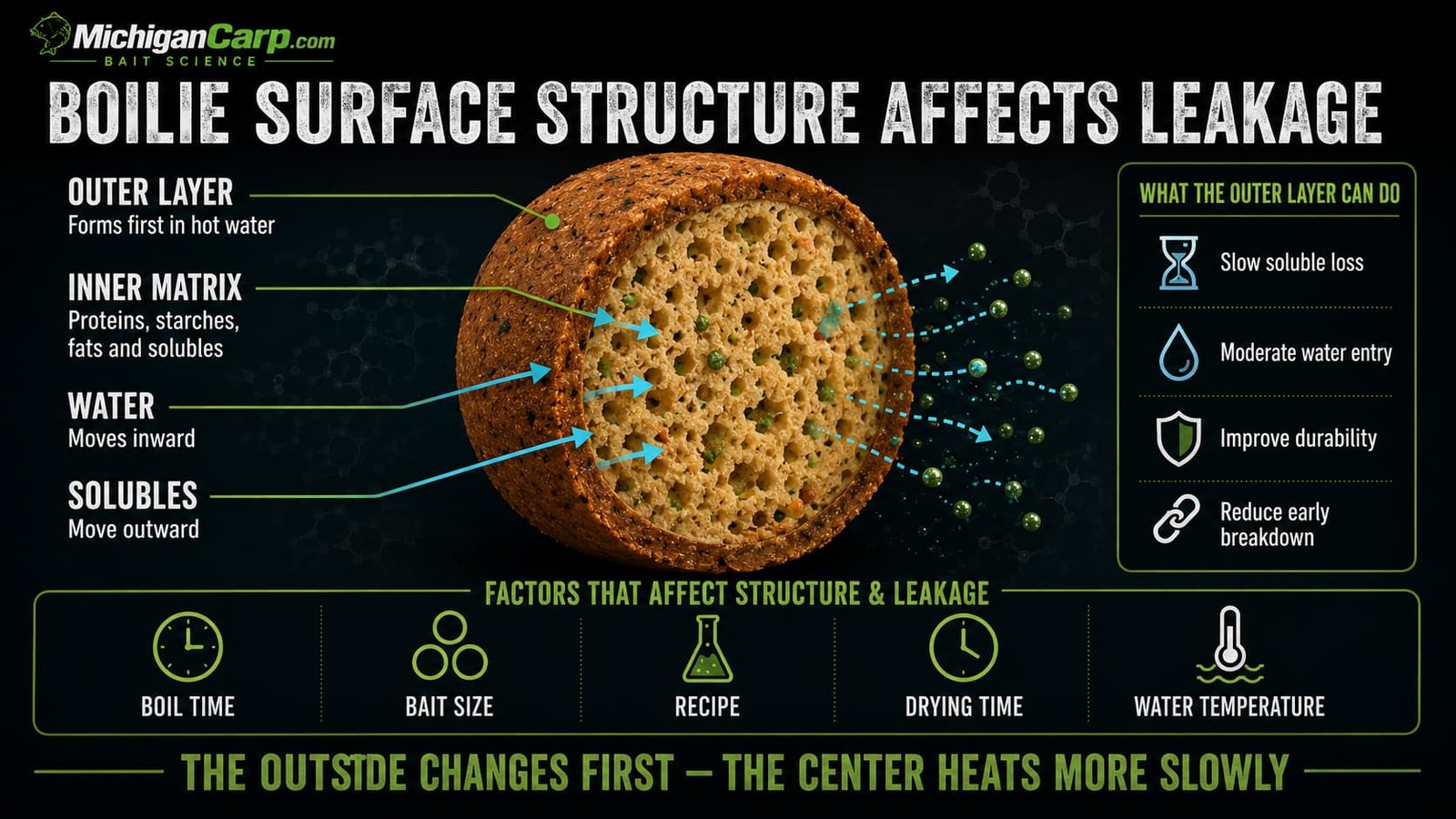
The Outside Changes First
The outer surface hits hot water first.
That surface begins to firm, tighten and form a skin.
This skin is important because it affects:
- how well the bait holds together;
- how fast water later enters the bait;
- how fast solubles leave the bait;
- how durable the bait is;
- how it dries;
- how it behaves after soaking.
The Inside Changes More Slowly
The center heats more slowly than the outside.
A large bait may have a firm skin before the center is fully changed.
That is why bait size matters.
A 10 mm boilie and a 24 mm boilie should not be treated exactly the same.
Boiling Is Not Just Hardening
Boiling can harden the bait, but it can also:
- wash out solubles;
- tighten the skin too much;
- reduce leakage;
- overcook delicate ingredients;
- change texture;
- change buoyancy;
- make bait slower than intended.
The goal is not maximum boiling.
The goal is the correct boil for the bait.
Boiling Is a Balance Between Structure and Leakage
This is the main idea.
Boiling must do enough to make the bait fishable.
But it should not do so much that it turns the bait into a dead lump.
Too Little Boiling
Under-boiled bait may:
- split;
- crack;
- stay soft;
- fall off the hair;
- break down too fast;
- fail during casting;
- lack a proper skin.
Too Much Boiling
Over-boiled bait may:
- become too hard;
- lose too many solubles;
- leak slowly;
- dry too hard;
- crack later;
- become dense;
- lose some attraction into the pan;
- become poor free bait even if it looks neat.
Correct Boiling
Correctly boiled bait should:
- hold together;
- form a usable skin;
- dry predictably;
- soak without collapsing;
- leak at the intended rate;
- match the fishing job;
- remain attractive and edible.
That balance changes by bait type.
A casein hookbait can be boiled harder than a soft milk/nut free bait.
What Boiling Does to Casein
Casein is one of the main reasons milk protein boilies can become firm, dense and durable.
But casein is not mainly a fast-leak ingredient.
It is a structural milk protein.
Casein systems are generally more heat-stable than whey proteins, while whey proteins are more heat sensitive and denature more readily under heat. Research on milk heat stability describes casein micelles as relatively heat-stable compared with whey proteins, while heat treatment can still alter protein interactions and aggregation under some conditions. Heat Stability Assessment of Milk.
Acid Casein
Acid casein can help create:
- hard skin;
- dense texture;
- tough bottom baits;
- strong hookbaits;
- slower breakdown;
- long soak durability.
After boiling and drying, acid casein-heavy baits can become very hard.
That can be useful for hookbaits.
It can be too much for free bait.
Rennet Casein
Rennet casein can create:
- firm texture;
- toughness;
- elastic structure;
- resilient hookbait character;
- long-session durability.
It may feel slightly different from acid casein in finished bait, often tougher or more resilient rather than simply dense and hard.
Micellar Casein
Micellar casein may provide:
- smoother milk-protein body;
- slower dairy depth;
- softer structure than hard acid casein;
- useful milk/nut character;
- practical USA sourcing through unflavored sports nutrition suppliers.
It is not automatically a direct replacement for acid casein.
Caseinate
Sodium caseinate and calcium caseinate behave differently from raw casein.
They can:
- smooth paste;
- improve dispersion;
- affect hydration;
- change texture;
- contribute milk-protein function.
Sodium caseinate may create smoother, more dispersive paste, while calcium caseinate can support firmer protein structure.
For the deep guide, use Casein in Boilies.
Practical Rule for Casein Baits
Casein-heavy baits usually need careful boiling and drying because they can keep hardening after they leave the pan.
Do not judge them immediately after boiling.
Judge them after drying and soaking.
What Boiling Does to WPC80
WPC80 is whey protein concentrate.
It is not casein.
That matters because whey proteins are more heat sensitive than caseins.
Food science literature widely recognizes that heat treatment can denature whey proteins and cause interactions with casein proteins, changing the structure and properties of milk systems. Experimental and Modelling Study of Milk Protein Denaturation.
In boilies, WPC80 can affect:
- paste smoothness;
- protein density;
- bait setting;
- leakage;
- dairy signal;
- finished texture.
WPC80 Can Tighten Bait
WPC80 may help the bait set more firmly during boiling.
This can be good when the bait needs body.
It can be a problem if the mix already contains a lot of casein, albumen or hard binders.
WPC80 Does Not Guarantee Fast Leakage
Unheated WPC80 can be more readily dispersed than acid casein, but it is still predominantly intact whey protein rather than a fast-diffusing hydrolysate.
During boiling, heat-sensitive whey proteins can denature and aggregate. The finished bait matrix, outer layer and drying method then influence how readily water enters and material leaves the bait.
Use WPC80 for protein and functional structure, but judge actual leakage only after boiling, drying and soak testing.
WPC80 Is Sensitive to Overuse
High WPC80 levels can make bait:
- expensive;
- dense;
- tight;
- less forgiving;
- harder to roll;
- more reactive during boiling.
Use WPC80 for a clear reason.
For the direct comparison, read Casein vs WPC for Boilies.
What Boiling Does to Skimmed Milk Powder and Milk Powders
Skimmed milk powder, nonfat dry milk, whole milk powder, buttermilk powder, cream powder and milk replacer are broader dairy powders.
They are not all specialist milk proteins.
They contain different amounts of:
- milk proteins;
- lactose;
- minerals;
- fat;
- whey products;
- milk solids;
- added ingredients in the case of milk replacer.
Skimmed Milk Powder / Nonfat Dry Milk
Boiling can affect skimmed milk powder by:
- changing surface texture;
- moving some soluble material into the boil water;
- contributing to milk body;
- improving paste cohesion;
- supporting creaminess.
It does not behave like acid casein.
Whole Milk Powder and Cream Powder
These add fat and richness.
Boiling can expose problems if levels are too high.
Too much high-fat dairy powder can cause:
- softer bait;
- greasy surface;
- slower drying;
- shelf-life concerns;
- different leakage behavior.
Buttermilk Powder
Buttermilk powder can contribute fine milk solids, dairy character and product-dependent acidity or tang.
Traditional sweet-cream buttermilk powder, cultured buttermilk powder and commercial blends are not necessarily identical. Read the ingredient statement before describing a particular product as cultured or fermented.
Boiling may reduce some delicate aroma, but the finished effect depends on the actual powder and the complete recipe.
Milk Replacer
Milk replacer is a formulated feed category rather than one standardized ingredient. Products can differ substantially in their protein sources, fat, lactose, plant ingredients, vitamins, minerals, emulsifiers, sweeteners and other additives.
Read the exact ingredient statement and guaranteed analysis. Avoid medicated products, and do not assume that a formula intended for livestock has been validated as fish feed simply because it contains dairy ingredients.
Boiling milk-replacer bait can expose:
- excess fat;
- stickiness;
- soft texture;
- slow drying;
- greasy surface.
For the broader ingredient and label guide, use Milk Powders in Boilie Making.
What Boiling Does to Egg
Egg is one of the main reasons boilies hold together.
When heated, egg proteins set and help bind the bait.
That setting helps create:
- structure;
- skin;
- firmness;
- casting strength;
- hair-rig durability.
Egg level matters because a bait with too little egg may not set strongly, while a bait with too much egg may become rubbery, dense or hard.
Egg and Milk Proteins Together
Egg proteins, milk proteins and starches work together during boiling.
That is why changing one part of the recipe affects the whole bait.
A bait containing casein, WPC80 and albumen may firm quickly, but that does not automatically mean it needs less boiling. The correct time still depends on bait diameter, the complete recipe, batch loading and the required finished texture.
A bait with high birdfood and nut meal may need enough boil to hold together but not so much that it loses its open texture.
What Boiling Does to Starch and Cereal Ingredients
Most boilies contain cereal ingredients such as semolina, maize meal, wheat products, rice flour or other starch-rich meals.
When starch is heated with water, it can gelatinize.
Starch gelatinization is affected by water, temperature, time and ingredient type. Food science research describes gelatinization as dependent on factors such as water availability, heating rate and temperature. Effect of Water Content on Gelatinization Functionality of Flour.
In boilies, starch changes help:
- firm the bait;
- improve binding;
- change texture;
- improve water absorption;
- support skin formation;
- make the bait less raw.
Why This Matters
A milk protein boilie is not only milk protein.
The cereal side of the mix is doing important work during boiling.
If the bait contains semolina, maize meal or other starch ingredients, boiling affects the entire structure.
Too Little Boiling
Starch-rich bait may remain weak, raw or fragile.
Too Much Boiling
The bait may become dense, tight and slow.
The key is correct cooking, not maximum cooking.
What Boiling Does to Birdfood and Seed Ingredients
Birdfood and seed ingredients behave differently from fine milk proteins.
They can add:
- texture;
- openness;
- roughness;
- visual speckling;
- leakage pathways;
- mechanical breakdown.
Boiling can soften some of the surrounding matrix, but many birdfood and seed particles remain physically important inside the bait.
Why Birdfood Helps Milk Protein Boilies
Milk protein baits can become dense.
Birdfood helps open them up.
That can improve:
- texture;
- breakdown;
- palatability;
- leakage pathways;
- rolling feel.
Boiling Risk
Over-boiling can reduce the advantage of an open birdfood bait by tightening the outer skin and slowing leakage.
For birdfood bait design, use Birdfood for Carp Boilies.
What Boiling Does to Nut Meals
Milk/nut boilies often contain:
- tiger nut flour;
- peanut protein;
- peanut meal;
- almond meal;
- coconut meal;
- seed meals.
Nut ingredients bring fat, texture, flavor, food value and bait identity.
Boiling can help set the surrounding matrix, but nut meals can also make bait more delicate if the structure is weak.
High Nut + High Milk Protein
A bait with nut meals and milk proteins can be excellent, but it needs balance.
Too much nut fat plus too much milk fat can create:
- soft bait;
- greasy bait;
- slow drying;
- storage issues.
Too much casein plus too much fine protein can create:
- dense bait;
- hard bait;
- slow leakage.
The best milk/nut boilies balance:
- milk proteins;
- milk powders;
- nut meals;
- birdfood;
- cereals;
- solubles;
- egg and liquid levels.
For milk/nut formulation, read How to Formulate a Milk, Nut and Birdfood Boilie Base Mix.
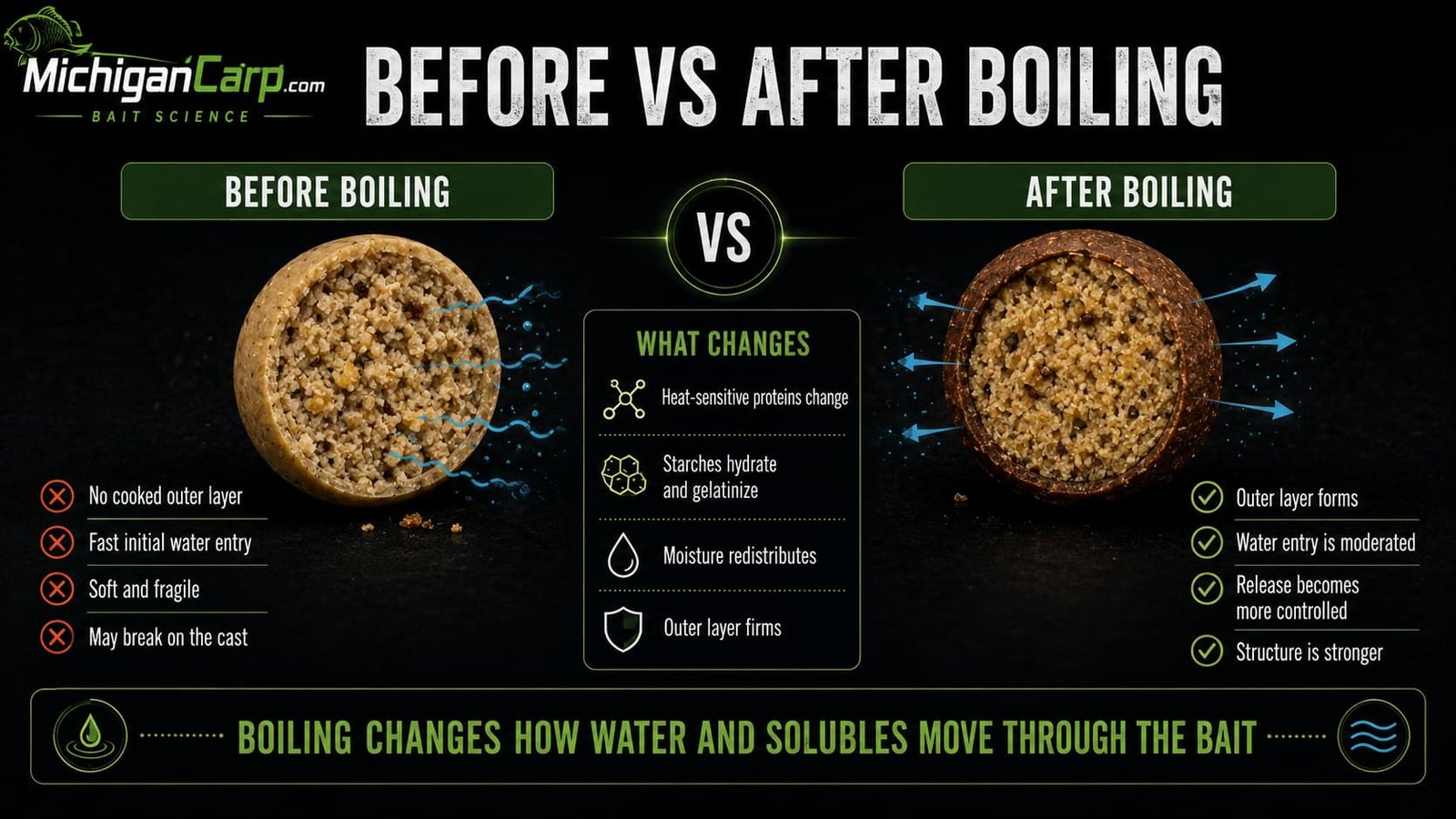
Boiling and Bait Skin
Bait skin is the outer layer that forms during boiling.
The outer layer helps influence water entry, soluble release, durability and breakdown, but it does not control these alone. The inner matrix, recipe, drying time and water temperature also matter.
A Good Skin
A good skin should:
- hold the bait together;
- prevent splitting;
- allow controlled leakage;
- survive casting;
- protect the inner bait;
- dry evenly;
- soak without cracking too quickly.
A Skin That Is Too Weak
A weak skin may cause:
- splitting;
- soft bait;
- mushy bait;
- poor casting strength;
- hair-rig failure.
A Skin That Is Too Tight
A tight skin may cause:
- slow leakage;
- slower release of solubles;
- hard free bait;
- poor short-session performance;
- bait that looks good but fishes slowly.
Practical View
Boiling builds the skin.
Drying changes it.
Soaking tests it.
All three matter.
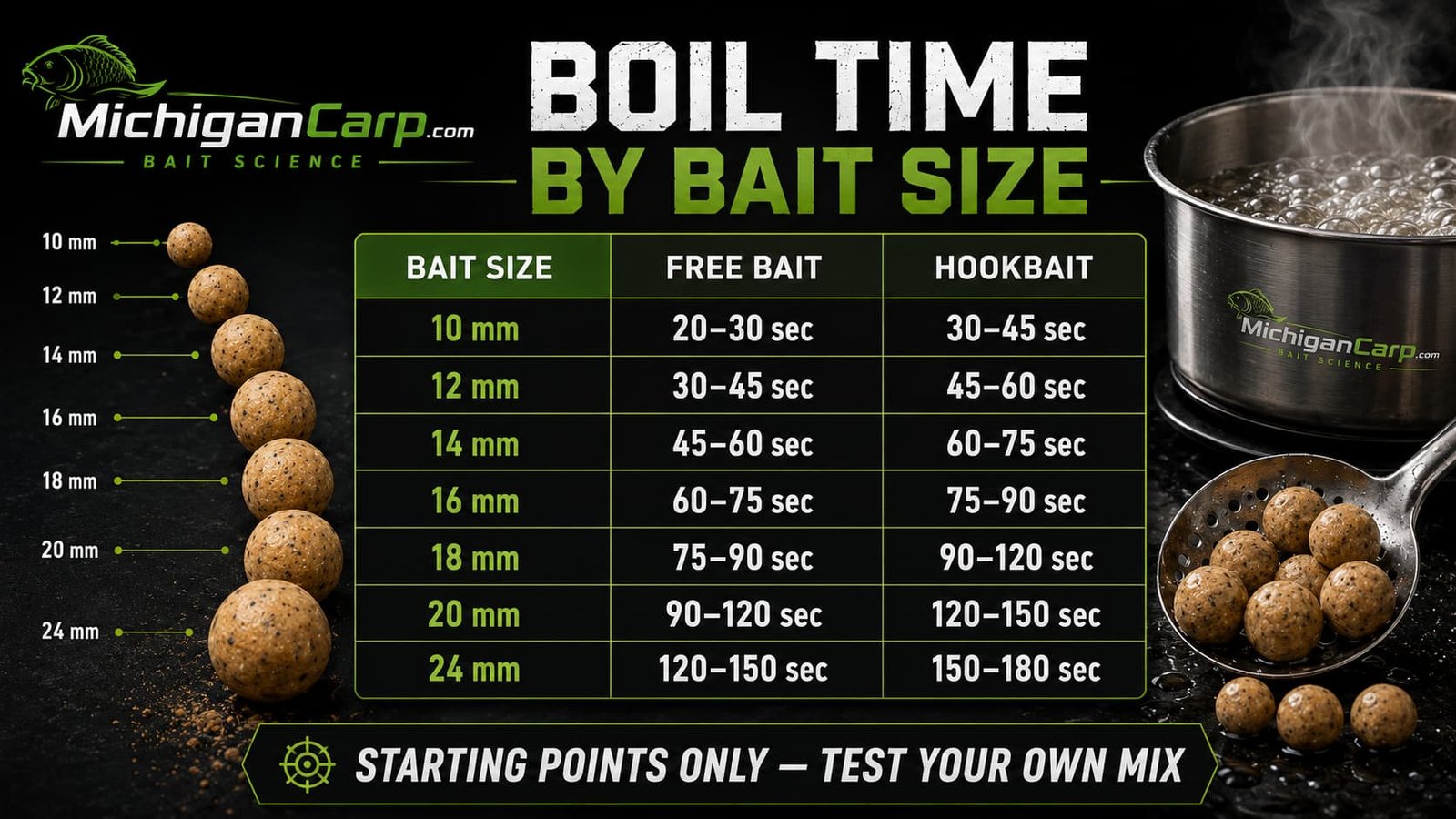
Boil Time by Bait Size
There is no universal boil time.
Bait size gives a starting point, but the correct time depends on the recipe, ingredient profile, egg level, casein level, WPC80 level, albumen level, bait hardness target and whether the bait is free bait or hookbait.
These times are sensible starting points for home bait making.
The table below uses timing from the return to a proper boil. Keep the water volume, bait temperature, batch weight and heat-recovery time as consistent as possible because the boilies are already heating before the water returns to boiling.
| Bait Size | Free Bait Starting Point | Hookbait Starting Point |
|---|---|---|
| 10 mm | 20–30 seconds | 30–45 seconds |
| 12 mm | 30–45 seconds | 45–60 seconds |
| 14 mm | 45–60 seconds | 60–75 seconds |
| 16 mm | 60–75 seconds | 75–90 seconds |
| 18 mm | 75–90 seconds | 90–120 seconds |
| 20 mm | 90–120 seconds | 120–150 seconds |
| 24 mm | 120–150 seconds | 150–180 seconds |
These are starting points, not laws.
For most milk/nut free baits, I would rather start slightly shorter and test the bait after drying and soaking than over-boil it from the beginning.
A 20 mm or 24 mm casein hookbait may need a longer boil than a soft free bait, but that should be decided by testing, not habit.
Adjust based on:
- recipe;
- milk protein level;
- casein level;
- WPC80 level;
- egg level;
- albumen level;
- bait size;
- desired hardness;
- drying plan;
- freezer bait vs shelf-life bait;
- free bait vs hookbait;
- water temperature;
- nuisance fish pressure.
Practical Rule
For free bait, start with the lower end of the range.
For hookbaits, start with the middle or upper end of the range.
For specialist hard casein hookbaits, longer boil times can be tested, but they should not be the default for ordinary free bait.
Boiling Free Baits vs Hookbaits
Free baits and hookbaits should not automatically be boiled the same way.
Free Baits
Free baits should usually:
- be edible;
- leak well;
- soften naturally;
- encourage feeding;
- not become too hard;
- match the hookbait;
- be economical.
Over-boiling free bait can make it too hard and slow.
Hookbaits
Hookbaits should usually:
- stay on the hair;
- survive casting;
- resist nuisance fish;
- last longer;
- hold shape;
- maintain buoyancy if needed;
- keep fishing after free bait softens.
Hookbaits can often justify longer boiling and longer drying.
Practical Rule
A hookbait can be tougher than the free bait.
That does not mean every bait in the bucket should be that hard.
Boiling Bottom Baits, Wafters and Pop-Ups
Different hookbait types need different care.
Bottom Baits
Bottom baits are usually the simplest.
Boiling should create enough skin and hardness to fish properly.
Casein-heavy bottom baits may continue hardening during drying.
Wafters
Wafters are more sensitive.
Boiling can alter:
- buoyancy;
- skin;
- water absorption;
- sink rate;
- balance after drying.
A wafter that balances before boiling may not balance after boiling and drying.
Test every batch.
Pop-Ups
Pop-ups need buoyancy.
Boiling can:
- reduce buoyancy;
- change skin;
- change drying;
- make pop-ups heavier;
- affect long-soak performance.
For pop-ups, boil time must be matched to the pop-up base and buoyant material.
Do not assume a milk protein paste will remain buoyant.
Boiling Milk/Nut Boilies
Milk/nut boilies are often rich, creamy and slightly fatty.
That makes boiling important.
A milk/nut bait may include:
- WPC80;
- skimmed milk powder;
- Nido;
- cream powder;
- milk replacer;
- tiger nut flour;
- peanut protein;
- nut meals;
- birdfood;
- oils or liquid foods.
What to Watch
Milk/nut boilies can become:
- too soft if high-fat ingredients dominate;
- too hard if casein and albumen are high;
- too greasy if oils and full-fat powders are overused;
- slow to dry if wet side is too heavy;
- slow to leak if over-boiled.
Practical Approach
For milk/nut free bait:
- avoid excessive boil time;
- dry enough for handling;
- test soak behavior;
- keep the bait edible;
- do not chase hookbait hardness.
For milk/nut hookbaits:
- increase structure;
- test long soaks;
- adjust buoyancy;
- dry longer if needed;
- record the batch.
Boiling Casein Hookbaits
Casein hookbaits are one of the main places where longer boil times make sense.
A casein hookbait may contain:
- acid casein;
- rennet casein;
- micellar casein;
- caseinate;
- WPC80;
- albumen;
- cork dust or pop-up base;
- cream powder;
- soluble attractors.
What Longer Boiling Can Do
Longer boiling can:
- strengthen the skin;
- increase durability;
- improve hair-rig life;
- reduce splitting;
- create tougher hookbaits.
What Longer Boiling Can Hurt
It can also:
- slow leakage;
- reduce soluble signal;
- change buoyancy;
- make bait too hard;
- reduce attraction if overdone.
Practical Hookbait Test
Test casein hookbaits after:
- 6 hours soaking;
- 12 hours soaking;
- 24 hours soaking;
- 48 hours soaking if needed.
Check:
- hardness;
- cracking;
- smell;
- leakage;
- buoyancy;
- hair-rig durability;
- nuisance fish resistance.
A good casein hookbait should last, but it should not become a dead stone.
Boiling and Leakage
Leakage is one of the biggest reasons boil time matters.
Boiling can reduce leakage by tightening the bait skin.
It can also lose some soluble material into the boil water.
The balance depends on:
- boil time;
- bait size;
- soluble ingredients;
- milk protein type;
- skin thickness;
- drying time;
- internal texture;
- soak time.
Faster Leakage Baits
Use shorter boil times when the bait needs:
- quicker signal;
- cold-water performance;
- short-session attraction;
- more open texture;
- softer free bait.
Slower Leakage Baits
Use longer boil times when the bait needs:
- durability;
- long soak time;
- hookbait strength;
- nuisance fish resistance;
- very long hookbait soak;
- warm-water long-session use.
Practical Rule
You are not just boiling to cook.
You are boiling to help shape water entry and soluble release.
Boiling and Soluble Ingredients
Many milk protein boilies also contain soluble ingredients such as:
- hydrolyzed whey;
- liver powder;
- yeast;
- betaine;
- amino acids;
- sugars;
- salts;
- liquid foods;
- CSL;
- hydrolysates;
- flavors;
- sweeteners.
Boiling can move some solubles into the water.
The longer and harder the boil, the more risk of losing fast-moving soluble material.
Practical Ways to Protect Soluble Signal
Use:
- shorter boil time for free bait;
- post-boil soaks;
- glugs;
- sprays;
- surface powders;
- matching paste wraps;
- lower-temperature drying;
- hookbait dips;
- soluble bag crumb;
- packbait with boilie crumb.
Do not put all attraction into the boilie and then over-boil it.
Layer the signal.
Boiling and Bait Smell
Fresh raw paste often smells stronger than boiled bait.
That is normal.
Boiling can reduce some volatile aromas and move some soluble material into the pan.
A bait may smell less dramatic after boiling but fish better because it has proper structure.
Do Not Judge Only by Smell
Judge by:
- rolling;
- boiling;
- drying;
- soaking;
- leakage;
- texture;
- fish response.
A bait that smells strong in your kitchen is not automatically better.
A bait that smells subtle after boiling may still leak well and be eaten confidently.
Boiling and Color
Boiling can change bait color.
Milk protein baits may become:
- lighter;
- duller;
- slightly darker;
- more matte;
- less vivid;
- more washed-looking.
Longer boiling can reduce surface brightness.
Drying can change color again.
Soaking can change it again.
Practical Rule
Judge final color after drying, not from raw paste.
If color matters, test:
- after rolling;
- after boiling;
- after 24-hour drying;
- after soaking.
Boiling and Buoyancy
Boiling can change buoyancy.
This matters for wafters, pop-ups and balanced hookbaits.
Boiling can cause:
- water uptake;
- trapped air loss;
- skin formation;
- density change;
- buoyant material movement;
- drying-dependent buoyancy shifts.
Wafter Testing
Test wafters:
- fresh after boiling;
- after 24-hour drying;
- after 48-hour drying;
- after 1-hour soak;
- after 12-hour soak;
- after 24-hour soak.
A wafter is only a wafter in water.
Do not trust dry-bench buoyancy.
Boiling vs Steaming
Some bait makers steam boilies instead of boiling them.
Steaming can reduce direct contact with water and may reduce soluble loss compared with boiling, depending on process.
Boiling Advantages
Boiling is:
- simple;
- fast;
- traditional;
- easy to scale;
- good for skin formation;
- easy for home bait makers.
Boiling Disadvantages
Boiling can:
- wash out solubles;
- overcook outer layers;
- make bait too hard;
- create inconsistent results if pan temperature drops.
Steaming Advantages
Steaming may:
- reduce direct water washout;
- preserve some soluble ingredients;
- create different texture;
- suit some hookbaits.
Steaming Disadvantages
Steaming may:
- take longer;
- require more setup;
- cook less evenly if overloaded;
- produce different texture than expected.
Practical View
Boiling is still the easiest home method.
Steaming is worth testing for specialist hookbaits or high-soluble baits.
Do not assume steaming is automatically better.
Test both.
Pan Management: Why Water Temperature Matters
When you add bait to boiling water, the water temperature drops.
If you overload the pan, the bait may sit in hot but non-boiling water.
That changes the cooking.
Good Pan Practice
Use:
- plenty of water;
- rolling boil before adding bait;
- small batches;
- one clearly defined timing method used consistently;
- gentle stirring;
- consistent bait size;
- same boil time per batch;
- clean water when needed.
Poor Pan Practice
Avoid:
- overloaded pan;
- cold bait dumped in huge amounts;
- inconsistent timing;
- boilies stuck together;
- dirty sugar/protein-heavy water used too long;
- guessing by eye every time.
Practical Rule
Consistency matters.
If you want repeatable bait, boil in repeatable batches.
Should You Time From Drop-In or Re-Boil?
Both methods can be repeatable if the complete process is standardized.
Timing from drop-in includes the water-recovery period. Timing from re-boil excludes that period from the clock, even though the boilies are already heating.
The table in this article uses the re-boil method:
- Bring the water to a rolling boil.
- Add a measured, manageable batch of boilies.
- Stir gently and record how long the water takes to return to boiling.
- Start the table timing when the water returns to a proper boil.
Keep the pan, water volume, bait temperature, batch weight, bait size, burner setting and recovery time as consistent as possible. If those variables change, the same number on the timer may not represent the same total heat treatment.
The important rule is not that one timing method is universally correct. The important rule is to define the method, control the variables and record what produced the finished bait you wanted.
Drying After Boiling
Drying is the main post-cook conditioning stage. It reduces moisture and continues to change hardness, surface texture, leakage, buoyancy and storage behavior, but it is not additional cooking.
A bait does not finish changing when it leaves the pan.
Drying affects:
- hardness;
- skin;
- surface texture;
- moisture;
- cracking;
- shelf-life;
- leakage;
- storage;
- buoyancy.
Short Drying
Useful for:
- freezer baits;
- softer free bait;
- short sessions;
- cold water;
- quick use.
Medium Drying
Useful for:
- general bottom baits;
- milk/nut boilies;
- practical freezer baits;
- multi-day bait use.
Longer Drying
Useful for:
- hookbaits;
- long sessions;
- harder baits;
- nuisance fish;
- part of a properly tested shelf-life process.
Over-Drying
Can cause:
- cracking;
- very hard bait;
- slow leakage;
- poor free-bait texture;
- bait that floats accidentally if very dry and porous.
Drying needs to match the bait’s job.
Soak Testing After Boiling
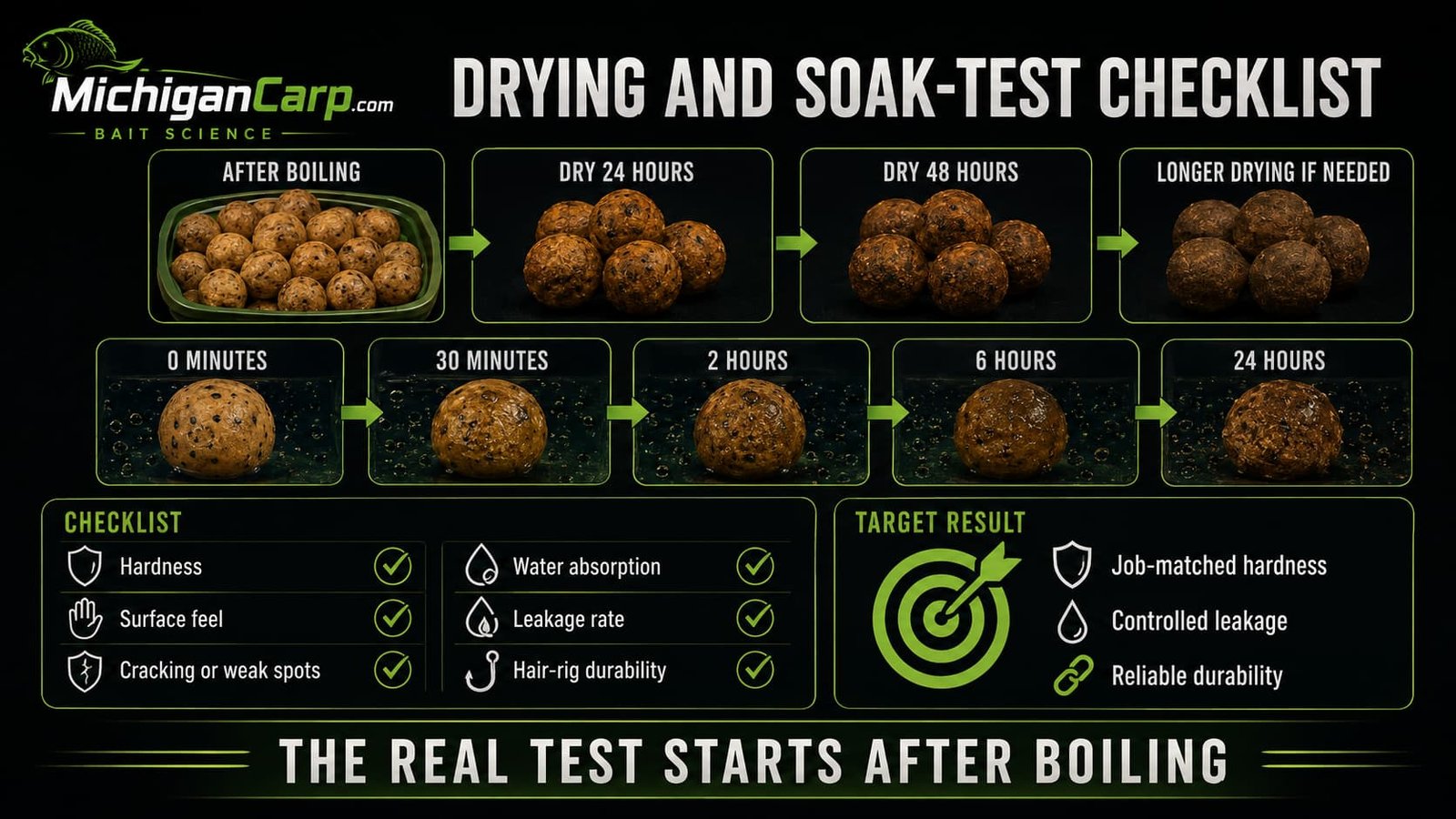
Soak testing is where you learn what the bait really does.
A bait should be tested in water before you trust it.
Basic Soak Test
Put several boilies in clean water and check them after:
- 30 minutes;
- 1 hour;
- 3 hours;
- 6 hours;
- 12 hours;
- 24 hours.
Check:
- surface texture;
- smell;
- leakage cloud;
- hardness;
- cracking;
- swelling;
- softness;
- color loss;
- oil slick;
- hair-rig durability.
Hookbait Soak Test
For hookbaits, also test:
- buoyancy;
- balance;
- cork exposure;
- hair stop strength;
- hookbait screw strength;
- nuisance fish resistance if possible.
Practical Rule
If a bait cannot pass a soak test, it is not finished.
Boil Time for Cold-Water Baits
Cold-water bait usually needs more care.
Carp often feed less aggressively in colder water, and bait may need to work quicker with less feed.
For cold-water milk protein boilies, consider:
- smaller bait size;
- shorter boil time;
- more open texture;
- less hard casein;
- carefully selected soluble support, such as a modest amount of hydrolyzed whey;
- lower fat;
- shorter drying;
- lower feed volume.
Cold-Water Goal
The bait should still hold together, but it should not become a dense, slow food brick.
Boil Time for Warm-Water Baits
Warm water does not automatically mean that every bait needs a harder boil. Higher water temperatures, longer sessions and nuisance-fish activity may justify a firmer hookbait, but the free bait should still be easy for carp to eat and should release material at the intended rate.
When carp are feeding confidently, richer milk/nut boilies can work well, provided the total fat level, hardness and feeding quantity remain appropriate.
For warm-water milk protein boilies, you can consider:
- slightly longer boil times;
- stronger casein structure;
- larger bait sizes;
- longer drying;
- more durable hookbaits;
- feed volume matched to observed fish activity.
Warm-Water Warning
Do not overdo it just because the water is warm.
A bait can still be too hard, too slow or too rich.
Boiling Shelf-Life Milk Protein Boilies
Shelf-life bait needs more than boiling.
Boiling helps set the bait, but shelf-life stability depends on the whole system.
You must consider:
- moisture;
- drying;
- preservatives;
- pH if relevant;
- sugar;
- salt;
- fat level;
- packaging;
- storage temperature;
- mold risk;
- rancidity risk.
Milk protein baits with whole milk powder, cream powder, milk replacer or nut meals may contain more fat.
That can increase the need for careful storage testing.
Practical Rule
Do not assume a harder boilie is automatically shelf-life safe.
Shelf-life bait must be designed and tested.
Boiling Freezer Milk Protein Boilies
Freezer baits are more forgiving.
You can use richer milk ingredients, softer textures and more natural liquid systems because room-temperature storage is not the goal.
But freezer baits still need correct boiling.
A freezer bait should:
- hold together;
- dry enough to bag;
- thaw properly;
- not collapse;
- not mold quickly after thawing;
- fish cleanly;
- match the session.
Shorter boil times can work well for freezer baits if the bait is still strong enough.
Common Boiling Mistakes
Mistake 1: Boiling Every Bait the Same
A 24 mm casein hookbait is not a 14 mm milk/nut free bait.
Mistake 2: Over-Boiling Free Bait
Free bait should encourage feeding.
It does not need to be as hard as a hookbait.
Mistake 3: Under-Boiling Hookbaits
Hookbaits need durability.
A weak hookbait wastes bites.
Mistake 4: Ignoring Drying
Boiling and drying work together.
Mistake 5: Judging Bait Too Early
Fresh-boiled bait is not the final bait.
Mistake 6: Overloading the Pan
This ruins consistency.
Mistake 7: Losing All the Solubles
Long boiling can wash out part of the bait’s signal.
Mistake 8: Ignoring Soak Tests
A hookbait that fails before its intended fishing window is not ready. A deliberately softer free bait may be designed to soften or break down sooner.
Mistake 9: Making Free Bait Too Hard
Hard bait is not always better.
Mistake 10: Not Keeping Notes
Without notes, you cannot repeat good batches or fix bad ones.
Practical Boiling Test Plan
Use this test plan when developing a new milk protein boilie.
Step 1: Make One Small Paste Batch
Use 250–500 g dry mix.
Do not start with a giant batch.
Step 2: Roll One Size
Choose one size, such as 16 mm or 20 mm.
Step 3: Split Into Boil-Time Groups
Example:
Batch A: 60 seconds
Batch B: 90 seconds
Batch C: 120 seconds
Batch D: 150 seconds
Step 4: Dry Separately
Label each batch.
Dry for:
24 hours
48 hours
Step 5: Soak Test
Soak each group and check:
- 1 hour;
- 6 hours;
- 12 hours;
- 24 hours.
Step 6: Choose the Best Job Fit
Pick the boil time based on intended use:
- free bait;
- hookbait;
- cold water;
- warm water;
- long session;
- nuisance fish;
- shelf-life test.
Step 7: Record the Result
Write down:
- boil time;
- bait size;
- drying time;
- hardness;
- leakage;
- cracking;
- smell;
- buoyancy;
- fishing result.
A good bait maker records what worked.
My Practical View
Boiling is one of the most underrated parts of boilie making.
A lot of anglers obsess over ingredients and then treat boiling as an afterthought.
That is a mistake.
With milk protein boilies, boiling is part of the formula.
Casein, WPC80, skimmed milk powder, milk replacer, egg, albumen, birdfood, cereals and nut meals all change when heat and water hit the bait.
A good boil time makes the bait fishable.
A bad boil time can make a good recipe too soft, too hard, too slow or too weak.
For my own milk/nut bait thinking, I do not want every boilie boiled into a rock.
Free bait should be eaten confidently.
Hookbaits should be tougher.
Casein baits need testing after drying.
WPC80 baits need checking for tightness and leakage.
Milk replacer baits need checking for fat, softness and drying.
The final bait is not the paste.
The final bait is:
ROLLED.
BOILED.
DRIED.
SOAKED.
FISHED.
That is the only version that matters.
The best rule is:
BOIL FOR THE JOB, NOT BY HABIT.
FAQ
What does boiling do to milk protein boilies?
Boiling sets the bait, forms a skin, changes texture, affects hardness, alters leakage, and helps the bait hold together. It also changes how milk proteins, egg, starches and solubles behave.
Does boiling make boilies harder?
Yes, boiling usually helps firm the bait, and drying after boiling often makes it harder. Casein-heavy boilies may continue to harden significantly during drying.
Can you over-boil boilies?
Yes. Over-boiling can make boilies too hard, too dense, slow to leak and less attractive as free bait.
Can you under-boil boilies?
Yes. Under-boiled boilies may split, stay soft, fall off the hair, fail during casting or break down faster than intended. Mold resistance is a separate storage issue controlled by moisture availability, pH, preservatives, handling, packaging and storage conditions.
How long should I boil 16 mm boilies?
A practical starting point is 60–75 seconds for free baits and 75–90 seconds for hookbaits, timed from when the water returns to a proper boil.
How long should I boil 20 mm boilies?
A practical starting point is 90–120 seconds for free baits and 120–150 seconds for hookbaits, depending on the recipe and desired hardness.
Do casein boilies need longer boiling?
Casein boilies often need enough boiling to set properly, but longer is not always better. They can become very hard after drying, especially if acid casein, rennet casein or albumen are high.
What does boiling do to WPC80 boilies?
Boiling can help WPC80-containing baits set and tighten, but over-boiling may reduce leakage and make the bait slower than intended.
Does boiling reduce attractors?
Some soluble ingredients may move into the boil water during cooking. That is why boil time, post-boil soaks, glugs, pastes and matching packbait can all matter.
Should hookbaits be boiled longer than free baits?
Often, yes. Hookbaits usually need more durability, while free baits should remain easy to eat and leak properly.
Should freezer baits be boiled less than shelf-life baits?
Sometimes, when the aim is to produce a softer, faster-working bait. Freezing itself does not determine boil time; bait diameter, recipe, required strength, drying plan and intended use do.
Does drying matter as much as boiling?
Yes. Drying after boiling strongly affects hardness, skin, leakage, cracking, storage and soak behavior.
Should I steam milk protein boilies instead of boiling?
Steaming can be useful for some high-soluble or specialist hookbait recipes, but boiling is simpler and reliable. Test both before deciding.
How do I know if my boil time is right?
Boil small test batches at different times, dry them separately, soak test them, and choose the version that matches the fishing job.
What is the biggest boiling mistake?
Boiling every bait the same way. Bait size, recipe, hookbait use, free bait use, water temperature and drying plan all matter.
Next Steps
Use these supporting guides next:
- Boilie School BS-05: Making Boilies Step by Step
- Milk Powders in Boilie Making
- Milk Proteins in Carp Bait
- Casein vs WPC for Boilies
- Casein in Boilies
- Milk Powders in Boilie Making
- How to Formulate a Milk, Nut and Birdfood Boilie Base Mix
- Nut Boilie Base Mix Recipes
- Birdfood for Carp Boilies
- The Bait Shed
- Boilie School
- Michigan Carp Guide Library