

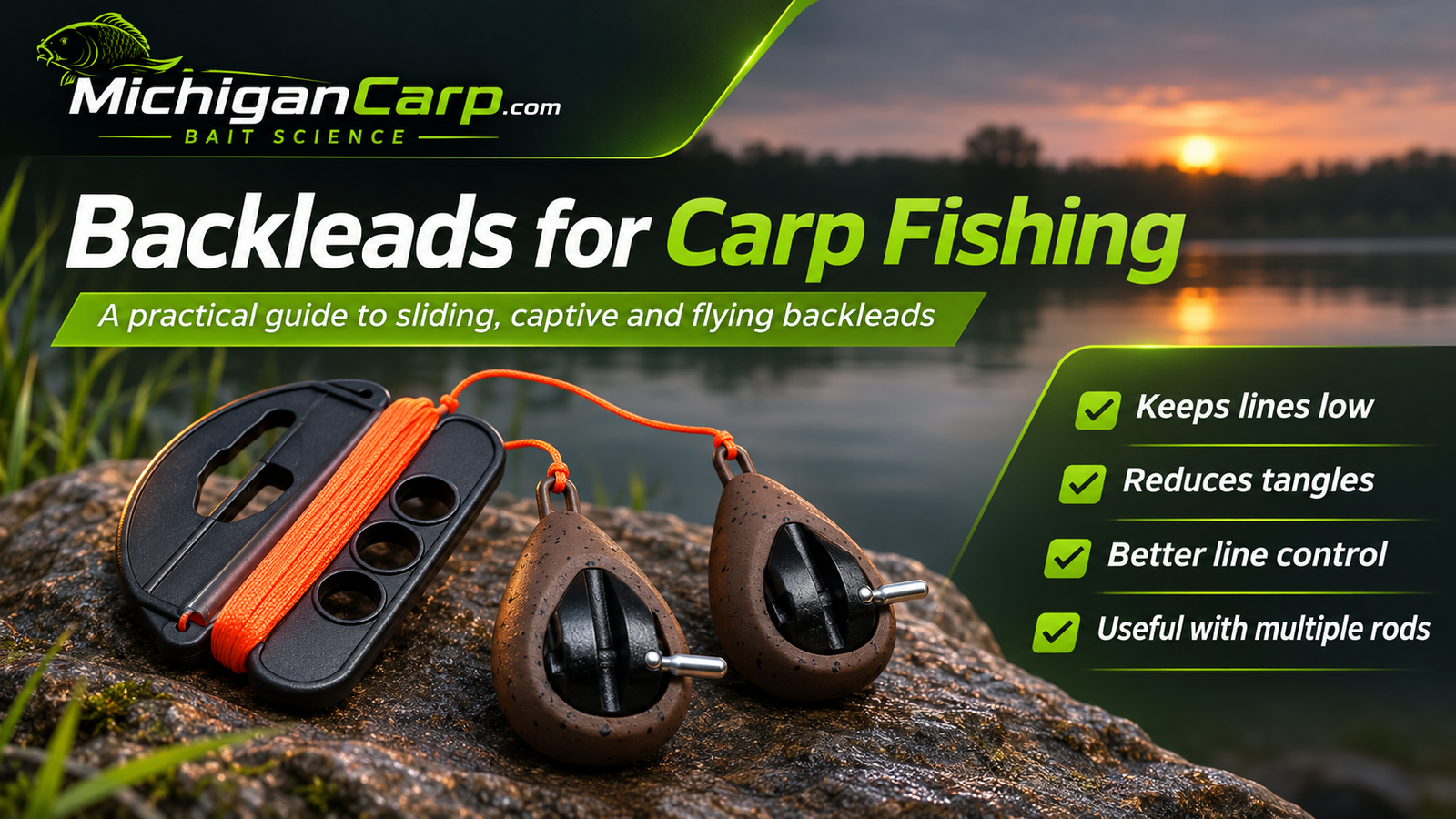
Backleads are designed to hold some of the carp-fishing mainline lower in the water, but they are not all the same. A traditional sliding backlead, a captive or tethered backlead and a flying backlead perform different jobs. Choosing the correct type can improve line control and reduce line encounters; choosing the wrong one can create snags, delay bite indication and make a hooked carp harder to land.
This practical MichiganCarp guide explains the differences, how each type is fitted, where they are useful, and when to fish without one. It also looks at using backleads with three rods, boat traffic, rivers and abrasive Michigan lakebeds, plus an unusual leadcore stiffener tip for captive backleads demonstrated in a short angling video. The priority throughout is predictable release and the safety of the fish.
Table of Contents
Quick Answer: Choosing a Backlead
| Type | How it works | Best starting use | Main caution |
|---|---|---|---|
| Sliding / clip-on | Attached to the mainline after casting and allowed to travel down toward the bottom | Lowering near-bank line on a clean, predictable lakebed | May stay on or move along the line when playing a fish |
| Captive / tethered | Attached after casting; tether runs to the bank and a release mechanism should free the mainline on a take | Holding a heavier near-bank weight without fighting the fish with that weight on the line | Tangled tether or failed release |
| Flying | Fitted before casting; travels back along the mainline in flight | Pinning line nearer the fishing spot on suitable clean ground | May catch on leader knots or be unsuitable for braid without the correct insert |
| Convertible / multi-purpose | Interchangeable parts permit more than one configuration | Flexibility if the maker provides proper instructions | Never improvise clips or release parts |
Simple rule: decide which part of your line needs controlling. To lower line close to the bank, think sliding or captive. To reduce raised line farther out near the terminal tackle, think flying. If lowering the line will put it across mussels, rock, weed or snags, consider no backlead at all.
What Backleads For Carp Fishing Can and Cannot Do
Without a backlead, tension draws the mainline on a relatively direct route between rod tip and fishing lead. Introducing a backlead creates an additional lower point along that route. This can reduce the amount of line suspended near the surface or across a carp patrol route, depending on the underwater contours and the type fitted.
It can be helpful when carp bump into taut lines, when fishing multiple rods or where boat traffic passes near the bank. But a backlead does not make the entire line invisible or safe from boat propellers. It also does not force the line to follow every contour on a deep or uneven lakebed. A poorly placed backlead can actually create a more hazardous line angle than a conventional tight line.
Much depends on what lies below the surface. See Best Depth for Carp Fishing for understanding shelves and depth changes, and Carp Fishing Line and Leaders for abrasion resistance and tackle balance.
1. Sliding and Clip-On Backleads
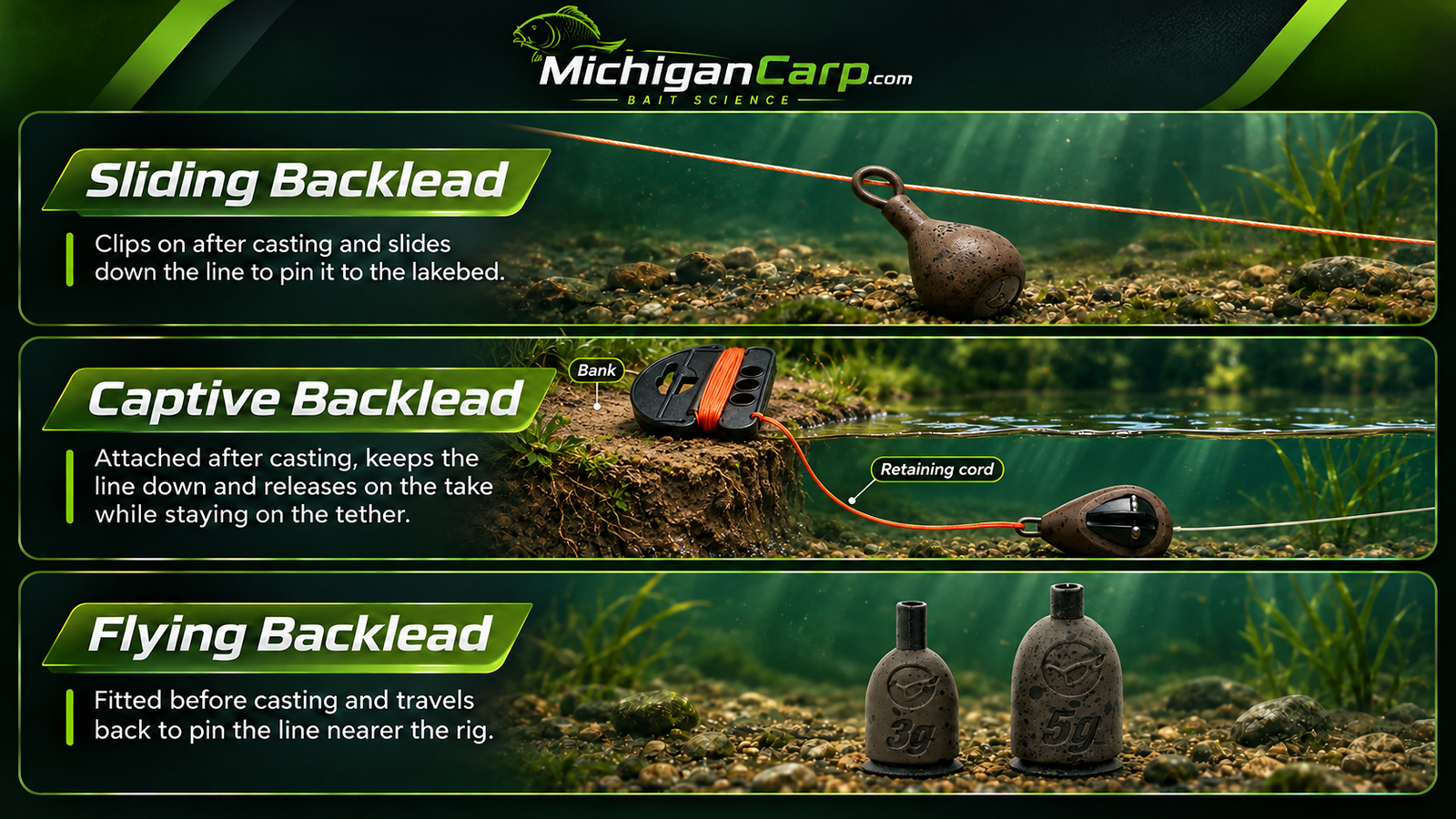
A traditional sliding backlead is put onto the mainline after the main lead and hookbait have been cast. The angler allows it to run down the line, under control, until the backlead settles where the line needs lowering. Usually this is somewhere in the margin or closer to the bank rather than directly at the hookbait.
The design varies. Some clips run freely and may stay on the mainline while you play a fish. Others are intended to separate from their weight if snagged. For example, Fox’s EDGES Downrigger Back Weights use a friction-fit connection that is designed to release the weight if it catches an obstruction. Do not assume every sliding backlead works the same way.
How to use a sliding backlead
- Cast and settle the fishing rig, maintaining the line tension needed for accurate presentation.
- Check that the near-bank bottom is clean and does not conceal a hard shelf, line-cutting mussels or snags.
- Attach the backlead to the mainline exactly as its manufacturer instructs; inspect the clip for rough edges.
- Lower it under control to a position that keeps the line clear of the hazards you have identified.
- Before fishing, simulate a take and retrieve to find out whether the backlead travels, releases or meets a leader connection.
Sliding backleads are often economical and easy to use, making them a sensible starting point on clean ground. Their disadvantage is that the weight or its clip may remain on the mainline during a fight. The backlead could then travel along the line or contact another component in a way you had not anticipated. Check that the arrangement cannot trap the line or interfere with fish-safe lead release.
Korda Intelligent Backleads: The Ring-and-Pear Design
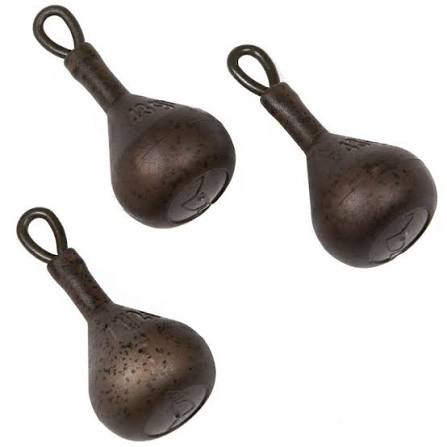
The pear-shaped weights pictured above are Korda Intelligent Backleads. The ring above the weight is a low-friction nylon line attachment. Korda describes a clip that can be attached one-handed, allowing the weight to slide down the mainline. The manufacturer also states that the backlead is designed to come free of the line if it becomes snagged.
This is a conventional clip-on backlead fitted after casting. It has no bank-connected retaining cord and should not be confused with a captive backlead that releases on a take, or a flying backlead fitted before the cast. Korda lists 0.25, 0.5, 1 and 1.5 oz versions—approximately 7, 14, 28 and 43 g—with three in a pack.
Using this style: settle the rig first, attach the clip to the mainline following the instructions supplied with the product, and lower the weight along the line towards a checked, unobstructed area. Let the ring travel freely rather than pulling the rig out of position. Test the complete arrangement for indication and retrieval before leaving it fishing.
Korda’s line-lay guidance explains that a standard backlead normally slides towards the rig while a fish is being played. Snag release is a fallback, not a reason to put the weight into weed or obstructions. A smooth ring also does not remove the indication delay caused by changing the line angle. Avoid this approach where an immediate response is needed to keep a carp away from snags; use the bank-side tests below to judge your own setup.
2. Captive Backleads
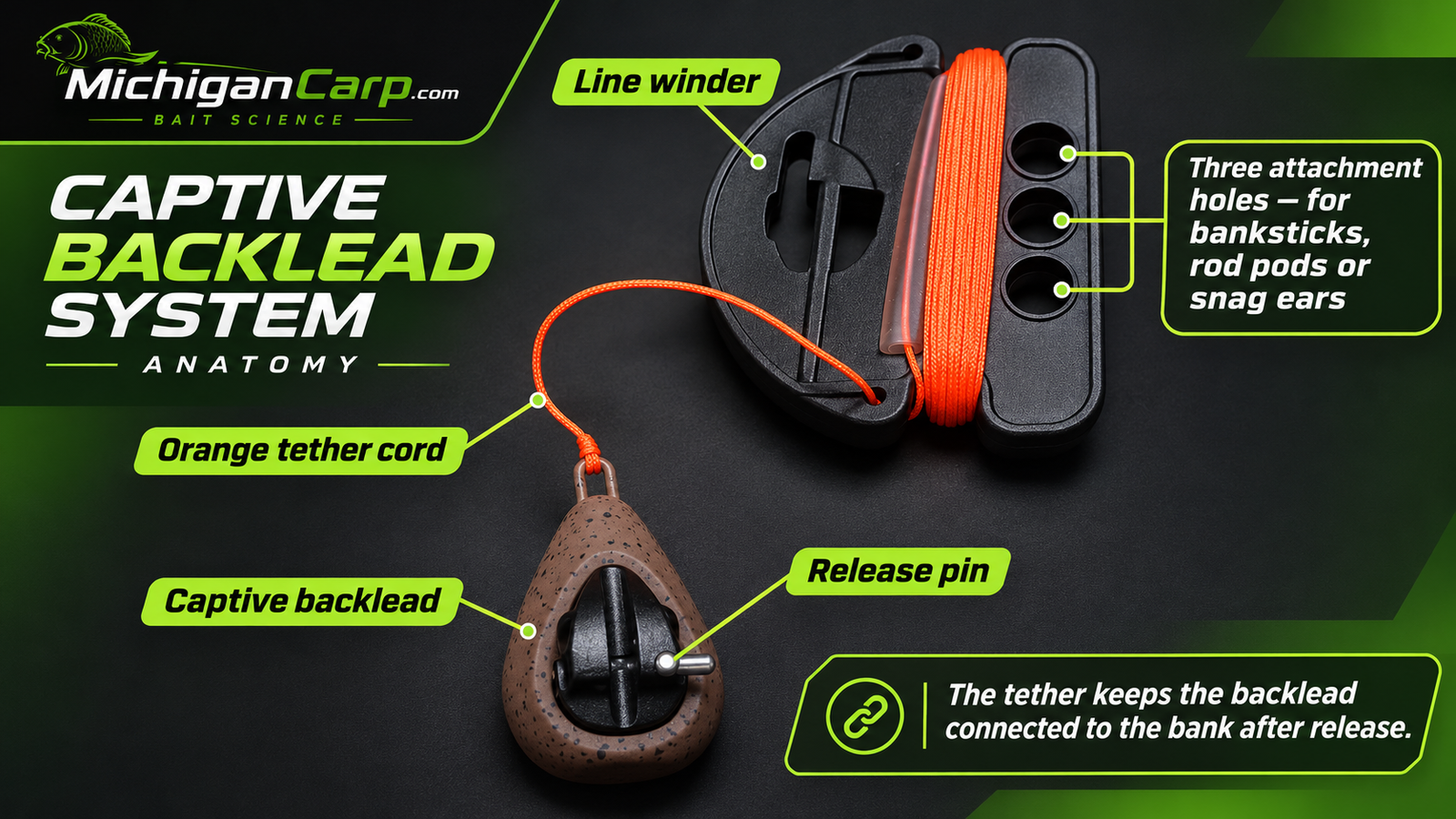
A captive backlead also clips onto the mainline after casting, but the weight has its own separate cord attached to the bank. It travels down the fishing line until it reaches the intended position and the tether limits further movement. On a take or strike, the captive backlead’s clip or gate is meant to open, leaving the fishing line free while the weight stays attached to its retaining cord.
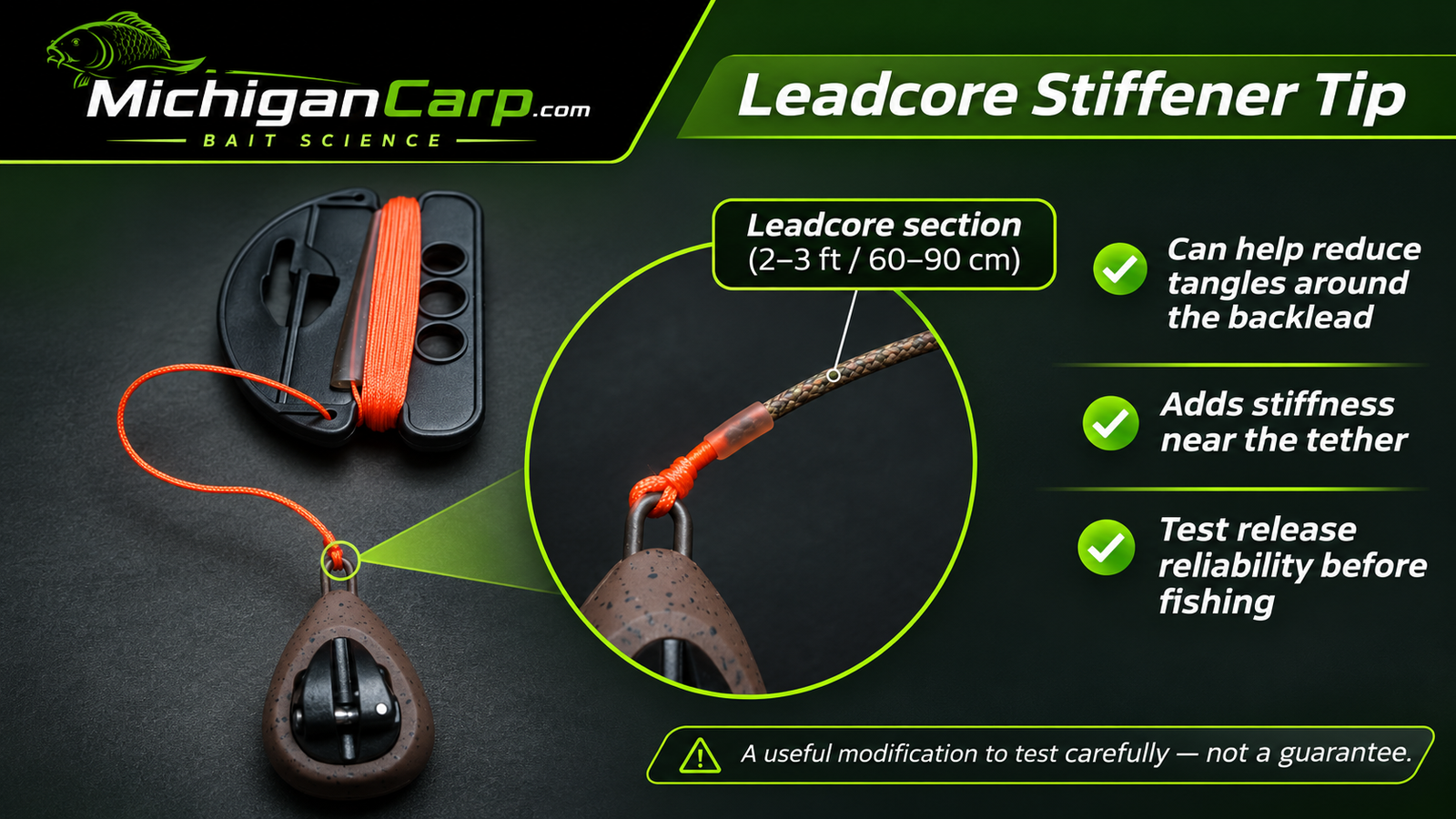
Winder mounting tip: The three circular holes on the retaining-cord winder are attachment points. Depending on the fittings and spacing, the winder can be secured to a bankstick, rod pod or compatible snag ears. Mount it so the orange retaining cord pays out freely and cannot wrap around an alarm, rod support or neighbouring line. These holes are for positioning the winder; they are not part of the backlead’s mainline release mechanism.
This is a practical design when a heavier weight is needed but you do not want that weight moving along the mainline while playing a carp. The Fox Captive Backweight has a mechanical gate and comes with a winder and 10 metres of orange cord. Manufacturer sizes include 1.25, 2, 3, 4 and 5 oz versions. The correct choice is the one that releases reliably with your line and your fishing angle—not simply the heaviest weight.
Setting up a captive backlead
- First settle the fishing rig and confirm the margin or underwater approach is free from hazards.
- Secure the captive backlead’s retaining cord to its intended bank attachment. Keep the cord away from the other rods, footwear, landing-net handles and access route.
- Clip the backlead onto the mainline with the gate or clip in its correct working position.
- Lower the backlead into a known clean area. The weight must not be dragged into weed, timber or a sharp drop-off.
- Pull line through the realistic directions of a take, sideways run and retrieve. Make sure it comes completely free of the captive mechanism.
- Test the alarm and bobbin with the backlead fitted before leaving the rod fishing.
A captive backlead is only an improvement if its release works every time under realistic conditions. A clean demonstration at the rod tip does not prove it will release correctly when its tether lies awkwardly on the bottom, when current pulls the cord or when a carp moves diagonally across the swim.
Leadcore Tether Tip
Jim Lightfoot Adventure Fishing demonstrates an uncommon modification in this short video about Fox captive backleads. He uses a short section of leadcore on the retaining tether near the captive weight to reduce the chance of the soft cord folding, twisting or wrapping around the backlead. He particularly mentions fishing rivers and the disturbance caused by crayfish moving along the bottom.
The underlying idea is sound enough to investigate: a stiffer section near the weight may be less likely to form loose loops that interfere with the clip or gate. It addresses a problem that is easily overlooked—the captive backlead may have a perfectly good release mechanism, but the tether can still become tangled around it. This deserves a place in a proper backlead guide rather than being lost in a passing comment.
Important qualification: This is a field modification described in a video, not a manufacturer-approved procedure or a tested guarantee. We have not independently reproduced the setup, and a stiffer tether can introduce fresh hazards if fitted badly. Exposed lead wire, protruding splices, loops or connections that catch the mainline are unacceptable.
- Any leadcore used for this purpose belongs solely to the separate, bank-connected backlead tether—not to the fishing mainline, hooklink or lead-release assembly.
- Do not let a stiffener create a wire end, enlarged loop or junction that could foul the captive gate or trap the mainline.
- Check the full range of tether movement, then repeat release tests with the weight submerged and the line pulled from different angles.
- If the release becomes less predictable, return to the original manufacturer’s tether arrangement. Do not fish an untested modification around snags.
The practical lesson is the value of tether management. Keeping the retaining connection orderly may matter as much as the weight’s release mechanism. We’ll retain the original video as a credited example, without treating the claim of guaranteed release as proven.
3. Flying Backleads
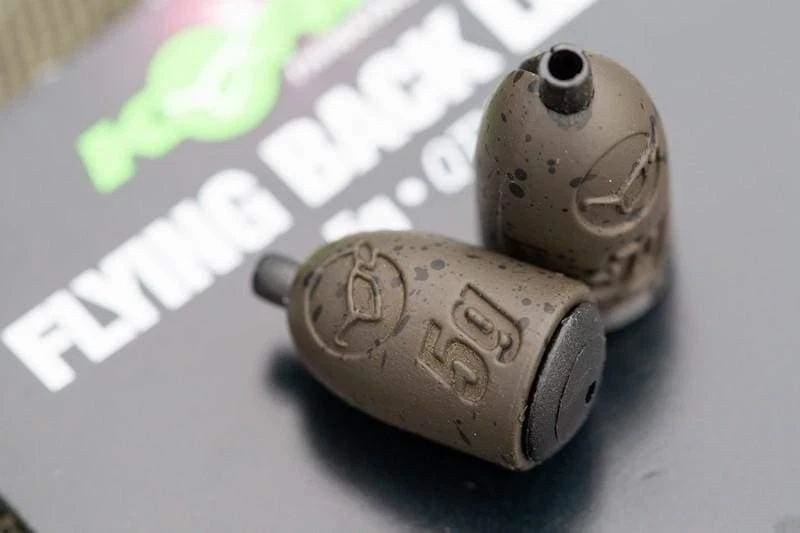
A flying backlead is fitted to the line before casting. During the cast, aerodynamic drag causes the small weight to move backwards along the mainline, away from the terminal lead. It then lands somewhere behind the fishing spot and can help keep the approach line lower in the water.
This is not the same job as a heavy captive backlead near the rod. Flying versions tend to be light. Korda’s Flying Backlead is available in 3 g and 5 g models, with a slotted insert for monofilament and a different insert intended for braid. The company warns that braid can catch in the standard slot. This is an excellent example of why you must match the backlead’s bore or insert to the actual mainline.
Before casting, confirm the position of any leader knot, buffer bead and other components. A flying backlead must not become a fixed obstruction that prevents a safe terminal arrangement from separating after a break-off. Use the maker’s compatible insert and bead arrangement; never improvise a stop knot to keep the weight in a particular place.
4. Multi-Purpose Backleads
Not every product fits neatly into one category. Some backleads have interchangeable inserts that allow them to work as a flying weight or a clip-on weight. Some have adjustable release pressure, and some are designed to let the weight detach from its clip when caught. A captive backlead instead usually aims to let the mainline detach from the weight on a take.
That distinction is more important than the branding. Ask whether the weight remains on the fishing line, whether the clip should separate and whether the complete setup still allows the carp to shed unsafe terminal tackle after a break-off.
Using Backleads With Three Rods
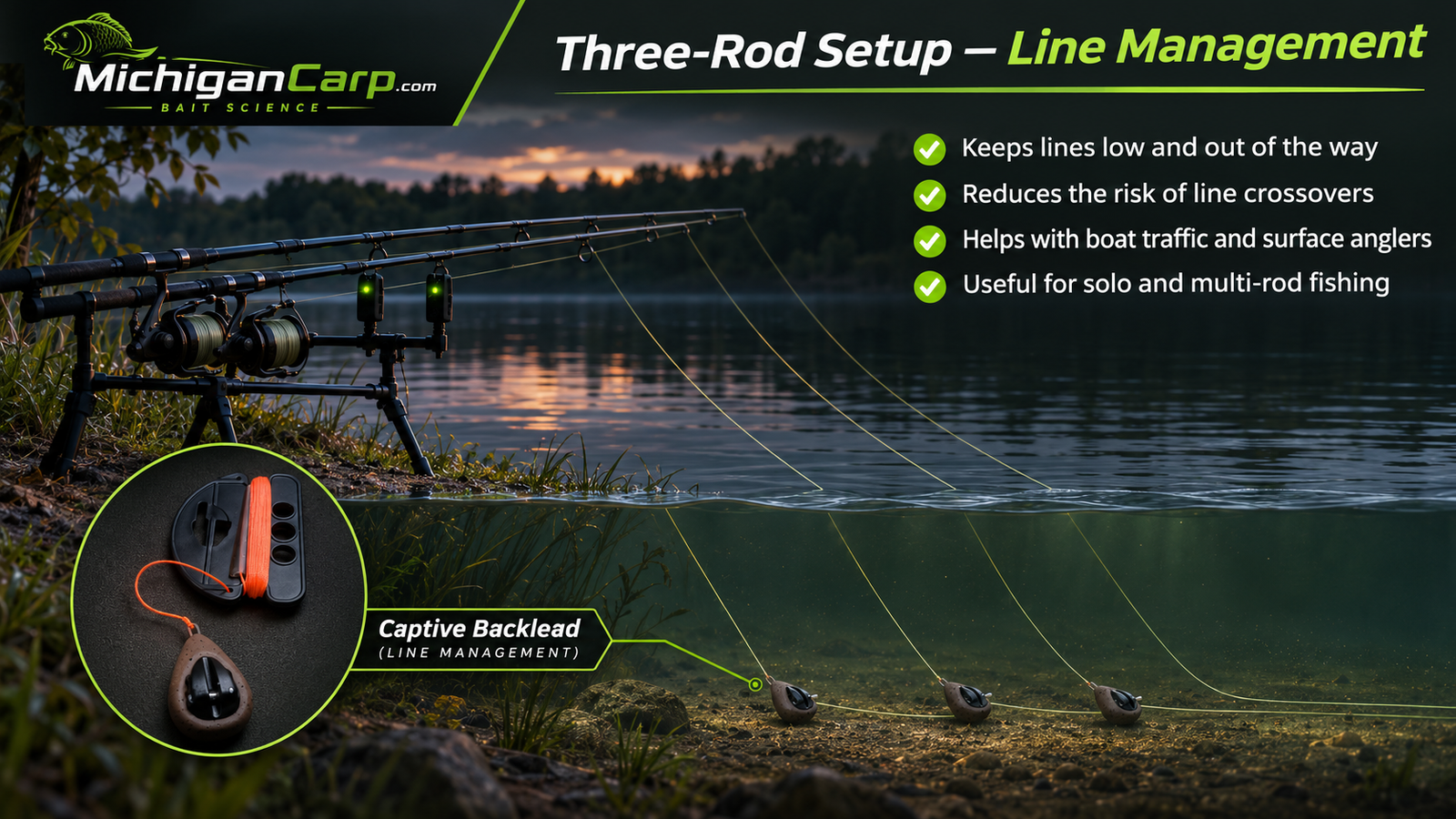
A three-rod carp setup can become difficult during a take, particularly if the rods are spread across different spots or distances. A hooked carp may run across the other two lines just when it is hardest to see and control the fish. Backleads can lower parts of the near-bank line, potentially reducing one kind of crossover. If a captive model releases properly, the hooked rod should then be free of its backlead weight.
That does not make three rods tangle-proof. A fish can cross the other lines farther out, change direction suddenly or reach them before the captive weight opens. The remaining backleads do not necessarily stop those lines being picked up. Rod spacing, line angles and the landing route still need to be planned before the first cast.
A sensible three-rod testing progression
- On a familiar clean bottom, start with one backleaded rod rather than equipping all three at once.
- Check that a slow run, a sharp take and a drop-back all register clearly on the alarms and indicators.
- Pull the line sideways as well as straight out to simulate a carp travelling across the swim.
- Watch whether the captive gate opens cleanly or the sliding weight moves as expected; reset and repeat.
- Try the arrangement with the actual line and leader materials used on the other rods, and confirm that nothing fouls the netting and landing area.
- Only expand to all three rods if the test shows a real improvement without delayed indication or new snag risk.
For multi-day sessions, the same checks should be repeated after a change in water level, weed conditions, current or the arrangement of the rods. A setup that was suitable at dusk may not remain suitable after floating debris or a strong wind moves through.
Backleads at Night
They can sometimes help with one of the main causes of nighttime line tangles: the hooked carp crossing raised near-bank lines. That is a legitimate reason to consider captive models. But they cannot guarantee the remaining rods will be clear, nor do they eliminate the need to respond promptly to alarms and control a fish.
Backleads must never become a reason to leave snag-fishing rods unattended or rely on delayed bite indication. If you cannot play a fish safely in darkness, reduce the number of rods, simplify their angles, move away from the obstruction or reel in the vulnerable rods.
Backleads and Boat Traffic
On Michigan lakes, close-passing boats can make elevated line a concern. Lowering some of the near-bank mainline can reduce the amount available to be caught by shallow traffic, but the line will rise again farther from the backlead and may still be vulnerable at different depths or angles.
Fox specifically identifies captive backweights for venues with boat traffic and current, but that does not mean any backlead eliminates propeller risk. If boats are passing dangerously close to your fishing lines, the safer response may be to retrieve the rods, adjust the fishing position or reduce the area covered.
Backleads in Rivers
Current can lift line, increase drag and move loose debris. A heavier sliding or captive backlead may improve a near-bank line angle on a clear river bottom, and a tethered model avoids playing the fish with the weight still running along the mainline if it releases as intended.
However, current also makes a backlead’s tether more likely to collect floating weed. The bottom may contain rock, sunken branches or sudden scour holes. More weight is not the answer if the line is being drawn across dangerous structure. Check how the tether settles and inspect it regularly where debris or crayfish activity is significant.
When Not to Use Backleads
| Situation | Why it can be worse | Better decision |
|---|---|---|
| Zebra mussels, sharp rock or riprap | Lowered line may be cut under tension | Keep the line clear of the abrasive edge |
| Submerged trees, stumps or heavy weed | Additional snag point; slower response to a take | Fish a safer route with direct indication |
| Steep ledges or pronounced gravel bars | A tight low line may run over an abrupt edge | Map the contour and adjust the fishing angle |
| Close snag fishing requiring instant contact | The backlead may delay bite indication | Avoid backleads and stay close to the rods |
| Unknown margin bottom | You cannot predict where weight or line will settle | Check the bottom first |
| Intermittent captive gate release | Risk of trapping the fishing line during a fight | Remove or repair the system before fishing |
This is not just theory. Korda’s line-lay guidance specifically discusses the dangers of lowered line over zebra mussels, snags, weed and sharp changes in depth, as well as delayed indication near snags.
Testing Bite Indication and Release
Before a backlead is left fishing, test the entire system, not just whether the backlead can be clipped to a line. Keep the rod secured and simulate the directions a carp could move. Watch the alarm and bobbin before the backlead separates or slides.
- Check a steady pull away from the bank.
- Check a fast take and a slow change in tension.
- Check a drop-back and a sideways pull.
- Confirm that any captive release actually frees the mainline, without the tether wrapping around it.
- Check the whole path of sliding and flying backleads relative to leader knots and fish-safe lead components.
- Repeat after adjusting weight, cord length, line tension, line material or fishing position.
If a carp could move a dangerous distance before you receive an unmistakable indication, the backlead is wrong for that situation. A sharper alarm setting does not fix the underlying line geometry.
Choosing Backlead Weight
There is no universal best backlead weight. Flying backleads may be only a few grams. Sliding designs commonly run from fractions of an ounce to a couple of ounces, while heavy captive systems can weigh several ounces. Depth, current, mainline tension, wind, bottom type and clip design all affect what works.
Choose the least complication and weight that achieves the needed line position without harming release or bite indication. More weight does not automatically give more safety or fewer line bites. In fact, it can increase friction, pull line across obstructions or place excess strain on a clip.
Buying Backleads
Specialist brands offer established designs and instructions, but there are also inexpensive backleads and compatible-looking clips on Temu and AliExpress. These marketplaces can be good places to compare the cost of straightforward sliding and flying models. Search for carp backlead, sliding back lead, flying backlead and captive backlead. Compare the delivered price, pack quantity and replacement clip availability rather than relying on the headline price.
A low price is useful only if the hardware is safe. Check for sharp moulding seams, rough line-contact edges, weak wire, a clip that traps braid, poor corrosion resistance or an unexplained release mechanism. On captive models in particular, do not take promotional claims as proof of reliable release. Test each weight and clip with your own line before trusting it on the bank.
For reference, the manufacturers’ product information is available for Fox captive backweights, Fox sliding downrigger weights, Korda flying backleads and Gardner drop-out backleads. These links illustrate mechanisms rather than endorse any one brand as the best choice.
Making Your Own Backleads
A homemade backlead may be economical, especially when you only need a simple sliding weight for a clean lakebed. But the important part is not making a weight that sinks: it is creating a line-contact and release arrangement that will not trap, abrade or damage your mainline. DIY backleads are not a substitute for a correctly engineered captive release mechanism.
- Use a smooth, line-friendly clip or insert with no burrs, exposed wire ends or sharp edges.
- Decide whether the finished backlead should slide freely, stay on the line during a fight or detach under a snag load. Verify what actually happens rather than assuming.
- Keep the weight and clip compatible with the mainline diameter, leader connection and fish-safe terminal arrangement.
- Test slow pulls, sharp takes, sideways pressure and drop-back indication under realistic conditions before fishing.
- If a home-made design binds, damages line, or cannot release safely, do not use it.
For an example of a homemade approach, see Cuttzy Airsoft’s homemade captive-backlead video. We have not independently tested this design; assess its line-contact surfaces and release behaviour using the checks above before considering it for fishing.
Common Problems and Fixes
| Problem | What to check | What to do |
|---|---|---|
| Alarm takes too long to register | Line drag, slack, weight position, release resistance | Reposition or remove the backlead and retest |
| Captive tether wraps around weight | Excess slack, very soft cord, current, bottom disturbance | Manage tether loops; use manufacturer arrangement or evaluate the stiffener idea cautiously |
| Sliding weight catches on a leader knot | Incompatible bore or stop arrangement | Use a compatible backlead or fish without it |
| Flying backlead traps braid | Wrong insert or rough slot | Use braid-specific insert when supplied |
| Weight settles in weed or rock | Insufficient knowledge of margin bottom | Move to clean water or remove |
| Three rods still tangle | Fish crosses lines farther out; poor rod angles | Simplify the rod spread and landing route |
| Backlead releases unexpectedly | Clip wear, inappropriate line size or tension | Inspect components and repeat test before fishing |
Frequently Asked Questions
Do backleads help catch more carp?
They can help where fish repeatedly contact raised line and the lakebed allows safe line pinning. They do not automatically increase catch rates, and they can reduce them if they damage indication or place line into snags.
What is the difference between a backlead and a flying backlead?
A traditional backlead is usually attached after casting and lowers line nearer the bank. A flying backlead is fitted before the cast and travels backwards along the mainline in flight, helping to control line closer to the fishing spot.
Does a captive backlead release when a fish takes?
It is designed to, but the result depends on the actual clip, line material, tether position and direction of pull. Test it repeatedly with the complete fishing arrangement before relying on it.
Can I use backleads with braided mainline?
Only if the particular clip or insert is suitable for braid. Some slotted fittings can trap the fibres. Follow the manufacturer’s compatibility instructions and inspect the line after testing.
Are backleads suitable around zebra mussels?
Often not. Their ability to hold the line lower can become a liability where that line must run across sharp shell-covered rocks or lakebed features. Keeping the line raised and clear may offer better fish protection.
Should I fit backleads to all three rods?
Not automatically. Trial one rod first, check release and indication, then decide whether additional backleads actually help the specific line angles. Backleads cannot prevent every crossover farther out.
Will backleads stop boats catching my line?
They can lower vulnerable near-bank sections, but they cannot guarantee protection from propellers or boat traffic. Retrieving rods when traffic is unsafe may be necessary.
Can I use a short piece of leadcore on a captive tether?
The video-linked stiffener modification is a useful experimental idea, not a proven universal practice. The leadcore would be on the separate bank-connected tether, never spliced into the fishing line for this purpose, and the setup must not foul the release. If testing is inconclusive, use the original tether.
My Practical View
I see backleads as tools for addressing a specific problem: an exposed line angle, nuisance line encounters, or potential line crossings when fishing multiple rods. I would not use them automatically. I would start by asking where the line actually lies, what it could rub against, how quickly a take will register and what the hooked carp will be able to reach.
For a clean-bottom three-rod setup, captive backleads may be worth trialling to reduce near-bank line crossings. On a shell-covered, snaggy lakebed with steep contours, I would be much less enthusiastic. A raised line with dependable bite indication can be a better and safer choice than a low one pulled through hazards.
The leadcore tether trick is exactly the sort of practical knowledge that deserves testing, but it is no substitute for a correctly functioning release. My rule is simple: if you cannot demonstrate a clean release and clear bite indication, do not fish with that backlead.
Related Guides and Sources
- Carp Fishing Line and Leaders for Michigan — abrasion, line choice and safe connections.
- Carp Lead Systems — why the complete lead-release system matters.
- Best Depth for Carp Fishing — understanding contours and line angles.
- Weed Beds and Carp Fishing — weed edges and safe fishing routes.
- Fox Captive Backweight product information.
- Korda: Line Lay and Backleads.
- Korda Flying Backlead fitting details.
- Video: homemade captive backleads — Cuttzy Airsoft.