

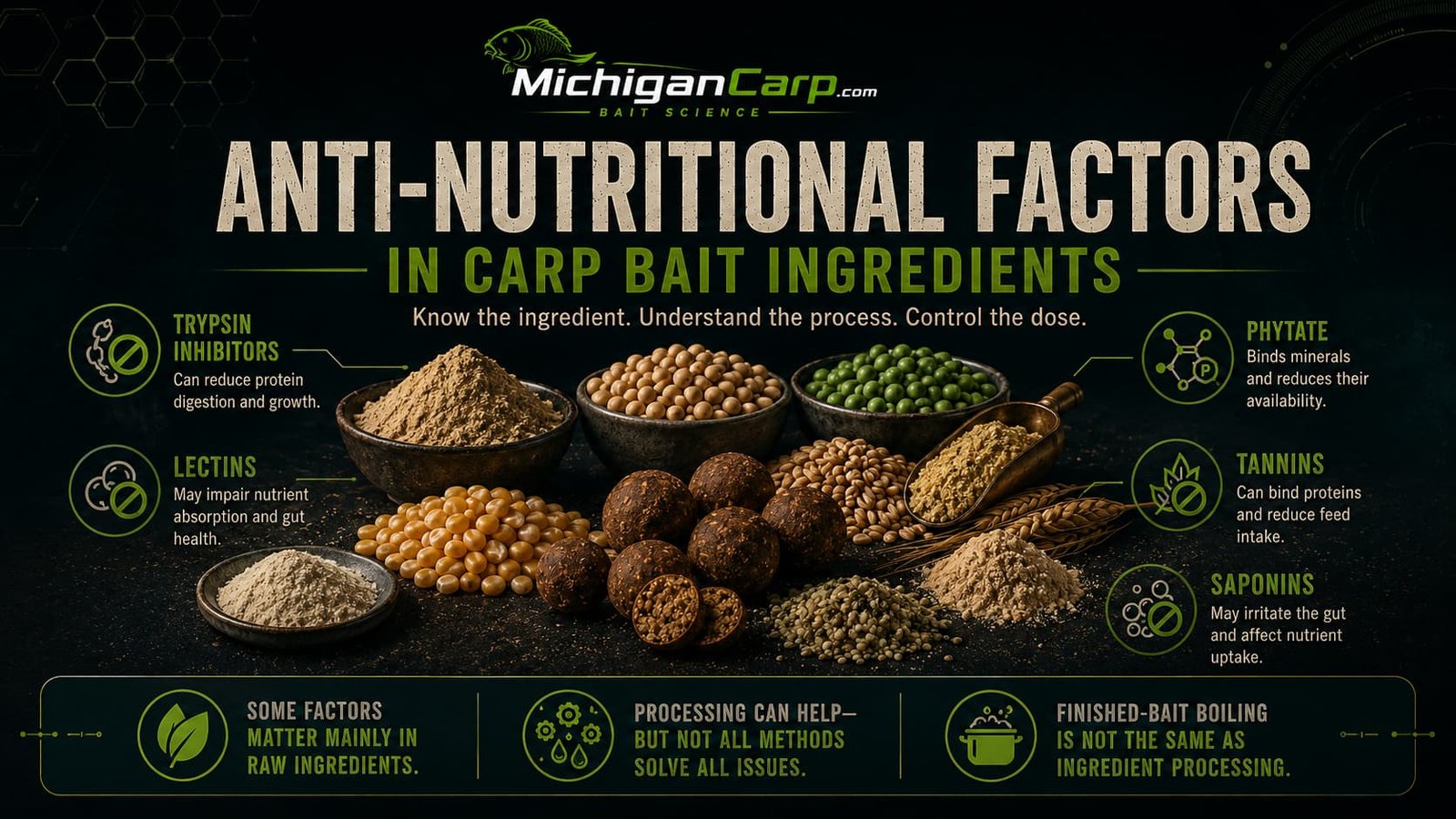
Anti nutritional factors in carp bait matter, but they are also easy to misunderstand.
The subject often gets pushed to one of two extremes. Some anglers assume anything natural, plant-based or high in protein must be a useful bait ingredient. Others treat every plant protein, seed meal, legume and cereal product as if it is automatically dangerous.
Neither view helps bait making.
Anti nutritional factors are naturally occurring compounds in some plant and feed ingredients that can interfere with nutrient digestion, mineral availability, enzyme activity, palatability or the real feeding value of a bait. They can matter in carp bait, especially when the bait is eaten in quantity.
But the useful questions are more specific:
- Which compound is present?
- Which ingredient contains it?
- Is the ingredient raw, treated, cooked, toasted, fermented, refined or hydrolysed?
- How much of the ingredient is being used?
- Is this a single hookbait or a heavily fed campaign bait?
- What else is in the formula?
A properly processed plant ingredient used sensibly in a balanced bait is very different from a cheap unidentified raw agricultural product used mainly because it shows a good crude-protein number.
This article explains the anti nutritional factors most relevant to homemade carp bait, including trypsin inhibitors, lectins, phytate, tannins, saponins, glucosinolates and gossypol. It also explains what processing can realistically do, when phytase matters, and where anglers are worrying unnecessarily.
This guide works alongside Raw vs Processed Ingredients in Carp Bait, How to Process Carp Bait Ingredients, Carp Bait Digestibility, What Boiling Does to Carp Bait and the main Bait Science hub.
For external feed-processing context, see FAO: Effects of Processing on the Nutritional Value of Feeds, FAO: Nutritional Fish Pathology and Feedipedia: Soybean Meal.
Table of Contents
Quick Start: Anti Nutritional Factors in Carp Bait
Anti nutritional factors in carp bait are not a reason to avoid every plant ingredient. They are a reason to understand ingredient identity, processing history and inclusion level.
| Practical question | Better bait-making answer |
|---|---|
| Are plant ingredients bad? | No. Many plant ingredients are useful when properly selected and processed. |
| Is soy bad in carp bait? | No. Raw soy and properly heat-treated soy are different ingredients. |
| Does boiling a boilie fix raw ingredients? | No. Finished-bait cooking is not the same as industrial ingredient processing. |
| Does heat solve phytate? | Not reliably. Phytate is a different problem from heat-sensitive trypsin inhibitors. |
| Is phytase an attractor? | No. Phytase is a targeted enzyme for phytate under suitable reaction conditions. |
| Do small inclusions matter? | Less than major formula components, especially in heavily fed bait. |
| Should hookbaits be judged the same as feed bait? | No. The amount consumed is completely different. |
The simplest rule is this:
Judge the actual ingredient, not just the plant name, protein percentage or price.
What Anti Nutritional Factors Actually Are
Anti nutritional factors are compounds that can reduce the efficient use of nutrients or reduce the practical feeding value of an ingredient.
Depending on the compound, amount and ingredient, they may:
- interfere with digestive enzymes;
- reduce protein utilization;
- bind minerals;
- reduce phosphorus availability;
- affect palatability;
- increase digestive challenge at high inclusion;
- lower the real value of a feed ingredient.
Plants contain these compounds for reasons connected with storage, structure and defence. That does not make plant ingredients bad carp bait ingredients. It means plant ingredients need to be evaluated correctly.
A well-manufactured soy flour, a heat-treated full-fat soy product, a processed soybean meal and a bag of raw ground soybean are not the same ingredient.
The Main Anti Nutritional Factors in Carp Bait Ingredients
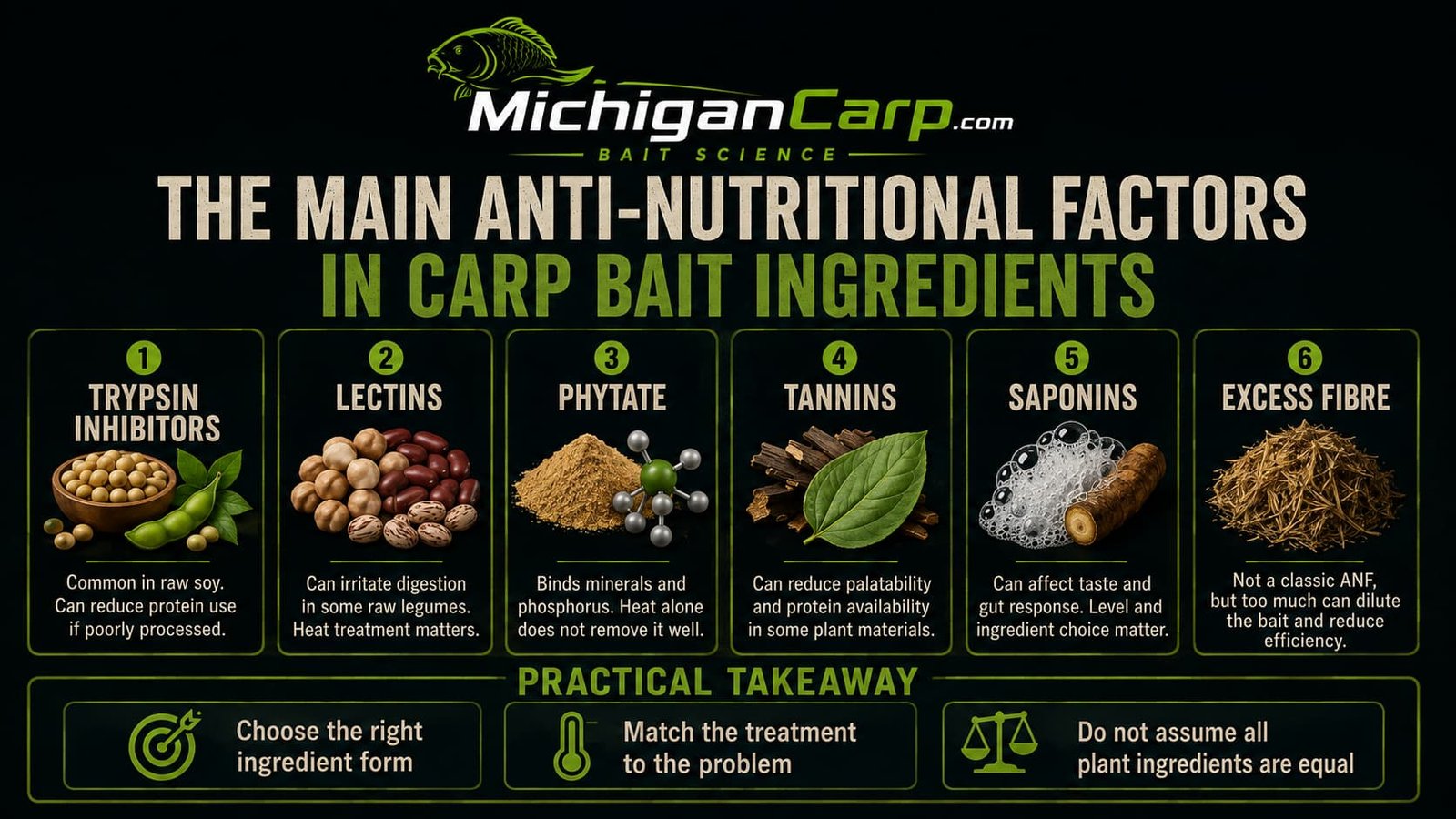
| Factor | Main sources | Main concern | Practical bait response |
|---|---|---|---|
| Trypsin inhibitors | Raw or inadequately treated soy and some legumes | Protein digestion interference | Use properly heat-treated ingredients |
| Lectins | Raw or underprocessed legumes and pulses | Digestive-function concern at meaningful levels | Use known processed products and correct preparation |
| Phytate | Seeds, grains, legumes, oilseed meals and bran-rich materials | Reduced phosphorus and mineral availability | Consider formula balance, phytase logic and ingredient selection |
| Tannins | Husks, seed coats, some legumes and plant meals | Palatability and protein-use effects at high levels | Use sensible inclusion and avoid rough bargain bulk |
| Saponins | Some legumes and oilseed ingredients | Ingredient- and dose-dependent effects | Know the product and avoid excessive inclusion |
| Glucosinolates | Rapeseed, canola and brassica-related materials | Ingredient-specific nutritional and palatability concern | Use appropriate processed products cautiously |
| Gossypol | Cottonseed products | Specialist toxicity concern | Avoid casual home experimentation |
| Excess fibre | Bran, husks, rough seed meals and low-grade plant bulk | Formula dilution and digestibility drag | Treat as a formulation issue rather than one named anti-nutrient |
The phrase anti nutritional factors should not be treated as one single problem. Different compounds require different thinking.
Why Carp Anglers Should Care
Anti nutritional factors matter most when bait is eaten in meaningful quantity.
A single hookbait and a heavily fed boilie campaign are not the same nutritional situation. If an angler feeds several pounds of bait over a multi-day session or repeatedly prebaits a water, the quality of the ingredient base matters more than it does in one isolated hookbait.
This is why anti nutritional factors belong beside Carp Bait Digestibility.
Crude protein can mislead bait makers
An ingredient with a good crude-protein number is not automatically a high-value carp bait ingredient.
You still need to consider amino-acid contribution, digestibility, processing history, fibre, fat freshness, anti nutritional factors and the complete formula.
Poor ingredients dilute strong ingredients
A bait maker can spend money on milk proteins, yeast products, hydrolysates and quality nut meals, then weaken the formula by overloading it with cheap plant bulk or poorly processed feed ingredients.
Repeated feeding magnifies formulation weaknesses
The more bait a fish consumes, the more relevant the quality and balance of the complete feeding system becomes.
That does not mean carp are analysing nutrition before they eat. It means poor feed design becomes more important as the amount consumed increases.
Trypsin Inhibitors and Soy Confusion
Trypsin inhibitors are among the best-known anti nutritional factors associated with raw soybeans and some legumes.
Trypsin is involved in protein digestion. When trypsin inhibitors remain active at significant levels, protein utilization can be reduced.
This is why the phrase soy flour is not enough information when choosing a bait ingredient.
Raw soy and processed soy are not the same
The important distinction is between:
- raw or inadequately processed soybean material;
- properly heat-treated full-fat soy;
- processed defatted soybean meal;
- processed soy flour;
- specialist soy protein ingredients.
Full-fat soy is not automatically the problem. The problem is unclear raw soybean material being treated as though it has already been correctly processed.
Feed-processing references commonly treat soybean heat processing as important because it reduces heat-labile anti nutritional factors such as trypsin inhibitors and lectins. The same references also warn that under-processing and over-processing are both possible problems.
My bait-making view on soy
I would not reject soy as a carp bait ingredient.
I would reject buying an unclear raw soybean material and assuming that the brief cooking of a finished boilie will automatically turn it into a properly processed ingredient.
In a balanced formula, a suitable processed soy ingredient can contribute protein, structure, rolling properties and economical bulk.
The mistake is using ingredient names without understanding ingredient form.
For the wider principle of judging an ingredient by its actual treatment, function and processing history, read Raw vs Processed Ingredients in Carp Bait.
Lectins in Legumes and Pulses
Lectins are another broad group of compounds associated particularly with legumes and pulses.
They should not be discussed as if every legume contains the same lectin level or every lectin behaves identically.
The practical bait lesson is simpler:
Raw and underprocessed pulse ingredients deserve more caution than known processed feed ingredients.
Relevant materials may include beans, peas, chickpeas, lupin products and other legume meals.
That does not mean these ingredients are useless. It means I would prefer known processed products, sensible inclusion levels, correct particle preparation and clear ingredient identification.
For the practical preparation side, read How to Process Carp Bait Ingredients.
Phytate: The One Anglers Need to Understand Properly
[IMAGE PLACEMENT: PHYTATE AND PHYTASE EXPLAINED — phytate-phytase-carp-bait.png]
Alt text: Phytate and phytase in carp bait showing grains, seeds, legumes, mineral binding, phosphorus availability and targeted enzyme treatment.
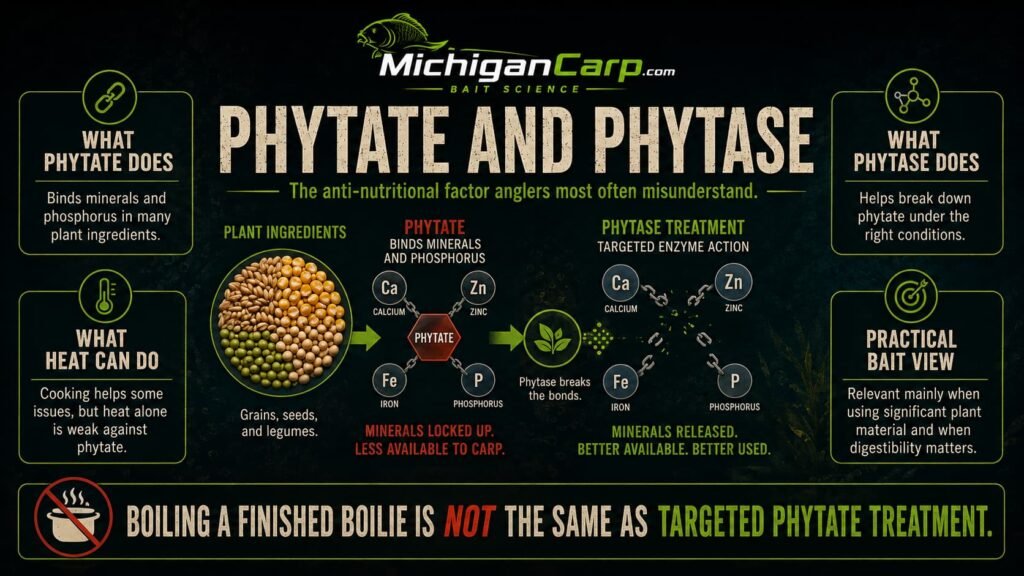
Phytate deserves separate attention because anglers often confuse it with heat-sensitive anti nutritional factors.
Phytate is found widely in seeds, grains, legumes, oilseed meals and bran-rich ingredients. Plants use it as a storage form associated with phosphorus.
From a feed-formulation perspective, the issue is that phytate-bound phosphorus can have poor availability, and phytate can also interfere with the availability of minerals and other nutrients.
The crucial lesson is:
Phytate is not the same problem as a trypsin inhibitor.
Heat treatment is not phytase treatment
Proper heat treatment can be important for ingredients containing heat-sensitive protease inhibitors and lectin-related issues. That does not mean ordinary heating automatically solves phytate.
This matters because anglers sometimes think:
I boiled the ingredient, so every anti nutritional factor has been removed.
That is not a reliable rule.
Phytase is a targeted enzyme used to break down phytate under suitable conditions. It needs the right substrate, moisture, pH, temperature and reaction time.
That is why phytate connects directly to Do Enzymes and Phytase Really Improve Carp Bait?.
Does soaking remove phytate?
Soaking can be part of some ingredient-processing systems, but I would not describe ordinary soaking as a guaranteed phytate cure.
The result depends on ingredient type, natural enzyme activity, moisture, temperature, pH and time.
The same caution applies to fermentation. Some fermentation systems can alter phytate levels, but fermentation should not be treated as one universal chemical process.
My practical phytate rule
I would not panic over normal amounts of grain, seed or plant protein in a mixed bait.
I would become more interested in phytate when the formula is heavily plant-based, high-phytate ingredients are stacked together, the bait is intended for heavy repeated feeding, or the bait maker is attempting a genuine feed-style formulation.
That is a formulation question, not an argument for throwing phytase into every hookbait.
Tannins, Saponins and Plant Compounds
Tannins can occur in plant husks, seed coats, legumes and various plant meals. At sufficiently high levels, tannin-rich ingredients can affect palatability and nutrient use.
But wording matters.
I would not group every plant polyphenol into one negative category. Different phenolic compounds have different properties.
The practical bait question is:
Is this particular ingredient contributing enough value to justify its inclusion?
For heavily husked, strongly astringent or unusual bargain plant meals, I would be cautious about making them a major part of a bait.
For modest inclusion of known seed, cereal and birdfood ingredients in a balanced formula, I would not automatically assume tannins are a major problem.
Saponins
Saponins occur in several plant ingredients, particularly some legumes and oilseed-derived materials.
They can have biological effects at higher levels, but they should not be used as a reason to condemn an entire ingredient family.
The important variables are ingredient identity, processing, saponin type, concentration and inclusion level.
My practical rule is simple:
Do not treat every plant-protein concentrate as clean protein just because the crude analysis looks attractive.
Glucosinolates, Gossypol and Specialist Feed Ingredients
Glucosinolates are most relevant when discussing rapeseed, canola and related brassica materials.
This is a good example of why modern processed feed ingredients should not automatically be judged by the reputation of the raw crop. Different rapeseed and canola products can differ substantially in processing and composition.
For a home bait maker, I would use specialist oilseed meals cautiously unless the exact product is understood.
Cottonseed products can contain gossypol. For most homemade carp bait makers, this is less a formulation opportunity than a warning against experimenting blindly with unfamiliar feed by-products.
There are enough useful and well-understood bait ingredients available that I see little reason for a home bait maker to build a formula around obscure livestock-feed leftovers simply because they are cheap.
Availability and low price do not automatically make an agricultural by-product a good carp bait ingredient.
Excess Fibre Is a Related Formulation Problem
Excess fibre deserves discussion, but I would separate it from classic named anti nutritional factors such as phytate, lectins or trypsin inhibitors.
Fibre is not automatically bad. Fibrous ingredients can contribute texture, open structure, physical breakdown and ingredient diversity.
The problem comes when rough plant bulk starts replacing ingredients with clearer nutritional or functional roles.
Examples include excessive use of bran, husks, low-grade cereal by-products, very rough seed meals and cheap high-fibre feed ingredients.
A little rough structure can be useful.
A bait made largely from rough cheap bulk is a different proposition.
Which Processing Methods Help Which Problems?
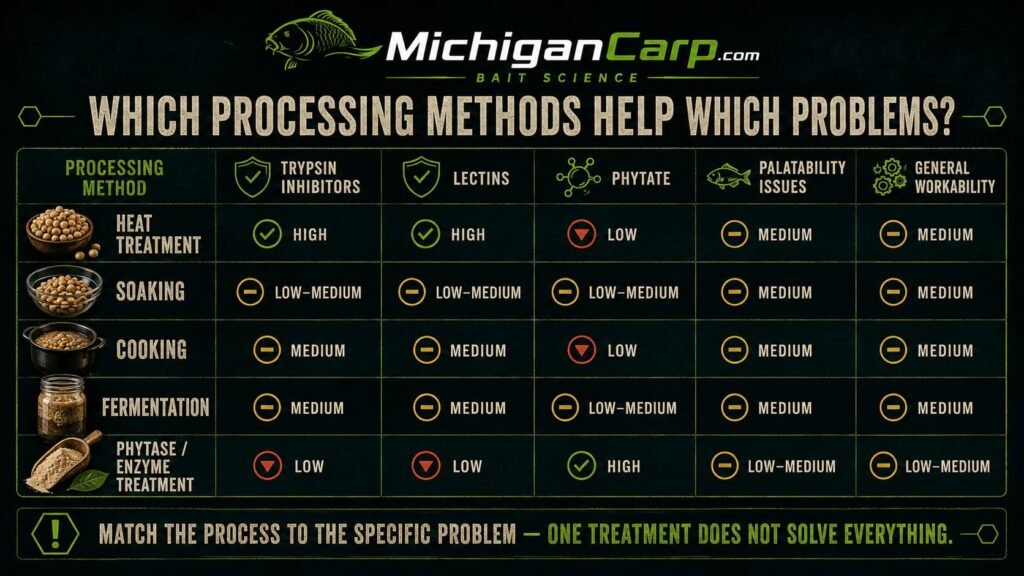
| Processing method | Most relevant to | Important limitation |
|---|---|---|
| Heat treatment | Trypsin inhibitors and some lectin-related issues | Does not solve every anti nutritional factor |
| Soaking and cooking | Particle hydration and ingredient-specific preparation | Not a universal phytate treatment |
| Fermentation | Can alter selected compounds depending on substrate and process | Results depend on organism, moisture, temperature, pH and time |
| Extrusion | Heat, pressure and physical restructuring | Effect depends on ingredient and process severity |
| Sprouting | Can activate natural biochemical changes | Not equally practical or useful for every ingredient |
| Phytase treatment | Phytate breakdown | Requires suitable moisture, pH, temperature and reaction time |
This is the section I wish more bait discussions included.
Processing is not one thing. There is no single treatment called make the ingredient digestible. Each process should answer a specific question.
For the practical decision process behind grinding, crushing, sieving, hydration, cooking, drying, fermentation and enzyme treatment, read How to Process Carp Bait Ingredients.
Does Boiling the Finished Boilie Remove Anti Nutritional Factors?
Do not rely on finished-boilie cooking as a substitute for choosing properly processed ingredients.
This is a crucial distinction.
Industrial ingredient processing may use controlled temperature, moisture, pressure, extrusion, residence time and targeted enzyme treatment.
A brief boil or steaming stage applied to a finished 20 mm or 24 mm boilie is a different process.
For example, I would not deliberately choose raw soybean flour and assume that boiling the final bait gives me the same product as buying a correctly heat-treated soy ingredient.
Finished-bait cooking has important jobs: setting structure, changing proteins, changing starches and creating durability.
But it should not be used as an excuse for poor ingredient selection.
For the full distinction, read What Boiling Does to Carp Bait: Heat, Steaming, Leakage and Structure.
Raw Soy, Full-Fat Soy and Soybean Meal
Because soy causes so much confusion, the decision needs to be clear.
| Soy ingredient | My bait-making view |
|---|---|
| Raw ground soybean | Avoid as a casual homemade bait ingredient |
| Properly heat-treated full-fat soy | Useful in balanced mixes at sensible inclusion |
| Processed soybean meal | Potentially useful depending on quality and formula |
| Processed soy flour | Useful when specification and processing are known |
| Soy protein concentrate or isolate | Specialist protein ingredients; judge by function and cost |
The important lesson is simple:
Soy is not one ingredient.
Practical Ingredient Choices for Homemade Carp Bait
| Ingredient | Decision |
|---|---|
| Raw soybean flour | Avoid |
| Properly heat-treated full-fat soy | Useful at sensible inclusion |
| Processed soybean meal | Useful depending on quality and formulation |
| Processed pea, chickpea or lupin ingredients | Potentially useful; favour known processed forms and moderate inclusion |
| Bran and husk-heavy materials | Texture tools, not the nutritional backbone |
| Rapeseed or canola meal | Ingredient-specific; check the exact product |
| Cottonseed meal | Specialist ingredient; unnecessary for most home bait makers |
| Quality cereal flours | Useful for structure and energy; not protein concentrates |
| Nut and seed meals | Useful, but count fibre, fat and complete formula balance |
Anti Nutritional Factors Are Often a Dose Problem
One of the most important ideas in this article is that ingredient amount matters.
Problems become more likely when one plant ingredient is used excessively, similar plant ingredients are stacked together, raw or uncertain ingredients dominate the mix, the bait is formulated mainly around cost, or the same bait is heavily fed over repeated sessions.
This is why I would not reject a bait simply because it contains soy, maize, wheat, seed meals, birdfood or nut products.
The question is how they are used together.
A balanced formula can contain plant ingredients without becoming a low-grade plant feed.
Hookbaits and Feed Bait Are Different
A specialist hookbait is used in tiny quantity.
A multi-day feeding system can expose fish to much larger amounts of the same ingredient package.
That is why I care more about anti nutritional load when designing free boilies, long campaigns, multi-day sessions, regular prebaiting programs and large-volume feed systems.
For a single hookbait, I am usually more concerned with presentation, durability, taste balance, signal and rig mechanics.
This is another reason hookbait design and feeding-bait design should not always be identical.
How This Applies to Homemade Boilies
For homemade boilie makers, the solution is not to remove every plant ingredient.
The better approach is:
- know the ingredient form;
- avoid raw problem ingredients;
- use processed plant proteins where appropriate;
- balance plant materials with complementary proteins and energy sources;
- control rough fibre;
- do not expect liquids to rescue a weak formula;
- use enzymes only when the process makes sense;
- judge the complete bait rather than one fashionable ingredient.
This connects directly with How to Formulate a Milk, Nut and Birdfood Boilie Base Mix and Carp Bait Digestibility.
The Danger of Budget Bait Logic
There is nothing wrong with economical bait.
On big Michigan waters, sensible bait economics are essential.
The problem begins when cheap bait is designed like this:
- find the cheapest protein number;
- find the cheapest cereal;
- add a lot of rough filler;
- add flavour;
- call it balanced.
That is not formulation.
A better economical bait uses ingredients because they have jobs: protein, energy, structure, texture, food signal, digestibility and practical handling.
Economy should come from intelligent balance, not simply the largest possible amount of cheap bulk.
Michigan Notes
This subject is especially relevant to the way many of us fish in Michigan.
Our fishing can involve large natural lakes, long sessions, heavy particle use, campaign baiting and feeding substantial quantities over several days.
Short sessions
On a short session, I am less concerned about creating a mathematically perfect complete feed.
I care more about location, signal, bait acceptance and correct quantity.
Three- to five-day sessions
When carp may consume substantial amounts of feed, I pay more attention to ingredient processing, digestibility, total fibre, total lipid, protein balance and baiting quantity.
Particle-heavy fishing
Particles can be an excellent foundation for Michigan big-water fishing, but each particle should be prepared correctly for what it is.
I would not use one blanket soaking and boiling rule for every seed, grain, nut or pulse.
Big-water bait economics
I would rather use a sensible combination of properly prepared particles, balanced boilies, crumb, chops and targeted liquid near selected rigs than make every pound of feed bait expensive or overload a mix with cheap plant bulk.
Common Mistakes
[IMAGE PLACEMENT: COMMON ANTI NUTRITIONAL MISTAKES — anti-nutritional-factor-mistakes-carp-bait.png]
Alt text: Common mistakes with anti nutritional factors in carp bait including judging by crude protein, using raw soy, assuming heat solves phytate and relying on finished boilie cooking.
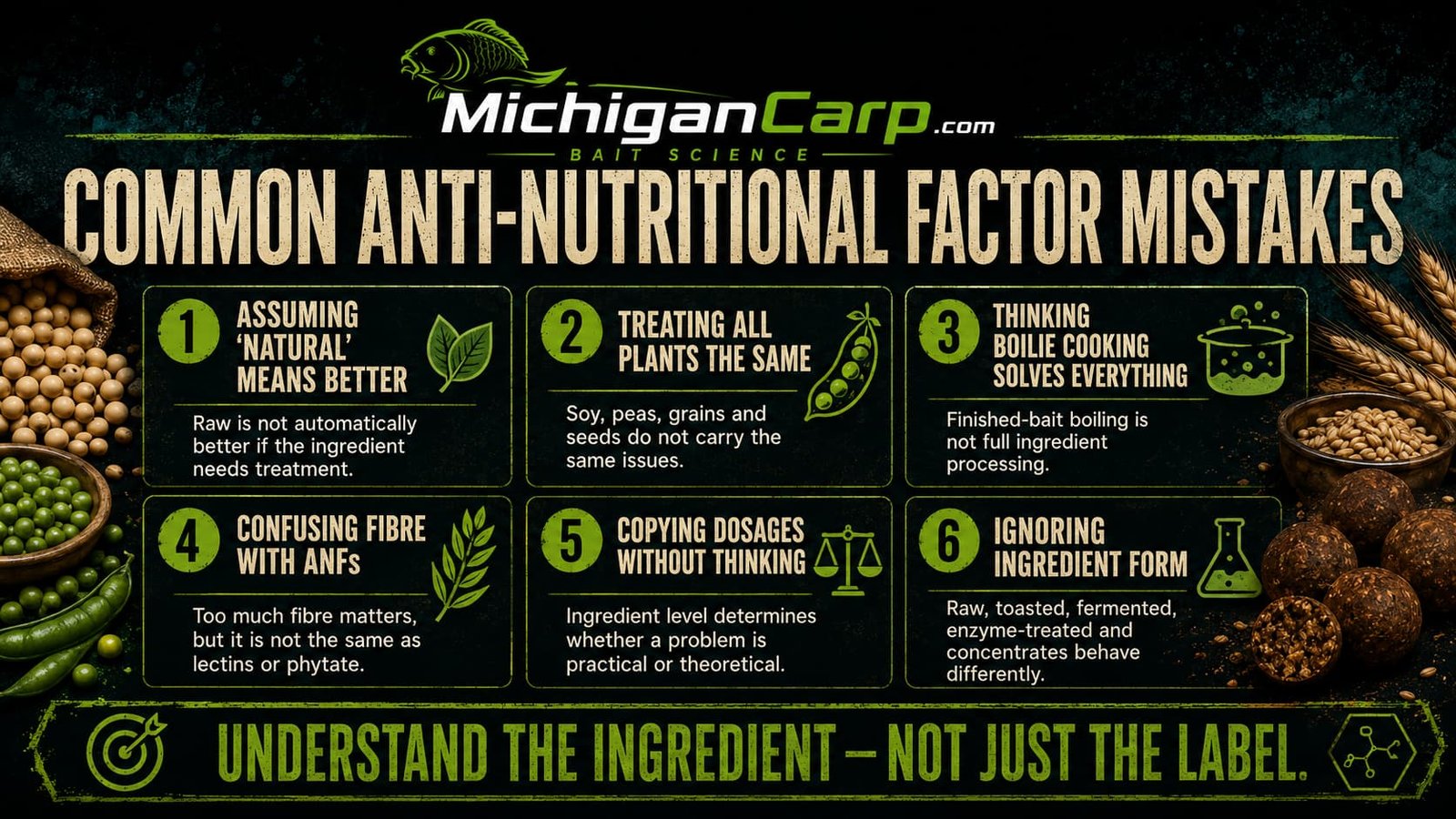
| Mistake | Why it causes problems | Better practice |
|---|---|---|
| Judging by crude protein alone | Protein percentage does not show digestibility or processing quality | Judge ingredient form and function |
| Confusing raw soy with full-fat soy | Processing is the key distinction | Use known properly processed soy products |
| Assuming heat solves phytate | Phytate is not the same as a heat-sensitive inhibitor | Use phytase logic only when justified |
| Using phytase as a generic additive | It needs substrate, moisture, pH, temperature and time | Treat it as a process, not a flavour |
| Treating every polyphenol as bad | Plant compounds differ widely | Judge ingredient and dose |
| Stacking similar plant ingredients | Multiple weak bulk ingredients can dominate the formula | Balance plant, dairy, yeast, nut and cereal roles |
| Relying on finished boiling to repair raw ingredients | Finished-bait cooking is not industrial ingredient processing | Choose correct ingredients before boiling |
| Trying to rescue weak bait with flavour | Liquids cannot fix poor base design | Build the formula properly first |
Simple Rules for Anti Nutritional Factors in Carp Bait
- Know whether the ingredient is raw or processed.
- Do not treat all soy products as the same ingredient.
- Separate phytate from heat-sensitive anti nutritional factors.
- Use phytase only when the phytate problem and treatment process justify it.
- Keep specialist plant meals at sensible inclusion unless you understand them well.
- Do not confuse fibre with every named anti nutritional compound.
- Judge tannin-rich ingredients by the actual product and dose.
- Use properly processed ingredients before relying on finished-bait cooking.
- Think harder about nutritional exposure during repeated heavy feeding.
- Judge the complete formula, not one ingredient in isolation.
My Practical View
I do not avoid plant ingredients in carp bait.
I avoid lazy ingredient decisions.
Raw soybean material and properly processed full-fat soy are not the same. A heat-sensitive trypsin inhibitor and phytate are not the same problem. Ordinary boilie cooking and targeted phytase treatment are not the same process.
A modest amount of cereal, seed meal, birdfood or processed plant protein in a balanced bait is not the same as building most of a formula around cheap agricultural bulk.
For homemade carp bait, I would keep the approach practical:
- buy ingredients you can identify;
- understand how they were processed;
- use plant ingredients for clear reasons;
- control inclusion levels;
- prepare particles correctly;
- use targeted processing for targeted problems;
- balance cost with real bait function.
Do not reject an ingredient because it comes from a plant. Reject poor ingredient knowledge, unsuitable processing and lazy formulation.
FAQ
What are anti nutritional factors in carp bait?
Anti nutritional factors in carp bait are compounds in some ingredients that can reduce nutrient digestion, mineral availability, enzyme activity, palatability or the wider nutritional value of a feeding system.
Is soy bad in carp bait?
No. Soy is not one ingredient. Raw soybean material deserves caution, while properly processed full-fat soy, soybean meal and processed soy ingredients can have useful roles in balanced bait.
Does boiling a finished boilie remove anti nutritional factors?
Do not rely on finished-bait cooking as a substitute for correctly processed ingredients. Different anti nutritional factors respond differently to heat, fermentation, enzyme treatment and other processing methods.
Is full-fat soy safe in carp bait?
The important issue is whether the product has been properly processed. Properly heat-treated full-fat soy is different from raw ground soybean material.
What is phytate?
Phytate is a plant storage compound associated with grains, seeds, legumes and oilseeds. It can reduce phosphorus availability and interfere with mineral and nutrient use.
Does soaking remove phytate?
Not reliably in every situation. The result depends on ingredient type, natural enzyme activity, moisture, temperature, pH and time.
Is phytase worth using in homemade carp bait?
It can make sense in a deliberately designed plant-heavy feeding bait or ingredient pre-treatment process, but it should not be treated as a generic attraction additive.
Can fermentation reduce anti nutritional factors?
Some fermentation processes can alter selected anti nutritional compounds, but the result depends on substrate, microorganisms, moisture, temperature, pH and time.
Should I avoid all plant ingredients in boilies?
No. Processed plant proteins, cereals, nut meals, seed meals and birdfoods can all have useful roles when selected properly and used in a balanced formula.
Do anti nutritional factors matter in hookbaits?
They are generally more relevant to heavily consumed feeding bait than to one isolated hookbait, because the amount eaten is very different.
Is excess fibre an anti nutritional factor?
It is better treated as a related formulation issue. Fibre can help texture and structure, but excessive rough bulk can dilute the nutritional value and balance of the bait.
What is the safest practical rule?
Use known ingredients, avoid unclear raw problem materials, keep inclusion levels sensible, process particles correctly and judge the complete bait rather than one ingredient in isolation.
Next Steps
- Raw vs Processed Ingredients in Carp Bait — understand when processing helps and when it is unnecessary.
- How to Process Carp Bait Ingredients — apply practical processing decisions to real bait ingredients.
- Do Enzymes and Phytase Really Improve Carp Bait? — separate real enzyme treatment from bait-making hype.
- What Boiling Does to Carp Bait: Heat, Steaming, Leakage and Structure — understand finished-bait cooking limits.
- Carp Bait Digestibility — connect ingredient form with usable nutrition.
- Amino Acids in Carp Bait: Free Amino Acids, Intact Proteins and What Carp Can Detect — understand protein form and food signal.
- The Science of Proteins, Peptides and Hydrolysates in Carp Bait — understand hydrolysis and soluble protein fractions.
- Fermented and Food-Signal Baits for Carp — understand fermentation without confusing it with spoilage.
- How to Formulate a Milk, Nut and Birdfood Boilie Base Mix — apply ingredient decisions inside a working boilie formula.
- Bait Science — browse the technical bait library.