

The Snowman Rig for Michigan Carp: A Critically Balanced Bottom-Bait Setup
If you want one “quietly deadly” presentation for Michigan waters, the Snowman is it.
It’s not a complicated rig. It’s simply a bottom bait with a small pop-up topper — but that tiny bit of buoyancy makes the hookbait easier to inhale, harder to ignore, and far less likely to settle awkwardly on light silt or low weed.
This is one of those setups that just keeps catching, especially when you’re fishing mixed bottoms and you want confidence your hookbait is sitting right.
Quick Start
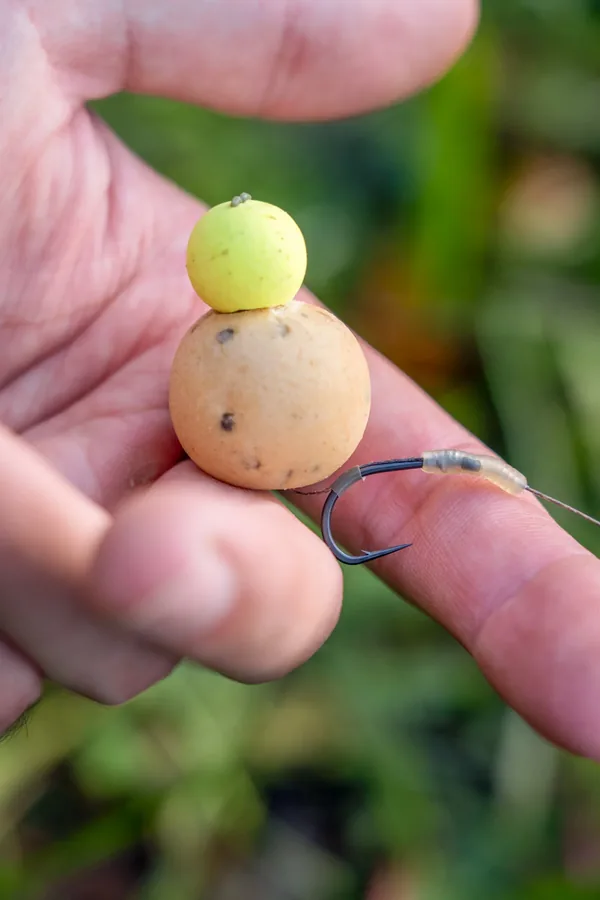
Image © One More Cast — used with permission (omctackle.com).
If you tie one snowman for most situations, do this:
- Hook: size 6 wide gape (size 4 if snags/heavy fish)
- Hooklink: 20–25 lb coated braid (go up to 35 lb when you’re locked up near snags or thick weed)
- Hookbait: 15–18 mm bottom bait + 10–12 mm pop-up topper
- Hair gap: about 5–10 mm between hook bend and the bottom bait (don’t choke it tight)
- Lead system:
- clean gravel/sand/clay = lead clip
- light silt / unknown / low weed = helicopter (safer presentation)
Test it in the edge before you cast. If the hook isn’t behaving, fix it before you put it out.
What the Snowman Rig Is
The Snowman is a hookbait presentation (not a whole new rig).
You’re still tying a normal bottom-bait rig (often a hair rig or blowback style). The “snowman” part is simply:
- Bottom bait (heavier)
- Small pop-up topper (buoyant)
That topper part-cancels the hook’s weight so the hookbait behaves like an easy mouthful instead of a lump that feels “dead” on the bottom.
Why it works so well in Michigan
1) Better in light silt and debris
A plain bottom bait can settle into the soft layer and look dull.
A snowman sits a touch prouder and stays easier for carp to pick up — without looking like a helicoptered pop-up presentation.
2) Faster, cleaner hook takes
A critically balanced hookbait is usually inhaled more cleanly.
That means the hook has a better chance to turn and take hold quickly — especially when fish are feeding confidently.
3) A “match the freebies” bait with extra bite
You can fish the same bottom bait as your feed, but still gain that extra “something” in the take.
This is ideal when you’re baiting with boilies/particles and want your hookbait to look natural — just slightly “alive.”
When to use it (and when not to)
Best situations
- clean sand/clay/gravel
- light silt
- low weed / scattered strands
- autumn leaf litter (when you want the bait just off the deck)
Not the best choice
- deep silt where everything plugs in (use pop-up rigs and helicopter)
- proper thick weed where the bait will disappear (go to chod-style pop-ups)
If you’re consistently coming back with weed on the hook or the bait buried, stop guessing and switch presentations.
Tackle and components
Hook: wide gape or curve shank.
- size 6 is the “daily driver”
- size 4 when you need extra hold (snags/current/big fish)
Hooklink: coated braid 20–25 lb as standard.
- strip 1–2 inches near the hook for movement
- 35 lb coated braid is absolutely fair play when you’re locked up near snags or dragging fish out of weed
Baits:
- bottom bait: 15–18 mm boilie (or hard hookbait)
- topper: 10–12 mm pop-up (matching or contrasting)
Lead system:
- lead clip on clean bottoms
- helicopter when you’re unsure, on light silt, or any time safety/presentation is better served
Step-by-step: tying the Snowman hookbait
This assumes a simple hair rig / bottom-bait rig base.
- Cut hooklink: 8–10 inches (shorter if snags; longer if light silt).
- Tie a small loop for the hair.
- Mount the bottom bait first (15–18 mm).
- Mount the pop-up topper second (10–12 mm).
- Add a hair stop and snug the baits together.
- Tie the hook with a knotless knot (6–8 turns).
- Set the hair length: aim for a 5–10 mm gap from hook bend to bottom bait.
- Test it in water: the hook should sit right and the bait should look “light,” not floating.
Tuning for Michigan bottoms
Light silt (common on inland lakes)
- go a touch more buoyant (stronger topper or smaller bottom bait)
- consider helicopter so the lead can settle without dragging the hookbait down
Hard gravel/sand bars (rivers and Great Lakes edges)
- keep it subtle (smaller topper or matching colour)
- lead clip or inline (if the bottom is truly clean)
Low weed / strands
- slightly more buoyancy helps keep the hookbait clear
- shorten the hooklink a little for control (6–8 inches)
Snags / timber / rocks
- step up to 35 lb hooklink when needed
- shorten the rig (often 6–7 inches)
- fish locked up and prioritise fish safety (safe lead release setup, sensible angles, no hero casts into the worst stuff)
Bait choices that make sense here
Spring (late April–May): smaller, easier baits; subtle toppers.
Summer: brighter topper can help on weed/silt; match your freebies.
Fall: snowman over boilies is a big-fish way to fish when they’re feeding hard.
Tip: if you’re feeding boilies, keep the bottom bait the same as your freebies and let the topper do the “separation” job.
Common mistakes
- Too much buoyancy: if the hook is being lifted, you’ll get poor hookholds.
- Hair too long: the bait can be mouthed without the hook taking hold.
- Never testing it: a 10-second margins test saves hours.
- Fishing it in deep silt anyway: if it’s plugging in, it’s not fishing.
- Weak gear in nasty swims: Michigan snags and weed can be brutal — scale up when needed (including 35 lb hooklink if that’s what it takes).
Michigan Notes
- On mixed bottoms (sand → gravel → light weed), the snowman is a confidence bait because it still looks natural but behaves “lighter.”
- If you’re unsure what you’re on, don’t force a lead clip into soft stuff — go helicopter for better presentation and safer mechanics.
- Zebra mussels and rocks chew hooklinks. If you’re on abrasive bottoms, check the last few feet constantly and re-tie early.
FAQ
Is the Snowman a “pop-up rig”?
No. It’s still a bottom-bait presentation — just critically balanced.
Do I need bright colours?
Not always. Clear water and pressured spots often do better with subtle toppers. In murk or weed, bright can help.
What’s the best hook size?
Size 6 is the all-rounder. Size 4 when you need extra hold or you’re fishing hard.
How much gap should there be between hook and bait?
A good starting point is 5–10 mm from hook bend to the bottom bait. Then test and adjust.
Can I use 35 lb hooklink on this?
Yes — especially around snags, thick weed, or heavy fish. Just keep the rig neat and fish-safe.
Next Steps
- Rigs Hub
- Rig Starter Kit
- Bottom-Bait Rigs Hub
- Pop-Up Rigs Hub
- Silt/Weed/Chod-Style Hub
- Hair Rig
- Blowback Rig
- KD Rig
- Ronnie Rig
- Multi Rig
- Combi Rig
- Chod Rig
- Full Reference Guide
Tight lines — keep it simple, keep it safe, and let the lakebed decide.
Best Rigs to Use It With
- Hair Rig (simple and effective)
- Blowback Rig (very good snowman mechanics)
- KD Rig (works, but test it properly)