
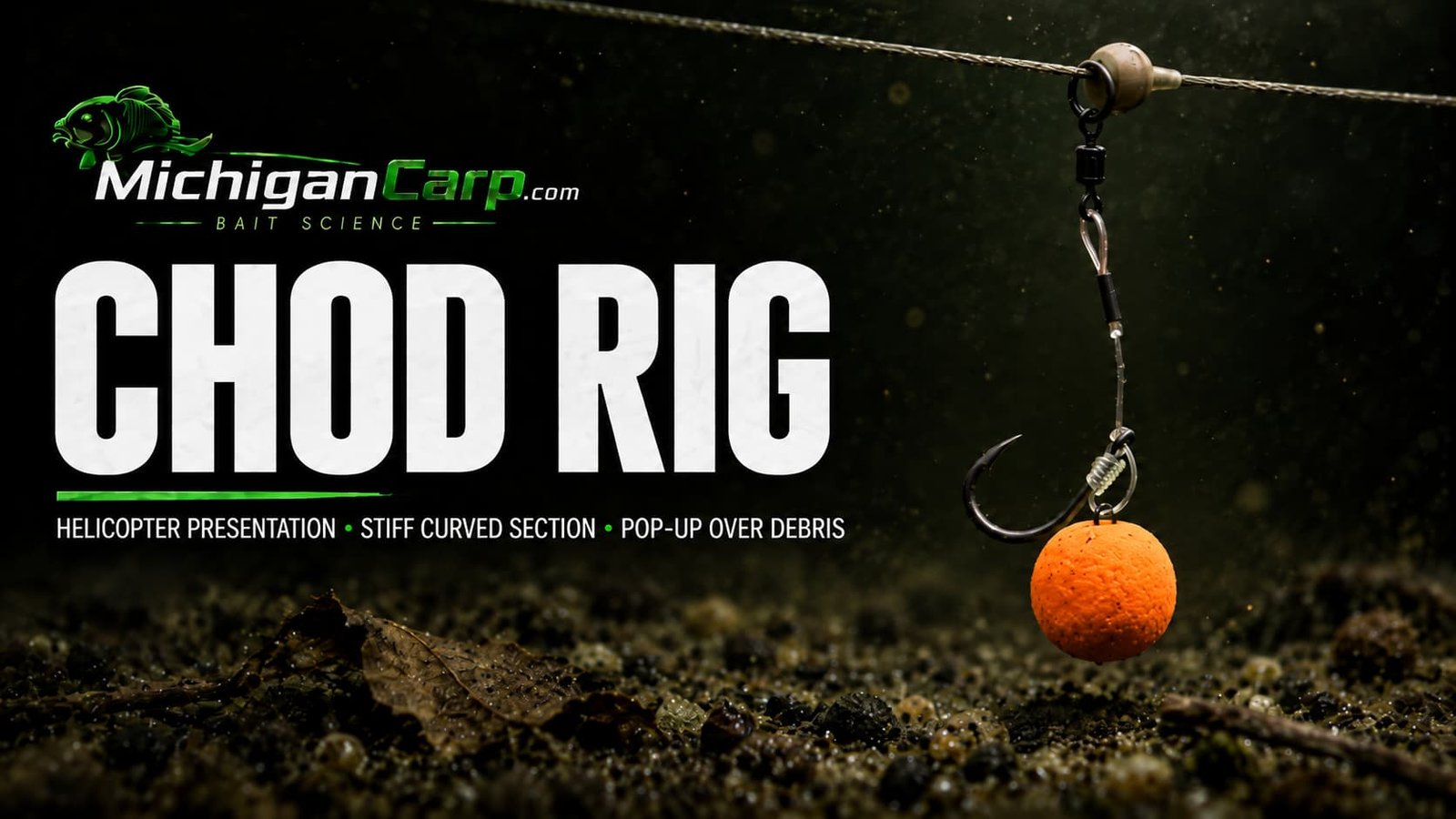
The Chod Rig is a specialist pop-up presentation for carp fishing over soft silt, low weed, leaf litter and other lakebed debris that can bury or foul a conventional hooklink.
Its real strength is not simply that the hookbait sits off the bottom. The complete setup allows a very short, stiff hook section to move on a helicopter-style leader or suitable main-line arrangement while the lead sinks farther into the soft material below it.
When the pop-up is balanced properly, the Chod section settles slowly onto the top of the weed, silt or debris instead of being dragged down with the lead.
That makes it one of the few rigs I would deliberately choose when I cannot guarantee that a conventional bottom-bait rig or low pop-up will land cleanly.
It is not a rig I would use simply because the bottom looks slightly untidy. If I can find clean gravel, sand, clay or firm silt and present a simpler rig properly, I usually will. The Chod earns its place when the lakebed itself is the problem.
For the wider rig-selection picture, use the MichiganCarp Rig Guide and the Complete Carp Rig Guide.
The Chod Rig is not a magic cast-anywhere rig. It is a short, stiff, critically balanced pop-up rig used on a safe helicopter system so the hookbait can settle above soft or messy lakebed material.
Quick Answer
For a dependable Chod Rig, start with a strong size 4 or 6 out-turned-eye Chod hook, 20- to 25-pound stiff Chod filament, a micro ring swivel for the hookbait and a ring swivel at the bottom of the hook section.
Keep the finished Chod section short—roughly 1.5 to 3 inches is a useful starting range—and shape the stiff material into a controlled curve. Use a buoyant 12–15 mm pop-up and add only enough putty or balancing weight around the lower swivel to make the entire hook section sink slowly.
Fish it on a properly constructed helicopter arrangement. Set the upper bead far enough above the lead for the Chod section to travel beyond the depth of the silt, weed or debris, but no farther than necessary. Most importantly, the top stop must be able to release or allow the hooklink swivel to come off the main line or leader if the line breaks.
Chod Rig Quick Start
| Part | Dependable Starting Point | What to Check |
|---|---|---|
| Hook | Strong size 4 or 6 Chod-style hook with an out-turned eye | Extremely sharp point, open gape and eye compatible with stiff filament |
| Hooklink | 20–25 lb stiff Chod filament | Holds a smooth curve without kinking |
| Hook section length | About 1.5–3 inches | Short enough to remain controlled but long enough for the chosen debris |
| Hookbait attachment | Micro ring swivel running on a D | Moves freely and cannot escape the D |
| Lower connection | Ring swivel suited to the helicopter system | Large ring moves freely on the line or leader |
| Hookbait | 12–15 mm buoyant pop-up as a starting point | Buoyant enough to lift the Chod section before counterbalancing |
| Counterbalance | Small amount of tungsten putty or matched balancing weight | Complete rig only just sinks |
| Lead system | Helicopter-style arrangement | Hooklink can move above the lead and detach safely after a break-off |
| Best bottom | Soft silt, low weed, dead weed, leaves and light debris | Not weed reaching the surface or dangerous snag fishing |
Those measurements are starting points rather than rules. Hook sizes vary between manufacturers, Chod filaments have different stiffness and memory, and pop-ups vary enormously in buoyancy. Tie the rig around the actual hookbait and hardware you intend to use, then test it in water.
Table of Contents
What Is a Chod Rig?
The modern Chod Rig is a very short stiff pop-up hook section used on a helicopter-style lead arrangement.
The word “chod” is carp-fishing slang for the soft debris, dead weed, leaves, silt and miscellaneous material that can cover a lakebed.
The rig was developed to solve a simple presentation problem: the lead may sink deeply into soft material, but the hookbait should not follow it.
On a conventional lead clip or inline setup, a lead that buries into deep silt can pull the hooklink down at a poor angle. A short hooklink may disappear with it.
With a Chod setup, the hook section moves independently on the main line or leader. As the lead sinks, the Chod section can remain higher and settle onto the surface of the debris.
Korda’s current explanation of the rig describes exactly this relationship between the short stiff hook section, critically balanced pop-up and helicopter system. Their detailed reference is useful additional reading: Korda — How to Use a Chod Rig.
How the Chod Rig Works
The Lead Can Sink Without Dragging the Hookbait With It
This is the defining mechanical advantage.
The lead may bury several inches into soft silt or settle down through low weed. Because the Chod section is not fixed directly beside the lead, it can remain above that material.
The upper bead determines how far the Chod section can travel away from the lead.
If you expect the lead to disappear six inches into soft material, allowing the hook section only an inch or two of travel defeats the point. If you set the bead three feet up the leader when the debris is only a few inches deep, you create unnecessary separation and reduce the immediate influence of the lead on the hooking sequence.
Set the system according to what you are actually fishing over.
The Stiff Hook Section Holds Its Shape
A proper Chod section is made from stiff monofilament-style material with enough memory to hold a controlled curve.
That curve effectively continues the shape of the hook and helps the hook turn as the hookbait is picked up.
A soft braid does not perform the same mechanical job and should not simply be substituted because it happens to be in the tackle box.
The Pop-Up Is Critically Balanced
The hookbait should have enough buoyancy to support the short Chod section before counterbalancing.
Then add just enough putty or balancing weight near the lower swivel to make the entire presentation sink very slowly.
This is important.
If the rig is heavily over-weighted, it can punch straight down into the weed or soft debris that you were trying to fish above.
The presentation should settle rather than drop like a stone.
Chod Rig Components and Correct Geometry
Out-Turned-Eye Chod Hook
The hook is not an incidental choice on this rig.
A dedicated Chod-style hook normally has an out-turned eye. This allows the stiff hooklink to leave the hook eye without being forced into an extreme angle.
That is very different from automatically choosing the strongly in-turned curve hooks often used on other carp rigs.
A size 4 or 6 is a practical starting point for most of the hookbait sizes I would use for Michigan carp. The actual hook should remain strong enough for the fish, weed and landing situation you expect.
For more on hook geometry, see Carp Hooks Explained.
Stiff Chod Filament
The hooklink needs enough stiffness and memory to retain its curve.
Dedicated Chod filament in roughly the 20- to 25-pound range is an easy starting point. Stronger versions can be appropriate where hook size, range or conditions demand them.
A useful material should straighten when manipulated but retain the curve you deliberately put into it rather than collapsing like braid.
The D and Micro Ring Swivel
The hookbait normally sits on a small ring swivel running on a D formed behind the hook.
That D gives the hookbait movement without fixing it rigidly to the hook shank.
Make the D neat rather than oversized. The swivel needs enough room to move but should not be able to jam into the hook eye or interfere with the point.
Lower Ring Swivel
The lower end of the stiff Chod section is normally attached to a ring swivel.
On the helicopter setup, the larger ring is the part that moves on the main line, leader or purpose-designed sleeve.
It must travel freely and—just as importantly—must be able to leave the leader or main line if a breakage occurs.
Pop-Up
A Chod Rig is fundamentally a pop-up presentation.
I would start with a genuinely buoyant 12–15 mm pop-up and match it to the hook rather than choosing the bait first and forcing the rig around it.
Bright hookbaits are popular because Chods are often cast as single-hookbait presentations to showing fish, especially in spring. They are not compulsory.
A washed-out, darker or food-based pop-up can work perfectly well when that suits the water and baiting approach better.
The Helicopter System Is Part of the Chod Rig
This is where the old MichiganCarp article was much too vague.
You cannot really explain a Chod Rig properly without explaining the helicopter arrangement around it.
The hook section sits above the lead rather than being attached directly beside it. During the cast, the Chod swivel can rotate around the main line or leader. When the lead lands and sinks, the hook section can slide away from it and settle higher.
That is why a helicopter system is so well suited to soft silt, low weed and leaf litter.
For the wider lead-system comparison, read Lead Clip vs Inline vs Helicopter.
Upper Bead Position
The top bead or stop controls how far the Chod section can travel up the line or leader.
It should be positioned far enough above the lead for the Chod to clear the material you expect the lead to enter.
That may mean only several inches over light debris, or substantially farther when fishing over deeper weed or soft silt.
I would not push the upper bead farther away from the lead than necessary. The farther the hook section is allowed to sit from the lead, the less directly the lead contributes to the first stage of the hooking process.
Lower Stop and Lead End
The lower part of the system keeps the Chod swivel from reaching or jamming against the lead connection.
Use components designed to work together rather than assembling random beads, sleeves and swivels that happen to fit on the line.
A properly designed system should cast cleanly, allow free rotation and behave predictably after a break-off.
Chod Rig Fish Safety: The Hooklink Must Be Able to Escape
This is one of the most important sections of the article.
On a helicopter or Chod system, fish safety does not simply mean that the lead can fall off.
If the main line breaks, the Chod hooklink must be able to come free from the leader or main line rather than remaining trapped between permanently fixed beads.
Purpose-designed safety systems use an upper bead or stop that can release, allowing the ring swivel to travel over the remaining line or leader connection and detach.
If a leader is being used, the ring swivel and safety components must also be compatible with any knot, splice or connection that the swivel may need to pass.
Never trap the Chod swivel between two permanently fixed components.
Lead release is a separate decision. In weed or snaggy conditions, dropping the lead can make landing a fish easier, but a system can still be fish-safe without automatically shedding the lead if the hooklink itself can detach correctly after a break-off.
Korda’s current helicopter guidance explains this distinction clearly: Korda — Helicopter Rigs and Fish Safety.
Naked Chod vs Leader Chod
The Chod can be constructed directly on suitable main line or on a purpose-designed leader system.
| Setup | Main Advantage | Main Consideration |
|---|---|---|
| Naked Chod | Fewer leader components and a low-profile presentation | Main line and dedicated Chod components must be compatible and resistant to damage |
| Leadcore or lead-free leader | Good abrasion resistance and controlled presentation near the lakebed | Safety bead and ring swivel must allow the hooklink to leave the leader after breakage |
| Fused or specialist leader | Convenient purpose-built helicopter platform | Use the complete system as designed rather than mixing incompatible parts |
A “naked” Chod does not simply mean sliding random beads onto any main line. Use components specifically intended for that system and inspect the line where the Chod swivel travels.
Likewise, leadcore or lead-free material is not automatically safe simply because it is sold as leader material. The complete break-off sequence matters more than the name on the packet.
How to Tie a Chod Rig Step by Step
The exact knots can vary with the chosen filament and hardware. The following is a dependable traditional build using an out-turned-eye hook, stiff Chod filament, a D and a lower ring swivel.
- Cut the stiff filament. Start with around 7–8 inches so there is enough material to tie the hook, D and lower swivel comfortably.
- Prepare the end. Cut the filament cleanly. A slight angle can make it easier to pass through a small hook eye.
- Thread the hook. Pass the stiff filament through the back of the out-turned hook eye.
- Whip the shank. Make around six neat turns down the shank as a practical starting point.
- Secure the hook section. Pass the working end back through the eye according to the chosen Chod-knot method and bed the whipping down firmly.
- Add the bait swivel. Slide a micro ring swivel onto the short tag end.
- Form the D. Pass the tag back through the hook eye from the rear to create a neat D behind the shank.
- Secure the D tag. Trim it carefully. If the chosen material is designed for a blobbed tag, carefully melt a small stop without heating the hooklink or hook point.
- Add the lower ring swivel. Pass the remaining stiff section through the appropriate eye of the swivel.
- Set the finished length. Fold the material at the point that gives roughly a 1.5- to 3-inch finished Chod section.
- Tie the swivel connection. Use the knot recommended for the chosen stiff filament. A compact two-turn blood-style knot is commonly used with dedicated Chod filament.
- Pull-test it. Moisten and bed the knot firmly, then apply steady pressure before trimming the tag.
- Shape the hook section. Manipulate the stiff filament into a smooth progressive curve rather than creating a sharp bend.
- Mount the pop-up. Attach it to the micro ring swivel with bait floss or another secure method suited to the bait.
- Add the counterbalance. Place a very small amount of putty or a matched weight around the lower swivel or knot.
- Water-test the finished rig. The complete Chod section should sink slowly and settle upright without collapsing or falling heavily.
The Korda Chod Rig tying guide provides a useful visual reference for the traditional build.
How Much Curve Should a Chod Rig Have?
The curve is one of the defining parts of the rig, but exaggerated curves are not automatically better.
I want a smooth continuation from the hook rather than a dramatic half-circle.
The stiff filament should help the hook turn as the hookbait moves through the carp’s mouth while still letting the hook section settle naturally.
Too little curve and the hook section may lose some of the aggressive turning effect that makes the rig useful.
Too much curve can make the presentation look and behave awkwardly and may bring the hook point too close to the hooklink.
Shape the rig around the actual hook pattern. Different out-turned-eye hooks need slightly different curves.
Pop-Up Choice and Critical Balancing
Pop-up buoyancy is central to the Chod Rig.
The bait must first be buoyant enough to lift the hook and short stiff section.
Then the lower swivel or putty provides enough counterweight to make the whole assembly descend slowly.
Do this test in the edge with the actual water temperature if practical. Pop-up buoyancy can change with bait formulation and after the bait has been submerged for some time.
Too Much Counterweight
If the rig drops quickly, remove weight.
An over-weighted Chod can pull itself down into weed, leaves or soft debris and lose the presentation advantage you selected it for.
Too Much Buoyancy
If the rig refuses to sink or requires a huge lump of putty, the hookbait may be too buoyant for the hook and Chod section.
Use a smaller pop-up, a heavier hook or a better matched bait rather than building an oversized counterweight around the swivel.
Matching the Chod Rig to Weed, Silt and Debris
Low Weed and Dying Weed
This is one of the Chod Rig’s strongest uses.
Low silkweed, dying weed and broken strands can easily mask a bottom-bait hook or low pop-up.
Set the top bead high enough that the Chod section can settle onto the upper surface of that material.
A small dissolving PVA foam nugget around the hook can help protect the point during the cast and initial descent.
Soft Silt
The lead may sink substantially farther into soft silt than the hookbait.
Allow enough movement between the lead and top stop to compensate for that depth.
Do not assume every dark, soft area requires the bead three feet up the leader. Learn as much as you reasonably can about the bottom and set the travel accordingly.
Leaf Litter and Natural Debris
Leaves, twigs, decaying vegetation and organic debris can make a conventional hooklink unreliable even when the bottom underneath is firm.
A Chod lets the pop-up settle on top of that material rather than disappearing beneath it.
Heavy Weed
The Chod is not an excuse to cast into weed so dense that you cannot land a fish safely.
If the weed reaches the surface, is heavily matted or leads directly into dangerous snags, finding a thinner area, clear hole or safe edge is usually more important than changing rigs.
The Weed Beds and Carp Fishing guide covers presentation and landing decisions in weed more broadly.
Casting a Chod Rig and Preventing Problems
A helicopter system is naturally resistant to many conventional hooklink tangles because the rig rotates around the leader during the cast.
That does not mean it is impossible to cast badly.
- Check that the Chod swivel rotates freely before every cast.
- Make sure the upper bead has not moved.
- Protect the hook point with dissolving foam when debris is likely.
- Use a controlled cast rather than repeatedly cracking the rig into the clip unnecessarily.
- Watch the rig in flight when possible.
- Feather the line before impact so the complete setup straightens.
- Check the hook point after every retrieval from weed, gravel or debris.
One of the Chod’s advantages is the ability to cast toward showing carp when you do not want to spend time repeatedly leading around or disturbing an area.
That advantage still has limits. “Cast anywhere” should never be interpreted as “cast into anything.”
When I Would Not Use a Chod Rig
I would not choose it automatically just because the swim contains a little silt or weed.
On a clean gravel, sand or clay area, a simpler bottom-bait or low pop-up rig often gives me everything I need.
I would also avoid the Chod when:
- weed is so dense that landing a fish would be unsafe;
- the top bead cannot be configured to release safely;
- the line or leader is badly abraded where the ring swivel must travel;
- the chosen pop-up cannot balance the hook section properly;
- I specifically want a bottom bait or wafter on the deck;
- a simpler Ronnie, Multi, Hair or Blowback presentation already sits cleanly.
The best rig is the simplest safe presentation that solves the actual lakebed problem.
Chod Rig Compared With Other Pop-Up Rigs
| Rig | Defining Feature | Choose It When |
|---|---|---|
| Chod Rig | Short stiff hook section travelling on a helicopter setup | Soft silt, low weed, leaf litter or uncertain debris |
| Ronnie / Spinner Rig | Low rotating hook mounted on a spinner swivel and separate boom | Clean bottoms, firm silt and light debris |
| Multi Rig | Loop attachment creates a movable D and allows fast hook changes | You want a versatile pop-up or balanced presentation on cleaner ground |
| Hinged Stiff Rig | Separate stiff hook section hinged to a boom | You want Chod-style hook mechanics with a dedicated boom |
Chod Rig vs Ronnie Rig
The Chod and Ronnie are both pop-up rigs but they solve different problems.
The Chod is built around awkward lakebeds. Its very short stiff hook section moves on a helicopter system and can settle above silt, weed and debris.
The Ronnie normally fishes much lower. Its hook rotates on a spinner swivel and its separate boom works best when that boom can settle reasonably cleanly.
If I know the area is clean or only lightly silty, I usually prefer the Ronnie. If I cannot trust the hook section to land cleanly, the Chod becomes much more attractive.
See Ronnie Rig for Carp Fishing.
Chod Rig vs Multi Rig
The Multi Rig gives you quick hook changes, a movable D and a very adaptable pop-up presentation.
It can be combined with different lead systems, including a helicopter arrangement when appropriate, but it does not replace the Chod when the key requirement is a very short stiff hook section that can settle directly onto the top of debris.
See Multi Rig for Carp Fishing.
Chod Rig vs Hinged Stiff Rig
These two are closely related in the way the stiff hook section is used.
The Chod section itself moves directly on the helicopter system.
The Hinged Stiff Rig uses a similar stiff pop-up hook section but connects it to a separate boom.
That boom gives more controlled separation over clean ground, firm silt and lighter debris but removes some of the Chod’s ability to settle independently above deeper mess.
The full construction belongs in the future specialist guide **Hinged Stiff Rig for Carp Fishing**.
A Practical Chod Rig Setup for Michigan Carp
Michigan waters give the Chod Rig a genuine role.
Natural lakes, reservoirs and dam ponds can contain deep organic silt, dying weed, leaf litter and mixed-bottom areas where a conventional short rig is difficult to trust.
Spring can leave dead weed and winter debris on the bottom before new growth becomes established. Summer can produce extensive low weed around feeding areas. Fall brings dying vegetation and more organic material back onto the lakebed.
For that kind of water, my starting point would be:
- a strong size 4 or 6 out-turned-eye Chod hook;
- 20- to 25-pound stiff Chod filament;
- a 1.5- to 3-inch hook section;
- a genuinely buoyant 12–15 mm pop-up;
- a critically balanced lower swivel;
- a purpose-designed helicopter system;
- an upper stop positioned according to the actual weed or silt depth;
- a release arrangement that lets the hooklink leave the line or leader after breakage.
I would then adapt the strength of the complete tackle—not just the hooklink—to the swim.
Weed, rock, timber and zebra mussels can make the main line, leader and landing route more important than small changes to the Chod section itself.
The goal is not merely to hook the carp. You need a realistic way to land it safely once you do.
Common Chod Rig Mistakes
Using the Wrong Hook Pattern
A strongly in-turned eye can fight against the stiff Chod filament and create poor hooklink geometry.
Start with a purpose-designed out-turned-eye Chod pattern.
Using a Soft Hooklink
The short stiff section is fundamental to the Chod Rig. Replacing it with supple braid produces a different rig.
Over-Weighting the Pop-Up
A Chod that drops quickly can disappear into the material it was supposed to sit above.
Use only enough counterbalance to make the complete presentation sink slowly.
Setting the Upper Bead Arbitrarily
The bead position should relate to the depth of the weed, debris or silt.
Do not automatically place it a foot, two feet or three feet from the lead because somebody else’s rig used that measurement.
Fixing the Top Bead Permanently
This can create a dangerous break-off situation.
The hooklink must be able to detach from the remaining main line or leader.
Believing the Lead Must Always Eject
Lead release can be very useful, especially in weed, but Chod safety is primarily about ensuring the hooklink itself can come free after line failure.
Using the Chod on a Clean Bottom for No Reason
If a simple Hair, Blowback, Multi or Ronnie Rig will present perfectly, use the simpler presentation.
Casting Into Weed You Cannot Land Fish From
A presentation can be mechanically perfect and still be irresponsible if a hooked carp has nowhere safe to go.
Ignoring Hook Sharpness
Because the Chod can sit farther from the lead than many other rigs, I want the hook point exceptionally sharp.
Check it before every cast and after retrieving from weed, gravel or debris.
Final Chod Rig Checklist
- Out-turned-eye hook is extremely sharp.
- Stiff Chod filament holds a smooth curve.
- D is neat and the micro swivel moves freely.
- Hook section is short and proportionate.
- Pop-up is genuinely buoyant.
- Complete hook section sinks slowly after counterbalancing.
- Ring swivel moves freely on the helicopter setup.
- Upper bead is set according to expected debris depth.
- Upper stop can release after a break-off.
- Hooklink swivel can leave the main line or leader safely.
- Lead release is configured appropriately for weed and snag risk.
- Hook point is protected during the cast when necessary.
- The swim provides a realistic and safe route to land the carp.
Frequently Asked Questions
What is a Chod Rig used for?
It is primarily a pop-up rig for soft silt, low weed, dead weed, leaves and lakebed debris where a conventional hooklink may be buried or fouled.
Does a Chod Rig need a helicopter setup?
Yes. The helicopter arrangement is fundamental to the conventional Chod because it allows the hook section to travel away from a lead that sinks into the lakebed.
What hook should I use for a Chod Rig?
Use a strong, sharp Chod-style hook with an out-turned eye so the stiff hooklink exits at an appropriate angle. Size 4 or 6 is a useful starting range for typical carp pop-ups.
How long should a Chod Rig be?
The stiff hook section is normally very short. Around 1.5 to 3 inches is a practical starting range, but hook size, debris and presentation height can justify adjustment.
How high should the top Chod bead be?
Set it far enough above the lead for the hook section to clear the expected depth of the silt, weed or debris. Keep it as close to the lead as the lakebed reasonably allows rather than automatically setting it a long distance away.
Should a Chod Rig pop-up sink slowly?
Yes. The complete hook section should be critically balanced so it only just sinks. An over-weighted Chod is more likely to bury itself in soft debris.
Can I fish a Chod Rig over heavy weed?
It can work over low or moderately deep weed when set correctly. It is not a justification for fishing into weed so thick or snaggy that a hooked fish cannot be controlled and landed safely.
Does the Chod lead need to fall off?
Not in every situation. Lead release can help in weed and snags, but the essential break-off safety requirement is that the Chod hooklink can detach from the main line or leader if the line breaks.
Is a Chod Rig better than a Ronnie Rig?
No. The Chod is more specialized for silt, weed and debris. The Ronnie is generally a cleaner, lower pop-up presentation where its boom can settle properly. Choose according to the lakebed rather than treating one as universally better.
Next Steps
For the broader system surrounding this rig, read Silt, Weed & Chod-Style Carp Rigs.
For lead-system choice and helicopter safety, use Lead Clip vs Inline vs Helicopter.
If the bottom is clean enough for a lower pop-up, compare the Ronnie Rig and Multi Rig.
For all rig families and the lakebeds they suit, return to the Complete Carp Rig Guide or the MichiganCarp Rigs Hub.
The Chod Rig is a specialist tool. Tie the hook section correctly, balance the pop-up carefully, build the helicopter system safely and use it because the lakebed gives you a reason—not because it looks more advanced than a simpler rig.