
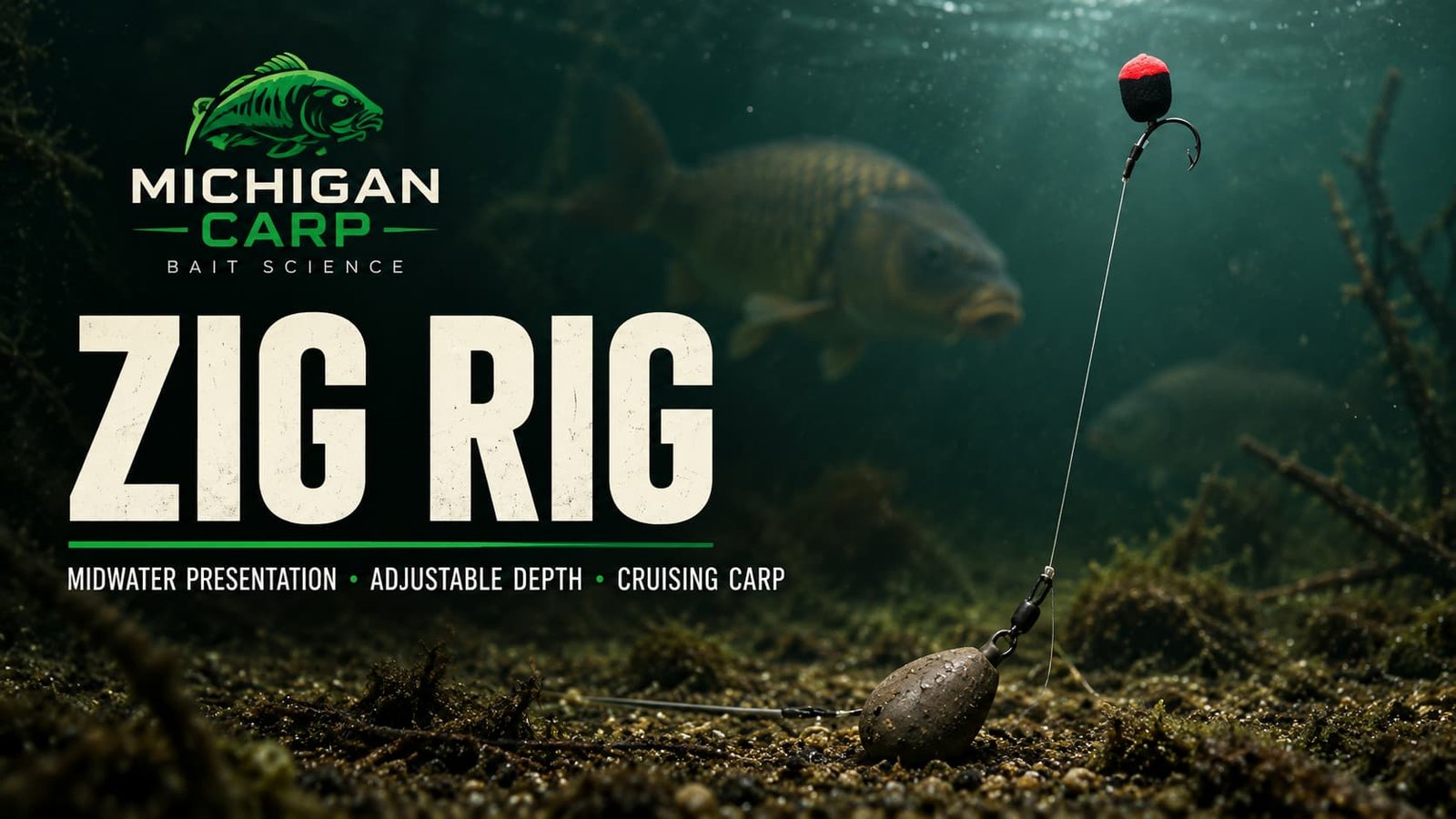
The Zig Rig is a specialist carp rig for one of the easiest situations to misread: fish that are present in the swim but are not feeding on the lakebed.
A conventional carp rig puts the hookbait on or very close to the bottom. A Zig Rig does the opposite. It uses a buoyant hookbait and a long monofilament hooklink to suspend that bait at a chosen level in the water column.
If the lake is 15 feet deep and the carp are cruising 5 feet below the surface, a perfect bottom rig can sit underneath them all day without getting noticed.
That is the problem the Zig Rig solves.
Zigs are often associated with hot summer weather, but they are not simply a summer rig. Carp can spend time off the bottom in spring sunshine, during insect activity, around suspended natural food, over deep water, above weed or whenever temperature, oxygen, light and food make another part of the water column more attractive.
The difficult part is not tying the rig. It is finding the depth at which the carp actually want to be.
Zig fishing is depth fishing. The rig only becomes effective when the hookbait intersects the level the carp are using.
For the wider rig-selection picture, use the MichiganCarp Rigs Hub and Complete Carp Rig Guide.
Quick Answer
A basic fixed Zig Rig uses a lead on the lakebed, a long clear monofilament hooklink and a small buoyant hookbait suspended somewhere between the bottom and the surface.
If you can see carp cruising, begin at approximately their level or slightly above it. If you cannot see them, search the water column systematically rather than leaving every rod at one arbitrary depth.
In moderate depths, a fixed Zig is simple and effective. In deeper water, an adjustable Zig is usually much easier because a purpose-built float system allows you to change the hookbait depth without repeatedly recasting or handling extremely long hooklinks.
A strong size 8 hook, 10–15 lb low-diameter dedicated clear Zig mono and an 8–12 mm piece of buoyant foam or suitably buoyant pop-up make a practical open-water starting point. Scale the tackle upward when big carp, weed or other hazards demand it.
Table of Contents
Zig Rig Quick Start
| Part | Practical Starting Point | What Matters |
|---|---|---|
| Rig type | Fixed Zig in moderate depth; adjustable Zig in deeper water | Choose the system you can cast, adjust and land fish with safely |
| Hook | Strong lightweight size 8 | Sharp point, enough strength for the fish and swim |
| Hooklink | 10–15 lb dedicated clear Zig mono | Use the lightest material that still lets you land fish safely |
| Hookbait | 8–12 mm Zig foam or small buoyant hookbait | Must remain positively buoyant with the hook attached |
| Fixed Zig depth | Hooklink length determines height above the bottom | Change depth until bites or fish signs identify the productive layer |
| Adjustable Zig | Purpose-built Zig float with shorter hooklink | Depth can be altered without recasting |
| Lead system | Safe lead clip for fixed Zig; purpose-built inline/float system for adjustable Zig | Do not improvise a trapped or unsafe lead arrangement |
| Best situations | Suspended, cruising or visibly midwater carp | Location and depth matter more than elaborate rig mechanics |
What Is a Zig Rig?
A Zig Rig suspends a buoyant hookbait above the lakebed.
The lead remains on the bottom while the buoyancy of the hookbait pulls the hook and long hooklink upward.
With a conventional fixed Zig, the hooklink length determines how far above the lead the hookbait sits.
For example, in 12 feet of water:
- a 3-foot Zig fishes roughly 3 feet above the bottom;
- a 6-foot Zig fishes around midwater;
- a 10-foot Zig puts the hookbait approximately 2 feet below the surface.
That simple relationship is what makes a fixed Zig easy to understand.
The difficulty starts when the water becomes much deeper. A 14- or 18-foot fixed hooklink is awkward to cast, difficult to store and potentially difficult to net a carp on.
That is where the adjustable Zig becomes important.
Korda’s current Zig guide makes the same distinction between conventional fixed Zigs and adjustable float systems used to make deep-water Zig fishing easier. See How to Use a Zig Rig for Carp Fishing.
Why Carp Spend Time Off the Bottom
A carp does not have to be feeding on the lakebed simply because that is where our lead is sitting.
The water column contains changing layers of temperature, oxygen, light and natural food. Carp can move through those layers during the same day.
Some of the clearest Zig opportunities occur when fish are visibly cruising, rolling well above the bottom or repeatedly showing at a consistent depth.
Other opportunities are less obvious. Bottom rods may remain completely quiet even though carp are present in the swim.
Spring Sunshine
Spring is an important Zig period because bright sun can warm the upper layers before the deeper water changes very much.
Carp may spend substantial periods higher in the water even while anglers continue fishing exclusively on the bottom.
Summer Heat
Summer is the season most anglers associate with Zig fishing, especially when carp are cruising around open water or sitting below the surface during bright conditions.
But warm water alone does not tell you where they will be.
Oxygen, weed, wind, shade, boat pressure and water temperature all affect where carp are comfortable.
For that wider picture, read Carp Water Temperature Guide for Michigan Lakes and Dissolved Oxygen and Carp Fishing.
Natural Food in the Water Column
Carp may also leave the bottom when natural food is concentrated higher in the water.
The practical point is not to identify every microscopic organism. It is to recognize that fish consistently occupying midwater are giving you information.
If you repeatedly see carp five or six feet down in fifteen feet of water, the lakebed is not where I would automatically put every hookbait.
Fixed Zig vs Adjustable Zig
These are two ways of solving the same problem.
| Feature | Fixed Zig | Adjustable Zig |
|---|---|---|
| Depth control | Change hooklink length | Move the float up or down without recasting |
| Best water depth | Shallow to moderate depth | Moderate to very deep water |
| Casting | Gets harder as hooklink length increases | Shorter hooklink makes deep-water casting easier |
| Landing fish | Very long hooklinks can make netting awkward | Shorter hooklink is much easier to manage |
| Complexity | Very simple | More specialist components and setup |
| Changing depth | Usually requires recasting or changing rigs | Depth can be changed while the rig remains in the swim |
| Best use | Known depth and manageable hooklink length | Searching different levels or fishing deep water |
When I Would Use a Fixed Zig
A fixed Zig is difficult to beat for simplicity.
If the lake is 8 or 10 feet deep and I want to fish a hookbait 4 or 6 feet off the bottom, there is little need to complicate the system.
The hooklink length tells me exactly where the hookbait is sitting.
When I Would Use an Adjustable Zig
Once the required fixed hooklink becomes difficult to cast or land a fish on, the adjustable Zig becomes the better tool.
A purpose-built adjustable system uses a buoyant float above the lead with a much shorter Zig hooklink attached to the float.
The float can be moved vertically through the water column by releasing or retrieving line.
That means you can test one depth, move the hookbait a foot or two, test another level and continue searching without recasting every time.
Current Korda guidance specifically recommends adjustable Zig systems once very long fixed hooklinks become difficult to cast and land fish on. Adjustable Zig Fishing Guide.
How to Find the Right Zig Rig Depth
This is the most important part of Zig fishing.
You can tie the neatest Zig imaginable and still blank if the carp are four feet above it.
If You Can See the Carp
Use what the fish are telling you.
If carp are consistently cruising at one visible level, start the Zig at approximately that height or slightly above it.
Do not leave a bait several feet underneath obvious fish because the hooklink happened to be that length when you arrived.
If You Cannot See Them
Search the water column.
With three rods, I would rather test three genuinely different levels than cast three identical Zigs.
For example, in 12 feet of water you might begin with:
- one hookbait around 3–4 feet above the bottom;
- one around 6 feet up;
- one around 2–3 feet below the surface.
That is not a magic formula. It simply divides the water column into useful starting zones.
If one depth produces a bite or repeated liners, move another rod closer to that level and narrow the search.
Make Small Depth Changes
Once you are close, a one- or two-foot change can matter.
That is one of the biggest advantages of an adjustable Zig. You can move through the layers without repeatedly casting over the fish.
Do not turn “change depth every 30 minutes” into a rigid rule either.
If fish are obviously using one layer, stay with the evidence. If the swim is dead and you have no indication that the bait is at the right height, keep searching.
Record the Productive Depth
When a Zig produces a fish, record the actual depth.
“Somewhere around halfway” is much less useful than knowing that the hookbait was 4 feet below the surface in 14 feet of water.
That information becomes particularly valuable if another fish is caught at the same level.
How to Tie a Fixed Zig Rig
A fixed Zig is mechanically simple. That is one of its strengths.
- Decide the target height. Measure the water depth and decide how far above the bottom you want the bait.
- Cut the Zig hooklink. Allow enough extra material for the hook knot and swivel loop.
- Form a small hair. Keep it short so the buoyant bait sits close to the hook without interfering with the point.
- Tie the hook. A compact knotless knot works well with a suitable Zig hook and mono.
- Mount the hookbait. Add buoyant foam or another small buoyant bait and confirm it lifts the hook.
- Tie the lead-system end. A figure-eight loop gives a convenient connection to a quick-change swivel.
- Add an anti-tangle sleeve. A short sleeve helps push the Zig hooklink away from the lead connection.
- Connect to a safe lead system. A conventional lead clip is a practical fixed-Zig starting point.
- Check the complete rig in water. The hookbait must rise positively and the mono should not be kinked or twisted.
- Measure the finished length. Know the actual hookbait height rather than relying on an approximate guess.
Long monofilament hooklinks are easier to manage when stored on large-diameter Zig winders rather than wrapped tightly around a small rig board.
How an Adjustable Zig Rig Works
An adjustable Zig changes the reference point.
With a fixed Zig you measure up from the lakebed.
With an adjustable Zig it is often easier to measure down from the surface.
A purpose-built Zig float runs above an inline lead arrangement. A shorter hooklink—often around 3–4 feet—is attached above the float.
After casting, the float is allowed to rise toward the surface. You then draw it down to the required level in controlled increments.
Worked Adjustable-Zig Example
Suppose the adjustable Zig uses a 4-foot hooklink and you want the hookbait 3 feet below the surface.
After allowing the float to rise fully, you account for the 4-foot hooklink and then draw the system another 3 feet down.
4-foot hooklink + 3 feet below the surface = approximately 7 feet of controlled draw-down from the fully surfaced reference point.
The exact procedure depends on the adjustable system being used, so follow the manufacturer’s component order and setup instructions rather than improvising a float, inline lead and beads.
Korda explains the surface-down method in detail in How to Set Up an Adjustable Zig Rig.
Best Hooklink Material for Zig Rigs
Dedicated Zig mono is normally the best material for the job.
The hooklink needs to be:
- strong enough to land the carp safely;
- supple enough to cast well;
- low in visibility;
- resistant to unnecessary coiling;
- appropriate for a suspended rather than lakebed presentation.
Why I Prefer Mono to Fluorocarbon
Fluorocarbon is denser and designed to sink.
That is useful for many bottom rigs but works against what I am trying to achieve with a Zig.
A dedicated clear Zig mono is therefore the more natural starting material.
How Strong Should the Zig Hooklink Be?
Do not chase invisibility by using line that is too weak for the water.
Ten- to fifteen-pound dedicated Zig mono is a reasonable open-water starting band, but big Michigan carp, weed, nearby timber or abrasion risk may justify stronger material.
The correct strength is the lightest hooklink that still gives you a realistic chance of landing the carp safely.
A UK angler fishing small clear gravel pits may make a different choice from an angler targeting large commons beside Michigan weed beds and submerged timber.
Hooks for Zig Rig Fishing
Zig hooks need a slightly different balance from many heavy bottom-rig hooks.
The hook should be strong enough for the fish but not unnecessarily heavy, because the small buoyant hookbait has to support it.
A strong size 8 wide-gape or dedicated Zig hook is a sensible starting point.
I would move toward a size 6 when the fish are large, the hookbait is big enough to support it or the swim demands stronger tackle.
A size 10 can work with very small hookbaits in open water, but I would not scale down automatically just because Zig rigs are often described as finesse fishing.
Hook strength and sharpness still matter.
Best Zig Rig Hookbaits
The hookbait has two jobs.
- It must remain buoyant enough to hold the hook at the chosen depth.
- It must give the carp enough reason to investigate or inhale it.
Zig Foam
High-density Zig foam is one of the simplest options because its buoyancy is predictable and it can be trimmed to different shapes and sizes.
It can also be combined into two colours without adding much weight.
Small Pop-Ups
A small highly buoyant pop-up can also work, but test it with the actual hook and hair before fishing.
Some food-based pop-ups that easily support a normal pop-up rig do not provide the same positive lift once attached to a Zig hook.
Does Zig Colour Matter?
There is no single colour I would treat as universally best.
Black, yellow, red, orange, white and combinations of colours can all be useful.
Instead of assuming one colour is magical, treat colour as another variable to test alongside depth.
If one rod repeatedly produces at the same depth and on the same colour, that is useful information. If the depth changes but the colour keeps working, that tells you something different.
How to Stop Zig Rigs Tangling
Long hooklinks make tangle prevention important.
- Use fresh mono without tight coils or kinks.
- Keep the hair short and the hookbait compact.
- Use a short anti-tangle sleeve at the swivel.
- Lay the hooklink out behind you before casting if bank space allows.
- Use dissolving foam around the hook where appropriate.
- Make a smooth controlled cast rather than an uncontrolled punch.
- Feather the lead before it hits the water so the hooklink can straighten.
- Check for twist after every retrieve.
With an adjustable Zig, purpose-built systems often let you secure the hookbait temporarily close to the float with PVA during the cast, greatly reducing the length of loose hooklink flying through the air.
That is another reason adjustable systems become attractive in deep water.
Lead Systems and Zig Rig Safety
A Zig is only useful if the complete tackle system remains safe.
Fixed Zig
A properly constructed lead clip is a practical general-purpose system.
The lead arrangement should be capable of releasing appropriately if weed or snag pressure demands it, and no component should trap the fish if the main line breaks.
Adjustable Zig
Use a complete adjustable Zig system designed for the job.
The float needs to move correctly, the main line needs to pass through the intended components freely and the lead arrangement must remain safe.
This is not a system I would build from unrelated floats, beads and inline leads just because they appear to fit together.
For the wider lead-system principles, use Lead Clip vs Inline vs Helicopter.
What Does a Zig Rig Bite Look Like?
Do not assume every Zig bite will produce a full screaming run.
With a long hooklink, the carp can move some distance before the lead and main line transmit the same indication you expect from a short bottom rig.
Possible indications include:
- one or two unexpected alarm bleeps;
- a rod tip that pulls down or springs back;
- a slow tightening of the line;
- a drop-back;
- a conventional fast run.
Watch the rod as well as the alarm.
Current adjustable-Zig guidance also warns that midwater takes can be surprisingly subtle because of the movement available between the carp, hooklink and lead.
Landing Carp on Long Zig Rigs
This is one of the weaknesses of very long fixed Zigs.
If the hooklink is longer than the rod, you may reach the swivel before the carp is close enough to the net.
That can become particularly awkward when fishing alone.
Plan for it before you cast.
- Keep the landing area clear.
- Use a long enough net handle for the bank.
- Step backward carefully where safe rather than trying to wind the swivel through the rod guides.
- Have another angler net the carp when possible.
- Use an adjustable Zig instead when the fixed hooklink becomes impractical.
The adjustable system solves much of this problem because the hooklink itself can remain only a few feet long even when the hookbait is fishing far higher above the lakebed.
Main Line and Heavy Michigan Tackle
Your Zig hooklink does not have to match the breaking strain of the main line.
Michigan carp fishing can justify heavy main line around weed, rocks, timber and zebra mussels. The Zig hooklink, however, is fishing in the water column and needs enough finesse to present a small buoyant bait naturally.
That creates a compromise.
I would not drop to extremely light Zig mono simply because it looks elegant. Equally, using unnecessarily thick 30- or 40-pound hooklink material can make a small suspended hookbait clumsy.
Match the Zig hooklink to the fish and the actual danger zone.
If carp are suspended over open 20-foot water, the problem is very different from fishing six feet down above submerged weed or timber.
Zig Rig Fishing in Michigan
Zigs deserve a bigger role in Michigan carp fishing than they usually receive.
Many of our larger lakes and impoundments contain enough depth that carp can spend long periods well above the bottom.
Clear water makes suspended fish easier to observe in some situations, while deep water can make their vertical position more important than anglers realize.
I would pay particular attention to Zig opportunities when:
- carp are visibly cruising but ignoring bottom bait;
- fish repeatedly show well away from the margins;
- bright spring sun warms the upper water;
- summer fish spend long periods beneath the surface;
- bottom rods remain dead despite obvious carp activity;
- the water is deep enough that several different vertical zones are available;
- fish are holding above weed rather than feeding inside it.
The key is not to assume that “summer equals surface.”
Water temperature, oxygen, wind and depth need to be considered together. MichiganCarp’s Best Depth for Carp Fishing explains why the productive level can change with conditions.
When I Would Not Use a Zig Rig
Zigs are specialist tools, not replacements for ordinary carp fishing.
If the carp are clearly feeding hard on the bottom, I would normally put the hookbait where the feeding is happening.
I would also avoid or rethink a Zig when:
- the fish are feeding confidently over a baited bottom spot;
- heavy weed or timber makes a long light hooklink unsafe;
- boat traffic makes long midwater tackle vulnerable;
- the swim is so shallow that a normal bottom or surface presentation is more logical;
- the hooklink length makes landing fish unsafe or impractical;
- I have no reason to believe the carp are using midwater and better evidence points elsewhere.
If the fish return to feeding near the lakebed, the Pop-Up Rigs Guide covers Ronnie, Multi, Slipped D and Combi-style alternatives.
Common Zig Rig Mistakes
Fishing One Depth All Day
The productive level can move.
If nothing is happening and there are no signs that your depth is correct, change it.
Putting Every Rod at the Same Height
Until you locate the carp, use the rods to gather information.
Three identical Zigs tell you much less than three carefully separated depths.
Using Hooklink That Is Too Weak
Finesse only helps if you can land the carp.
Scale the mono to the fish, weed and snags rather than copying a breaking strain developed for a completely different water.
Using Fluorocarbon Because It Is Invisible
Fluorocarbon’s density makes it a poor default choice for a rig designed to suspend a bait upward in the water column.
Using a Hookbait That Is Barely Buoyant
A Zig hookbait should positively support the hook throughout the intended fishing period.
Test it before fishing and again after prolonged soaking if necessary.
Casting a Kinked Hooklink
Long mono remembers tight coils and poor storage.
Replace badly kinked material rather than assuming water tension will straighten everything perfectly.
Waiting Only for a Screaming Run
Zig indications can be short and strange.
Watch the rod tip and react to abnormal indication rather than relying only on the alarm.
Using a Very Long Fixed Zig When an Adjustable Rig Is Safer
There is no prize for struggling with a 15-foot fixed hooklink simply because a fixed Zig is simpler.
Once casting and landing become awkward, move to an adjustable system.
Final Zig Rig Checklist
- I know the approximate water depth.
- I have chosen fixed or adjustable Zig according to that depth.
- The hook is sharp and strong enough for the fish.
- The Zig mono is strong enough for the swim.
- The hookbait remains positively buoyant.
- The hair is short and tidy.
- The hooklink has no serious kinks or twists.
- The lead system is fish-safe.
- I know the exact depth at which the hookbait is fishing.
- Different rods are searching different levels when the productive depth is unknown.
- I have a practical plan for landing a carp on the hooklink length being used.
- I am watching the rod tip as well as the bite alarm.
Frequently Asked Questions
What is a Zig Rig?
A Zig Rig is a buoyant carp rig that suspends the hookbait above the lakebed so carp can be targeted at a specific depth in the water column.
When should I use a Zig Rig?
Use one when carp are cruising, showing or holding away from the lakebed, or when bottom rods remain quiet despite clear evidence that fish are present.
Are Zig Rigs only for summer?
No. They can work whenever carp spend time off the bottom. Spring sunshine can produce excellent Zig conditions, and midwater fish can occur at other times of year as temperature, oxygen and food distribution change.
What depth should I start a Zig Rig at?
If you can see the fish, begin around their level. If you cannot, divide the water column into several useful zones and search different depths. Move in one- or two-foot increments once you start receiving signs.
What is the difference between a fixed and adjustable Zig?
A fixed Zig uses hooklink length to determine the bait’s height above the bottom. An adjustable Zig uses a specialist float system that lets you move the bait vertically without repeatedly recasting or changing hooklinks.
When should I use an adjustable Zig?
Use one when the water is deep enough that a fixed hooklink becomes difficult to cast, store or land fish with, or when you want to search several depths without recasting.
What hook size is best for Zig fishing?
A strong size 8 is a good all-round starting point. Move larger or smaller according to hookbait size, fish size and the strength required in the swim.
What line should I use for a Zig hooklink?
Clear dedicated Zig mono is the normal choice. Around 10–15 lb is a practical open-water starting band, but use stronger material where big fish, weed or snags require it.
What is the best Zig hookbait?
Buoyant Zig foam is simple, durable and easy to trim. Small high-buoyancy pop-ups can also work. Whatever you choose must remain buoyant enough to support the hook for the full fishing period.
What colour Zig bait is best?
There is no universal best colour. Black, yellow, red, orange, white and combinations can all work. Test colour after making sure you are fishing at the right depth.
Can I use a Zig Rig over weed?
Yes, provided the carp can be landed safely. A Zig can present a bait above weed very effectively, but do not use a light long hooklink over dense weed or snags that you cannot control a hooked carp through.
Next Steps
For the wider rig library, return to the MichiganCarp Rigs Hub or Complete Carp Rig Guide.
To understand why fish move vertically through a lake, use Best Depth for Carp Fishing, Carp Water Temperature Guide and Dissolved Oxygen and Carp Fishing.
For conventional lakebed pop-up presentations, use the Pop-Up Rigs Guide.
And for the lead systems beneath all of these rigs, read Lead Clip vs Inline vs Helicopter.
The Zig Rig is ultimately a location tool as much as a rig. Find the carp’s level, put a buoyant hookbait into that zone and keep adjusting when the fish move. When the depth is right, a very simple Zig can catch carp that every bottom rig in the swim is fishing underneath.