
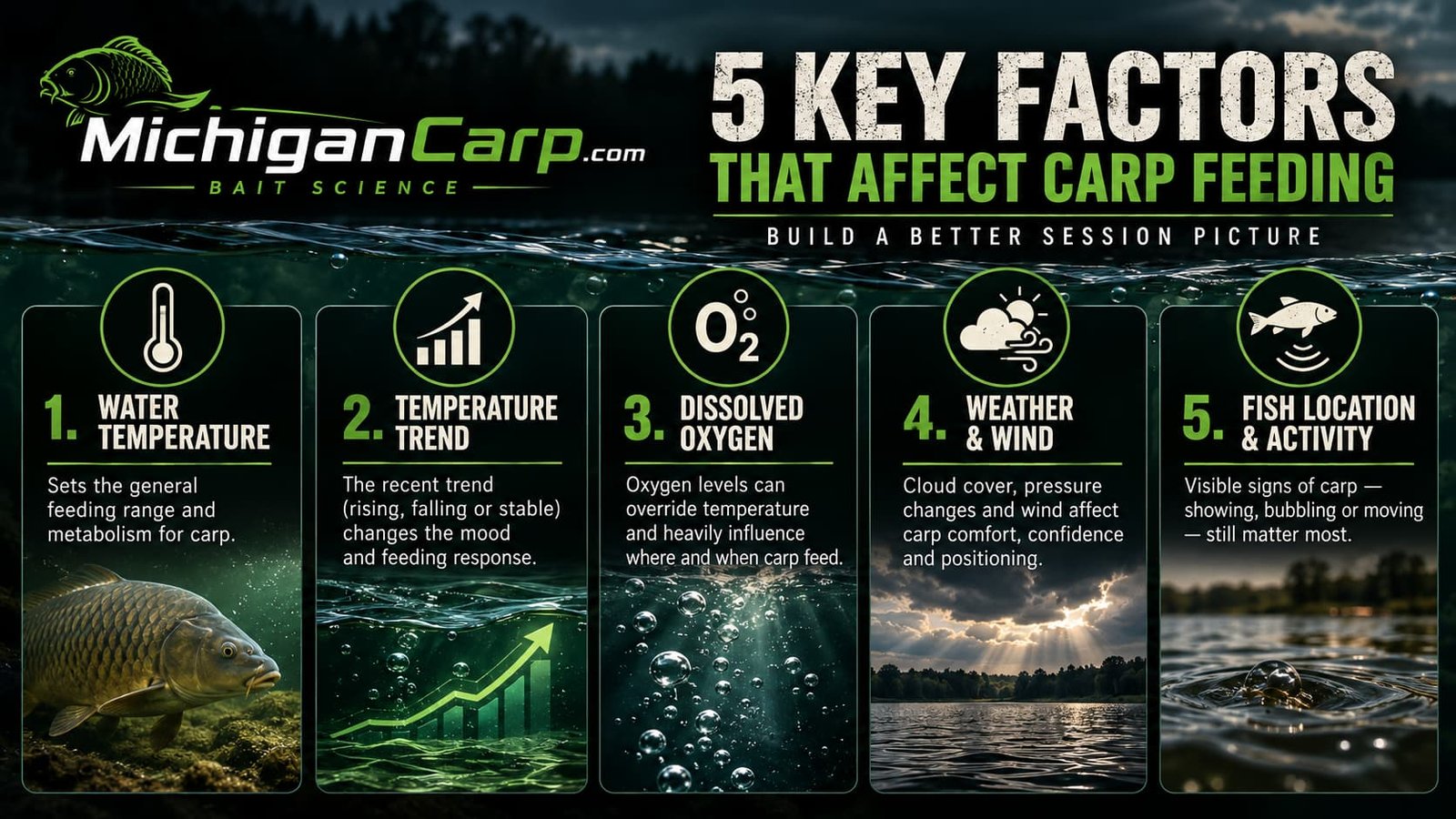
Water temperature is one of the most useful clues in carp fishing, but a reading on its own never tells the whole story. A Michigan lake at 52°F with stable weather and an approaching mild front may offer a better opportunity than water at 62°F immediately after a sharp cold snap.
For anglers fishing wild lakes, reservoirs and river-connected waters, water temperature, the 24–72-hour trend, dissolved oxygen, sustained wind and actual fish activity are more useful together than any one of them in isolation.
This guide includes a carp feeding temperature chart, a practical 0–10 scorecard and an interactive Quick Trip Calculator. It is intended to help you judge when a session deserves your time, not predict a catch or replace the need to find fish.
A note about the scores: These are MichiganCarp’s judgment-based estimates for practical fishing conditions, especially spring and autumn. They are not scientifically measured feeding rates, a universal biological optimum or a percentage chance of catching a carp.
Table of Contents
Quick Start: Carp Feeding Temperature Chart
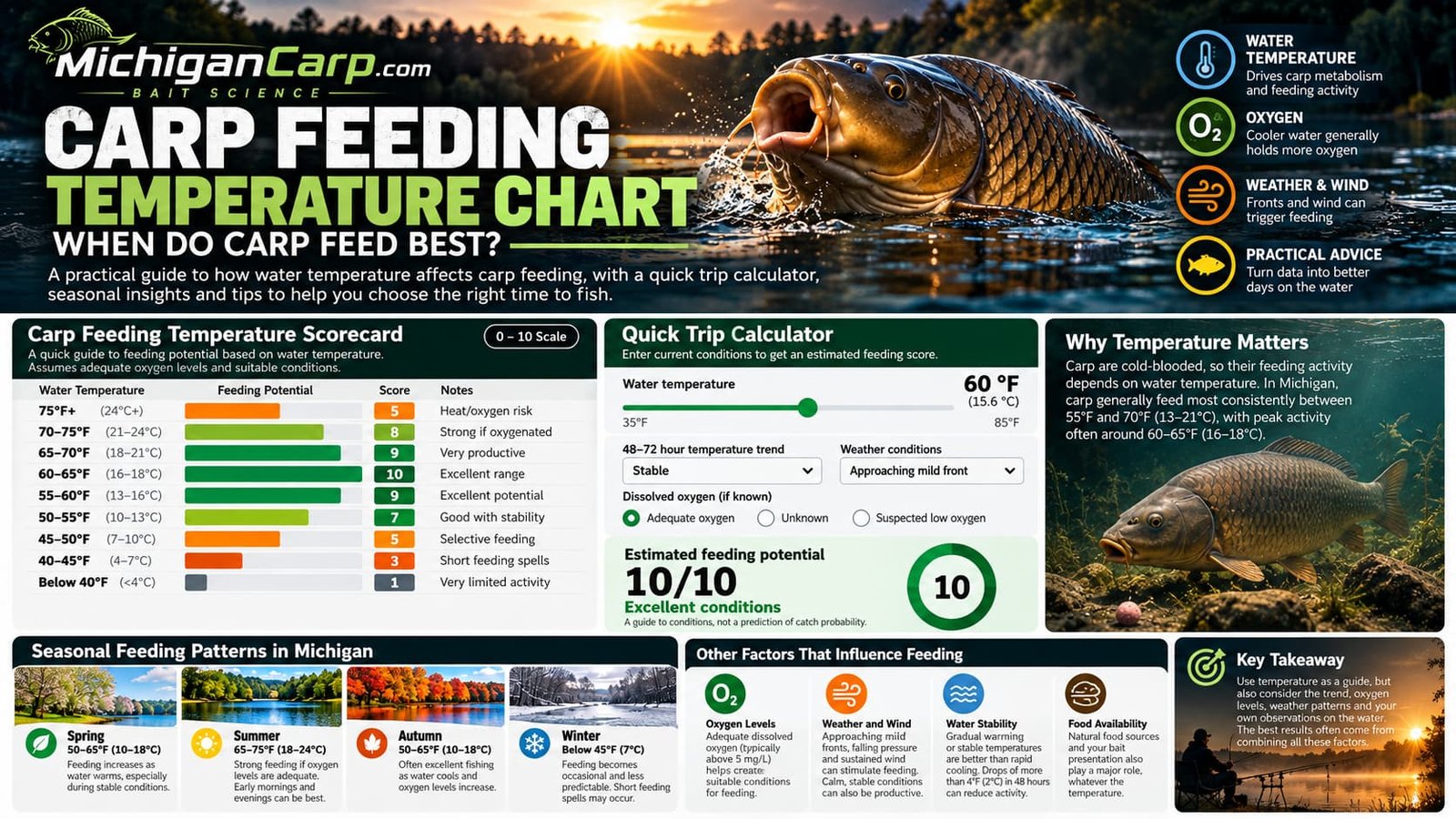
Use these approximate temperature bands as a starting point, then consider the trend, season, oxygen and fish location. The high score around 60–65°F reflects the kind of stable autumn water that can make a wild-lake session worthwhile; carp can also feed strongly in substantially warmer water.
📱 Mobile readers: swipe the table left or right to view the feeding scores and fishing notes.
| Water Temperature | Celsius | Feeding Score | Typical Feeding Potential |
|---|---|---|---|
| Above 75°F | Above 24°C | 5/10 | Can feed strongly, but heat and oxygen may limit suitable habitat |
| 70–75°F | 21–24°C | 8/10 | Strong feeding when oxygen is adequate |
| 65–70°F | 18–21°C | 9/10 | Very productive under suitable conditions |
| 60–65°F | 16–18°C | 10/10 | Excellent potential, particularly in autumn |
| 55–60°F | 13–16°C | 9/10 | Excellent potential with stability |
| 50–55°F | 10–13°C | 7/10 | Good if stable or gently rising |
| 45–50°F | 7–10°C | 5/10 | Selective feeding; timing matters |
| 40–45°F | 4–7°C | 3/10 | Shorter, less predictable feeding periods |
| Below 40°F | Below 4°C | 1/10 | Very limited activity, but feeding remains possible |
Important: Scores describe potential, not certainty. Active spawning, low oxygen, rapid cooling or an empty swim can invalidate an otherwise excellent temperature score. The °C ranges are rounded equivalents.
What is the best water temperature for carp fishing?
For an autumn trip on a wild Michigan water, 55–65°F (about 13–18°C) is often a productive and manageable range when temperatures are stable or cooling gently. That does not mean 60–65°F is the temperature of maximum carp growth or metabolism.
FAO aquaculture guidance describes warmer favorable temperature ranges for common carp under suitable conditions. Fishing success also depends on oxygen, season, spawning, food, fish location and angling pressure. For additional background, see FAO: Improving Pond Water Quality.
Why Water Temperature Influences Carp Feeding
Carp are ectothermic fish: the surrounding water influences their body temperature and many physiological processes. As water warms within tolerable limits, metabolism, digestion and movement can increase. But warmer is not automatically better for fishing. High temperatures can coincide with lower oxygen availability, heavy weed, boat traffic or feeding concentrated into darkness.
The USGS explanation of temperature and water describes how temperature affects aquatic biology and water chemistry. For a fuller Michigan-specific discussion of temperatures, depths and seasonal movements, read our Carp Water Temperature Guide for Michigan Lakes.
Temperature trends matter more than a single reading
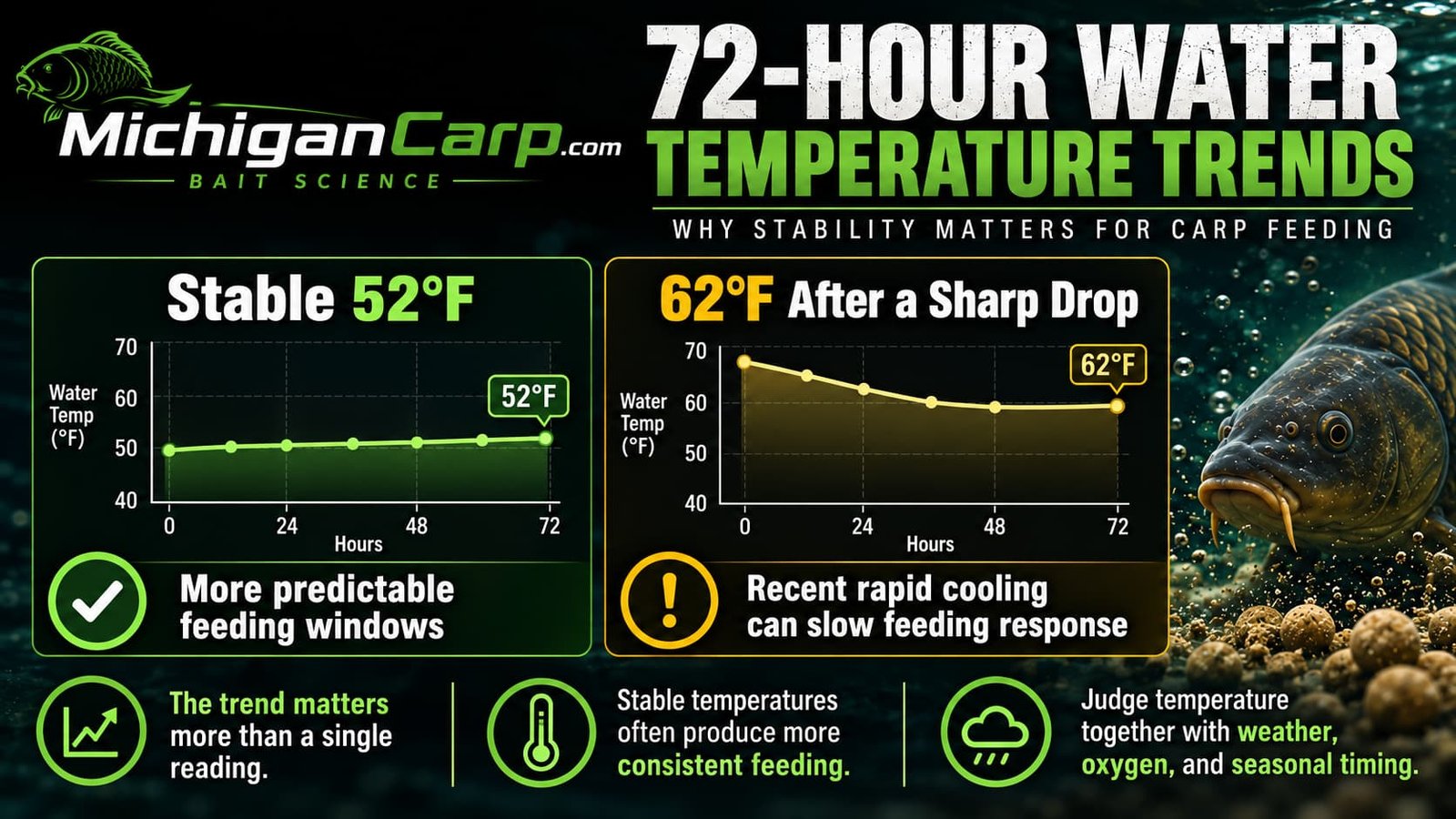
Consider two waters, each showing 54°F today. One has held between 53°F and 55°F for three days; the other has fallen from 61°F after a hard cold front. Both are technically 54°F, but the first may offer the more predictable feeding opportunity.
Try to establish the 24-hour direction and the 48–72-hour trend before deciding. A modest spring rise may bring carp onto sun-warmed margins. In autumn, stability or gentle cooling can be better than a sudden four- or five-degree drop. Measurements at the fishing depth are more useful than assuming a surface reading represents the whole lake.
The Four Seasonal Feeding Patterns in Michigan
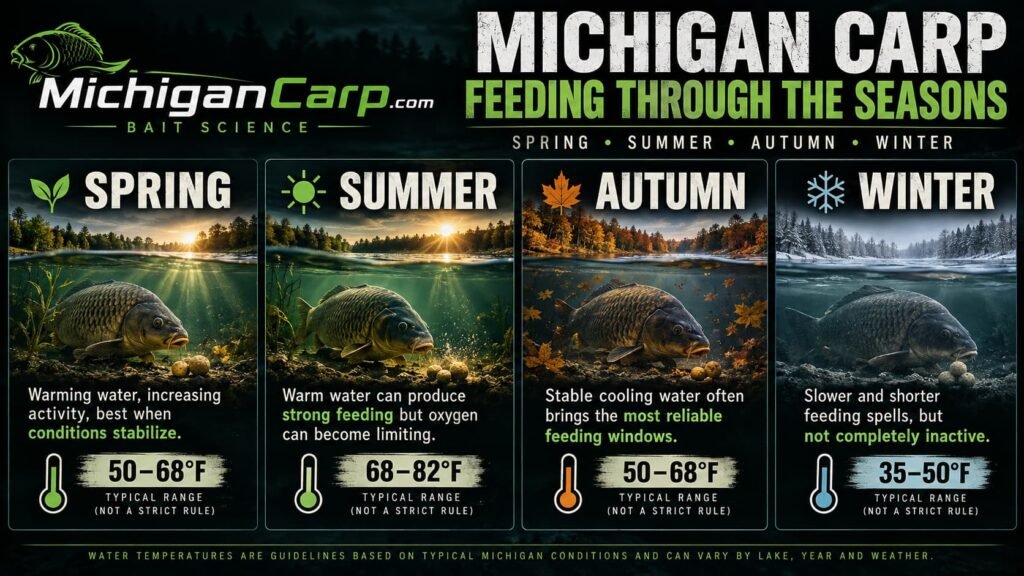
Spring: Rising temperatures and pre-spawn opportunity
At around 40–50°F, feeding is often selective, but sheltered shallow water can improve quickly after several mild days. As conditions build through 50–60°F, carp may move more confidently between holding areas and food-rich margins. Look for dark bottoms, reeds, warming bays and easy access to nearby depth.
As shallow water moves into the 60s°F, watch for spawning behaviour. Carp showing, thrashing or chasing through vegetation may be focused on reproduction rather than eating. FAO guidance discusses the common carp’s reproductive requirements and temperature influences in Propagation of Common Carp. Local conditions and spawning timing vary. Avoid targeting fish that are actively spawning.
Summer: Good feeding, with an oxygen qualification
Carp can feed strongly in warm summer water, including 70–75°F and above. But the best spot is not necessarily the warmest or the deepest. On stratified lakes, cooler water below the thermocline can be oxygen-poor; hot, stagnant shallow water may also be uncomfortable.
Look for usable weed edges, inflows, safe movement routes, shade and sustained moderate wind. Dawn, dusk and night may provide better opportunities during hot spells. Where fish are present and feeding, baiting can be more substantial; where oxygen or location is doubtful, adding more bait rarely solves the problem.
Autumn: Stable cooling and valuable feeding windows
This is where the scorecard is particularly useful. Water holding roughly 55–65°F while cooling gently can produce excellent opportunities. Food-rich shelves, remaining green weed, silt edges and routes towards deeper water become worth examining.
Below about 50°F, be more selective: favor stable temperatures, a mild spell or a useful pre-front period over rapidly falling water. Below roughly 45°F, a short, unusually favorable window may be more realistic than committing to several nights. Our Carp Bite Windows in Michigan guide explains how feeding periods can be brief even when fish are clearly present.
Winter: Slow but not stopped
There is no universal temperature where all carp stop feeding. In water below 45°F, expect less frequent feeding and place greater emphasis on locating fish, accurate presentation and restrained baiting. Below 40°F, stable water and a short warm spell can still matter where fishing is legal and safe, but expectations should be modest.
How Dissolved Oxygen Affects Carp Feeding
Dissolved oxygen, usually reported in milligrams per litre (mg/L), helps determine which parts of a lake remain usable for fish. Cold water can hold more oxygen at saturation than warm water, but actual oxygen levels also depend on circulation, plants, decomposition and depth. The USGS guide to dissolved oxygen and water explains these relationships.
As broad screening guidance, oxygen above about 6 mg/L is generally reassuring in many freshwater fishing situations; 3–5 mg/L deserves caution, and concentrations below roughly 3 mg/L can represent significant stress. These are not precise carp feeding thresholds, and a single surface reading cannot prove that deeper water is adequately oxygenated.
Summer stratification and autumn turnover
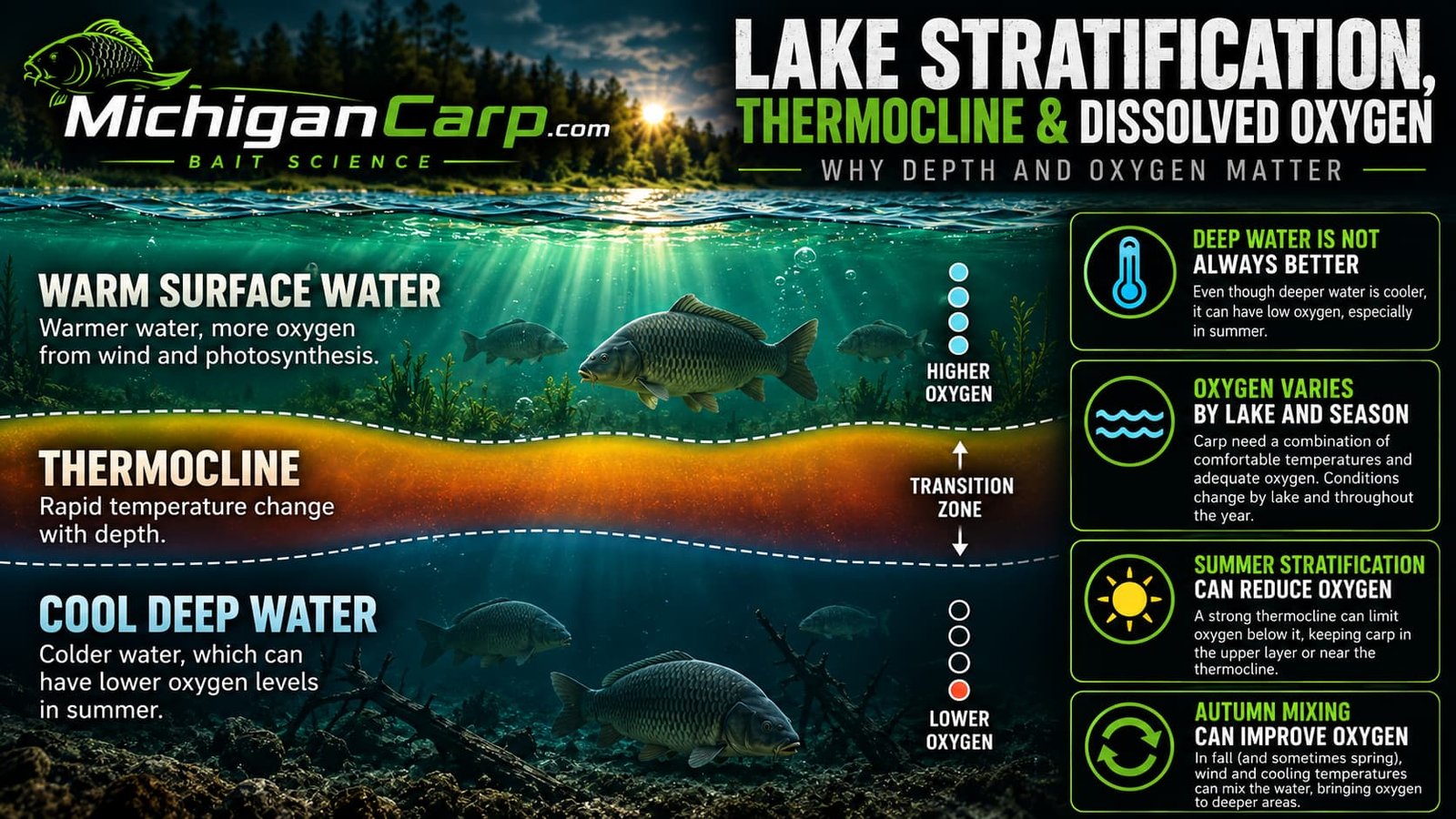
During summer, warm surface water may sit above colder deep water. If deep layers receive little mixing, decomposition can draw down oxygen, even where the temperature looks attractive. Autumn surface cooling and wind may eventually mix those layers and improve oxygen distribution, but the timing varies by lake and year.
A thermometer or underwater camera at your hookbait depth is valuable; a depth-by-depth oxygen profile is better when oxygen is in doubt. For the full watercraft explanation, see Dissolved Oxygen and Carp Fishing in Michigan Lakes.
Weather Fronts, Wind and Carp Feeding
Approaching mild fronts
A mild approaching front can coincide with cloud cover, useful wind and a change in feeding activity. That combination can be worth fishing, but there is no established universal rule that falling barometric pressure alone switches carp on. Our guide to Barometric Pressure and Carp Fishing examines the wider weather pattern rather than a single pressure number.
Sustained wind
Wind can shift surface water, distribute food, alter clarity and encourage mixing. A moderate, steady wind arriving at a productive bank may help. An unsafe, rapidly changing wind—or a windward bank with no food or carp—may not. Pay attention to the direction over several days, not merely the gusts at the time of casting.
Sharp cold fronts
Rapid cooling, substantial cold rain and repeated very cold nights may shorten feeding periods, especially late in autumn. A lake stabilising at 51°F may be a better four-day prospect than one plunging from 58°F towards 48°F. Fish the trend rather than an isolated temperature.
Quick Trip Calculator: Estimate Your Carp Feeding Potential
Use the calculator below after checking the water temperature, preferably at the depth you intend to fish. Choose the temperature trend over the previous 48–72 hours, the weather pattern and the oxygen condition if known.
How to use it:
- Enter the water temperature in °F or °C.
- Select whether the water is stable, gradually changing or cooling rapidly.
- Select the weather pattern.
- Choose the dissolved-oxygen condition, or leave it as Unknown.
- Read the score and the explanation together; never use the score instead of locating fish.
Carp Feeding Quick Trip Calculator
Combine water temperature, recent trends, weather and oxygen conditions to assess a fishing window.
These are practical fishing estimates, not calibrated catch probabilities. Fish location, spawning, depth-specific oxygen and safe access still matter.
The calculator uses transparent, judgment-based adjustments, not a validated statistical model. Unknown oxygen is treated as an assumption, not a verified safe reading. When low oxygen is suspected, the calculator withholds the numerical recommendation and presents a caution instead. A score of 8/10 is not an 80% chance of catching.
Understanding the feeding score
| Score | Practical interpretation |
|---|---|
| 9–10 | Excellent temperature/weather potential; still confirm location and fish activity |
| 7–8 | Promising; worth considering with a sound swim and presentation |
| 5–6 | Moderate; look for shorter feeding periods and local advantages |
| 3–4 | Limited; precise location and small feeding opportunities matter |
| 0–2 | Poor general conditions; wait for improvement unless evidence suggests otherwise |
Override: If low dissolved oxygen is suspected, the result should be treated as a caution regardless of any favorable temperature reading. During active spawning, this scorecard is not a useful feeding prediction either.
Michigan Notes: Applying the Scorecard to Wild Lakes
Measure temperature at the fishing depth
A surface reading taken at a boat launch may differ from water around a hookbait 15 feet down. Wind, inflows, shaded margins, lake depth and stratification can create substantial differences. Compare like with like: note the depth and time of each reading.
Use USGS monitoring stations carefully
USGS Water Data for the Nation can supply river temperature, flow, level and sometimes dissolved oxygen, depending on the station. These measurements are especially useful for regional trends and river-influenced waters. However, a river station cannot establish the exact temperature or oxygen level in a reservoir swim. Dam release depths, sensor locations and local mixing can make readings quite different.
Keep a simple fishing log
Record water temperature at depth, the 24–72-hour trend, wind direction, weather changes and overnight lows. Separate carp showing, liners, takes and captures. The fish may be present without actively feeding. Over several seasons, paired records can reveal local patterns that a general-purpose scorecard cannot.
Frequently Asked Questions
At what temperature do carp stop feeding?
There is no single cut-off. Feeding generally becomes less frequent as water cools, but carp can still be caught below 40°F when fish are located and conditions cooperate.
Is 50°F too cold for carp fishing?
No. Stable or gently warming water around 50°F can produce worthwhile fishing, especially with a favorable forecast and accurate bait placement.
Do carp feed better as water temperature rises?
Gradual warming often helps in spring or after cold periods, but warming alone cannot guarantee feeding. In midsummer, additional warmth can create oxygen or comfort problems instead.
Is 60°F a good water temperature for carp?
Yes. Around 60°F can be excellent for spring or autumn fishing, but it is not a universal biological optimum or a substitute for understanding spawning, oxygen and location.
Can carp feed in 75°F water?
Certainly. Carp are capable of strong warm-water feeding. Check oxygen, safe fish handling and when the fish actually visit the feeding area.
Does dissolved oxygen affect where carp feed?
Yes. Severe oxygen depletion can restrict where carp can comfortably hold or feed. Deep, cool water is not automatically well oxygenated.
Does falling barometric pressure trigger feeding?
Not reliably on its own. Pressure changes often coincide with wind, cloud, rain and temperature changes, so look at the complete pattern.
Should I fish deeper water in autumn?
Sometimes. Shelves and deeper routes can be useful, but food, oxygen, temperature and the fish’s actual movements matter more than depth alone.
Next Steps: Turn the Score Into a Fishing Plan
Before committing to a long session, ask three questions: Is the water usable and reasonably stable? Are carp actually using the area? Does the weather offer a fishable window? The chart and calculator help with the first and third; observation and watercraft answer the second.
For the practical follow-through, use our Carp Session Planning in Michigan guide to bring swim choice, weather, baiting and session logistics together. Keep your own notes, learn the waters you fish and revise your expectations as the conditions change.
MichiganCarp.com — Bait Science, Watercraft and Wild Carp Fishing.