

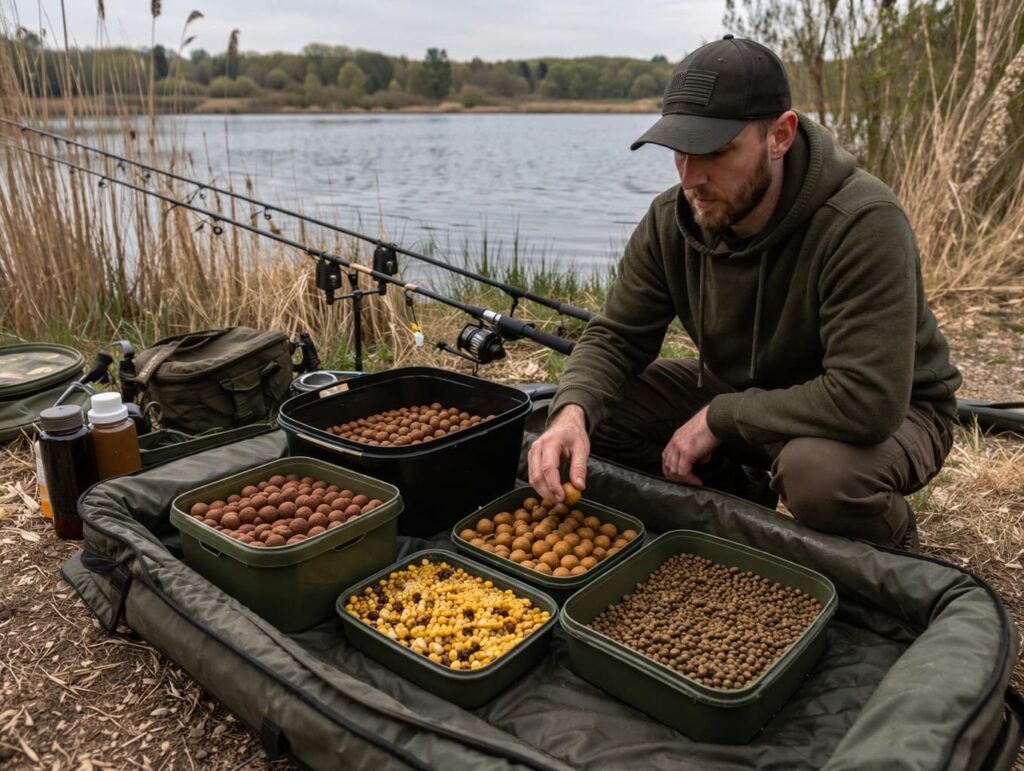
Fall is one of the most interesting times of the year for carp bait.
It can also be one of the easiest seasons to misread.
Early fall can fish almost like summer. The water still holds warmth, carp are active, natural food is available, and fish may feed confidently on boilies, corn, pellets, particles, and tiger nuts.
Late fall is completely different.
As water temperatures drop, feeding windows shorten, digestion slows, and carp become less willing to deal with heavy bait. The same baiting approach that worked in September can be too much by late October or November.
That is why the best carp bait for fall fishing is not one single bait.
It depends on where you are in the fall season.
On Michigan lakes, autumn baiting needs to follow the water, not the calendar. Some years, September still feels like summer. Other years, cold fronts, turnover, rain, wind, and fast temperature drops can push carp into a much more cautious feeding mood.
This guide explains how to choose fall carp bait properly, including corn, boilies, pellets, particles, tiger nuts, and how baiting should change from early fall into late fall.
Quick Start
- Early fall can fish like summer, with boilies, particles, pellets, corn, and tiger nuts all useful.
- Late fall should be treated more like cold-water fishing.
- Corn remains one of the safest fall bait choices because it is simple and easy to eat.
- Boilies work well in early fall and during stable feeding periods.
- Particles can be excellent early, but should be reduced as water cools.
- Pellets are useful in warmer fall water but lose strength as temperatures drop.
- Tiger nuts are good when you need a tougher hookbait or more selectivity.
- Bait amounts should reduce as water temperature falls.
- In fall, water temperature trend matters more than the date.
Why fall baiting is different
Fall is a transition season.
That means carp behavior can change quickly.
In summer, carp often feed more confidently. They digest food well, move regularly, and may stay over a baited area. In winter and cold water, everything slows down. Carp feed less often, move less, and often take only small amounts.
Fall sits between those two worlds.
The problem is that anglers often fish the whole season the same way.
They remember a good September session and keep using the same baiting approach into late October. Or they switch to cold-water tactics too early and underfeed fish that are still willing to feed strongly.
Fall baiting needs adjustment.
You are watching for the shift.
The best carp bait for fall fishing is the bait that matches where the carp are in that shift from warm-water feeding to cold-water caution.
Michigan Notes: In Michigan, fall can change fast. A warm stable week can produce strong feeding. A sharp cold front can make the same swim feel empty two days later.
Early fall vs late fall
The easiest way to understand fall baiting is to split it into two parts.
Early fall
Early fall often behaves like late summer.
The water still holds warmth. Weed may still be active. Natural food is still available. Carp may feed heavily when conditions are right.
In early fall, you can often use:
- boilies
- corn
- pellets
- particles
- tiger nuts
- mixed baiting approaches
You can also use more bait than you would in cold water, provided fish are feeding.
Late fall
Late fall is different.
Once water temperatures begin dropping steadily, carp become less predictable. Feeding windows shorten. Fish may hold deeper, move less, or feed only during short favourable periods.
In late fall, better bait choices are usually:
- corn
- small boilies
- small PVA bags
- light pellet use
- minimal particles
- single hookbait approaches
The amount of bait becomes more important than the bait itself.
Watch the water temperature trend
Fall baiting is not about a fixed date.
It is about the trend.
A stable 52°F can fish better than a falling 58°F. A mild spell after cold weather can wake fish up. A sharp drop can slow feeding even if the temperature still looks reasonable.
Watch for:
- stable temperatures
- gradual warming periods
- cold fronts
- sharp overnight drops
- wind direction changes
- turnover signs
- water clarity changes
If the water is stable or slightly warming, carp may feed well.
If the water is falling quickly, reduce bait and fish more carefully.
Michigan Notes: Fall carp often respond better to stability than raw temperature. A stable cool lake can outfish a warmer lake that is dropping fast.
Corn in fall
Corn is one of the safest fall carp baits.
It works because it is simple, visible, easy to eat, and widely accepted. As water cools, those qualities become more important.
In early fall, corn can be used more positively. You can fish it with pellets, particles, or boilies. It can help create quick feeding confidence and works well on public waters.
In late fall, corn becomes even more useful because it allows you to fish small. A few grains around the hookbait can be enough. You do not need to build a large feeding area.
Use corn in fall when:
- water is cooling
- fish are feeding lightly
- you want quick acceptance
- you are fishing short sessions
- you want a simple hookbait and feed match
- you are unsure how much fish will eat
Corn is weaker when nuisance fish, birds, turtles, or crayfish are still active. If they are clearing it quickly, reduce loose feed or move to a tougher hookbait.
For more detail, read Corn for Carp in Michigan.
Boilies in fall
Boilies can be excellent in fall.
In fact, early fall can be one of the best times to use them.
Carp may still be feeding confidently, and a boilie approach gives you control, durability, and selectivity. If you are targeting better carp, fishing longer sessions, or trying to avoid nuisance activity, boilies make a lot of sense.
Early fall is a good time for:
- small boilie spreads
- chopped boilies
- boilie crumb
- wafters
- balanced hookbaits
- boilies with particles
- boilies with pellet support
As fall progresses, reduce the amount.
Late fall boilie fishing should be much more controlled. A single hookbait with a few broken boilies may be better than a full spread. Smaller boilies usually make more sense than large baits as water cools.
Use boilies in fall when:
- fish are feeding confidently
- nuisance fish are active
- you need a durable hookbait
- you are fishing longer sessions
- water temperatures are stable
- you want more selectivity than corn
Avoid heavy boilie baiting when the water is dropping quickly or fish are only feeding briefly.
For boilie-specific timing, read When to Use Boilies for Carp in Michigan.
Pellets in fall
Pellets are useful in fall, but their value changes as the water cools.
In early fall, pellets can still work very well. The water is warm enough for breakdown, and carp may respond quickly to the attraction they release. Small pellets in PVA bags, pellets with corn, and pellets around boilie hookbaits can all be effective.
In late fall, pellets become less reliable.
As water cools, pellet breakdown slows. Carp feed less actively, and the fast attraction advantage is reduced. That does not mean pellets stop working, but they should be used in smaller amounts.
Use pellets in fall when:
- water is still reasonably warm
- carp are likely nearby
- you want quick attraction
- you are fishing short sessions
- you are using PVA bags
- you are supporting corn or boilies
Reduce pellet use when:
- water drops sharply
- nuisance fish are active
- fish are feeding slowly
- you need bait to remain intact for longer
Michigan Notes: Pellets are strongest in early fall and weakest once the water begins fishing like cold water. Treat them as support bait, not the whole plan.
For more detail, read Pellets for Carp.
Particles in fall
Particles can be very strong in early fall.
Carp may still browse actively around weed, silt, margins, and natural food areas. A controlled particle approach can hold fish and encourage feeding.
Good early fall particle options include:
- corn
- hemp
- tiger nuts
- mixed particles
- maize
- prepared seed blends
Particles work best when carp are feeding confidently and you have enough session time for them to settle.
As water cools, reduce particle use.
Late fall is not usually the time for heavy particle beds. Carp are feeding less, and small food items can fill them or spread them away from the hookbait.
Use particles in early fall when:
- water is stable
- fish are browsing naturally
- you are fishing weed edges
- you are fishing longer sessions
- carp are clearing bait confidently
Use particles lightly or not at all in late fall when:
- water is cold
- feeding windows are short
- fish are only passing through
- you are fishing short sessions
For the full particle guide, read Particles for Carp Fishing Guide.
Tiger nuts in fall
Tiger nuts are a useful fall bait because they give you durability and selectivity.
They are tougher than corn and can remain fishing longer. They are also useful when nuisance fish are still active in early fall.
Tiger nuts work well when:
- corn is being cleared too quickly
- nuisance fish are active
- you want a tougher hookbait
- carp already recognise them
- you are fishing particles
- you want a more selective hookbait
In early fall, tiger nuts can be used with corn, hemp, or mixed particles.
In late fall, use them more sparingly. A single tiger nut hookbait or a tiger nut with a few grains of corn can be enough.
Tiger nuts are not always the fastest bait, so if carp are feeding lightly, keep the rest of the baiting minimal.
Michigan Notes: Tiger nuts have accounted for some very good Michigan carp. In fall, they are best used as a controlled hookbait, not as heavy loose feed.
Hookbait choice in fall
Fall hookbait choice should follow feeding confidence.
In early fall, carp may take bottom baits, wafters, tiger nuts, corn, and boilies confidently. In late fall, lighter or smaller hookbaits often make more sense.
Good fall hookbaits include:
- corn
- small boilies
- wafters
- tiger nuts
- artificial corn
- balanced hookbaits
- small pop-ups where bottom conditions require them
Wafters can be especially useful in fall because they reduce the effort needed for a carp to pick up the bait. That can help when fish are feeding more cautiously.
A bright hookbait can work in coloured water or when fish are moving through. In clear or pressured water, a subtle hookbait may be better.
For pairing hookbait and feed, read Best Hookbait and Freebait Combinations for Carp.
Early fall baiting approach
Early fall allows a more positive approach.
If carp are feeding, you can use moderate baiting and build the swim carefully. This is a good time to use combinations like boilies and particles, corn and pellets, tiger nuts over hemp, or boilie hookbaits over mixed bait.
A good early fall approach might be:
- start with a controlled amount of bait
- use corn or pellets for quick attraction
- add boilies or tiger nuts for durability
- use particles if fish are feeding confidently
- top up only after activity
Do not dump bait in just because early fall can be good. Start with a plan and respond to the fish.
Late fall baiting approach
Late fall needs a lighter hand.
As water cools, reduce bait amount and simplify the approach. You are often fishing for shorter feeding windows and fewer bites.
A good late fall approach might be:
- corn hookbait with a few grains of corn
- small boilie with two or three broken freebies
- wafter over crumb
- small PVA bag
- tiger nut with minimal feed
- near-single hookbait approach
Late fall is not usually about holding fish for hours over a big baited area. It is about being in the right place when a feeding window opens.
Michigan Notes: In late fall, one well-placed bait can beat a pile of feed. The colder the water gets, the more careful baiting should become.
How much bait to use in fall
Fall bait amount should reduce as the season progresses.
Early fall can allow moderate baiting if fish are feeding. Late fall often needs very little bait.
Start with less than you think.
Increase only if:
- carp are feeding confidently
- bait is being cleared
- bites are coming
- the water is stable
- fish are staying in the area
Reduce bait if:
- water temperature drops
- bites slow after feeding
- fish are only showing but not feeding
- nuisance species dominate
- the swim feels dead after baiting
For bait amount, read How Much Bait to Use for Carp.
How often to bait in fall
Fall baiting frequency should also change.
In early fall, small top-ups can help if fish are feeding. In late fall, repeated baiting can hurt more than help.
Do not bait by the clock.
Bait by response.
Top up when there is activity. Leave the swim alone when it feels quiet or cautious. After a bite, do not automatically throw more bait in. Recast accurately and watch.
For bait timing, read How Often Should You Bait for Carp.
Fall baiting around weed
Weed can remain important in fall, especially early.
Weed holds natural food and gives carp cover. But as fall progresses, some weed begins dying back. That can change oxygen, water clarity, and where carp are comfortable.
Early fall weed edges can be excellent. Particles, corn, tiger nuts, boilies, and pellets can all work near clean spots beside weed.
Late fall weed needs more caution. Dying weed can create poor conditions in some areas. Look for cleaner edges, open patches, and areas where fish still show signs of feeding.
Michigan Notes: In fall, not all weed is good weed. Healthy weed edges can hold fish. dying, rotting weed can push them away.
Fall baiting on pressured public waters
Public waters often remain pressured into fall, especially during mild weather.
Carp may have seen bait all season. They may be cautious around obvious feeding. Heavy baiting can be a mistake.
On pressured fall waters, use:
- smaller bait amounts
- subtle hookbaits
- corn in tight patches
- small boilies
- tiger nuts
- wafters
- light crumb
- minimal particles
Quiet fishing matters. So does accurate casting.
Michigan Notes: By fall, some public-water carp have had a full season of pressure. Less obvious baiting can be a real edge.
Fall prebaiting
Prebaiting can work in fall, but timing matters.
Early fall prebaiting can be very effective if carp are feeding and returning to the same areas. Small, regular baiting with boilies, corn, particles, or tiger nuts can build confidence.
Late fall prebaiting is more limited. Carp feed less regularly, and heavy prebaiting can become wasteful.
If prebaiting in fall, keep it light and consistent.
Do not dump bait.
Always check local rules before prebaiting public, park, campground, federal, or managed waters.
For the full guide, read Carp Prebaiting in Michigan — Does It Work?.
Simple fall bait plans
Early fall short session
Use corn and pellets in a tight area with a corn, wafter, or small boilie hookbait.
Early fall longer session
Use a controlled mix of particles and boilies with a boilie, tiger nut, or wafter hookbait.
Late fall short session
Use a corn hookbait with a few grains of corn, or a small boilie with light crumb.
Late fall pressured water
Use a small wafter, tiger nut, or subtle boilie with minimal freebait.
Fall nuisance fish situation
Use tiger nuts, boilies, artificial corn, or tougher hookbaits with reduced loose feed.
Common Mistakes
Treating all fall fishing the same
Early fall and late fall are completely different.
Using too much bait late in the season
As water cools, bait amounts should usually reduce.
Ignoring temperature trends
A falling temperature trend can kill feeding even if the water still seems warm enough.
Overusing particles in late fall
Particles are strong early, but heavy particle baiting becomes risky as water cools.
Forgetting corn
Corn remains one of the safest fall baits, especially when fish are feeding lightly.
Fishing summer tactics after the lake has changed
Do not let September success control your November baiting.
Ignoring pressure
By fall, carp may have seen months of bait and rigs. Subtle baiting often works better.
FAQ
What is the best carp bait for fall fishing?
The best carp bait for fall fishing depends on timing. Early fall suits boilies, corn, pellets, particles, and tiger nuts. Late fall usually calls for corn, small boilies, wafters, and lighter baiting.
Is corn good for fall carp fishing?
Yes. Corn is one of the safest fall baits because it is simple, visible, easy to eat, and works well as water cools.
Do boilies work in fall?
Yes. Boilies can be excellent in early fall and during stable feeding periods. Use fewer boilies as water cools.
Are particles good in fall?
Particles can be very good in early fall, especially near natural feeding areas. In late fall, reduce particle use.
Should I use pellets in fall?
Pellets can work in early fall and warmer water. As temperatures drop, use them more lightly as support bait.
How much bait should I use in fall?
Use more in early fall if fish are feeding. Reduce bait as water cools and feeding windows shorten.
Next Steps
Read Best Carp Bait for Summer Fishing to compare early fall with warm-water baiting.
Then read Best Carp Bait for Cold Water to adjust your approach as late fall cools down.
For bait amount and timing, read How Much Bait to Use for Carp and How Often Should You Bait for Carp.
For bait-specific choices, connect this page with Corn for Carp in Michigan, Pellets for Carp, Particles for Carp Fishing Guide, and When to Use Boilies for Carp in Michigan.
Then link everything back to the main Carp Bait Guide.