
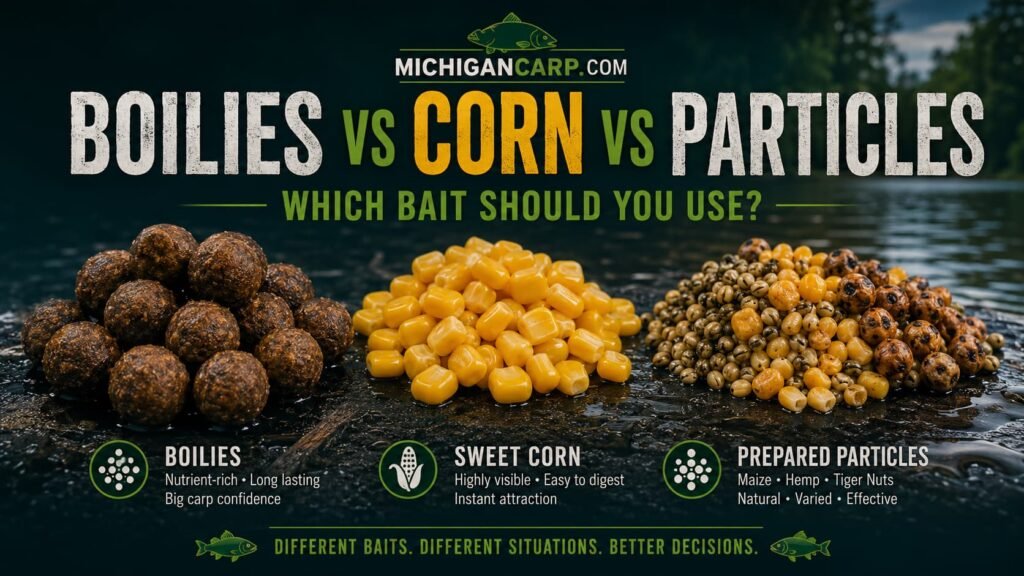
Boilies vs corn vs particles for carp is not really a question of which bait is best.
It is a question of which bait fits the session.
Corn can be the fastest way to get a bite.
Boilies can be the best way to fish a selective hookbait and build a repeatable food signal.
Particles can hold carp in an area and encourage natural browsing.
All three can catch carp.
All three can also be used badly.
The mistake is choosing bait by habit instead of by situation.
A short spring session on a public Michigan lake is not the same as a three-day summer session on a known feeding route.
A clear margin with turtles is not the same as a deep channel with nuisance fish.
A beginner trying to catch a first carp does not need the same bait plan as someone prebaiting a big lake for several days.
This article compares boilies, corn and particles so you can choose the right bait for the job.
For the broad bait-choice hub, use Carp Bait Guide.
For the full boilie learning route, start with Boilie School.
For corn-specific use, read Corn for Carp in Michigan.
For particle strategy, use Particles for Carp Fishing.
The clean answer is simple:
USE CORN WHEN YOU NEED SPEED AND CONFIDENCE.
USE BOILIES WHEN YOU NEED CONTROL AND SELECTIVITY.
USE PARTICLES WHEN YOU NEED BROWSING, HOLDING POWER AND FEEDING ACTIVITY.
The best bait is the one that matches the water, the session and the carp in front of you.
Table of Contents
Quick Start: Boilies vs Corn vs Particles for Carp
Use this quick table before choosing your bait.
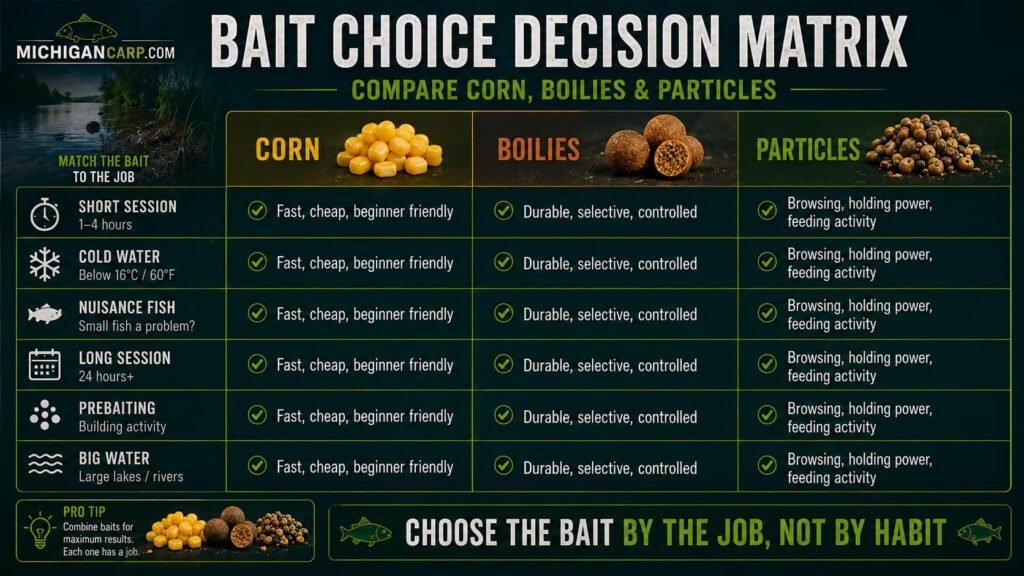
| Situation | Best Starting Choice | Why |
|---|---|---|
| First carp / beginner session | Corn | Cheap, simple, visible and fast |
| Cold water / early spring | Corn or single boilie | Low feed, easy presentation |
| Short session | Corn or small boilie trap | Fast results matter |
| Overnight session | Boilie, corn, or small particle patch | Depends on nuisance fish and water temperature |
| Multi-day session | Boilies and/or particles | Better holding power and repeatability |
| Turtles active | Boilie or tiger nut | Tougher than soft corn |
| Small nuisance fish active | Boilie or tiger nut | More durable hookbait |
| Big public lake | Boilies plus controlled particles | Food signal and session control |
| Heavy prebaiting | Boilies or prepared particles | Repeatable feed over time |
| Very low confidence swim | Corn | Best simple test bait |
| Selective larger-fish approach | Boilies | Better control over size, nutrition and durability |
| Natural browsing area | Particles | Matches grubbing behavior |
Simple rule:
Corn finds bites.
Boilies control the hookbait.
Particles build feeding activity.
The best anglers know when to use one, when to combine two and when to avoid overcomplicating all three.
What Each Bait Does Best
Boilies, corn and particles are not the same kind of bait.
They do different jobs.
Corn
Corn is the confidence bait.
It is soft, visible, cheap, simple and accepted quickly by carp in many waters.
Corn is excellent when you need to find out whether carp are willing to feed.
Boilies
Boilies are the control bait.
They let you control size, firmness, buoyancy, flavor, leakage, nutrition and hookbait durability.
Boilies are strongest when you want a repeatable baiting system or a more selective hookbait.
Particles
Particles are the browsing bait.
They encourage carp to search, grub and stay in an area.
Particles are strongest when carp are already likely to feed and you want to build activity without relying on one large bait item.
Each bait has a job.
Problems start when anglers ask one bait to do everything.
The Big Comparison
| Factor | Corn | Boilies | Particles |
|---|---|---|---|
| Speed | Very fast | Medium to fast | Medium |
| Beginner friendly | Excellent | Good | Good if prepared correctly |
| Cost | Very low | Medium to high | Low to medium |
| Preparation | Minimal if canned | Buy or make | Often requires soaking/cooking |
| Hookbait durability | Low to medium | High | Varies |
| Nuisance resistance | Low | Good | Varies |
| Selectivity | Low to medium | Medium to high | Low to medium |
| Holding power | Low to medium | Medium | High when used well |
| Cold-water use | Excellent in tiny amounts | Good with low feed | Use carefully |
| Warm-water use | Excellent | Excellent | Excellent |
| Prebaiting | Limited | Excellent | Excellent |
| Long sessions | Useful but vulnerable | Strong | Strong |
| Turtles | Weak | Better | Tiger nuts best among particles |
| Best role | Quick confidence bait | Controlled hookbait and food bait | Browsing and feeding area |
This is why no single bait wins every time.
A bait that is perfect for one session can be wrong for another.
When Corn Is the Best Choice
Corn is often the best bait when you need a simple, quick, low-risk starting point.
Use corn when:
- you are new to carp fishing;
- you are testing a swim;
- you only have a short session;
- the water is cold;
- carp are showing but not feeding heavily;
- you want a small visible hookbait;
- you are fishing light baiting amounts;
- you do not want complicated preparation;
- you want a bait that many carp accept quickly.
Corn is especially useful in Michigan because many waters are not heavily pressured by carp anglers.
On some waters, carp may see corn more naturally than boilies.
That does not mean corn is always better.
It means corn is often the fastest way to ask the question:
Are carp here and willing to pick up bait?
For the full corn article, read Corn for Carp in Michigan.
When Corn Is the Wrong Choice
Corn is not magic.
It has weaknesses.
Corn can be poor when:
- nuisance fish are stripping the hookbait;
- turtles are active;
- the hookbait needs to last overnight;
- you want a more selective larger-fish approach;
- you are fishing at distance and need a secure bait;
- you are feeding too much loose corn;
- you need a stronger food-bait signal over several days.
Corn is also easy to overuse.
Because it is cheap, anglers often feed more than the session needs.
In cold water or short sessions, a few grains may be enough.
The problem is rarely corn itself.
The problem is usually too much corn in the wrong situation.
When Boilies Are the Best Choice
Boilies are the better choice when you need control.
Use boilies when:
- the hookbait must stay on the rig longer;
- nuisance fish are a problem;
- turtles are bothering soft baits;
- you want a larger hookbait profile;
- you are fishing overnight;
- you are prebaiting;
- you want a repeatable baiting campaign;
- you want a food bait rather than only an instant bait;
- you need a bait that works with specific rigs;
- you want to fish one hookbait over a controlled spread of freebies.
Boilies are also useful when you want separation from small loose feed.
A single boilie over a small amount of corn, hemp or crumb can stand out without looking unnatural.
Boilies do not have to mean heavy baiting.
A single 15 mm or 18 mm boilie can be a very clean low-feed hookbait.
For the full learning route, start with Boilie School.
For beginner boilie foundations, read Boilie Basics.
For fishing boilies, use How to Fish Boilies for Carp.
When Boilies Are the Wrong Choice
Boilies can be the wrong choice when:
- carp have not seen them before and you need instant confidence;
- you are fishing a very short exploratory session;
- the bait is too large for the situation;
- you are overfeeding boilies in cold water;
- you are using a poor-quality bait with little attraction;
- you are relying on flavor instead of location;
- corn or natural particles would give faster feedback.
Boilies are not a shortcut around watercraft.
A good boilie in the wrong place is still in the wrong place.
On low-pressure Michigan waters, boilies may need introduction.
That does not make them weak.
It means they work best when used with a clear plan.
When Particles Are the Best Choice
Particles are the better choice when you want carp to browse and stay in an area.
Use particles when:
- carp are feeding naturally;
- you are fishing a known route;
- you are working a margin, weed edge, silt patch or shallow shelf;
- the session is long enough for feeding activity to build;
- you want to hold carp without relying only on boilies;
- you can bait accurately;
- you have prepared the bait safely;
- you want a cost-effective feed source;
- you are fishing warm water or a clear feeding window.
Particles can make carp search.
That is their strength.
A good particle patch can keep fish grubbing, turning, clouding the bottom and revisiting the area.
For the full strategy guide, read Particles for Carp Fishing.
For safe prep, read How to Prepare Particles for Carp Fishing.
When Particles Are the Wrong Choice
Particles are wrong when they are used without restraint.
Particles can hurt you when:
- the water is cold and fish are barely feeding;
- the session is too short;
- you do not know whether carp are present;
- you cannot bait accurately;
- you use dry or underprepared particles;
- you feed too much too soon;
- nuisance fish or turtles dominate the bait;
- the hookbait gets lost in a huge patch;
- you keep adding bait because nothing has happened.
Particles are not a search tool by themselves.
They are a feeding tool.
Find likely carp first, then use particles to create or support a feeding opportunity.
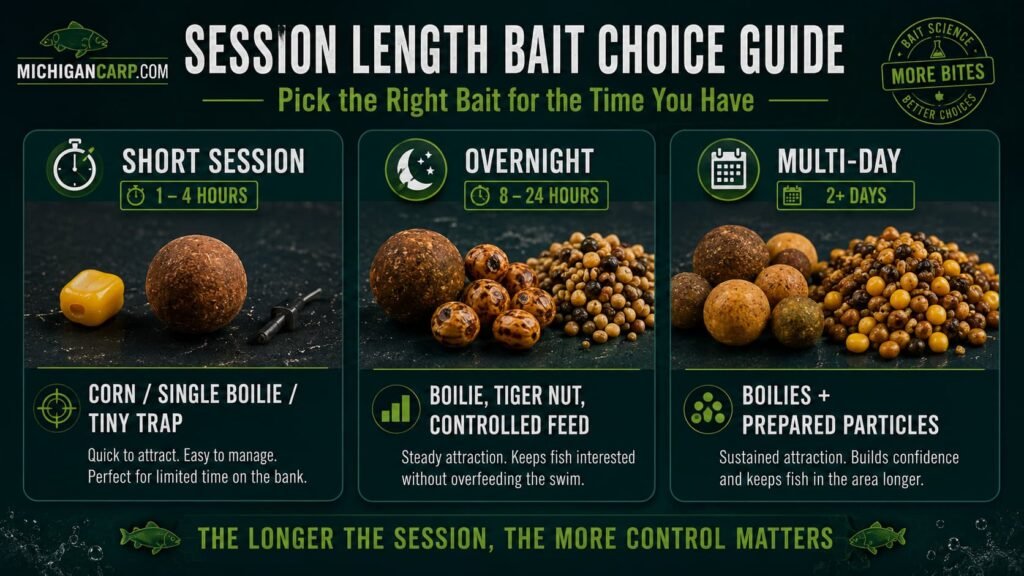
Short Sessions: Corn Usually Wins
For short sessions, speed matters.
You may only have a few hours.
You do not need a complex baiting campaign.
Good short-session choices include:
- sweet corn;
- corn plus plastic corn;
- single boilie;
- small wafter;
- tiny PVA trap;
- a few grains of corn around the hookbait.
Corn often wins because it is simple and fast.
A short session is usually about getting one clean chance.
That means the bait should be easy to present and easy for carp to accept.
Avoid large particle beds unless you already know fish are feeding there.
Overnight Sessions: Match the Hookbait to the Problem
Overnight sessions change the decision.
The bait must keep fishing while you are not watching it.
Corn can still work, but it may be stripped.
Particles can hold fish, but they can also attract nuisance activity.
Boilies or tiger nuts may be better hookbaits when the rig needs to stay active.
Good overnight approaches include:
- boilie over a small particle patch;
- tiger nut over maize and hemp;
- corn plus plastic corn over light feed;
- boilie over crumb and a few particles;
- two rods on controlled bait and one rod on a single hookbait.
The best overnight bait is not always the bait that gets attention fastest.
It is the bait that stays fishing properly.
Multi-Day Sessions: Boilies and Particles Become Stronger
Longer sessions give you more room to build a swim.
That is where boilies and particles become more useful.
For multi-day fishing, think in systems:
- boilies for repeatable food signal and hookbait control;
- particles for browsing and holding activity;
- corn for fast response and visual attraction;
- tiger nuts or boilies when nuisance fish or turtles are a problem.
A strong multi-day plan might use:
- prepared maize, hemp or mixed particles as controlled feed;
- boilies as the main hookbait and food item;
- corn as a quick response bait;
- tiger nuts when a tougher particle hookbait is needed.
Do not take “multi-day” as permission to dump bait.
Long sessions should create better information, not careless feeding.
Cold Water: Keep It Small
Cold water favors restraint.
Corn can be excellent because it is soft, visible and usable in tiny amounts.
Boilies can work well as single hookbaits or very small traps.
Particles should be used carefully.
Good cold-water choices include:
- single corn hookbait;
- corn plus plastic corn;
- single boilie;
- small wafter;
- tiny amount of hemp;
- very small maize or corn trap only if fish are feeding.
Avoid large beds of particles in cold water unless you have clear evidence.
The colder the water, the more important it is to make the hookbait count.
Warm Water: Particles Become More Useful
As water warms and carp feed more actively, particles become stronger.
Warm water allows more browsing, more movement and longer feeding spells.
That does not mean heavy baiting is automatic.
It means you can build more confidently when fish are present.
Warm-water bait choices include:
- corn for speed;
- boilies for control;
- maize and hemp for feeding activity;
- mixed particles for longer sessions;
- boilies over particles for selectivity;
- tiger nuts where nuisance activity is a problem.
Warm water gives you more options.
It also makes overfeeding easier.
Build by signs, not by habit.
Big Lakes vs Small Venues
Michigan carp fishing often means big public water.
That changes bait choice.
Big Lakes
On big lakes, you may need bait that helps carp stop, browse and return.
Particles and boilies are stronger here when used accurately.
Corn can still catch, but it may not hold fish as well on its own.
Good big-lake bait plans include:
- boilies over light particles;
- maize and hemp with a boilie hookbait;
- corn to test a margin or showing fish;
- tiger nuts where toughness matters;
- gradual prebaiting if allowed and practical.
Small Venues
On small venues, corn may be enough.
A few grains in the right place can outfish a complicated bait plan.
Boilies still help with nuisance fish and selectivity.
Particles should be scaled down.
Small water punishes overfeeding faster.
For finding fish before baiting, use How to Locate Carp Before You Cast and Reading a Lake Like a Carp Angler.
Nuisance Fish and Turtles
Nuisance activity changes the bait decision quickly.
Corn is attractive, but it is also easy to strip.
Particles can attract activity, but not all of it will be carp.
Turtles can make soft hookbaits almost useless in some margins.
If Corn Gets Stripped
Try:
- corn plus plastic corn;
- harder maize;
- tiger nut;
- boilie;
- wafter;
- shorter soak on hookbait corn only if it still stays secure;
- fishing slightly away from the nuisance zone.
If Turtles Are Active
Use:
- tiger nuts;
- boilies;
- tougher hookbaits;
- less loose corn;
- fewer particles in the margin;
- deeper or slightly cleaner areas.
Do not fight nuisance fish or turtles by adding more soft bait.
That usually feeds the problem.
Hookbait vs Freebait
A lot of bait-choice confusion comes from mixing up hookbait and freebait.
The best hookbait is not always the best freebait.
Corn as Hookbait
Corn is fast and visible, but not very durable.
Corn as Freebait
Corn is excellent in small amounts, but easy to overfeed.
Boilies as Hookbait
Boilies are durable, controlled and rig-friendly.
Boilies as Freebait
Boilies are useful for food baiting, but can be expensive and slow if the fish are not used to them.
Particles as Hookbait
Tiger nuts, maize and chickpeas can work as hookbaits, but they need correct prep and rigging.
Particles as Freebait
Particles are excellent for feeding activity, but can bury the hookbait if overused.
The best bait plan often separates the two jobs:
one bait to attract and hold fish, another bait to catch them.
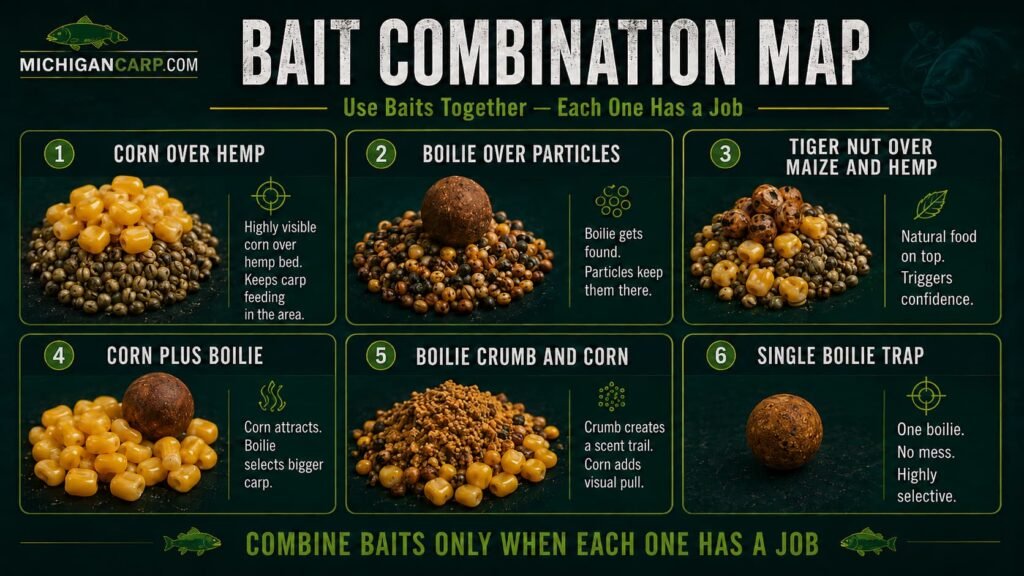
Good Bait Combinations
You do not always have to choose only one.
The best answer is often a simple combination.
Corn Over Hemp
Good for short sessions, spring margins and quick confidence.
Use small amounts.
Boilie Over Particles
Good for longer sessions and more selective fishing.
The particles create activity.
The boilie controls the hookbait.
Tiger Nut Over Maize and Hemp
Good when you want a tough particle hookbait over a browsing mix.
Useful with nuisance fish or turtles.
Corn and Boilie Together
Good when carp accept corn quickly but you want the boilie to stand out.
A small boilie with a grain of corn can be a strong visual hookbait.
Boilie Crumb and Corn
Good for small traps.
Useful when you want attraction without a big feed.
Single Boilie With No Feed
Good when the swim is uncertain, the water is cold or you want to avoid nuisance fish.
Simple is often better.
Beginner Route
For a beginner, the best route is simple.
Start with corn.
Learn:
- where carp feed;
- how to present a bait;
- how little feed is often enough;
- how carp show themselves;
- how nuisance fish behave;
- how to avoid overfeeding.
Then add boilies.
Use boilies when:
- corn is being stripped;
- you need a longer-lasting bait;
- you want more selectivity;
- you want to fish overnight;
- you want to build a repeatable bait.
Then add particles.
Use particles when:
- you can prepare them safely;
- you can bait accurately;
- you understand the session length;
- you have a reason to create a feeding area.
That route builds skill instead of confusion.
Corn first.
Boilies next.
Particles with discipline.
Advanced Route
For a more advanced angler, bait choice becomes a system.
You might use:
- corn to test a swim;
- boilies to control the hookbait;
- particles to build feeding;
- tiger nuts for nuisance control;
- crumb for leakage;
- small top-ups based on signs.
The advanced question is not:
What bait is best?
The advanced question is:
What job does this bait need to do today?
That is the difference between bait collection and bait strategy.
Michigan Public-Water Notes
Michigan public-water carp fishing often rewards practical bait decisions.
Many waters are large, lightly pressured by carp anglers and full of natural food.
That means carp may not need much bait to investigate a spot.
On some waters, corn is enough.
On others, boilies become useful because they stay fishing and create a repeatable food signal.
On longer sessions, prepared particles can help hold fish near a travel route, weed edge, margin or silty feeding area.
The important part is not copying a UK baiting campaign or a social media mix.
The important part is matching the bait to:
- the water;
- the season;
- the session length;
- the nuisance fish;
- the carp activity;
- your ability to bait accurately.
For Michigan, I would rather fish a simple bait in the right place than a complicated bait in guessed water.
Location still beats bait.
Common Mistakes
Asking Which Bait Is Best
The better question is which bait fits the session.
Feeding Too Much Corn
Corn is cheap, so anglers overfeed it.
Using Boilies Without a Plan
Boilies are strongest when used consistently and deliberately.
Using Particles Without Safe Prep
Dry or underprepared particles should not be fished.
Making Every Bait Mix Too Complicated
Three good ingredients used properly beat ten random ingredients used badly.
Ignoring Nuisance Fish
Soft bait may not survive long enough to catch carp.
Using Summer Baiting in Spring
Cold water needs restraint.
Thinking Particles Are Always Better Because They Are Cheap
Cheap bait still needs good preparation and good placement.
Forgetting the Hookbait
Freebait should lead carp to the hookbait, not hide it.
Changing Bait Instead of Moving
Sometimes the bait is fine and the location is wrong.
My Practical View
I do not see boilies, corn and particles as rivals.
I see them as tools.
Corn is the quick question.
Boilies are the controlled answer.
Particles are the feeding-area builder.
For many Michigan sessions, I would start with corn if I needed fast feedback.
I would use boilies when I needed a stronger hookbait or a longer-term food bait.
I would use particles when I had enough confidence in the location to create a feeding area.
The mistake is trying to make one bait do every job.
My rule is:
CHOOSE THE BAIT BY THE JOB, NOT BY HABIT.
That keeps bait simple, practical and effective.
FAQ
Are boilies better than corn for carp?
Boilies are not always better than corn. Boilies are more durable and selective, while corn is often faster, cheaper and easier for carp to accept.
Are particles better than boilies?
Particles are better for creating browsing and feeding activity. Boilies are better when you want a controlled hookbait, stronger durability and a repeatable food bait.
What is the best bait for beginner carp fishing?
Corn is usually the best beginner bait because it is cheap, simple, visible and widely accepted by carp.
When should I use boilies instead of corn?
Use boilies when you need a tougher hookbait, better nuisance resistance, more selectivity, overnight durability or a repeatable baiting approach.
When should I use particles instead of corn?
Use particles when you want carp to browse and stay in an area, especially during longer sessions or warmer conditions.
Can I use boilies over particles?
Yes. A boilie over prepared particles is one of the best combinations because the particles create feeding activity while the boilie controls the hookbait.
Can I use corn with boilies?
Yes. Corn can add quick visual attraction, while boilies provide a stronger and more durable hookbait.
What bait is best in cold water?
Corn, single boilies, small wafters and tiny traps usually suit cold water better than large beds of particles.
What bait is best in warm water?
Corn, boilies and particles can all work in warm water. Particles become more useful when carp are feeding actively and the session is long enough.
What bait is best when turtles are active?
Boilies and tiger nuts are usually better than soft corn when turtles are active.
Should I prebait with corn, boilies or particles?
Boilies and prepared particles are usually better for structured prebaiting. Corn can work, but it is often better for quick response and small baiting amounts.
What is the biggest bait-choice mistake?
The biggest mistake is asking which bait is best instead of asking which bait fits the water, season, session length and feeding situation.
Next Steps
Use these routes next:
- Carp Bait Guide
- Boilie School
- Boilie Basics
- How to Fish Boilies for Carp
- Corn for Carp in Michigan
- Particles for Carp Fishing
- How to Prepare Particles for Carp Fishing
- Tiger Nuts for Carp Fishing
- Spring Particles for Carp
- How to Locate Carp Before You Cast
- Michigan Carp Guide Library