
Tinned sweet corn, prepared maize, corn hookbaits and light baiting strategy
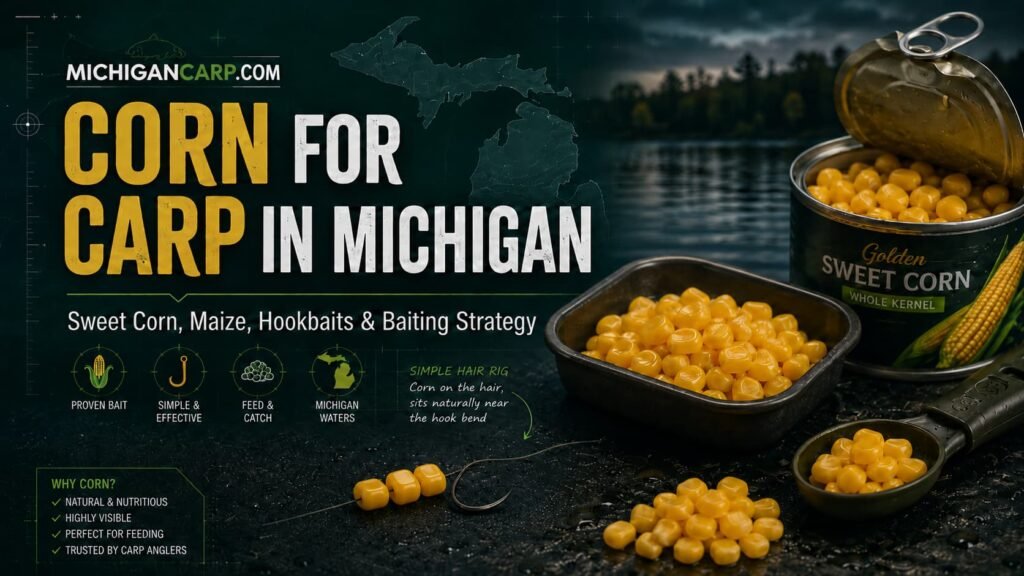
Corn for carp in Michigan is one of the simplest and most useful bait subjects on the whole site.
Corn catches carp.
It is cheap, easy to buy, easy to use, highly visible and quickly accepted by carp on many public waters.
That does not mean corn is always the best bait.
It does not mean you should throw in piles of it.
It does not mean corn will fix poor location, unsafe rigs or bad timing.
But when it is used properly, corn is one of the best starting baits for Michigan carp fishing.
It works for:
- beginners;
- short sessions;
- cold water;
- spring fishing;
- margin fishing;
- simple baiting;
- testing new swims;
- light particle-style fishing;
- quick acceptance around feeding carp.
Corn also teaches one of the most important carp bait lessons:
simple bait is not weak bait.
The key is knowing when corn is the right tool, how much to use, when to switch to tougher hookbaits and how to avoid overfeeding.
For the broad bait route, start with Carp Bait Guide.
For the full particle system, use Particles for Carp Fishing.
For corn compared directly with tiger nuts, read Sweet Corn vs Tiger Nuts for Carp.
My simple corn rule is:
USE CORN WHEN YOU WANT QUICK ACCEPTANCE.
FEED LESS THAN YOU THINK.
WATCH THE RESPONSE.
SWITCH TO TOUGHER BAITS WHEN CORN STOPS FISHING PROPERLY.
That is how corn stays useful instead of becoming lazy bait.
Table of Contents
Quick Start: Corn for Carp in Michigan
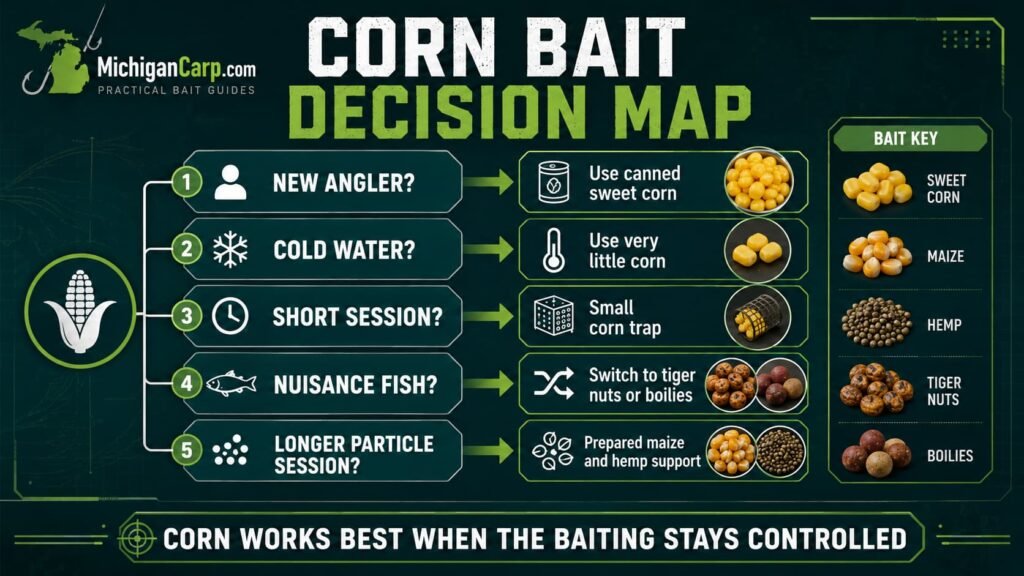
| Situation | Corn Strategy |
|---|---|
| New angler | Use canned sweet corn first |
| Short session | Use a small handful and a corn hookbait |
| Cold water | Use very little corn around the rig |
| Spring fishing | Use corn to test warming margins and shelves |
| Summer fishing | Use corn with pellets, hemp, maize or boilies if fish are active |
| Nuisance fish | Reduce loose corn or switch to tiger nuts / boilies |
| Overnight fishing | Use corn carefully; consider tougher hookbaits |
| Testing a new swim | Start with corn before heavier baiting |
| Margin fishing | Use small amounts and watch for clouding, bubbles and movement |
| Particle fishing | Use corn with hemp, maize or mixed particles |
| Beginner baiting | Keep it tight and simple |
| Targeting better fish | Use corn as support, but consider tiger nuts or boilies as hookbait |
The beginner answer is simple:
open a can of sweet corn, fish two or three grains on the hair, feed lightly and focus on finding carp.
The advanced answer is still simple:
use corn when it solves the bait problem in front of you.
Why Corn Works So Well for Carp
Corn works because it gives carp a simple feeding decision.
It is:
- soft;
- visible;
- edible;
- easy to pick up;
- easy to crush;
- easy to feed lightly;
- easy to match as hookbait and loose feed.
Carp do not need to work hard to deal with it.
That makes corn especially useful when you want one quick chance rather than a major feeding spell.
Corn also has familiarity on its side.
On many public waters, carp have already encountered corn from casual anglers, panfish anglers, catfish anglers, duck-feeding areas, campground banks or general public use.
That does not make corn automatic.
But it often means corn looks less suspicious than a large, unfamiliar specialist bait.
On lightly pressured Michigan waters, a few grains of corn can sometimes be more natural than a big bright boilie sitting alone on a clean spot.
That is why corn remains important.
Not because it is complicated.
Because it is accepted.
Canned Sweet Corn vs Dry Maize
Corn bait usually means one of two things:
- canned sweet corn;
- dry maize / field corn.
They are not the same bait in practical use.
Canned Sweet Corn
Canned sweet corn is the best starting point for most anglers.
It is:
- ready to fish;
- soft;
- bright;
- easy to hair rig;
- easy to feed in small amounts;
- simple to carry;
- useful for quick sessions.
For beginners, canned sweet corn is usually the right first choice.
You can open the can and fish.
No soaking.
No boiling.
No preparation mistake.
Dry Maize
Dry maize is different.
It can be excellent as particle bait, but it must be prepared properly.
Dry maize should be:
- soaked;
- boiled;
- rested;
- cooled;
- stored safely.
Do not throw dry maize into the lake.
Use dry maize only when you understand safe particle preparation.
For the full preparation route, use Particles for Carp Fishing.
Is Corn Beginner Bait?
Corn is beginner-friendly.
That does not mean it is only beginner bait.
There is a difference.
A beginner bait is simple enough to use while learning.
A weak bait is a bait that has limited value.
Corn is not weak.
Experienced carp anglers still use corn because it solves real problems.
Corn is useful when you want:
- quick acceptance;
- visual attraction;
- a soft food item;
- a small trap;
- light baiting;
- a simple hookbait;
- a cheap loose feed;
- a way to test a swim.
The mistake is not using corn.
The mistake is using corn without thought.
Corn as a Hookbait
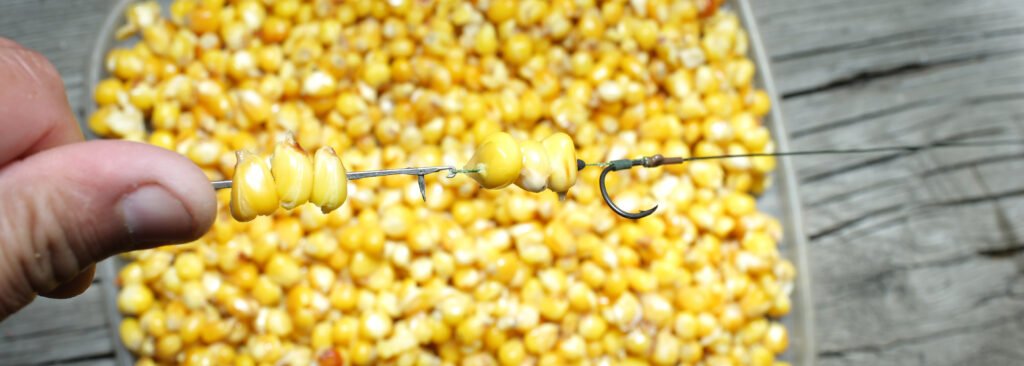
Corn makes an excellent hookbait because carp can pick it up easily.
It can be fished:
- directly on the hook;
- on a hair rig;
- as a stack of two or three grains;
- tipped with artificial corn;
- with foam or buoyant corn;
- with a small boilie;
- with a tiger nut;
- over corn, hemp, maize or mixed particles.
For most serious carp fishing, hair-rigging corn is cleaner than burying the hook inside the bait.
A hair rig leaves the hook exposed and lets the corn behave like a small food item.
One Grain of Corn
Best for:
- cold water;
- cautious feeding;
- small hookbaits;
- clear water;
- light baiting.
Two or Three Grains of Corn
Best for:
- general fishing;
- short sessions;
- beginner setups;
- visible hookbait profile.
Corn With Artificial Corn
Best for:
- added buoyancy;
- nuisance fish;
- longer soak times;
- hookbait durability.
Corn Tipped Tiger Nut
Best for:
- visibility plus toughness;
- nuisance fish;
- longer sessions;
- mixed particle fishing.
Use Sweet Corn vs Tiger Nuts for Carp when deciding whether corn alone is enough.
Corn as Loose Feed
Corn is very useful as loose feed, but it needs restraint.
Because corn is cheap, anglers often feed too much.
That is one of the most common corn mistakes.
A large pile of corn can:
- fill carp;
- attract nuisance fish;
- bring in birds;
- feed turtles;
- spread carp around;
- make the hookbait less important;
- reduce the chance of a quick pickup.
A better approach is controlled feeding.
Think in terms of:
- a few grains;
- a tight handful;
- a small patch;
- a short line of bait;
- a light top-up after evidence.
Corn should help the hookbait get found.
It should not bury the hookbait in free food.
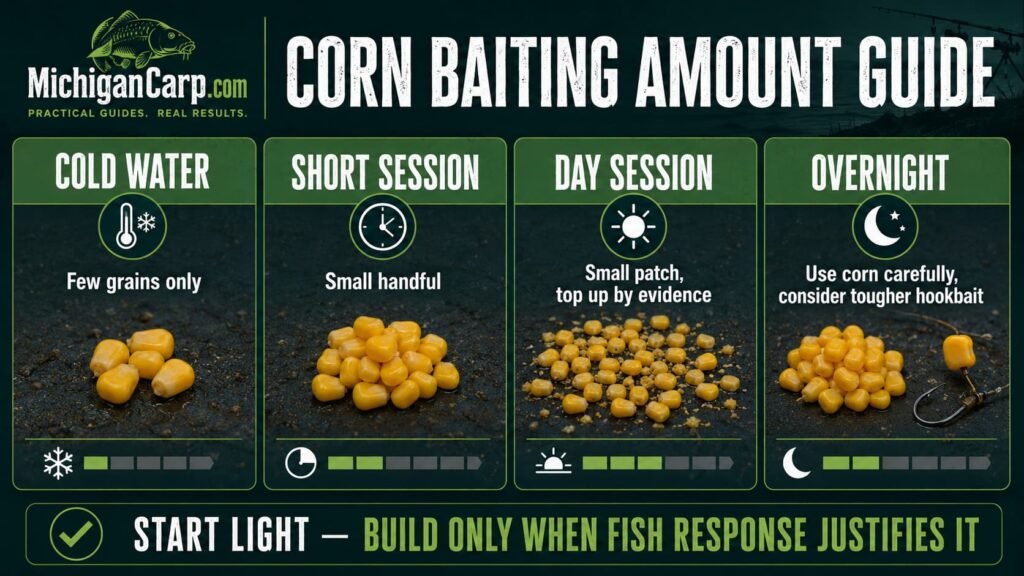
How Much Corn Should You Use?
Use less than you think at first.
The right amount depends on:
- water temperature;
- session length;
- fish activity;
- nuisance fish;
- swim size;
- baiting accuracy;
- whether carp are present;
- whether you are trying to catch one fish or hold a group.
Short Session
Use:
- two or three grains on the hair;
- a few grains to a small handful as feed.
Short sessions do not need a baited carpet.
They need a clean chance.
Day Session
Start with:
- a small handful;
- tight baiting;
- top-ups only after signs or action.
Overnight Session
Corn can still work overnight, but watch durability.
If corn is missing every time you check, use a tougher hookbait such as tiger nut, boilie or artificial corn.
Multi-Day Session
Corn can support a longer baiting plan, but it should usually be part of a wider system with particles, boilies or tougher hookbaits.
Do not turn a multi-day session into uncontrolled corn dumping.
For broader feeding logic, use Baiting Strategy: How Much, How Often and Why.
[IMAGE 3 — CORN BAITING AMOUNT GUIDE HERE]
Corn in Cold Water
Corn is one of the best cold-water carp baits.
Cold-water carp often feed less, move less and respond in shorter windows.
Corn helps because it is:
- small;
- soft;
- visible;
- easy to eat;
- useful in tiny amounts.
In cold water, do not build a big feeding area.
Think in terms of one bite.
A good cold-water corn setup might be:
- one or two grains on the hair;
- five to ten grains around the rig;
- a clean bottom;
- accurate placement;
- very little disturbance.
Corn is especially useful in early spring when carp begin visiting warming areas but are not yet feeding hard.
Good cold-water corn spots include:
- sheltered margins;
- dark-bottomed bays;
- reed edges;
- shallow shelves near deeper water;
- sun-warmed corners;
- soft silt where carp are browsing.
For broader cold-water bait choices, use Best Carp Bait for Cold Water.
Corn in Spring
Spring is one of the best times to use corn.
Early spring is still cautious fishing.
Carp may move before they feed heavily.
That makes corn useful because it allows you to test a swim without overbaiting.
Use corn in spring when:
- carp are showing in shallow water;
- margins are warming;
- wind pushes warmer water into a bank;
- you see bubbles, clouding or movement;
- you want a small, simple trap.
Do not bait like it is summer just because you have seen carp move.
Movement and feeding are not always the same thing.
Start light.
Build only when fish response says to build.
For seasonal context, use Spring Carp Fishing in Michigan and Spring Particles for Carp.
Corn in Summer
Corn still works very well in summer, but its role changes.
Summer carp may feed harder.
That means corn can be used more confidently, especially with:
- pellets;
- hemp;
- maize;
- pigeon feed;
- boilies;
- tiger nuts;
- method or pack-bait approaches;
- small PVA traps where suitable dry support bait is used.
Corn is useful in summer because it gives quick acceptance.
A small amount of corn with pellets or chopped boilie can create a fast trap.
Corn also works well in margins where carp are already browsing.
Look for:
- clouded water;
- fizzing;
- reed movement;
- cruising fish;
- rolling fish;
- shade lines;
- weed-edge feeding.
The weakness in summer is nuisance activity.
Small fish, turtles, birds and crayfish can all become more active.
If corn disappears too quickly, reduce loose feed or switch the hookbait to tiger nuts, boilies or artificial corn.
Use Summer Carp Fishing in Michigan for the seasonal strategy.
Corn in Fall
Fall can be a very good corn season.
Early fall often fishes like late summer.
Carp may still feed confidently, and corn can work well with:
- boilies;
- pellets;
- maize;
- hemp;
- tiger nuts;
- chopped bait.
As water cools, corn becomes useful again because it is easy to eat and does not require heavy feeding.
The key in fall is watching the trend.
Stable mild weather may allow more bait.
Sharp cold drops usually call for less.
Use Fall Carp Fishing in Michigan for seasonal planning.
Corn in Winter
Winter corn fishing should usually be very light.
A few grains may be enough.
In winter, location matters far more than bait quantity.
Good winter corn use looks like:
- one grain or two grains on the hair;
- very few freebies;
- a small clean spot;
- patient timing;
- minimal disturbance.
Do not feed a winter swim like a summer swim.
Use Winter Carp Fishing in Michigan if you fish outside the main season.
Corn With Hemp
Corn and hemp are a strong combination.
Corn gives:
- visibility;
- easy pickup;
- hookbait matching;
- quick acceptance.
Hemp gives:
- small-item browsing;
- grubbing activity;
- longer searching;
- natural feeding behavior.
This combination is useful near:
- weed edges;
- silt;
- reed margins;
- shallow shelves;
- natural feeding areas.
Use hemp carefully.
A little hemp can keep fish searching for a long time.
Too much hemp can make the hookbait less important.
For full particle use, read Particles for Carp Fishing.
Corn With Maize
Corn and maize are related, but they are not the same in use.
Sweet corn is soft and ready to fish.
Maize is harder, larger and needs preparation.
A practical mix might use:
- prepared maize as feed;
- sweet corn as a visible hookbait;
- hemp as a small-particle support;
- tiger nut or boilie when a tougher hookbait is needed.
Corn and maize work best when carp are feeding confidently and the water temperature supports particle fishing.
Do not use dry maize.
Prepare it properly.
Corn With Tiger Nuts
Corn and tiger nuts often work better together than separately.
Corn gives fast acceptance.
Tiger nuts give toughness.
A strong setup is:
- one tiger nut tipped with corn;
- small amount of corn as feed;
- a few chopped tiger nuts;
- light hemp or maize support if needed.
Use this when:
- carp like corn;
- nuisance fish are active;
- the hookbait needs to last longer;
- you want visibility plus control;
- you are fishing over particles.
For the full comparison, use Sweet Corn vs Tiger Nuts for Carp.
For tiger nut preparation, use Tiger Nuts for Carp Fishing.
Corn With Boilies
Corn can support boilie fishing very well.
It can add:
- color;
- quick acceptance;
- small food items;
- visual contrast;
- cheap feed;
- confidence around the hookbait.
Good options include:
- corn around a single boilie;
- corn and chopped boilie;
- corn tipped boilie;
- boilie hookbait over a small corn patch;
- corn, pellet and boilie crumb for short sessions.
Corn can help bridge beginner bait and boilie fishing.
Use Boilie School for the full boilie learning route.
Use How to Fish Boilies for Carp for boilie baiting patterns.
Corn With Pellets
Corn and pellets can make a quick short-session trap.
Corn gives visual food items.
Pellets add faster attraction as they break down.
This can work well in:
- summer;
- day sessions;
- short evening trips;
- method-style traps;
- small PVA bags with dry pellet support;
- swims where carp are already nearby.
Be careful in cold water.
Pellets plus corn can become too much food if fish are not active.
Use small traps first.
Corn in Method Mix and Pack Bait
Corn can work well in method mix or pack bait, especially when used lightly.
Common uses include:
- whole corn in the mix;
- crushed corn;
- creamed corn as a binder;
- corn near the hookbait;
- corn as a visible food item in a small trap.
The mistake is making the trap too large.
A big ball of bait may look attractive to the angler, but it can overfeed the spot or make the hookbait less important.
A smaller, tighter trap is often better.
Use enough bait to create interest.
Do not use so much that the rig becomes an afterthought.
Corn and PVA
Wet canned corn is not normally PVA-friendly because water melts PVA.
Do not put wet corn straight into a PVA bag unless you have tested the exact setup.
Better options include:
- dry pellets;
- crushed boilie;
- dry crumb;
- towel-dried bait tested first;
- PVA-safe liquids;
- small dry stick mixes;
- corn-flavored dry support bait.
For most anglers, corn is better used as loose feed around the rig or as the hookbait, while pellets and crumb handle the PVA work.
Always test PVA before fishing.
Corn in Clear Water
Corn is bright.
That can be good or bad.
In clear water, corn gives a strong visual target.
This can help fish find the bait.
But it can also look obvious if overused.
Clear-water corn strategy should usually be:
- light;
- accurate;
- tight;
- low disturbance;
- matched to visible carp activity.
Use one or two grains rather than a bright pile.
If fish are cautious, use corn tipped with a more subtle hookbait or switch to a smaller presentation.
Corn in Weedy Water
Corn can work very well near weed.
Carp naturally search weed edges for food.
Use corn near:
- clean holes;
- weed edges;
- reed margins;
- thin weed;
- gravel or silt beside weed;
- travel routes through vegetation.
Do not throw corn into unfishable weed and place the rig where it cannot work.
The bait should help carp find the hookbait.
It should not hide the presentation.
For weed and cover strategy, use Weed Beds and Cover if that page is live, or use Reading a Lake Like a Carp Angler as the broader watercraft guide.
Corn on Silt
Corn can be good on clean feeding silt.
Carp often browse silt for natural food.
A few grains of corn can fit that feeding style well.
But presentation matters.
If the rig sinks into soft silt or the hook is masked, bait choice will not save it.
Useful options include:
- balanced corn;
- artificial corn;
- small pop-up corn;
- wafter-style presentation;
- light feeding rather than heavy baiting.
Use corn to create a clear food signal.
Do not bury the rig.
Corn and Nuisance Fish
Corn’s biggest weakness is that many things eat it.
That can include:
- panfish;
- small catfish;
- gobies in some waters;
- turtles;
- birds;
- crayfish.
If corn keeps disappearing, ask:
- is the bait too soft?
- am I feeding too much?
- is the swim full of nuisance species?
- should I use artificial corn?
- should I switch to tiger nuts?
- should I use a boilie?
- should I move the rig?
Do not keep adding corn just because corn is gone.
That may only feed the nuisance problem.
Corn is best when carp are the main fish using it.
When to Stop Using Corn
Corn is not always the right answer.
Switch away from corn when:
- it disappears too quickly;
- nuisance fish dominate;
- the hookbait will not survive;
- you need more selectivity;
- carp are feeding on larger food items;
- you are fishing longer sessions;
- you need a more durable hookbait;
- the bait is filling fish without producing pickups.
Good alternatives include:
- tiger nuts;
- boilies;
- artificial corn;
- maize hookbaits;
- balanced hookbaits;
- wafters;
- small pop-ups.
Use corn until it stops solving the problem.
Then change for a reason.
Simple Corn Setups
Basic Beginner Corn Setup
Use:
- two or three grains of corn on the hair;
- small handful of corn as feed;
- simple safe rig;
- clean bottom.
Best for:
- beginners;
- short sessions;
- public waters;
- spring and cool water.
Cold-Water Corn Trap
Use:
- one or two grains of corn;
- very few freebies;
- accurate placement;
- minimal disturbance.
Best for:
- winter;
- early spring;
- short feeding windows;
- cautious carp.
Corn and Pellet Trap
Use:
- corn hookbait;
- small pellet patch;
- a few grains of corn;
- tight baiting.
Best for:
- summer;
- short sessions;
- quick attraction.
Corn and Hemp Browsing Setup
Use:
- corn hookbait;
- small amount of hemp;
- light corn feed;
- clean spot near weed or silt.
Best for:
- warm water;
- natural feeding areas;
- browsing carp.
Corn-Tipped Tiger Nut
Use:
- one tiger nut;
- one grain of corn or artificial corn;
- small particle support;
- simple hair rig.
Best for:
- nuisance fish;
- longer sessions;
- visual target plus durability.
Best Places to Use Corn in Michigan
Corn works best where carp are already likely to feed.
Good corn spots include:
- sheltered bays;
- warm margins;
- reed edges;
- weed edges;
- shallow shelves;
- silt pockets;
- campground banks;
- quiet park lakes;
- river-connected backwaters;
- channel edges;
- clean spots near cover.
Corn is weaker when used randomly in dead water.
Use watercraft first.
Read:
- How to Locate Carp Before You Cast
- Reading a Lake Like a Carp Angler
- Signs Carp Are Feeding
- Best Depth for Carp Fishing
Find the fish.
Then use corn.
Is Corn Legal for Carp Fishing in Michigan?
Corn is commonly used as bait by anglers, but rules can change by water, access site, park property, method and local regulation.
Before fishing or prebaiting, check the current official rules.
Use:
Michigan Carp Fishing Regulations
and confirm current state rules through the official Michigan DNR Fishing Regulations.
Pay special attention when fishing:
- parks;
- campgrounds;
- managed waters;
- public access sites;
- waters with special rules;
- places where prebaiting or chumming may be restricted.
Do not rely on old advice.
Check the current rules before the trip.
Corn Storage and Bank Use
Canned corn is easy, but it still needs common sense.
On the bank:
- keep unused corn clean;
- do not leave it baking in direct sun all day;
- avoid dirty bait tubs;
- do not mix old sour corn with fresh bait unless you intended that treatment;
- take leftover cans and trash home;
- do not dump unused bait at the access site.
For longer sessions, keep corn cool where possible.
If bait smells rotten, looks wrong or seems unsafe, do not use it.
For broader bait storage and prep, use The Bait Shed.
Common Corn Mistakes
Feeding Too Much
Corn is cheap, but overfeeding still ruins fishing.
Thinking Corn Is Only Beginner Bait
Corn is simple, not weak.
Using Corn Before Finding Carp
Location comes first.
Ignoring Nuisance Fish
If corn disappears constantly, change the plan.
Fishing Corn on a Poor Rig
A good bait on a bad rig is still a bad presentation.
Using Wet Corn in PVA Without Testing
Wet corn can melt PVA.
Test first.
Baiting Like It Is Summer in Cold Water
Cold water needs very small amounts.
Not Switching When Corn Stops Working
Use tiger nuts, boilies or artificial corn when durability is needed.
Dumping Leftover Corn
Keep banks clean.
Do not leave bait mess behind.
Changing Everything After One Blank
A quiet session may be location, timing, weather or presentation.
Do not blame corn too quickly.
Michigan Notes
Corn for carp in Michigan works because it fits the way many anglers actually fish here.
Michigan has plenty of public waters where carp are not conditioned to complex specialist bait.
A few grains of corn in the right place can be more effective than an overcomplicated bait used badly.
Corn is especially useful for:
- quick public-water sessions;
- spring scouting;
- short evening trips;
- new swims;
- cold-water bites;
- margin fishing;
- simple particle support;
- testing whether carp are present.
But Michigan waters also punish lazy baiting.
Many are:
- large;
- weedy;
- natural-food rich;
- affected by boat traffic;
- shared with other users;
- full of nuisance species at times.
That means corn should be used with watercraft.
Do not throw it everywhere.
Use it where carp already want to be.
My Practical View
I still trust corn because it gives information.
If corn gets picked up quickly, it tells me carp are willing to feed.
If corn is untouched, I may be in the wrong place or the wrong window.
If corn keeps disappearing but I am not catching carp, nuisance fish may be the problem.
If corn gets bites but will not stay on long enough, tiger nuts, boilies or artificial corn may be the next step.
That is the value of corn.
It is not just bait.
It is feedback.
My rule is:
CORN IS THE SIMPLEST WAY TO ASK THE WATER A QUESTION.
If the water answers, build carefully.
If it does not, do not panic.
Think location first.
Then presentation.
Then bait.
FAQ
Is corn good for carp in Michigan?
Yes. Corn is one of the most useful carp baits in Michigan because it is simple, visible, cheap, easy to use and quickly accepted by carp on many waters.
Is canned sweet corn ready to use for carp?
Yes. Canned sweet corn is ready to use straight from the can.
Can I use dry maize instead of canned corn?
Yes, but dry maize must be soaked, boiled and rested properly before fishing. Do not use dry maize straight from the bag.
How much corn should I use for carp?
Start with less than you think. For short sessions or cold water, a few grains to a small handful is often enough.
Is corn good in cold water?
Yes. Corn is one of the better cold-water carp baits because it is small, soft and easy to eat.
Is corn good in summer?
Yes. Corn works well in summer, especially with pellets, hemp, maize, particles or boilies. Watch for nuisance fish and overfeeding.
Is corn only a beginner bait?
No. Corn is beginner-friendly, but it remains useful for experienced anglers when the situation calls for quick acceptance and simple baiting.
Should I hair rig corn?
For serious carp fishing, hair-rigging corn is usually better than burying the hook inside the bait.
How many grains of corn should I put on a hair rig?
One to three grains is a practical starting range. Use fewer in cold water and more when fish are feeding confidently.
Can I use corn with tiger nuts?
Yes. Corn and tiger nuts work very well together. Corn gives visibility and acceptance, while tiger nuts add toughness and durability.
Can I use corn with boilies?
Yes. Corn can support boilie fishing by adding visual attraction and quick acceptance around the hookbait.
Can I use corn in PVA bags?
Wet canned corn usually is not PVA-friendly. Test first or use dry pellets, crumb, crushed boilies or PVA-safe materials instead.
What should I do if nuisance fish keep stealing corn?
Use less loose corn, try artificial corn, switch to tiger nuts or boilies, or move away from nuisance-heavy areas.
Is corn better than tiger nuts?
Not always. Corn is better for quick acceptance and simplicity. Tiger nuts are better for toughness, durability and selectivity.
What is the biggest corn mistake?
Feeding too much before you know carp are present and feeding.
Next Steps
Use these routes next:
- Carp Bait Guide
- Particles for Carp Fishing
- Sweet Corn vs Tiger Nuts for Carp
- Tiger Nuts for Carp Fishing
- Spring Particles for Carp
- Best Carp Bait for Cold Water
- Baiting Strategy: How Much, How Often and Why
- How to Locate Carp Before You Cast
- Michigan Carp Guide Library