

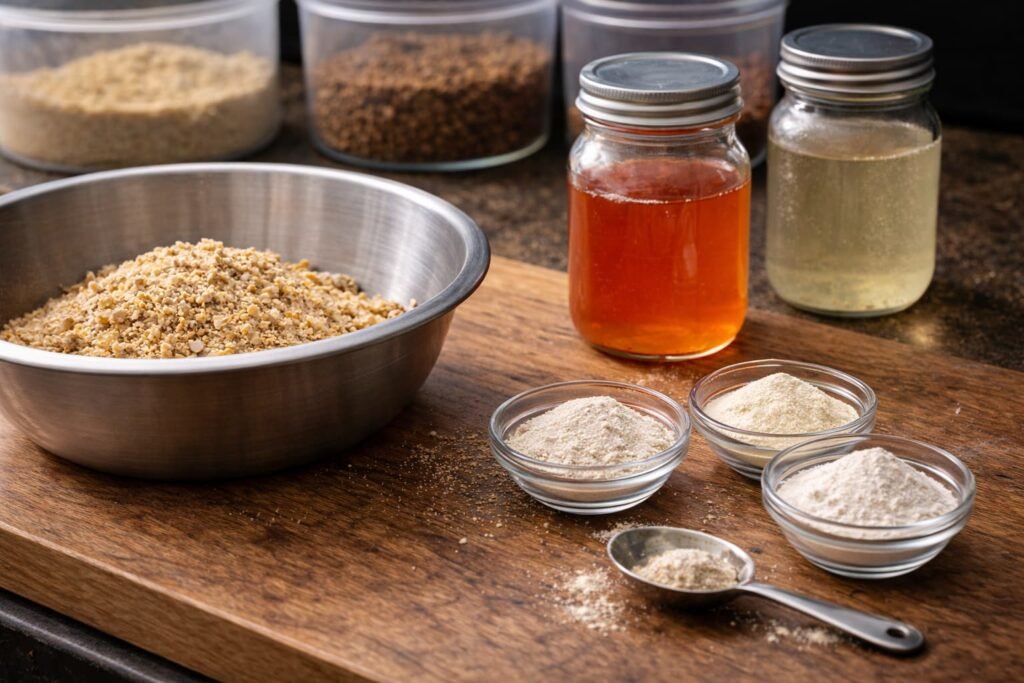
How pH Changes Carp Bait Performance
How pH changes carp bait performance is a useful subject, but it is also easy to exaggerate. Some anglers treat acidity and alkalinity as a secret attraction code. Others ignore pH completely.
Neither approach is particularly useful.
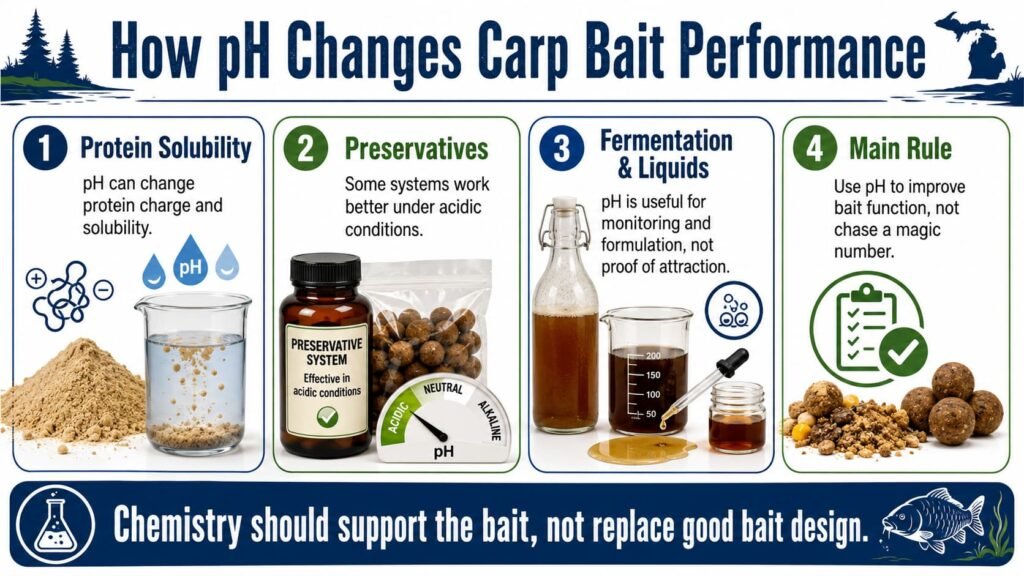
pH can affect protein solubility, preservative performance, fermentation, liquid stability, ingredient behaviour, and the way some parts of a bait package interact with water.
What pH does not do is turn a poor bait into a good one. There is no simple rule that says acidic bait catches carp and alkaline bait does not, or vice versa.
The better way to use pH is as part of wider bait design. Think about the ingredients being used, their solubility, the preservative system, the bait form, the water temperature, and what you actually want the bait to do.
This guide works alongside Salt, Acids and Mineral Signals in Carp Bait, The Science of Minerals, Salts and pH in Carp Bait, Why Some Carp Baits Leak Faster Than Others, and the main Bait Science hub.
Quick Answer
pH matters because it can change how bait ingredients behave, but pH alone is not an attraction strategy.
In practical carp bait, pH can affect:
- protein solubility
- ingredient charge and interaction
- preservative effectiveness
- fermentation behaviour
- liquid stability
- some aspects of bait breakdown and leakage
The best rule is:
Use pH to help the bait perform its intended job. Do not chase extreme acidity or alkalinity simply because it sounds scientific.
What pH Actually Means
pH describes how acidic or basic an aqueous solution is.
The simple practical scale is:
- below pH 7: acidic
- around pH 7: neutral
- above pH 7: basic or alkaline
The pH scale is logarithmic. A change of one whole pH unit represents a tenfold change in hydrogen-ion activity.
That is important because moving from pH 7 to pH 6 is not a tiny chemical shift in the way moving from 70°F to 69°F is a small temperature change.
At the same time, carp bait is a complex food matrix. A boilie contains solids, proteins, carbohydrates, fats, minerals, water, and other ingredients. Measuring the pH of a bait slurry can be useful, but it does not tell you everything about how the whole bait will behave underwater.
Bait pH Is Not a Magic Attraction Number
This is the most important point in the article.
There is no universal ideal pH number for carp bait.
A milk-protein bait, a fermented corn liquid, a fishmeal boilie, a fruit-acid hookbait, and a particle mix are very different systems. Trying to force all of them toward one supposed perfect pH makes little sense.
The better questions are:
- What ingredients are in the bait?
- How soluble are they?
- Does the bait need preservation?
- Is fermentation part of the system?
- Is this a short-session hookbait or bulk free bait?
- Is the bait too hard and slow to hydrate?
- Is the acid or alkaline ingredient actually improving anything?
pH is one variable inside the system. It is not the system.
How pH Affects Protein Solubility
Protein solubility is one of the clearest reasons pH matters in bait science.
Proteins carry electrical charges that change with pH. Each protein has a pH region where its net charge approaches zero. This is commonly called its isoelectric point.
Near that region, many proteins become less soluble and are more likely to aggregate or precipitate. Move the pH away from that region and solubility can improve.
That basic principle matters when working with:
- casein
- caseinates
- whey proteins
- fish proteins
- soy proteins
- pea and other vegetable proteins
- protein hydrolysates
However, do not turn this into the idea that adding acid automatically makes every protein bait more soluble.
The finished result depends on:
- which proteins are present
- the actual pH reached
- heat treatment
- salts and minerals
- the amount of water available
- bait structure
- drying time
- the presence of fats and carbohydrates
For milk-protein bait building, read Casein, Caseinate, WPC and Skimmed Milk Powder.
pH and Bait Leakage Are Related, but Not Identical
Anglers sometimes assume that lowering pH automatically creates faster leakage.
That is too simple.
Bait leakage is controlled by several interacting factors:
- ingredient solubility
- bait porosity
- particle size
- surface area
- boiling or steaming
- drying time
- outer skin hardness
- water temperature
- liquid treatment
- pH-dependent ingredient behaviour
pH may influence the solubility and behaviour of some ingredients, but it cannot overcome a badly designed physical structure.
A heavily boiled, tightly bound, extensively dried bait can still be slow even if its liquid package contains acid.
For the wider practical guide, read Why Some Carp Baits Leak Faster Than Others.
Acidity Is Not the Same as Attraction
This distinction needs to be clear.
An acidic bait is not automatically an attractive bait.
Acid ingredients can be useful because they may:
- lower the pH of a liquid system
- support certain preservative systems
- change the taste profile
- interact with proteins and minerals
- fit fruit, fermented, sour, or food-derived bait profiles
Those are legitimate bait-making roles.
What is much harder to justify is the idea that carp simply sense a low-pH halo and are automatically pulled toward it.
The practical bait maker should focus on the food package and how the acid supports it.
Citric Acid in Carp Bait
Citric acid is popular because it is easy to obtain, easy to measure, and useful in several kinds of bait system.
It can be used to:
- acidify a liquid mixture
- support some preservation strategies
- adjust a sour or fruit-style profile
- support controlled hookbait treatments
- adjust selected fermented or food-liquid systems
The important word is controlled.
Adding more citric acid does not necessarily produce more attraction.
Too much acid can:
- make a bait harsh
- change taste more than intended
- alter protein behaviour
- interfere with the original bait identity
- make interpretation of test results difficult
Use citric acid because it is doing a specific job, not because a low pH number looks impressive.
Citric Acid vs Fermented Acidity
Citric acid and a fermented bait liquid should not be treated as identical simply because both may be acidic.
A simple citric-acid solution mainly gives you an acidifying ingredient and a particular taste contribution.
A fermented liquid can contain a much broader mixture of:
- organic acids
- grain-derived material
- yeast-related compounds
- soluble food fractions
- fermentation by-products
That is why two liquids with similar measured pH can still be very different bait ingredients.
For the fermentation side, read What Fermented Bait Liquids Really Do and Fermented and Food-Signal Baits for Carp.
pH and Preservatives
Preservation is one of the most practical reasons for bait makers to understand pH.
Some common food preservatives perform better under acidic conditions because their antimicrobial activity depends partly on chemical form and pH.
This is relevant when working with ingredients such as:
- potassium sorbate
- sodium benzoate
- acid-supported liquid foods
- shelf-life hookbait treatments
This does not mean that lowering the pH automatically creates a safe shelf-life bait.
Shelf stability also depends on:
- water activity
- hygiene
- ingredient quality
- preservative concentration
- packaging
- storage temperature
- contamination after production
Acidification is one tool in preservation. It is not a replacement for proper formulation and handling.
For the wider subject, read Carp Bait Preservatives: What They Really Do.
pH and Fermentation
Fermentation and pH are closely connected, but again, the relationship is more complicated than simply saying lower pH is better.
During controlled fermentation, microbial activity can produce organic acids and other metabolites. The pH may fall as the process develops.
That can be useful as one indicator of change, but smell, handling, starting material, time, temperature, and hygiene still matter.
A lower pH number does not prove that a homemade bait liquid is:
- safe
- stable
- attractive
- properly fermented
Controlled fermentation is useful. Rotten bait is not.
pH and Hydrolysates
Hydrolysates bring another layer to the subject because they contain proteins that have already been broken into smaller fractions.
Depending on the product, a hydrolysate may contain mixtures of:
- larger peptides
- smaller peptides
- free amino acids
- salts
- other soluble food compounds
pH can affect the charge and behaviour of these components in solution, but that does not mean you need to manipulate every hydrolysate aggressively.
Usually the better question is whether the product already fits the bait.
Read Hydrolysates in Carp Bait and Proteins, Peptides and Hydrolysates in Carp Bait for the deeper protein discussion.
pH and Free Amino Acids
Free amino acids can change ionic form as pH changes.
That is basic chemistry, but the bait conclusion should be kept sensible.
You do not need to calculate the exact charge state of every amino acid before making boilies.
The practical lessons are:
- free amino acids behave differently at different pH values
- a complex bait matrix affects the final environment
- highly soluble ingredients still need a bait structure that lets them escape
- chemical detectability does not automatically equal feeding success
For the direct amino-acid discussion, read Do Carp Detect Free Amino Acids the Way Anglers Think? For the wider feeding-response sequence, continue with Carp Feeding Attractants Explained.
pH and Milk-Protein Baits
Milk-protein baits are one of the best examples of why pH needs to be considered alongside ingredient choice.
Casein, caseinate, whey protein, milk powder, and hydrolysed dairy proteins do not all behave the same way.
The finished bait may be affected by:
- protein type
- protein concentration
- liquid acidity
- mineral content
- egg level
- heat treatment
- drying time
A milk bait should not be acidified blindly in an attempt to increase leakage.
Often, bait structure, crumb use, liquid coating, drying time, and choosing the right milk ingredients are better first adjustments.
Acidic Baits vs Alkaline Baits
Neither acidic nor alkaline bait is automatically superior.
| Direction | Possible Practical Role | Main Risk |
|---|---|---|
| Acidic support | Preservation, sour profile, selected liquid systems, protein interaction | Assuming lower pH always means better attraction |
| Near-neutral system | Simple balanced bait with minimal manipulation | Assuming neutral means inactive |
| Alkaline support | Selected ingredient-processing or formulation roles | Using alkalinity as a gimmick or pushing pH too far |
The correct direction depends on the ingredient system and the purpose of the bait.
Can Carp Detect a pH Difference?
This is where bait discussion often runs ahead of evidence.
Carp have well-developed chemical senses and can respond to dissolved food-related compounds. But that does not justify claiming that an acidic or alkaline bait automatically creates a special pH-trigger response.
A pH-adjusted bait may behave differently because:
- some proteins become more or less soluble
- preservatives work differently
- taste changes
- fermentation products differ
- soluble materials interact differently
Those are enough reasons to study pH without inventing a universal pH attraction theory.
Lake Water pH Is Not Constant
The water surrounding the bait is not chemically identical everywhere or at every time.
Water pH can vary with:
- geology
- alkalinity and buffering capacity
- organic matter
- groundwater influence
- aquatic plant growth
- algal activity
- photosynthesis
- respiration
- depth and water movement
In productive weedy areas, daytime photosynthesis can consume carbon dioxide and contribute to rising pH. Overnight respiration can add carbon dioxide back and lower pH again.
This does not mean anglers need to carry a laboratory around the lake.
It means that the idea of one permanent lake pH number can be misleading.
Bait pH vs Lake pH
A useful distinction is the difference between the pH of the bait and the pH of the lake.
A small bait cannot realistically change the pH of a whole lake or large swim.
Any chemical difference created by a dissolving bait is likely to be local and temporary, especially in moving water, windy conditions, or large volumes of lake water.
That is why I would not build a bait strategy around creating a giant acidic or alkaline cloud.
Instead, focus on:
- ingredient behaviour
- bait solubility
- food-signal leakage
- bait texture
- preservation
- how quickly the hookbait and surrounding feed begin working
Cold Water vs Warm Water
pH remains chemically relevant in both cold and warm water, but the baiting strategy changes.
| Condition | Best pH-Related Thinking | Main Risk |
|---|---|---|
| Cold water | Focus on solubility, crumb, light liquids, and small active traps | Believing more acid can compensate for too much feed |
| Cool spring water | Controlled fermented liquids, hydrolysates, crumb, and moderate acid support | Making the bait too complicated |
| Warm water | Food value, particles, pellets, boilies, and stable liquid systems | Spoilage and uncontrolled fermentation |
| Very warm water | Prioritize oxygen, fish location, bait freshness, and controlled feed | Focusing on chemistry while ignoring watercraft |
In cold water, the priority is usually making a small amount of bait communicate effectively.
That may involve soluble food ingredients, crumb, light hydrolysate use, yeast extract, or a controlled fermented liquid. It does not require pushing bait toward an extreme pH.
pH Testing for Home Bait Makers
You do not need a laboratory to use basic pH testing sensibly.
Useful tools include:
- wide-range pH strips for rough screening
- a calibrated digital pH meter for more consistent liquid testing
- simple batch records
The most useful testing is comparative.
For example:
- record the pH of a liquid before fermentation
- measure it again during the process
- compare two preservative systems
- compare untreated and acidified hookbait liquids
- record what changes in texture, smell, stability, and bait behaviour
Do not measure pH just to collect numbers. Measure it when the result helps answer a bait-making question.
How to Test the pH of a Boilie
A dry boilie does not have a simple pH in the same way that a bottle of liquid does.
For a practical comparison between batches, you can create a consistent bait slurry:
- Crush or grind the bait sample.
- Use the same weight of bait for every test.
- Add the same volume and type of water.
- Mix thoroughly.
- Allow the same resting time for each batch.
- Measure with the same calibrated meter or test method.
This gives you a comparative test rather than pretending there is one perfect absolute bait-pH number.
Michigan Notes
Michigan is exactly the sort of place where simple pH claims become unreliable.
We fish a wide range of waters:
- clear hard-water lakes
- marl-bottom lakes
- weedy shallow systems
- dark stained northern lakes
- river systems
- impoundments
- Great Lakes-connected waters
The chemistry and buffering of these waters can differ considerably.
For practical Michigan carp fishing, I would use pH thinking in four main areas:
1. Preserved bait
If you are making shelf-life hookbaits or preserved liquids, pH becomes a genuine formulation issue rather than an attraction theory.
2. Fermented liquids
Tracking pH can be useful as one part of monitoring a controlled fermentation process.
3. Protein-heavy boilies
Understanding that protein behaviour changes with pH can help explain why some mixes become dense, aggregate badly, or behave differently after liquid changes.
4. Comparing waters
Do not assume a bait behaves identically in every Michigan lake. Water chemistry, temperature, movement, and bait structure all influence what happens after the bait enters the water.
Practical Bait Systems
Cold-water small trap
- durable hookbait
- small amount of active crumb
- light yeast or hydrolysate support
- controlled acidic support only if it fits the bait
- minimal loose feed
Fermented particle system
- safely prepared particles
- controlled CSL-style or fermented grain liquid
- pH monitoring if you are evaluating fermentation progress
- boilie, tiger nut, maize, or balanced hookbait
Milk and nut boilie system
- balanced milk, nut, cereal, and birdfood structure
- correct milk-protein choices
- moderate savoury or fermented support
- acid adjustment only where it performs a real formulation job
- crumb and chops for leakage before simply increasing acid level
Shelf-life hookbait system
- controlled water content
- clean production
- appropriate preservative system
- pH support where required by the preservative strategy
- small test batches before scaling up
Common Mistakes
Chasing an ideal pH number
There is no single perfect pH for every carp bait.
Assuming acidity equals attraction
Acid ingredients can have useful formulation roles, but lower pH does not automatically mean more bites.
Using acid to fix poor bait structure
A closed, hard, heavily dried bait usually needs a structure and leakage review before it needs more chemistry.
Ignoring preservation chemistry
pH genuinely matters in some preservative systems. This is one of the areas where guessing makes little sense.
Confusing pH with total food signal
Two liquids with the same pH can have completely different compositions and bait value.
Assuming lake pH never changes
pH can vary through the day and between areas, especially in biologically active waters.
Making too many changes at once
If you change acid level, hydrolysate level, flavour, sweetener, and preservative together, you learn very little from the result.
Simple Rules for Using pH in Carp Bait
- Use pH as a formulation tool, not a magic attraction number.
- Remember that protein type matters.
- Do not confuse acidity with food signal.
- Use acids for a defined purpose.
- Respect preservative chemistry.
- Test fermented liquids rather than guessing.
- Fix bait structure before chasing chemistry.
- Compare batches consistently.
- Expect different waters to behave differently.
Final Verdict
pH matters in carp bait, but not because there is a secret acidic or alkaline number that unlocks feeding.
Its real importance is more practical.
pH can influence protein solubility, ingredient behaviour, preservative performance, fermentation, and the chemistry of bait liquids. It can help explain why changing one part of a recipe sometimes changes far more than taste or smell.
But pH remains only one part of the bait system.
A good bait still needs sensible ingredients, digestibility, appropriate food value, useful leakage, good texture, correct preservation, and a presentation that fishes properly.
For Michigan carp fishing, use pH thinking to make better bait decisions. Do not let it become another complicated theory that distracts from finding the carp and presenting good bait in the right place.
FAQ
Does pH matter in carp bait?
Yes. pH can influence protein solubility, preservative performance, fermentation, and the behaviour of some bait ingredients and liquids. It is a formulation factor, not a magic feeding trigger.
Is acidic bait better for carp?
Not automatically. Acidic ingredients can be useful for preservation, fermentation-related systems, taste, and selected ingredient interactions, but lower pH does not automatically mean greater attraction.
Does citric acid improve carp bait?
It can when it has a clear job, such as acidifying a liquid, supporting a preservative strategy, or fitting a fruit or sour bait profile. More citric acid is not automatically better.
Can pH change protein solubility?
Yes. Protein charge and solubility can change with pH, and many proteins are least soluble around their isoelectric region.
Does pH affect potassium sorbate and sodium benzoate?
Yes. Their antimicrobial performance is pH-dependent, which is why acidification can be part of a properly designed preservation system.
Does lake pH change during the day?
It can. Photosynthesis, respiration, carbon dioxide, buffering, biological activity, and water movement can all contribute to variation.
Should I measure the pH of homemade fermented liquids?
It can be useful as one part of batch monitoring, especially when comparing changes over time. pH alone does not prove that a liquid is safe or attractive.
What is the best pH for carp bait?
There is no universal best pH for every carp bait. The correct approach depends on ingredient type, bait purpose, preservation needs, and the complete bait system.
Next Articles
Read these next to go deeper into pH, acids, minerals, leakage, preservation, and ingredient behaviour:
- Salt, Acids and Mineral Signals in Carp Bait
- The Science of Minerals, Salts and pH in Carp Bait
- Why Some Carp Baits Leak Faster Than Others
- Carp Bait Preservatives: What They Really Do
- What Fermented Bait Liquids Really Do
- Fermented and Food-Signal Baits for Carp
- Hydrolysates in Carp Bait
- Proteins, Peptides and Hydrolysates in Carp Bait
- Casein, Caseinate, WPC and Skimmed Milk Powder
- Enzymes in Carp Bait: Phytase and Pre-Digestion Explained
- Raw vs Processed Ingredients in Carp Bait
- Bait Science