

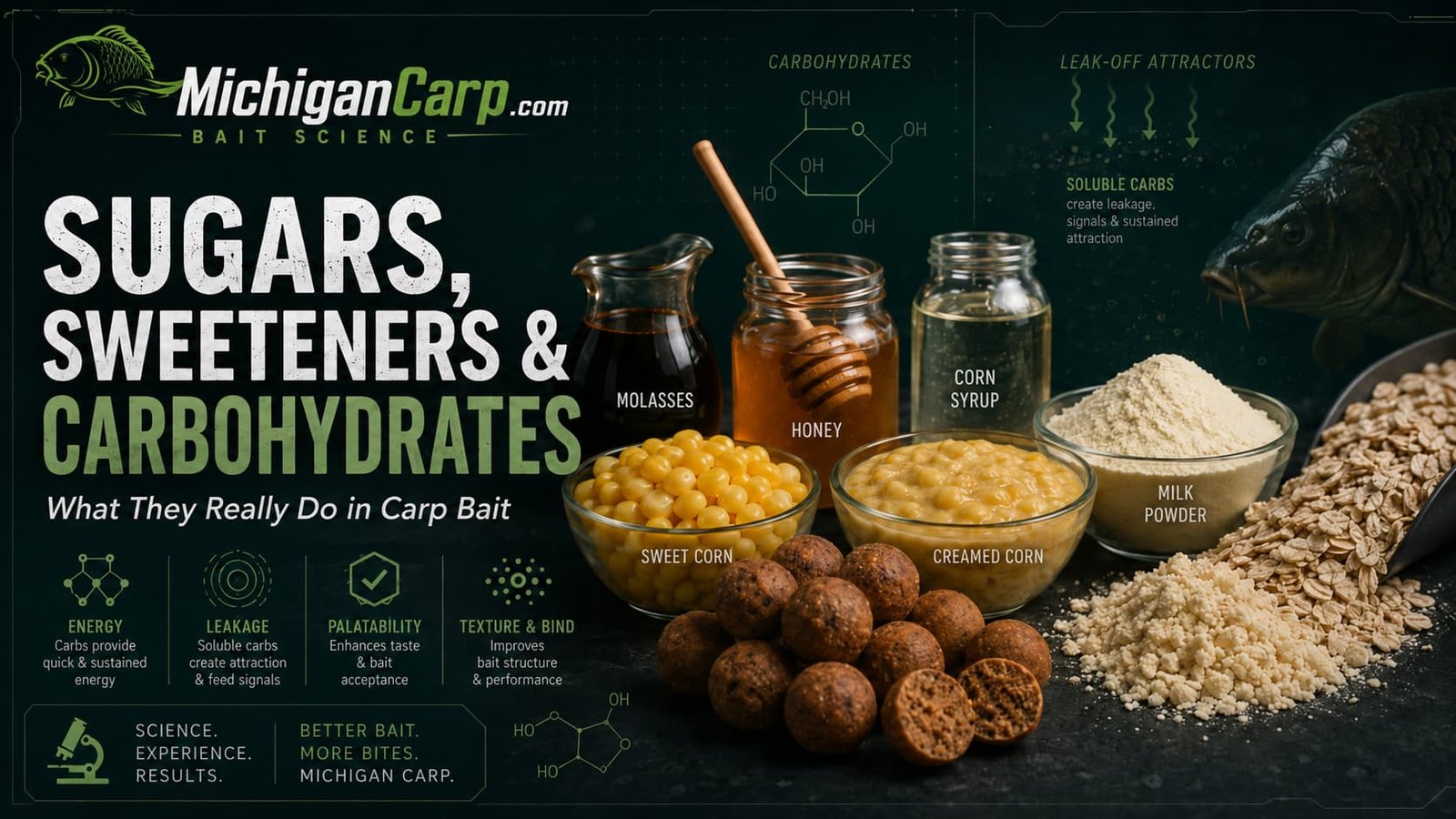
Sugars, sweeteners and carbohydrates in carp bait are often misunderstood because anglers mix three different ideas into one simple word: sweet.
Sugars, sweeteners and carbohydrates in carp bait should be judged by their bait job, not by human sweetness alone.
That creates two bad extremes. One angler treats sweet bait as if carp are chasing dessert. Another dismisses sweetness completely because it sounds like human thinking. Neither view is useful enough for serious bait making.
The truth is more practical. Sugars, sweeteners and carbohydrates can all matter in carp bait, but they do not all do the same job. Some dissolve and leak. Some bind packbait. Some help fermentation. Some affect rolling, texture and finished-bait hardness. Some contribute energy. Some simply round a flavor profile at a tiny dose.
Sweetness by itself does not make bait good. A sweet bait in the wrong place is still in the wrong place. A sticky bait that does not break down properly is still badly designed. A sweetener that tastes strong to humans may not create the same feeding response in carp.
The better question is not, “Do carp like sweet bait?”
The better question is:
What is this sugar, sweetener or carbohydrate actually doing inside the bait system?
For boilie-specific sweetener use, read Sweeteners for Boilies. For packbait mechanics, read Packbait for Carp Fishing. For the wider bait-prep route, use The Bait Shed.
Table of Contents
Quick Answer: Sugars, Sweeteners and Carbohydrates in Carp Bait
Sugars, sweeteners and carbohydrates can help carp bait when they are used for a clear job. They may improve leakage, binding, fermentation, texture, bait identity, hookbait taste or food value. But sweetness alone should not be treated as a magic feeding trigger.
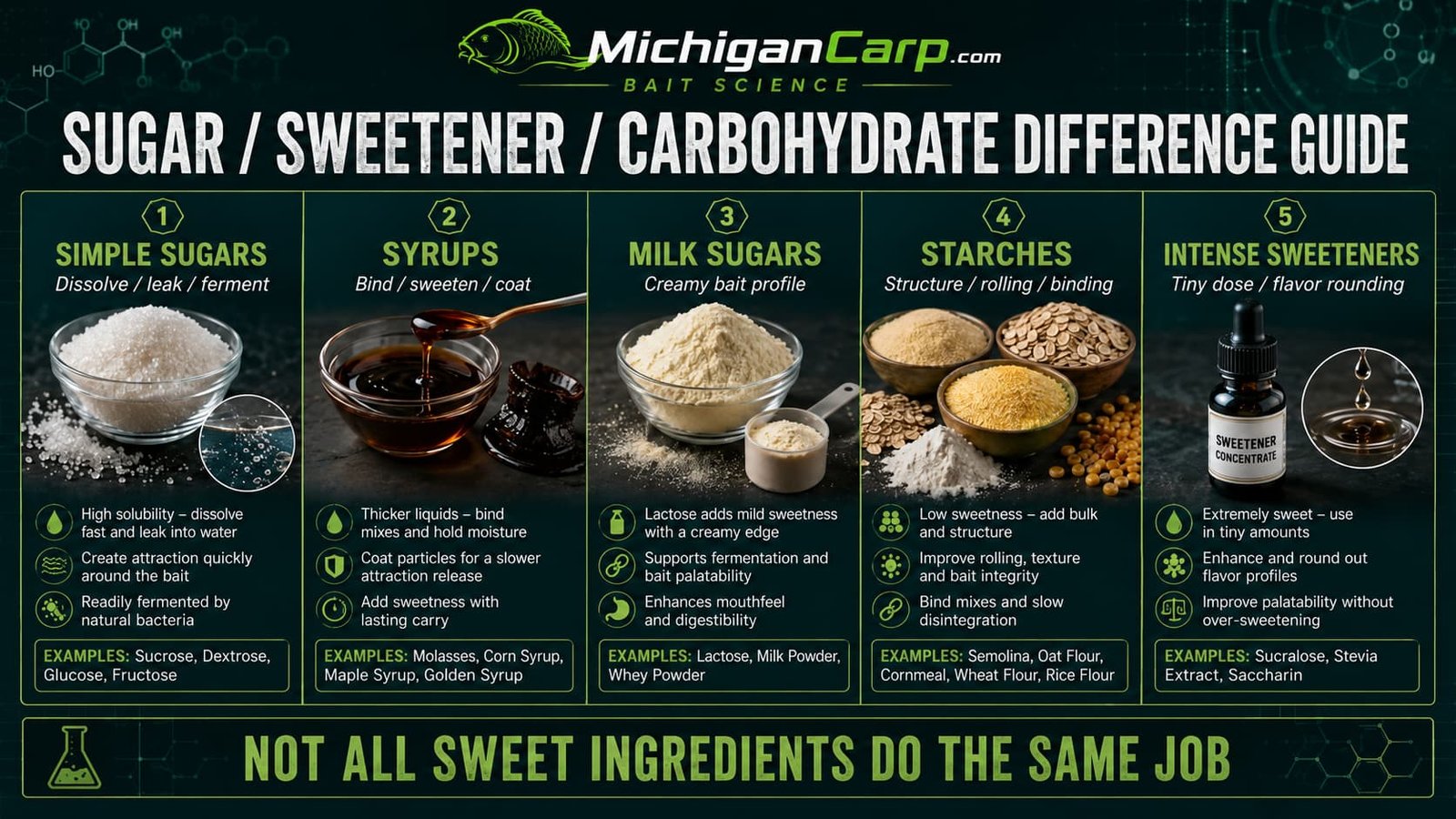
| Term | Examples | Main bait job |
|---|---|---|
| Sugar | Sucrose, glucose, fructose, lactose | Solubility, sweetness, fermentation support, some energy value |
| Sweetener | Bait sweeteners, Betalin-style products, stevia-style products | Taste rounding at low dose |
| Syrup | Molasses, honey, corn syrup | Binding, leakage, sweetness, texture and liquid character |
| Carbohydrate | Semolina, maize meal, oats, panko, flour, starches | Structure, rolling, binding, energy and bait mechanics |
| Sweet food bait | Sweet corn, creamed corn, fruit, tiger nut liquor | Bait identity, familiarity, feed value and practical use |
The key distinction is simple:
Sugar is not the same as sweetener. Sweetness is not the same as nutrition. Carbohydrate is not the same as sweet taste.
Once those ideas are separated, bait decisions become much cleaner.
Sugar, Sweetener and Carbohydrate Are Not the Same
Anglers often say “sweet” when they really mean several different things. That is where the confusion begins.
A sugar is usually a soluble carbohydrate such as sucrose, glucose or fructose. It may bring sweetness, solubility, fermentability and some energy value. Table sugar, honey sugars, molasses sugars, corn syrup and lactose from milk ingredients all sit somewhere in this broad area, but they do not behave identically in bait.
A sweetener is normally used mainly for perceived sweetness. Strong bait sweeteners can be used at very low levels. They may round a flavor or soften bitterness, but they usually contribute very little bulk nutrition because the dose is tiny. The FDA treats high-intensity sweeteners as a separate category from ordinary sugars in food use, which supports the practical bait-making distinction between bulk sugars and low-dose sweetening agents. See the FDA guide to high-intensity sweeteners.
A carbohydrate is the bigger category. Many important bait ingredients are carbohydrate-heavy without being especially sweet. Semolina, maize meal, oats, panko, breadcrumb, wheat flour, cornmeal and many birdfoods are not used because they taste like sugar. They are used because they help the bait roll, bind, cook, break down, carry food value or create a usable structure.
That difference matters. If you call everything “sweet,” you miss the real reason the ingredient is in the mix.
What Carp Science Actually Suggests
Carp can respond strongly to chemical cues, but carp taste is not just a copy of human taste. That is why the phrase “carp like sweet bait” is too blunt.
Research on carp taste responses has shown that sucrose can produce relatively small responses compared with some salts, acids and extracts, while amino acids and other compounds may produce stronger or different responses depending on the test. See the PubMed abstract for Taste Response in the Facial Nerve of the Carp.
This does not mean sweet ingredients are useless. It means the reason they work is not always simple sweetness. A sweet ingredient may help because it leaks, binds, ferments, softens a profile, improves texture, supports a familiar bait identity or makes a hookbait more acceptable at short range.
The correct bait-making conclusion is careful:
Sweet ingredients can help bait performance, but human sweetness should not be treated as proof of carp attraction.
For the wider feeding-response chain, read Carp Feeding Attractants Explained.
Carbohydrates as Food and Structure
Carbohydrates are important in carp bait because carp can use carbohydrate-rich foods and because many bait forms depend on carbohydrate ingredients for structure.
FAO material on fish digestive physiology notes that common carp do not possess a true stomach and that carbohydrate-digesting enzymes such as maltase and amylase occur at high levels in the intestine of common carp. See the FAO section on digestive physiology in fish.
That matters because carp anglers commonly use cooked maize, sweet corn, oats, panko, cereals, semolina, maize meal, pigeon feed, tiger nuts and other carbohydrate-rich ingredients. These foods do not need to act like a sugar trigger to be useful. They may be useful because carp can eat them, digest parts of them, recognize them as food, and feed on them confidently in the right situation.
In boilies, carbohydrates often provide the practical frame that makes the bait usable. Semolina helps rolling. Maize meal adds structure and firmness. Birdfood adds texture and open structure. Oats and panko help packbait bind and break. Breadcrumb helps method mixes carry liquids and release particles.
None of that should be reduced to “sweet.” A bait can be high in carbohydrate because it needs structure, not because it is trying to taste like sugar.
For ingredient-function thinking, read Boilie Ingredients Explained. For digestibility, read Carp Bait Digestibility.
Why Sweet Ingredients Still Work
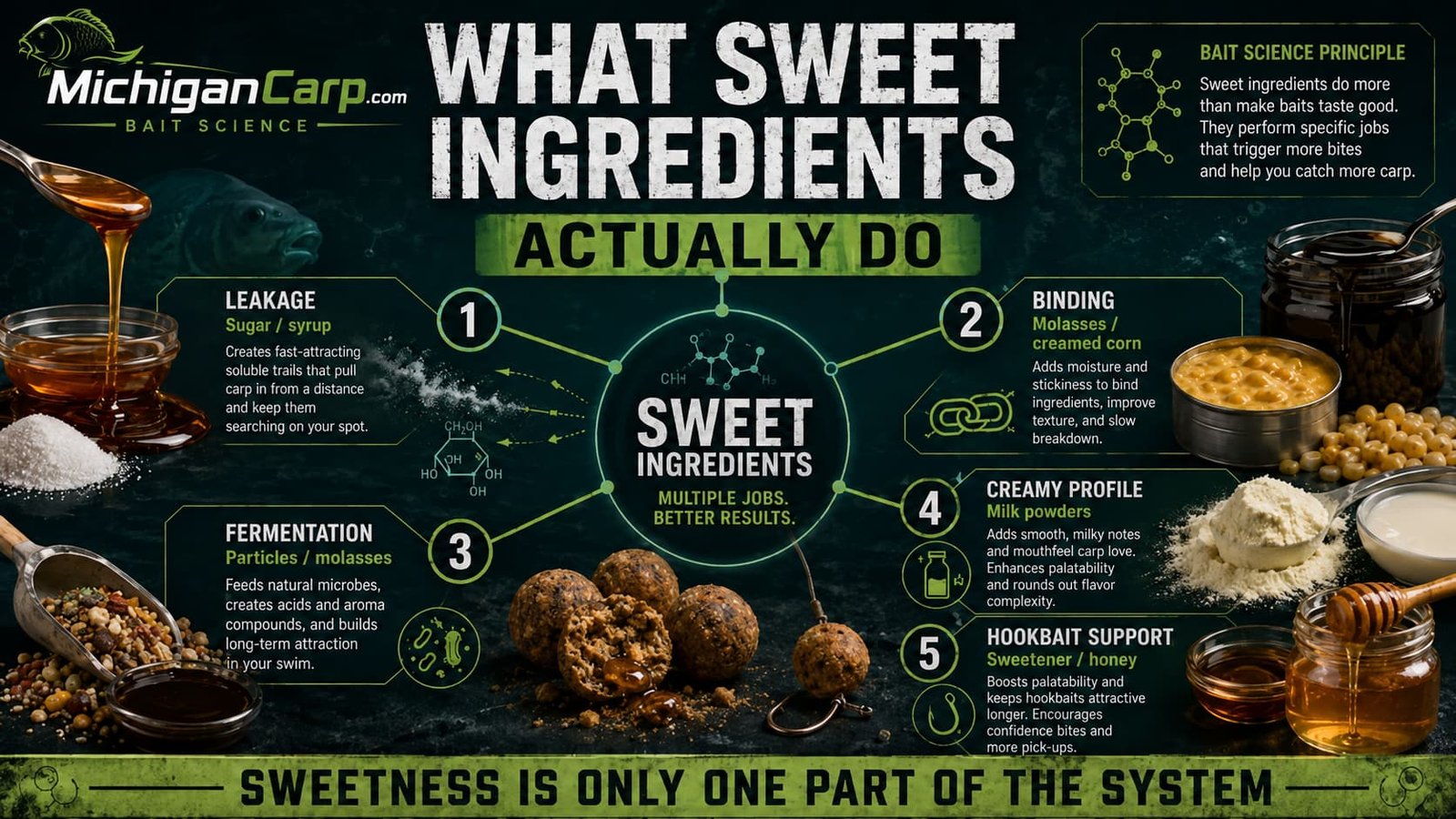
Sweet ingredients often work because they do practical things inside bait.
Molasses is a good example. It is sweet, but its value is not only sweetness. It is dark, sticky, soluble, strongly flavored and useful in particles, method mixes, packbait and some boilie liquids. Used lightly, it can help bind and leak. Used heavily, it can make a mix too tight, too heavy or too slow to break down.
Honey is similar. It brings sugars, aroma, viscosity and a soft natural sweetness, but it is not just a flavor. It changes the liquid phase. It affects how the bait handles. For a neutral outside reference on honey identity and grading, see the USDA extracted honey standards.
Creamed corn is another useful example. It is sweet, but in packbait it also supplies moisture, small food particles, corn identity and binding. That makes it more useful than plain sugar in many North American packbait systems.
Milk powders can contain lactose, but they should not be thought of as sweeteners only. Depending on the product, milk powders may contribute protein, minerals, milk solids, solubility, fine clouding, creaminess, texture and nutritional value. The lactose is only one part of the ingredient.
The lesson is simple: judge the whole bait job, not just the sweetness.
Table Sugar, Sucrose and Simple Sweetness
Table sugar is cheap, soluble and easy to use. Chemically, sucrose is a disaccharide made from glucose and fructose units; see PubChem: Sucrose.
In bait, table sugar may help with sweetness, leakage and fermentation support, but it should not be treated as a complete bait additive. It does not supply the same practical structure as oats, panko or maize meal. It does not supply the same creamy food profile as milk powder. It does not behave like a strong bait sweetener used by the drop.
Used in small amounts, sugar can fit into particle liquor, packbait liquids or controlled fermentation. Used carelessly, it can make a bait sticky, brittle, overly sweet, unstable or weak in food value.
For home bait work, I would not build a serious bait around table sugar. I would use it only when it has a specific role.
Molasses, Honey and Syrups
Molasses, honey and syrups are often more useful than plain sugar because they bring more than one effect.
Molasses can darken a mix, add a deep sweet background, help particles or packbait carry a strong food smell, and support mild fermentation when used sensibly. In packbait, it can help bind the mix. But the same stickiness becomes a problem if the bait no longer breaks down properly around the hookbait.
Honey is smoother and lighter. It can work well in small amounts with milk/nut, cream, fruit and hookbait treatments. It can also help powdered coatings stick to a hookbait. But honey is not cheap bulk bait, and large amounts rarely make sense in ordinary mixes.
Corn syrup and similar sweet syrups can improve binding and coating. They can be useful in method mixes or hookbait treatments, but they can also make baits too sticky or slow to release. That is why any syrup-heavy mix should be water tested before fishing.
The practical rule is this: wet sweet ingredients must be counted as part of the liquid phase. They are not invisible extras.
For liquid choice, read When to Use Each Type of Carp Bait Liquid.
Sweet Corn, Creamed Corn and Particle Liquor
Sweet corn catches carp because it is more than sweet. It is visible, soft, familiar, easy to eat, cheap, simple and effective in small amounts. It can be used as hookbait, feed bait or part of a packbait system.
Creamed corn is useful because it adds moisture, corn smell, small food particles, sweetness and binding. In a classic oats-and-panko packbait, creamed corn is not there simply to make the bait sweet. It helps create the right texture and breakdown.
Particle liquor is where sugars and carbohydrates become especially interesting. Cooked maize, tiger nuts, pigeon feed, hemp blends and soaked grains can develop sweet, grainy or mildly fermented liquids. Sugar, molasses or honey may support that process, but safe preparation comes first.
Sweet liquid does not fix underprepared particles. Dry, hard or unsafe particles should not be fished just because they have been soaked in something sweet.
For corn-specific use, read Corn for Carp in Michigan. For particle preparation, read How to Prepare Particles for Carp Fishing.
Sweeteners in Boilies
Sweeteners can be useful in boilies, but this article should not become another version of the dedicated boilie sweetener guide.
The broad principle is that sweetener should support the bait’s identity. In a milk/nut bait, it can round cream, vanilla, Scopex, tiger nut, coconut and milk-powder notes. In a fruit bait, it can soften sharp or thin flavor edges. In liver, yeast or hydrolysate baits, it can reduce harshness without turning the bait into candy.
Strong sweeteners should be used at low, measured levels. They should not replace a proper base mix, soluble food ingredients, digestibility or good bait texture. If the bait is badly built, more sweetener will not make it good.
For the full boilie-specific article, use Sweeteners for Boilies.
Sweetness in Packbait and Method Mix
Packbait is one of the best places to use sweet grocery ingredients because the mechanical job is clear.
Creamed corn, molasses, honey, corn syrup, tinned milk-style liquids and sweet boilie crumb can all help a packbait bind and release. But the breakdown matters more than the smell. A packbait should cast, sink, crack open, release food and leave the hookbait clear.
Sweet sticky liquids can ruin that if they are overused. Too much molasses or syrup can make the mix behave like clay. Too little binder can make it fall apart before it reaches the bottom. The right amount is found by testing, not by smelling the bucket.
A bland-smelling packbait that opens perfectly around the hookbait can be better than a powerful sweet mix that sits there as a lump.
For the full method, use Packbait for Carp Fishing.
Sweetness, Fermentation and Spoilage
Sugars and carbohydrates matter in fermentation because they can feed microbial activity. This is why particles, tiger nuts, maize liquor, molasses-treated bait and grain-based mixes can change after soaking, cooking and resting.
Useful fermentation should be controlled, clean and repeatable. It may smell sweet, mildly sour, grainy, nutty, fruity or pleasantly fermented. Bad spoilage is different. Rotten, putrid, moldy or foul bait should not be used.
Sweetness should never be used to hide bad bait. If a bucket smells unsafe, adding honey or molasses does not make it safe.
For fermented bait context, read Fermented and Food-Signal Baits for Carp.
When Sweetness Helps Most
Sweetness helps most when it supports a clear bait job.
It can round a fruit flavor, soften a bitter hydrolysate, support a milk or cream profile, improve a packbait binder, feed controlled fermentation, sweeten a particle liquor, or give a hookbait a slightly stronger point-of-capture identity.
It is weakest when it is used as a replacement for bait design. If the base mix is poor, the bait does not leak, the particles are unsafe, the packbait will not open or the swim contains no carp, sweetness will not solve the problem.
That is the difference between using sweetness and relying on sweetness.
When Sweetness Hurts the Bait
Sweetness can hurt bait when it creates bad mechanics, unstable storage or confused taste signals.
Too much syrup can make packbait too sticky. Too much sweetener can make boilies taste harsh or artificial. Too much sugar can create sticky, brittle or unstable bait. Too much sweet liquid in hookbait soaks can soften the bait, seal the surface or affect buoyancy.
Sweet ingredients can also attract nuisance fish in some waters. That does not make them bad. It just means the bait has to match the session, water temperature, stock, feeding pressure and target fish.
More sweetener does not mean more attraction. More syrup does not mean better leakage. More molasses does not mean better particles.
Dose and finished-bait behavior matter.
How I Would Test Sweet Ingredients
The easiest mistake is changing too many things at once. If you add more sweetener, change the fruit flavor, alter the base mix and add molasses to the feed, you will not know what mattered.
A cleaner test uses the same base bait and changes only the sweet side. Start with a control bait. Make a low-dose version. Make a moderate-dose version. If hookbaits are part of the system, make a hookbait-only stronger version while keeping the freebait unchanged.
| Test version | Change | What it shows |
|---|---|---|
| Control | No added sweetener or extra sweet liquid | Shows the base bait on its own |
| Low dose | Small measured sweetener or syrup change | Tests whether light rounding helps |
| Moderate dose | Higher but still controlled level | Shows whether sweetness improves or overpowers |
| Hookbait-only | Stronger hookbait treatment only | Tests point-of-capture attraction without changing all feed |
Judge each bait at more than one stage. Raw paste tells you something, but it is not the final bait. Check the bait after boiling, after drying, after storage and after time in water. For packbait, test castability and breakdown. For hookbaits, test firmness and buoyancy after treatment.
That is how sweet ingredients become bait development instead of guesswork.
Michigan Notes
In Michigan waters, sweet ingredients have a very practical role because corn, creamed corn, oats, panko, molasses, milk powders and sweet particle liquors all fit common North American carp methods.
Lightly pressured carp may accept simple sweet bait quickly, especially around corn, particles and packbait. But many Michigan waters also contain heavy natural food: snails, mussels, weedbeds, insect life, crayfish and seasonal food movement. Sweetness does not replace finding the fish.
For my own fishing, I would rather use a small, accurate, well-designed sweet corn or milk/nut packbait trap in the right location than dump a huge sweet bait pile where carp are not feeding.
Sweet bait works best when it supports good watercraft.
Common Mistakes
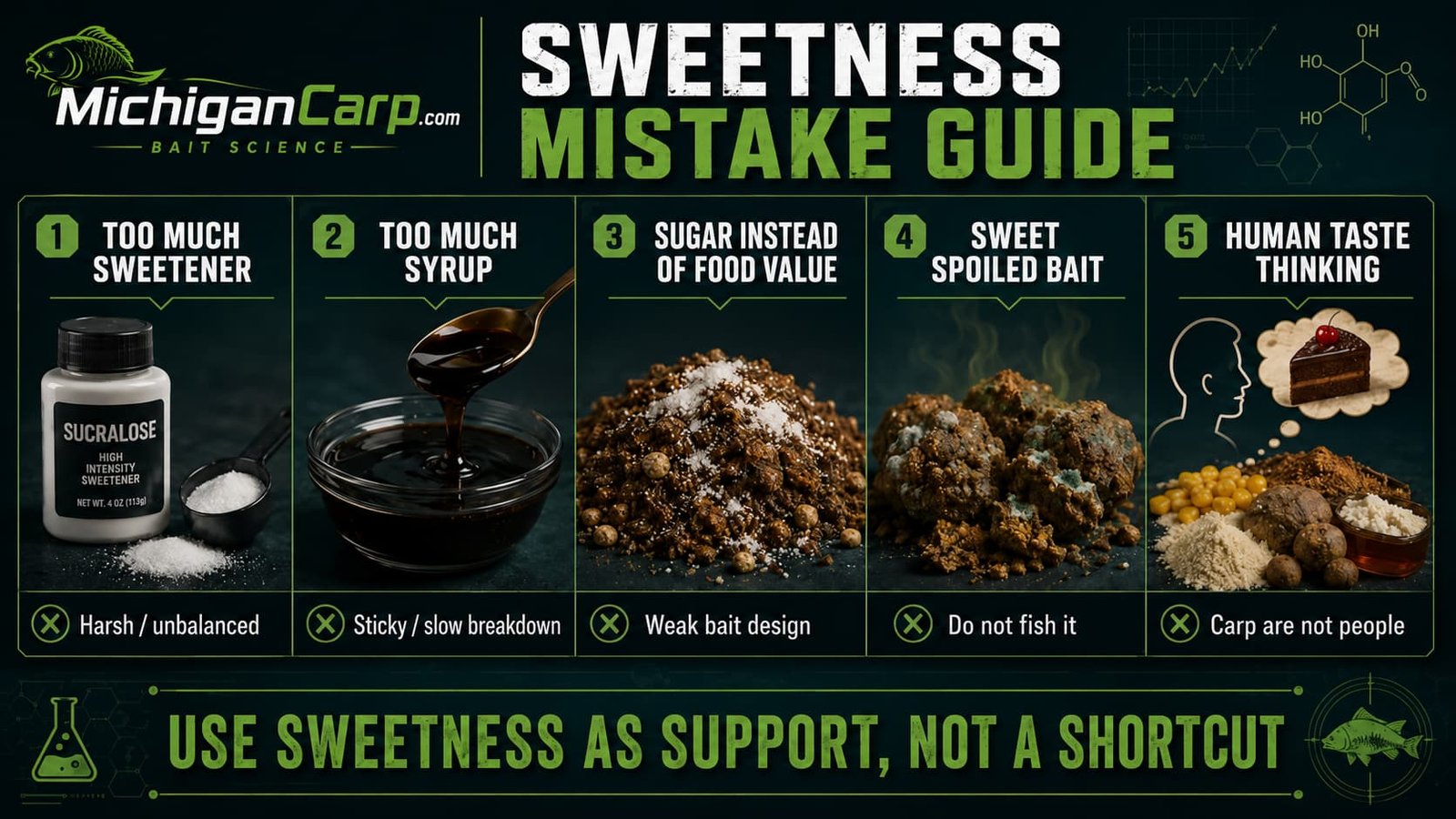
The first mistake is thinking that sweet means attractive. Sweet to humans is not automatic proof of carp response. The finished bait has to work in water and in the feeding situation.
The second mistake is using too much. High-dose sweetener, heavy syrup, excess molasses or overdone hookbait soak can make bait less balanced, not better.
The third mistake is using sugar instead of food value. Sugar can have a place, but it is not a complete bait. It does not replace digestible ingredients, texture, solubility or safe preparation.
The fourth mistake is making packbait too sticky. If the bait will not open properly, it does not matter how good it smells in the bucket.
The fifth mistake is ignoring fermentation control. Sweet particles can ferment, but spoiled bait is not useful bait.
The final mistake is not measuring. Unmeasured sweet liquid use cannot be repeated. If you cannot repeat it, you are not really developing bait.
My Practical View
I use sweet ingredients, but I do not worship them.
Corn works. Creamed corn works. Molasses works. Honey can work. Milk powders work. Sweeteners can work. But they work best when they have a specific job.
In packbait, sweet ingredients can help bind, leak and create a food signal. In boilies, they can round flavors and support bait identity. In particles, they can develop liquor and controlled fermentation. In milk/nut bait systems, they can support creaminess and acceptance.
But sweetness is not a substitute for watercraft, bait structure, safe preparation, digestibility or field testing.
Sweetness is a supporting tool, not the bait design.
That keeps the bait honest.
FAQ
Do carp like sweet bait?
Carp can be caught on sweet bait, but sweetness alone should not be treated as a magic trigger. Sweet ingredients often work because they affect leakage, texture, fermentation, binding and bait acceptance.
Can carp detect sugar?
Carp can detect chemical cues, but their response to sugars does not necessarily match human sweetness perception. Sweet ingredients should be judged by finished-bait behavior, not human taste alone.
Is sugar good in carp bait?
Sugar can be useful in small amounts for solubility, sweetness, fermentation support and texture, but it should not replace proper bait design.
Is molasses good for carp bait?
Yes. Molasses can be useful in particles, packbait, method mix, boilies and glugs when used carefully. Too much can make bait heavy, sticky or slow to break down.
Is honey good for carp bait?
Honey can be useful in small amounts, especially in hookbait soaks, packbait and milk/nut or fruit-style bait systems. It should be counted as part of the liquid phase.
Is sweet corn good for carp?
Yes. Sweet corn is one of the most practical carp baits because it is soft, visible, cheap and easy to use. It works for more reasons than sweetness alone.
Are artificial sweeteners good in boilies?
They can be useful at low levels to round flavors and support palatability, but they should not dominate the bait. For boilie-specific guidance, use the dedicated sweetener article.
What is the difference between sugar and sweetener?
Sugar is usually a soluble carbohydrate with some food value. Sweetener is used mainly to create sweetness and may be used at very low doses.
Are carbohydrates important in carp bait?
Yes. Many carp baits rely on carbohydrate ingredients such as semolina, maize meal, oats, panko, wheat flour and corn products for structure, energy and bait mechanics.
Can too much sweetener ruin bait?
Yes. Too much sweetener or syrup can make bait unbalanced, sticky, harsh, slow to break down, or too artificial in taste profile.
Does sweetness help fermentation?
Simple sugars can support controlled fermentation, but fermentation must be clean and intentional. Rotten bait should not be used.
Should packbait be sweet?
Packbait can be sweet, but breakdown matters more than sweetness. A good packbait must bind, cast, sink and open around the hookbait.
Next Steps
Continue with these related MichiganCarp.com guides:
- Sweeteners for Boilies
- Carp Feeding Attractants Explained
- The Science of Carp Bait Solubility and Leakage
- Carp Bait Digestibility
- When to Use Each Type of Carp Bait Liquid
- Packbait for Carp Fishing
- Corn for Carp in Michigan
- How to Prepare Particles for Carp Fishing
- Boilie Liquids & Additives
- Boilie Ingredients Explained
- Bait Science
- The Bait Shed
- Michigan Carp Guide Library