

How to Use Hydrolysates in Carp Bait
Hydrolysates are among the most discussed ingredients in modern carp bait, but they are also among the easiest to misunderstand.
Fish hydrolysate. Liver hydrolysate. Whey hydrolysate. Krill hydrolysate. Protein hydrolysate.
The name appears on bait labels everywhere.
But the word hydrolysate does not automatically tell you:
- how soluble the product is;
- how concentrated it is;
- what proportion of peptides or free amino acids it contains;
- how quickly it will release from a finished bait;
- whether it is a liquid or powder;
- how it will affect bait texture;
- whether it suits the bait you are making.
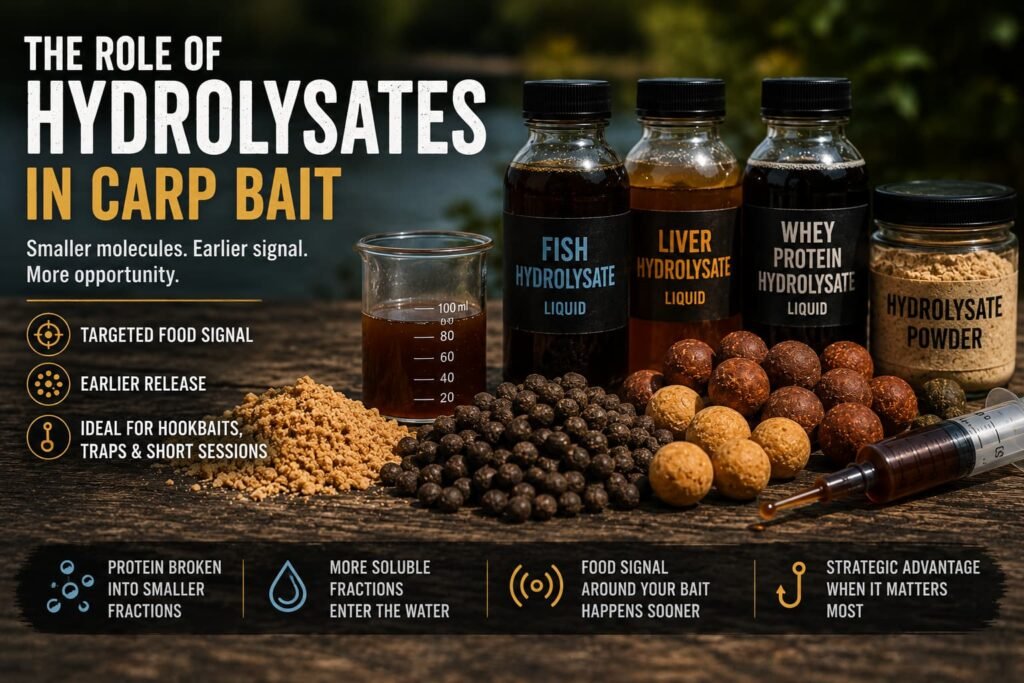
A hydrolysate is best understood as a protein-derived ingredient whose original protein structure has been partially broken down into smaller fractions.
Depending on the starting material and process, the finished product may contain a mixture of:
- larger protein fragments;
- peptides of different sizes;
- shorter peptides;
- free amino acids;
- other soluble material carried over from the original ingredient.
Different hydrolysis conditions can produce hydrolysates with different molecular-size distributions and functional properties, which is why two products carrying the same broad label can behave differently.
For carp anglers, the practical question is not:
Are hydrolysates good?
The better question is:
Where does this particular hydrolysate make sense in my baiting system?
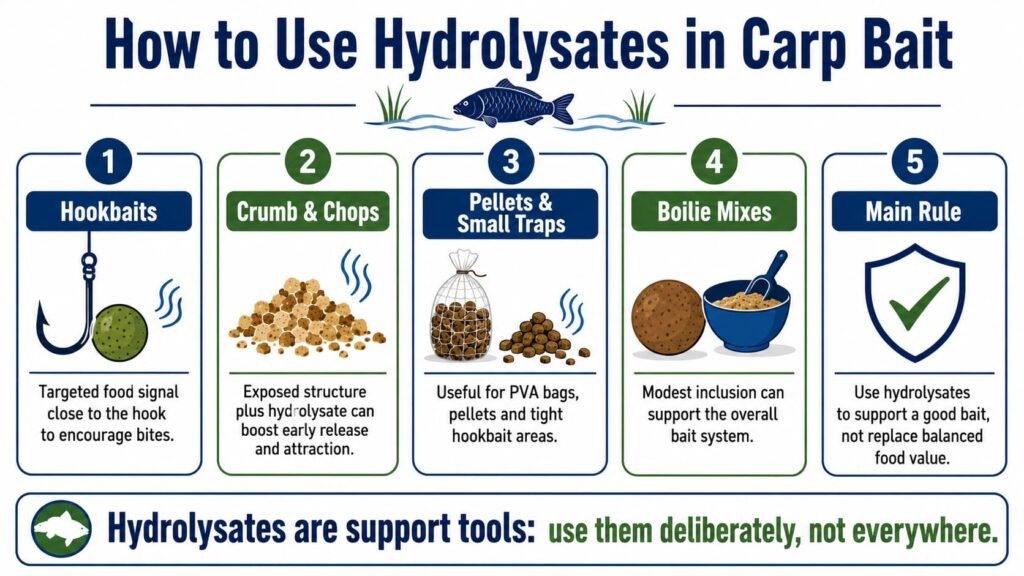
For me, the strongest applications are usually:
- boilie crumb;
- chopped boilies;
- pellets;
- paste;
- stick mixes;
- suitable PVA bag contents;
- boilie liquids;
- selected hookbait treatments;
- small controlled traps.
This article is the practical guide to those applications.
For the deeper technical explanation of source proteins, processing, degree of hydrolysis, peptide distribution, product form and release behavior, read What Hydrolysates Really Do in Carp Bait.
For the wider relationship between intact proteins, peptides, hydrolysates and free amino acids, read Proteins, Peptides and Hydrolysates in Carp Bait.
Quick Start
The practical version is this.
Use hydrolysates selectively
They often make the most practical sense in:
- crumb;
- chops;
- pellets;
- paste;
- small trap mixes;
- selected hookbait treatments.
Do not assume every hydrolysate behaves the same
Source material, processing, concentration and product form matter.
Do not assume every hydrolysate releases rapidly
A finished bait’s release behavior still depends on:
- ingredient solubility;
- inclusion level;
- bait structure;
- cooking;
- drying;
- surface area;
- water access;
- temperature;
- water movement.
Liquid and powdered hydrolysates are different formulation tools
A liquid may suit:
- surface treatment;
- crumb;
- pellets;
- paste;
- post-boil application.
A powder may suit:
- base mixes;
- dry crumb systems;
- pastes;
- dry coatings;
- more precisely controlled formulation.
More is not automatically better
A sensible amount in the correct part of the baiting system is usually more useful than pouring an expensive hydrolysate across every piece of free bait.
Location remains first
No liquid or powder compensates for fishing an empty part of the lake.
What Is a Hydrolysate?
In bait terms, a protein hydrolysate is produced when larger protein structures are partially broken down.
The exact process varies.
The resulting product can contain different proportions of:
- larger peptides;
- smaller peptides;
- free amino acids;
- water-soluble protein-derived material.
The important word is:
different.
The name hydrolysate is a category label.
It is not a complete product specification.
One product may be:
- thick;
- dark;
- concentrated;
- strongly flavored;
- mainly liquid.
Another may be:
- dry powder;
- pale;
- relatively neutral;
- highly dispersible.
A third may contain much more residual material and behave very differently again.
The modern MichiganCarp.com position is therefore:
Judge the product, not the category name.
The companion technical article explains why the term alone does not define exact peptide distribution, solubility, concentration or release behavior.
Hydrolysates and Whole Protein Ingredients Have Overlapping Roles
It is tempting to simplify the subject into:
whole proteins feed and hydrolysates attract.
I do not think that is a useful way to describe them.
Whole protein ingredients can contribute:
- nutritional protein;
- amino-acid supply after digestion;
- texture;
- binding;
- firmness;
- hardness;
- formulation structure.
Hydrolysates can contribute:
- selected protein-derived fractions;
- peptides;
- free amino acids;
- soluble material;
- liquid-food support;
- targeted surface treatment;
- local application in crumb, paste or pellets.
These are not completely separate jobs.
An intact protein ingredient can release some detectable material.
A hydrolysate can still contribute nutritional value.
The useful question is not:
Which is better?
It is:
What does the complete bait need each ingredient form to do?
For the full protein-continuum explanation, read Proteins, Peptides and Hydrolysates in Carp Bait.
Why I Prefer Targeted Hydrolysate Use
Hydrolysates can be expensive.
That alone is a good reason to use them intelligently.
Imagine two baiting situations.
Situation 1
You have:
- five gallons of particles;
- several pounds of pellets;
- several kilograms of boilies.
Pouring a concentrated hydrolysate across all of that may be expensive and difficult to evaluate.
Situation 2
You have:
- one cup of crumb;
- several chopped boilies;
- a handful of crushed pellets;
- one hookbait.
Now a small amount of hydrolysate can be applied precisely.
That is why my general approach is:
Broad food liquids across the wider food area.
Concentrated hydrolysates closer to the active rig area.
That does not mean hydrolysates cannot be used in bulk feed.
It means concentrated ingredients should earn their place.
For the wider comparison between broader fermented-liquid use and selective hydrolysate placement, read Fermented Liquids vs Hydrolysates for Carp.
Where Hydrolysates Work Best
This is the most useful part of the subject.
Rather than asking which hydrolysate has the strongest smell, start with the bait form.
1. Boilie Crumb
Boilie crumb is one of my favorite hydrolysate applications.
Why?
Because crumb provides:
- high exposed surface;
- easy coating;
- small controlled bait volume;
- easy mixing;
- easy comparison against untreated crumb.
The physical form of crumb already differs from a whole hardened boilie.
More internal bait structure is exposed to water.
A suitable hydrolysate can then be distributed through that crumb.
This does not mean crumb plus hydrolysate becomes a magical long-range attraction cloud.
The practical advantage is more controlled:
you can build a small, active feeding area around the rig without applying a large quantity of food.
Practical approach
Start with:
- boilie crumb;
- optional crushed pellet;
- optional small chops.
Add the hydrolysate gradually.
The objective is:
lightly treated crumb
not:
wet paste
Mix thoroughly and allow time for the liquid to distribute before adding more.
For the physical side of the process, read Why Surface Area Matters in Carp Bait.
2. Chopped Boilies
Chopped boilies are another excellent application.
A chopped boilie gives you:
- the same basic bait identity as the free boilies;
- different exposed surfaces;
- irregular food pieces;
- an easy way to distribute a small liquid treatment.
A practical mix might contain:
- whole boilies;
- halves;
- quarters;
- crumb.
I would normally treat the smaller bait fraction more heavily than the entire freebait supply.
This creates a simple structure:
whole bait for feeding;
chops and crumb for local activity.
The point is not that one form is automatically superior.
It is that different bait forms can perform different jobs in the same swim.
3. Pellets
Pellets can be useful carriers for hydrolysate treatment, but they should always be tested.
Different pellets absorb liquid differently.
Some remain firm.
Some soften rapidly.
Some begin breaking down before they reach the lakebed.
My practical method
Treat a small sample first.
Check it:
- after 10 minutes;
- after 30 minutes;
- after one hour.
You want to know:
- Is it absorbing?
- Is it softening?
- Is it turning greasy?
- Is it becoming paste?
- Does it still suit the fishing situation?
A treatment that destroys pellet mechanics is not automatically an improvement.
Hydrolysate-treated pellets can make sense in:
- small trap fishing;
- crumb-and-pellet patches;
- PVA bag contents where the product is PVA-compatible;
- localized rig-area feeding.
4. Paste
Paste is a very useful hydrolysate carrier because it can be adjusted easily.
You can change:
- softness;
- thickness;
- liquid level;
- breakdown rate;
- layer thickness.
Possible uses include:
- wrapping a boilie;
- small paste pieces in crumb;
- paste around a lead where legal and practical;
- small hand-placed edge traps.
The danger is overcomplication.
A paste does not need:
- hydrolysate;
- yeast extract;
- CSL;
- syrup;
- flavor;
- oil;
- sweetener;
all at once.
My preferred rule remains:
one lead idea and one support idea.
For example:
Savoury paste
Lead:
liver hydrolysate
Support:
light yeast-derived savoury layer
Or:
Milk and nut paste
Lead:
yeast-based savoury support
Support:
matching sweet or flavor profile
Keep the formulation understandable.
5. Stick Mixes and PVA Bags
Hydrolysates can work well in small stick mixes and bags.
But two things matter.
PVA compatibility
Not every liquid is suitable.
Test the actual product with the actual bag material.
Do not assume.
Mix mechanics
A bag mix should not become:
- wet;
- sticky;
- heavy;
- difficult to fill;
- slow to disperse.
Light treatment is usually enough.
A practical small mix might contain:
- boilie crumb;
- crushed pellet;
- fine dry ingredient;
- small hydrolysate treatment.
The job is:
small controlled application around the hookbait.
Not a liquid bomb.
6. Hookbait Treatments
Hookbaits are one of the most logical places to use concentrated treatments.
The total amount of bait is small.
That allows precise application.
Possible treatments include:
- light coating;
- coat-and-dry cycles;
- short soak;
- hydrolysate incorporated into a conditioner.
But hookbait mechanics must remain first.
Always check:
- hardness;
- skin integrity;
- buoyancy;
- wafter balance;
- pop-up buoyancy;
- nuisance-fish resistance.
A perfectly treated hookbait that no longer presents correctly is a bad hookbait.
My preferred method
For hardened bottom baits:
- Apply a light coat.
- Allow it to absorb or dry back.
- Repeat only if needed.
- Test the bait in water.
For wafters and pop-ups:
- Treat one sample first.
- Test buoyancy.
- Compare untreated and treated versions.
- Do not assume the balance will remain unchanged.
For the complete hookbait treatment process, read How to Treat Boilies for Carp Step by Step.
7. Boilie Liquids
Hydrolysates can be used:
- in the liquid phase before rolling;
- as a post-boil treatment;
- in surface coatings;
- in glug systems.
These approaches are not identical.
In the liquid phase
Advantages:
- incorporated throughout the dough;
- easy batch consistency.
Watch:
- dough handling;
- softness;
- rolling;
- cooking behavior;
- final hardness.
Post-boil treatment
Advantages:
- precise surface application;
- easy batch comparison;
- separate treatment of small session quantities.
Watch:
- overwetting;
- storage stability;
- microbial spoilage;
- changes in hardness.
The correct method depends on:
- the hydrolysate;
- the bait formula;
- whether the bait is freezer bait or shelf life;
- expected storage time.
Liquid Hydrolysates vs Powdered Hydrolysates
This distinction deserves more attention.
Liquid Hydrolysates
Often practical for:
- crumb;
- chops;
- pellets;
- paste;
- post-boil treatment;
- hookbait treatment.
Advantages can include:
- easy distribution;
- simple coating;
- easy blending with compatible liquids.
Watch:
- water content;
- spoilage;
- storage instructions;
- solids content;
- bait softening.
Powdered Hydrolysates
Often practical for:
- base mixes;
- dry crumb;
- paste powders;
- dry coating systems;
- precisely weighed formulation.
Advantages can include:
- easier dry dosing;
- longer storage in suitable conditions;
- less unwanted liquid added to the mix.
Watch:
- clumping;
- hygroscopic behavior;
- uneven mixing;
- assumptions about solubility.
A powder is not automatically more concentrated.
A liquid is not automatically faster.
Again:
judge the actual product.
Main Types of Hydrolysates Used in Carp Bait
The source material matters because it changes the starting protein and the wider composition of the product.
But source name alone still does not tell you everything about the finished hydrolysate.
Fish Protein Hydrolysates
Potential practical fits include:
- fishmeal boilies;
- fish-based pellets;
- crumb;
- paste;
- savoury marine bait systems.
Consider:
- source species;
- processing;
- solids content;
- concentration;
- liquid or powder form;
- compatibility with the complete bait.
Fish hydrolysate is not automatically the correct choice for every boilie simply because carp eat animal protein.
It has to fit the bait system.
Liver Hydrolysates
Liver hydrolysates can fit:
- hookbait treatments;
- crumb;
- chopped boilies;
- pellets;
- paste;
- selected boilie liquids;
- non-marine bait systems requiring a deeper savoury layer.
For homemade liver hydrolysate, beef liver is my preferred starting material when I want a darker, richer profile.
I particularly like liver-based material in small targeted applications rather than automatically pouring it across the entire bait supply.
For the dedicated guide, read Liver Hydrolysate for Carp Bait.
Shellfish and Krill Hydrolysates
These may fit:
- marine bait systems;
- fishmeal boilies;
- pellet blends;
- crumb;
- paste.
Again, evaluate the product.
Do not buy solely on:
- strong odor;
- dark color;
- expensive branding.
Ask:
- What is the source?
- Is it genuinely hydrolyzed?
- Is it liquid or powder?
- What is the recommended inclusion?
- What is the solids content?
- How should it be stored?
Whey and Milk-Protein Hydrolysates
These deserve consideration in non-marine bait systems.
Potential fits include:
- milk-protein baits;
- nut baits;
- cereal baits;
- birdfood mixes;
- selected powders in dry formulations.
This is an interesting area because hydrolysates do not have to mean:
fish, liver or marine bait.
A milk or nut-based boilie can use a protein system that includes:
- intact milk proteins;
- whey protein;
- casein-derived ingredients;
- selected hydrolyzed protein fractions.
The important point is still balance.
For more on milk-protein ingredients, read Casein, Caseinate, WPC and Skimmed Milk Powder in Carp Bait.
Yeast Products Are Not Automatically Hydrolysates
This distinction matters.
Yeast extract, yeast autolysate, liquid yeast and fermented grain liquids are often placed in the same general angling conversation as hydrolysates.
But they should not automatically be treated as the same product category.
Their:
- starting material;
- processing;
- composition;
- concentration;
can be different.
For the full comparison, read Yeast, CSL and Fermented Liquid Foods for Carp Bait.
Hydrolysates in Cold Water and Short Feeding Windows
Hydrolysates are often promoted as cold-water ingredients.
I would be more careful.
Cold water does not make every hydrolysate automatically superior.
What changes is the fishing situation.
You may be dealing with:
- shorter feeding windows;
- lower bait quantities;
- smaller traps;
- precise placement;
- fish moving through rather than feeding for hours.
Those conditions can make targeted hydrolysate use practical.
For example:
Small crumb trap
Use:
- crumb;
- a few chops;
- light treatment.
Pellet patch
Use:
- small quantity of pellets;
- tested light liquid treatment.
Hookbait treatment
Use:
- durable hookbait;
- precise coat-and-dry treatment.
The useful idea is:
small, controlled application during limited feeding opportunities.
Not:
hydrolysates beat cold water.
Warm-Water Use
Hydrolysates can also be useful in warm water.
There is no reason to restrict them to spring or fall.
But warm-water fishing may support larger feeding systems.
That changes the economics.
For example:
Wider area
Use:
- particles;
- pellets;
- boilies;
- compatible economical food liquid.
Rig area
Use:
- crumb;
- chops;
- selected hydrolysate.
Hookbait
Use:
- precise treatment only if needed.
This is often more sensible than treating five gallons of particles with an expensive specialist liquid.
Short Sessions vs Multi-Day Sessions
Short Session
I would emphasize:
- location;
- small bait quantity;
- crumb;
- chops;
- pellets;
- selected liquid treatment.
Hydrolysates can fit very well here because the total bait volume is small.
Multi-Day Session
I would emphasize:
- sustainable food;
- bait economy;
- repeatable top-ups;
- consistent freebait.
Then use the hydrolysate selectively in:
- rig-area crumb;
- chop;
- pellet mix;
- hookbait treatment.
That is generally closer to how I use them in my own fishing.
A Practical Three-Layer System
For Michigan-style fishing, I like a simple three-layer approach.
Layer 1 — Wider Food Area
Use:
- particles;
- pellets;
- selected boilies.
Main job:
FOOD
Hydrolysate use:
Usually limited unless cost and application justify broader use.
Layer 2 — Active Rig Area
Use:
- crumb;
- chopped boilies;
- crushed pellets;
- small paste pieces.
Main job:
LOCAL FEEDING ACTIVITY
Hydrolysate use:
This is usually the most logical area for targeted treatment.
Layer 3 — Hookbait
Use:
- boilie;
- tiger nut;
- maize;
- another durable presentation.
Main job:
PRESENTATION
Hydrolysate use:
Precise treatment only when it has a clear purpose.
This gives:
food across the area;
activity around the rig;
precision at the hookbait.
Michigan Notes
Michigan carp fishing presents some unusual baiting problems.
Many waters are:
- large;
- lightly studied;
- naturally rich;
- seasonally cold;
- difficult to prebait regularly.
Carp may:
- move long distances;
- visit feeding areas briefly;
- follow seasonal routes;
- use shallow water only during certain windows.
That makes bait location more important than liquid choice.
My own approach is:
First
Find the fish.
Then
Decide how much food the situation can support.
Then
Decide whether a targeted hydrolysate treatment adds anything useful.
On large waters, I often see more sense in using hydrolysates on:
- crumb;
- chops;
- pellets;
- hookbaits;
- small traps;
than using large quantities across the entire freebait supply.
That keeps the system:
- practical;
- economical;
- testable.
How to Test a Hydrolysate Properly
Do not judge a hydrolysate only by smell.
A strong human smell does not prove superior fishing performance.
Test the product in the actual bait form.
Test 1 — Pellet treatment
Compare:
- untreated pellets;
- lightly treated pellets.
Observe:
- absorption;
- softening;
- breakdown.
Test 2 — Crumb
Compare:
- dry crumb;
- lightly treated crumb.
Observe:
- clumping;
- paste formation;
- water behavior.
Test 3 — Hookbait
Compare:
- untreated bait;
- treated bait.
Test:
- hardness;
- balance;
- buoyancy;
- durability.
Test 4 — Fishing comparison
Where practical, compare:
- one controlled hydrolysate treatment;
- one simpler control.
Do not change:
- hydrolysate;
- flavor;
- color;
- rig;
- bait quantity;
all at once.
Otherwise you learn very little.
Common Mistakes
Assuming every hydrolysate is fast-leaking
Product and finished-bait behavior vary.
Buying by smell
Strong odor is not a product specification.
Using too much
More is not automatically better.
Drowning crumb
You wanted an active crumb mix, not paste.
Softening pellets too far
Test before fishing.
Ignoring hookbait mechanics
Check hardness and buoyancy.
Treating every part of the bait system
A targeted local application may be more useful.
Mixing too many liquids
One clear lead treatment is easier to understand.
Ignoring the base bait
Hydrolysates support a bait system.
They do not rescue a poorly designed bait.
Ignoring location
The best liquid in the wrong part of the lake is still in the wrong part of the lake.
My Practical View
I use hydrolysates as tools.
Not as a bait philosophy.
The label does not impress me.
The job matters.
For my own fishing, I think about hydrolysates in this order:
1. What product is it?
- fish?
- liver?
- whey?
- another protein source?
2. What form is it?
- liquid?
- powder?
3. What am I treating?
- crumb?
- chops?
- pellet?
- paste?
- boilie?
- hookbait?
4. How much bait am I treating?
There is a huge difference between:
- ten hookbaits;
- one pound of crumb;
- five gallons of freebait.
5. What practical job needs doing?
- localized crumb treatment?
- pellet treatment?
- paste?
- hookbait conditioning?
- base-mix formulation?
Once those questions are answered, the decision becomes much easier.
My preferred approach is:
use broad food ingredients for broad feeding;
use concentrated hydrolysates selectively;
use bait form intelligently;
protect bait mechanics;
test the actual product;
solve location before chemistry.
FAQ
What is a hydrolysate in carp bait?
A hydrolysate is a protein-derived ingredient in which larger protein structures have been partially broken down into smaller fractions. Depending on the product, this can include different mixtures of peptides and free amino acids.
Are all hydrolysates fast-leaking?
No. Actual behavior depends on the source, processing, product form, concentration and the structure of the finished bait. The technical companion article explains these variables in more detail.
Are hydrolysates better than whole protein ingredients?
Not automatically. Intact proteins and hydrolysates can perform different and overlapping jobs. The correct choice depends on the complete bait formulation.
Where should I use liquid hydrolysates?
Good practical applications include:
- crumb;
- chops;
- pellets;
- paste;
- selected post-boil treatments;
- hookbait conditioners.
Where should I use powdered hydrolysates?
Powders can fit:
- boilie base mixes;
- dry crumb;
- paste powders;
- coating systems;
- carefully controlled dry formulations.
Are hydrolysates good for hookbait treatment?
They can be. Use light treatment and test hardness, balance and buoyancy before fishing.
Can hydrolysates be used on pellets?
Yes, but test the pellet first because liquid absorption can change texture and breakdown.
Do hydrolysates work in cold water?
They can be useful in cold-water fishing, particularly in small, precise traps and short feeding windows. They should not be treated as automatically superior simply because the water is cold.
Should every boilie contain a hydrolysate?
No. A boilie can be effective without one. Hydrolysates should have a clear formulation or application role.
Can I combine hydrolysates with fermented liquids?
Yes, but the ingredients should have different jobs. A broader fermented food liquid may make sense across freebait, while a hydrolysate may be reserved for crumb, pellets or hookbait treatment.
Final Thoughts
Hydrolysates are useful ingredients.
But they are not magic liquids.
They should not be judged by:
- smell alone;
- color;
- price;
- marketing language;
- the word hydrolyzed on the label.
The important questions are:
- What is the source material?
- How was it processed?
- Is it liquid or powder?
- What am I putting it on?
- How much bait am I treating?
- What job do I want it to perform?
For my style of fishing, the strongest hydrolysate applications are usually controlled and deliberate:
crumb;
chopped boilies;
pellets;
paste;
small traps;
selected hookbait treatments.
The wider food area can still be built with:
- real food;
- particles;
- pellets;
- boilies;
- economical compatible liquids.
The hydrolysate does not need to dominate the entire baiting system.
It only needs a clear job.
That is the practical role of hydrolysates in carp bait.
Next Articles
Continue through the Bait Science cluster with:
What Hydrolysates Really Do in Carp Bait
Proteins, Peptides and Hydrolysates in Carp Bait
Fermented Liquids vs Hydrolysates for Carp
Liver Hydrolysate for Carp Bait
Fermented and Food-Signal Baits for Carp
What Fermented Bait Liquids Really Do
Yeast, CSL and Fermented Liquid Foods for Carp Bait
Fermented Liquids vs Hydrolysates vs Sweet Liquids
The Science of Carp Bait Solubility and Leakage
Why Surface Area Matters in Carp Bait