

Fishing pressure and carp behavior are closely connected, but the subject is often oversimplified.
When a familiar swim suddenly becomes difficult, anglers often say the fish have “wised up,” become “riggy,” or simply stopped feeding. Sometimes there is truth behind that observation, but pressured carp are not supernatural fish that can identify every hook, line and boilie from fifty yards away.
The more useful explanation is that common carp can learn from experience, modify their behavior after stressful events and become less vulnerable to repeated angling under some conditions. Carp can also respond to repeated disturbance, predictable bankside activity and the same fishing patterns appearing again and again.
Scientific studies have demonstrated short-term hook avoidance in common carp following direct hooking, while experiments have also found that social exposure to another carp being caught can alter subsequent behavior. However, research examining longer periods shows that a single hooking event does not necessarily create permanent avoidance; the effect can weaken with time. Hook Avoidance Induced by Private and Social Learning in Common Carp and Reexamining One-Trial Learning in Common Carp provide useful experimental evidence for both sides of that picture.
For the angler, that distinction matters. Pressured carp are not impossible to catch, but repeated disturbance can change the terms under which they are prepared to feed confidently.
The answer is rarely a miracle rig. More often it is better location, better timing, quieter angling and a presentation that gives the fish fewer reasons to become cautious.
Table of Contents
Quick Start: Fishing Pressure and Carp
| Pressure Factor | Possible Carp Response | Practical Angling Response |
|---|---|---|
| Repeated hooking | Greater caution around rigs or baited hooks | Improve location and presentation before changing rigs |
| Repeated casting | Fish may leave or delay using shallow/exposed areas | Cast less and recast with a reason |
| Heavy bank activity | Reduced confidence close to shore | Keep movement quiet and use lower-pressure windows |
| Repeated baiting in obvious areas | Carp may approach differently or use the area at safer times | Adjust timing, quantity and baiting position |
| Lines across patrol routes | Fish may change route or approach | Improve line lay and rod positioning |
| Daytime recreation | Feeding may shift toward quieter periods or areas | Watch dawn, dusk and post-traffic periods |
| Heavy use of obvious swims | Nearby overlooked water may become more valuable | Fish the edge of pressure rather than copying it |
| Clear water and bright light | Increased visual exposure | Use cover, ripple, low light and quieter presentation |
The practical principle is straightforward: pressure does not simply make carp “hard.” It changes the risk-reward balance of when and where they are prepared to feed.
What Fishing Pressure Really Means
Understanding fishing pressure and carp behavior starts with recognizing that pressure is not simply a count of anglers on the bank.
A water can have relatively few carp anglers and still produce highly cautious fish if those carp repeatedly encounter hooks, lines, noisy casting and disturbance in the same limited areas. Conversely, a busier water may still contain catchable fish if the pressure is spread across a large area or if carp retain plenty of quiet water where they can feed without repeatedly encountering danger.
Pressure can include repeated hooking and release, but it can also include non-angling disturbance such as pleasure boats, kayaks, paddleboards, swimmers, dogs, lure anglers and constant movement along accessible banks.
On many Michigan waters, that mixed recreational pressure may be more important than specialist carp angling alone.
The key question is therefore not simply:
How many people fish here?
It is:
How predictable is the disturbance experienced by the carp?
A bank that receives heavy traffic every afternoon may become very different from the same bank at first light. An obvious point may attract repeated casts, while the adjacent weed edge or quieter inside line receives almost none.
That difference creates opportunity.
Do Carp Really Learn From Angling?
Yes, but the evidence deserves careful wording.
Common carp have demonstrated learning ability in controlled experiments. One study found that carp learned to locate food using either a visual cue or a repeated movement strategy, demonstrating that they can solve feeding-related learning tasks rather than relying purely on instinct. Cue-Based and Algorithmic Learning in Common Carp provides useful background on that cognitive flexibility.
More directly relevant to anglers, experimental catch-and-release studies have shown reduced angling vulnerability after hooking. Carp with direct experience of being caught became more cautious toward baited rigs, and short-term behavioral effects were also seen in fish exposed socially to another carp being hooked.
That does not mean a carp permanently remembers every rig it has encountered.
Longer-term follow-up work found no evidence that a single hooking event continued to produce full hook avoidance beyond several months, although previously hooked fish could remain more cautious in their approach at an intermediate testing point.
The practical interpretation is therefore more useful than the old idea of a carp becoming permanently “educated.”
Repeated experience can reduce catchability, but behavior remains flexible.
Individual Carp Are Not All Equally Cautious
One reason pressured waters can be confusing is that individual carp differ.
Research into common carp behavior has demonstrated consistent differences in traits such as risk-taking and competitive behavior. Some fish explored novel environments more readily and gained access to restricted food sooner than others. Coping Strategies in Common Carp provides evidence of these repeatable individual differences.
That matters because an angling population is not made up of identical fish.
Some carp may repeatedly make themselves vulnerable.
Others may approach the same situation more cautiously.
This can help explain why certain individual carp are caught frequently while others in the same lake are rarely seen on the bank.
It also means we should be careful with statements such as “the carp have learned the rig.”
Some fish may have changed their behavior. Others may not have experienced the same event at all.
What Pressured Carp May Actually Avoid
A pressured carp does not necessarily need to understand a fishing rig in human terms.
It only needs to associate some combination of cues with risk.
Those cues could include the immediate experience of the hook, the presence of a rig around food, disturbance in a particular area or repeated environmental patterns that precede uncomfortable events.
That is an important distinction because anglers often respond to pressure by changing one tiny item of tackle while leaving every other part of the situation unchanged.
They fish the same swim, cast to the same feature, introduce the same amount of bait, stretch lines across the same route and recast at the same intervals.
Then they change the hooklink and expect everything to be different.
Sometimes the better change is much larger:
fish somewhere the carp feel safer.
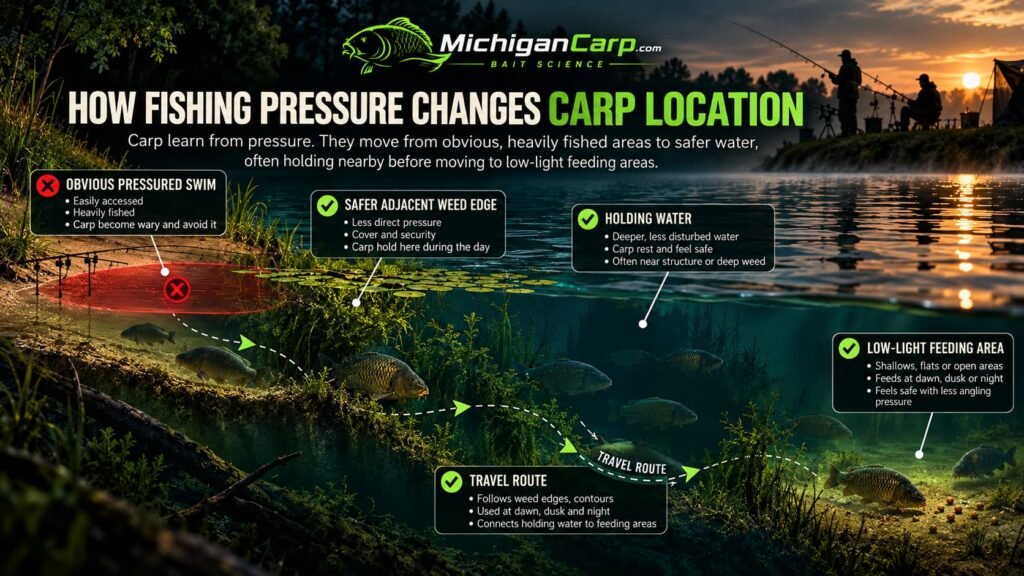
Pressure Changes Where Carp Feel Safe
The relationship between fishing pressure and carp location becomes especially obvious when the same areas receive repeated disturbance.
On an lightly pressured water, fish may use obvious feeding areas openly for long periods. Under heavier disturbance, the same area may remain productive but only during limited periods, or carp may use a nearby edge instead of sitting directly on the most obvious feature.
That is why I increasingly think in terms of pressure gradients rather than pressured and unpressured lakes.
A famous swim may be heavily disturbed.
The water forty yards to one side may receive very little direct pressure.
A busy margin may become quiet after dark.
A weed edge may provide enough cover for fish to hold close to a heavily used bank.
A deeper route may connect the same fish to a shallow feeding area once the activity drops.
For the parent location system, use How to Find Carp in Lakes. That page covers food, safety, comfort and travel routes, which become even more important when pressure is added.
Holding Water and Feeding Water May Separate
One of the easiest mistakes on pressured waters is assuming that seeing carp means you have found where they are prepared to feed.
Fish may hold in one area and feed somewhere else.
During bright daylight they may sit near deeper water, weed, shade, dock structure or another secure area, then move onto a shallower feeding zone once disturbance falls.
This distinction is covered in more detail in Where Carp Hold During the Day.
On pressured water I pay particular attention to transitions between secure holding areas and feeding water because these can create intercept points where the fish feel less exposed than they do in the obvious hotspot itself.
Pressured Carp Often Change Timing Before They Abandon an Area
A good area does not necessarily stop being good because anglers disturb it.
What may change is when carp use it.
This is particularly relevant on public Michigan waters where boat traffic, swimmers and bankside activity often follow a predictable daily pattern.
A shallow flat may be active at first light, quiet through the busy afternoon and productive again near dusk.
A marina edge may receive fish before the boats start moving.
A campground margin may be almost impossible during the busiest part of the day but come alive once people settle down.
The carp have not necessarily abandoned the food or feature.
The risk has changed.
This is why a blank afternoon is not always evidence that the swim is wrong.
Sometimes the angler is fishing the correct area during the wrong confidence window.
Low Light Can Reduce Exposure, But It Is Not a Magic Rule
Dawn, dusk and darkness often become important on pressured waters because disturbance usually decreases and visual exposure may be lower.
However, “pressured carp only feed at night” is far too absolute.
Cloud, wind ripple, colored water, shade and reduced recreation can all create confidence during daylight.
Equally, a heavily disturbed night swim may remain poor simply because the disturbance continues.
The real question is:
When does this area become safe enough for carp to use confidently?
On a clear inland lake that may be dusk.
On a windy reservoir it may be midday when wave action covers the margin.
On another water it may be a quiet two-hour period after the pleasure boats stop.
Pressure interacts with conditions rather than overriding them.
Wind and Ripple Can Change the Pressure Equation
Wind is especially interesting on pressured water because it can change several things at once.
Ripple reduces visibility.
Waves create cover.
Wind can move food.
It can alter oxygen and temperature.
It can also make human disturbance less obvious from the fish’s perspective.
That does not mean the windward bank is automatically correct, but a previously exposed zone may become much more usable once conditions change.
For the full moving-water system, use Wind, Waves and Current for Michigan Carp Fishing.
The important point is that pressure is not static.
A water that feels dangerous to carp in bright calm conditions may become very different once wind, cloud or darkness reduces exposure.
Natural Food Can Increase Confidence
Pressured carp still need to eat.
That sounds obvious, but it is one of the most useful tactical ideas on difficult waters.
A naturally productive area gives fish a reason to accept some risk because there is something worth feeding on.
Weed, snails, insect-rich silt, mussels, inflows and other natural food areas can therefore remain highly valuable even on heavily pressured waters.
This does not make carp careless.
It means the food reward is real.
A small angling trap placed in a natural feeding area may therefore require less introduced bait than an attempt to attract fish into barren water.
For the food-and-location system, use How to Find Natural Carp Feeding Areas in Michigan Lakes.
Signs Become More Valuable When Opportunities Are Short
On difficult water, subtle feeding evidence becomes extremely important because the confidence window may be brief.
A few bubbles along a weed edge, repeated clouding, a liner at the same depth or one carp rolling quietly in a low-pressure area can be more useful than waiting for dramatic shows.
The complete sign-reading guide is Signs Carp Are Feeding.
The important adjustment is patience.
Do not automatically cast at the first sign.
Watch long enough to determine whether the fish are stationary, moving, feeding or simply passing through.
On pressured water, observation can prevent you from destroying the very opportunity you have just discovered.
Quiet Angling Matters More Than Clever Angling
The old article was right about one thing that deserves keeping: how you behave on the bank matters.
Repeated casting, heavy footsteps in a shallow margin, wading, loud baiting and unnecessary movement can all increase disturbance.
But I would avoid pretending we know exactly which individual noise every carp can detect at every distance.
The practical approach is simply to remove unnecessary disturbance.
If the rig is fishing correctly, I do not recast because I am bored.
If fish are feeding close to the bank, I do not keep walking along the edge.
If I can introduce bait quietly, I do.
If I can position rods so lines do not cut through the most obvious route, I do.
This is not complicated stealth theater.
It is simply reducing avoidable disturbance.
Line Lay Can Become Part of the Pressure
Fishing line is another area where anglers often jump from sensible observation to unsupported certainty.
Carp can contact line.
Lines can cross routes.
Tight line angles can make an area physically different.
But there is no reason to assume every carp sees every line and instantly understands that it leads to danger.
The practical objective is therefore not to make line “invisible.”
It is to make the overall setup less intrusive.
Where conditions allow, I want the line entering the water cleanly, avoiding obvious patrol routes and not slicing unnecessarily through shallow feeding areas.
That can mean changing rod position rather than changing line material.
The Rig Usually Is Not the First Problem
Pressured-water discussions often become rig discussions too quickly.
There is certainly a role for rigs that hook effectively and present cleanly.
But the correct rig in the wrong area remains the wrong fishing decision.
Before changing the hook pattern, hooklink material or presentation, I ask:
Is the carp actually using this area?
Is it feeding?
Is the rig sitting cleanly?
Is the hookbait appropriate?
Is the line disturbing the route?
Am I fishing at the correct time?
Only after those questions make sense do small rig changes become particularly useful.
For the broader presentation system, use The Complete Michigan Carp Rig Guide.
Match the Rig to the Bottom, Not to the Word “Pressure”
There is no universal pressured-carp rig.
A clean gravel area may suit a straightforward bottom-bait presentation.
Light weed may call for a different hookbait or hooklink arrangement.
Soft silt may require a rig that settles gently and remains visible.
A very small accurate feeding spot may suit a compact PVA presentation.
The rig should solve the presentation problem in front of you.
It should not become more complicated simply because somebody has described the water as difficult.
Clean presentation is valuable because it removes uncertainty.
That is very different from complexity for its own sake.
How Fishing Pressure Changes Baiting
Heavy baiting is not automatically wrong on pressured water, just as light baiting is not automatically right.
The amount should reflect:
- how many carp are using the area;
- how actively they are feeding;
- water temperature;
- natural food;
- session length;
- competition from other species;
- and whether the fish are returning after disturbance.
Where carp are cautious or only visiting during a short window, a small accurate trap often makes more sense than building a large obvious food bed.
Where a substantial group is feeding strongly, more bait may be justified.
Pressure should therefore change the decision process, not create another fixed rule.
The useful question is not “Should pressured carp get less bait?”
It is:
How much bait does this feeding situation justify?
Repeated Baiting Can Be Good or Bad
A regularly baited area can become productive because carp learn that food is available there.
That same area can also become difficult if the food repeatedly coincides with hooking and disturbance.
Those two processes can occur together.
This is another reason catch rates on pressured waters can change over time.
Carp may still visit the food but approach more cautiously.
They may feed at different times.
They may work the edge before entering the center.
They may remain catchable, but the previous routine becomes less efficient.
That is why I prefer to watch what the carp actually do rather than assuming that a historically successful baited spot will always fish the same way.
Overlooked Water Is Valuable Only When It Makes Carp Sense
“Fish where nobody else fishes” is not enough.
Some ignored water is ignored because it is poor.
The best overlooked areas still need a reason for carp to use them.
Useful examples include:
- a quiet weed edge beside a heavily fished point;
- a margin route behind the popular casting line;
- a bay mouth connecting food and deeper water;
- the edge of a famous feature rather than its center;
- a shaded bank that becomes usable in bright conditions;
- or a short route between holding and feeding water.
The objective is not to be different.
The objective is to find lower-risk water that still solves a carp problem.
Public-Water Pressure in Michigan
On Michigan public waters, fishing pressure and carp behavior are often influenced by far more than specialist carp anglers.
Many waters receive relatively little dedicated carp fishing but large amounts of general recreation.
That can include:
- bass and pike anglers;
- boats;
- jet skis;
- kayaks;
- paddleboards;
- swimmers;
- campers;
- walkers;
- dogs;
- and heavy activity around launches and public access.
A carp may therefore experience strong daily disturbance without ever seeing another carp angler.
This is why I do not define pressure only by the number of bivvies on the bank.
A quiet-looking Michigan lake can become extremely disturbed between late morning and evening during summer.
The same water at dawn may feel completely different.
Clear Water Magnifies Some Types of Pressure
Clear water can make exposed areas less forgiving because carp have good visual information about their surroundings and anglers may also be easier to detect.
That does not mean clear water automatically produces cautious carp, but it increases the value of shade, depth, weed, ripple and careful bank behavior.
For the broader light-and-visibility system, use Water Clarity and Carp Fishing.
On clear water, I pay particular attention to situations where conditions reduce exposure naturally rather than trying to solve everything with terminal tackle.
Pressure Can Make Carp More Predictable
Pressure sounds negative, but once a pattern develops it can actually make part of the lake easier to interpret.
If carp consistently leave an exposed margin when boat traffic begins, that is information.
If they repeatedly return after sunset, that is information.
If the famous swim receives heavy casting while carp use the quieter weed edge beside it, that is information.
If dawn produces feeding signs while the afternoon never does, that is information.
Pressure becomes useful when it creates repeatable behavior.
The mistake is assuming that the pressure pattern will never change.
Carp behavior remains flexible, and changes in wind, temperature, food and human activity can alter the pattern again.
A Practical Pressure-Response System
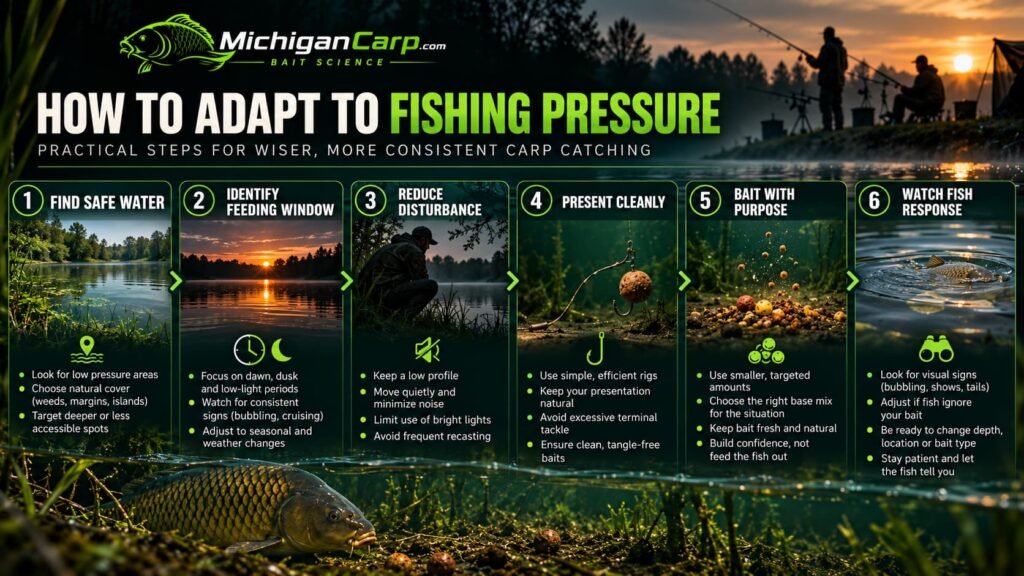
1. Confirm That Pressure Is Really the Problem
Do not blame pressure for a blank session before confirming that carp are actually using the area.
Poor location remains poor location.
2. Identify the Source of Disturbance
Is the pressure coming from carp anglers, boats, swimmers, constant casting, a busy bank or something else?
Different problems require different responses.
3. Look for the Safer Alternative
That might be deeper water, weed, shade, a quieter bank, a less obvious route or simply a different time of day.
4. Find the Confidence Window
Watch dawn, dusk, weather changes, wind, cloud and periods when recreational activity falls.
5. Reduce Unnecessary Disturbance
Cast accurately, recast with a reason and keep bank movement sensible.
6. Present Cleanly
Match the rig to the bottom and make sure the line arrangement does not unnecessarily compromise the area.
7. Bait According to Fish Response
Start with a defensible amount and increase only when the fish give you a reason.
8. Keep Watching
Pressure patterns change. Do not allow yesterday’s successful theory to become tomorrow’s blind habit.
Common Mistakes on Pressured Waters
Blaming Pressure for Every Blank
Sometimes the carp are simply somewhere else.
Pressure should not become an excuse for weak location.
Overcomplicating the Rig
A complicated rig does not compensate for a poor swim, poor timing or bad line lay.
Fishing the Most Obvious Water Automatically
The classic spot may still be excellent, but it may be receiving the strongest concentration of disturbance.
Recasting Because Nothing Has Happened
If the rig is fishing correctly, repeated casting can create the very disturbance you are trying to avoid.
Treating Night Fishing as the Universal Solution
Lower light can help, but the important factor is the confidence window, not darkness by itself.
Assuming Carp Remember Every Capture Forever
Research supports learning and hook avoidance, but the evidence does not justify permanent-memory claims after one hooking event.
Assuming Every Carp Responds the Same Way
Individual common carp show repeatable behavioral differences, including differences in risk-taking.
Trying to Be Different for the Sake of It
An unusual swim is useful only if carp have a reason to use it.
My Practical MichiganCarp View
My view of fishing pressure and carp is that the subject becomes much easier to understand once we stop treating pressured fish as permanently “educated.”
Carp do not need human-like reasoning to become harder to catch. If certain experiences repeatedly lead to risk, fish capable of learning can change how they respond to those situations. Experimental work on common carp supports that basic principle.
At the same time, I would not describe pressured carp as permanently educated fish that can detect every rig and remember every capture forever. The research does not support that level of certainty, and field conditions are far more complicated than controlled experiments.
My practical interpretation is therefore simpler.
Pressure changes confidence.
Confidence changes where carp will spend time, when they will feed and how much disturbance they will tolerate.
That means the strongest response to pressure is rarely a more complicated rig. It is to understand where the carp feel safer, when that safety improves and how to fish the opportunity without destroying it.
On Michigan waters, that may mean fishing before the boats arrive, using the weed edge beside the obvious swim, waiting for wind to put cover on a clear margin or putting one accurate trap on a natural feeding route rather than creating a huge baited area.
Good pressured-water fishing is really good watercraft with less margin for error.
FAQ
Do carp learn from being caught?
Yes. Experimental studies have shown that common carp can reduce their vulnerability to angling after direct hooking experience, and short-term effects have also been observed following social exposure to another carp being caught.
How long do carp remember being caught?
There is no simple universal duration. Experimental research found that the effect of a single hooking event weakened over time and did not support permanent hook avoidance beyond several months.
Do all carp become equally difficult after capture?
No. Individual carp differ in behavior and risk-taking, so vulnerability to angling is unlikely to be identical across every fish in a population.
What is the best rig for pressured carp?
There is no universal pressured-carp rig. The best presentation is one that hooks effectively, suits the lakebed, remains safe and is placed where carp are prepared to feed.
Should I use less bait on pressured waters?
Sometimes, but not automatically. Bait quantity should match fish numbers, feeding intensity, water temperature, natural food and the length of the feeding window.
Are nights always better for pressured carp?
No. Dawn, dusk, cloud, ripple, wind or simply the end of daytime disturbance may create the better opportunity. The important factor is confidence, not darkness by itself.
Can boats and recreational activity create fishing pressure?
Yes. Disturbance does not have to come from carp anglers. Boats, swimmers, paddleboards, lure anglers and heavy bankside activity can all change how usable a particular area is at a particular time.
Should I fish away from everyone else?
Only if the quieter water also gives carp a reason to use it. Low pressure without food, cover, comfort or a route is not automatically a good location.
Does fishing pressure make carp stop feeding?
No. Carp still need to feed, but pressure can influence where and when they do it confidently.
What matters most when fishing pressured carp?
Location and timing come first, followed by quiet angling, clean presentation and baiting that suits the actual feeding situation.
Next Steps
For the parent location system, read How to Find Carp in Lakes.
For secure daytime holding water, use Where Carp Hold During the Day.
To identify actual feeding activity, continue with Signs Carp Are Feeding.
For natural food and feeding habitat, use How to Find Natural Carp Feeding Areas in Michigan Lakes.
For clear-water confidence and visibility, read Water Clarity and Carp Fishing.
For wind, ripple and moving-water effects, continue with Wind, Waves and Current for Michigan Carp Fishing.
For rigs and presentation, use The Complete Michigan Carp Rig Guide.