
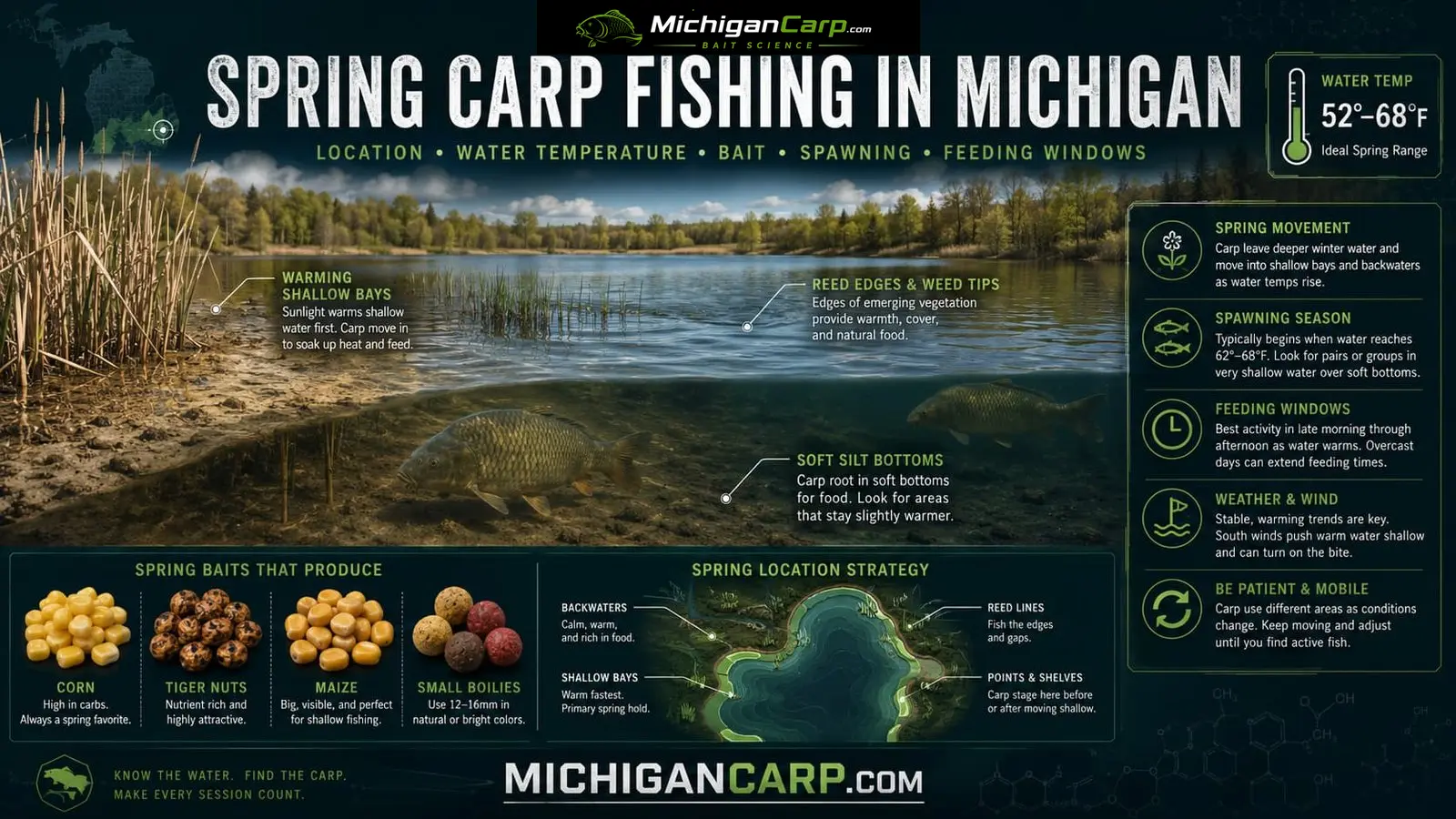
Spring carp fishing in Michigan is one of the most exciting parts of the carp season, but it is also one of the easiest times to get wrong.
After winter, everyone wants to get back out. The ice disappears, the sun feels stronger, shallow bays start to look alive, and carp begin showing signs of movement again. But spring carp are not always ready to feed heavily just because the air feels warm or the calendar says April.
That is the first big spring lesson.
Spring carp fishing in Michigan is controlled more by water temperature trends than by calendar dates.
A single warm afternoon may put carp in the shallows, but a cold night can push them back out. A dark-bottom bay may wake up quickly, while a deep clear lake may lag behind for weeks. A warm wind can switch on a bank, but a cold wind can make the same area feel empty. Carp may move before they feed properly. They may visit shallow water for warmth before they are willing to eat much bait. They may roll, cruise or gather near spawning areas without giving you a real feeding opportunity.
This article explains how to approach spring carp fishing in Michigan properly, including early spring water temperature, warming trends, shallow bays, reed edges, soft silt, wind direction, pre-spawn feeding, spawning confusion, post-spawn recovery, spring bait choice, light baiting, particles, boilies, tiger nuts, corn and short feeding windows.
For the full year-round seasonal framework, read Michigan Carp Fishing Seasons.
For the broader location process, read How to Find Carp in Lakes.
For visible signs of activity, read Signs Carp Are Feeding.
For spring particle strategy, read Spring Particles for Carp.
The simple spring rule is this:
Find warmth first, food second, safety water third, and do not overbait before the carp prove they are feeding.
Table of Contents
Quick Start: Spring Carp Fishing in Michigan
Use this table as the quick spring strategy guide.
| Spring Phase | Where to Look | Feeding Pattern | Best Bait Approach | Biggest Mistake |
|---|---|---|---|---|
| Ice-out / very early spring | Stable water, soft silt, deeper edges, first warming corners | Short, subtle feeding windows | Small hookbaits, tiny PVA sticks, light crumb | Fishing too shallow too soon |
| Warming trend | Dark-bottom bays, reed edges, shallow silt near depth | Carp may move shallow during warmest part of day | Corn, maize, small boilies, tiger nuts, light particles | Overbaiting after seeing one fish |
| Early pre-spawn | Shallow bays, reed lines, routes outside spawning areas | Feeding can improve quickly | Moderate but controlled baiting | Confusing rolling with feeding |
| Spawning period | Shallow weed, reeds, warm margins | Activity may be high but feeding poor | Leave spawning fish alone | Targeting fish focused on spawning |
| Post-spawn | Nearby feeding areas, bay mouths, weed edges, soft silt, points | Feeding improves again as fish recover | Boilies, particles, tiger nuts, corn, light packbait | Assuming all carp recover at once |
| Late spring / early summer transition | Weedlines, mussels, points, shallow-to-deep routes | More consistent feeding | Build bait only where signs confirm fish | Still fishing early-spring amounts everywhere |
Spring carp fishing rewards observation.
A shallow bay with no signs is only a theory. A shallow bay with warm wind, soft silt, bubbles, clouded water and a deeper route nearby is a real opportunity.
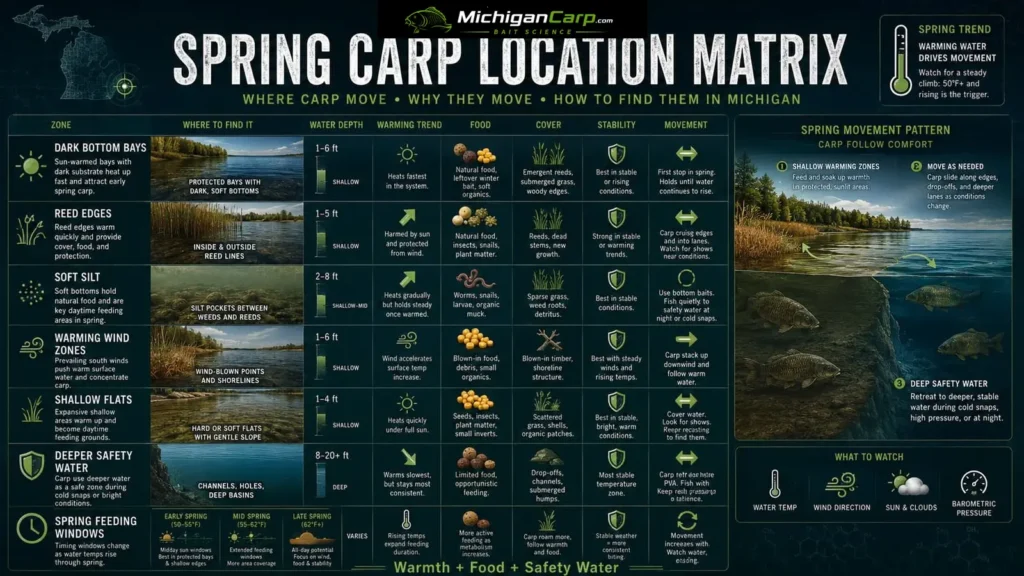
Spring Starts With Water Temperature, Not the Calendar
The biggest mistake in spring is thinking the month tells you everything.
It does not.
Michigan spring conditions can vary dramatically by region, lake type and year. A shallow southern Michigan lake may wake up earlier than a deep northern lake. A dark-bottom bay can warm much faster than open water. A dam pond, river mouth or channel may behave differently from an inland lake. A warm week can pull carp shallow, but one sharp cold front can push them back toward deeper, more stable water.
For carp fishing, the trend matters more than the exact number.
A lake that has moved from cold, stable water into several days of warming can be better than a lake that touched a slightly higher temperature for one afternoon and then dropped hard overnight. Carp respond to comfort, stability and opportunity. They may not feed confidently the first day conditions improve, but they often begin exploring the areas that warm first.
In practical terms, spring watercraft starts with asking:
Has the water been warming for several days?
Did the night temperatures stay reasonable?
Is the wind pushing warmer surface water into a useful bank?
Is there food in the shallow area?
Can carp retreat to deeper water if conditions change?
That last point is important. Early spring carp often like shallow water, but they do not want to be trapped there. The best spring shallows usually have an escape route: a bay mouth, a drop-off, a channel, a point, or deeper water nearby.
For official forecasts before a trip, use NOAA / National Weather Service. For lake layout and contour scouting, use Michigan DNR Inland Lake Maps.
Early Spring: The First Real Movement
Early spring is usually about finding the first areas carp are willing to visit, not forcing a heavy baiting campaign.
At this stage, carp may still be slow. They may feed briefly. They may show only during the warmest part of the day. They may roll or cruise without dropping down on bait. The visible signs can be subtle: one or two slow bubbles, a small patch of clouded silt, reed movement, a single fish rolling, or a bow wave in a protected corner.
The best early spring areas usually share three traits.
First, they warm faster than the surrounding water.
Second, they offer natural food.
Third, they connect to safer water.
Dark-bottom bays are good because they absorb heat. Soft silt can hold natural food. Reed edges and early weed can attract insects, snails and carp movement. Sheltered corners can warm faster during sunny conditions. Shallow flats near deeper water can become temporary feeding zones during the warmest part of the day.
This is not usually the time to fill it in with bait.
A better approach is to fish small, controlled traps. A few grains of corn, a small amount of maize, a tiger nut, a small boilie, a light crumb patch, or a small PVA stick can be enough. You are trying to intercept carp that are beginning to move and feed, not condition a whole lake.
Early spring also rewards patience. A bay may look dead in the morning and become active in the afternoon after the sun has worked on it. If you arrive, cast heavily at first light and leave by lunch, you may miss the most important window.
Warming Trends and the First Shallow Bays
A warming trend is one of the strongest spring signals.
One sunny day can help. Three or four mild days can change the lake.
When shallow water warms, carp often investigate bays, reed edges, dark-bottom corners and soft-bottom flats. They may not always feed hard, but they start appearing where winter carp were absent. The first shallow movement can be cautious and brief, but it is often the beginning of the spring pattern.
The best shallow bays are not just shallow.
They need a reason.
Look for bays with dark bottom, soft silt, reeds, early weed growth, sun exposure, low boat pressure, wind pushing in or across, and a route back to deeper water. A shallow sterile sand beach may warm quickly, but it may not hold much food. A soft-bottom bay with reeds, insects and a nearby drop-off is far more interesting.
Wind direction can make a big difference. A warm wind pushing into a shallow bay can move warmer surface water, food particles, insects, color and carp confidence into that area. A cold wind hitting the same bay can make it worse.
The best spring shallow bay often looks ordinary until conditions line up.
Then you see small signs.
A few bubbles.
A slight cloud.
A reed stem knocking.
A bow wave sliding along the margin.
One rolling fish.
That is when spring carp fishing becomes serious.
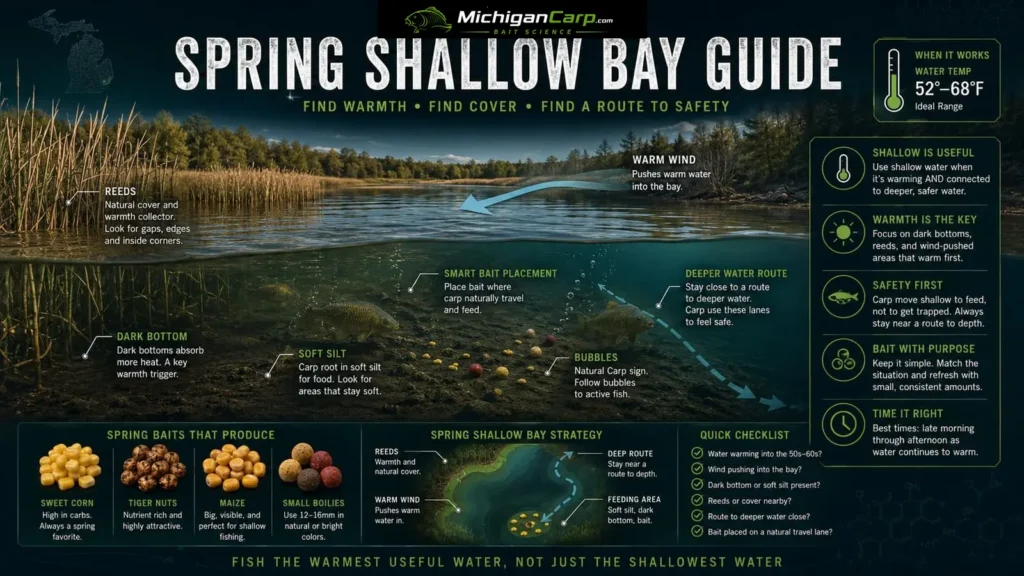
Best Spring Carp Locations in Michigan Lakes
Spring location is about finding the warmest useful water, not just the warmest water.
Useful water means carp have a reason to be there. Food, cover, safety and movement all matter.
Dark-bottom bays are often excellent because they warm quickly and may hold soft silt, insects and early natural food. Reed edges can be strong because they provide cover, warmth and food at the base of the stems. Soft silt pockets can produce bubbles and clouded water when carp start rooting. Shallow flats near deeper water can become temporary feeding areas during warming periods.
Bay mouths are also important. Sometimes carp will not push all the way into the back of a bay, but they will travel across the mouth or hold just outside it. If the shallow water looks right but the fish are not fully committed, the route leading in and out may be better than the shallowest corner.
Points can be good in spring when they connect deeper water to warming shallows. A point leading into a bay, or a point with wind pushing across one side, can act as a travel marker. One side may hold warmer water or food. The tip may give access to deeper safety water.
Inlets can be good or poor depending on temperature and flow. A warmer inflow can attract fish. A cold inflow can push them away. Muddy runoff may bring food and color, but it can also drop temperature or make presentation difficult. Do not assume every inflow is good in spring. Check what it is doing to the water.
On dam ponds, channels and reservoirs, spring carp may use softer backwaters, current seams, warmer margins, shallow arms and quiet edges off the main flow. Deep water nearby can be important because conditions change quickly.
For natural food location, read How to Find Natural Carp Feeding Areas in Michigan Lakes.
Spring Wind Direction and Weather Changes
Spring wind can either help you or hurt you.
A warm wind can push surface warmth, food, color and oxygen into a bank or bay. If that wind hits dark bottom, reeds, soft silt, early weed or a bay mouth, it can create a strong feeding opportunity. A cold wind can do the opposite, especially after a mild spell. It can chill shallow water, push fish back off the bank and make a previously active area feel empty.
This is why you should not blindly fish the wind in spring.
Ask whether the wind is improving the area.
A southwest wind after several mild days may be very different from a cold north wind after a frosty night. A windward bay with soft silt and reeds may be worth fishing. A windward stretch of sterile sand may still be poor. A sheltered bay may beat the windward bank if it has held warmth through cold nights.
Spring fronts matter too.
After a stable warming trend, carp may become much easier to locate. After a sharp cold front, shallow signs may vanish. A warm rain can sometimes help shallow water and inflows, but cold rain can knock things back. Bright sun can warm protected shallows, but clear cold nights can undo some of that gain.
The practical spring weather rule is:
Fish warming trends aggressively, but fish cold setbacks carefully.
During warming periods, look shallow and watch for signs.
After cold setbacks, check routes, bay mouths and slightly deeper water before assuming the fish have disappeared.
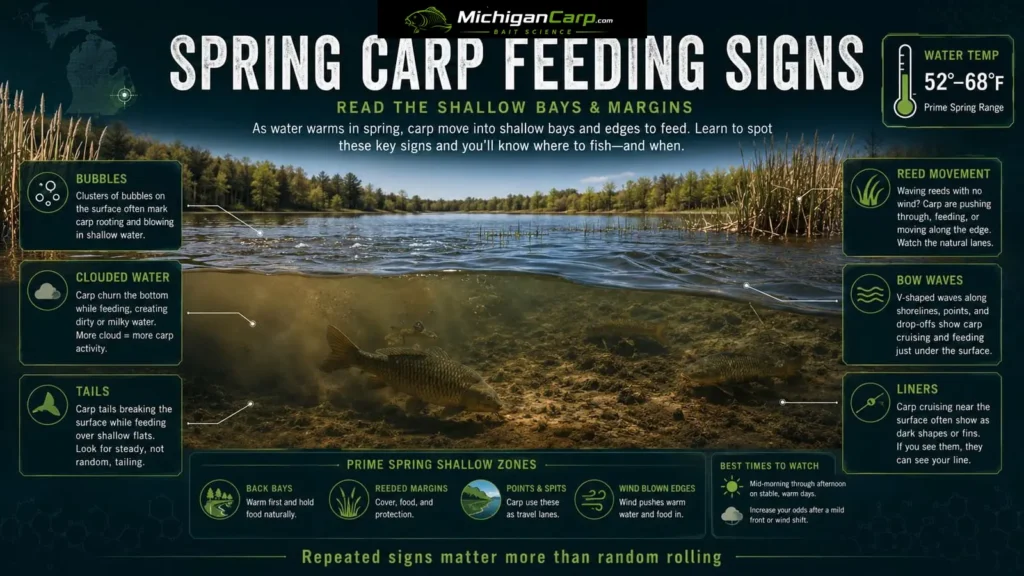
Signs Carp Are Feeding in Spring
Spring signs can be obvious, but they are often subtle at first.
The earliest useful signs are usually slow bubbles, small clouded patches, brief rolling, shallow bow waves, moving reeds and occasional tails in warm water. These signs may appear during short windows, often in the warmest part of the day.
Bubbles over soft silt are important, but they need interpretation. Random bubbles may be bottom gas. Moving bubbles that creep across a shallow bay, especially with clouded water nearby, are much more interesting.
Clouded water can be a very strong spring clue. Carp rooting in soft silt, clay, marl or reed bases can create small clouds that move or reform. If a shallow corner clouds during the warmest part of the day and then clears overnight, that is worth noting.
Rolling fish should be treated carefully. A roll shows carp are present, but not always feeding. Repeated rolling near a bay mouth, reed edge or shallow route is useful. One random roll in open water is weaker.
Tails are excellent signs, but tailing fish in spring are easy to spook. Stay low, watch the direction of movement and place bait carefully. Do not drop heavy bait directly on them.
Liners can also matter. If you get repeated liners on a route outside a shallow bay, carp may be moving in and out without settling on your bait. That is not failure. It is information.
For a deeper guide to reading activity, use Signs Carp Are Feeding.
Pre-Spawn Feeding: The Best Spring Window
Pre-spawn can be one of the best feeding windows of the year.
As water warms and carp become more active, they may feed strongly before spawning. This is the period many anglers hope to hit: carp are awake, moving, building energy and willing to eat.
But the window can be unpredictable.
Weather can move it forward or backward. Different parts of a lake may warm at different speeds. Not all carp spawn at the same time. Some fish may feed while others are already gathering in shallow areas. A shallow bay may show carp activity for days before they become genuinely catchable.
Pre-spawn locations often include shallow bays, reed edges, early weed, soft silt, gravel/silt transitions, bay mouths, points leading to spawning areas and routes just outside shallow zones.
The route outside the obvious activity can be more productive than the visible commotion. Carp may move in and out of shallows, and feeding fish may hold slightly off the bank before or after visiting the spawning areas.
Baiting can be increased carefully during pre-spawn if fish are feeding. Corn, maize, tiger nuts, particles, small boilies, crumb and light packbait can all work. This is a good time to build a swim only if the carp are clearly using it.
A good pre-spawn setup might include one rod on the shallow feeding edge, one on the route into the bay and one on slightly deeper safety water. Let the fish tell you which zone matters.
Spawning Confusion: Activity Is Not Always Feeding
Spring carp fishing becomes difficult when spawning begins.
Carp may crash, roll, push through reeds, cloud water, move in groups and show all over the shallows. It can look like the best carp fishing of the year, but it may actually be the worst time to catch them.
Spawning carp are not focused on feeding in the normal way.
They may ignore bait completely. They may be more interested in chasing, grouping and rubbing through weed or reeds. They may be visible, noisy and frustrating. This is where many anglers confuse activity with feeding.
There is also an ethical side. If carp are actively spawning, the best decision is to leave those fish alone and look elsewhere. Target fish before or after spawning activity, or fish routes and nearby feeding areas where carp are genuinely feeding rather than spawning.
Signs of spawning behavior may include groups of carp thrashing in very shallow water, repeated crashing in reeds or weeds, chasing behavior, fish rubbing through vegetation, and lots of movement with little interest in bait.
A single rolling fish or a few carp in shallow water does not automatically mean spawning. But if the activity is clearly spawning behavior, do not force the issue.
The practical rule is:
Do not mistake spawning noise for feeding confidence.
Post-Spawn Recovery and Late Spring Feeding
After spawning, carp do not all recover at once.
Some fish may be tired and uninterested. Others may begin feeding again quickly. The lake can feel inconsistent for a while, with fish visible but feeding windows uneven.
Post-spawn fishing often improves when carp move away from the shallow spawning areas and begin using nearby food again. Good locations include bay mouths, weed edges, soft silt, reed edges, points, hard/soft transitions and routes back toward deeper water.
This is a time to watch for real feeding signs rather than just fish presence. Bubbles, clouded water, liners, tails and repeated rolling over food areas matter more than random cruising.
Bait choice can become more flexible. Boilies, particles, tiger nuts, maize, corn, crumb and light packbait can all work. Baiting can increase if carp are feeding properly, but it should still be based on evidence.
Late spring often blends into early summer. Weed growth becomes more important. Natural food increases. Nuisance fish become more active. Boat traffic begins to matter. The best anglers adjust quickly instead of fishing the same early-spring approach too long.
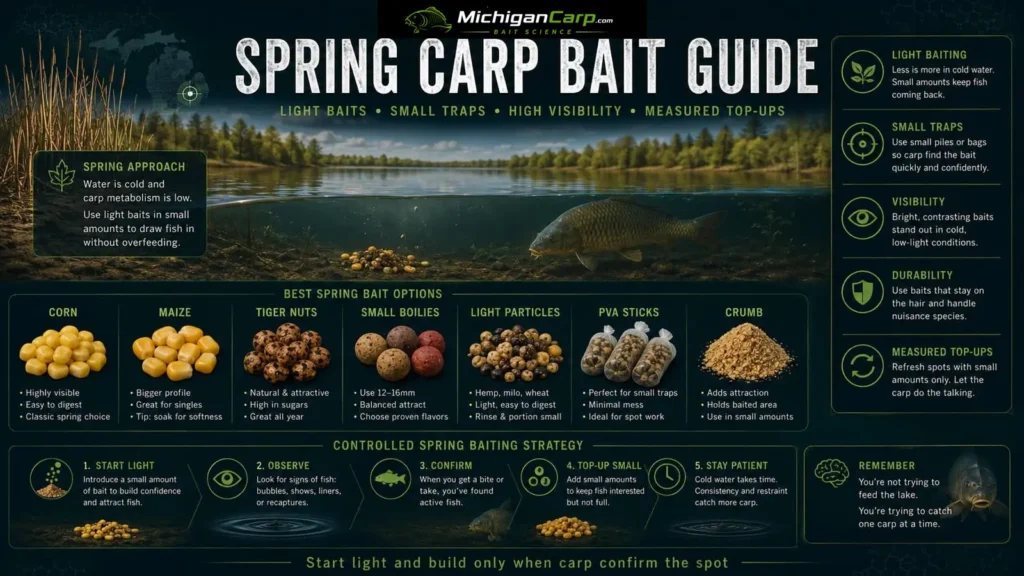
Spring Bait Strategy
Spring bait strategy should begin with restraint.
The biggest baiting mistake in spring is feeding like it is summer before the fish are ready. Carp may eat, but their feeding windows can be short. They may move through a swim without staying. They may pick up a single bait but ignore a large bed. They may feed one afternoon and disappear after a cold night.
Start with bait that is easy to find and easy to digest in modest amounts.
Corn, maize, tiger nuts, small boilies, light particles, small PVA sticks, crumb and small packbait traps can all work. You do not need to choose one bait for all of spring. Match the bait to the phase and location.
In very early spring, small hookbaits and tiny traps are often best.
During warming trends, corn, maize, tiger nuts and small boilies can be excellent in shallow bays and routes.
During pre-spawn feeding, you can increase bait if the fish are clearly eating.
During spawning activity, avoid targeting spawning fish.
After spawning, build the baiting only when carp are feeding again.
Spring is also a good time to use attractive but controlled bait. A small amount of crumb around a hookbait, a light PVA stick, or a few particles around a visible feeding route can be better than a heavy spread.
For general bait comparison, read Best Carp Bait for Michigan Lakes.
Spring Particles, Corn, Tiger Nuts and Boilies
Particles are very useful in spring, but they need to be used with control.
Corn and maize are easy, visible and familiar carp baits. They can work well in warming shallows, soft silt, shallow bays and light baiting situations. Prepared maize is especially useful when you want a slightly tougher particle than canned corn.
Tiger nuts can be excellent in spring because they are durable, selective and work well around weed, snails, silt edges and shallow feeding areas. They should always be prepared safely. For safe preparation and hookbait use, read Tiger Nuts for Carp Fishing.
Spring particles should not be used as a dumping exercise. Small amounts are often enough. A light scattering on a feeding route, a few grains around a hookbait, or a small particle trap with a boilie or tiger nut hookbait can be very effective.
Boilies also have a place in spring, especially when you want a more selective hookbait or a repeatable food signal. Smaller boilies, chopped boilies, crumb and single hookbaits can be better than large beds of whole bait early in the season. As pre-spawn feeding improves, boilies can become stronger.
For spring-specific particle advice, read Spring Particles for Carp.
For the broader particle guide, read Particles for Carp Fishing.
For corn, read Corn for Carp in Michigan.
How Much Bait to Use in Spring
Spring baiting should be based on evidence.
Do not decide the amount at home and force it onto the lake.
In very early spring, a single hookbait, a tiny PVA stick, a few grains of corn, or a small amount of crumb can be enough. If the fish are barely feeding, more bait does not fix the problem.
During a warming trend, you can increase slightly. A small pouch of particles, a few broken boilies, a light scattering of maize, or a small packbait trap can work if signs suggest carp are present.
During pre-spawn feeding, baiting can become more confident. But even then, build gradually. If liners, bubbles, clouding and bites increase, add bait. If the swim goes quiet, reduce bait and rethink placement.
After spawning, start controlled again. Some fish may feed, others may not. Let the lake show you.
A simple spring baiting rule is:
Start with less. Add only when carp confirm the spot.
If you are fishing a short session, keep bait tight and accurate. If you are fishing multiple days, you can build slowly, but only if signs and results justify it.
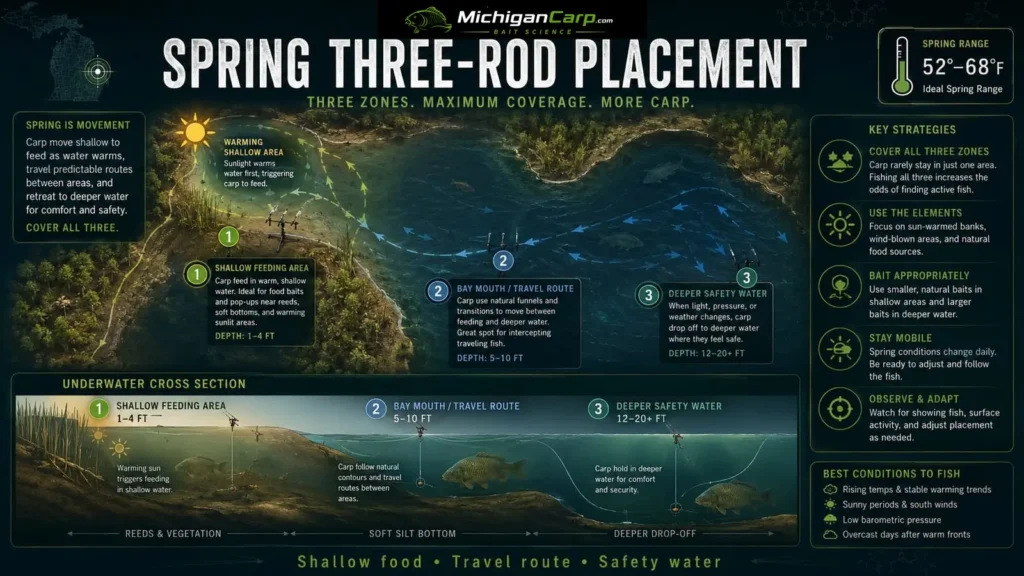
Spring Rod Placement
Spring rod placement should answer questions.
Do not cast all rods to the same shallow guess.
A good spring three-rod layout might be:
- one rod in the warmest shallow feeding area;
- one rod on the route into or out of that area;
- one rod on slightly deeper safety water.
This layout tells you whether carp are fully committed to the shallow area, moving through, or still holding off.
In a shallow bay, one rod might fish the soft silt edge, one the reed or weed route, and one the bay mouth. On a point, one rod might fish the windward side, one the tip or shelf, and one the deeper side. Near a spawning area, one rod might fish a genuine feeding route outside the activity rather than the commotion itself.
The key is learning.
If the shallow rod produces nothing but the bay-mouth rod gets liners, fish may not be fully moving in. If the shallow rod gets bites during the warmest part of the day, the bay has switched on. If the deeper rod produces after a cold night, the fish may have backed off.
Do not use three rods to repeat one assumption.
Use them to read spring movement.
Spring Session Plan
A good spring session starts before you arrive.
Check the weather trend first. Look for several days of warming, reasonable night temperatures, wind direction and whether a cold front has just passed. Then study the lake map and identify shallow bays, reed edges, soft silt, darker-bottom areas, bay mouths, points and deeper water nearby.
When you arrive, do not rush to cast.
Watch first.
Look for bubbles, rolling fish, clouded water, moving reeds, bow waves and bird activity. Check the wind. Walk the bank if possible. Look close before looking far because spring carp may be right in the margins during a warming trend.
Start with light baiting. Put one bait where spring warmth and food make sense, one on the likely route, and one on safer water. Give the swim time. Spring carp may feed in short windows, and recasting too often can make things worse.
If signs develop, adjust carefully. Move one rod closer to the activity, not all three. Add bait only if carp are feeding. If the shallow water stays dead after a cold night, move toward the bay mouth, deeper edge or more stable water.
At the end of the session, write down what happened. Spring patterns change quickly, but good notes help you track warming trends, productive winds, active bays and bite times.
Common Spring Carp Fishing Mistakes
The first mistake is fishing too shallow too soon.
Spring carp may visit shallow water before they feed there. If the shallow bay has no signs, no warmth, no food and no nearby depth, it may not be ready.
The second mistake is overbaiting. Heavy baiting before fish are feeding confidently can kill your chance. Spring rewards small, accurate, controlled baiting.
The third mistake is ignoring cold nights. A warm afternoon does not always overcome a freezing night. Carp may back out of shallow water after sharp temperature drops.
The fourth mistake is confusing spawning activity with feeding. Carp crashing in the reeds are not automatically catchable feeding fish. Respect spawning activity and look for genuine feeding before or after it.
The fifth mistake is not watching long enough. Spring signs may appear during short windows. If you arrive, cast immediately and stop observing, you may miss what the lake is telling you.
The sixth mistake is fishing the same spring pattern for too long. Late spring changes fast. Weed grows, spawning happens, boat traffic begins and early summer patterns start to replace early spring patterns.
My Practical View
Spring carp fishing in Michigan is about timing more than force.
You cannot make carp feed heavily before they are ready. You can only put yourself in the right area when the conditions start to line up.
I want warming water, useful shallow habitat, nearby safety water and real signs. Dark-bottom bays, reed edges, soft silt, warm wind, bay mouths and shallow-to-deep routes all get my attention. But I still want confirmation. Bubbles, clouded water, tails, liners or repeated rolling matter more than theory.
I also want restraint.
Early in spring, I would rather be slightly under-baited than heavily over-baited. A few grains of corn, a tiger nut, a small boilie, a light PVA stick or a small crumb patch can be enough when the fish are only just waking up. As the season develops and pre-spawn feeding improves, I will feed more if the carp prove they are staying.
The final rule is simple:
In spring, follow warming trends, fish useful shallow water near safety, watch for real feeding signs, and build bait only when the carp confirm the spot.
FAQ
When does spring carp fishing start in Michigan?
Spring carp fishing in Michigan starts when safe, legal, ice-free access is available and carp begin responding to warming water. In many areas, meaningful movement can begin in March or April, but conditions matter more than dates.
What is the best spring carp location in Michigan?
The best spring carp locations are usually shallow areas that warm quickly and connect to deeper safety water. Dark-bottom bays, reed edges, soft silt, shallow flats, bay mouths and sun-facing banks can all be productive.
Do carp feed right after ice-out?
Carp can feed after ice-out, but feeding is often slow and brief. Light baiting, small hookbaits and careful location are usually better than heavy baiting.
What water temperature is best for spring carp fishing?
There is no single magic number. A warming trend is often more important than an exact temperature. Carp become more active as water warms, especially when shallow areas warm for several days and nights do not drop too sharply.
What bait should I use for spring carp?
Good spring carp baits include corn, maize, tiger nuts, small boilies, light particles, crumb, small PVA sticks and single hookbaits. Use modest amounts until carp prove they are feeding.
Are tiger nuts good in spring?
Yes, tiger nuts can be very good in spring, especially around weed, silt edges, shallow feeding areas and selective hookbait situations. They must be prepared safely.
Are boilies good for spring carp?
Boilies can work well in spring, especially as single hookbaits, chopped bait, crumb, small boilies or controlled baiting. Avoid large beds of boilies before carp are feeding confidently.
How much bait should I use in spring?
Use less bait than you would in summer. Start with small amounts and increase only when you see signs, liners, bites or clear feeding activity.
Where do carp go before spawning?
Before spawning, carp often move toward shallow bays, reed edges, weed growth, warm margins and routes near spawning areas. They may feed on nearby routes before moving fully into spawning behavior.
Should I fish for spawning carp?
No. If carp are clearly spawning, leave them alone and look for genuine feeding fish before or after the spawning activity.
Why are carp rolling but not biting in spring?
Rolling shows carp are present, but not always feeding. They may be moving, staging, warming, gathering before spawning or using a route away from your bait.
Is afternoon better than morning in spring?
Often, yes. In early spring, the warmest part of the day can be better than first light, especially after sun has warmed shallow water.
Does wind matter in spring carp fishing?
Yes. A warm wind pushing into food-rich shallow water can help. A cold wind can hurt. Fish wind only when it improves the habitat.
What is the biggest spring carp fishing mistake?
The biggest mistake is overbaiting or fishing shallow water before conditions and feeding signs justify it.
Next Steps
Use these supporting guides next:
How to Find Natural Carp Feeding Areas in Michigan Lakes
Best Carp Bait for Michigan Lakes
Boilies vs Corn vs Particles for Carp
Summer Carp Fishing in Michigan