

Prebaiting big lakes can create a serious edge, but a four-week campaign is not four weeks of steadily adding more bait. It is a controlled test of one location, one repeatable food signal and one set of assumptions. The lake decides whether the campaign progresses.
That distinction matters on large Michigan waters. Carp may travel long distances, change routes with wind and water temperature, move away from boat pressure, and spend time on natural food that no amount of bait will replace. A campaign can build confidence on a genuine patrol route. It cannot make an empty area important simply because it is convenient to fish.
This is the operational companion to Carp Prebaiting in Michigan. That broader guide explains when prebaiting is worth doing. This article assumes the situation has passed that first test and shows how to run a practical four-week big-lake campaign without turning the calendar into a feeding rule.
If the location is not yet proven, stop here and use Advanced Big Lake Carp Tactics first. Finding the fish and preparing a spot are two different jobs. Location comes before bait in both.
A four-week campaign is a series of decisions: observe, probe, confirm, adapt and fish. Increase bait only when the evidence improves.
Table of Contents
Quick Start: The Four-Week Campaign at a Glance
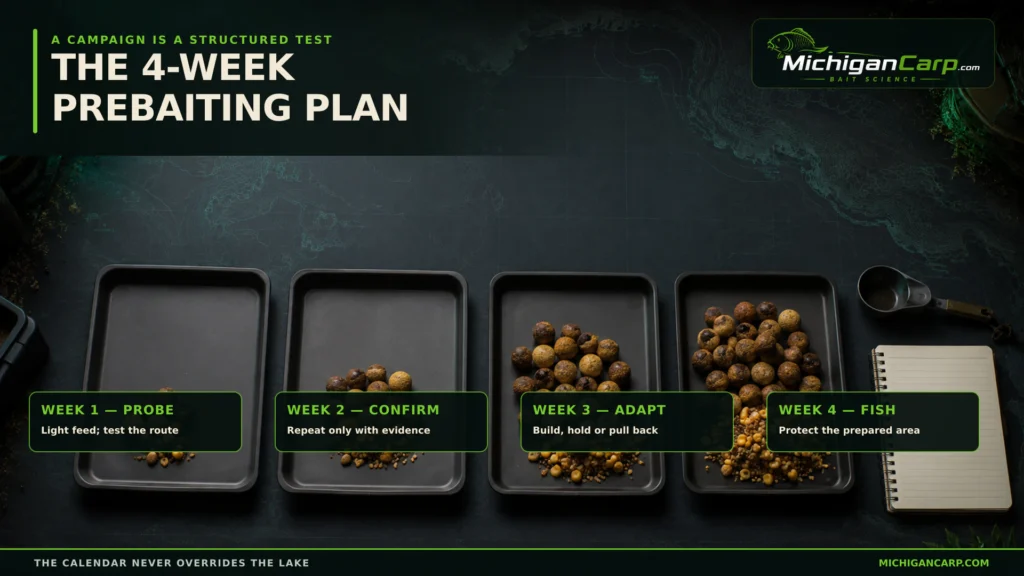
The plan below is a decision framework, not an automatic feeding ladder. Week 3 does not receive more bait simply because it follows Week 2. Each week must earn the next step.
| Stage | Main Job | Starting Action | Progress Only When | Stop or Reduce When |
|---|---|---|---|---|
| Before Week 1 | Prove the location | Observe without bait; map one compact target and one backup | Carp signs, prior captures or a believable route repeat | The area is only convenient, not productive |
| Week 1 | Probe | Two light, accurately measured feeds | The area remains active and bait appears to be used | Bait remains, conditions shift or nuisance species dominate |
| Week 2 | Confirm | Repeat the same bait, place and rhythm | Evidence improves across more than one visit | One weak clue is doing all the work |
| Week 3 | Adapt | Increase slightly, hold steady or pull back | Carp presence and bait clearance are both credible | The route, water conditions or access changes |
| Week 4 | Fish | Protect the prepared area and start with little extra feed | Fish response during the session justifies a top-up | The prebaited spot no longer matches the lake |
A main area and one backup are enough. Running five baited spots spreads observation, time and money so thinly that it becomes difficult to learn anything. The main spot should be compact enough to bait accurately and broad enough for two or three rigs only if the bottom and fish movement genuinely support that.
Use the same core bait through the campaign. You may adjust amount, particle fraction or whole-boilie fraction for a reason, but do not change flavor, food signal and presentation every visit. Consistency is part of the test.
Before Week 1: Prove the Spot Deserves Bait
Do not use bait to answer a location question that observation could answer more cleanly. Spend at least two visits watching the area under useful conditions. One dawn and one evening observation are more informative than driving past at noon and deciding the swim looks comfortable.
A good campaign spot is normally part of something the carp already use: a route between deep safety water and a feeding shelf, a clean patch beside weed, a firm edge next to softer natural-food ground, a bay mouth, a sheltered wind-influenced bank, or a quiet margin that receives regular visits. The exact feature matters less than repeat use.
| Pre-Campaign Check | Pass | Warning |
|---|---|---|
| Carp evidence | Shows, feeding bubbles, disturbed silt, bow waves, liners from a previous session or reliable captures | No direct sign and no history |
| Route logic | The area connects feeding water, cover, depth or a known movement line | Featureless water selected only for access |
| Bottom | Rig can be presented and bait will remain in the intended zone | Steep slope, deep debris, dense weed or undertow carries bait away |
| Access | You can bait quietly and accurately two or three times a week | Every visit creates noise, attention or conflict |
| Fishing access | The spot will still be legally and practically fishable in Week 4 | Events, closures, swimmers, boat traffic or other anglers are likely to block it |
| Backup | A second nearby route can be monitored without splitting the main campaign | No alternative if wind or pressure makes the main area wrong |
Mark the Target Without Advertising It
Record two or three shore markers, a measured casting distance and the line of the drop. If using a boat where legal and safe, record the route and exact feature without leaving a marker that creates a navigation hazard or advertises the spot. A phone waypoint can help, but shore triangulation and a measured cast still matter when GPS accuracy or wind drift is poor.
The feeding area should be defined in practical terms: for example, a compact patch on the clean side of a weed edge, not “somewhere in the bay.” Accuracy lets you interpret results. If each visit lands in a different place, the campaign has no consistent treatment.
Use the Backup as Insurance, Not a Second Full Campaign
The backup area can receive a very light test feed or observation only. Its job is to protect the session if the wind changes, the main swim is occupied, or carp shift routes. Feeding both areas equally doubles the cost and halves the clarity. Choose one main hypothesis.
Choose a Campaign Bait You Can Repeat
A campaign bait has to be affordable, safe, repeatable and suitable for the nuisance species. It also has to match the way you intend to fish. Four weeks of particles followed by an unrelated single hookbait is less coherent than a food system that carries through to the rig area.
| Campaign Direction | Strength | Watch For | Best Fit |
|---|---|---|---|
| Boilie-led | Easy to count, weigh, spread and repeat; relatively selective | Cost, rolling on slopes, crayfish and birds | Longer campaigns, larger fish, nuisance pressure and matching hookbaits |
| Prepared-particle-led | Economical browsing food with many small items | Safe preparation, wet-weight inconsistency, panfish, turtles and birds | Warm water, active carp and areas that can hold browsing fish |
| Boilie plus particle | Combines repeatable larger food items with a busy feeding patch | The particle fraction becoming uncontrolled bulk | Known feeding areas where nuisance pressure is manageable |
| Pellet-supported | Adds manufactured feed, crumb and short-term signal | Breakdown, richness and bait disappearing without carp involvement | Small support fraction when the actual pellet has been water-tested |
| Selective hard-bait plan | Reduces attention from some small fish | No bait is nuisance-proof; crayfish and turtles can still dominate | Whole boilies, properly prepared maize or tiger nuts where legal and appropriate |
Use Particles for Carp Fishing for preparation and safety, and Pellets for Carp for choosing and water-testing manufactured feed. Pellets are usually better as a measured support layer than as the entire four-week campaign because their structure and food signal can change quickly in water.
Record Components Separately
A pound of dry boilies and a pound of wet prepared particles do not represent the same dry matter, food density or number of items. If the campaign uses a blend, record each component separately: whole boilies, chopped boilies, prepared maize, small seed and pellets. “One bucket” is too vague to reproduce.
Weigh a normal scoop of each prepared component at home. Then the field log can say “12 ounces of prepared particles plus 4 ounces of boilies” instead of “a few scoops.” That small habit makes the four-week comparison much more useful.
Do Not Chase Novelty
The objective is familiarity and repeat visits, not a new flavor every Monday. Keep the base food signal stable. If something changes, change one variable with a written reason. Adding three new liquids, a different pellet and a brighter bait at once destroys the information the campaign should produce.
Week 1: Probe the Area
Week 1 asks whether the location and bait can produce a repeatable response. It is not the time to “establish a bed” with a large introduction. The lighter the first treatment, the easier it is to recover if the spot is wrong.
First Baiting Visit
Observe first. If the area still makes sense, apply roughly 8–16 ounces (225–450 g) of total ready-to-use bait to one compact zone. Use the lower end in cool water, uncertain conditions or low carp activity. This is a practical starting range, not a rule and not a claim about how much the fish require.
Record water temperature if available, wind, water level, clarity, weed condition, bird or turtle activity, carp signs and the exact bait. Leave quietly. Do not stand over the spot for another hour throwing in extra handfuls because the first amount looked small.
Second Baiting Visit
Return after a consistent interval—often 48 to 72 hours for a realistic Michigan schedule. Observe before adding anything. If the route still looks active and there is no negative evidence, repeat approximately the same amount. Repetition is more useful than increasing at the second visit.
If safe observation shows bait untouched, do not cover it with another layer. If birds, panfish, turtles, crayfish or current are responsible for the activity, modify the bait type or placement before concluding that carp are responding.
Week 1 Decision
- Progress: carp signs repeat, the area stays relevant and bait use is credible.
- Hold: location still looks right but evidence is weak or ambiguous.
- Stop: bait remains, the route disappears, access becomes unsuitable or nuisance activity dominates.
Week 2: Confirm Repeat Visits
Week 2 is about confirmation. One muddy patch, one missing handful or one carp showing somewhere in the bay is not enough. Look for a pattern across more than one visit.
Keep the same core bait and target. If Week 1 produced credible evidence, a sensible starting range is about 12–24 ounces (340–680 g) per visit, usually on two visits. If evidence remains uncertain, repeat the Week 1 level instead. The week number never earns a larger feed.
Look for Converging Evidence
The strongest case combines several clues: carp show on the route, the bottom becomes freshly disturbed, feeding bubbles occur near the target, the bait appears to clear at a realistic rate, and later short fishing produces liners or bites. Each clue has alternatives. Together they become more persuasive.
The protected Signs Carp Are Feeding guide explains how to separate carp activity from wind bubbles, decomposing bottom material and other false positives. Use that evidence standard here rather than treating any fizzing as proof.
Keep the Area Compact
Do not widen the baited area simply because you have more confidence. A big spread can make sense on a broad travel line, but it also makes the fish harder to position and the campaign harder to measure. First confirm that carp are returning to the original zone. Expansion should solve a presentation problem, not satisfy the urge to cover water.
Do Not Fish the Main Spot Without Accounting for Pressure
A short test session can provide valuable evidence, but lines, leads, captures and bank activity change the treatment. If you fish the main area in Week 2, record it and do not pretend the spot remained undisturbed. When possible, observe the main zone and fish the backup or another water until the planned Week 4 session.
Week 3: Build Carefully or Pull Back
By Week 3, the campaign should have a direction. Either carp are using the zone often enough to justify more food, the evidence supports holding the level, or the original idea is failing. Continuing exactly as planned despite poor evidence is not discipline. It is sunk-cost thinking.
When a Small Increase Makes Sense
A measured increase can make sense when carp presence is credible, bait clears at a repeatable rate, water conditions remain stable, and nuisance activity is not explaining the result. In that situation, about 1–2 pounds (450–900 g) of total ready-to-use bait per visit is a practical moderate range for one compact zone. A large, active shoal may justify more, but the campaign should produce that evidence before the amount rises.
When Holding Steady Is the Stronger Choice
Hold the Week 2 amount when the area is still promising but the response is only partial. Stable feeding at a moderate level is more valuable than a forced increase. You are not trying to discover the maximum amount the swim can absorb. You are trying to create confident feeding that leaves a hookbait competitive.
When to Reduce, Rest or Move
Reduce or stop when bait remains, carp signs shift away, a cold front changes the route, oxygen or weed conditions deteriorate, or nuisance species become the main consumers. Resting the spot for several days may tell you more than feeding it again. If the lake points elsewhere, use the backup rather than trying to buy loyalty from a moving fish.
Week 4: Fish the Prepared Area
The final week is not a celebration bait-up. It is where the campaign is converted into a clean fishing opportunity. A tidy feeding pattern can be damaged by a large final dump, three leads scattered across the zone or constant recasting before the expected window.
The Final Pre-Session Feed
If the spot has been clearing reliably, apply the established amount roughly 24–48 hours before fishing. Match the interval that worked during the campaign. Do not double it because this is the “last feed.” If the response has been strong but conditions change before the session, reduce or skip the final introduction.
Arrival and Rod Placement
Watch the water before setting up. If the route still matches the plan, place the first rig on the heart or clean edge of the prepared area. A second rig can cover the approach line, and a third—where rules, safety and swim width allow—can test the backup or a deeper safety route. Do not put three rigs shoulder to shoulder on one small feeding patch.
| Session Situation | Starting Feed | Top-Up Decision |
|---|---|---|
| Carp active on arrival | Rigs first; little or no automatic loose feed | Top up after a bite, clear feeding spell or strong evidence |
| Area looks right but quiet | Small matching top-up or PVA around the rig | Wait through the expected window before increasing |
| Conditions shifted but main spot still plausible | Keep main rod; use another rod to test the adjusted route | Feed the new line only after it shows promise |
| Main spot now looks wrong | Do not fish it from obligation | Move to the backup or follow current signs |
| Multiple fish respond | Replace only part of what may have been eaten | Use capture rate and continued activity, not excitement, to scale up |
During the session, use the completed On-the-Water Adjustments system: change location, timing, presentation and baiting in that order. The four-week investment does not remove the need to read the current water.
How Much Bait to Use Per Visit
No single amount can account for carp numbers, fish size, water temperature, natural food, nuisance species, bottom type and visit frequency. The ranges below are cautious field starting points for one compact campaign zone. They are not feeding requirements, legal limits or promises.
| Evidence Level | Practical Starting Range Per Visit | Use When | Do Not Increase Because |
|---|---|---|---|
| Cold, uncertain or low confidence | 8–16 oz (225–450 g) total bait | First probes, cool water, low stock or unclear response | The amount looks small on a big lake |
| Moderate, repeatable response | 1–2 lb (450–900 g) total bait | Carp signs and bait clearance repeat under stable conditions | A calendar week changed |
| Strong confirmed feeding | 2–4 lb (0.9–1.8 kg) total bait | Several carp or a known shoal is clearing the zone and nuisance pressure is understood | One busy visit or missing bait alone |
| More than 4 lb (1.8 kg) | Exceptional rather than default | High-stock water, strong repeated evidence and a spot that demonstrably carries it | Big water supposedly requires big bait |
For the broader quantity system, use How Much Bait to Use for Carp. The campaign ranges here are deliberately narrow because they apply to repeated feeds before fishing, not the total bait for every possible session.
Frequency Can Matter More Than One Large Feed
Two smaller, accurate visits can teach you more than one large weekly introduction. They also shorten the time between bait and observation. Most anglers cannot bait daily, and they do not need to. A realistic two-visit rhythm is better than a perfect schedule that cannot be maintained.
Adjust for Season and Water Temperature
Early spring and late fall campaigns usually need lower amounts, tighter zones and more willingness to stop. Stable summer and early-fall conditions may support more food, but warm water also brings weed growth, natural food, turtles, panfish, boat traffic and occasional low-oxygen problems. Use Seasonal Baiting and the Carp Water Temperature Guide to interpret the current season rather than following the same four-week amounts year-round.
Read the Evidence and Change the Plan
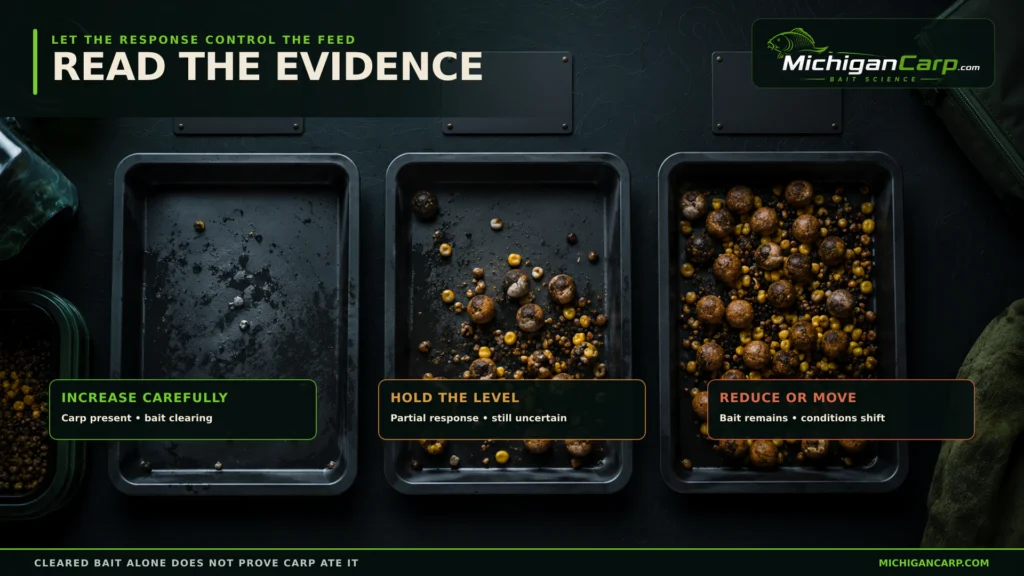
A campaign becomes useful when it changes according to evidence. The most important image is not an upward line of bait. It is a decision tree.
| Evidence | Likely Meaning | Next Action |
|---|---|---|
| Carp show or feed on the exact line; bait clears; conditions stable | Campaign is probably intersecting genuine carp use | Repeat or increase slightly |
| Bait partly clears; occasional carp signs; nuisance activity possible | Response is promising but not resolved | Hold amount and improve observation |
| Bait disappears but no carp evidence | Consumer is unknown | Change bait selectivity or verify with a camera where legal and practical |
| Bait remains; no carp signs | Location, timing or amount may be wrong | Stop feeding; rest or move |
| Carp show outside the baited area | Route shifted or the bait is off-line | Follow the fish; do not defend the original waypoint |
| Nuisance fish, turtles, birds or crayfish dominate | The food is not reaching carp as intended | Reduce, harden or simplify the bait; consider a boilie-led plan |
| Cold front, oxygen concern, weed change or heavy pressure | The campaign environment changed | Reduce, pause or use the backup |
Cleared Bait Is Not Proof
Bait can disappear through carp, other fish, crayfish, turtles, ducks, geese, current, slope or soft bottom. A camera can help where its use is safe and permitted, but even a camera samples one field of view. Combine it with water signs and eventual fishing results.
Silence Does Not Mean Add More
When a spot goes quiet, the first questions are location, conditions and observation quality. More food is only one possible response, and often the weakest. If the fish moved with wind, temperature, oxygen or pressure, additional bait on the old line creates waste.
A Failed Campaign Can Still Be Useful
If the log shows that one route stopped after a wind change, particles attracted turtles, or the chosen access disturbed the margin, the campaign produced information. The failure is repeating it without change. A four-week blueprint should make future campaigns shorter and more precise.
Keep the Campaign Accurate, Quiet and Legal
Check the rules before the first baiting visit, not on the morning of the final session. Use the current Michigan Carp Fishing Regulations guide as a practical starting point and confirm details in the official 2026 Michigan Fishing Regulations.
State fishing rules are not the only layer. City parks, state parks, campgrounds, federal land, marinas, utility properties and private access agreements may impose additional limits on access, hours, boating or introducing bait. Do not assume that legal fishing automatically gives permission to run a prebaiting campaign from every property.
Keep Food Bait Separate from Baitfish Rules
Boilies, prepared seeds and manufactured pellets are not baitfish. Do not introduce live fish, move baitfish between waters or treat live-bait rules as permission to release unused organisms. Follow the official rules for every bait category actually used.
Prevent Movement Between Waters
Do not transfer lake water, aquatic plants, mud or unused living material from one water to another. Clean equipment and dispose of leftovers responsibly. The official 2026 regulations remind anglers to dispose of bait containers properly and prevent the spread of invasive species. A campaign is not an excuse to leave spoiled bait or empty containers at an access site.
Protect the Spot and Other Anglers
Bait quietly, avoid blocking ramps and public paths, and do not create wildlife concentrations where walkers or land managers will see a mess. Do not claim ownership of a public swim because you baited it. If another angler is there in Week 4, use the backup and remain courteous.
Use a Simple Campaign Log
The log does not need to be complicated. It needs enough detail to distinguish a genuine pattern from memory and optimism.
| Date / Time | Conditions | Carp Evidence | Bait and Amount | Nuisance Evidence | Decision |
|---|---|---|---|---|---|
| Visit 1 | Wind, temperature, water level, clarity | Shows, bubbles, disturbance, none | Each component by weight | Birds, turtles, panfish, crayfish, unknown | Repeat, hold, reduce, stop |
| Visit 2 | |||||
| Visit 3 | |||||
| Visit 4 | |||||
| Visit 5 | |||||
| Fishing session | Bites, liners, shows, captures | Starting feed and top-ups | Keep, modify or abandon |
Add one map note: exact target, casting distance, shore markers and the backup. Photograph the water from the same angle on each visit when that can be done without revealing private information. Changes in weed, level and clarity are often easier to see in a sequence of photographs than from memory.
Write the Decision Before the Next Visit
End every entry with one of four words: repeat, increase, reduce or stop. Add one sentence explaining why. That prevents the next baiting visit from becoming an emotional response to how much time or bait has already been invested.
FAQ
Do I have to prebait for four full weeks?
No. The four-week structure is useful when access, fish movement and a longer campaign justify it. Two or three light feeds before a weekend can be enough on a known route. Stop early if the evidence fails.
How often should I bait during the campaign?
Two consistent visits a week is a practical starting rhythm for many anglers. Daily baiting can work, but only when the spot, fish response, cost and access support it. A repeatable schedule is more useful than an ambitious schedule that collapses.
Should the amount increase every week?
No. Increase only when carp presence, bait clearance and stable conditions support it. Hold, reduce or stop whenever the evidence weakens.
Is a bucket of bait too much on a big lake?
It may be far too much, reasonable or not enough for a large active shoal. “Big lake” does not answer the quantity question. Stock, activity, water temperature, nuisance species and observed clearance do. Start with weighed amounts rather than bucket volume.
Are boilies better than particles for a long campaign?
Boilies are easier to count, repeat and match with hookbaits, and they can be more selective. Prepared particles are economical and encourage browsing but can attract more nuisance activity. A controlled blend often works, but the best choice depends on the water.
Should I fish the spot during the first three weeks?
Ideally, keep pressure off the main area until the planned session. If you run a short test, record it because leads, lines and captures alter fish confidence. Fish the backup or observe when possible.
What if someone else fishes the baited swim?
Public water remains public. Use the backup, remain courteous and do not create conflict. The possibility of another angler using the spot is one reason a four-week campaign should never be your only plan.
What if the wind changes before the final session?
Reassess the lake. Keep a rod on the prepared area only if it still makes sense, then test the new route with another rod. If the fish clearly moved, follow them. Previous bait is not a reason to ignore current conditions.
Next Steps
- Carp Prebaiting in Michigan — decide whether prebaiting fits the venue and session.
- Advanced Big Lake Carp Tactics — prove the route before introducing food.
- How Much Bait to Use for Carp — scale feed to temperature, activity and session type.
- Signs Carp Are Feeding — judge bubbles, disturbed water, shows and liners accurately.
- On-the-Water Adjustments — respond if the final session does not match the campaign plan.