

How Carp Feed: Underwater Behavior Explained
If you really want to improve your carp fishing, you need to understand one thing first:
How carp actually feed underwater.
Most anglers spend too much time thinking about bait names, rig trends, and casting distance without first understanding what the fish are actually doing on the lakebed.
Carp do not usually feed like hunters charging at prey. Most of the time they feed by grubbing, testing, sorting, and moving slowly through small feeding areas.
Once you understand that, a lot of other things become clearer:
- why subtle baiting often works better than piling it in
- why fizzing and tiny sediment clouds matter
- why some takes are confident and some are just liners or aborted pickups
- why simple rigs often outfish clever-looking ones
- why location still comes first
This page is the practical explanation. If you want the broader bait overview, start with Carp Bait Guide for Michigan Lakes. If you want the deeper science and ingredient-thinking side, read The Smart Angler’s Guide to Carp Bait. If you want the practical big-lake application, follow this with Best Carp Bait for Michigan Lakes.
Quick Start
If you want the simple version, remember this:
- Carp usually feed by grubbing along the bottom, not chasing bait around
- They rely heavily on smell and taste, not sight alone
- They often test bait before eating it properly
- Feeding areas are usually tight and repeatable, not random
- Your bait needs to sit naturally where they are already feeding
- Your rig needs to hook fish on a cautious pickup, not just an aggressive take
- Overbaiting often kills your chance faster than underbaiting
How Carp Actually Find Food
Carp are not predators in the usual sense. They are natural foragers.
They move slowly over the lakebed looking for things like:
- snails
- bloodworm
- insect larvae
- mussels
- small invertebrates
- edible bits trapped in silt, weed, or soft bottom
They find that food mainly by using:
- smell in the water
- taste through the mouth and barbels
- subtle movement and contact with the bottom
That is why a bait that leaks attraction and sits in the right spot is easier for a carp to find than one that simply looks impressive to us.
In simple terms, carp often smell food before they properly inspect it.
The “Grubbing” Feeding Behavior
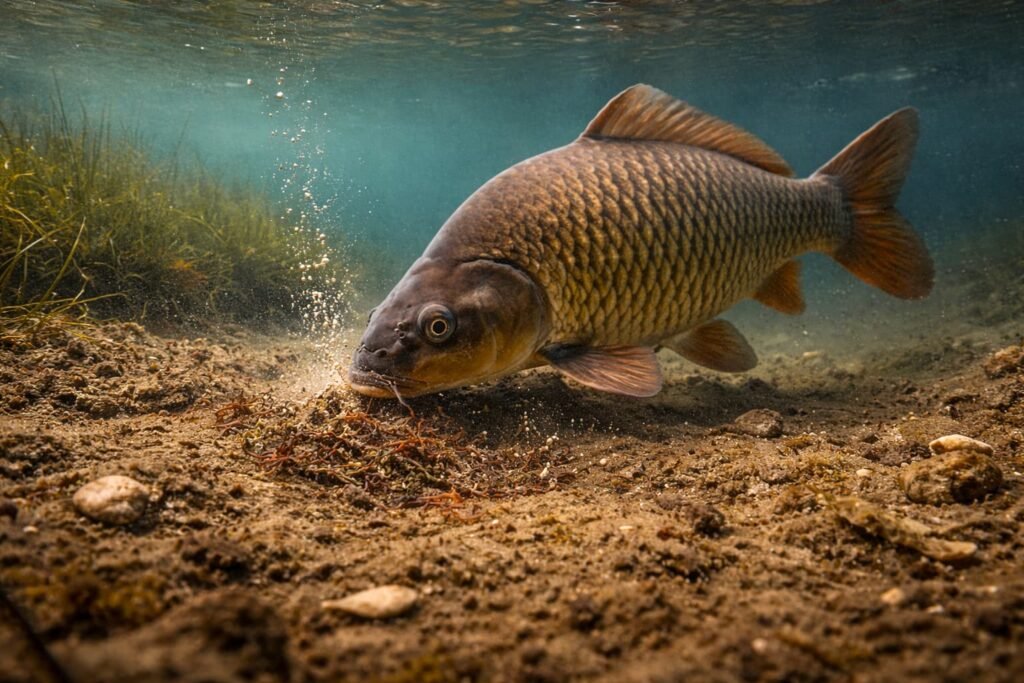
A lot of feeding happens with carp moving along the bottom and taking in mouthfuls of silt, debris, and food together.
They then sort that material by:
- sucking it in
- separating edible items from waste
- blowing out what they do not want
- moving a few inches and repeating the process
That creates the signs anglers often see as feeding activity:
- small clouds of disturbed silt
- tiny streams or patches of bubbles
- subtle rolling or tailing movement
- repeated disturbance in one small area
If you see gentle fizz and soft sediment disturbance in the same area more than once, there is a fair chance fish are feeding there.
Why Carp Produce Bubbles (Fizz)
Not every bubble is a carp.
But when carp grub through soft bottom, they often release:
- trapped gases from the lakebed
- tiny air pockets
- disturbed organic matter
The key is the pattern.
Good carp fizz is usually:
- small rather than explosive
- in a line, patch, or small area
- repeated rather than random
- tied to soft bottom, silt, weed edges, or feeding zones
That matters because it gives you a clue not just that fish are present, but that they are actually feeding.
How Carp Test Your Bait
Carp do not always rush in and eat confidently.
Very often they:
- approach carefully
- suck in the bait
- test it
- either eject it or eat it properly
This can happen very quickly.
That is why the following things matter so much:
- sharp hooks
- efficient rig mechanics
- natural presentation
- hookbaits that do not feel out of place
- not burying the rig under too much feed
A lot of missed chances happen because the fish found the bait, tested it, and did not like how it behaved.
Why Carp Reject Bait
Carp reject bait for a few common reasons:
- something feels wrong
- the hook or rig creates resistance
- the bait feels unnatural
- the fish are feeding cautiously
- the area is too disturbed
- they have already seen similar mistakes before
On clearer Michigan waters, especially where fish have natural food and get a good look at what is going on around them, this matters even more.
Your job is not just to make bait attractive.
Your job is to make the whole presentation feel safe, natural, and easy to accept.
Feeding Zones: Not Everywhere
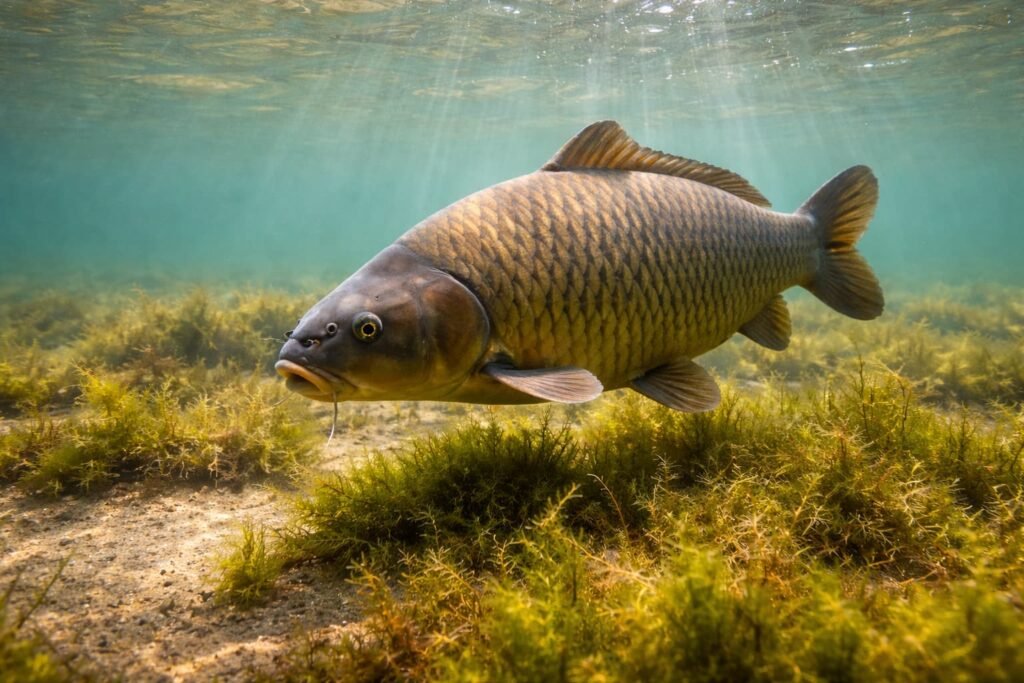
One of the biggest mistakes anglers make is assuming carp feed all over the lake in the same way.
They do not.
Most of the time, they feed in small repeatable zones.
These can include:
- weed edges
- silt patches
- shallow warming areas
- margins
- transition lines
- spots with natural food already present
That is why finding carp comes first.
A brilliant bait in the wrong area is still the wrong bait.
How This Affects Your Baiting
Now it all starts to connect.
Tight Feeding = Better Results
Because carp feed in small zones, your baiting usually works better when it is:
- tight
- accurate
- controlled
- built around a clear feeding area
Do not spread bait everywhere unless the situation truly calls for it.
Natural Feeding = Better Bites
Because carp are often grubbing and sorting, your baiting should often match that behaviour:
- small particles
- crumb
- tight little patches
- light but regular feed
- hookbait sitting naturally among free offerings
Overbaiting Kills Action
Too much bait can:
- fill fish up
- reduce competition
- move the feeding zone too wide
- bury your rig in feed
- make the whole area feel wrong
On Michigan lakes with plenty of natural food already available, overbaiting is often one of the quickest ways to slow the whole thing down.
That is one reason the practical big-water follow-up page matters: Best Carp Bait for Michigan Lakes.
How This Affects Your Rig Choice
Once you understand how carp feed, rig choice gets simpler.
Bottom Feeding = Bottom Baits Work
If carp are grubbing on the lakebed, then:
- bottom baits often make perfect sense
- balanced simple presentations often shine
- overcomplicated rigs are often unnecessary
Cautious Feeding = Efficient Rigs
Because carp often test bait before fully committing, your rig needs to:
- hook quickly
- work with limited movement
- avoid unnecessary complexity
- stay sharp and efficient
Messy Bottom = Presentation Matters
If the rig is buried, tangled, or masked by debris:
- fish may not find it properly
- the bait may behave unnaturally
- bites can turn into nothing
That is where tight PVA work, careful lead placement, and sensible presentation come in.
The lesson is simple:
Match the rig to the feeding situation, not to fashion.
How This Affects Your Location
Because carp feed where natural food exists, you should pay close attention to places such as:
- silt areas
- weed edges
- shallow warm zones
- margins
- natural patrol routes
If fish are not feeding there, the bait and rig are already on the back foot.
This is why location remains more important than tackle cleverness.
Michigan Notes
On Northern Michigan waters, a few things stand out again and again:
- natural food can be abundant
- carp often feed heavily on the lakebed
- clear water can make fish more cautious
- spring feeding is often light and focused
- summer feeding can be stronger but still selective
- silt and weed edges are often key feeding areas
That means your approach should usually focus on:
- finding feeding fish first
- presenting bait naturally
- keeping the baiting under control
- avoiding unnecessary complication
Common Mistakes
- Thinking carp “hunt” bait like predators
- Spreading bait too widely
- Ignoring fizz and feeding signs
- Assuming sight matters more than smell and taste
- Using rigs that do not suit cautious feeding
- Burying the rig in too much feed
- Fishing a nice setup where there are no feeding fish
- Overcomplicating presentation when a simple one would do
FAQ
Do carp actively hunt bait?
Usually not in the way many anglers imagine. Most of the time they feed by grubbing along the bottom and sorting food from debris.
What are carp bubbles or fizz?
Usually small bubbles caused by carp disturbing the lakebed while feeding.
Do carp see bait easily?
They can, but when feeding they rely heavily on smell, taste, and close-range inspection.
Why do carp pick up and drop bait?
Because they often test bait before properly eating it, especially in pressured or clear-water situations.
Is natural bait always better?
Not always, but bait that behaves like part of the lakebed and fits what fish are already feeding on often gets accepted more confidently.
What is the biggest lesson here?
Carp feed in small zones, cautiously, and close to the bottom. Your baiting and rigs should reflect that.
Next Steps
Build out the full picture with these pages:
- Carp Bait Guide for Michigan Lakes — the broad practical overview
- Best Carp Bait for Michigan Lakes — how to apply bait properly on big natural waters
- The Smart Angler’s Guide to Carp Bait — the deeper ingredient and science side
Final Word
Most anglers do not need more bait choice.
They need a clearer picture of what carp are actually doing underwater.
Once you understand that carp are grubbing, sorting, testing, and feeding in tight little zones, better decisions start to follow:
- better location
- better baiting
- better rigs
- better takes
That is where better carp fishing really starts.