

Back leads for carp fishing are one of those bits of tackle that can either solve a real problem or create one you did not have in the first place.
Used properly, a drop back lead can pin your main line down, keep it away from boats and birds, reduce liners, and help you fish multiple rods more neatly from the bank. Used badly, it can kill bite indication, give a hooked carp extra time to reach snags, drag your line across mussels or rocks, and make a simple setup more complicated than it needs to be.
That is why the weight matters. A back lead is not just “a small lead clipped on the line.” Its weight changes the angle of your line, the resistance a carp feels, how quickly your alarm registers a take, how much line can move before you know about it, and whether the back lead stays pinned or lifts off the bottom.
For Michigan carp fishing, I would treat back leads as a useful tool, not standard kit. Many Michigan waters are big, open, weedy, mussel-lined, snaggy, or affected by boats and wind. Some situations suit back leads very well. Others are better fished with low rod tips, semi-slack line, tubing, leader material, heavier main leads, or simply better swim choice.
Quick Start: When to Use a Back Lead
Use a drop back lead when you have a clear reason:
- Boat, kayak, or paddleboard traffic is likely to catch your main line.
- Birds are picking up the line.
- You are fishing multiple rods close together and need better line control.
- Carp are feeding close to your line and you want the line pinned down.
- You are fishing from a raised bank, dock, or pier and the line angle is too high.
- You are fishing short to medium range over clean bottom.
- You can still get proper bite indication.
Do not use a back lead just because it looks “carpy.” Leave it off when:
- You are fishing near snags, timber, reeds, pads, or heavy weed.
- There is a bar, weedbed, rock ridge, mussel bed, or sharp shelf between you and the rig.
- You are fishing long range and already have poor indication.
- The bottom is unknown.
- The back lead forces your line across zebra mussels, rocks, metal, or old timber.
- You cannot get the back lead to run freely on the line.
- Your bobbin/indicator setup is too heavy for the back lead you are using.
A good simple starting point is a 0.5 oz drop back lead on clean, short-to-medium-range stillwater. Go lighter only when conditions are calm and close. Go heavier only when tow, depth, boats, current, or rod-tip height demand it.
What Is a Drop Back Lead?
A drop back lead is a small weight clipped onto your main line after you have cast out. Once clipped on, it slides down the line and settles on the lakebed between your rod tip and your rig.
The idea is simple: instead of your main line cutting through the water above bottom level, the back lead pulls part of that line down. This can make the line less obvious to feeding carp and less exposed to boats, birds, floating weed, or other anglers’ lines.
Most carp anglers use the term “back lead” broadly, but there are several types.
The Main Types of Back Leads
1. Clip-On Running Drop Back Leads
This is the normal style most anglers mean when they say “drop back lead.”
You cast out, sink the line, then clip the back lead onto the main line near the rod tip. You lift the rod and let the lead slide down the line until it settles where you want it.
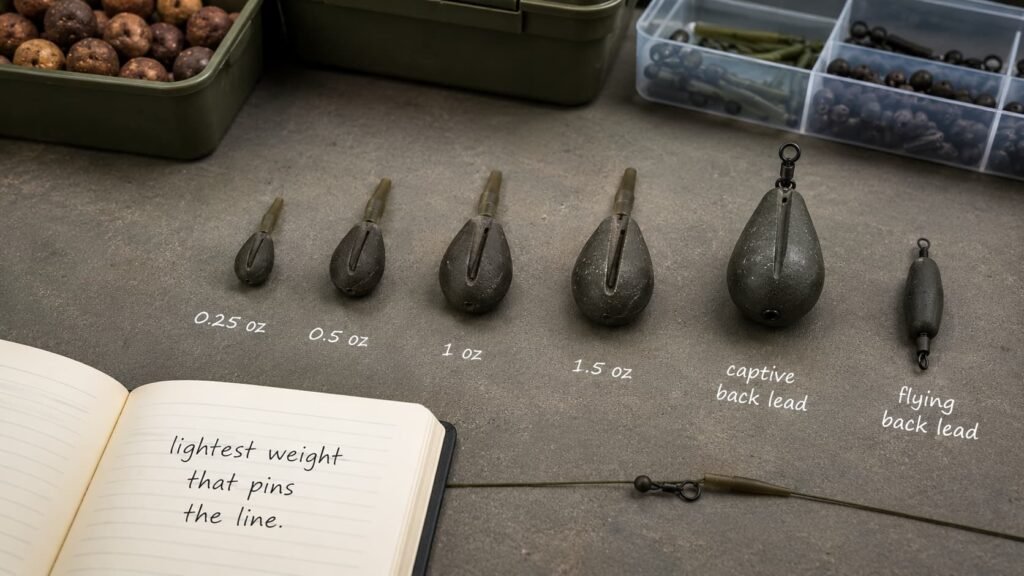
Common sizes are roughly:
- 0.25 oz / 7 g
- 0.5 oz / 14 g
- 1 oz / 28–31 g
- 1.5 oz / 42–43 g
This style is good because it is simple, quick, and removable. It can be used one-handed and allows you to decide how far down the line you want the lead to slide.
The downside is that the back lead usually remains on the line during the fight. It may slide toward the rig, catch on weed, catch on leader knots, or become awkward when playing a fish close in.
2. Captive Back Leads
A captive back lead is a heavier back lead attached to a cord or winder near the rod pod, snag ears, bankstick, or alarm. It clips onto the line, slides down, and pins the line firmly near the bank. When you strike or pick up the rod, the line releases from the back lead, leaving the weight behind on its cord.
This removes the back lead from the fight, which is a big advantage.
Captive back leads are usually heavier than normal clip-on back leads. Common sizes include roughly 1.25 oz, 2 oz, 3 oz, 4 oz, and even 5 oz depending on brand and purpose.
They are best used where you genuinely need a heavy close-in line pinning system: boat traffic, current, high banks, steep margins, or situations where a small running back lead will not hold bottom.
The downside is line angle. Because captive back leads are often used close to the bank, they can create a steep angle from rod tip to back lead, then another angle from back lead to rig. That can reduce indication if the setup is not balanced.
3. Flying Back Leads
Flying back leads are added to the line before the cast. During the cast, they slide back up the main line and land behind the rig. Their job is not to pin the whole line from rod tip to rig. Their job is to pin the last section of line near the end tackle.
Flying back leads are usually much lighter than drop back leads. Sizes around 3 g, 5 g, 7.5 g, and 10 g are common.
They can be useful where carp are feeding near the rig and you want the last few feet or yards of line pinned down. They are often better with slack or semi-slack line than with very tight lines.
The downside is that they do not solve boat traffic near the bank, and if they do not slide properly they may end up too close to the rig or interfere with the terminal setup.
4. Putty, Tungsten Sinkers, and Line-Pinning Accessories
Tungsten putty, sinkers, and rig sleeves can help pin down the hooklink or leader section, but they are not the same as a proper drop back lead.
Use them for rig concealment near the hookbait. Use back leads for controlling the main line.
Why Use Back Leads at All?
A back lead can help with four main problems.
1. Line Concealment
Carp can bump into tight lines. On pressured waters, that can make them lift, turn, or avoid the area. A back lead can lower the line so carp are less likely to brush against it.
This matters most in shallow water, clear water, close-range fishing, and areas where carp are feeding confidently around the baited spot.
It matters less in deep water, rough water, colored water, or places where carp are not especially line-shy.
2. Boat and Kayak Traffic
This is one of the strongest reasons to use a back lead in Michigan.
On rivers, dam ponds, public lakes, and near boat launches, a high main line can be a problem. Boats, kayaks, paddleboards, and trolling anglers can pick up your line. A back lead can pull the line down and reduce that risk.
This does not mean back leads make boat traffic safe in every swim. If boats are running directly over your rigs in shallow water, the better answer may be to move, fish shorter, fish at quieter times, or put rod tips low.
3. Bird Life
Swans, geese, ducks, gulls, and diving birds can catch exposed line. Back leads help keep line below the danger zone.
This is especially useful when fishing areas with steady bird movement close to the bank.
4. Multiple Rod Control
With three rods on a pod or banksticks, back leads can help keep lines separated and lower in the water. This can reduce crossed lines when a fish kites across the swim.
That said, back leads are not a cure for poor rod placement. If all three rods are fished at sharp crossing angles, back leads may make the setup worse.
Why the Weight of the Back Lead Matters
The weight of a back lead decides how it behaves. It affects line lay, bite indication, rig movement, snag risk, and fish-playing control.
A back lead has to be heavy enough to do its job, but no heavier than necessary.
Too Light
A back lead that is too light may:
- Fail to pin the line down.
- Lift off the bottom when the bobbin tightens.
- Move in undertow or current.
- Slide back toward the rod tip.
- Give inconsistent bite indication.
- Be useless in boat traffic.
- Fail to hold the line down from a raised bank.
A very light 0.25 oz back lead can be excellent in calm, close-range fishing, but it is not a heavy-duty boat-traffic tool.
Too Heavy
A back lead that is too heavy may:
- Drag the main line down at too steep an angle.
- Mask bite indication.
- Move the rig when it slides down the line.
- Pull the main lead out of position if you tighten carelessly.
- Catch in weed, stones, mussels, or debris.
- Create more friction during a take.
- Make drop-back bites harder to read.
- Interfere when playing fish.
- Increase the risk of lost tackle.
The mistake is thinking heavier is always safer. A heavy back lead can pin the line well, but it can also turn your setup into a poor indication system.
A Practical Back Lead Weight Guide
Use this as a starting point, then test it in your own swim.
| Situation | Suggested back lead weight | Notes |
|---|---|---|
| Calm close-range stillwater | 0.25 oz / 7 g | Good for subtle line pinning, not for heavy tow or boats |
| General stillwater, short to medium range | 0.5 oz / 14 g | Best starting point for many clean-bottom situations |
| Light tow, raised rod tips, moderate bird activity | 1 oz / 28–31 g | More positive line control, but watch indication |
| Stronger tow, deeper margin, more boat activity | 1.5 oz / 42–43 g | Use only if bottom is clean and indication remains acceptable |
| Captive back lead for boat traffic/current | 1.25–3 oz | Good where the back lead releases from the line on the take |
| Heavy captive back lead for strong current/boat pressure | 4–5 oz | Specialist use, not a general stillwater choice |
| Flying back lead near the rig | 3–10 g | Pins the last section of line, not the whole main line |
For most Michigan bank fishing on clean bottoms, I would start with 0.5 oz. If that does not hold the line down, try 1 oz. I would not jump straight to heavy back leads unless the situation demands it.
Should the Back Lead Be Heavier Than the Bobbin?
As a general rule, the back lead should be heavy enough that the bobbin or indicator does not simply lift it off the bottom before the alarm registers movement.
This is important.
If the back lead is very light and the bobbin is heavy, a take may first lift the back lead instead of moving line cleanly through the alarm. That delay can cost you indication.
A simple way to think about it:
- Light back lead = use a light bobbin and a visible drop.
- Medium back lead = use a balanced bobbin, not too heavy.
- Heavy bobbin or windy conditions = make sure the back lead still stays pinned, or do not use one.
Do not set the bobbin tight up to the alarm with no drop. You need some visible movement below the rod so a lift, drop, or forward pull can show.
How Back Leads Affect Bite Indication
This is the big trade-off.
Without a back lead, the line runs more directly from rod tip to rig. With a back lead, the line changes direction. It may run from rod tip to back lead, then from back lead to the main lead.
That extra angle can dull indication.
If the fish moves straight away from you, you may still get a clear take. If the fish kites sideways, comes toward you, or moves over a feature, the back lead can delay the signal.
The longer the range and the steeper the angles, the worse this can become.
Forward Takes
A forward take is usually the easiest one to register. The fish moves away, the line tightens, the bobbin rises, and the alarm sounds.
Back leads normally handle this better than sideways or drop-back bites, provided the back lead runs freely.
Drop-Back Bites
A drop-back bite happens when the fish picks up the rig and moves toward you. The line slackens and the bobbin drops.
Back leads can make drop-backs harder to read because some of the slack may gather between the rig and the back lead before it reaches the rod end. If the clip has friction, weed, or a sharp line angle, the indication can be delayed further.
This is one reason you should never fish back leads with a lifeless indicator setup. You need a bobbin that can drop and rise clearly.
Sideways Kiting
This is where back leads can be most dangerous.
A carp can kite sideways while keeping steady tension on the line. If your line is pinned through a back lead and the angle is poor, the fish may move a long way before your alarm tells the truth.
In open water, you may get away with it. Near snags, weed, reeds, or timber, that delay can mean a lost fish.
Back Leads and Snags
Back leads and snags do not mix well.
If there is timber, reeds, lily pads, dock posts, rocks, mussels, sunken branches, or old metal between you and the fish, a back lead can create a line angle that gives the carp more time to reach trouble.
In snag fishing, early indication is everything. You want to know quickly and take control quickly. Anything that delays indication is a risk.
There are exceptions, but they are not beginner situations. If you are locked up near snags, fishing hit-and-hold, or using heavy mono because of abrasion, think very carefully before adding a back lead.
In most snaggy Michigan waters, I would rather fish a clean line angle, strong mono, rod tips low, and a simple lead setup than add another weight to the system.
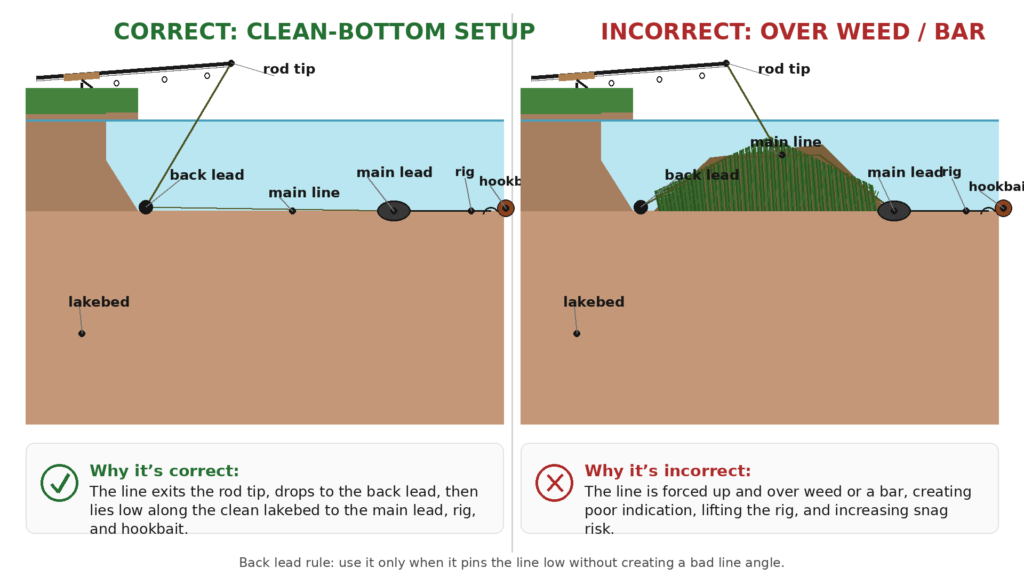
Back Leads, Weed, and Bars
A back lead works best over clean bottom.
Weed and bars are where things go wrong.
If your line goes from the rod tip down to a back lead, then up over a weedbed or gravel bar, then back down to the rig, you have created a poor line path. The fish may move the rig, but the movement may not reach the alarm cleanly.
Weed can also catch the back lead itself. If the back lead is still attached to the line during the fight, it can collect weed and become a problem close in.
Do not assume the bottom is clean just because the rig landed well. The back lead may settle in a completely different part of the swim. That area matters too.
Back Leads and Mussels in Michigan
Michigan carp anglers need to think about mussels, especially zebra and quagga mussels in the Great Lakes, connected waters, harbors, river mouths, and some inland lakes.
A back lead can force your main line down onto the bottom. That is good over clean sand, clay, or soft silt. It is not good if the bottom is covered in sharp mussel shells.
If your line is pinned hard across mussels and a carp kites, the line can saw across those shells. That can cost you the fish.
In mussel areas:
- Use strong abrasion-resistant mono.
- Check the line after every fish or heavy retrieve.
- Avoid pinning line across known shell beds.
- Do not use back leads to “hide” line if they create a cutting angle.
- Consider tubing or leaders only where legal and fish-safe.
- Keep the setup simple and safe.
Back Leads and Main Lead Systems
A back lead does not replace the main lead. The main lead still has to cast properly, hold bottom, and help the hook take hold.
There is no fixed rule that says a 1 oz back lead must be paired with a certain main lead. The two do different jobs.
That said, balance matters.
If you are using a very light main lead and a heavy drop back lead, you may move the rig when you slide the back lead down or tighten up. If you are using a semi-fixed lead and poor indication, the fish may move without registering properly.
For open-water back-lead fishing, a running lead can be a very sensible option because line movement can transmit more freely. A lead clip or helicopter setup can still be used, but you must test indication and fish safety.
The main lead should be chosen for the rig, bottom, casting distance, and fish safety. The back lead should be chosen for line control.
How to Set Up a Drop Back Lead Correctly
Here is a practical bank-side routine.
- Cast to the spot and feather the cast.
- Feel the lead down if conditions allow.
- Sink the main line.
- Place the rod on the rest and let the line settle.
- Clip the back lead onto the main line near the rod tip.
- Lift the rod slowly and let the back lead slide down under control.
- Do not yank or tighten hard.
- Let the back lead settle.
- Tighten gently until you have contact.
- Set the bobbin with a proper drop.
- Watch the bobbin for a minute to see if tow or wind is creeping it up.
- Recheck after weed, boat wash, or a liner.
The back lead should be in line with the rod tip and rig as much as possible. Avoid setting it off to the side.
If the back lead will not slide freely, remove it. Do not force it.
How Far Down the Line Should It Go?
The farther the back lead slides away from the rod tip, the shallower the line angle usually becomes. That can improve indication compared with a back lead sitting directly below the rod tip.
However, there is no perfect distance. It depends on depth, bottom slope, range, and what you are trying to avoid.
For boat traffic near the bank, you may only need to pin the line close in. For line concealment, you may want it farther down the line. For raised banks or piers, you may need enough distance to reduce the steep rod-tip angle.
Do not send it so far that it reaches weed, rocks, bars, or the rig area and causes trouble.
When Captive Back Leads Make Sense
Captive back leads are useful when you need serious close-in line control but do not want the back lead on the line during the fight.
Good uses include:
- Boat traffic close to the bank.
- River or channel fishing with steady flow.
- High banks or platforms.
- Situations where a normal clip-on back lead keeps catching during the fight.
- Short-to-medium-range clean-bottom fishing.
The important part is setting the retaining cord correctly. It must be long enough for the back lead to reach bottom and settle properly, but it must not become a tangled mess around rods, alarms, banksticks, or your feet.
A captive back lead is not magic. It still creates a line angle. Use it where the advantage is worth that compromise.
When Flying Back Leads Make Sense
Flying back leads are best when the line near the rig is the issue.
They are useful when:
- Carp are feeding close to the hookbait.
- The water is clear and shallow.
- You are fishing slack or semi-slack lines.
- You want the last section of line pinned without a separate clip-on back lead.
- You are fishing over clean bottom.
They are not the best answer for boat traffic near the rod tip. They also do little for birds close in.
A flying back lead should be able to slide and settle properly. Check compatibility with mono, braid, leaders, and knots. Do not let it jam against a leader knot or swivel in a way that creates a fish-safety problem.
Advantages of Drop Back Leads
Better Line Concealment
This is the main advantage. A pinned line is less likely to cut through the swim at carp body height.
Less Trouble From Boats
On public Michigan waters, this can be a major benefit. A line pinned close to the bottom is less likely to be caught by a prop, kayak paddle, trolling line, or passing boat.
Fewer Bird Problems
Back leads can keep line away from geese, ducks, swans, and gulls.
Better Three-Rod Organization
They can help keep lines lower and more controlled when fishing multiple rods from the bank.
Fewer Liners
If fish are brushing into your line, a back lead may reduce false bleeps and line bites.
Useful From High Banks and Piers
A back lead can reduce the steep angle from a raised rod tip down to the water.
Disadvantages of Drop Back Leads
Reduced Bite Indication
This is the biggest drawback. A back lead can delay or dull takes, especially drop-backs and sideways kiting fish.
More Snag Risk
The extra line angle can give a hooked carp more time to reach weed, timber, reeds, rocks, or other snags.
Problems Over Uneven Bottom
Bars, weedbeds, shelves, and mussel beds can make back leads a poor choice.
More Tackle on the Line
Any extra clip, ring, or weight can catch weed, leader knots, tubing, or debris.
Possible Rig Movement
A heavy back lead sliding down the line can move the main lead if you are careless.
Harder Fish Playing
Running back leads can slide down toward the rig during the fight. That can be awkward close in.
Environmental Cost
Most back leads are still lead-based. Losing them is not good practice. Use snag-safe designs, retrieve lost tackle where possible, and consider nontoxic alternatives where available.
Michigan Notes
For Michigan carp fishing, I would use back leads selectively.
On a quiet inland lake with clean sand or clay bottom, a 0.5 oz drop back lead can be a neat way to pin the line and fish unobtrusively.
On a weedy natural lake, I would be far more cautious. Weed between you and the rig can ruin indication and catch the back lead.
On rivers like the Muskegon, Au Sable, Grand, or Kalamazoo, the current, debris, rocks, and boat traffic all matter. In some swims a captive back lead may help. In others it will just collect weed and leaves or create a dangerous line angle.
On Great Lakes harbors, marinas, river mouths, and piers, think hard about mussels, concrete edges, rocks, boat traffic, and public access. Back leads can help with line control, but they can also pin your main line onto sharp bottom.
On dam ponds and reservoirs, look for old timber, rock, mussels, steep shelves, and bottom debris. Do not backlead blindly.
The old rule applies: know the bottom before you pin your line to it.
Common Mistakes
Using Back Leads Everywhere
Back leads are situational. They are not a default requirement.
Going Too Heavy
Heavy back leads feel secure, but they can ruin indication and create snagging problems.
Using Them Over Weed
Weed between rod and rig is one of the worst places for a back lead.
Ignoring the Bobbin Setup
A poor indicator setup makes a back lead much worse. Use a visible drop and balance the bobbin weight.
Tightening Too Hard
If you tighten aggressively after adding the back lead, you can move the rig or lift the back lead.
Fishing Near Snags
Back leads near snags can delay your reaction. That is a serious problem.
Forgetting Fish Safety
Any back lead system must release, run freely, or detach safely. Do not use anything that can trap a fish on a broken line.
Best Practical Setup for Most Michigan Carp Anglers
For a clean-bottom lake or pond, short to medium range, and normal bank fishing:
- Main line: strong abrasion-resistant mono.
- Main lead: normal carp lead matched to range and bottom.
- Back lead: 0.5 oz clip-on running back lead.
- Indicator: light to medium bobbin with a visible drop.
- Line: semi-slack, not bowstring tight.
- Rod tips: low if possible.
- Bottom: checked for weed, rocks, mussels, and debris.
If the 0.5 oz back lead moves in tow, try 1 oz.
If 1 oz still does not hold, ask whether a back lead is really the right tool. You may need lower rod tips, a different swim, a captive system, or a heavier main lead instead.
Final Verdict
Back leads are useful, but they are not harmless.
The correct weight is the lightest back lead that pins the line effectively without spoiling indication or creating extra risk. For many stillwater carp situations, that means starting around 0.5 oz. For light close-range work, 0.25 oz may be enough. For tow, boat traffic, raised banks, or deeper margins, 1 oz to 1.5 oz may be needed. For heavy boat traffic or current, a captive back lead in the 1.25 oz to 3 oz range may be the better tool.
The most important point is not the number stamped on the lead. It is what that weight does to the whole system.
A back lead changes the line angle. It changes bite indication. It changes how quickly you know a carp is hooked. It changes how the fish can move before you react.
Use one when it solves a real problem. Leave it off when it creates more problems than it fixes.
FAQ
Are back leads worth using for carp fishing?
Yes, but only in the right situation. They are worth using for boat traffic, birds, line concealment, and clean-bottom close-to-medium-range fishing. They are not worth using over weed, bars, snags, or unknown bottom.
What weight back lead should I start with?
For general stillwater carp fishing, start with 0.5 oz. Go lighter for calm close-range work and heavier for tow, raised banks, or boat traffic. Do not use more weight than you need.
Do back leads reduce bite indication?
They can. Back leads create extra line angles and resistance. They are especially risky for drop-back bites, sideways kiting fish, long-range fishing, and swims with weed or raised features between you and the rig.
Should I use a back lead with a running lead?
A running lead can be a good match because line can move more freely through the system. It may improve indication compared with some semi-fixed setups. Still, the whole setup must be tested.
Are captive back leads better?
They are better when you need a heavy back lead but do not want that weight on the line during the fight. They are useful for boat traffic, current, and high-bank situations. They still need clean bottom and sensible line angles.
Are flying back leads the same as drop back leads?
No. A flying back lead slides back up the line during the cast and pins the line near the rig. A drop back lead is clipped on after the cast and slides down from the rod end.
Should I use back leads near snags?
Usually no. Near snags, quick bite indication is critical. A back lead can delay indication and give the carp more time to reach danger.
Can back leads damage line?
They can if they are poorly designed, jammed, dragged through debris, or forced over sharp mussels and rocks. Use smooth clips, check your line often, and avoid pinning line across abrasive bottom.
Next Steps
For more line-control and presentation work, see:
- Carp Rigs
- Best Carp Lead Systems
- How to Fish Three Rods for Carp
- Reading the Bottom for Carp Fishing
- Carp Fishing in Weed
- Carp Fishing Around Snags
- Michigan Carp Fishing Gear Guide