

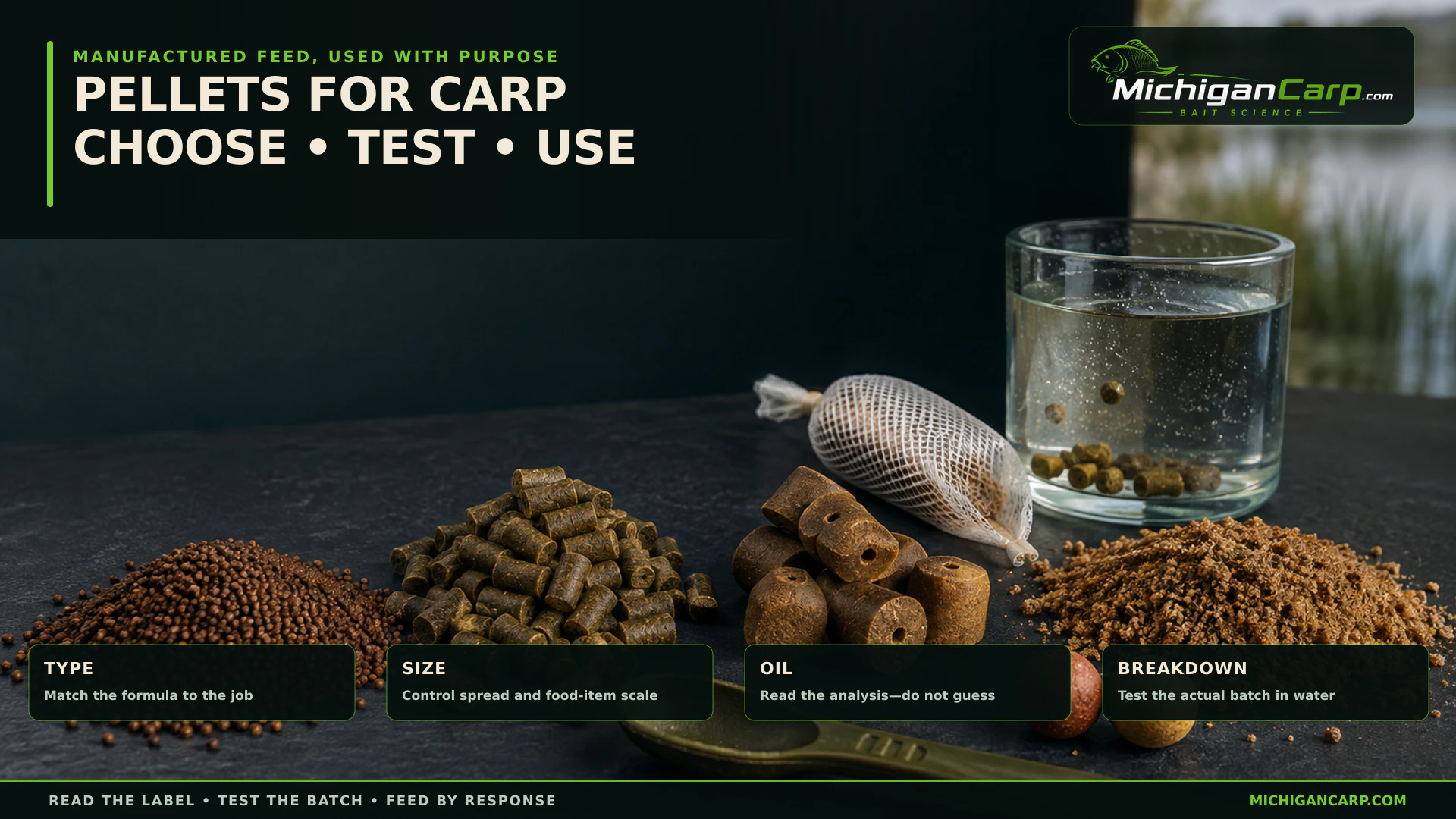
Pellets for carp are useful because they let an angler introduce manufactured food in a compact, repeatable form. They can provide tiny feed items around a hookbait, add crumb to a method or packbait, build a tight PVA trap, or supply a larger pellet that can be banded or drilled as the hookbait itself.
The mistake is treating every brown cylinder as the same bait. A 2 mm koi pellet, a dense trout feed, an oily marine-style pellet, a porous expander and a hard drilled hook pellet may differ in formula, energy, density, manufacturing process and water stability. Diameter matters, but it does not tell the whole story. Two pellets of the same size can soften, float, sink, swell, shed material and retain structure very differently.
That is why I do not buy pellets for carp only by flavor, color or reputation. I begin with the fishing job, read the label, test the actual batch in water, then use enough to support the hookbait without turning a precise trap into an uncontrolled pile of food.
This article owns that practical pellet decision. Use the Carp Bait Guide for Michigan when choosing between pellets, corn, particles, boilies and other bait families. Use Baiting Strategy for Carp Fishing for the wider question of how much, how often and why.
Choose the right pellets for carp by its job. Confirm its behavior in water. Feed more only when the fish justify it.
Table of Contents
Quick Start: Choose the Pellet by Job
Start with the job, not the product name. If the aim is a small PVA trap, a dry micro-pellet blend may make sense. If the aim is a durable hookbait, an ordinary feed pellet that softens in ten minutes is the wrong tool even if carp like its formula. If the aim is to add a small pellet fraction to particles, a rich high-oil feed may be unnecessary.
| Fishing Job | Useful Starting Pellet | What to Confirm | Main Risk |
|---|---|---|---|
| Tight PVA bag or stick | Dry 2–4 mm pellets, crumb or a measured blend | PVA compatibility, casting behavior and breakdown | Damp or oily treatment melting the bag early |
| Method feeder or packbait support | Crushed pellet or soaked micro pellets used as one component | Binding, release and whether the feeder empties cleanly | Turning the mix into heavy paste |
| Small loose-feed patch | 4–8 mm sinking feed pellet | Sink rate, spread, softening and nuisance-fish response | Feeding more food than the situation needs |
| Hookbait | Purpose-made drilled or bandable pellet | Attachment and structure for the full soak period | The bait softening before the rig is checked |
| Cold or uncertain water | Small amount of micro pellet, crumb or lower-oil feed | Actual breakdown at current water temperature | Assuming a rich pellet is automatically more attractive |
| Warm water with confirmed feeding | Mixed sizes or a moderate feed pellet | Whether carp—not bluegills, catfish or turtles—are clearing it | Automatic top-ups because activity looks busy |
| Long session | Pellets as one controlled layer beside durable freebait | How often the pellet component needs replacing | Relying on pellets alone after they have broken down |
Pellets are strongest when their physical behavior solves a specific problem. They are not automatically “fast,” “oily,” “high protein” or “long lasting.” Those descriptions may fit one product and fail completely on the next.
What a Fishing Pellet Actually Is
A pellet is a manufactured feed form, not one ingredient. Ground raw materials are mixed, conditioned and shaped by pelleting or extrusion, then dried; some feeds receive oil or other coatings after shaping. The formula may include fishmeal, plant proteins, cereal fractions, oils, vitamins, minerals, binders and other ingredients selected for the species and production job.
The manufacturing route changes the finished structure. The University of Florida’s guide to preparing fish feeds explains that dry feeds may be pelleted, crumbled or extruded and may be made to float or sink. Skretting’s description of commercial feed production also shows how grinding, mixing, extrusion, drying and oil application build the finished pellet.
For carp fishing, this means the pellet is both food and delivery system. Its ingredients matter, but so do its pores, density, surface coating, hardness, size and ability to stay intact. A pellet can remain visibly whole while soluble material leaves the surface. Another can split quickly and create residue without producing the same food value or feeding response. Visible breakdown is useful evidence, but it is not a direct meter of attraction.
Pellets Are Not Particles
In carp language, particles are normally prepared seeds, grains, nuts or legumes. Pellets are manufactured compound feed. They can be combined, but their storage, water behavior and food density are different. A seed remains a recognizable food item after soaking and cooking; a pellet is designed to hydrate and eventually lose structure. That distinction is why the pellet page should support—not sit inside—the Particles for Carp Fishing Guide.
Fast Breakdown Is Not the Same as Fast Attraction
Breaking a pellet exposes more surface and creates fine material in the rig area. That can be useful. It does not prove that carp will arrive quickly, choose the hookbait or remain in the swim. Release, transport, detection and acceptance are separate stages. The protected Science of Carp Bait Solubility and Leakage explains that wider mechanism; this guide stays focused on using the finished pellet.
Main Pellet Types for Carp Fishing
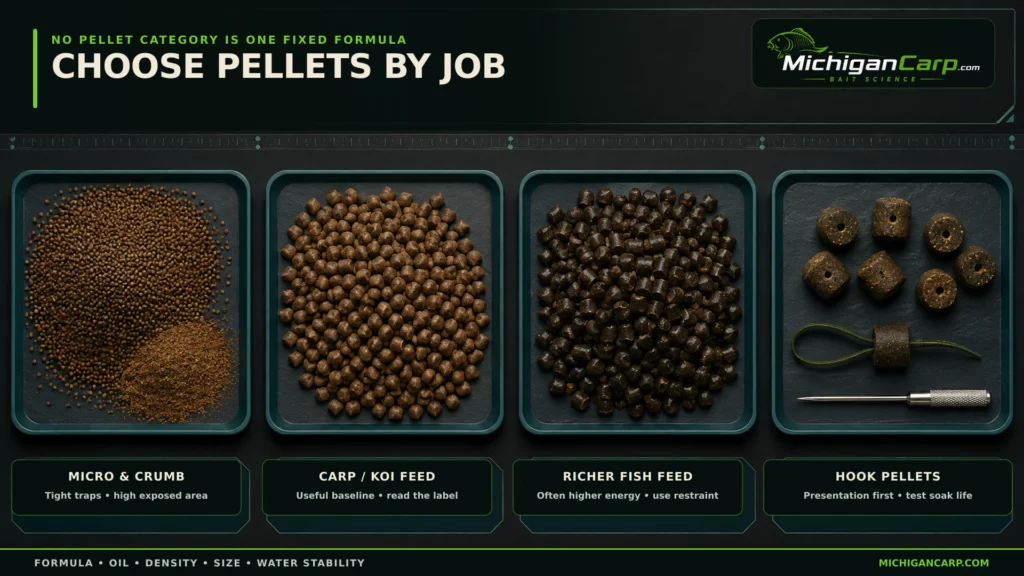
Category names are useful starting points, not guarantees. “Trout pellet” describes a feed market, not one universal protein, fat or breakdown specification. “Koi pellet” may be floating or sinking and can vary across life stage and product line. Read the label and test the batch even when the category is familiar.
| Pellet Category | Practical Strength | Best Carp-Fishing Role | Check Before Use |
|---|---|---|---|
| Carp or koi feed | Formulated for cyprinid feeding, often available in several sizes | General loose feed, testing new pellet systems, floating observation where permitted | Floating/sinking behavior, analysis, color additives and water stability |
| Trout or salmonid feed | Can provide a compact, energy-rich manufactured food | Measured warm-water feed, pellet blends, crushed rig-area traps | Actual fat level, coating, density and whether the richness suits the baiting plan |
| Marine or “halibut-style” pellet | Often dense, dark and strongly associated with fishmeal/oil systems | Selective measured feed or durable larger pellet where its structure fits | Formula, oil, soak life and nuisance species; the name alone proves little |
| Coarse or cereal-led pellet | May provide a less oily, economical feed direction | Bulk support, method mixes and restrained non-marine combinations | Binder, hardness, dust level and whether it carries enough useful food value |
| Micro pellet or crumble | Many small items and high exposed surface area | PVA, sticks, method feeders, packbait and small hookbait zones | Spread, powder content and whether nuisance fish clear it immediately |
| Expander pellet | Porous structure can take on water and be prepared as soft bait | Soft hookbait or feeder presentation when carefully prepared | Exact preparation, buoyancy change and attachment strength |
| Purpose-made hook pellet | Designed to be drilled, banded or remain attached longer | Hookbait over matching or complementary pellet feed | Full-session soak test, rig balance and resistance to nuisance fish |
Carp and Koi Pellets
Carp and koi feeds are a sensible place to begin because the intended fish are cyprinids. They are not automatically the “best carp pellet,” but their labels often provide a useful reference point. Products may be designed to float for visual feeding, sink for bottom feeding, support growth, maintain fish, or enhance color. The fishing job may not need every feature included for pond management, so compare the guaranteed analysis and price rather than paying for a label alone.
Trout and Richer Fish Feeds
Trout feeds are often described by carp anglers as uniformly high protein and high oil. That is too simple. Specifications change by product, fish size and pellet diameter. Skretting’s Oncor trout feed, for example, states that protein decreases and oil increases as pellet size increases within that range. The lesson is not to buy that particular feed; it is to stop inferring composition from the words “trout pellet.”
A rich feed can be valuable when carp are feeding confidently, but food density matters. A small volume may deliver more energy than a similar volume of a lower-fat pellet or plain particle mix. Richness is not free attraction. In cool water, uncertain swims or short bite-focused traps, I would rather use a small measured amount than assume more oil must be better.
Micro, Expander and Hook Pellets
Micro pellets and crumbles are about distribution and exposed surface. Expanders are about a porous pellet that can be prepared to a chosen texture. Hook pellets are about mechanical reliability. Those are different jobs. Do not soak ordinary micro pellets and expect them to become durable hookbaits, and do not assume a hard hook pellet will break down like the feed surrounding it.
Read the Pellet Label Before You Buy
The bag is part of the bait test. The FDA explains that an animal-food label should identify the product and provide information needed for safe and effective use; ingredients are normally listed by weight order and the label may include guaranteed analysis and feeding directions. Read the FDA animal-food labeling guidance when a feed label is unfamiliar.
| Label Field | What It Tells You | What It Does Not Prove |
|---|---|---|
| Intended species and life stage | The animal and production job the feed was formulated for | That it is the best bait for wild carp in your water |
| Crude protein | A minimum protein declaration in the guaranteed analysis | Digestibility, amino-acid release or attraction |
| Crude fat | A minimum fat declaration and useful clue to energy density | How quickly oil will leave the finished pellet in cold water |
| Crude fiber | A maximum fiber declaration | Complete carbohydrate composition or pellet hardness |
| Ingredient list | Major ingredients in descending weight order | The exact percentage of each ingredient unless separately stated |
| Pellet size and float/sink description | Physical format intended by the manufacturer | Exact breakdown in your water and temperature |
| Lot code and date | Traceability and a freshness reference | Good storage after the bag was opened |
| Medication or veterinary-feed wording | The feed contains or is governed by a drug-use direction | Permission to use it as recreational fishing bait |
Do not use medicated aquaculture feed as fishing bait. If the label carries medication, veterinary-feed directions, withdrawal wording or a drug claim, leave it for its intended controlled use. Do not buy damaged bags, pellets with visible mold, or bulk feed with no reliable identity.
Also resist “protein number shopping.” A high crude-protein figure does not tell you how the pellet will fish. It may be appropriate to the farmed species and growth stage, but carp bait still has to fit the water, quantity, presentation and feeding response. Physical quality and freshness can matter more than a few extra percentage points on the analysis.
How Size, Oil, Density and Processing Change the Pellet
Size Changes the Feeding Pattern
Small pellets create many individual food items per ounce and can spread through PVA, method mix or a tight hand-fed patch. Larger pellets create fewer, more substantial items and may stay visible as discrete feed for longer. That does not mean small always breaks first. Binder, extrusion, coating and density can outweigh diameter, which is why size should be treated as one control rather than the conclusion.
A mixed-size blend can extend the physical sequence around the hook: fine crumb begins hydrating immediately, micro pellets provide small items, and medium pellets retain more identity. Use that deliberately. A random sweep of every size in the garage creates no cleaner result than one or two well-tested fractions.
Oil Changes Energy and Handling
Higher-fat pellets can be energy dense and may show a visible oil film. That film is not a universal attraction meter, and cold water changes viscosity and movement. Some oil can also sit on the surface or coat PVA material. Read the analysis, use rich pellets with restraint, and avoid adding more oil simply because the pellet is called “fishmeal” or “halibut.”
Density Controls Where the Pellet Works
Floating pellets are useful when surface feeding is the actual method and local rules and bird pressure allow it. They also reveal whether fish will approach feed, but wind can move them away from the rig area. Sinking pellets are normally simpler for bottom fishing, yet slope, undertow, weed and soft silt still affect where they finish. Test a few in a clear container, then test a small amount at the venue edge when practical.
Water Stability Is a Design Choice
Aquaculture feed is often designed to remain intact long enough for the intended fish to consume it without excessive waste. That can make a high-quality feed slower to disintegrate than an angling slogan suggests. Crumbling, crushing, drilling or soaking changes that structure. Decide whether you need intact food items, a soft feeder component, exposed crumb or a durable hookbait, then prepare only the portion needed for that job.
Water-Test Every New Pellet
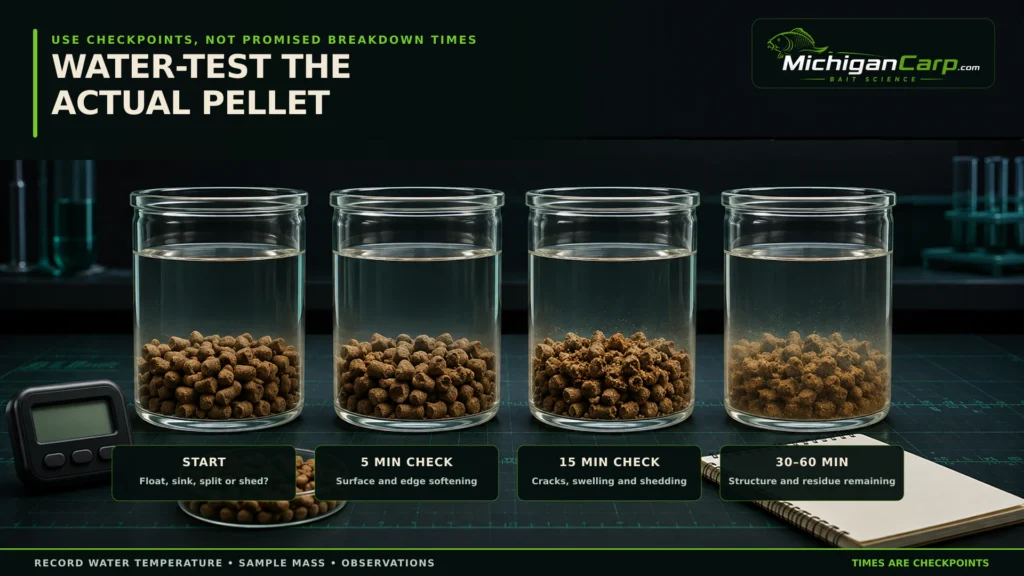
A controlled water test is the quickest way to replace assumptions with evidence. Use the water temperature that matters to the session, keep sample mass and water volume consistent, and compare untreated pellet with any soaked, crushed or liquid-treated version you plan to fish. Tap water is useful for comparison; venue water can be used for a second realistic check.
| Checkpoint | Observe | Fishing Meaning |
|---|---|---|
| Start | Float, sink, suspend, split, fizz or shed surface dust | Initial delivery and whether the pellet reaches the intended zone |
| 5 minutes | Edge softening, swelling, color change and first cracks | Early PVA, feeder and short-session behavior |
| 15 minutes | Handling strength, shedding, cloud and intact core | Whether the pellet remains a food item or becomes mostly crumb |
| 30 minutes | Shape retained, residue, oil film and softness | Whether a loose-feed patch still contains discrete pellets |
| 60 minutes and planned rig interval | Attachment strength, remaining structure and bottom residue | Whether a hook pellet or long-soak presentation remains fishable |
These are observation points, not promised breakdown times. Repeat the test at cold and warm temperatures if the same pellet will be used across seasons. If you are comparing brands, use equal dry mass rather than equal handfuls; pellet size and density make handful comparisons unreliable.
Test the Complete Presentation
Do not stop after watching loose pellets in a glass. Tie the actual PVA bag and time it in water. Load the actual feeder and confirm it releases. Band or drill the actual hook pellet and check it at the longest expected recast interval. A pellet that behaves beautifully as loose feed may fail immediately after soaking, compressing or coating.
How to Present Pellets for Carp
| Method | Pellet Preparation | Hookbait Logic | Control Check |
|---|---|---|---|
| Solid PVA bag | Dry micro pellets, crumb or a dry mixed-size blend | Wafter, boilie, corn, tiger nut or tested hook pellet | Bag melts fully and contents do not trap the hook |
| PVA stick or mesh | Crushed pellet with dry crumb; add only PVA-safe treatment | Durable bait that complements the crumb | Stick breaks open instead of remaining rubbery |
| Method feeder | Lightly dampened micro pellets or pellet crumb blended for release | Small boilie, corn, wafter or purpose-made pellet | Feeder empties at the intended time |
| Packbait | Pellet crumb as a measured fraction, not the only binder | Hookbait chosen for the complete pack and nuisance pressure | Pack breaks consistently after the cast |
| Loose feed | Dry sinking pellets or a tested blend | Match the food direction but keep the hookbait mechanically reliable | Feed lands where the rig fishes and is not rolling down slope |
| Hook pellet | Band, drill or hair-mount without splitting | The pellet itself is the hookbait | Attachment survives casting, soak time and nuisance fish |
Pellets in PVA
Dry pellets are one of the simplest PVA fillers, but the complete bag still needs testing. Damp storage, water-based liquids and condensation can start dissolving PVA before the cast. Heavy oil or very hard edges can affect sealing and packing. Keep bags dry, use only a treatment known to be PVA compatible, and test one finished bag in a bucket instead of trusting the liquid label.
A small bag does not need five unrelated pellet types. One micro pellet, one slightly larger pellet and a little crumb are normally enough to create different exposed surfaces without hiding the hookbait under excessive feed.
Pellets in Method Mix and Packbait
Crushed pellet is useful because it adds dry food material and absorbs liquid. That same absorption can make a mix heavy, sticky and slow if too much water is added. Build the feeder or pack around release mechanics first. The protected Packbait for Carp Fishing covers the wider oats, panko, corn and binder system; pellet crumb should support that system rather than silently changing it.
Pellets as Hookbaits
A banded pellet leaves the pellet intact but demands the right band tension. A drilled pellet must survive drilling without splitting and remain on the hair in water. A soft expander needs an attachment method suited to its texture. Whatever the method, test the hookbait for the longest likely soak—not merely until it looks attractive in the margin.
In many Michigan situations I prefer a boilie, tiger nut, corn stack or wafter over pellet feed because the durable hookbait keeps fishing after the loose pellets soften. The right pairing is explained in Best Hookbait and Freebait Combinations for Carp.
How Much Pellet Should You Use?
The correct amount depends on fish presence, temperature, session length, pellet richness, nuisance pressure, accuracy and the rest of the feed. The numbers below are cautious starting ranges for one rig-area trap, not universal limits. Pellet density varies, so weigh a few normal scoops at home until your hand and container have meaning.
| Situation | Cautious Starting Amount | When to Increase | When to Stop |
|---|---|---|---|
| Single PVA bag | About 20–60 g, sized to the bag and cast | Only by enlarging the complete tested presentation | Bag becomes bulky, slow to melt or masks the hookbait |
| Method feeder | About 15–40 g of finished feeder mix per cast | Fish repeatedly clear the feeder and return | Frequent recasts create more food than response |
| Unknown short-session spot | One small trap or roughly 50–150 g total around a rod | Confirmed feeding, liners, bites or cleared bait | No carp evidence and nuisance fish dominate |
| Known warm-water feeding area | Roughly 150–300 g as a tight initial patch | Carp feed confidently and the patch is being consumed | Activity scatters, slows or becomes mostly non-carp |
| Pellet added to particles or boilies | About 10–25% of the feed by weight as a starting layer | The quick pellet component improves response without shortening the session | The mix becomes unnecessarily rich or loses durable food items |
Across three rods, do not automatically multiply the largest amount by three. One rod can carry the pellet test while the other two preserve different feed levels or bait types. If every rod uses the same heavy pellet trap, you lose both control and the ability to learn.
Top up because carp have fed or the presentation needs resetting—not because an hour has passed. Use How Much Bait to Use for Carp when the amount decision involves the whole swim rather than the pellet component alone.
Pellets Through Michigan Seasons and Water Types
Cold Water and Early Spring
Cold water does not make pellets useless, but it removes the case for careless feeding. Softening and diffusion may slow, oils behave differently and carp may feed in shorter, less predictable windows. Use a small pellet or crumb component around a hookbait that remains important. A few grams in a PVA trap can be more useful than a wide bed of rich feed.
Test the pellet at the actual temperature. If it remains hard and inert-looking for much longer than expected, crush part of it rather than adding more whole pellets. If it turns to paste but carp are not present, its breakdown has not solved the location problem. Use Best Carp Bait for Cold Water for the full seasonal bait decision.
Warm Water and Active Carp
Late spring through early fall gives more scope for pellets when carp are active. Mixed sizes can create both fine material and discrete food items, and measured top-ups can hold a small feeding group. Warm water also increases bluegill, bullhead, catfish, turtle and crayfish interference. Busy water is not automatically productive carp water; confirm which species are responsible.
Hot weather adds an oxygen and fish-care question. Do not use heavy feed simply because digestion and breakdown appear faster. Watch water conditions, weed state and fish response. The Summer Carp Bait Guide places pellets inside the wider warm-water plan.
Rivers, Current and Sloping Reservoir Margins
Pellets can move before they soften. Current carries fine crumb downstream, rounded pellets roll, and a steep dam-pond shelf can put loose feed below the rig. Use a tighter delivery method, a heavier or less mobile pellet, or place the hookbait on the downstream or downhill edge where the food is likely to collect. A PVA bag can protect accuracy, but only if it lands and opens cleanly.
Weed, Silt and Soft Bottoms
Micro pellets can disappear into thick weed or deep debris while still creating some local food signal. That may be useful, but the hookbait must remain findable and fishable. A compact PVA parcel on a clean weed edge is often more controlled than spreading pellets through the weed. On soft silt, keep the parcel light enough that the lead and bait do not bury deeply, and consider whether crumb is becoming part of the silt rather than a clear feeding target.
Combine Pellets Without Losing Control
Pellets With Corn or Particles
Corn supplies visible, recognizable food items while pellets add a manufactured feed fraction and exposed crumb. Prepared particles encourage browsing while pellets can work in the tighter rig area. The combination is useful only when each layer has a job. If a five-gallon particle bucket already contains peanuts, tiger nuts, pigeon feed, hemp and maize, adding a large volume of rich pellets may increase cost and food density without improving the plan.
Pellets With Boilies
Pellet crumb and chops can create an active area while whole boilies retain durable food items and a reliable hookbait match. This is especially useful when you do not want to loose-feed many boilies. Keep the profiles coherent if possible, but do not assume every fishmeal pellet belongs beside every milk, nut or fruit boilie. Mechanical complement matters more than forcing flavor symmetry.
Pellets With Liquids
Some pellets absorb liquid quickly; others carry a surface coating and take very little. Treat a small separate batch, wait, then test softness, PVA compatibility and release. Water-based treatments can damage PVA. Heavy oil can slow wetting, make pellets slippery and increase the energy load without proving a better feeding response.
For a repeatable system, keep most pellets dry and use one measured treatment on the rig-area portion only. That leaves an untreated control and prevents the whole bag from becoming an irreversible experiment. When to Use Each Type of Carp Bait Liquid explains how to choose the liquid by its job.
Storage, Safety and Common Pellet Mistakes
Dry feed still deteriorates. Moisture can support mold, pests can contaminate a bag, and fats can oxidize. The FAO recommends short storage, dry conditions and protection from heat, moisture and infestation in its feed-storage guidance. For the angler, that means buying an amount you can rotate, retaining the lot/date information, sealing the feed after opening and keeping it out of a hot vehicle or damp shed.
Use clean food-grade containers. Label repacked pellets with product, size, lot and opening date. Do not mix every leftover pellet into one anonymous bucket because the oldest or damaged fraction can no longer be traced. If a pellet smells sharply stale, paint-like or rancid, shows mold, feels damp, contains webbing or insects, or has changed dramatically from the fresh bag, discard it rather than masking it with flavor.
Mistake: Assuming Darker Means Better
Color can come from ingredients, processing or added pigments. A dark pellet is not automatically richer, more soluble or more attractive. Read the analysis and test it.
Mistake: Buying the Highest Protein Number
Crude protein is one label field, not a bait score. A moderate feed that sinks, stores well, breaks as required and fits the session can be more useful than an expensive high-protein product used without control.
Mistake: Treating Breakdown as Disappearance
When a pellet loses shape, its material remains in the swim unless eaten or transported away. Fine residue can still feed small fish and invertebrates. “It breaks down” is not permission to overbait.
Mistake: Using Feed That Was Not Intended for Open-Water Baiting
Avoid medicated feeds, spoiled feed and unidentified industrial or livestock pellets. Use recognizable non-medicated fish feed or purpose-made angling pellets, follow local rules, and take unused bait home. Feeding wildlife or dumping leftovers is not responsible baiting.
FAQ
What are the best pellets for carp?
The best pellets for carp are the those whose formula and physical behavior fit the job. Carp or koi feed is a useful baseline; micro pellets suit PVA and method work; richer trout or marine-style feeds can suit measured warm-water feeding; purpose-made hook pellets suit durable presentations. Read the label and water-test the actual batch.
Are trout pellets good for carp fishing?
They can be very useful, but trout pellets are not one fixed formula. Protein, fat, density and size vary by product. Use the guaranteed analysis and water test rather than assuming every trout feed is highly oily or fast breaking.
Do pellets work in cold water?
Yes, but use them lightly and test them at the current temperature. Small pellets, crumb or a lower-oil feed can support a cold-water hookbait without creating a large rich feed bed. Location and timing remain more important than pellet strength.
What size pellets should I use for carp?
Use 2–4 mm pellets and crumb for small traps, PVA and feeders; 4–8 mm pellets for general loose feed; and larger purpose-made pellets when you need a discrete freebait or hookbait. Size alone does not determine breakdown, so test each product.
Can pellets be used in a PVA bag?
Dry pellets are usually practical PVA fillers. Keep them dry, use only PVA-compatible liquids and test the completed bag in water. Damp pellets or water-based treatments can start dissolving the bag before casting.
Can I use pellets as a carp hookbait?
Yes. Use a pellet band, drill the pellet carefully, or choose a prepared expander system. Test attachment and structure for the longest expected soak. A durable boilie, tiger nut, corn stack or wafter may remain a better hookbait over softer pellet feed.
How long do carp pellets take to break down?
There is no reliable universal time. Formula, extrusion, binder, coating, oil, diameter, density, water temperature and preparation all matter. Check at 5, 15, 30 and 60 minutes, then at the planned rig interval.
Should I soak pellets before fishing?
Soak pellets only when the presentation requires it, such as a method feeder or prepared expander. Add liquid gradually and test release. Loose-feed and PVA pellets are often better kept dry until use.
Next Steps
Use these pages to connect pellet choice to the rest of the bait system:
- Carp Bait Guide for Michigan — choose the wider bait family and job.
- Baiting Strategy for Carp Fishing — decide how much, how often and why.
- How Much Bait to Use for Carp — scale the complete feed plan.
- Best Hookbait and Freebait Combinations — keep a durable, logical hookbait over pellet feed.
- When to Use Each Type of Carp Bait Liquid — treat pellets without losing mechanical control.
- Packbait for Carp Fishing — use pellet crumb inside a tested feeder or pack system.
My practical pellet rule is simple: buy a recognizable non-medicated feed, read the bag, water-test the batch, keep the hookbait fishing, and increase the amount only after carp—not the angler’s impatience—provide the evidence.