

Do fermented baits help more in cold water or warm water?
My honest answer is:
They can work in both, but I use them differently.
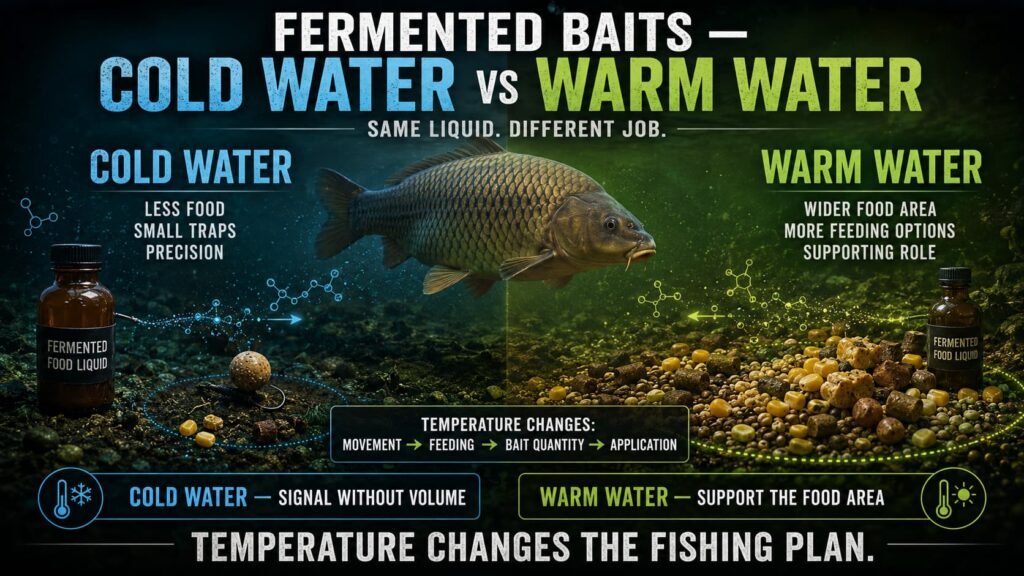
In cold water, fermented liquids can help a small amount of bait create a more active local food signal without forcing me to introduce much feed.
As the water warms and carp feed more actively, the same type of liquid can become part of a broader feeding system built around particles, pellets, chopped boilies and repeated top-ups.
The important difference is not that fermentation somehow switches on in cold water and switches off in summer.
The fish and the fishing situation change.
Water temperature can affect:
- carp movement;
- feeding intensity;
- duration of feeding periods;
- food intake;
- metabolism;
- depth use;
- oxygen conditions;
- the amount of bait it makes sense to introduce.
Controlled studies on common carp support a strong relationship between temperature and feeding, although the exact optimum varies with fish size, acclimation and experimental conditions.
That is why I think the useful question is not:
Are fermented baits better in cold water?
It is:
What job should fermented bait perform under the conditions I am actually fishing?
For the wider explanation of fermentation, start with What Fermented Bait Liquids Really Do.
For the broader liquid-selection system, read When to Use Each Type of Carp Bait Liquid.
Quick Start
The practical answer is simple.
Cold Water
Use fermented liquid to help small amounts of bait work efficiently.
Good uses include:
- hookbait coatings;
- crumb;
- chopped boilies;
- tiny pellet traps;
- small particle patches;
- accurate single-hookbait fishing.
Main rule: Less bait. More accuracy. Controlled liquid use.
Cool Spring Water
Use fermented liquids as carp begin moving more but are not necessarily ready for heavy feeding everywhere.
Good uses include:
- small particle mixes;
- maize and hemp;
- crumb traps;
- selected boilies;
- travel-route fishing;
- warming shallows near deeper water.
Main rule: Follow movement first. Let the liquid support the trap.
Warm Water
Use fermented liquids as part of a wider feeding system.
Good uses include:
- particles;
- pellets;
- chopped boilies;
- method mixes;
- packbait;
- repeated top-ups;
- evening and overnight feeding areas.
Main rule: Food comes first. The liquid supports the food area.
Very Warm Water
The priority can change again.
Think first about:
- dissolved oxygen;
- water movement;
- healthy weed;
- inflows;
- shade;
- nighttime feeding;
- early morning windows;
- nuisance fish;
- bait spoilage.
Main rule: When conditions are very warm, oxygen and location can matter more than the liquid.
For the wider seasonal picture, use Carp Water Temperature Guide for Michigan Lakes and Seasonal Baiting.
The Real Cold-Water vs Warm-Water Difference
Fermented bait is often described as a cold-water tactic.
There is some practical logic behind that idea, but the explanation is often too simplistic.
The claim should not be:
Fermented bait is active, so temperature no longer matters.
Temperature still matters.
The bait still has to:
- take on water;
- release soluble material;
- interact with the surrounding water;
- reach fish that are actually present and willing to investigate.
The carp also have to be in the area.
The practical cold-water advantage is different:
When carp are feeding less, a small amount of carefully prepared bait can make more sense than a large bed of food. Fermented liquid can support that small-bait approach.
As the water warms, carp may feed more actively and for longer periods.
Now it may become realistic to use:
- more particles;
- more pellets;
- more boilies;
- larger baited areas;
- more frequent top-ups.
The fermented liquid has not stopped being useful.
Its role has changed.
My simplest way of thinking about it is:
Cold water: help a small trap work efficiently.
Warm water: support a larger food system.
What Counts as Fermented Carp Bait?
Fermented carp bait should be the product of a controlled food process.
Possible examples include:
- fermented corn liquid;
- fermented grain liquid;
- homemade CSL-style liquid;
- controlled particle fermentation liquid;
- selected grain or cereal ferments;
- other carefully managed food fermentation systems.
The important word is:
controlled.
Fermentation is not the same thing as spoilage.
A useful fermented bait liquid may smell:
- sour;
- grainy;
- yeasty;
- tangy;
- mildly sweet;
- food-like.
That does not mean:
- moldy;
- rancid;
- putrid;
- obviously rotten.
I do not believe that the worse a bait smells to a human, the better it becomes for carp.
For the practical homemade corn-liquid guide, read Homemade CSL for Carp Fishing in Michigan.
Why Cold Water Changes the Baiting Decision
The biggest cold-water change for me is not the liquid.
It is the amount of food I want to introduce.
When carp are moving less or feeding in shorter windows, large quantities of bait can be unnecessary.
That is where fermented liquid can fit extremely well.
You can build a trap from:
- one hookbait;
- a little crumb;
- a few chopped boilies;
- a small amount of pellet;
- several grains of maize;
- a controlled liquid treatment.
The baited area remains small.
The hookbait is easy to locate.
The swim is not overloaded with food.
That is why fermented liquid can be particularly useful in cold-water fishing.
Not because it defeats temperature.
Because it fits low-volume, accurate fishing.
For a wider cold-water bait approach, read Best Carp Bait for Cold Water.
For liquid choices beyond fermentation, use Best Liquids for Carp Fishing in Cold Water.
Best Cold-Water Uses for Fermented Bait
A Light Hookbait Treatment
A small amount of fermented liquid can be used to coat or condition a hookbait.
The aim is not to leave the hookbait permanently submerged until it becomes soft.
The aim is to add a controlled treatment while keeping the bait mechanically correct.
After treatment, always recheck:
- hardness;
- buoyancy;
- balance;
- skin strength;
- resistance to nuisance species.
This approach makes most sense when the hookbait is being fished over little or no free bait.
Crumb Traps
Crumb is one of my favorite cold-water bait forms.
It lets me introduce relatively little actual food while exposing much more bait surface directly to the surrounding water.
A simple trap could contain:
- boilie crumb;
- crushed pellet;
- several chopped boilie pieces;
- a light fermented-liquid treatment.
Add the liquid gradually.
The finished material should still behave as crumb.
Do not keep adding liquid until you accidentally create paste.
For the wider physical principle behind this, read Why Surface Area Matters in Carp Bait.
Chopped Boilies
Chops can be very useful when I want:
- fewer whole baits;
- more individual food items;
- increased exposed surface;
- a tight feeding area.
A light fermented treatment can support that approach.
The combination of whole baits, chops and crumb also lets you vary the physical release pattern without adding another five attractors.
Tiny Pellet Patches
Pellets can work very well in small traps, but they should be treated carefully.
I prefer to:
- treat a small amount;
- allow absorption time;
- check the texture;
- add more liquid only if required.
The object is not to turn the pellets into soup before they reach the water.
Small Particle Patches
Maize, hemp and a few selected particles can work very well with a compatible fermented corn or grain liquid.
The key word remains:
small.
Cold-water particle fishing should not simply be summer particle fishing with fewer rods.
The amount of food has to match the actual feeding situation.
My Favorite Cold-Water Principle: Signal Without Volume
My favorite way to describe a cold-water fermented-bait strategy is:
signal without volume.
That could mean:
- six chopped boilies instead of fifty whole boilies;
- a small crumb trap instead of a large method ball;
- a handful of maize instead of a bucket;
- one treated hookbait instead of coating every bait in the session bag.
The fermented liquid supports the small trap.
It is not the entire attraction system.
Good location, correct timing and accurate placement still matter more than the bottle.
Rising Water and Falling Water Are Not the Same
A temperature reading is useful.
The direction of change can be just as important.
Slowly Rising Water
A sustained warming trend can increase movement and open opportunities in:
- shallow bays;
- dark-bottomed areas;
- protected margins;
- reed edges;
- early weed growth;
- areas close to deeper water.
My liquid strategy may remain quite light.
The most important improvement may come from moving the bait into the correct warming area rather than increasing the liquid concentration.
Falling Water After a Cold Front
A sharp fall can shorten feeding windows and change movement.
My response is usually:
- reduce the amount of feed;
- tighten the baited area;
- simplify the trap;
- keep the presentation accurate.
I do not automatically make the bait chemically stronger because the water became colder.
The first adjustment is usually the fishing approach.
Cool Spring Water: The Transition Period
Cool spring water deserves its own section because it is not the same as deep winter and it is not yet summer.
The fish may begin:
- traveling farther;
- visiting shallow water;
- inspecting new weed growth;
- feeding on emerging natural food;
- moving between depth zones.
This is where I think fermented liquids can fit extremely well with:
- maize;
- hemp;
- pigeon feed;
- crumb;
- chopped boilies.
A practical spring system might look like this.
Wider Feed
Use a small amount of:
- maize;
- hemp;
- pigeon feed.
Treat lightly with:
- CSL-style liquid;
- compatible fermented corn liquid.
Rig Area
Use:
- crumb;
- chops;
- crushed pellets.
Hookbait
Use:
- boilie;
- maize;
- tiger nut;
- another durable high-confidence hookbait.
The important point is that spring baiting should expand with feeding activity, not simply because the calendar has reached May.
The site’s Seasonal Baiting guide makes the same practical distinction: early spring usually calls for little and accurate baiting, while bait quantity can increase later as fish activity and conditions justify it.
Why Fermented Bait Still Works in Warm Water
Warm water does not make fermented bait irrelevant.
The context changes.
As carp feed more actively, I may be able to use:
- larger particle mixes;
- pellets;
- whole boilies;
- chopped boilies;
- crumb;
- method mix;
- packbait;
- repeated top-ups.
Now the fermented liquid becomes part of a larger food system.
For example:
Particle Mix
- maize;
- hemp;
- pigeon feed;
- tiger nuts;
- peanuts;
- pellets;
- controlled fermented-liquid treatment.
Boilie Support
- whole boilies;
- chopped boilies;
- crumb;
- one selected liquid that fits the bait.
Method or Packbait
Fermented liquid can contribute to the moisture and food-liquid system, but the mechanics of the mix still come first.
The difference remains:
Cold water: make a small amount of bait work efficiently.
Warm water: support a feeding area that carp may be willing to use for longer.
Best Warm-Water Uses for Fermented Bait
Particle Mixes
This is probably the most obvious summer use.
Fermented corn or grain-style liquids fit naturally with:
- maize;
- wheat;
- pigeon feed;
- hemp;
- mixed particles.
On larger Michigan waters, this can be useful when the objective is to create a feeding area rather than rely entirely on boilies.
Pellets
Warm-water sessions often give more room for pellet use.
A compatible fermented liquid can be applied lightly.
Again, test absorption and breakdown.
A treatment that destroys the pellet before it reaches the bottom is not automatically an improvement.
Chopped Boilies and Crumb
These can form the transition between:
- the wider food area;
- the active rig zone;
- the hookbait.
I like this because the entire swim does not have to be chemically identical.
The particle area can have one food-liquid treatment.
The crumb zone can be more active.
The hookbait can remain simple.
Method Mix and Packbait
Warm conditions can suit these approaches very well where carp are feeding confidently.
The liquid must still respect the physical job of the mix.
It should not ruin:
- binding;
- casting;
- packing;
- breakdown;
- release.
Build the mechanics first.
Then fit the liquid around them.
Evening and Overnight Feeding Areas
On busy public waters, feeding can improve when:
- boat traffic falls;
- swimmers leave;
- light fades;
- margins become quieter.
A food area built with particles, pellets, chops and a controlled fermented treatment can fit this situation well.
For the wider seasonal picture, read Summer Carp Fishing in Michigan.
Very Warm Water: Stop Thinking About Liquid First
At high summer water temperatures, the most important question may not be:
Which liquid should I use?
The more useful question may be:
Where are the best oxygen conditions and feeding windows?
In hot conditions, I pay more attention to:
- moving water;
- wind exposure;
- inflows;
- healthy green weed;
- areas with circulation;
- nighttime cooling;
- early morning periods;
- shaded margins.
A sophisticated liquid in poor environmental conditions is still in the wrong place.
That is why I reduce the importance of liquid choice when:
- the water is unusually warm;
- carp activity is clearly limited;
- weed is deteriorating;
- the lake is stagnant;
- fish are consistently showing elsewhere.
Fermented bait can still work in warm water.
But location, oxygen and timing can become more important than liquid selection.
A Practical Fermented-Bait Temperature Framework
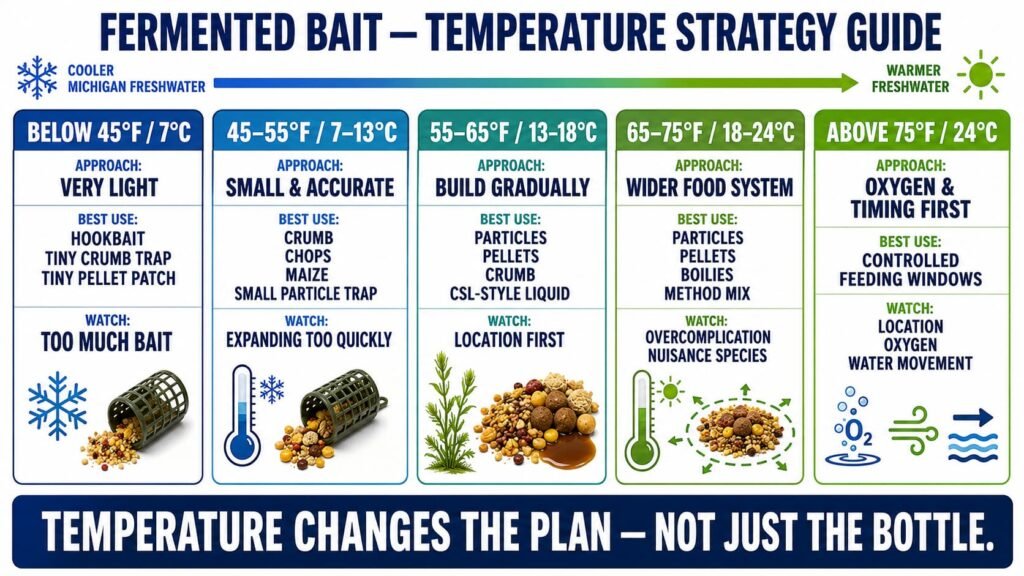
These bands are fishing guidelines rather than exact biological thresholds.
Below 45°F / 7°C
Baiting approach:
Very light.
Best fermented-bait uses:
Hookbait coating, tiny crumb trap, very small pellet patch.
Main danger:
Too much food.
45–55°F / 7–13°C
Baiting approach:
Small, accurate traps.
Best uses:
Crumb, chops, maize, small particles and treated hookbaits.
Main danger:
Expanding the baiting program too quickly.
55–65°F / 13–18°C
Baiting approach:
Increase gradually when fish activity justifies it.
Best uses:
Particles, pellets, crumb, chops and CSL-style liquids.
Main danger:
Trying to use liquid as a substitute for finding fish.
65–75°F / 18–24°C
Baiting approach:
Broader feeding systems become more practical where carp are active.
Best uses:
Particles, pellets, boilies, method mix and packbait.
Main danger:
Overcomplication and nuisance species.
Above 75°F / 24°C
Baiting approach:
Judge oxygen, feeding periods and fish location first.
Best uses:
Controlled food areas during genuine feeding windows.
Main danger:
Focusing on bait chemistry while ignoring environmental conditions.
The site-wide Carp Water Temperature Guide for Michigan Lakes should be used alongside these baiting bands because temperature also affects location, movement, feeding windows and depth choice.
Same Liquid, Different Job
This is the central idea of the whole article.
Imagine one bottle of fermented corn liquid.
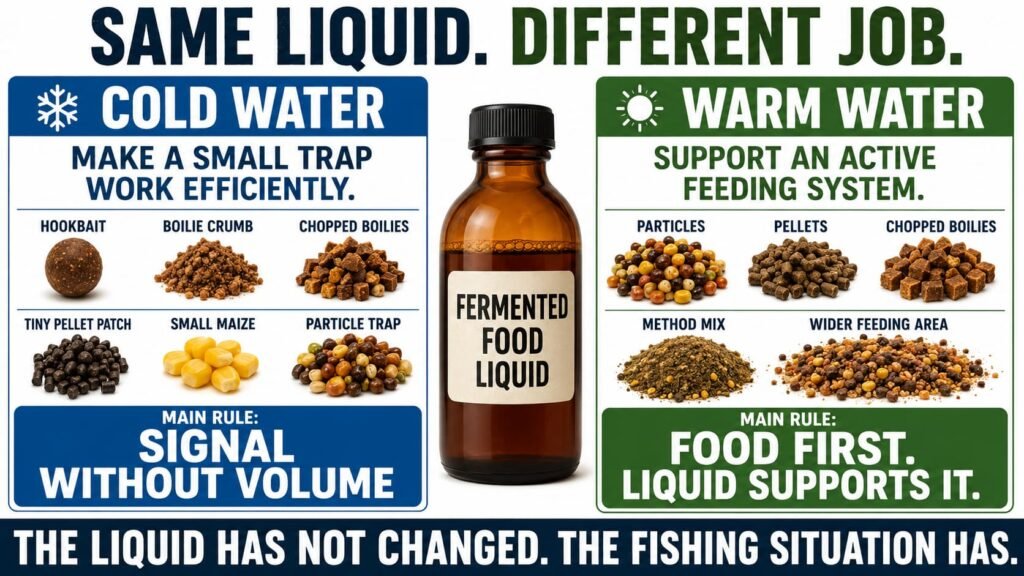
Cold-Water Job
Use it on:
- a small amount of crumb;
- a few chops;
- a tiny maize patch;
- selected hookbaits.
Purpose:
Make a small trap work efficiently.
Warm-Water Job
Use it through:
- a larger particle mix;
- pellets;
- chops;
- method mix;
- a wider food area.
Purpose:
Support an active feeding system.
The liquid has not changed.
The fishing situation has.
That is why I do not like simplistic labels such as:
cold-water liquid
or
summer-only liquid
without first looking at:
- the product;
- bait form;
- bait quantity;
- fish activity;
- session length.
Michigan Notes
Michigan waters create several situations where fermented bait makes practical sense.
Large Natural Lakes
Carp may travel long distances and feed in relatively short periods.
Solve location first.
Do not expect a liquid to attract fish across hundreds of acres of water.
Clear Lakes
Small accurate traps can make sense where heavy baiting is unnecessary.
Weed Edges
Fermented particles, maize and crumb can fit naturally into a food-based approach near productive healthy weed.
Channels and Moving Water
I like repeated small release surfaces:
- crumb;
- chops;
- pellets;
- method mix.
The answer is not simply making the liquid stronger.
Busy Summer Waters
Time the baiting strategy around quieter feeding periods.
No liquid strategy can guarantee success if disturbance has moved the fish somewhere else.
Three Seasonal Systems I Would Actually Use
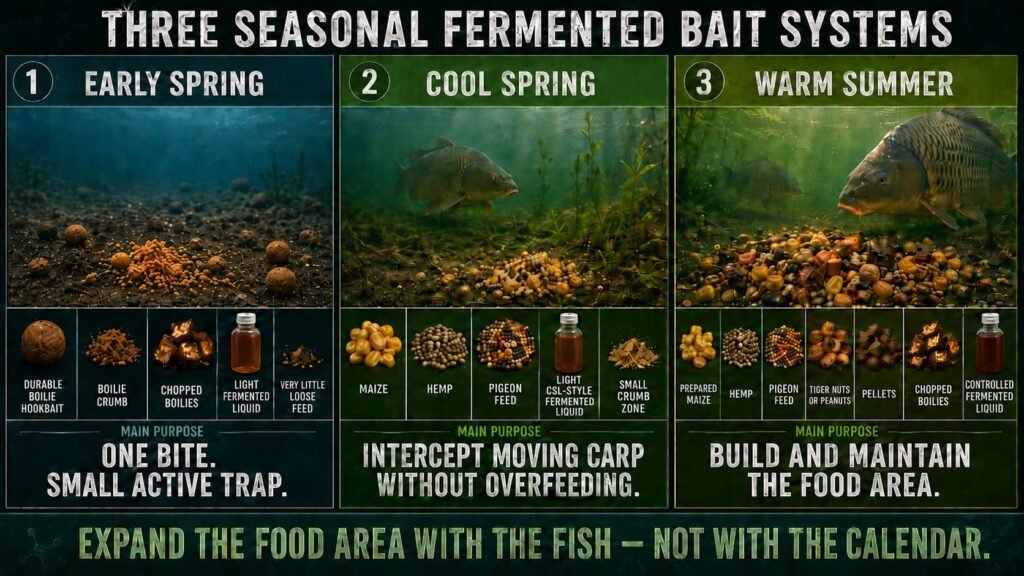
Early Spring Trap
Use:
- a durable hookbait or simple boilie presentation;
- a small amount of crumb;
- several chopped boilies;
- a light fermented-liquid treatment;
- minimal loose feed.
Purpose:
Try to create one realistic chance from a small active trap.
Cool Spring Particle System
Use:
- maize;
- hemp;
- pigeon feed;
- light CSL-style or fermented-corn treatment;
- crumb close to the rig;
- a simple hookbait.
Purpose:
Intercept moving carp without immediately overfeeding them.
Warm Summer Food Area
Use:
- prepared maize;
- hemp;
- pigeon feed;
- tiger nuts or peanuts where appropriate;
- pellets;
- chopped boilies;
- controlled fermented liquid through the wider feed.
Purpose:
Build and maintain a feeding area when conditions and carp activity justify it.
When Fermented Bait Is Overrated
Fermented bait becomes overrated when it is expected to solve the wrong problem.
It cannot fix:
- poor location;
- dead water;
- a bad presentation;
- unsafe particle preparation;
- spoiled bait;
- excessive feeding;
- poor oxygen conditions;
- badly timed sessions.
It is also overrated when every bait decision is explained through smell.
The lake is not a bait shed.
The fish are responding to a complete environment involving:
- temperature;
- depth;
- natural food;
- oxygen;
- weed;
- water movement;
- disturbance.
Fermented bait supports good fishing.
It does not replace it.
Common Mistakes
Using More Liquid Because the Water Is Colder
Cold water usually calls for control, not chemical aggression.
Reduce food quantity and improve accuracy before reaching for more liquid.
Confusing Fermentation With Spoilage
Controlled fermented food character is not the same as rotten bait.
Using the Same Bait Quantity All Year
The baiting level should change with actual fish behavior and conditions.
Ignoring Bait Form
The same liquid used on:
- hard boilie;
- crumb;
- pellet;
- cooked maize;
- method mix;
can behave differently because the physical bait is different.
Treating Summer as Permission to Overfeed
Warm water may support more feeding, but only where fish are present and conditions are suitable.
Ignoring Oxygen
In very warm conditions, carp location may be influenced by environmental factors that matter more than liquid selection.
Changing the Liquid Instead of Moving
When the carp have moved, another glug is rarely the answer.
My Practical View
Fermented bait can work in both cold and warm water.
But I use it differently.
Cold Water
I use fermented liquid to support:
- small traps;
- crumb;
- chops;
- tiny particle patches;
- selected hookbaits.
The emphasis is:
precision and low food volume.
Cool Spring Water
I use it to support:
- light particle baiting;
- maize;
- hemp;
- small food areas;
- travel-route fishing.
The emphasis is:
follow movement and expand slowly.
Warm Water
I use it through:
- particles;
- pellets;
- chops;
- method mix;
- wider food areas.
The emphasis is:
supporting a feeding system.
Very Warm Water
I think first about:
- oxygen;
- timing;
- water movement;
- shade;
- wind;
- weed.
The emphasis is:
find the right fish before worrying about the right liquid.
That is my answer to the title question.
Fermented bait is not automatically better in cold water.
But cold water often creates exactly the kind of fishing situation where a fermented food liquid can be particularly useful:
small amounts of bait, shorter feeding windows and a need for accurate local activity.
In warm water, the same liquid remains useful.
It simply becomes one part of a larger food strategy.
FAQ
Do fermented baits work in cold water?
Yes. They can fit very well into small, accurate cold-water approaches using crumb, chops, tiny pellet patches, small particle traps and lightly treated hookbaits.
Do fermented baits work in warm water?
Yes. They can be used with particles, pellets, chopped boilies, method mix and wider feeding areas when carp are feeding actively.
Are fermented baits better in cold water?
Not automatically. Their practical advantage in cold water is that they suit small, precise baiting systems. In warm water, they remain useful but often become part of a larger feeding strategy.
Should I use more fermented liquid in cold water?
No. Cold water normally calls for controlled application and reduced bait quantity rather than heavier liquid use.
What is a good cold-water fermented bait approach?
A small trap of crumb or chops with a durable hookbait and a light fermented-liquid treatment is a sensible starting point.
What is a good warm-water fermented bait approach?
A controlled particle and pellet system with chopped boilies and a compatible fermented liquid is a practical starting point where carp are feeding confidently.
Does fermented bait work in very warm water?
It can, but oxygen, fish location, water movement and feeding windows may become more important than liquid choice.
Is CSL-style liquid useful in cold water?
A CSL-style liquid can be used lightly in crumb, chopped boilies, pellets and small particle patches. The amount of food remains just as important as the liquid.
Can fermented bait go bad?
Yes. Controlled fermentation and spoilage are different processes. Obviously moldy, rancid or putrid bait should not be treated as desirable fermented bait.
Final Thoughts
The biggest mistake in this subject is looking for one universal temperature rule.
Fermented bait does not belong to one season.
Its role changes.
In cold water:
use it to help a small trap work efficiently.
In cool spring water:
use it to support light baiting as movement increases.
In warm water:
use it as part of a broader food system.
In very warm water:
solve oxygen, location and timing first.
That is more useful than saying fermented bait is simply a cold-water attractor.
Temperature changes the fishing situation.
Your baiting strategy should change with it.
Next Steps
Continue through the Bait Science and seasonal bait series with:
What Fermented Bait Liquids Really Do
Best Liquids for Carp Fishing in Cold Water
When to Use Each Type of Carp Bait Liquid
Fermented Liquids vs Hydrolysates for Carp
Fermented Liquids vs Hydrolysates vs Sweet Liquids
Homemade CSL for Carp Fishing in Michigan
Carp Water Temperature Guide for Michigan Lakes