
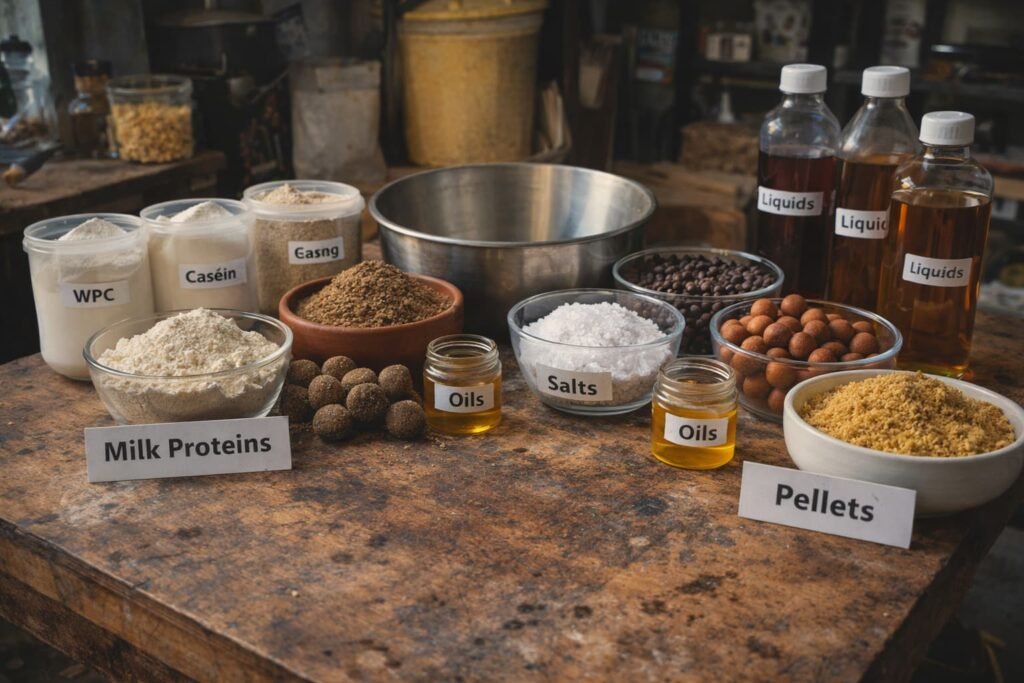
Compare Ingredients
This page is here to help you make better bait decisions without rebuilding your whole mix every five minutes. It is the comparison page in the bait section — the place where you step back, look at two approaches side by side, and decide what actually makes more sense for the bait you are trying to build.
If Carp Bait Guide is the broad front-door bait page, Bait Science is the deeper why, and The Bait Shed is the practical workshop, then Compare Ingredients is where you tighten decisions before changing the whole bait around.
Quick Start
- Milk Powders for Carp Boilies — A Starter Guide
- Raw vs Processed Ingredients in Carp Bait
- Solubility vs Nutrition in Carp Bait
- Anti-Nutritional Factors in Carp Bait Ingredients
What This Page Is For
Good bait making is not just about adding more ingredients. It is about choosing the right ingredient family, the right level of processing, the right type of food signal, and the right kind of richness for the conditions you are fishing in.
That means comparing things properly:
- milk proteins vs cheaper dairy blends
- raw materials vs properly processed ingredients
- solubility vs long-term food value
- cheap fillers vs ingredients that actually earn a place
- sharp attraction vs steady confidence bait
- ingredients that sound good on paper vs ingredients that behave well in the finished bait
Start with These Comparisons
If you are not sure where to begin, start with the comparisons below. These are the ones most likely to improve your bait decisions quickly.
- Milk Powders for Carp Boilies — A Starter Guide — a practical starting point for understanding common dairy options.
- Raw vs Processed Ingredients in Carp Bait — one of the biggest real-world bait questions.
- Solubility vs Nutrition in Carp Bait — useful if your bait either feels too dead or too empty.
- Anti-Nutritional Factors in Carp Bait Ingredients — important if you are leaning heavily on plant ingredients and feed materials.
- Sugars, Sweeteners, and Carbohydrates in Carp Bait — useful if you want to separate taste, energy, and marketing hype.
How to Compare Ingredients Properly
The mistake many bait makers make is comparing ingredients by label language instead of by function. An ingredient should earn its place in one or more of the following ways:
- Nutrition — does it genuinely add feeding value?
- Digestibility — is it easy enough for the fish to deal with in the conditions?
- Food signal — does it improve smell, taste, leakage, or attraction in a useful way?
- Texture and structure — does it help the bait roll, bind, dry, break down, or release properly?
- Practical use — does it actually make sense in the bait you are trying to fish?
If an ingredient sounds impressive but does not clearly help in one of those areas, it may not belong in the bait at all.
Common Comparison Traps
- Comparing ingredients by protein number alone.
- Assuming expensive means better.
- Assuming raw means more natural and therefore better.
- Assuming soluble means nutritionally useful.
- Ignoring inclusion level and total mix balance.
- Changing several ingredient groups at once and then not knowing what actually helped.
Michigan Notes
On Michigan waters, ingredient comparison matters because the bait often has to work under mixed and awkward conditions. Big natural lakes, cool spring water, natural food, zebra mussels, short feeding windows, and moving fish all make it more important to build bait that is believable, digestible, and practical rather than just rich or fashionable.
That is why comparison matters so much. A bait does not need every “best” ingredient. It needs the right family of ingredients doing the right jobs for the conditions in front of you.
Use This Section Alongside
Compare Ingredients works best when used alongside the other main bait sections:
- Carp Bait Guide — the broad bait overview.
- Bait Science — the deeper why behind ingredient behaviour.
- The Bait Shed — the practical workshop side.
- Boilie School — the structured route into better boilie building.
- Tactics — where bait decisions meet real bank choices.
Next Steps
After this page, the best next reads depend on what you are trying to improve next.
- Carp Bait Guide — go here if you want the broader bait picture first.
- Bait Science — go here if you want the deeper why behind ingredient behaviour.
- The Bait Shed — go here if you want practical workshop-style bait improvements.
- Boilie School — go here if you want a structured boilie learning route.