

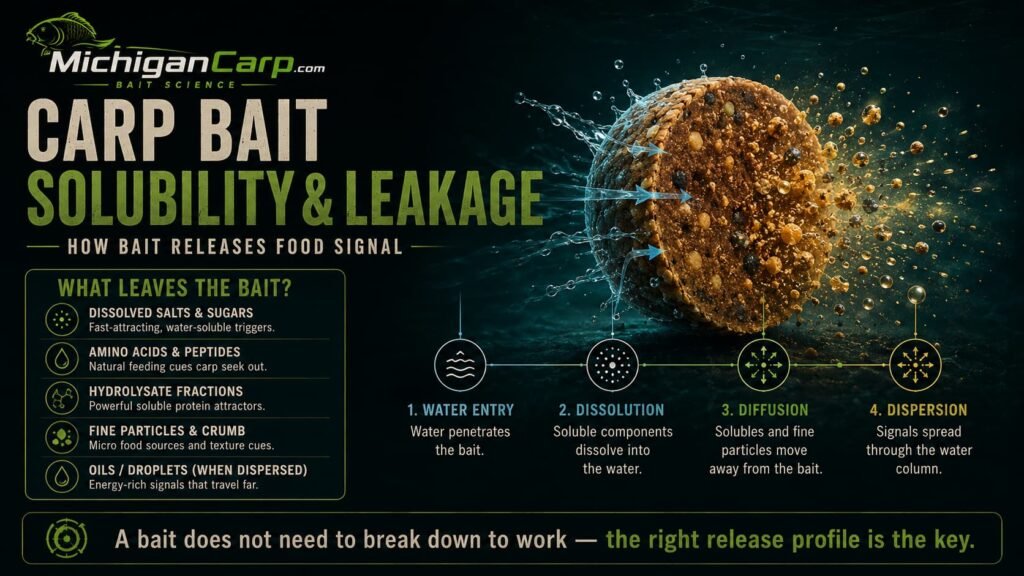
Carp bait solubility and leakage control how a bait communicates underwater.
That does not mean a boilie has to melt, collapse or disappear before it becomes active. A physically durable bait can still release dissolved food signals into the surrounding water. At the same time, a bait can visibly break apart while releasing surprisingly little useful dissolved material.
This is where anglers often confuse three different things: solubility, leakage and breakdown.
Solubility is about whether a material can enter solution in water. Salt and sugar are simple examples. Some amino acids, organic acids and soluble fractions of hydrolysates also belong in this discussion.
Leakage is broader bait language. It describes material leaving the bait and entering the surrounding water. Some of that material may be truly dissolved. Some may be fine particles, suspended material, emulsified droplets, surface powder, crumb or eroded fragments.
Breakdown is physical collapse or erosion. It can help release material, but it is not required for release to happen.
A bait does not have to fall apart to leak, and a bait that falls apart is not automatically releasing the best food signal.
This article is the core explanation of how carp bait releases food signal into water. It works with How to Use Hydrolysates in Carp Bait, Proteins, Peptides and Hydrolysates in Carp Bait, Boilie Liquids and Additives, What Boiling Does to Carp Bait, How Bait Texture Affects Carp Feeding Confidence, Water Activity in Boilies and the main Bait Science hub.
For external technical background, see OpenStax: The Dissolution Process, Physicochemical and Functional Properties of Vegetable and Cereal Proteins and AOCS: Emulsions — Making Oil and Water Mix.
Table of Contents
Quick Start: Carp Bait Solubility and Leakage
Carp bait solubility and leakage are best understood as a water-access problem.
Water must reach the bait, enter accessible parts of the structure, dissolve suitable compounds, and allow those dissolved compounds to move outward. At the same time, fine particles, crumb, dust, oils, emulsified droplets and physical fragments may also leave the bait.
| Term | What it means | Simple bait example |
|---|---|---|
| Solubility | A material enters solution in water | Salt, sugar, organic acids, some amino acids |
| Leakage | Material leaves bait into the surrounding water | Dissolved signal, fine particles, hydrolysate fractions, crumb |
| Diffusion | Dissolved material moves through water-filled spaces | Soluble compounds moving from inside a boilie outward |
| Dispersion | Fine material spreads without fully dissolving | Boilie dust, method mix particles, fine crumb cloud |
| Emulsification | Small droplets are held in another liquid phase | Oil droplets carried in an emulsified bait liquid |
| Breakdown | The bait physically loses pieces or collapses | Paste erosion, pellet breakdown, soft bait fragmenting |
The useful rule is:
Do not judge bait release by hardness alone. Judge how water enters, what can dissolve, what disperses, and how the finished bait structure controls release.
Solubility and Leakage Are Related but Different
The words are often used together, but they are not identical.
Solubility is a chemical property. It asks whether a substance can dissolve in water and to what extent. Leakage is the practical fishing result. It asks what leaves the bait, how quickly it leaves, and what kind of local food-signal zone the bait creates.
This difference matters because not everything leaving bait is dissolved.
A boilie may release salts, sugars, organic acids, free amino acids and smaller soluble food fractions. It may also release fine seed particles, birdfood particles, boilie crumb, powdered coatings, emulsified droplets, oil traces and softened fragments.
All of those can affect the local feeding environment. But they do not all move or behave in the same way.
| Material leaving bait | Likely behaviour | Practical meaning |
|---|---|---|
| Salt and simple sugars | Dissolve readily | Fast water-soluble signal |
| Organic acids | Often water-active | May affect local taste/pH context depending on use |
| Free amino acids | Small dissolved compounds | Relevant to chemosensory and taste discussions |
| Small peptides and hydrolysate fractions | Product-dependent soluble release | Protein-derived food signal |
| Fine powders and crumb | Disperse physically | Create local particles and exposed surfaces |
| Oils | Separate phase unless emulsified/dispersed | Not the same as water-soluble signal |
| Large protein structures | Generally slower or less water-mobile | More important for food value and structure |
This is why “more leakage” is not always a useful goal. The better goal is the right kind of release for the fishing situation.
How Bait Releases Food Signal
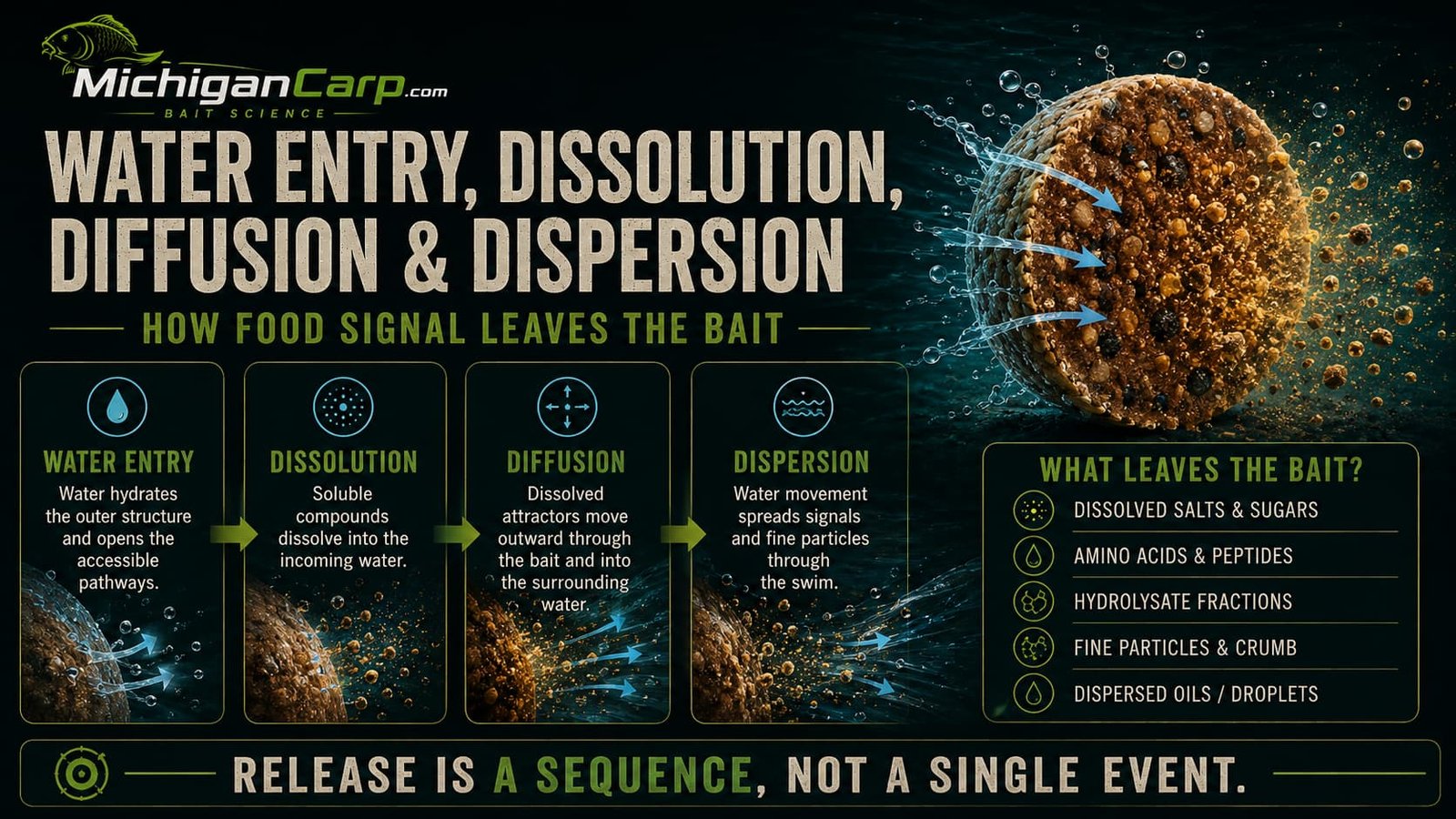
The basic release sequence is simple:
Water contacts the bait → water enters accessible structure → soluble material dissolves → dissolved material moves outward → water movement carries and dilutes the signal.
The outer surface changes first. The bait skin hydrates, soluble surface material begins to move, coatings start working, powders wet out, and any exposed crumb or cracks become active quickly.
Internal release takes longer because water has to move deeper into the structure. Material trapped near the centre of a dense 24 mm boilie cannot behave like powder dusted on the surface. It has a longer path to travel and may be held inside a cooked, dried, protein-starch-egg matrix.
This is why the same recipe can behave differently as a whole boilie, chop, crumb, paste, powder-coated hookbait or glugged bait.
The formula matters, but the finished format matters just as much.
The Bait Matrix Controls Water Access
A finished boilie is not just a list of ingredients. It is a matrix.
Egg proteins, milk proteins, starches, cereal particles, seed meals, fats, fibres, minerals and liquids are held together by mixing, rolling, heating, drying and storage. Two baits can contain similar ingredients and still leak differently because the final structure is different.
The matrix controls how quickly water enters, whether pores are connected, how tightly ingredients are bound, how strong the skin becomes, how much the bait swells, how easily particles are released and how far soluble material must travel.
| Matrix factor | Effect on release |
|---|---|
| Surface skin | Can slow water entry or create a staged release |
| Internal porosity | Allows water access if pores are connected |
| Fine grinding | Can create dense paste or smooth structure |
| Coarse ingredients | Can create texture, cracks and exposed food particles |
| High binding | Improves durability but can slow release |
| High fat or oil | Can interfere with water access if overused |
| Heavy drying | Improves storage and hardness but slows rehydration |
| Cracks and cuts | Give water faster access to internal material |
A good bait is not always the most open bait. It still needs to cast, stay on the rig, resist nuisance species where needed, and remain functional for the intended water time.
The practical target is controlled access, not uncontrolled collapse.
Ingredient Form Matters
Different ingredients release differently because they are different materials.
A spoonful of salt, a spoonful of hydrolyzed whey, a spoonful of liver powder, a spoonful of tiger nut flour and a spoonful of oil do not behave the same way in water. Some dissolve. Some disperse. Some swell. Some form particles. Some separate into another phase.
This is why bait design should separate water-soluble ingredients from structural food ingredients.
| Ingredient type | Release role | Practical use |
|---|---|---|
| Salt, sugars and small organic acids | Fast dissolved material | Useful in controlled amounts for immediate water activity |
| Free amino acids | Small water-active compounds | Specific sensory/formulation role, not magic dust |
| Hydrolysates | Protein-derived soluble fractions | Useful in liquids, powders, crumb and hookbait prep |
| Milk proteins | Food value, structure and variable solubility | Need correct ingredient selection and processing |
| Cereals and starches | Structure, binding, texture and some release | Controlled by cooking, grinding and hydration |
| Birdfood and seed meals | Texture, openness and particles | Good for physical activity and surface area |
| Oils and fats | Energy and separate-phase movement | Useful, but not the same as water-soluble leakage |
For proteins and hydrolysates, use Proteins, Peptides and Hydrolysates in Carp Bait. For hydrolysate application, use How to Use Hydrolysates in Carp Bait. For amino-acid claims, use Do Carp Detect Free Amino Acids the Way Anglers Think?.
Oils Do Not Leak Like Water-Soluble Signals
Oil is useful in bait, but it should not be described as if it behaves like salt, sugar or amino acids.
Water-soluble compounds enter the water phase. Oils and fats are different. They can move out of bait, smear, spread, form droplets, float, bind with particles or become part of an emulsion if the system supports that.
This matters because heavy oil use can sometimes reduce water access rather than improve it. A bait that is overloaded with oil may smell strong and look rich, but it is not necessarily releasing the right water-soluble food signal.
Oil can still be valuable for energy, texture, taste profile and bait conditioning. The point is simply that oil release and water-soluble leakage are different processes.
| Material | How it behaves | Bait lesson |
|---|---|---|
| Salt/sugar | Dissolves in water | Fast soluble release |
| Hydrolysate liquid | May contain water-soluble food fractions | Useful for soluble signal if not overused |
| Oil | Separate phase unless dispersed/emulsified | Use for energy/profile, not as a simple solubility shortcut |
| Emulsified liquid | Small droplets dispersed in another phase | Can help distribute oily components more evenly |
For fat balance, use How to Balance Fat in Boilies: Milk, Nut and Seed Mixes. For emulsifier logic, use Lecithin in Carp Bait.
Surface Area Changes Everything
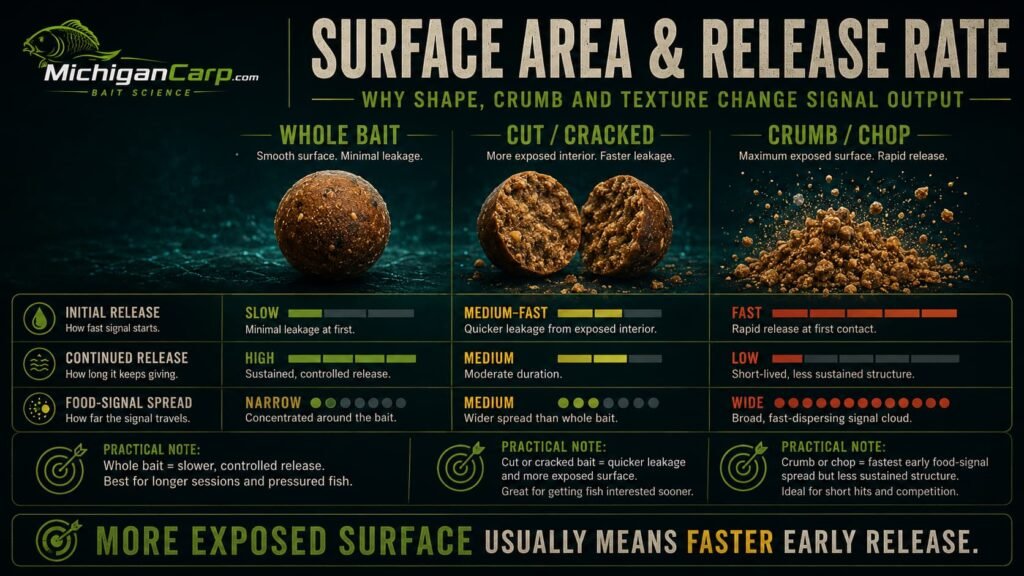
Surface area is one of the easiest ways to control bait release without changing the recipe.
A whole boilie has limited exposed surface compared with its volume. A chopped boilie exposes the internal structure. Crumb exposes far more surface. Dust and paste are even more direct.
This is why a 24 mm bait can behave one way on the hair and very differently when crushed into crumb around the rig.
| Bait format | Water access | Best use |
|---|---|---|
| Whole boilie | Slowest access to centre | Durability, selective feeding, longer water time |
| Halves | Exposes some internal structure | Faster local food signal without full crumb |
| Chops | Much more exposed surface | Rig-area activity and mixed feeding texture |
| Crumb | Very high surface area | Short sessions, cold water, sticks, method and traps |
| Paste | Direct water access and erosion | Fast activity where durability is less important |
| Powder coating | Immediate outer skin | Hookbait signal and short-session lift |
Surface area is also why crumb works so well with hydrolysates and yeast liquids. The liquid does not have to escape from the centre of a dense boilie. It is spread through exposed bait particles where water can reach it quickly.
For the dedicated guide, use Why Surface Area Matters in Carp Bait.
Cooking, Drying and Rehydration
Cooking and drying are not just production steps. They change the release system.
Heating can set proteins, gelatinize starches, firm the bait, create a skin, change texture and alter how easily water enters. Longer boiling does not simply make bait “better cooked.” It changes the physical structure and may reduce some fast surface leakage while increasing durability.
Drying removes water and changes water activity, storage behaviour, hardness and rehydration rate. A heavily dried bait may still release signal, but it often needs time to rehydrate before deeper internal release develops.
| Production choice | Likely release effect | Main warning |
|---|---|---|
| Shorter cook | Softer, potentially more open bait | May reduce durability and water life |
| Longer cook | Firmer skin and stronger structure | Can slow fast leakage |
| Light drying | Faster rehydration and softer bait | Lower storage stability |
| Heavy drying | Harder bait and improved storage handling | Slower rehydration and delayed internal release |
| Controlled rehydration | Can restart surface activity before fishing | Wet bait needs careful storage |
For heat effects, use What Boiling Does to Carp Bait: Heat, Steaming, Leakage and Structure. For drying and storage, use Water Activity in Boilies and How to Store Homemade Boilies.
pH, Protein Solubility and Bait Release
pH can affect how some ingredients behave, especially proteins.
Many proteins have a region near their isoelectric point where solubility is reduced. Moving away from that region can change charge behaviour and solubility, but this does not mean “make every bait acidic” or “acid equals attraction.”
The practical point is more careful: protein solubility is ingredient-specific and pH-dependent. Casein, whey proteins, egg proteins, soy proteins, pea proteins and fish proteins do not all behave the same way.
pH also interacts with salt level, heat history, drying, other ingredients and the finished bait matrix. That is why pH should be treated as one formulation variable, not a one-number attraction theory.
For the deeper article, use How pH Changes Carp Bait Performance.
Water Temperature, Movement and the Local Signal Zone
Once material leaves the bait, the surrounding water controls transport and dilution.
Still water, wind movement, undertow, river current, wave action and boat disturbance can all change how released material moves. A bait may release effectively, but moving water can carry the signal away quickly. In still water, a tighter local zone may remain around the bait for longer.
The strongest dissolved signal is usually closest to the bait source, not spread evenly across a whole lake.
A bait does not need to send a magical chemical cloud across the lake. It needs to work where carp actually pass, feed or investigate.
Temperature also matters, but it should not be simplified into “cold water stops leakage.” Physical release still happens in cold water. What changes is the rate of some processes and, just as importantly, carp location, movement and feeding behaviour.
| Condition | Release lesson | Fishing lesson |
|---|---|---|
| Cold water | Release may be slower but still occurs | Use smaller bait quantities and more precise local signal |
| Warm water | Release, softening and spoilage risk can increase | Balance signal with food value and storage care |
| Still water | Local zone may persist longer | Accurate placement matters |
| Current or wind movement | Signal can transport and dilute faster | Position bait relative to fish movement and flow |
| Big natural lakes | No bait replaces location | Find carp first, then tune release profile |
Burst Release vs Sustained Release
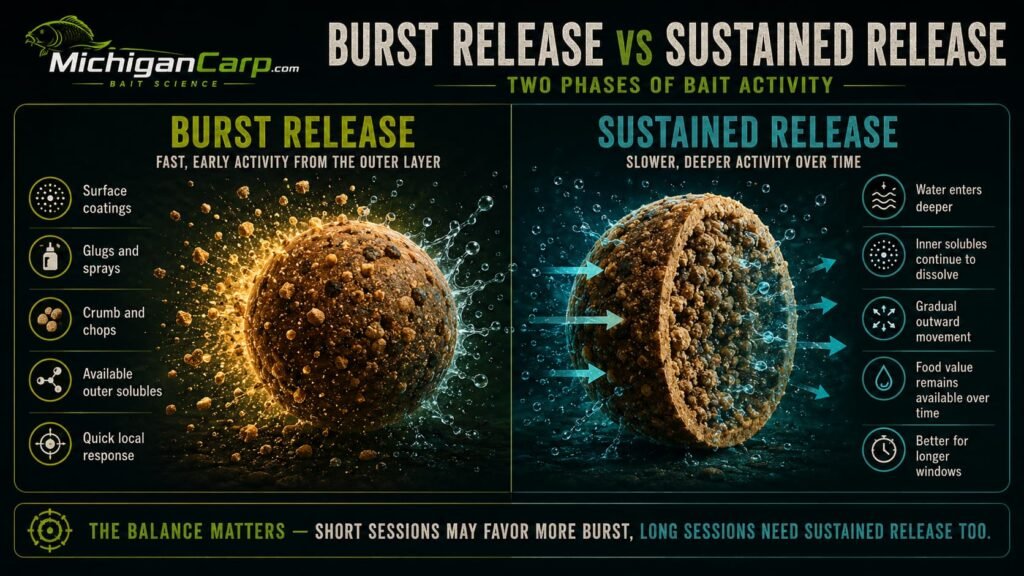
A useful bait system often has two release phases.
Burst release is the early activity from surface coatings, soluble powders, glugs, crumb, small particles, sprays and easily available material near the bait surface.
Sustained release develops as water moves deeper into the bait, internal material dissolves, dissolved compounds move outward, and the bait gradually softens or erodes.
Neither phase is automatically better. The right balance depends on the job.
| Fishing goal | Release priority | Bait format |
|---|---|---|
| Short-session trap | Strong local burst release | Crumb, chops, powder coating, treated hookbait |
| Single hookbait | Targeted surface activity | Spray, light soak, dusting, small PVA trap |
| Overnight session | Mixed early and sustained release | Whole boilies plus crumb/chops |
| Multi-day session | Balanced release and food value | Durable bait with controlled soluble fraction |
| Campaign baiting | Consistent food signal | Repeatable bait, moderate solubles, good nutrition |
The goal is not maximum leakage at all costs. The goal is the right release profile for the baiting job.
How to Test Bait Release at Home
You do not need a laboratory to make useful comparisons.
A simple home test will not tell you exact chemical concentrations, but it can show which bait hydrates faster, softens faster, clouds more, cracks sooner, releases more particles or holds together longer.
| Test rule | Why it matters |
|---|---|
| Use equal bait weight | Stops one sample being tested unfairly |
| Use equal water volume | Keeps dilution comparable |
| Use the same water temperature | Temperature changes behaviour |
| Use identical containers | Improves visual comparison |
| Change one variable at a time | Shows what caused the difference |
| Record fixed times | Lets you compare 1, 6, 12 and 24 hours |
Good comparisons include whole boilie versus chop, chop versus crumb, short boil versus long boil, one-day drying versus five-day drying, untreated bait versus powder-coated bait, and light glug versus heavy glug.
Record hydration, surface softening, core firmness, visible clouding, particle release, cracking, weight change if measured, and hookbait durability on the actual rig.
Do not confuse visible clouding with total dissolved food signal. Clouding is useful to observe, but it is not a complete chemical analysis.
For a full test structure, use How to Test Boilies Before Fishing.
Michigan Notes
Michigan waters create very different bait-release situations.
On cold spring lakes, I usually want a bait system that communicates locally without requiring a large amount of feed. That often means a durable hookbait with small amounts of crumb, chops, stick mix, powder coating or controlled soluble liquid.
On warmer summer and fall sessions, I become more interested in the balance between release and food value. Carp may feed harder, so the bait needs to remain worth eating repeatedly, not just shout for a few minutes and disappear.
On impoundments, river sections and wind-driven lakes, water movement changes how signal transports and dilutes. This makes placement relative to travel routes, wind, undertow, weed edges, snags and natural feeding zones more important than simply increasing glug strength.
On large natural lakes, no amount of solubility replaces location. Find carp first. Then choose bait format and release rate to build an effective feeding zone where the fish already move or feed.
Common Misunderstandings
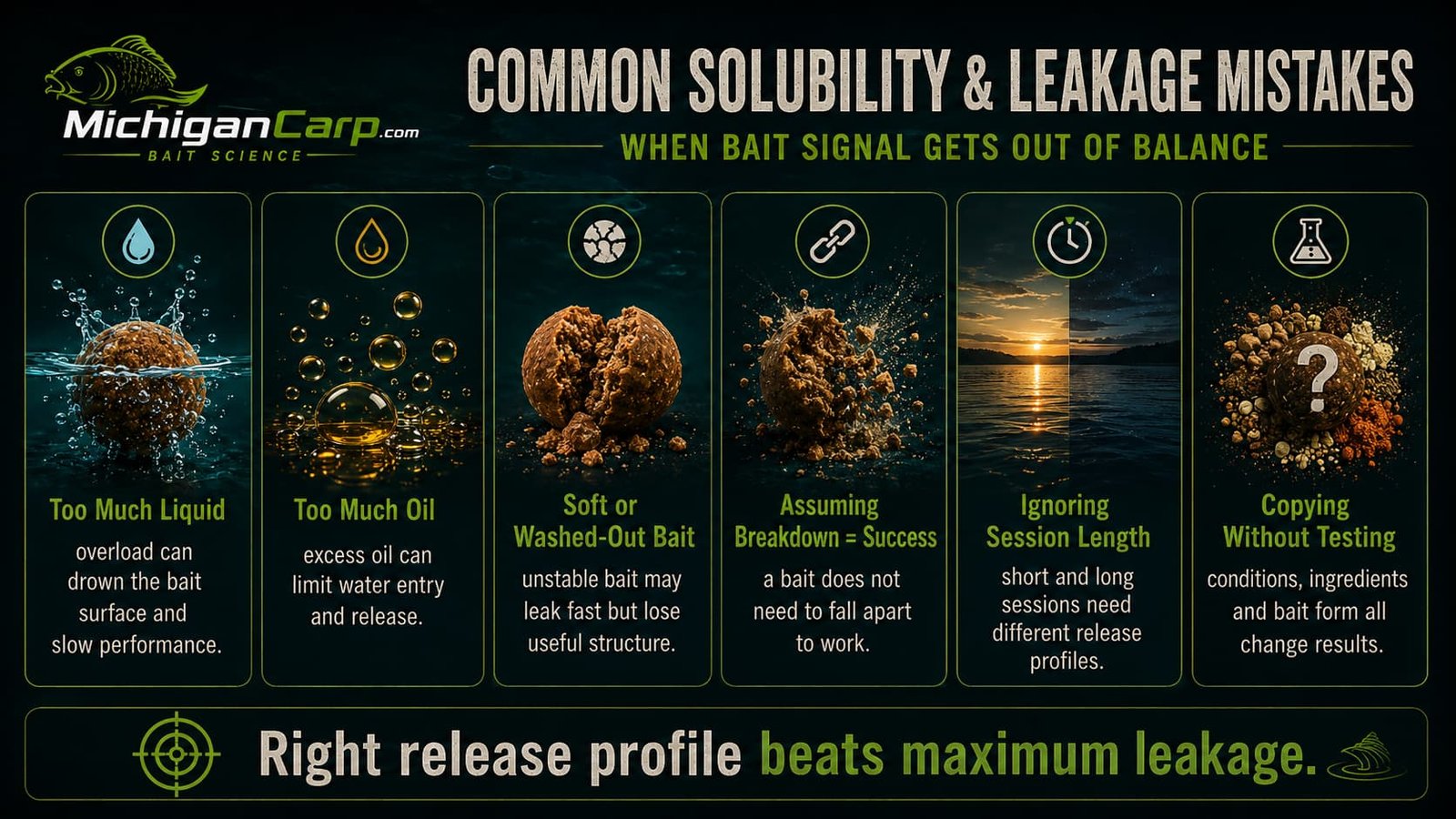
| Misunderstanding | Better view |
|---|---|
| A bait must break down to leak | A durable bait can stay intact while releasing dissolved material |
| Everything leaving bait is dissolved | Leakage can include dissolved compounds, particles, droplets and fragments |
| More soluble is always better | The right release profile depends on the fishing job |
| More oil means more leakage | Oil is not the same as water-soluble food signal |
| Strong bucket smell means strong underwater signal | Air aroma and water release are different things |
| Cold water stops bait release | Release still occurs, but rates and fish behaviour may change |
| One ingredient controls leakage | The whole matrix, process, format and water conditions matter |
| Soft bait is automatically superior | The bait still has to cast, present and last long enough |
Simple Rules for Carp Bait Solubility and Leakage
Separate dissolution from physical breakdown. Remember that water must gain access before internal material can release effectively. Think about ingredient form, molecular size, matrix structure, surface area and water movement.
Do not treat oils like water-soluble signals. Do not judge bait by bucket smell alone. Do not assume that the fastest-leaking bait is always the best bait.
Use whole boilies when you need durability and sustained food value. Use chops, crumb, powders and paste when you need faster local activity. Use glugs and hydrolysates to support the bait, not to replace good formulation.
Most importantly, test in water. A bait that looks good on paper still needs to work as a finished bait.
My Practical View
Carp bait solubility and leakage are not about making every bait as soft, wet or powerful-smelling as possible.
A working bait is a physical and chemical system. Water reaches the bait, enters accessible parts of the matrix, dissolves suitable compounds and allows dissolved material to move outward. At the same time, fine particles may disperse, fragments may separate, and oils or emulsified material may behave in their own way.
The speed and character of that release depend on the ingredient list, but also on grinding, mixing, cooking, drying, surface area, bait size, water temperature, water movement and session goal.
For my own Michigan fishing, I want controlled release. In spring or short sessions, that may mean a faster local signal from crumb, chops, powder coatings and treated hookbaits. In warmer water or longer sessions, I want early activity supported by real food value and a bait that carp can return to confidently.
The goal is not maximum leakage. The goal is the right release profile for the water, the session and the baiting job.
FAQ
What does solubility mean in carp bait?
Solubility means whether and how readily a bait component can enter solution in water. Salt, sugar, some organic acids, some amino acids and certain hydrolysate fractions are examples of water-active materials.
What is bait leakage?
Bait leakage is the broader release of material from bait into the surrounding water. It can include dissolved compounds, dispersed particles, suspended material, droplets, crumb and physical fragments.
Does a boilie need to break down to release attraction?
No. A boilie can remain physically intact while soluble compounds dissolve and move out through hydrated parts of the bait structure.
Is visible clouding the same as dissolved food signal?
No. Clouding often shows dispersed particles, fine powders or physical material. It can be useful, but it does not prove how much dissolved food signal is present.
Do smaller molecules leak faster?
Smaller dissolved molecules often move more readily through water-filled spaces than large structures, but release also depends on charge, concentration, bait matrix, porosity and water access.
Why does pH matter to bait solubility?
pH can change the charge and solubility behaviour of many proteins. The result is ingredient-specific, so pH should be treated as a formulation variable rather than a simple attraction shortcut.
Does oil improve bait leakage?
Oil can leave bait and affect the feeding environment, but it is not water-soluble and does not behave like salt, sugar, amino acids or soluble peptides.
Why does crumb work quickly?
Crumb has high surface area and short distances between internal material and surrounding water. It also releases fine physical particles rapidly.
Does cold water stop bait leakage?
No. Release still occurs in cold water, although some physical rates and carp feeding behaviour may change.
Can I test bait leakage at home?
Yes. Use equal bait weights, equal water volumes, identical containers, controlled temperature and fixed observation times. Compare one variable at a time.
Is the fastest-leaking bait always best?
No. Short-session traps may benefit from rapid local signal, while longer campaigns often need a balance between early release, sustained release and food value.
Next Steps
- Why Some Carp Baits Leak Faster Than Others — practical formulation and process factors that control release rate.
- Why Surface Area Matters in Carp Bait — whole boilies, chops, crumb, paste and exposed structure.
- How to Test Boilies Before Fishing — compare water uptake, softening, cracking and durability.
- Solubility vs Nutrition in Carp Bait — balance quick signal with real food value.
- Proteins, Peptides and Hydrolysates in Carp Bait — understand protein forms and soluble fractions.
- How to Use Hydrolysates in Carp Bait — apply hydrolysates without overpowering the bait.
- Boilie Liquids and Additives — fit liquids into the complete bait system.
- What Boiling Does to Carp Bait — understand heat, steaming, leakage and structure.
- How Bait Texture Affects Carp Feeding Confidence — connect structure, softness and feeding response.
- How pH Changes Carp Bait Performance — understand pH without turning it into bait mythology.
- Bait Science — browse the technical bait library.