

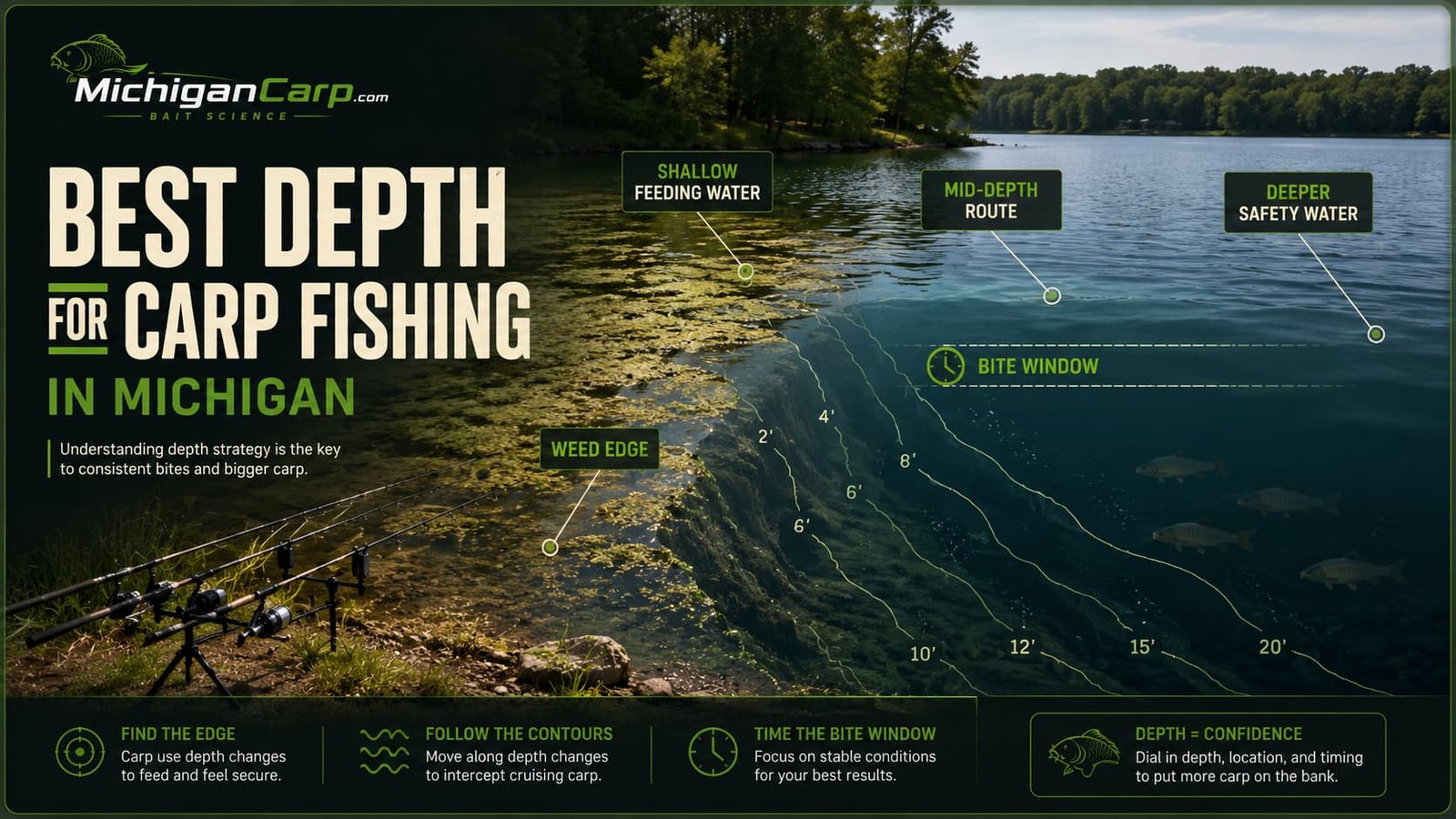
The best depth for carp fishing is not one fixed number. Carp may feed in two feet of warming spring water, patrol the edge of a six-foot weed bed in summer, move along a ten-foot shelf in fall, or hold in deeper stable water during cold conditions. The right depth depends on season, water temperature, oxygen, weed, light, pressure, food, safety and how confidently carp can move between feeding and holding areas.
That is especially true on Michigan lakes. A shallow bay can be excellent after a few warm days, poor after a cold wind, and useful again when low light, ripple and natural food bring carp back in. A deeper edge can look boring from the bank but act like a route between comfort water and feeding water. A clear hole beside weed can matter more than the whole open flat. A channel edge may be more important than the deepest basin itself.
The useful question is not:
What depth do carp like?
The better question is:
Which depth zone gives carp food, comfort, oxygen, safety, movement and a clean place for me to present a rig?
This guide explains how to choose depth for carp fishing in Michigan lakes, how carp use shallow, mid-depth and deeper water, why depth changes often matter more than exact depth, how seasons change the answer, and how to connect depth to water temperature, oxygen, wind, weed, baiting, rigs and fish care.
For the wider location process, read How to Find Carp in Lakes. For the condition-reading system, use Watercraft and Conditions for Michigan Carp Fishing. For temperature, read Carp Water Temperature Guide for Michigan Lakes.
Quick Answer: What Is the Best Depth for Carp Fishing?
As a practical starting point, many visible carp feeding situations happen in shallow water from roughly 2 to 8 feet, especially during spring, low light, warm margins, colored water, weed edges and natural-food activity. But feeding depth is not the same as holding depth. Carp may feed shallow and then slide back to safer mid-depth or deeper water nearby.
For many Michigan lake situations, the strongest areas are not simply shallow or deep. They are the transitions: the edge of a flat, the drop beside a weed bed, the channel mouth, the shelf near a bay, the first clean strip outside reeds, or the route between a feeding area and safer water.
Use the table below as a starting point, not a rule.
Table of Contents
| Situation | Good starting depth | Why it can work |
|---|---|---|
| Early spring warming water | 2–8 feet | Shallow bays and dark bottoms can warm first and activate natural food |
| Late spring and pre-spawn movement | 3–10 feet | Carp may patrol warm edges, reeds, bays, flats and nearby routes |
| Bright summer daytime | 6–15 feet | Mid-depth water can give comfort, cover, oxygen options and safety |
| Summer evening, dawn or night | 2–8 feet | Carp often move shallower when light, pressure and temperature improve |
| Fall feeding periods | 5–12 feet | Productive shelves, weed edges and routes can hold repeat feeding fish |
| Cold winter conditions | 10–25+ feet | Stable deeper water may hold carp for longer periods |
| Clear signs of feeding | Fish the signs first | Bubbles, clouding, liners, rolling fish and repeated movement beat theory |
The best depth is the one that gives carp a reason to be there and gives you a way to fish it properly. A random cast to 18 feet is not better than a clear 6-foot weed edge with food, movement and fish signs. A shallow flat is not better than a nearby drop-off if the flat is cold, bright, pressured and lifeless.
Do not fish a number. Fish the reason carp would use that number.
The Best Depth Is Not a Number
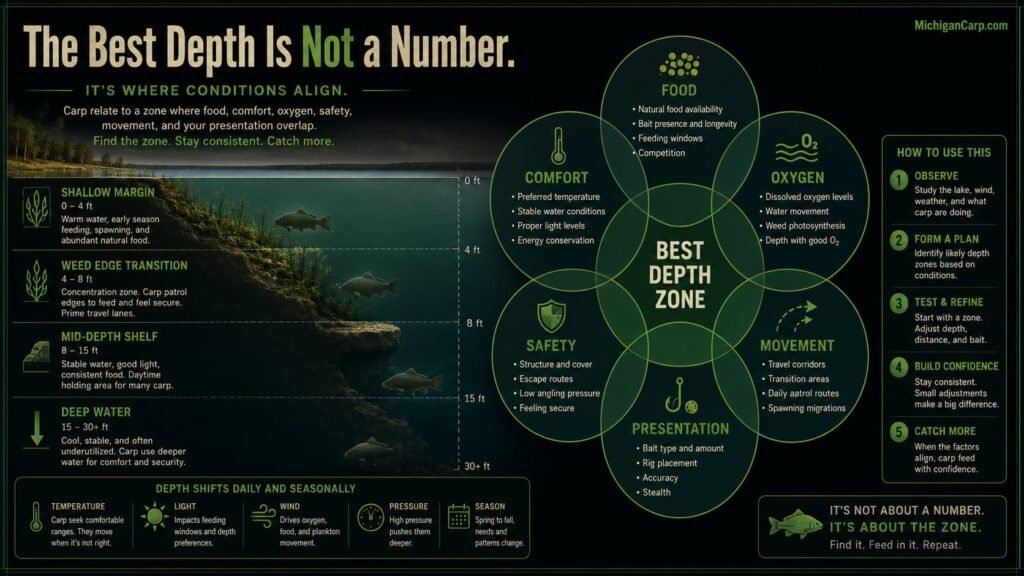
Depth only matters because of what comes with it.
Two feet of water can be excellent if it is warming, colored, full of natural food, close to cover and being used by confident carp. Two feet of water can also be useless if it is cold, clear, bright, disturbed, empty and disconnected from safer water. Fifteen feet can be excellent if it is a comfortable holding route beside weed, food or a shelf. Fifteen feet can also be dead if it is featureless open water with no reason for carp to stop.
This is why depth should be read as a package. Ask what that depth gives the fish. Does it give warmth? Shade? Oxygen? Cover? Natural food? A patrol route? Safety from disturbance? A transition into deeper water? A clean bottom for feeding? A quiet window when boat traffic drops?
The more of those answers line up, the stronger the depth becomes.
Michigan carp are often sensible. They feed where food is available and conditions feel safe. They hold where comfort and protection are better. They move between those zones when temperature, light, oxygen, wind and pressure make the move worthwhile. The depth number helps you describe that zone, but the number itself is not the reason carp are there.
A good depth decision starts by combining three things:
Where can carp feed? Where can they hold safely nearby? Where can you present and land fish cleanly?
When one depth zone answers all three, it deserves attention.
Shallow Feeding Water
Shallow water is where many carp anglers first see feeding activity. Bubbles, fizzing, tails, muddy patches, reed movement, bow waves and rolling fish are often easier to spot in shallow margins than in deeper open water.
In Michigan, shallow feeding water becomes especially important when spring sun warms a bay, wind pushes food into a margin, fresh weed growth attracts natural food, reeds hold insects and silt life, or low light gives carp the confidence to feed close in. Shallow water can also fish well in summer at dawn, dusk and night when bright light and daytime pressure have dropped.
Good shallow areas are rarely just “shallow.” They usually have another reason. A dark-bottom bay warms faster. A reed edge holds food. A silt pocket may contain natural invertebrates. A lily pad line gives cover. A shallow weed bed can hold oxygen and food when healthy. A wind-blown edge can collect surface drift and break up light. A shallow shelf close to deeper water lets carp feed and retreat without traveling far.
That nearby escape water matters. A flat that drops from three feet into seven or eight feet can be much better than a huge shallow bay with no clear route out. Carp can slide in to feed, then drift back to safety when the light changes, boat traffic arrives, a cold wind hits, or the feeding spell ends.
Shallow fishing is strongest when the fish are there for a clear reason. Do not fish shallow simply because carp can feed shallow. Fish shallow when warmth, food, cover, movement and signs tell you carp are willing to use it.
For feeding signs, read Signs Carp Are Feeding. For spring shallow-water decisions, read Spring Carp Fishing in Michigan.
Mid-Depth Holding and Patrol Water
Mid-depth water is often where carp spend time when they are not actively feeding shallow.
On many Michigan lakes, depths around 6 to 15 feet can give carp a useful compromise. The water may be more stable than a skinny margin, less exposed than shallow flats, close enough to food to move quickly, and deep enough to feel safe during bright daylight or pressure. These areas may not always show obvious surface signs, but they can quietly hold fish.
Good mid-depth areas include the back edge of shallow flats, weed edges, shelves, old channels, gravel or sand bars dropping into deeper water, soft-to-hard transitions, points, bay mouths, the outside edge of reeds, and slopes leading away from productive margins.
These are often better than featureless open water because carp use them as routes. They may travel along the contour, drift off the weed edge, pause near a clean hard spot, or stage at the bottom of a shelf before moving shallow in the evening.
For bank anglers, this depth zone is often more practical than chasing the deepest water. A reachable mid-depth weed edge, channel lip or transition can be fished accurately and quietly. A random long cast to the middle may reach deeper water but miss the actual route.
If you had to build one simple bank-angler rule, it would be this:
Do not only fish the shallow flat. Also fish the edge that lets carp move on and off it.
That edge is where many takes come from.
Deeper Stability Water
Deeper water matters most when carp need stability.
In hot summer weather, deeper water can offer cooler, more stable conditions, especially near channels, shelves, basin edges, shaded steep banks, deeper weed, or areas with water movement. That does not mean carp stay deep all day. Often they hold deeper and feed shallower when the window improves.
In winter or very cold water, deeper stable areas can become even more important. Carp may group more tightly, move less, and hold where temperature swings are slower. Short feeding windows can still happen shallower, especially during mild spells, but the center of the fish’s world often shifts closer to deeper stability.
The mistake is assuming the deepest water is automatically the best water. A deep hole with no food, no route and no connection to fish movement may be less useful than the edge of that hole. Carp often use the lip, slope, channel edge, shelf, or transition beside deeper water rather than sitting in the deepest point all the time.
Good deeper-water areas usually connect to something: a feeding flat, a weed edge, a bay mouth, a channel, a point, a soft-silt area, a wintering basin, a current seam, or a safe route between day and night areas.
Fish deeper water when it explains carp comfort. Do not fish it just because the number is bigger.
For cold-water thinking, read Winter Carp Fishing in Michigan. For summer comfort and oxygen, read Summer Carp Fishing in Michigan.
Depth Changes Matter More Than Exact Depth
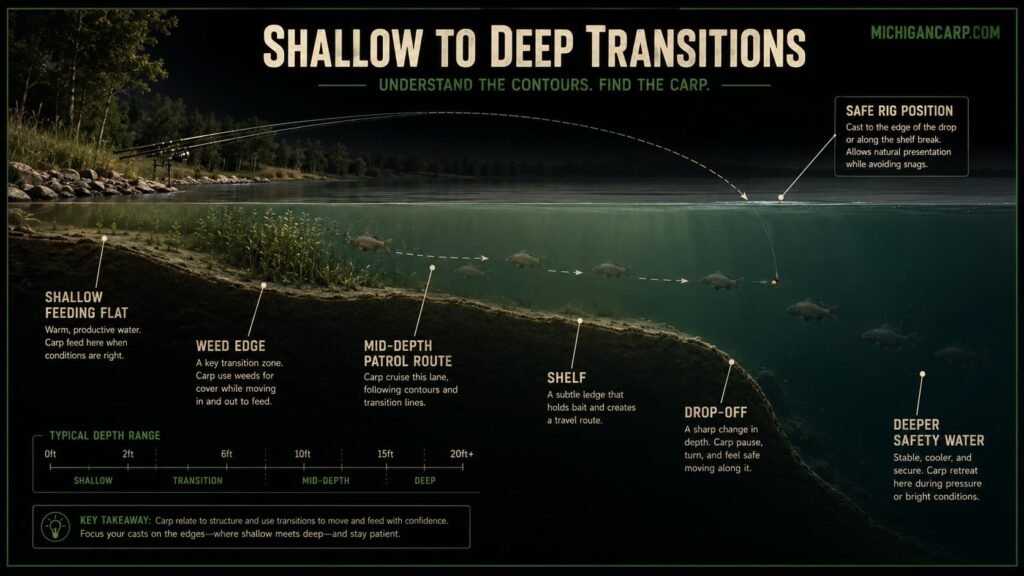
The most productive depth is often not “four feet,” “eight feet” or “twelve feet” by itself. It is the change between one depth and another.
Depth changes let carp move efficiently. A carp can feed shallow, drop slightly deeper when disturbed, follow a contour, patrol a weed edge, slide into a channel, or sit just off a flat until conditions improve. Those movements are easier when the lakebed gives them a clear route.
Look for shelves, drop-offs, ledges, channels cutting through flats, bay mouths, points tapering into deeper water, weedlines beside depth changes, reed edges with a nearby channel, flats that fall into a basin, and bars that create a clean travel line.
Depth changes are especially useful because they combine options. The shallow side may provide food. The deeper side may provide comfort and safety. The edge may provide the route. The top of the shelf may fish at dusk. The bottom of the shelf may hold fish in bright daylight. The inside turn may collect silt and food. The outside turn may guide moving carp.
That is why a bland-looking contour line can outfish a beautiful open flat. The flat may look inviting, but the transition explains how carp move.
For more on reading bottom structure, use Reading the Bottom for Carp. For movement routes, read How Carp Move Around a Lake.
Best Depth by Season in Michigan
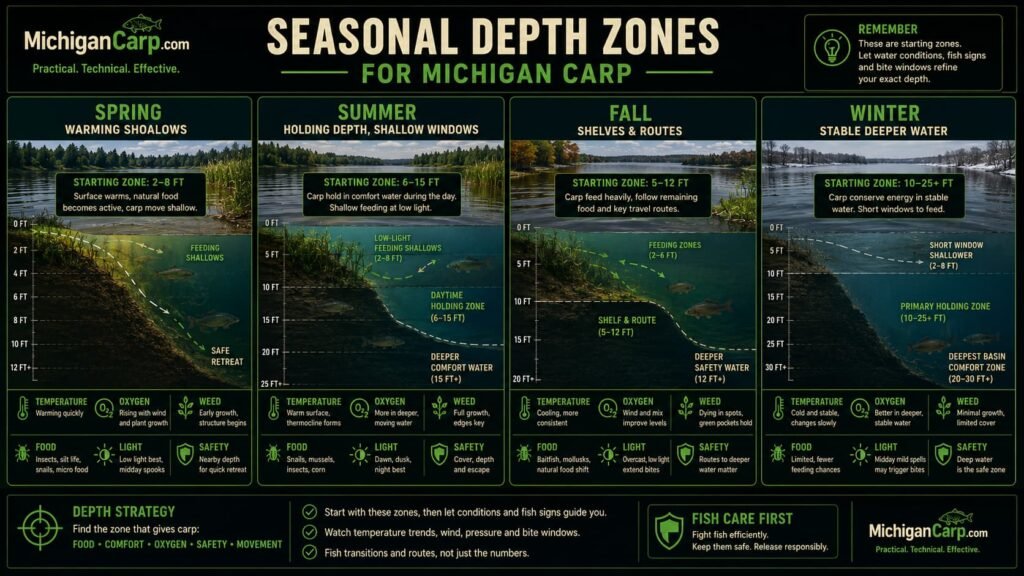
Season changes depth more than many anglers realize. The same swim can be useful in one month and nearly empty in another. Use the seasonal depths below as starting points, then refine them with water temperature, oxygen, wind, weed, fish signs and safety.
Spring Depth
Spring often pulls attention shallow because shallow water can warm faster than the main lake. After several mild days, dark-bottom bays, reed edges, soft-silt flats, protected corners and early weed growth may become active. Carp may move into 2 to 8 feet of water when warmth and food line up.
The best spring depth is not always the absolute shallowest water. It is usually shallow water with nearby depth or a safe route out. A bay that warms quickly but connects to a channel, drop-off or deeper flat is stronger than an isolated shallow corner with no escape route.
Cold nights and cold fronts still matter. A spring bay can go from excellent to poor very quickly if the water cools. In those conditions, check the first drop, the sheltered edge, the deeper mouth of the bay, or the route carp used to enter.
Summer Depth
Summer usually spreads carp across more depth zones. Carp may hold in mid-depth water during bright, hot or pressured periods, then feed shallower at dawn, dusk, night or during wind-rippled windows.
Good summer starting points include weed edges in 6 to 15 feet, deeper margins with shade or cover, shelves leading off shallow plateaus, channels near food, wind-rippled edges, inflows, and deeper water close to natural feeding areas.
In hot weather, oxygen becomes part of the depth decision. A shallow bay may look right but fish poorly if it is hot, still and full of dying weed. A wind-rippled weed edge, shaded margin, inflow seam, or mid-depth route may be much more comfortable.
Fall Depth
Fall can create excellent depth patterns because carp often feed heavily but location becomes more specific. Weed changes, water cools, natural food shifts, and carp begin using routes between productive feeding shelves and deeper safety water.
Depths around 5 to 12 feet can be strong starting points in fall, especially when connected to remaining green weed, mussels, soft silt, points, bay mouths, drop-offs or deeper wintering water. The key is not to fish summer memories too long. If a shallow weed bed is dying and foul, look for the cleaner edge, the nearest transition, or deeper water beside the remaining food.
Winter Depth
Winter usually makes stable water more important. Carp often spend longer periods in deeper basins, channels, sheltered pockets and areas where temperature changes more slowly. They are usually not spread evenly across the lake.
That does not mean every winter bite comes from the deepest water. Short feeding windows can happen shallower during mild spells, sunny afternoons, inflow changes or low-pressure windows. But the safer starting point is often deeper stable water close to any reliable food source or route.
For the full seasonal system, read Michigan Carp Fishing Seasons, Seasonal Carp Movement in Michigan and Carp Bite Windows in Michigan.
Depth, Water Temperature and Oxygen
Depth, water temperature and oxygen should be read together.
Water temperature affects carp comfort, movement, feeding windows and bait response. Depth affects how quickly water warms or cools. Oxygen affects whether carp can stay comfortable in a zone long enough to feed confidently.
USGS explains that dissolved oxygen is important for aquatic life and that warm water holds less dissolved oxygen than cold water. For the science background, read USGS: Dissolved Oxygen and Water.
In practical carp-fishing terms, this means shallow warm water can be excellent in spring but poor in hot, stagnant summer conditions. Deeper water can be stable and comfortable, but not always productive if it is disconnected from food. Weed can add oxygen and food when healthy, but dying weed can foul rigs and reduce comfort. Wind can improve a depth zone by adding ripple, mixing, color and food movement.
A thermometer helps, but it is not the whole answer. Look at the trend. Is the water warming or cooling? Is the shallow bay improving or fading? Is the weed healthy or dying? Is the wind pushing into that depth zone? Are carp showing there at the same time each day? Are liners, bubbles or rolling fish confirming the route?
For depth decisions, the trend often matters more than one reading. A shallow area warming from 46°F to 52°F may become more interesting than a deeper area holding steady but lifeless. A hot bay sitting at 80°F with no ripple, dying weed and no signs may be worse than a cooler edge with wind and movement.
For more detail, read Carp Water Temperature Guide for Michigan Lakes and Dissolved Oxygen and Carp Fishing.
Depth, Weed Beds and Natural Food
Weed often tells you which depth zone has life in it.
Healthy weed can hold food, cover, oxygen, shade and routes. Michigan EGLE explains that native aquatic plants are important for inland lakes because they oxygenate water and provide habitat and food resources for fish and wildlife. For the environmental background, read Michigan EGLE: Native Aquatic Plants.
For carp anglers, the practical point is simple: weed makes depth meaningful. A six-foot weed edge with clean holes, food, wind ripple and carp signs may be far better than a featureless ten-foot open area. A pad edge in three feet can be excellent if it has shade, food, movement and safe landing. A deeper weedline in twelve feet can hold carp through the day and produce takes during low-light windows.
The same warning still applies. Weed is not automatically good. Thick unsafe weed, dying weed, fouled bottom, impossible pad beds or snaggy reeds can make a depth zone poor even when carp are present. The best weed depth is the one that gives carp food and cover while still letting you present a rig and land fish safely.
Read Weed Beds and Carp Fishing in Michigan before fishing heavy vegetation. For rig choice around weed, use The Complete Michigan Carp Rig Guide.
Wind, Current and Depth
Wind and current can completely change which depth is useful.
A warm spring wind can push warmer surface water into a shallow bay. A cold wind can make the same bay worse. A steady summer ripple can make a mid-depth weed edge more comfortable. Current can create seams, slacks and routes where carp can feed without sitting in the hardest water. Wave action can stir food on a shallow shelf, but heavy waves can make the area unsafe or impossible to fish cleanly.
This is why depth should never be read from a map alone. A contour line gives you structure. Wind and current tell you how the water is behaving today.
Look for wind pushing across a shelf, ripple hitting a weed edge, current brushing the side of a channel, an inflow creating a soft seam, a bay mouth receiving drift, or a point where deeper water and surface movement meet. Those are the places where a depth zone becomes active.
The best wind-depth combination often gives carp several advantages at once: food movement, oxygen, cover, color, comfort and a safe route. The worst combination gives only rough water, poor presentation, line bow, unsafe landing and no fish signs.
For the complete moving-water guide, read Wind, Waves and Current Carp Fishing.
Depth by Time of Day
The best depth can change during the day.
In clear water, bright sun and boat pressure may push carp away from shallow exposed areas. They may hold deeper, tuck into weed, sit under shade, or use quieter mid-depth routes. The same fish may move shallower at dawn, dusk or after dark when light drops and human pressure eases.
In spring, shallow water may improve through the day as sun warms it. An area that is too cold at 8 AM may be active by mid-afternoon. In summer, the opposite can happen. A shallow bay that looked alive at first light may become too hot, bright or disturbed by noon. In fall, a mild afternoon may create a short feeding spell. In winter, the warmest part of the day may be the only realistic chance.
Do not assume a swim is dead because it is dead at the wrong time. Carp may use the same depth zone for only a short window. They may feed shallow at dawn, hold on the drop through the day, return to the edge at dusk, and disappear again after dark.
Good depth fishing means matching the cast to the clock. One rod can cover the holding edge while another watches the shallow feeding route. A third can test the transition or the clean hole. When liners, fizzing or rolling fish show a pattern, adjust the depth instead of blaming the bait.
For timing, read Carp Bite Windows in Michigan.
Bank Angler Depth Strategy
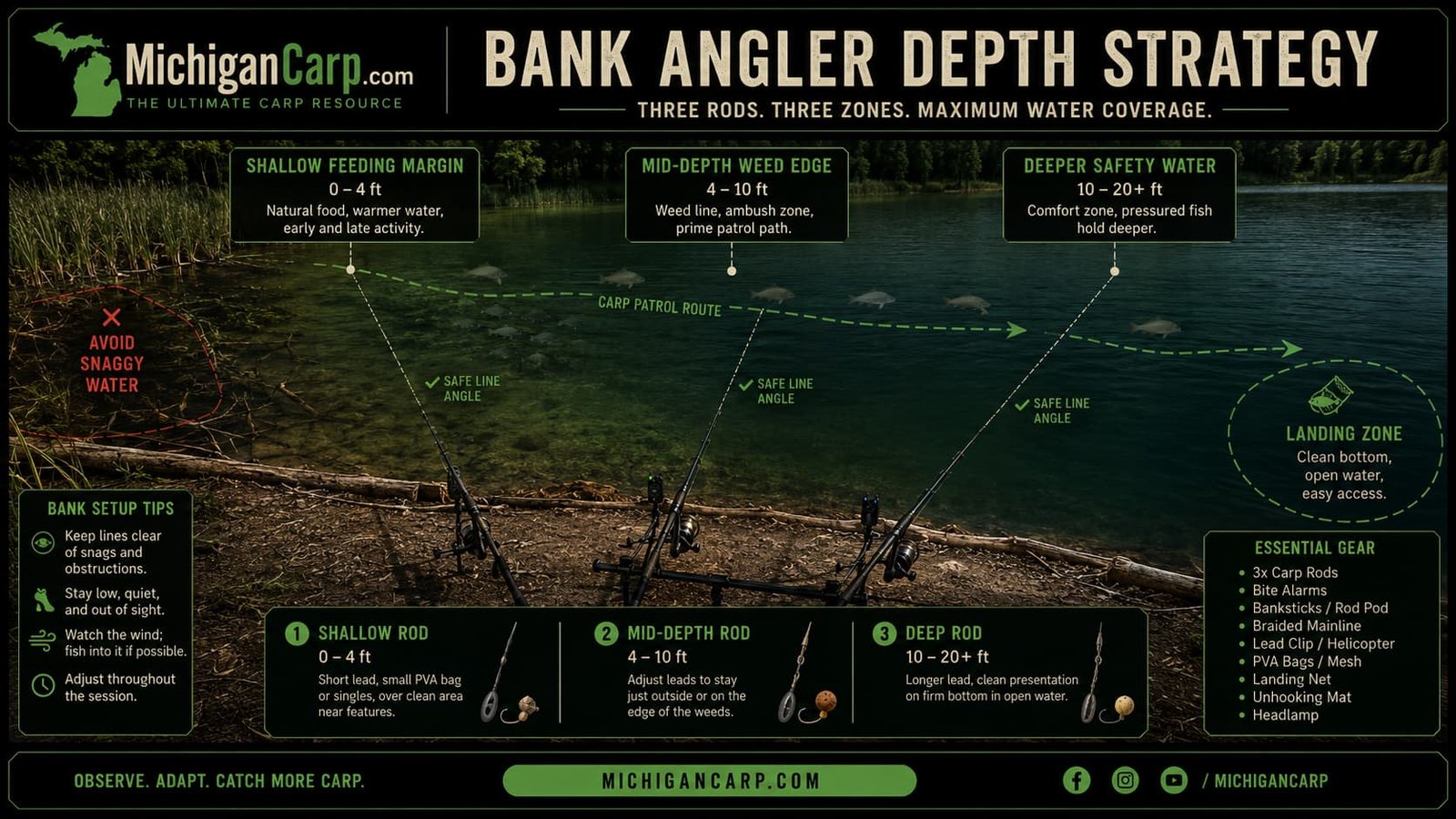
For bank anglers, the best depth is often the one you can fish accurately, quietly and safely.
You do not need to reach the deepest part of the lake to catch carp. In many Michigan situations, a reachable depth change is more useful than a long cast to open water. A margin that drops from three feet into seven feet, a weed edge in eight feet, a channel lip at casting range, or the back edge of a shallow flat can all be better than throwing bait into the middle just because it is deeper.
Start by building a simple depth picture from the bank. Where is the shallow food? Where is the nearest safety water? Where is the clean presentation area? Where can you land a fish? Where will a hooked carp try to go? Where can you control the line angle?
A good bank swim often gives you a choice of zones. One rod may fish the shallow feeding edge. One rod may fish the mid-depth route. One rod may fish the deeper transition. Over the session, the carp will often tell you which depth is active. Liners on one rod, fizzing near another, or repeated shows along the edge can tell you more than theory.
Distance is not the point. Accuracy and safety matter more. A well-placed bait on a clean six-foot edge can beat a sloppy cast into sixteen feet. A near-margin rod can be deadly if carp are using the edge quietly. A deep rod can be useful if it sits on the route, not just in empty water.
For broader tactical planning, read Carp Fishing Tactics in Michigan.
Using Depth Maps Without Being Fooled
Depth maps are useful, but they do not tell the whole story.
A map can show a drop-off, channel, flat, basin, point or hump. It may help you narrow down likely areas before you arrive. Michigan DNR provides inland lake maps that can be useful starting points for understanding contours on many waters. Use Michigan DNR Inland Lake Maps as a starting resource.
But a map will not always show soft silt, fresh weed, dying weed, zebra mussels, snails, bloodworm-type areas, clean gravel, colored water, boat pressure, angler pressure, bird activity, bottom debris, or carp actually using the swim.
Use maps to choose areas worth checking. Then let the water confirm or reject the map. Look for bubbles, rolling fish, liners, clouded patches, bird activity, fresh weed growth, wind lanes, foam lines, clean bottom, safe landing, and signs of repeated movement.
A contour with no food, no route and no signs is still just a contour. A plain-looking margin with repeated evening carp movement may be more valuable than the prettiest drop-off on the map.
Depth maps help you start smarter. They do not replace watching the water.
Baiting by Depth
Baiting should change with depth and situation.
In shallow water, carp can be easier to spook. Heavy baiting, repeated casting, loud spod work or throwing bait directly on top of visible fish can ruin a short window. A small trap, chopped boilies, corn, crumb, particles, a PVA stick or a tight patch often makes more sense until carp confirm the spot.
In mid-depth water, you may have more room to build confidence. A controlled patch along a patrol edge, shelf or weedline can work well, especially when carp are likely to revisit the same route. Still, do not spread bait so wide that fish feed everywhere except the rig.
In deeper water, accuracy becomes more important because bait can scatter, undertow can shift light feed, and line angle can hide what is happening. Think about where the bait settles, not just where it lands. If you are fishing a slope, shelf or channel edge, a tight feed area can be much better than bait rolling or spreading down the drop.
Depth also changes bait response. In cold deeper water, smaller amounts and more soluble signals may be enough. In warm shallow food-rich areas, carp may already have natural food and need careful presentation rather than a pile of bait. In summer weed, bait should usually be placed on the fishable edge, not dumped into the thickest cover.
For bait choice, use Carp Bait Guide for Michigan Lakes. For safe particles, use Particle Prep for Carp Fishing.
Rig and Fish-Care Decisions by Depth
The best depth is not a good fishing depth if you cannot present a rig cleanly and land the fish safely.
Shallow water can be snaggy, weedy and spooky. A carp hooked close in may charge straight for reeds, pads, timber or weed. Mid-depth weed edges can be excellent, but only if the line angle and tackle let you control the fish. Deeper water may look safer, but steep banks, rocks, mussels, long line angles, waves and poor netting positions can still create problems.
Before choosing a depth, think through the whole fight. Can the rig sit cleanly? Will the lead hold? Is the line crossing weed? Can you get to the rods quickly? Can you keep the fish out of snags? Can you net it from that bank? Is the landing area safe? Is the water too warm for long fights? Are waves or boat traffic making the swim unsafe?
This is especially important on Michigan public waters with weed, stumps, zebra mussels, rocks, steep banks, boat wakes and campground shorelines. A depth zone may hold carp, but if every hooked fish is likely to be lost or damaged, it is not a responsible swim.
For rig selection, read The Complete Michigan Carp Rig Guide. For handling and safe release, read Fish Care and Safety.
A Simple Depth-Finding System
Step 1: Start with season
Decide whether the season points you toward warming shallows, summer comfort water, fall feeding routes or winter stability. This gives you the first depth range to investigate.
Step 2: Check water temperature trend
Ask whether the water is warming, cooling or stable. A warming shallow bay and a cooling shallow bay are not the same swim.
Step 3: Add oxygen and comfort
Look for wind ripple, healthy weed, inflows, shade, low light and areas that avoid hot stagnant water. Comfort decides whether carp can stay and feed.
Step 4: Find food and cover
Depth is strongest when it connects to natural food: weed edges, reeds, pads, silt, mussels, snails, insects, channels, bars or soft-to-hard transitions.
Step 5: Locate the route
Look for the path between feeding water and holding water. Shelves, drop-offs, bay mouths, channel edges and weedlines often matter more than the flat itself.
Step 6: Confirm with signs
Watch for rolling fish, liners, bubbles, clouding, tails, weed movement, reed knocks and repeated movement. Signs should refine your depth choice.
Step 7: Fish what you can present safely
Do not choose a depth you cannot fish properly. Clean presentation and safe landing are part of location.
Common Depth Mistakes
Fishing only shallow water
Carp may feed shallow, but they often hold deeper nearby. The edge that connects shallow food to safer water is often better than the flat alone.
Fishing only the deepest water
Deep water is not automatically best. The lip, slope, channel edge or connected shelf may be far more useful than the deepest point.
Ignoring depth changes
A plain depth number means little without a transition. Shelves, drop-offs, weed edges and bay mouths explain movement.
Using one depth all year
Spring, summer, fall and winter all change carp location. A depth that is perfect in May may be poor in August or November.
Trusting maps more than fish signs
Maps are tools, not proof. Repeated carp signs in a plain-looking swim beat a perfect-looking contour with no activity.
Forgetting oxygen in summer
Hot shallow water can be poor if it is stagnant, bright and low in comfort. Look for wind, weed, shade, inflows and low-light windows.
Ignoring fish-care risk
A depth zone is not worth fishing if you cannot land carp safely from it.
My Practical MichiganCarp View
For Michigan carp fishing, I do not treat depth as a fixed answer. I treat it as part of the watercraft puzzle.
I like shallow water when it is warming, alive, colored, covered, low-light, food-rich or showing fish. I like mid-depth water when it sits beside weed, shelves, routes, channels or pressure-safe holding areas. I like deeper water when stability matters, especially in cold water or during uncomfortable summer conditions. But I trust transitions more than numbers.
The best-looking depth is usually the one that lets carp do two things easily: feed and escape. A three-foot feeding margin beside a seven-foot drop can be better than twenty feet of open water. An eight-foot weed edge with wind ripple can be better than a shallow bay with no oxygen and no signs. A twelve-foot shelf near fall food can be better than the deepest basin.
That is the real rule:
The best depth for carp fishing is the depth zone where food, comfort, oxygen, safety, movement and presentation overlap.
Find that overlap and the exact number becomes less mysterious.
FAQ
What depth do carp feed in most often?
Many visible carp feeding situations happen in shallow water, often around 2 to 8 feet, especially in spring, low light, colored water and food-rich margins. But carp may hold deeper before and after feeding.
Do carp prefer deep or shallow water?
Carp use both. They often feed shallow when conditions are right and hold deeper or in mid-depth cover when comfort, safety or pressure matters more.
Should I fish the deepest part of the lake?
Not automatically. The edge of deeper water, a shelf, channel lip or route between deep water and feeding water is often better than the deepest hole itself.
What is the best depth for carp in spring?
Spring often favors shallow warming water, especially 2 to 8 feet in protected bays, reed edges, soft-silt flats and early weed growth close to deeper safety water.
What is the best depth for carp in summer?
In summer, carp often hold around mid-depth weed edges, shelves, channels and comfort water, then move shallower during dawn, dusk, night, wind or low-pressure feeding windows.
What is the best depth for carp in fall?
Fall often rewards shelves, weed edges, feeding flats and routes in roughly 5 to 12 feet, especially near deeper water and remaining natural food.
What is the best depth for carp in winter?
Winter often pushes carp toward deeper stable water, channels and basins, although short feeding windows can still happen shallower during mild or stable conditions.
Are carp deeper in clear lakes?
They often spend more time deeper or near cover during bright daylight on clear lakes, then move shallower when light drops, wind adds cover, or pressure decreases.
Do depth changes matter more than depth?
Often, yes. Shelves, drop-offs, channel edges, weedlines and shallow-to-deep transitions help carp move between feeding and holding areas.
Can I catch carp close in?
Yes. Carp often feed close to the bank when margins offer food, cover, low disturbance and a safe route. Quiet close-range fishing can be better than casting long for no reason.
How do I find depth from the bank?
Use lake maps, visual clues, marker work where appropriate, lead feel, cast counts, weed on the rig, line angle, bottom feel, and fish signs. Do not rely on maps alone.
Does oxygen affect carp depth?
Yes. Oxygen can affect whether carp are comfortable in a depth zone, especially in hot weather, stagnant bays, weed beds, inflows and wind-rippled water.
Does bait choice change by depth?
The bait may not need to change as much as the baiting approach. Shallow fish often need quieter, tighter baiting. Deeper or route-based fishing may need more accuracy and attention to where the feed settles.
Is weed depth good for carp?
Healthy weed at a fishable depth can be excellent because it offers food, cover and oxygen. Thick unsafe weed or dying weed can be poor and risky.
What is the biggest mistake when choosing depth?
The biggest mistake is fishing a number instead of fishing the reason carp would use that depth. Food, comfort, oxygen, safety, movement and presentation matter more than the number alone.
Next Steps
Read these next:
- How to Find Carp in Lakes
- Carp Fishing Tactics in Michigan
- Watercraft and Conditions for Michigan Carp Fishing
- Carp Water Temperature Guide for Michigan Lakes
- Dissolved Oxygen and Carp Fishing
- Wind, Waves and Current Carp Fishing
- Weed Beds and Carp Fishing in Michigan
- Carp Bite Windows in Michigan
- Signs Carp Are Feeding
- Fish Care and Safety
The best depth for carp fishing is not the deepest water, the shallowest water, or the number someone gave you online. It is the depth zone that gives carp a reason to be there and gives you a safe, clean way to fish it.