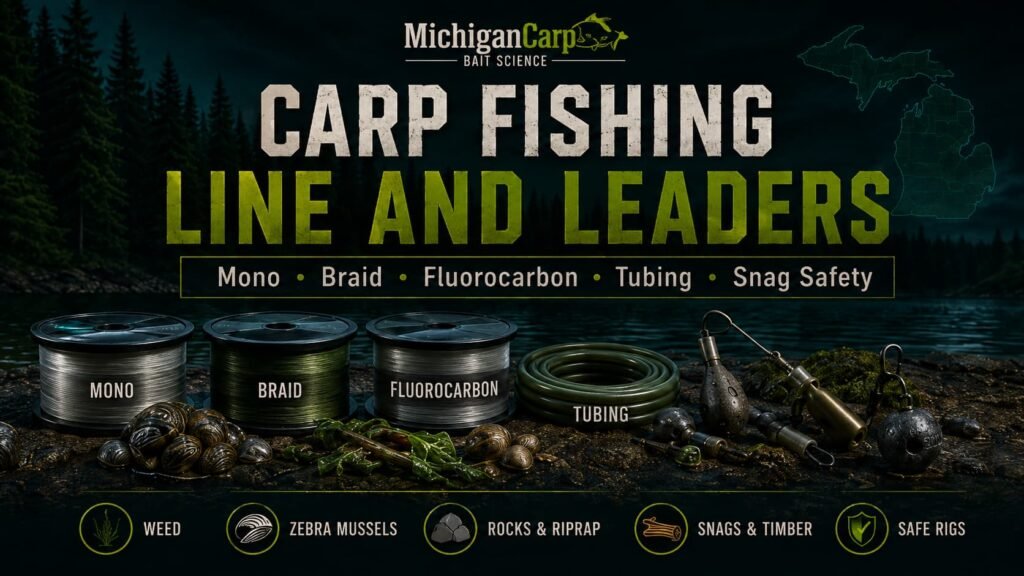
Carp fishing line in Michigan is not just about breaking strain.
It is about abrasion, stretch, control, safety, bottom type, weed, zebra mussels, rocks, timber, rivers, channels, distance, casting shock, leader knots, lead systems and what happens if something breaks.
That is why line and leaders deserve their own guide.
A carp angler fishing a clean inland lake can often use simple monofilament straight through with tubing and a safe lead system. A carp angler fishing a river lined with zebra mussels may need heavy mono, fluorocarbon or braided snag-leader protection. A carp angler fishing stump fields, timber, riprap, bridge edges, weeds or dam ponds may need very different gear again.
The wrong line system does two things badly.
First, it loses fish.
Second, it can leave fish trailing dangerous tackle.
Michigan carp fishing often involves rough public water: weed beds, mussel-covered rocks, timber, riprap, boat channels, river mouths, dam ponds, stump fields, current seams, campground banks, bridge edges and Great Lakes-connected water. Light line and casual rig thinking can get punished fast.
This guide explains carp fishing line and leaders for Michigan in practical detail: mono, braid, fluorocarbon, shock leaders, snag leaders, rig tubing, lead-free leaders, leadcore, heavy mono leaders, fluorocarbon abrasion leaders, braided leaders, leader lengths, knots, rig safety, line checks and full setup combinations for different waters.
For the main gear guide, read Carp Fishing Gear for Michigan.
For rig safety, read Michigan Carp Rig Guide.
For handling and release, read Carp Fish Care and Safety.
For choosing locations and conditions, read Watercraft and Conditions for Michigan Carp Fishing.
The simple rule is this:
Choose the line system for the hazard between you and the carp, not just the size of the carp.
Table of Contents
Quick Start: Carp Fishing Line for Michigan
Use this table as the fast starting guide.
| Michigan Situation | Mainline Starting Point | Leader / Tubing Option | Why |
|---|---|---|---|
| Clean small lake, close range | 15–20 lb mono | Rig tubing or no leader if safe | Simple, forgiving, easy to cast |
| General Michigan lake | 18–25 lb mono | Tubing or short lead-free leader | Good balance of strength, stretch and safety |
| Light weed | 20–25 lb mono | Tubing, lead-free leader or safe lead clip | Extra control and weed resistance |
| Heavy weed | 25–40 lb mono or suitable braid | Tubing, heavy mono/fluoro leader or lead-free leader, safe drop-off lead where justified | Control, abrasion and lead-safety management |
| Zebra mussels / shell / riprap | 20–30 lb abrasion-resistant mono | 35–60 lb heavy mono or fluorocarbon abrasion leader | Mussels and rocks cut weak line |
| Stumps / timber / deadheads | 25–40 lb mono or braid depending distance and control | 50–85 lb braided snag leader or heavy mono leader where safe | Prevents cut-offs and improves control |
| Rivers / channels | 20–40 lb mono depending flow/snags | Heavy mono, fluorocarbon or braided snag leader | Current and abrasion increase risk |
| Long casting with heavy leads | 12–20 lb mono depending range | Tapered shock leader or 40–60 lb shock leader | Protects against crack-offs during casting |
| Braid mainline | 30–50 lb braid depending venue | Rig tubing, heavy mono/fluoro leader, lead-free leader or shock leader | Protects fish and adds abrasion buffer |
| Extreme snag fishing | 30–40 lb mono, 50 lb braid or heavier system where justified | 50–60 lb mono/fluoro snag leader or 50–85 lb braided snag leader | Only when the swim genuinely demands it |
| Winter / short-range cold water | 15–20 lb mono | Minimal tubing or simple safe setup | Low disturbance and simple safety |
| Boat-placed rigs | 25–40 lb mono or braid depending hazards | Longer abrasion leader if needed | Casting is less important; control and abrasion matter more |
This table is a starting point, not a rulebook.
A clean lake does not need extreme line. A brutal snag swim does not deserve light line. A leader is not automatically safe or unsafe because of its breaking strain. The safety comes from the whole system.
A heavy leader can be the right tool.
A poorly arranged heavy leader can also be dangerous.
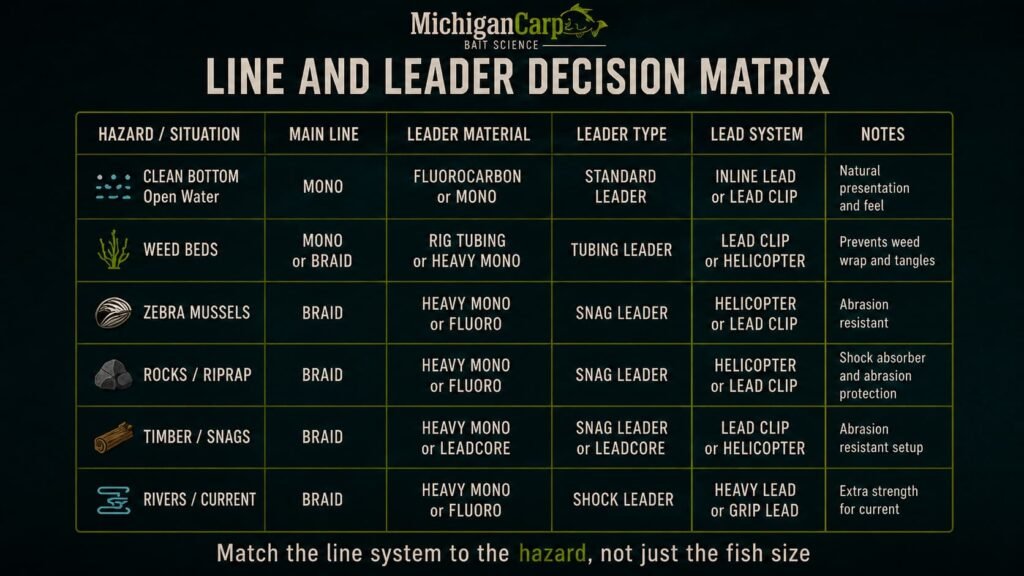
The Big Principle: Line Choice Is About Hazards
Carp do not usually break line because they weigh thirty pounds.
They break line because they use the water against you.
A twenty-pound carp that runs across zebra mussels can cut light mono quickly. A carp that buries in weed can create huge pressure. A fish that reaches timber can saw through line or lock the rig in place. A river carp can use current and rocks. A channel carp can reach pilings, riprap, cable, concrete, mussels or boat debris. A dam pond carp can bury around stumps and old wood.
So the first question is not:
What breaking strain lands a carp?
The better question is:
What line system survives the swim and still remains fish-safe?
That changes the answer.
Open water may only need moderate mono.
Mussels may need abrasion-resistant mono plus a heavy leader.
Heavy weed may need stronger mono, braid, safer lead ejection and more direct control.
Timber may require extreme leader material, but only if the rig still allows lead release and fish safety.
Long-range casting may require a shock leader, but that shock leader must not make the terminal setup unsafe.
Line choice is part of fish care.
A break-off is not just frustrating. It can leave a carp towing line, lead, leader and hooklink. Good line and leader choices reduce that risk.
Mono, Braid and Fluorocarbon: What Each Material Does
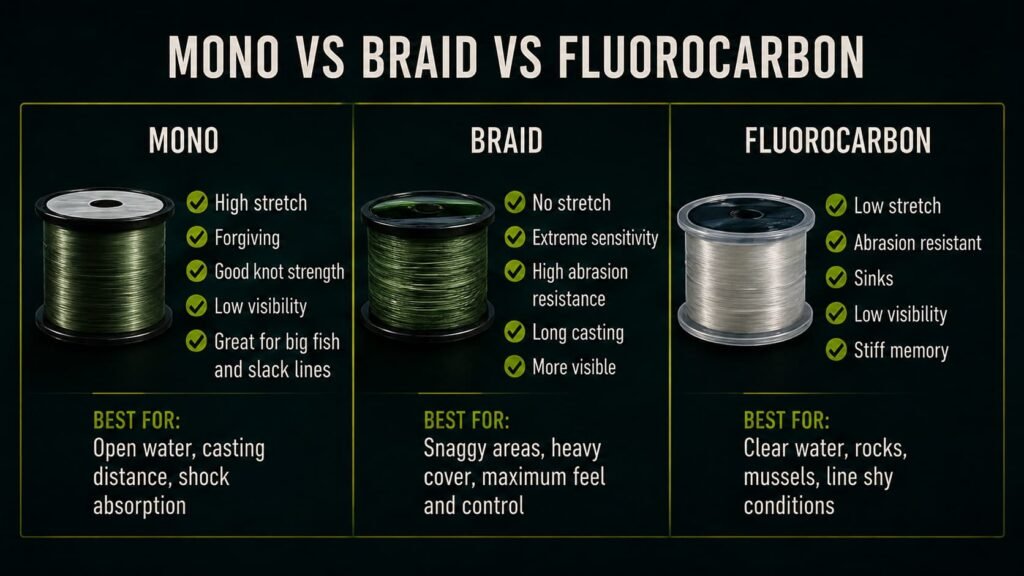
The three main mainline materials are monofilament, braid and fluorocarbon.
Each has strengths and weaknesses.
Monofilament
Monofilament is the best default line for many Michigan carp anglers.
It stretches, casts well, knots well, behaves predictably and gives a cushioning effect during the fight. That stretch helps reduce hook pulls and gives a margin of safety when a carp lunges near the net.
Mono also handles public-water fishing well. It is forgiving, affordable and easy to replace.
The downside is abrasion. Mono can be cut by zebra mussels, rocks, sharp timber, concrete and riprap if it is too light or damaged. Heavy abrasion-resistant mono helps, but no mono is magic.
Use mono when:
you are learning carp fishing
you fish mixed Michigan lakes
you want forgiveness during the fight
you fish moderate range
you want simple knots and easy handling
you need a practical all-round line
Braid
Braid has very low stretch and high strength for its diameter.
It gives excellent bite detection, direct contact and control. It can be useful for weed fishing, boat work, long-range feature finding, marker work and some extreme snag situations.
But braid is not automatically safer.
Because it is thin and low-stretch, braid can be harsh on fish if used without tubing or leader protection near the rig. It can also cut into weed, timber or fish contact points differently from mono. Low stretch gives control, but it also gives less cushioning.
Use braid when:
you need direct control
you fish heavy weed and can manage the fight
you use boat support
you need sensitivity at range
you understand leaders and fish protection
your water justifies the trade-off
Korda’s braided mainline guidance specifically warns that thin braid should be used with a thick mono leader, leadcore setup, fused leader or tubing to protect fish during the fight. Korda Braided Main Lines Guide
Fluorocarbon
Fluorocarbon sinks quickly, is less visible underwater and can be abrasion resistant.
It can be useful as a mainline in clear water, as a heavy leader near abrasive bottom, or as a boom / hooklink material in rig construction. For Michigan carp anglers, it is often more useful as a leader material than as an everyday mainline.
The downsides are stiffness, cost, handling, knot sensitivity and reduced forgiveness compared with mono.
Use fluorocarbon when:
you need a sinking line
you fish clear water
you need abrasion protection near the rig
you want a heavy leader around rocks or mussels
you can tie and test knots properly
Korda describes fluorocarbon mainlines as fast-sinking, low-visibility and abrasion resistant, while also noting they work best with slack or semi-slack style fishing rather than tight bowstring line. Korda Fluorocarbon Main Lines and Leaders
Mainline Breaking Strain for Michigan Carp
Breaking strain is useful, but it does not tell the whole story.
Diameter, stretch, abrasion resistance, knot strength, age, UV exposure, line damage and the type of structure in the swim all matter.
Use these ranges as practical starting points.
| Mainline Strength | Best Use |
|---|---|
| 12–15 lb mono | Clean open water, smaller carp, short sessions, low hazards |
| 15–20 lb mono | General open-lake carp fishing, beginner setups, moderate range |
| 20–25 lb mono | Good Michigan all-round range for bigger carp, weeds and mixed bottom |
| 25–30 lb mono | Weed, rocks, mussels, rivers, channels and harder public-water fishing |
| 30–40 lb mono | Heavy weed, snags, boat-placed rigs, stump fields and extreme local hazards |
| 30–50 lb braid | Weed, boat work, direct control, feature work, some snag situations |
| 50 lb+ braid | Specialist heavy work only; use with leader/tubing and safe rig thinking |
A beginner fishing a clean lake should not jump straight to extreme line just because big carp exist.
But an angler fishing zebra mussels, timber, heavy weed or river structure should not pretend light line is “sporting” if it repeatedly causes break-offs.
The right line is the lightest line that can land fish safely in that specific water.
In Michigan, that often means heavier than bass or walleye anglers expect.
Why Leaders Are Used
A leader is a heavier, tougher, lower, stiffer or more protective section added near the rig.
Leaders are used for several different reasons:
abrasion protection
shock absorption during casting
fish protection near the rig
pinning the final section down
reducing line lift around wary fish
protecting against zebra mussels, rocks or timber
helping a helicopter or chod setup work
giving control near weed or snags
Those reasons are not the same.
A shock leader is mainly for casting.
A snag leader is mainly for abrasion and fish control.
A lead-free leader or leadcore leader is mainly for pinning and rig presentation.
A fluorocarbon leader is often used for abrasion, sinking and lower visibility.
Tubing protects fish and helps prevent tangles.
Do not say “leader” without knowing which job it is doing.
The Safety Problem With Leaders
Leaders are useful, but they can become dangerous if the rest of the rig is wrong.
The danger is tethering.
If the mainline breaks above the leader, the carp may be left with the leader, hooklink, lead and terminal components attached. A safe system must let the fish shed the lead or release the hooklink arrangement rather than towing a heavy, jammed setup.
This is the real leader-safety principle:
The stronger the leader system, the more carefully the lead system must be designed.
A heavy leader is not the problem by itself.
The problem is a heavy leader combined with a fixed lead, jammed bead, unsafe clip, trapped swivel, or top stop that prevents the hooklink from coming free.
Examples of unsafe thinking:
leadcore with fixed beads that cannot release
inline leads jammed over leader knots
lead clips that cannot eject the lead
helicopter rigs with fixed top beads
quick-change swivels left uncovered
leaders joined with bulky knots that block lead release
shock leaders used without checking how the lead passes over the knot
Examples of safer thinking:
tubing with safe lead clip
lead clip adjusted so the lead can eject when needed
inline safety sleeves designed to release or pass over knots
helicopter systems with top beads that can discharge
lead-free or leadcore leaders used only with compatible safety components
heavy snag leader plus lead system tested under break-off conditions
Korda’s lead-system guidance emphasizes that carp lead setups must remain safe if the mainline breaks, and that inline systems must be able to pass over shock-leader knots or detach in a way that leaves the bore clear. Korda Lead System Guide
Heavy Leaders: When They Are Correct
Some Michigan carp anglers will need heavy leaders.
That is not overkill if the water demands it.
Heavy leaders make sense when you are fishing:
zebra mussel-covered rock
riprap
bridge edges
concrete walls
timber
stumps
deadheads
heavy weed
river channels
dam ponds
boat-placed baits near cover
long casts with heavy leads
big fish in rough water
A heavy leader can protect the last few feet of line where most abrasion occurs. It can absorb casting shock. It can help you turn a fish before it reaches a snag. It can prevent the line from being sliced during the first part of the fight.
But heavy leaders are not a free pass.
They make the system stronger, which means the break point may move somewhere else. If the mainline breaks above a dangerous fixed rig, the carp may be left with more tackle. If the hooklink is too strong and the lead cannot eject, the fish may be tethered.
So the correct question is not:
Is a heavy leader too strong?
The correct question is:
Is the whole system strong enough to land the fish, and safe enough if something still breaks?
Snag Leaders vs Shock Leaders
Snag leaders and shock leaders are often confused.
They are not the same thing.
Shock Leader
A shock leader protects against the force of casting.
If you cast a heavy lead, solid PVA bag, method feeder, spomb or baited rig at distance, the force during the cast may exceed what the mainline can safely handle. A shock leader adds a heavier section that takes that casting load.
Shock leaders are about casting safety.
They are most important when using:
lighter mainline for distance
heavy leads
large PVA bags
spods or spombs
long-range casting
hard power casting
A shock leader should normally be long enough to wrap around the spool several times when casting, pass through the rod rings and still leave enough leader outside the tip to absorb the load.
For carp fishing, that often means about two rod lengths plus several turns on the reel, but the exact length depends on rod length, casting style and safety.
Snag Leader
A snag leader protects against abrasion and structure during the fight.
It may be heavy mono, fluorocarbon, braided leader material, lead-free leader, leadcore or heavy tubing depending on the setup.
Snag leaders are about landing fish safely around hazards.
They are useful around:
zebra mussels
rocks
stumps
timber
weed
riprap
bridge pilings
channels
river current
dam-pond debris
A snag leader does not always need to be long. Sometimes the last three to six feet matter. Sometimes you need six to twelve feet. Sometimes, in extreme mussels, rocks or timber, a longer abrasion section is justified.
Can One Leader Do Both?
Yes, sometimes.
A heavy mono or braid leader can be both shock leader and snag leader.
But the rig must be checked for casting, knot passage, lead release and fish safety.
Do not use a shock leader only for casting and then ignore what happens during a break-off.
Leader Materials Explained
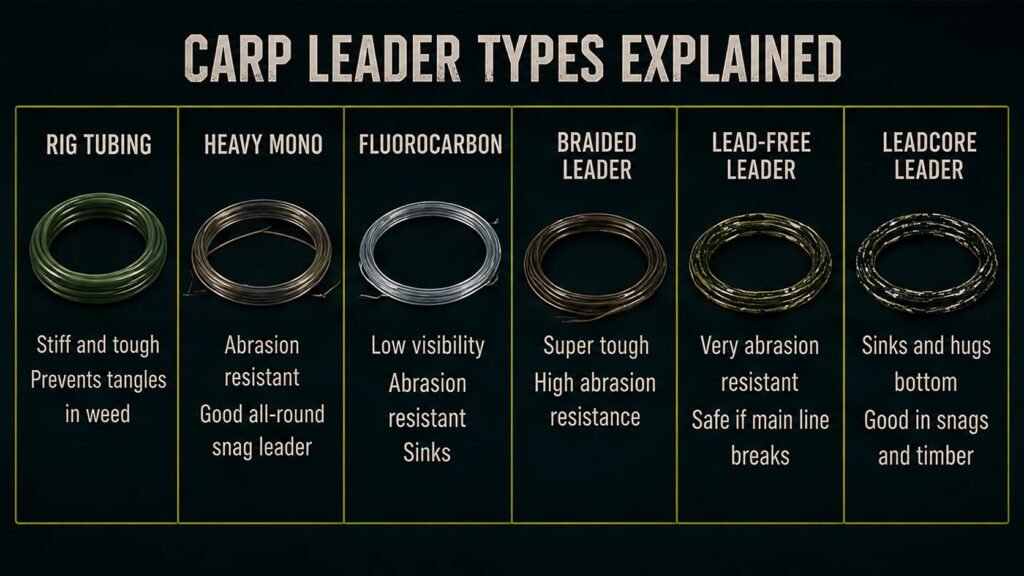
Different leader materials behave differently.
Rig Tubing
Rig tubing is the simplest fish-protection option.
It protects the carp from the mainline near the rig, reduces tangles and helps the final section lie better. Tungsten tubing also helps pin the line down.
Tubing is excellent for beginners and many Michigan waters.
Use tubing when:
the water is clean to moderately rough
you want simple fish protection
you are fishing lead clips or inline leads
you do not need extreme abrasion resistance
you want fewer leader-safety complications
Tubing is not a true snag leader. It protects the fish and helps presentation, but it is not a substitute for heavy abrasion protection around mussels, rock or timber.
Heavy Mono Leader
Heavy mono is a strong, forgiving snag and shock leader option.
It has stretch, good knot behavior and reasonable abrasion resistance. It is thicker than braid, which can make it more fish-friendly near the body and less likely to cut into some obstructions.
Use heavy mono when:
you need abrasion resistance
you want shock absorption
you fish rocks, riprap or moderate timber
you want a leader that is easier to handle than fluorocarbon
you fish rivers or channels
Common carp snag/shock leader ranges include 35–60 lb depending on the situation. Korda describes snag leaders as very tough materials, including heavy mono in 50 lb and 60 lb versions, or abrasion-resistant braided materials such as 50 lb Arma-Kord and heavier XT versions for extreme fishing. Korda Leader Guide
Heavy Fluorocarbon Leader
Heavy fluorocarbon is useful for abrasion, sinking and low visibility.
It is especially useful near rocks, mussels, shell, clear water and hard bottom.
The downsides are stiffness, cost and knot sensitivity. You must test knots carefully. Fluorocarbon can be excellent, but it punishes sloppy knots.
Use heavy fluorocarbon when:
zebra mussels or shell are present
water is clear
you want the leader to sink hard
you need abrasion resistance near the rig
you are fishing short to medium range
Common practical ranges may include 30–60 lb depending on venue. Extreme shell/riprap situations may justify heavier, but only if the whole rig remains safe.
Braided Snag Leader
A braided snag leader can be extremely strong and abrasion resistant.
It is useful around timber, stumps, weed and some snaggy situations where strength and suppleness matter.
The downside is that braid has little stretch and can be thin for its strength. It must be used carefully near fish and with proper tubing, leader systems or fish-safe arrangements.
Use braided snag leaders when:
timber or stumps are the main hazard
you need direct control
you need a leader that can withstand punishment
you understand braid’s lack of stretch
your rig remains fish-safe
Korda describes Arma-Kord as a tough abrasion-resistant braided leader for shock or snag use, with 30 lb and 50 lb versions and an 85 lb XT version for extreme fishing. Korda Arma-Kord
Lead-Free Leader
Lead-free leaders are heavy woven leaders that sink and pin the end tackle down.
They are useful for presentation, fish protection and certain safe lead systems.
Use lead-free leaders when:
you want a pinned-down terminal setup
you want a supple leader
you fish lead clips or helicopter systems designed for it
you understand splicing and safety
Lead-free leaders must be spliced correctly and used with safe lead systems.
Leadcore
Leadcore is a woven leader with a lead inner core.
It pins the line down very well and can be used with lead clips, helicopter systems and chod setups when properly constructed.
But leadcore is not beginner tackle.
It can be dangerous if beads, swivels or lead systems cannot discharge properly. It must be spliced correctly. It must be matched to the correct lead system.
Use leadcore only when:
you understand rig safety
the venue allows it
the system lets the hooklink or lead discharge safely
you can splice correctly
you are not creating a tethering risk
Korda’s leadcore leader guidance describes pre-tied systems built with lead-release and No-Trace safety features so the hooklink can detach if the line breaks. Korda Kable Ready Tied Leadcore Leaders
Leader Length: How Long Should It Be?
Leader length depends on the job.
Tubing Length
Rig tubing is often used in the final 18 inches to 3 feet above the rig.
The aim is fish protection, anti-tangle control and keeping line away from the fish’s flank near the rig.
Short Abrasion Leader
A short abrasion leader may be 3–6 feet.
Use this when the main abrasion risk is close to the rig: mussels on bottom, rocks near the hookbait, riprap close to the spot, or hard structure the fish may contact immediately.
Medium Snag Leader
A medium snag leader may be 6–12 feet.
Use this when fish are likely to run across nearby rocks, stumps, weed stems, mussel edges or timber during the first part of the fight.
Long Snag Leader
A long snag leader may be 12–30 feet or more in extreme cases.
This is specialist fishing.
Use only where the venue demands it, such as heavy zebra mussels over a long margin shelf, timber fields, dam ponds, boat-placed baits near rough structure, or channels where the fish can run across several abrasion points.
Long leaders add knot, casting and safety complications. Do not use them casually.
Shock Leader Length
A casting shock leader normally needs enough wraps on the reel to take the casting load, plus length through the rod rings and outside the tip.
A common practical rule is around two rod lengths plus several turns on the spool, adjusted for rod length and casting style.
The knot must pass through rings smoothly, and the terminal system must remain safe.
Scenario-Based Line and Leader Combinations
This is where the advice becomes practical.
The following combinations are starting points, not rigid rules. Adjust to the actual swim, fish size, casting distance, line condition and safety requirements.
Scenario 1: Clean Inland Lake, Short to Medium Range
Best for:
clean bottom, light silt, minimal weed, no major rocks, no zebra mussel problem, normal bank fishing.
Setup A — Simple and safe
| Component | Choice |
|---|---|
| Mainline | 15–20 lb mono |
| Leader | No leader or 2–3 ft tubing |
| Lead system | Safe lead clip or safe inline lead |
| Hooklink | 15–25 lb coated braid or supple braid |
| Hook | Size 6 or 4 wide gape |
| Best baits | Corn, maize, boilies, tiger nuts, packbait |
This is the best beginner setup.
It is simple, forgiving and safe when built properly.
Setup B — More abrasion margin
| Component | Choice |
|---|---|
| Mainline | 20–25 lb mono |
| Leader | 2–3 ft tungsten tubing or short lead-free leader |
| Lead system | Lead clip |
| Hooklink | 20–25 lb coated braid |
| Hook | Size 6 or 4 |
| Best baits | Boilies, corn, tiger nuts |
Use this when the lake is mostly clean but has scattered weed, shell, dock edges or occasional rough spots.
Scenario 2: Weedy Michigan Lake
Best for:
summer weed beds, weed edges, clear holes, low weed, cabbage, coontail, milfoil, soft weeded margins.
Setup A — Moderate weed
| Component | Choice |
|---|---|
| Mainline | 20–25 lb mono |
| Leader | Tubing or short lead-free leader |
| Lead system | Lead clip with tail rubber adjusted to eject if needed |
| Hooklink | 20–35 lb coated braid |
| Hook | Strong size 4 or 2 |
| Best baits | Tiger nuts, boilies, wafters, pop-ups |
Use this where weed is present but controllable.
Setup B — Heavy weed
| Component | Choice |
|---|---|
| Mainline | 25–40 lb mono or 50 lb braid if you understand braid |
| Leader | Heavy tubing, lead-free leader or 35–50 lb abrasion leader |
| Lead system | Lead clip or drop-off inline system where justified |
| Hooklink | 25–35 lb coated braid or stronger snag hooklink |
| Hook | Strong size 4 or 2 |
| Best baits | Durable boilies, tiger nuts, pop-ups, wafters |
In heavy weed, lead ejection may be fish care. Dropping the lead can help the carp rise above weed and reduce weeded fish.
But do not drop leads unnecessarily in open water.
Important weed note:
Do not cast into impossible weed just because carp are there. Find holes, lanes, edges and safe landing angles.
Scenario 3: Zebra Mussels, Shell and Riprap
Best for:
mussel beds, shell bars, rocky channels, concrete walls, riprap banks, bridge edges, Great Lakes-connected water.
Setup A — Mussel edge / shell bed
| Component | Choice |
|---|---|
| Mainline | 20–30 lb abrasion-resistant mono |
| Leader | 35–50 lb fluorocarbon or heavy mono abrasion leader |
| Lead system | Lead clip or safe inline system tested over leader knot |
| Hooklink | 25 lb coated braid or fluorocarbon boom depending rig |
| Hook | Beaked point or strong wide gape |
| Best baits | Boilies, tiger nuts, wafters, maize |
This setup gives abrasion protection near the business end while retaining mono’s forgiveness.
Setup B — Severe zebra mussels / riprap
| Component | Choice |
|---|---|
| Mainline | 25–40 lb mono or 50 lb braid with protection |
| Leader | 50–60 lb heavy mono or fluorocarbon abrasion leader |
| Lead system | Lead clip or safe helicopter/lead system that cannot jam |
| Hooklink | Strong coated braid or fluorocarbon/boom setup |
| Hook | Strong size 4 or 2, check point often |
| Best baits | Boilies, tiger nuts, strong hookbaits |
This is not finesse fishing. If mussels are slicing you off, the setup must change.
Check the last several feet after every cast, fish or suspected contact.
Scenario 4: Stump Fields, Timber and Deadheads
Best for:
dam ponds, flooded timber, old riverbeds, stump fields, snaggy arms, drowned wood.
Setup A — Controlled timber edge
| Component | Choice |
|---|---|
| Mainline | 25–30 lb mono |
| Leader | 50 lb heavy mono or braided snag leader |
| Lead system | Safe lead clip |
| Hooklink | 25–35 lb coated braid or snag braid |
| Hook | Strong size 4 or 2 |
| Best baits | Tiger nuts, boilies, maize, durable hookbaits |
Use this when fish can be kept away from the worst wood with rod angle and pressure.
Setup B — Extreme timber / boat support
| Component | Choice |
|---|---|
| Mainline | 30–40 lb mono or 50 lb braid |
| Leader | 50–85 lb braided snag leader or 60 lb heavy mono |
| Lead system | Lead clip/drop-off system where fish safety demands it |
| Hooklink | Strong braid or coated snag hooklink |
| Hook | Heavy-wire size 2 or 4 |
| Best baits | Tiger nuts, large boilies, strong hookbaits |
This is specialist work.
Only fish this way if you can control the fish and land it safely. If the carp can immediately reach timber and tether itself, the swim may not be ethical from that angle.
Korda’s Arma-Kord product information notes that the more buoyant version can be suitable where you do not want the leader sinking too far among tree stumps or similar bottom snags. Korda Arma-Kord
Scenario 5: Rivers and Channels
Best for:
current, river bends, channels, river mouths, current seams, riprap, bridge edges, boat traffic.
Setup A — Moderate current / mixed bottom
| Component | Choice |
|---|---|
| Mainline | 20–30 lb mono |
| Leader | 35–50 lb mono or fluorocarbon leader |
| Lead system | Running lead, lead clip or river-safe lead arrangement |
| Hooklink | 20–35 lb coated braid |
| Hook | Strong size 4 or 2 |
| Best baits | Maize, boilies, tiger nuts, packbait where appropriate |
Mono is useful here because stretch cushions surges in current.
Setup B — Heavy current / rocks / mussels
| Component | Choice |
|---|---|
| Mainline | 25–40 lb mono or controlled braid setup |
| Leader | 50–60 lb heavy mono/fluoro or 50 lb braided leader |
| Lead system | Safe running or lead clip system that holds bottom |
| Hooklink | Strong coated braid or abrasion-aware setup |
| Hook | Heavy-wire size 2 or 4 |
| Best baits | Boilies, tiger nuts, maize |
Do not use light line in a rocky channel because the carp are “only twenties.” The rocks and mussels are the problem.
Scenario 6: Long Casting With Heavy Leads or Solid Bags
Best for:
big lakes, distance casting, solid bags, heavier leads, open-water bars, long chucks.
Setup A — Mono distance setup
| Component | Choice |
|---|---|
| Mainline | 12–18 lb mono depending range and venue |
| Leader | Tapered shock leader or 40–60 lb shock leader |
| Lead system | Inline or lead clip compatible with leader knot |
| Hooklink | Short bag rig or standard hooklink |
| Hook | Size 6 or 4 |
| Best baits | Solid bags, boilies, wafters, corn |
Use only if the venue is clean enough for lighter mainline.
Setup B — Stronger distance setup
| Component | Choice |
|---|---|
| Mainline | 18–25 lb mono |
| Leader | Tapered leader or 50 lb shock/snag leader |
| Lead system | Safe lead clip or inline sleeve that passes/discharges over knot |
| Hooklink | Coated braid or bag rig |
| Hook | Strong size 4 or 6 |
| Best baits | Boilies, solid bags, PVA sticks |
Casting safety matters. A crack-off with a heavy lead is dangerous to people, tackle and fish.
Korda’s long-range mainline guidance describes traditional distance setups using lower-diameter mono with shock leaders such as braid or heavier mono to absorb casting force. Korda Long Chuck Tapered Main Line
Scenario 7: Braid Mainline Setup
Best for:
weed control, boat support, direct contact, feature finding, long-distance indication, specialist fishing.
Setup A — Braid with tubing
| Component | Choice |
|---|---|
| Mainline | 30–50 lb braid |
| Leader | 3 ft rig tubing |
| Lead system | Lead clip or safe inline |
| Hooklink | Coated braid or fluorocarbon boom |
| Hook | Matched to bait and venue |
| Best baits | Boilies, tiger nuts, bags, wafters |
Simple braid setup, but not for every beginner.
Setup B — Braid with heavy leader
| Component | Choice |
|---|---|
| Mainline | 50 lb braid |
| Leader | 50–60 lb mono/fluoro leader or lead-free leader |
| Lead system | Carefully tested safe clip/inline/heli system |
| Hooklink | Strong hooklink matched to rig |
| Hook | Strong pattern |
| Best baits | Boilies, tiger nuts, pop-ups, strong baits |
Use when braid alone is too thin near the fish or too vulnerable around abrasion.
With braid, always think about fish protection near the rig. Korda’s braid guidance emphasizes using thick mono leader, leadcore/fused leader or tubing with braid to prevent thin line damaging scales or fins during a hard fight. Korda Braided Main Lines Guide
Scenario 8: Boat-Placed Rigs at Short Range
Best for:
Loud Dam-style dam ponds, weedy flats, long margins, stump edges, places where casting is not needed but control matters.
Setup A — Heavy mono boat-placed setup
| Component | Choice |
|---|---|
| Mainline | 30–40 lb mono |
| Leader | 50–60 lb mono/fluoro leader or heavy tubing |
| Lead system | Safe lead clip/drop-off if weed/snags justify it |
| Hooklink | Strong coated braid or snag hooklink |
| Hook | Heavy-wire size 2 or 4 |
| Best baits | Tiger nuts, boilies, maize, strong hookbaits |
Because casting is not the issue, you can prioritize strength, abrasion and control.
Setup B — Braid boat-control setup
| Component | Choice |
|---|---|
| Mainline | 50 lb braid |
| Leader | Heavy mono/fluoro leader or lead-free leader |
| Lead system | Safe lead clip/drop-off system |
| Hooklink | Strong hooklink |
| Hook | Heavy-wire size 2 or 4 |
| Best baits | Durable hookbaits |
This setup gives direct control, but you must manage drag, rod angle and fish protection carefully.
Scenario 9: Extreme Snag Fishing
Best for:
only the roughest swims where carp immediately head for wood, mussels, rocks, bridge edges or heavy weed.
This is not normal fishing.
This is controlled, prepared, close-contact carp fishing.
Extreme setup example
| Component | Choice |
|---|---|
| Mainline | 40 lb mono or 50–65 lb braid depending swim |
| Leader | 60 lb heavy mono/fluoro or 85 lb braided snag leader |
| Lead system | Drop-off lead or fish-safe lead clip arrangement |
| Hooklink | Very strong coated braid or snag hooklink |
| Hook | Heavy-wire size 2 or 4 |
| Rod / drag | Strong rod, controlled drag, no casual free-spool |
| Landing plan | Net ready, boat support if safe/legal, no delay |
This kind of setup should only be used when you have a realistic chance of stopping and landing the carp.
Extreme line does not make an unsafe swim ethical.
If the carp will immediately reach an unrecoverable snag, do not fish that angle.
When Not to Use a Leader
Leaders are useful, but they are not always necessary.
Do not use a leader when:
the water is clean and mainline straight through is safer
you do not understand the lead system
the leader knot blocks lead release
the venue bans leaders or leadcore
the leader adds unnecessary complexity
you cannot test the break-off safety
you are using it only because it looks “carpy”
A simple mono mainline with tubing and a safe lead clip may be better than a poorly built leadcore or heavy-leader system.
The cleanest safe setup that solves the problem is usually the best setup.
Leadcore and Lead-Free Leaders: Use Carefully
Leadcore and lead-free leaders are common in carp fishing, but they require care.
They can pin the line down, protect fish and create clean presentations. They can also create tethering risks when used with unsafe beads, fixed helicopter stops or lead systems that cannot discharge.
Lead-Free Leader
Lead-free leader is often the safer and more acceptable choice on many waters because it is supple and contains no lead core.
It still must be spliced correctly and paired with compatible lead systems.
Leadcore
Leadcore pins down extremely well, but it can be dangerous if used badly.
The common leadcore safety mistakes are:
bad splices
fixed beads
unsafe helicopter stops
inline leads that cannot pass off
leader knots blocking release
using leadcore where it is not allowed
using it without understanding break-off behavior
If you use leadcore, test the entire system. Ask what happens if the mainline breaks above the leader.
If the answer is “the carp tows the whole thing,” do not use it.
Tubing: The Best Beginner Protection
Rig tubing is underrated.
For many Michigan carp anglers, tubing gives enough protection without the complications of heavy leaders.
Tubing helps:
protect the fish near the rig
reduce tangles
keep the last section down
cover mainline near the lead
make lead clips and inline systems neater
Tubing is especially good for:
beginners
clean lakes
moderate weed
short to medium-range fishing
simple lead clips
safe inline systems
Tubing will not survive zebra mussels like a true snag leader, but it is often the best starting point.
If the swim is clean enough, start with tubing before jumping into leadcore or heavy leaders.
Knots for Mainline and Leaders
A line system is only as strong as its knots.
This is where many carp anglers lose fish.
Different materials require different knots. Mono to mono, mono to braid, braid to leader, fluorocarbon to swivel and leadcore splices all behave differently.
Common connection options include:
back-to-back grinner / uni knot
Albright-style knots
FG knot for braid to heavy leader
Mahin-style leader knot
figure-eight loop knots
spliced loops for leadcore and lead-free leaders
palomar knot for some braid/swivel connections
The best knot is the one you can tie perfectly and test under pressure.
Do not use a knot because someone online said it is strongest if you cannot tie it consistently.
Knot rules:
wet mono and fluorocarbon before tightening
tighten slowly and evenly
trim tags neatly but not too close
test every leader knot hard
retie after abrasion
check knots after every fish
never cast a shock leader knot you have not tested
Knot strength varies by material and by whether the line is knotted or unknotted. A published fluorocarbon leader strength test found differences between manufacturer claims, knot strength and unknotted strength, which reinforces the practical point: test your actual knots, not just the label on the spool. Fluorocarbon Leader Strength Study
Line Checks and Maintenance
Line is a consumable item.
It wears out.
Michigan water can damage line quickly. Zebra mussels, rocks, weed stems, wood, sand, silt, concrete, boat docks, UV exposure and repeated casting all take a toll.
Check the last few feet constantly.
Run the line through your fingers carefully. Feel for rough spots, flat spots, nicks, curls, cuts, fuzzing, whitening, kinks or crushed sections.
Retie when you find damage.
Cut off damaged line immediately. Do not tell yourself it will be fine. The next fish will find the weak spot.
Maintenance checklist:
check the last 3–6 feet after every cast in rough water
check the leader after every fish
check the leader knot after every fight
check hooklink and swivel connections
change line after heavy abrasion
replace old mono after UV or storage damage
dry and clean reels after wet sessions
do not store line in hot sunlight
do not ignore wind knots or loops
In mussel or riprap water, small nicks cost big fish.
Drag, Rod Angle and Line System
Line strength does not work alone.
The rod, reel drag, lead system and angler all matter.
A strong line system can still fail if the drag is too tight, the rod angle is wrong, the fish reaches a snag, or the angler lets the line rub across a sharp edge.
Use the rod to cushion.
Use the drag to prevent sudden breakage.
Use side pressure to steer fish away from danger.
Do not let carp gain enough line to reach timber, pilings or heavy weed.
Do not fish locked-up unless the situation demands it and the entire setup can handle it.
In snag fishing, control starts before the bite. Rods should be positioned to reduce bad line angles. Bite alarms and bobbins should be set so you know quickly when a fish is moving. Net and mat should be ready.
Line strength is not a substitute for fish-playing skill.
Safe Break-Off Thinking
Every rig should be judged by what happens if it fails.
Ask these questions:
If the mainline breaks, can the lead come off?
Can the hooklink detach from a helicopter leader?
Can the lead pass over the leader knot?
Can the fish shed tubing, leader and lead?
Will the fish be left towing a heavy lead?
Is the hooklink weaker, equal or stronger for a reason?
Is the leader too long for the situation?
Is the swim too dangerous to fish from that angle?
Do not think only about landing fish.
Think about what the carp is left with if you do not land it.
A strong system should reduce break-offs, but it must still be safe when break-offs happen.
Hooklink Strength and the “Weak Link” Problem
Some anglers think the hooklink should always be the weakest part.
Sometimes that makes sense.
Sometimes it does not.
If a hooklink breaks at the hook, the carp may be left with a hook but not a lead. That can be better than towing a full leader and lead system.
But if the hooklink is too weak for the swim, you will repeatedly lose carp in snags, weeds or rocks. That is not good fish care either.
The real goal is controlled failure.
The whole setup should be strong enough to land fish in that swim. If it fails, it should fail in a way that leaves the carp with the least dangerous tackle possible.
In clean water, a moderate hooklink is fine.
In snag water, the hooklink may need to be very strong.
In a helicopter setup, the hooklink swivel must be able to escape if the mainline breaks.
In a lead clip setup, the lead must be able to eject.
In extreme snag fishing, the whole system may be heavy because the aim is not to break at all.
Do not rely on one universal “weakest link” rule.
Build the system for the swim.
Michigan-Specific Hazard Guide
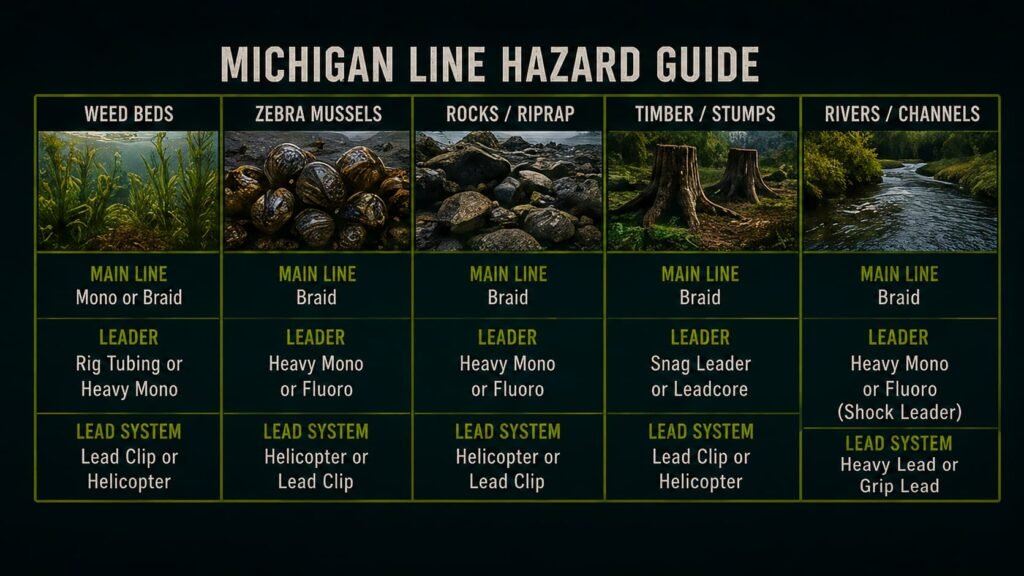
Zebra Mussels
Zebra mussels are one of the main reasons Michigan carp anglers need heavier abrasion protection.
They coat rocks, timber, shells, docks, bridge edges and hard bottom. They can cut line during the fight. They also damage hook points and leaders.
Best response:
abrasion-resistant mono
heavy mono or fluorocarbon leader
check line constantly
avoid bad angles across shell
use stronger hooks
retie often
Weed
Weed creates drag, pressure and tangles.
Best response:
stronger mainline
safe lead clips or drop-off systems where justified
strong hooklinks
fish holes, lanes and edges
apply controlled pressure early
do not let fish bury deeply
Timber and Stumps
Timber requires control and abrasion resistance.
Best response:
heavier mono or braid
snag leader
strong hooks
safe lead system
shorter controlled fight
boat support where safe/legal
do not fish impossible angles
Rocks and Riprap
Rocks cut line and damage knots.
Best response:
abrasion-resistant mono
heavy mono/fluoro leader
beaked point hooks
careful line angle
retie after contact
Rivers and Channels
Current increases pressure and can move line across structure.
Best response:
strong mono or braid
abrasion leader
lead heavy enough to hold
safe running or clip system
smooth drag
landing plan
Great Lakes-Connected Water
Big water may require distance, abrasion, wind and long runs.
Best response:
line capacity
quality mono or braid setup
shock leader if casting heavy at range
abrasion leader if mussels/rock present
safe lead system
weather-aware fishing
For large-water location, read Finding Carp in Big Michigan Lakes.
Recommended Setup Combinations by Angler Type
Beginner Michigan Carp Angler
| Component | Recommendation |
|---|---|
| Mainline | 18–20 lb mono |
| Protection | Rig tubing |
| Lead system | Safe lead clip |
| Hooklink | 20–25 lb coated braid |
| Hooks | Size 6 and 4 wide gape |
| Best use | Clean to moderate lakes |
This catches carp and teaches good habits.
Regular Lake Angler
| Component | Recommendation |
|---|---|
| Mainline | 20–25 lb abrasion-resistant mono |
| Protection | Tubing or short lead-free leader |
| Lead system | Lead clip or inline lead |
| Hooklink | 20–35 lb coated braid |
| Hooks | Size 6, 4 and 2 |
| Best use | General Michigan lakes, weed, mixed bottom |
This is the most useful all-round setup.
Mussel / Rock Angler
| Component | Recommendation |
|---|---|
| Mainline | 25–30 lb abrasion-resistant mono |
| Protection | 35–60 lb heavy mono or fluorocarbon leader |
| Lead system | Safe clip/inline tested over knot |
| Hooklink | Strong coated braid or combi rig |
| Hooks | Strong size 4 or 2 |
| Best use | Shell, riprap, concrete, channel walls |
This reduces cut-offs.
Heavy Weed Angler
| Component | Recommendation |
|---|---|
| Mainline | 25–40 lb mono or 50 lb braid |
| Protection | Tubing, lead-free leader or heavy leader |
| Lead system | Lead clip/drop-off where justified |
| Hooklink | Strong coated braid |
| Hooks | Heavy-wire size 4 or 2 |
| Best use | Weed edges, holes, lanes, summer weed |
This is about control.
Extreme Snag Angler
| Component | Recommendation |
|---|---|
| Mainline | 40 lb mono or 50–65 lb braid |
| Protection | 60 lb mono/fluoro or 50–85 lb braided snag leader |
| Lead system | Tested fish-safe lead-release system |
| Hooklink | Very strong snag hooklink |
| Hooks | Heavy-wire size 2 or 4 |
| Best use | Stumps, timber, extreme mussels, brutal snags |
This is only for experienced anglers and realistic landing situations.
What I Would Use in Michigan
For most of my Michigan carp fishing, I would start stronger than a typical beginner setup but not jump straight to extreme tackle.
My default public-water setup would be:
20–25 lb abrasion-resistant mono
rig tubing or short lead-free leader
safe lead clip
20–35 lb coated braid hooklink
strong size 4 or size 2 hooks depending bait and venue
That covers a lot of lakes, weed edges, public banks and normal carp situations.
For mussels, rocks or channel edges, I would step up:
25–30 lb mono
35–60 lb heavy mono or fluorocarbon abrasion leader
tested lead clip or safe inline system
strong hooklink
frequent line checks
For timber, stumps and heavy weed, I would step up again:
30–40 lb mono or controlled braid setup
50–85 lb snag leader where justified
drop-off lead only if it genuinely improves fish safety
strong hooks
boat support if safe and legal
no fishing impossible snags
The key is not macho tackle.
The key is matching the system to the swim.
Common Line and Leader Mistakes
The first mistake is using line that is too light for the water.
Carp may not be giant, but Michigan hazards can be brutal.
The second mistake is using heavy leaders without safe lead systems.
A heavy leader is only safe if the lead and hooklink arrangement can discharge properly.
The third mistake is thinking braid solves everything.
Braid gives control, but it also needs fish protection and careful drag management.
The fourth mistake is using fluorocarbon without testing knots.
Fluorocarbon can be excellent, but bad knots fail.
The fifth mistake is assuming leadcore is automatically professional.
Bad leadcore setups are dangerous.
The sixth mistake is not checking the last few feet of line.
In mussel and rock water, small damage matters.
The seventh mistake is casting shock leaders without checking the knot.
A cracked-off lead is dangerous.
The eighth mistake is fishing impossible snags.
No line system makes an unethical swim safe.
The ninth mistake is using old line too long.
Mono ages. Leaders wear. Braid frays. Replace damaged line.
The tenth mistake is following universal rules.
Line and leader choice is venue-specific.
My Practical View
Michigan carp line and leaders are about landing fish cleanly and protecting fish if something goes wrong.
I do not believe in using light line to make carp fishing feel more sporting when the swim has mussels, stumps, heavy weed or rocks. That is not sporting. That is gambling with the fish.
I also do not believe in throwing extreme leaders at every water just because they sound tough. A simple mono setup with tubing can be safer and better on clean water.
The best line system is the one that matches the actual risk.
Clean lake? Keep it simple.
Weed? Step up and control the fish.
Mussels? Add abrasion protection.
Timber? Use serious gear or do not fish the angle.
Distance casting? Use a proper shock leader if needed.
Braid? Protect the fish near the rig.
Leadcore? Only if you understand safety.
The final rule is simple:
Use enough line and leader to land carp safely, but build the system so the fish is not tethered if something still breaks.
FAQ
What is the best carp fishing line for Michigan?
For most Michigan carp fishing, 18–25 lb monofilament is the best starting point. Step up to heavier mono, braid or leaders when fishing weed, rocks, zebra mussels, timber, rivers or channels.
Is mono or braid better for carp fishing?
Mono is better for most beginners because it is forgiving, easy to use and has stretch. Braid gives more direct control and sensitivity but needs careful leader or tubing protection near the rig.
Should I use fluorocarbon for carp?
Fluorocarbon can be useful as a heavy abrasion leader around rocks, mussels and clear water. It can also be used as a mainline in some specialist situations, but it is not the easiest all-round beginner line.
What breaking strain mainline should I use for Michigan carp?
Use 15–20 lb mono for clean water, 20–25 lb mono for general Michigan lakes, 25–30 lb mono for weed and abrasion, and heavier line for severe snags, rocks or timber.
Do I need a leader for carp fishing?
Not always. On clean water, mainline straight through with tubing may be enough. Use leaders when you need abrasion protection, casting shock absorption, fish protection or presentation control.
Should a carp leader be stronger than the mainline?
Often yes. Shock leaders and snag leaders are commonly stronger than the mainline because their job is to absorb casting force or resist abrasion. The safety issue is whether the rig can still discharge the lead and avoid tethering the fish if the mainline breaks.
Is the leader supposed to be weaker than the mainline?
No, not as a universal rule. That advice is too simplistic. The leader may be heavier than the mainline for shock or abrasion. The whole system must be fish-safe if something breaks.
What is a shock leader?
A shock leader is a heavy section of line used to absorb the force of casting heavy leads, solid bags, spods or long-distance rigs.
What is a snag leader?
A snag leader is a heavy abrasion-resistant section used to protect against rocks, zebra mussels, timber, weed, stumps, current or other hazards during the fight.
What leader should I use for zebra mussels?
For zebra mussels, use abrasion-resistant mono mainline and consider a 35–60 lb heavy mono or fluorocarbon leader depending on severity. Check the leader constantly.
What leader should I use around timber?
Around timber, use strong mainline and a heavy snag leader such as heavy mono or abrasion-resistant braided leader material. Only fish the swim if you can land carp safely.
Is braid good around weeds?
Braid can be good around weed because it gives direct control, but it has little stretch and needs fish protection near the rig. Heavy mono can also be excellent.
Is leadcore safe for carp?
Leadcore can be safe when spliced correctly and used with compatible lead systems, but it can be dangerous if beads, clips or inline leads cannot release properly. It is not beginner tackle.
Are lead-free leaders safer than leadcore?
Lead-free leaders can be simpler and are often preferred where leadcore is banned or unwanted, but they still need safe lead systems and proper splicing.
Is rig tubing enough?
Rig tubing is enough on many clean or moderate waters. It protects fish and reduces tangles, but it is not a true abrasion leader for heavy mussels, rocks or timber.
How long should a carp leader be?
Tubing may be 18 inches to 3 feet. Short abrasion leaders may be 3–6 feet. Snag leaders may be 6–12 feet or longer in extreme situations. Shock leaders usually need enough length for several turns on the reel plus the rod length.
What knot should I use for leaders?
Use a knot you can tie perfectly and test hard. Common options include back-to-back grinner/uni, Albright-style knots, FG knots for braid to heavy leaders, Mahin-style knots and spliced loops for leadcore or lead-free leaders.
How often should I check my line?
Check the last few feet after every cast in rocks, mussels, weed or timber. Check after every fish and retie immediately if you feel nicks, roughness or damage.
What is the safest line setup for beginners?
A safe beginner setup is 18–20 lb mono, rig tubing, safe lead clip or safe inline lead, 20–25 lb coated braid hooklink and sharp size 6 or 4 carp hooks.
What is the biggest line and leader mistake?
The biggest mistake is using either line that is too light for the swim or heavy leaders with unsafe lead systems. You need strength and safety together.
Next Steps
Use these supporting guides next:
Carp Fishing Gear for Michigan
Watercraft and Conditions for Michigan Carp Fishing
Finding Carp in Big Michigan Lakes
External references:
Korda Carp Fishing Leader Guide
Korda Lead System Safety Guide
Korda Braided Main Lines Guide
Korda Fluorocarbon Main Lines and Leaders
Korda Arma-Kord Leader Material
Gardner HydroTUFF Shock Leader
Michigan DNR Fishing Regulations
Michigan Invasive Species Prevention for Boaters and Anglers