

Carp feeding looks simple from the bank. A fish lowers its head, disturbs the bottom, picks something up and moves on.
Underwater, much more is happening.
A common carp can detect food, approach it, draw material into the mouth with suction, sort edible particles from sediment and debris, reject unwanted material, reposition retained food, crush harder items with its pharyngeal teeth and continue feeding without ever giving the angler a dramatic surface sign.
That feeding process matters because it connects several parts of carp fishing that anglers often treat separately: location, natural food, bait size, baiting pattern, hookbait presentation, rig mechanics and the signs you see on the surface.
This page is about the feeding behavior itself. It does not replace How Carp Find Food Underwater, which covers sight, smell and taste in more detail, or Signs Carp Are Feeding, which explains how to interpret bubbles, clouded water, liners, tails and other visible clues.
The goal here is simpler:
UNDERSTAND WHAT THE CARP IS ACTUALLY DOING ON THE BOTTOM — THEN MAKE YOUR BAITING AND PRESENTATION FIT THAT BEHAVIOR.
Table of Contents
Quick Start: How Carp Feed Underwater
| Feeding stage | What the carp is doing | What it means for the angler |
|---|---|---|
| Finding food | Using chemical, tactile and visual information to locate potential food | Put bait where carp already have a reason to search |
| Intake | Drawing food, water and often sediment into the mouth by suction | Hookbaits need to enter the mouth naturally |
| Sorting | Separating useful food from silt, debris and unwanted particles | Pickup does not automatically mean the bait will be swallowed |
| Rejection | Spitting or expelling unwanted material | Efficient hooking can matter during a brief pickup |
| Processing | Repositioning, crushing and swallowing retained food | Texture and size affect how a bait is handled |
| Continued foraging | Moving through the feeding area and repeating the process | Feeding can become concentrated around productive zones |
If you only remember a few things from this guide, remember these:
- Common carp are highly effective bottom foragers, but they are not restricted to feeding on the bottom.
- They can take in food and sediment together, then sort what they want internally.
- A carp picking up your hookbait does not guarantee that it intends to swallow it immediately.
- Bottom disturbance, clouding and some fizz can accompany feeding, but no single surface sign proves that carp are feeding.
- Feeding areas can become localized and repeatable where food, safety and suitable bottom overlap.
- Rig choice should follow the bottom and the feeding situation rather than fashion.
- Bait quantity should match the number of fish, their feeding intensity, the session length and the natural food available.
Carp Are Flexible Feeders, Not Just Bottom Grubbers
Most carp anglers associate feeding carp with fish rooting through silt, picking particles from the lakebed or working along weed edges. That is a good starting picture because common carp are strongly adapted for benthic feeding.
But it becomes misleading if we turn it into an absolute rule.
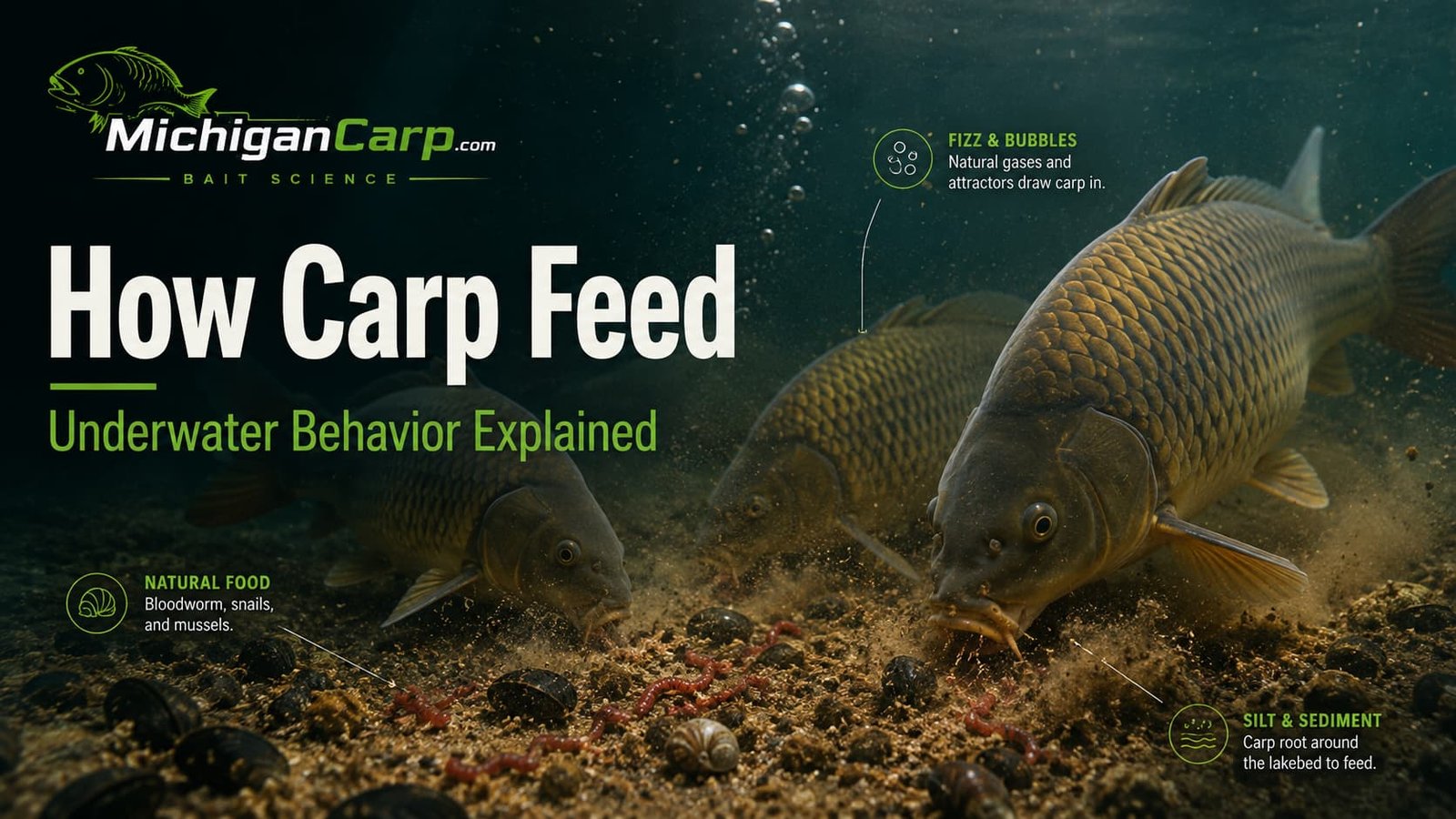
Common carp are opportunistic omnivores. Depending on food availability and conditions, they can feed on benthic invertebrates, insect larvae, worms, mollusks, crustaceans, plant material, detritus and other available foods. They can also take food higher in the water column when opportunity favors it.
The practical lesson is that feeding mode changes with the food source.
A carp rooting for chironomid larvae in soft silt behaves differently from a carp picking snails from weed, crushing mussels on harder bottom, intercepting drifting food or confidently feeding on a prepared baited patch.
That is why the question should not simply be, “How do carp feed?”
Ask instead:
- What food are they trying to obtain?
- What bottom are they feeding over?
- How concentrated is the food?
- How many carp are feeding together?
- Are they settled, passing through or feeding in a short window?
For the location side of that decision, use How to Find Carp in Lakes. This article stays focused on what happens once carp begin feeding.
How Carp Draw Food Into the Mouth
Carp do not need to bite food in the way a mammal does.
They are suction feeders.
By rapidly changing the volume of the mouth and pharyngeal region, a carp can generate water movement that draws nearby material toward and into the mouth. That can include the target food, loose particles, fine sediment and other debris surrounding it.
Detailed work on carp feeding mechanics has shown that intake is only the beginning. Food is moved and processed inside the mouth and pharynx through a series of coordinated actions rather than simply being sucked in and swallowed. The classic research is Sibbing’s study of food handling in common carp, while modern flow-tracing work has also demonstrated the complexity of suction-driven food transport in carp: In Vivo Intraoral Waterflow Quantification Reveals Hidden Mechanisms of Suction Feeding in Fish.
For the angler, the key point is simple:
A hookbait does not need to be aggressively bitten to enter a carp’s mouth.
A carp feeding close to the bottom can inhale a boilie, corn, tiger nut, pellet, small particle or other item as part of the same water movement used to sample the surrounding feed.
This is one reason presentation matters so much. A hookbait that is buried, tangled, wrapped in weed or held unnaturally by the hooklink may not behave like the free food around it.
Grubbing: What Carp Are Doing in Silt and Soft Bottom
“Grubbing” is useful angling language for the head-down feeding behavior seen when carp work through soft lakebed material.
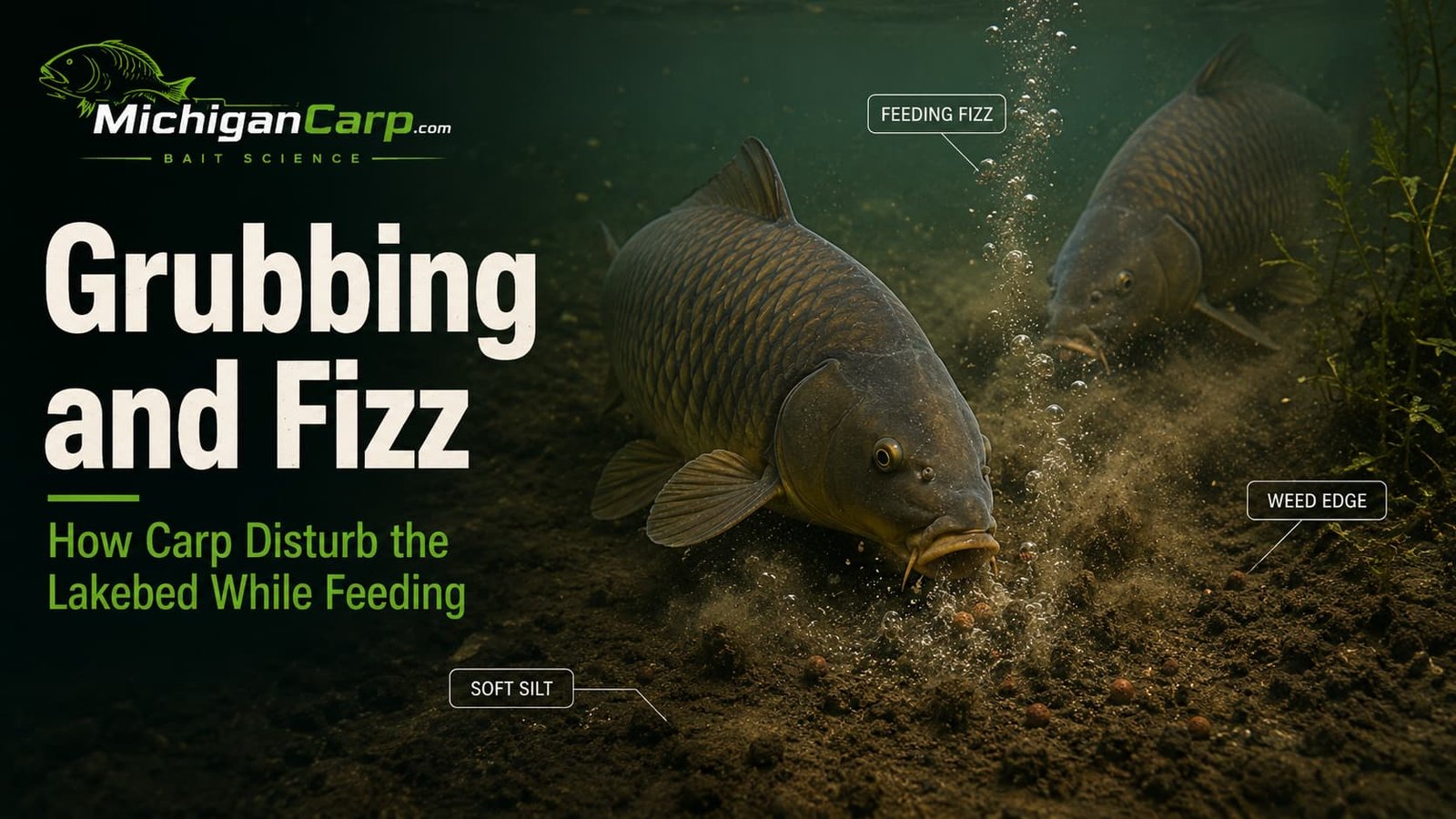
The fish may repeatedly draw sediment and food into the mouth, sort the mixture, eject unwanted material and move forward to repeat the process. Research on common carp describes them taking up sediment and selecting benthic food from it, and experimental work consistently shows that their bottom feeding can resuspend fine material into the water column.
That is why feeding carp can create:
- localized sediment clouds
- dirty or stained water in otherwise clear shallows
- small trenches or disturbed patches on very soft bottom
- movement around weed roots and reed margins
- bubbles when sediment disturbance releases trapped gas
Common carp have been shown experimentally to increase suspended solids through benthic feeding. For ecological background, see Effects of benthic-feeding common carp and filter-feeding silver carp on benthic-pelagic coupling.
From a fishing point of view, this gives us useful evidence — but not certainty.
A cloud of silt can be carp. It can also be waves, waterfowl, turtles, boat wash or other fish. Bubbles can accompany bottom disturbance, but random bottom gas is common on organic silt. The value comes from pattern, movement and repetition, not from one bubble.
For the full surface-reading system, use Signs Carp Are Feeding: Bubbles, Fizzing and Liners.
What Happens After Food Enters the Mouth
This is the part of carp feeding behavior that matters most to rig anglers.
Food entering the mouth is not automatically swallowed.
Carp possess a highly developed internal food-handling system. Experimental work has described actions including rinsing, repositioning, selective retention and spitting before food is transported for crushing and swallowing.
Intake
The carp draws food and surrounding water into the mouth.
Internal Sorting
Edible material can be separated from silt, grit and other unwanted particles. Carp are built to feed in exactly the sort of messy environment where food and non-food material arrive together.
Repositioning
Retained food can be moved inside the oropharyngeal cavity rather than swallowed immediately.
Rejection
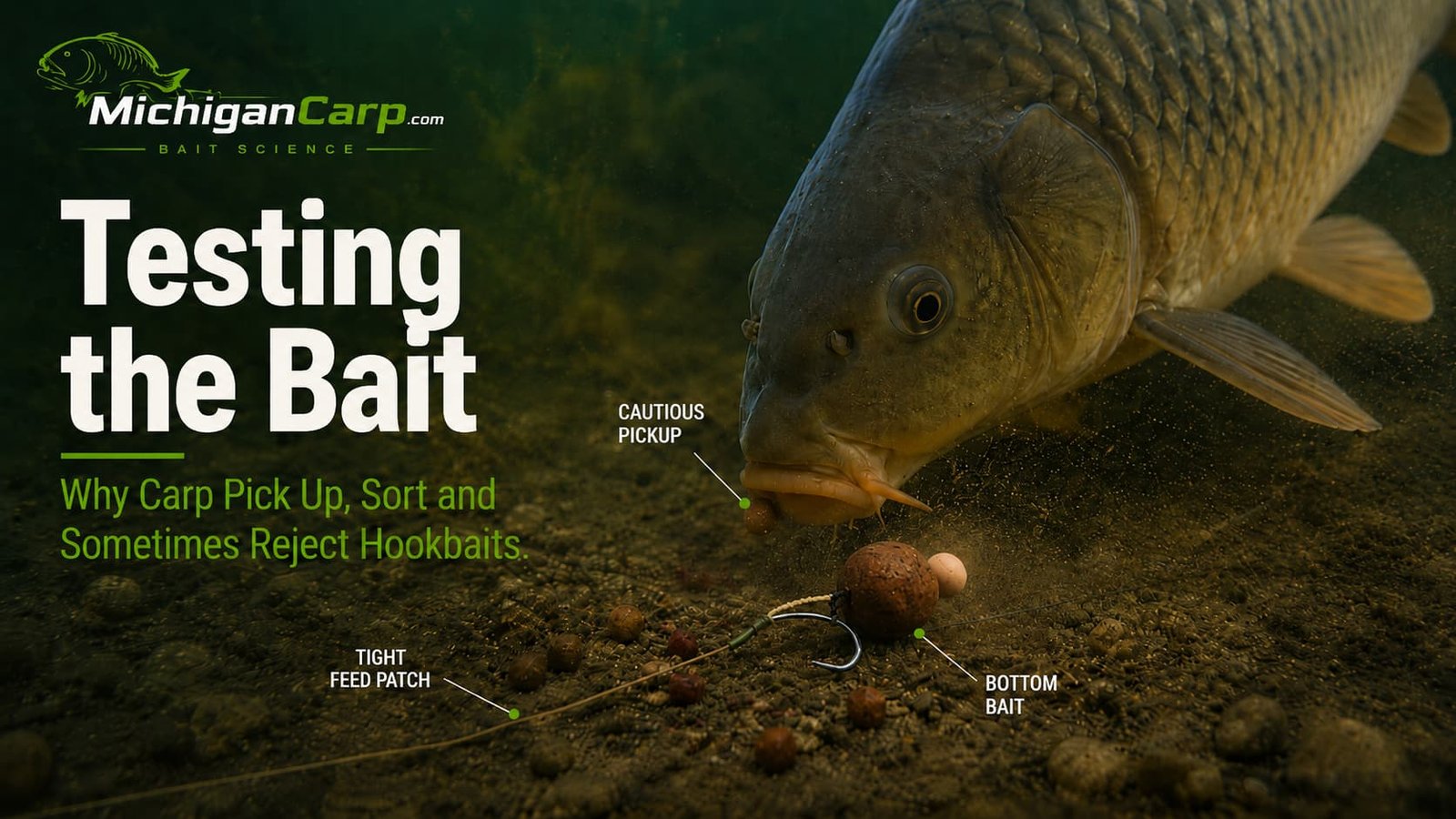
Material the fish does not retain can be expelled. From an angler’s point of view, this is the biological reason a brief pickup and ejection is possible.
Crushing and Swallowing
Carp do not have oral teeth for chewing at the front of the mouth. Harder food can be processed farther back by pharyngeal teeth before swallowing.
The important distinction is between what science can show and what anglers infer from it.
Science supports the fact that carp can selectively retain and reject material after intake. What we usually cannot know from the bank is why one individual carp rejected one individual hookbait. Resistance, rig position, texture, size, previous disturbance, simple sampling behavior or another factor may all be involved.
So I would avoid claims such as “the carp knew there was a hook” unless underwater evidence actually proves it.
Why Carp Sometimes Pick Up and Reject a Hookbait
A carp can investigate a bait without behaving as though every pickup is a committed feeding decision.
That matters because anglers often imagine a take as a simple sequence:
Carp sees bait → eats bait → swims away.
Real feeding can be much less tidy.
A carp may feed through a patch, inhale several particles, expel debris, reposition food, move a short distance, return to the same patch and repeat the process. A hookbait can enter that sequence without the fish ever “deciding” in the human sense that this particular bait is safe or unsafe.
This is where good rig mechanics become useful.
The rig does not need to trick a carp into thinking metal does not exist. It needs to:
- present cleanly on the bottom you are fishing
- allow the hookbait to enter the mouth effectively
- keep the hook in a useful position during a pickup
- avoid tangles or buried hook points
- give the hook a chance to take hold during movement or rejection
The image uses a straightforward bottom-bait hair-rig style presentation because that keeps the teaching point clear. This section is about feeding behavior, not about declaring one rig universally best.
For actual rig selection by silt, weed, gravel, debris and hookbait type, go to The Complete Michigan Carp Rig Guide.
Taste, Smell, Barbels and Close-Range Food Assessment
Carp feeding is not controlled by sight alone.
Common carp have extensive chemosensory abilities, and taste reception around the lips, barbels and other facial areas has been studied for decades. Modern work also continues to show that chemical composition can affect oral feeding responses in cyprinid fishes, including common carp.
For a recent example, see Taste Responses of Carp Fishes to Carboxylic Acids: Feeding Behavior.
But this page should not duplicate the whole sensory article.
The practical point is that feeding involves information arriving at several stages:
- before the carp reaches the food
- as the food is approached
- when it contacts the lips and barbels
- after it enters the mouth
That is one reason bait design should not be reduced to “strong smell.” Dissolved signals, texture, physical presentation and what happens after intake all matter.
For the dedicated sensory explanation, read How Carp Find Food Underwater: Sight, Smell and Taste. For the wider bait-science interpretation, use The Smart Angler’s Guide to Carp Bait.
How Different Bottom Types Change Feeding Behavior
Carp can feed over many bottom types, but the way they obtain food — and the evidence left behind — changes with the substrate.
Soft Silt
Soft silt can hold insect larvae, worms, detritus and other natural food. Carp may root deeply enough to create obvious clouding and bottom disturbance. A rig can also sink into the same material, so a productive feeding area is not automatically an easy presentation area.
Weed Edges and Clear Holes
Weed can support snails, larvae, small invertebrates and other food. Carp may pick items from stems, feed around roots, work clear holes or patrol edges where food and access overlap.
For the complete feature guide, read Weed Beds and Carp Fishing.
Gravel, Clay and Firmer Bottom
Harder bottom can make presentation cleaner and may hold mussels, snails or food trapped along transitions. Feeding may create less dramatic clouding than on deep silt, so anglers often need to rely more on repeated fish presence, rolling, liners, timing or known food.
Mussel and Snail Areas
Hard natural food changes the physical feeding problem. Carp are capable of processing hard items with their pharyngeal apparatus, but these areas can also create serious line-abrasion problems for anglers.
Margins and Shallow Flats
Shallow feeding can be visually obvious because tails, bow waves, sediment plumes and body movement are easier to see. The same shallow water can also make carp easier to disturb, so presentation may need to be much quieter than it would be at range.
For learning what your lead and rig are actually landing on, use Reading the Bottom for Carp.
Why Feeding Areas Can Become Localized and Repeatable
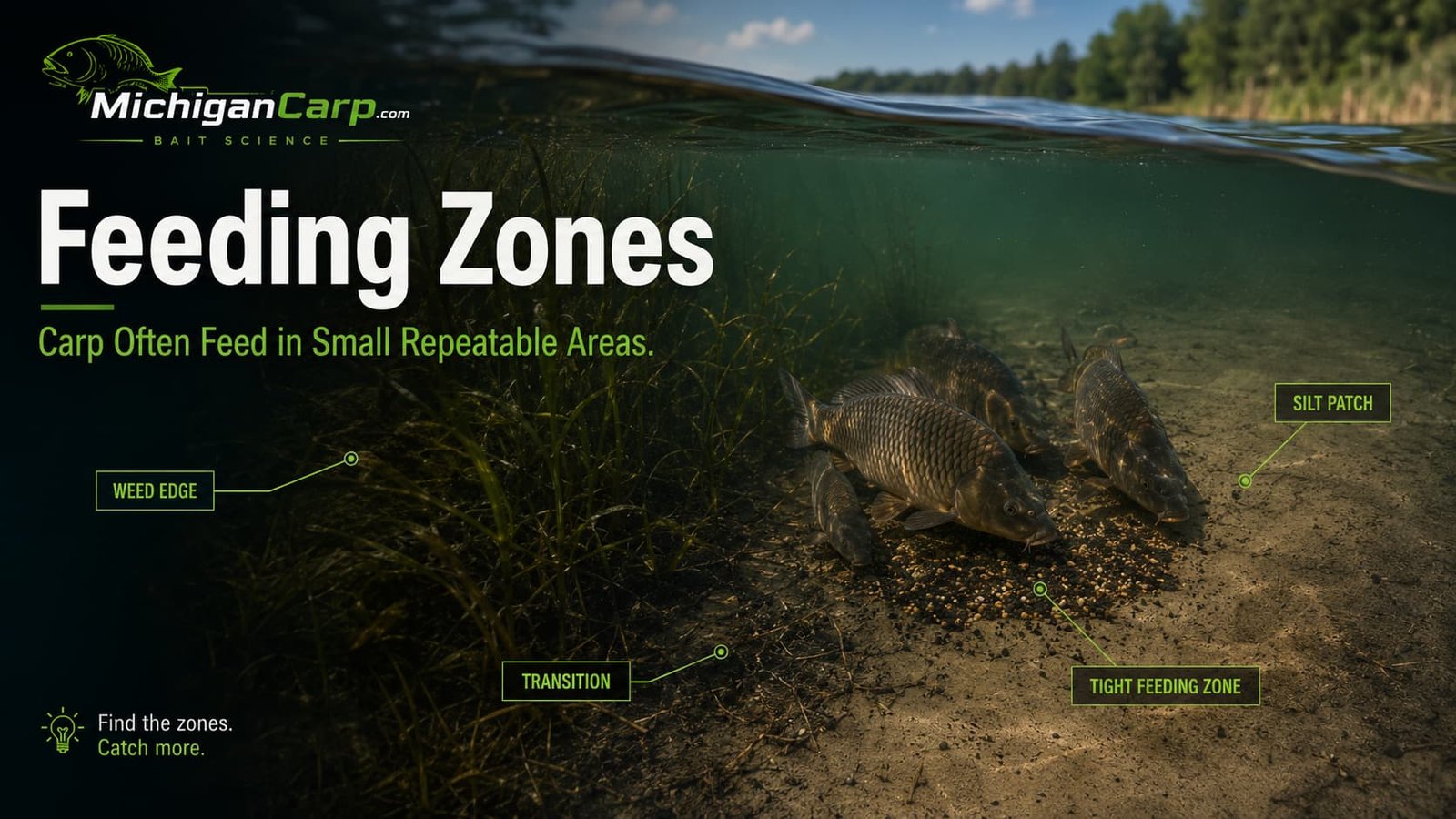
The old version of this article said carp usually feed in tight, repeatable areas. That was too absolute.
Carp can graze over broad flats, travel while feeding, spread through weed or move considerable distances between food sources.
But feeding can become strongly localized when several things overlap:
- a concentrated natural food source
- a hard/soft bottom transition
- a clear hole or edge in weed
- a margin with regular food
- a mussel or snail area
- a route that links holding water to feeding water
- a baited patch that fish repeatedly revisit
This distinction matters.
A feeding zone is not “good” because it is small. It is good because carp have a reason to spend feeding time there.
On Michigan lakes, I look for overlap rather than one magic feature: food plus cover, food plus a route, a weed edge plus clean presentation, or a soft feeding area close to deeper safety water.
For the broader tactical system, use Carp Fishing Tactics in Michigan and How to Find Carp in Lakes.
Feeding Fish, Traveling Fish and Holding Fish Are Not the Same
One of the most useful distinctions in carp fishing is separating three different situations:
| Situation | What the fish may be doing | What the angler should avoid assuming |
|---|---|---|
| Feeding | Stopping, searching, taking food and repeatedly working an area | That more bait is automatically needed |
| Traveling | Moving between areas, possibly giving liners or occasional shows | That a visible carp is feeding where it shows |
| Holding | Resting, sheltering, regulating comfort or waiting before movement | That the fish will respond to bait immediately |
This helps explain a common frustration: carp can be present without feeding on your spot.
A rolling fish shows presence. A liner can show movement. Neither one proves feeding.
For daytime holding behavior, use Where Carp Hold During the Day. For actual feeding evidence, return to Signs Carp Are Feeding.
How Feeding Behavior Should Change Your Baiting
Feeding behavior does not support one universal baiting rule.
The old article leaned too heavily toward “tight feed is good” and “overbaiting kills action.” Both can be true, but neither is a law.
The useful question is:
WHAT FEEDING RESPONSE AM I TRYING TO CREATE?
A Small Concentrated Patch
A small patch can be excellent when fish numbers are modest, feeding windows are short, the water is cold, the spot is precise or you want the hookbait encountered quickly.
Crumb, particles, chopped boilies, pellets or a small PVA presentation can encourage repeated picking and sorting around the hookbait.
A Wider Grazing Area
A broader spread can make sense when multiple carp are feeding confidently across a flat, when you are trying to hold a group, or when the fish naturally graze over a larger area.
The mistake is not “spreading bait.” The mistake is spreading bait when the carp are not behaving in a way that makes the spread useful.
Heavy Baiting
Large quantities can work when enough carp are present, appetite is strong and the campaign or session supports it. They can fail badly when only a few fish visit briefly, water is cold, natural food is abundant or the bait bed is much larger than the feeding activity.
So I would replace the old rule “overbaiting kills action” with a better one:
BAIT VOLUME HAS TO MATCH FISH NUMBERS, APPETITE, WATER TEMPERATURE, SESSION LENGTH AND HOW LONG CARP ARE ACTUALLY STAYING IN THE AREA.
For bait selection rather than feeding mechanics, use Best Carp Bait for Michigan Lakes or the broader Carp Bait Guide.
How Feeding Behavior Should Change Your Rig Choice
Understanding feeding behavior should simplify rig choice, not make it more complicated.
Start with the bottom.
- On a clean firm bottom, a straightforward bottom-bait or balanced presentation may be all you need.
- Over light silt, the lead and hooklink need to settle without pulling the hookbait too deeply.
- In weed or debris, the priority becomes presenting cleanly and landing fish safely.
- On mussel-strewn or abrasive bottom, line protection and tackle strength may matter more than a tiny rig-mechanics advantage.
Then think about the feeding situation.
If carp are actively grubbing through a tight particle patch, your hookbait should behave naturally enough to enter that feeding sequence. If they are feeding sparsely over a hard natural-food area, a durable single hookbait may be more appropriate. If they are feeding over weed, a perfectly designed bottom-bait rig buried in vegetation is still a poor presentation.
The rule is:
MAKE THE RIG FIT THE BOTTOM FIRST, THEN MAKE THE HOOKBAIT FIT THE FEEDING BEHAVIOR.
Use The Complete Michigan Carp Rig Guide for the actual builds.
How Temperature, Light, Oxygen and Pressure Change Feeding
Feeding mechanics do not change every time the weather changes, but the opportunity to feed certainly does.
A carp may be physically capable of feeding at a wide range of temperatures, yet its movement, appetite, time spent on a spot and willingness to use shallow exposed water can change dramatically.
Temperature
Cold water generally shortens feeding windows and reduces the amount of bait I want to introduce until the fish prove otherwise. Warming spring water can pull carp into shallow food-rich zones, while high summer temperatures make oxygen, weed condition and timing more important.
Use Carp Water Temperature Guide for Michigan Lakes for the full seasonal temperature framework.
Light
Clear shallow water can make feeding behavior easier for anglers to observe but may also make fish less willing to remain exposed. Dawn, dusk, cloud, ripple and darkness can change how long carp stay in a feeding area.
Oxygen and Weed
A food-rich area can still be poor if the water is uncomfortable. Healthy weed, moving water and wind can improve a swim; hot stagnant water or dying weed can do the opposite.
Pressure
Boat traffic, repeated casting, bank disturbance and angling pressure can change where and when carp are prepared to feed. I treat this as a practical field observation rather than pretending every pressured carp reacts identically.
For timing rather than mechanics, read Carp Bite Windows in Michigan.
Michigan Feeding Situations I Pay Attention To
Michigan gives carp anglers a wide range of feeding environments: soft inland-lake silt, cabbage and milfoil edges, reed margins, river-influenced reservoirs, zebra-mussel areas, sand, clay, drowned river mouths and large open-water flats.
From a practical fishing point of view, I pay special attention to the places where food and a safe presentation overlap.
Soft Silt Beside Firmer Ground
The silt may contain the food, while the firmer edge gives me the cleaner rig presentation.
Weed Edges With Snails and Clear Holes
The carp have food, cover and a route, but I still need somewhere safe to land a fish and somewhere the hookbait can fish properly.
Mussel or Snail Areas
These can be excellent natural-food zones, but abrasion becomes part of the fishing decision.
Shallow Bays During Short Windows
When fish slide in to feed, I would rather place a small accurate trap in the area they are already using than try to create a huge bait bed before I know how long they will stay.
Large-Lake Routes Between Food and Safety
Not every carp has to be settled over a baited spot. Intercepting a route can work, but that is a different tactical problem from fishing a true feeding zone.
That distinction is one of the reasons I keep feeding behavior, location and visible feeding signs as separate articles on MichiganCarp.com.
Common Mistakes When Interpreting Carp Feeding
Assuming Every Bubble Is a Feeding Carp
Bubbles become useful when they move, repeat and connect with the right bottom or other signs.
Assuming Every Visible Carp Is Feeding
Carp can roll, cruise, hold, spawn or travel without feeding normally.
Thinking a Pickup Must Be a Committed Bite
Food can be sampled, sorted and rejected after intake. A short pickup is still a meaningful part of the feeding sequence.
Blaming the Hookbait Before Checking Presentation
If the hook is masked, the rig is tangled or the bait has disappeared into silt, bait chemistry is not the first problem to solve.
Treating Tight Baiting as a Universal Rule
Concentrated feeding can be useful, but groups of carp can also graze broadly. Match the baiting pattern to what the fish are doing.
Treating Heavy Baiting as Automatically Wrong
Heavy feeding can work extremely well when enough fish and enough appetite are present. It fails when the bait volume exceeds the opportunity.
Assuming Rejection Proves the Carp Detected the Hook
Carp naturally sort and reject material. Without direct underwater evidence, we should be careful about assigning a reason to one rejection.
My Practical MichiganCarp View
The more I think about carp feeding, the less useful it becomes to separate bait, rigs and location into isolated subjects.
The fish connects them for us.
A carp enters an area because it has a reason to be there. It detects potential food. It approaches. It takes material into the mouth. It sorts it. It retains some and rejects some. Then it either keeps working the area or moves on.
Our job is to fit into that sequence.
I want the rig on a bottom where it can fish cleanly. I want the hookbait to behave sensibly among the feed. I want enough bait to create or support feeding without assuming more is always better. And I want to see repeated evidence that the carp are actually using the area before I blame the bait.
That is a much stronger system than chasing the newest flavor or rig every time the alarms stay quiet.
The simple rule is:
FIND WHERE CARP HAVE A REASON TO FEED. PRESENT THE BAIT CLEANLY. LET THEIR ACTUAL BEHAVIOR DECIDE WHAT YOU CHANGE NEXT.
Research Note: Evidence vs Practical Interpretation
This article deliberately separates established feeding biology from angling interpretation.
Scientific evidence supports that common carp use suction during feeding, can sort food internally, can selectively retain and spit material, and can strongly disturb and resuspend sediment while benthic feeding.
The strongest background sources used here include:
- Food Handling in the Carp (Cyprinus carpio): Its Movement Patterns, Mechanisms and Limitations — detailed food intake, sorting, spitting and processing mechanics.
- In Vivo Intraoral Waterflow Quantification Reveals Hidden Mechanisms of Suction Feeding in Fish — modern measurement of suction-driven food transport, including common carp.
- Effects of Benthic-Feeding Common Carp and Filter-Feeding Silver Carp on Benthic-Pelagic Coupling — experimental evidence of sediment disturbance and resuspension associated with common-carp feeding.
- Taste Responses of Carp Fishes to Carboxylic Acids: Feeding Behavior — recent experimental work on oral feeding responses in common carp and other cyprinids.
Practical statements about how I would respond with bait quantity, rig placement or rod positioning are angling interpretation. They are not presented as laboratory proof that every carp will respond in exactly the same way.
FAQ
How do carp actually feed underwater?
Common carp often draw food and surrounding material into the mouth by suction. They can then sort, reposition, retain or reject material before harder food is processed farther back in the pharyngeal region.
Do carp suck boilies into their mouth?
Yes. A boilie or other hookbait can be drawn into the mouth by the same suction-feeding mechanism used for natural food and loose feed. The exact movement depends on bait size, distance, bottom conditions and how the rig allows the bait to move.
Why do carp spit bait out?
Selective rejection is part of normal carp food handling. Carp may expel sediment, debris or food they do not retain. From the bank, we usually cannot prove the exact reason one specific hookbait was rejected.
Do carp always feed on the bottom?
No. Common carp are strongly adapted for benthic feeding, but they are flexible omnivores and can exploit food higher in the water column when conditions and food availability favor it.
Does carp fizz always mean feeding?
No. Feeding carp can disturb silt and release trapped gas, but bottom gas, decaying vegetation, turtles, other fish and physical disturbance can also create bubbles. Moving, repeated fizz connected with other carp signs is stronger evidence than one isolated bubble.
Why do carp return to the same feeding areas?
Some areas repeatedly provide food, safety, comfortable water and easy access. Weed edges, silt pockets, hard/soft transitions, margins, mussel areas and travel routes can therefore become repeat feeding zones. Carp can also feed broadly, so repeatability should be confirmed by observation rather than assumed.
Should I always bait tightly for feeding carp?
No. Tight baiting can be excellent for short windows, small groups and precise spots. A wider spread can suit grazing fish or larger groups. Match the baiting pattern to fish numbers, feeding intensity and the type of area they are using.
What rig is best when carp are grubbing?
There is no single best grubbing rig. The bottom decides first. Use a clean bottom-bait or balanced rig on firm ground, and choose a presentation that will not bury or tangle in silt, weed or debris. Fish safety and reliable presentation matter more than fashionable rig names.
Next Steps
Use these guides to build outward from feeding behavior:
- How Carp Find Food Underwater — sight, smell, taste and food detection.
- Signs Carp Are Feeding — bubbles, fizz, clouding, liners, rolling fish and visible evidence.
- How to Find Carp in Lakes — the parent location process.
- Reading the Bottom for Carp — understand the substrate under the rig.
- The Complete Michigan Carp Rig Guide — choose the presentation for the actual lakebed.
- Carp Bite Windows in Michigan — understand when feeding opportunity opens and closes.
- Carp Fishing Tactics in Michigan — return to the main tactics hub.
Final Word
Understanding how carp feed changes the way you look at a swim.
Bubbles are no longer just bubbles. Silt is no longer automatically bad bottom. A pickup is no longer the same thing as a committed bite. A rig is no longer judged only by how clever it looks in your hand.
You start asking better questions.
- What food are the carp working for?
- How are they obtaining it?
- Is the feeding concentrated or spread out?
- Can my hookbait enter the same feeding process naturally?
- Is the rig actually fishing on that bottom?
- Do the signs prove the fish are feeding, or only that they are present?
Those questions are more useful than chasing a new bait or rig every time the fishing becomes difficult.
Find the feeding reason. Read the behavior. Present cleanly. Then let the carp tell you what to change.