

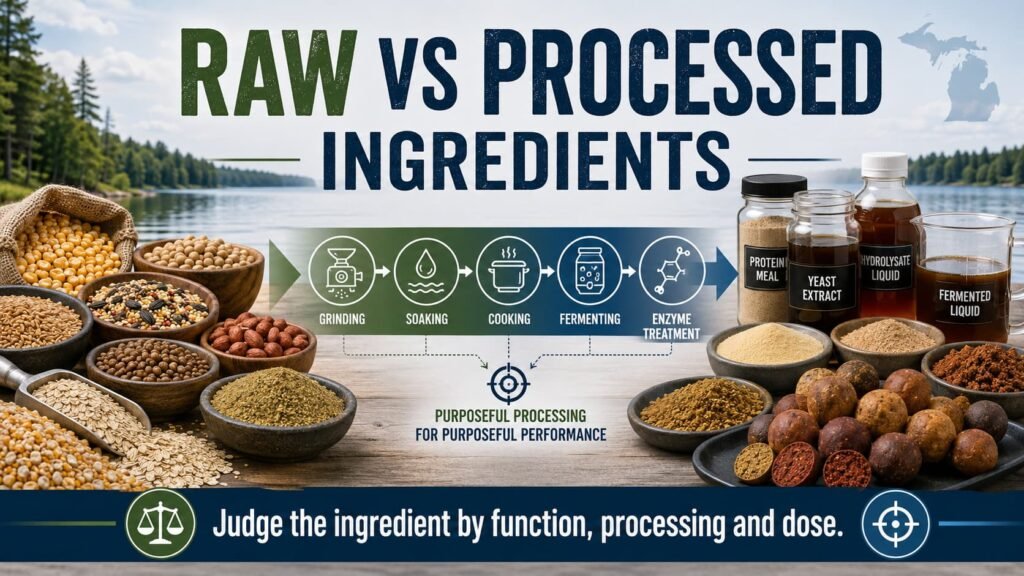
Raw vs processed ingredients in carp bait is one of the most important bait-making subjects to understand. Anglers often talk as if raw ingredients are automatically better, cleaner, more natural, or more attractive. Others assume processed ingredients are always artificial, dead, or inferior. Both views are too simple.
The real question is not whether an ingredient is raw or processed. The real question is: has the ingredient been treated in a way that helps the finished bait?
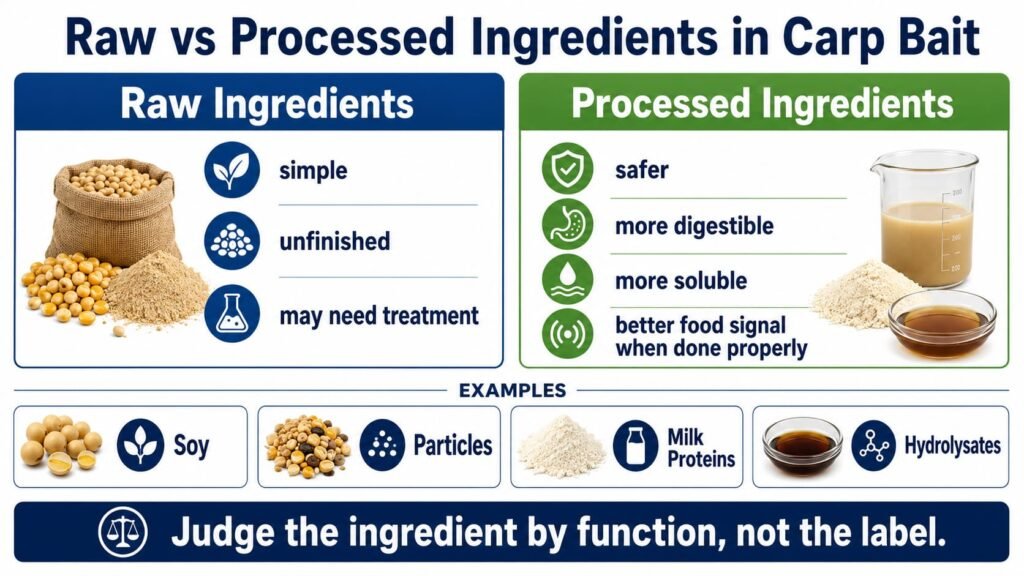
Some ingredients work well with very little treatment. Some raw ingredients are unfinished, hard to digest, awkward in a boilie mix, or poor at releasing food signal. Some processed ingredients are far more useful because they have been cooked, toasted, fermented, hydrolysed, micronised, concentrated, or refined in a way that makes them safer, more digestible, more soluble, or easier to use.
But processing can also go too far. An ingredient can be over-refined, over-heated, stripped of character, or dressed up with a technical name while doing very little in the bait.
For Michigan carp fishing, this matters because we often use homemade bait, particles, feed ingredients, milk proteins, nut meals, birdfoods, seed meals, yeasts, liquids, and boilies on big natural waters. The bait does not need to be complicated, but the ingredients do need to make practical sense.
This guide explains the broader decision: when processing helps, when it is unnecessary, and why the words raw and processed are not enough by themselves.
For practical decisions about grinding, crushing, sieving, hydration, cooking, moisture control, fermentation and enzyme treatment, read How to Process Carp Bait Ingredients Properly.
For ingredient problems such as phytate, trypsin inhibitors, lectins, tannins and other anti-nutritional factors, read Anti-Nutritional Factors in Carp Bait Ingredients.
This guide also works alongside Enzymes in Carp Bait: Phytase and Pre-Digestion Explained, What Boiling and Heat Really Do to Carp Bait Ingredients, Carp Bait Digestibility, and the main Bait Science hub.
Quick Answer
Raw ingredients are not automatically better, and processed ingredients are not automatically worse. Good processing can improve safety, digestibility, solubility, texture, food signal, leakage, consistency, and bait performance. Bad processing can make ingredients lifeless, harsh, over-refined, or poor value.
The best bait makers judge ingredients by function. Ask what job the ingredient is doing in the bait, how well it performs after preparation, and whether the processing has improved or damaged its value.
Raw vs Processed: The Simple Difference
| Ingredient Type | What It Means | Potential Strength | Potential Weakness |
|---|---|---|---|
| Raw ingredient | Little treatment beyond drying, grinding, or basic handling | Simple, natural character, often cheap | May be hard to digest, unsafe, locked-up, or weak in food signal |
| Processed ingredient | Cooked, toasted, fermented, hydrolysed, refined, micronised, or otherwise treated | Can be safer, more digestible, more soluble, and more functional | Can be overdone, over-refined, stripped, or too expensive for the gain |
The Best Question to Ask
Do not start with:
Is this raw?
Or:
Is this processed?
Start with this instead:
What has been done to the ingredient, and does that help the bait?
That question removes a lot of bait-making nonsense. Raw can be good. Processed can be good. Raw can be poor. Processed can be poor. The result depends on the ingredient, the treatment, the inclusion level, and the job it has in the finished bait.
What Raw Really Means in Carp Bait
When anglers say an ingredient is raw, they usually mean it has not been heavily treated. It may have been dried, ground, crushed, cleaned, or bagged, but it has not been cooked, fermented, hydrolysed, toasted, extracted, or refined in any meaningful way.
Raw ingredients may include:
- raw flours
- raw seed meals
- untreated soy flour
- dry grains
- dry particles
- crude feed ingredients
- whole seeds
- basic cereal products
- untreated legume meals
Raw does not automatically mean bad. But it also does not automatically mean safe, digestible, attractive, or useful.
Where Raw Ingredients Can Be Useful
Some raw or simple ingredients are perfectly useful when they have a limited, sensible job in the bait.
Structural flours
Semolina, wheat flour, maize flour, and similar ingredients can work well as binders, rollers, and structure builders. They do not always need advanced treatment if their main job is physical structure.
Birdfood-style ingredients
Some birdfood ingredients help with openness, texture, visual appeal, and bait breakdown. They do not always need to be highly processed if they are used sensibly.
Spices and simple support powders
Some spices, herbs, and flavour-support powders can work in fairly basic form. Their job is usually profile support rather than nutrition.
Seeds used at low inclusion
Some simple seed materials can be useful for texture, oil, and background food character when used moderately.
The key point is this: raw ingredients are often fine when they are doing a simple job and are not being asked to carry the bait nutritionally or create a major soluble food signal.
Raw Ingredients That Often Need Processing
This is where many homemade bait makers get caught out. Some ingredients look attractive because they are cheap, natural, or high in protein on paper, but they need proper treatment before they become truly useful.
Raw soy and soybean products
Raw soy is one of the clearest examples. Soy can be useful in carp bait, but raw soy and properly treated soy are not the same thing. Heat-treated soy, toasted soy, full-fat soya, and better-processed soy products usually make more sense than crude raw soy flour.
The issue is not whether soy is good or bad. The issue is which soy product you are using and what has been done to it.
For the specific issues around trypsin inhibitors, lectins, phytate and the difference between raw and correctly processed plant ingredients, read Anti-Nutritional Factors in Carp Bait Ingredients.
Dry particles and grains
Dry maize, wheat, hemp, chickpeas, beans, maples, and mixed particles are not ready for carp just because they came in a sack. They need safe preparation.
Soaking, cooking, resting, and sometimes light fermentation can transform dry grains into a much better carp food. Dry raw particles are raw material. Properly prepared particles are bait.
Raw legume flours
Pea flour, chickpea flour, bean meals, lupin products, and similar materials can have uses, but raw forms can be rough, awkward, and less digestible than treated versions.
Crude seed meals
Some seed meals bring texture and character. Others bring too much husk, fibre, anti-nutritional drag, or low-value bulk. Processing and quality matter.
Cheap feed by-products
Feed by-products can be useful, but some are built for livestock economics rather than serious carp bait. They may need careful inclusion, treatment, or balancing with better ingredients.
What Processing Really Means
Processing covers a wide range of treatments. It is not one thing.
Processing may include:
- soaking
- cooking
- toasting
- steaming
- extrusion
- micronising
- fermentation
- hydrolysis
- enzymatic treatment
- fine milling
- spray drying
- concentration
- refinement
- blending
Some processing is basic and practical. Some is technical. The important point is that processing changes how the ingredient behaves in the finished bait.
Good Processing vs Bad Processing
| Good Processing Can Improve | Bad Processing Can Cause |
|---|---|
| Digestibility | Dead, lifeless bait behaviour |
| Safety | Over-heated or denatured ingredients |
| Solubility | Loss of useful food signal |
| Texture and binding | Poor value for money |
| Consistency | Ingredients that sound technical but do little |
| Food signal | Over-refined powders with little character |
Processing is not automatically good. It is only good when it improves the ingredient’s job in the bait.
Processed Ingredients That Often Improve Bait
Toasted and heat-treated plant proteins
Proper heat treatment can make certain plant proteins more sensible in bait. This is why treated soy products often make more sense than raw soy products.
Prepared particles
This is the bank-side example every carp angler understands. Soaked and cooked maize, hemp, wheat, pigeon seed, and mixed particles are completely different from dry raw grains.
Preparation improves safety, texture, digestibility, attraction, and feeding confidence.
Fermented ingredients
Controlled fermentation can make some ingredients more active, more soluble, more food-like, and more useful as a signal. Fermented particles, CSL-style liquids, grain liquids, and yeast-based liquids all sit in this area.
Hydrolysates and predigested liquids
Hydrolysates are processed ingredients by design. Liver hydrolysate, fish hydrolysate, yeast hydrolysate, whey hydrolysate, and predigested protein liquids are useful because processing has already broken the ingredient down into more water-active forms.
Yeast extracts and autolysed yeast
Yeast extract and autolysed yeast-style products can outperform crude yeast because the processing makes them more savoury, soluble, and food-signalling.
Refined milk proteins
Casein, caseinate, micellar casein, whey protein, and other functional milk products are processed, but that does not make them inferior. Good refinement can make dairy ingredients more targeted, predictable, and useful in bait.
Raw vs Processed by Ingredient Type
| Ingredient Group | Raw Version | Processed Version | Best Practical View |
|---|---|---|---|
| Soy | Can be rough and problematic | Toasted, heat-treated, full-fat, or refined forms are usually better | Judge the soy product, not the word soy |
| Particles | Dry grains and seeds are unfinished | Soaked, cooked, conditioned, or fermented particles become proper bait | Preparation is essential |
| Milk ingredients | Cheap dairy powders can be basic bulk | Casein, caseinate, WPC, and micellar casein are more functional | Refinement can be a strength |
| Yeast | Plain yeast can be limited | Yeast extract and autolysed yeast offer stronger savoury signal | Processed yeast often works better |
| Proteins | Whole proteins may be slower and more locked in | Hydrolysates are more soluble and active | Use both for different jobs |
| Grains and cereals | Useful for structure but can be basic | Cooked, micronised, fermented, or refined forms may behave better | Depends on whether the job is structure or food signal |
Digestibility: Why Processing Matters
Digestibility is one of the biggest reasons processing matters. An ingredient can look good on paper but still be less useful if carp cannot process it well.
Good processing can improve digestibility by:
- reducing anti-nutritional drag
- softening hard structures
- opening up nutrients
- improving hydration
- breaking down proteins or carbohydrates
- making the finished bait behave more like food
This is why a cheap raw ingredient is not always better value than a slightly more expensive treated one.
Processing can influence ingredient usefulness, but processing and digestibility are not the same subject. For the full explanation of digestion, nutrient availability, absorption and usable food value, read Carp Bait Digestibility.
Solubility: Processed Ingredients Often Leak Better
Solubility matters because carp do not only respond to what is inside the bait. They respond to what leaves the bait.
Solubility and Release: Processing Can Change Both
Processing can change how an ingredient interacts with water, but processed does not automatically mean more soluble and it does not automatically mean faster leakage.
The result depends on what the process actually did.
Processing may:
- create smaller soluble protein fractions through hydrolysis
- increase exposed material through controlled grinding
- change hydration behaviour
- alter starch and protein structure through heat
- produce acids and other transformed food compounds through fermentation
- concentrate useful soluble fractions
- reduce release if the finished bait becomes excessively dense or resistant to water entry
This is why hydrolysates, yeast extracts, fermented liquids and other transformed food ingredients can be useful when their processing creates a clear functional advantage.
For the complete release mechanism, read The Science of Carp Bait Solubility and Leakage.
Food Signal: The Biggest Practical Difference
A raw ingredient can have nutrients and still be quiet underwater. A processed ingredient can sometimes create a stronger, more readable food signal at a lower inclusion.
Strong food-signal examples include:
- fermented liquids
- hydrolysates
- yeast extracts
- autolysed yeast
- predigested proteins
- treated particles
- post-boil liquid foods
- crumb and chopped bait treated with active liquids
These ingredients often work because processing has already done some of the work that helps the bait communicate in water.
Soy Is the Perfect Example
Soy is one of the clearest examples of why “raw vs processed” matters.
Raw soy may be cheap and high in protein on paper, but that does not automatically make it a good carp bait ingredient. Properly treated soy products are usually much easier to justify because they are more sensible in the finished mix.
The practical rule is simple:
Do not ask whether soy is good or bad. Ask which soy product it is, how it has been processed, and what job it is doing in the bait.
Particles Are the Bank-Side Example
Particles are the simplest way to understand this whole subject.
A sack of dry maize is not ready bait. A dry hempseed blend is not the same as soaked, cooked, oily, active hemp. A dry pulse mix is not the same as a safe, conditioned particle blend.
Prepared particles are raw materials turned into proper carp food by sensible processing.
Good particle preparation improves:
- safety
- texture
- digestibility
- food signal
- feeding confidence
- practical use on the bank
For Michigan carp fishing, prepared particles remain one of the best examples of processing done right.
Milk Proteins vs Cheap Dairy Powders
Milk ingredients are another useful example. A cheap dairy powder and a proper milk protein are not the same thing.
Better milk protein ingredients may be more processed and more refined, but that refinement is often the point. A proper casein, caseinate, micellar casein, or whey protein product can bring more function than a generic dairy powder.
Good milk ingredients can help with:
- protein quality
- bait texture
- binding
- leakage
- creaminess
- digestibility
- consistency
Less processed does not automatically mean more useful.
Feed-Grade vs Bait-Grade Ingredients
Feed-grade ingredients are not automatically bad. Many are very useful in carp bait when chosen carefully. But feed-grade materials are often designed around livestock economics, pellet manufacture, or broad animal feeding rather than high-quality carp bait.
Bait-grade ingredients are not automatically magic either. Some are excellent. Some are just better marketed.
The practical rule is this:
Do not buy the label. Buy the function.
Ask what the ingredient does, how consistent it is, how it behaves in the mix, and whether it earns its place compared with alternatives.
How This Affects Homemade Boilie Building
For home bait makers, this subject should change how every recipe is judged.
A better homemade boilie usually comes from:
- using structural ingredients that roll and bind properly
- choosing treated proteins where digestibility matters
- avoiding crude raw ingredients that need more work than they get
- using active processed ingredients where they genuinely help
- keeping cheap filler under control
- matching food-signal ingredients with proper bait structure
- not falling in love with words like natural, technical, premium, or raw
Good bait building is good decision-making stacked together.
Ingredient Job Test
Before adding any ingredient, ask what job it is supposed to do.
| Ingredient Job | Raw May Be Fine When | Processed May Be Better When |
|---|---|---|
| Structure | The ingredient is mainly binding, bulking, or opening the bait | You need improved texture, rolling, or consistency |
| Nutrition | The ingredient is already digestible and used sensibly | Digestibility, safety, or protein quality matters |
| Solubility | The bait does not need fast leakage from that ingredient | You need the bait to signal quickly |
| Food signal | The ingredient is only background support | You want active, readable food cues |
| Particles | Almost never as dry raw feed | Soaking, cooking, and conditioning are required |
When Processing Goes Too Far
Processing can help, but it can also damage ingredients or make them poor value.
Processing may go too far when an ingredient is:
- too harshly heat-treated
- over-refined
- stripped of useful character
- too expensive for the gain
- too technical-looking for what it actually does
- made lifeless by poor handling
This can happen with delicate liquids, milk-based ingredients, enzyme concepts, cheap denatured proteins, and even finished boilies that are overboiled or overdried.
Processing is not only what happened before you bought the ingredient. It is also what you do to it while making bait.
For the specific effects of heat on proteins, starches, enzymes, soluble material and the finished bait matrix, read What Boiling and Heat Really Do to Carp Bait Ingredients.
Cold Water vs Warm Water
Raw vs processed thinking changes with temperature because bait behaviour changes with temperature.
| Condition | Best Ingredient Thinking | Main Risk |
|---|---|---|
| Cold water | Use more soluble, active, processed food-signal ingredients in small amounts | Using too much crude food that does not leak quickly |
| Cool spring water | Prepared particles, crumb, yeast liquids, hydrolysates, and active hookbait treatments | Overfeeding before carp are feeding confidently |
| Warm water | More room for particles, grains, seed meals, and bulk feed if properly prepared | Nuisance fish, sloppy bait, or poor storage |
| Fall water | Digestibility and real food value matter more as fish feed heavily | Using crude filler instead of a balanced food package |
Michigan Notes
This topic matters a lot on Michigan carp waters. Many of our lakes are big, natural, clear, weedy, and full of real food. Carp may feed on snails, mussels, crayfish, insect larvae, silt food, weedbed food, and natural particles. A bait needs to make practical sense in that environment.
Michigan bait lessons:
- properly prepared particles usually beat dry crude grains
- treated plant proteins usually beat raw problematic ones
- active food liquids usually beat random bottle clutter
- good yeast, milk, and hydrolysate ingredients often beat decorative powders
- processed ingredients with a clear job usually beat raw ingredients that only sound natural
- natural-food waters reward believable bait, not just loud bait
For Michigan carp fishing, I would rather use a simple, well-prepared bait than a romantic pile of raw ingredients that do not work properly in water.
Common Mistakes
Assuming raw means better
Raw does not automatically mean better. It may simply mean unfinished, hard to digest, unsafe, or poorly suited to the bait.
Assuming processed means inferior
Many of the best bait ingredients work because they have been processed intelligently.
Buying by label romance
Natural, raw, feed-grade, technical, premium, and bait-grade are not enough. The ingredient still needs to do a real job.
Ignoring preparation
Particles, legumes, soy products, and some seed meals need proper treatment before they become good bait.
Using crude ingredients for serious nutritional jobs
If an ingredient is supposed to provide meaningful food value, digestibility and processing matter.
Over-processing the finished bait
A good ingredient can be dulled by poor boiling, over-drying, bad storage, or heavy-handed liquid treatment.
Confusing active with messy
Processed food-signal ingredients are useful. A sloppy, over-liquid, confused bait is not.
Simple Practical Rules
- Judge function, not label: raw and processed are not enough by themselves.
- Prepare particles properly: dry grains are raw materials, not finished carp food.
- Respect treated soy: raw soy and treated soy are not the same bait ingredient.
- Use hydrolysates with purpose: they are processed to leak food signal.
- Use refinement where it helps: milk proteins and yeast extracts are often useful because of processing.
- Do not overdo processing: heat, drying, and refinement can go too far.
- Match the ingredient to the job: structure, nutrition, solubility, and food signal are different roles.
Final Verdict
Raw vs processed ingredients in carp bait is not a simple argument. Raw is not automatically better. Processed is not automatically worse. The finished bait is what matters.
Good processing can make ingredients safer, more digestible, more soluble, more consistent, more food-like, and easier to use. Bad processing can strip ingredients, overheat them, over-refine them, or make them sound better than they perform.
For Michigan carp fishing, the best approach is practical: use raw or simple ingredients where they do a simple job, use processed ingredients where they improve digestibility or food signal, prepare particles properly, and build bait around function rather than labels.
FAQ
Are raw ingredients better for carp bait?
Not automatically. Some raw ingredients are useful, but others need soaking, cooking, toasting, fermentation, hydrolysis, or refinement before they perform properly in bait.
Are processed ingredients bad for carp bait?
No. Many processed ingredients are useful because processing improves digestibility, solubility, safety, consistency, or food signal.
Is toasted soy better than raw soy in carp bait?
Usually, yes. Properly treated soy products are generally more sensible than crude raw soy flour because treatment improves how the ingredient behaves in bait.
Do particles count as processed bait?
Yes. Once maize, hemp, wheat, or mixed particles are soaked, cooked, conditioned, or fermented, they have been processed — and usually improved.
Are hydrolysates too processed?
Not by default. Hydrolysates are useful because they have been broken down into more soluble, food-signalling forms.
Are refined milk proteins better than cheap dairy powders?
Often, yes, depending on the bait. Proper casein, caseinate, micellar casein, and whey products can bring more function than cheap generic dairy powders.
Should I avoid feed-grade ingredients?
No. Some feed-grade ingredients are very useful. The key is to judge quality, function, consistency, and whether the ingredient suits the bait you are making.
Can processing damage ingredients?
Yes. Too much heat, over-refinement, poor storage, overboiling, and over-drying can reduce the value of otherwise good ingredients.
Next Articles
Read these next to move from the broad raw-versus-processed decision into practical processing, ingredient problems, enzyme treatment, heat and wider bait design:
- How to Process Carp Bait Ingredients Properly
- Anti-Nutritional Factors in Carp Bait Ingredients
- Enzymes in Carp Bait: Phytase and Pre-Digestion Explained
- What Boiling and Heat Really Do to Carp Bait Ingredients
- Carp Bait Digestibility
- Solubility vs Nutrition in Carp Bait
- Fermented and Food-Signal Baits for Carp
- The Role of Hydrolysates in Carp Bait
- Casein, Caseinate, WPC and Skimmed Milk Powder
- Bait Science
- Boilie School