

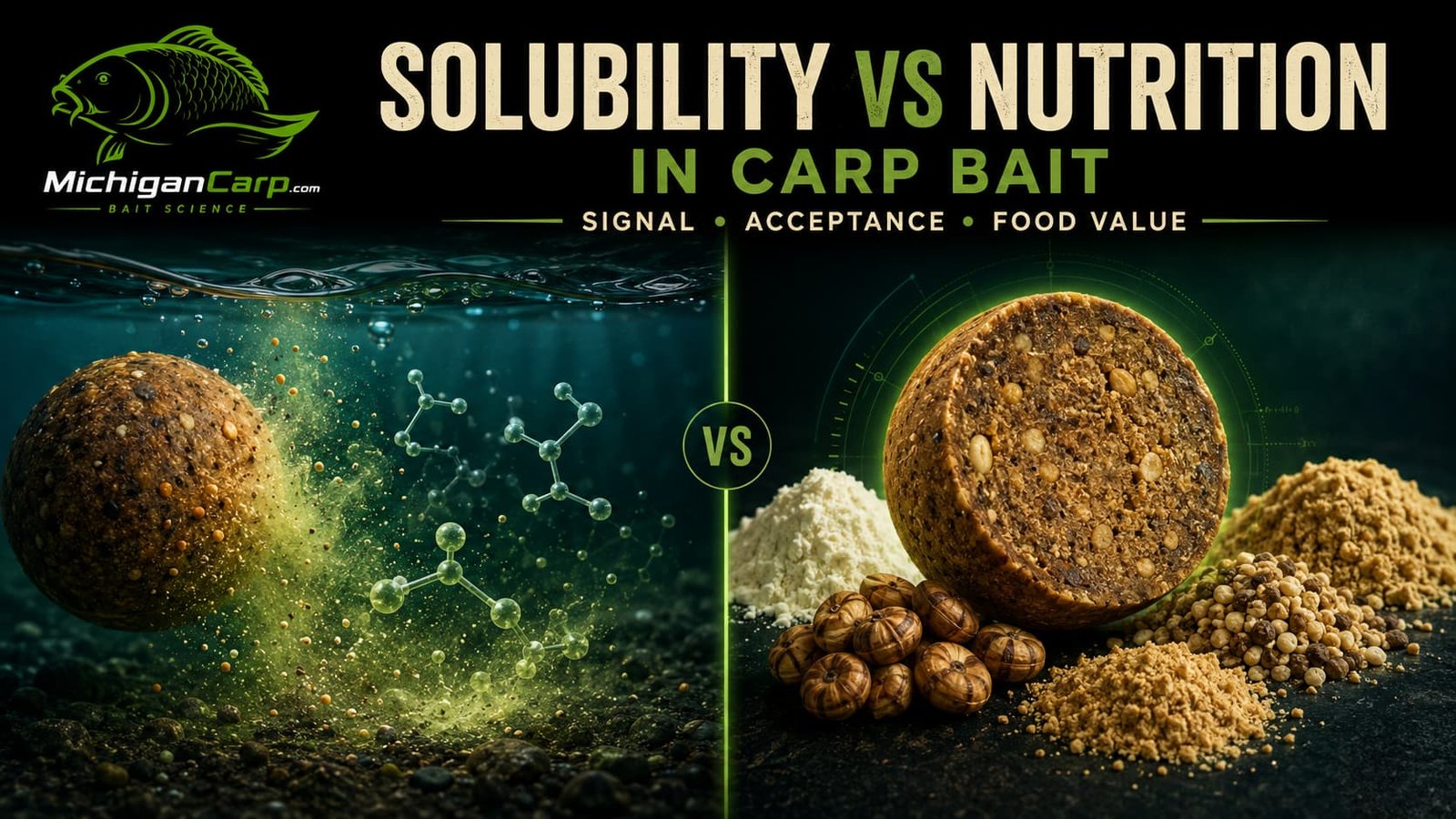
Solubility vs nutrition in carp bait is not a battle between two opposing bait theories.
A bait can be highly soluble and still offer very little food value. Another bait can be built from excellent food ingredients but communicate too slowly for the fishing situation. The strongest approach is usually not choosing one side. It is understanding what job the bait needs to do and where each quality belongs in the system.
For practical bait design, I separate the subject into three jobs:
| Job | Main question | Bait priority |
|---|---|---|
| Signal | What leaves the bait and enters the water? | Soluble compounds, food liquids, fine particles, hydrolysates, salts, acids and taste-related cues |
| Acceptance | Does the carp continue sampling and take the bait properly? | Palatability, texture, taste balance, mouthfeel and presentation |
| Food value | What does the bait provide once eaten? | Digestible protein, energy, useful nutrients, ingredient quality and sensible balance |
Those three jobs overlap, but they are not identical.
Solubility helps the bait communicate. Nutrition gives the bait substance once eaten. A good bait system uses the right balance for the water, season and session length.
This article is the strategy page. It connects fast signal, real food value, hookbait logic, free-bait logic and practical Michigan baiting systems.
For the release mechanism, read Carp Bait Solubility and Leakage. For why one bait leaks faster than another, read Why Some Carp Baits Leak Faster Than Others. For whole boilies, chops, crumb, dust and paste, read Why Surface Area Matters in Carp Bait.
This guide also connects with Carp Bait Digestibility, Proteins, Peptides and Hydrolysates in Carp Bait, How to Use Hydrolysates in Carp Bait, Carp Feeding Attractants Explained and the main Bait Science hub.
For external technical background, see OpenStax: The Dissolution Process, UF/IFAS: A Review of Feed Attractants as a Guide for Aquaculture Operations and National Academies: Nutrient Requirements of Fish and Shrimp.
Table of Contents
Quick Start: Solubility vs Nutrition in Carp Bait
Solubility and nutrition answer different questions.
Solubility is about what can leave the bait and enter the surrounding water. Nutrition is about what the bait contributes after a carp actually eats and processes it.
The goal is not maximum leakage or maximum protein. The goal is the right balance for the fishing job.
| Situation | Signal priority | Food-value priority | Practical bait logic |
|---|---|---|---|
| Few-hour session | High | Moderate | Small active trap, crumb, chops and a targeted hookbait |
| Day session | High | Moderate to high | Fast local signal with enough real food to hold interest |
| Overnight session | Medium to high | Medium to high | Early signal plus durable bait that remains useful |
| Three- to five-day session | Medium | High | Balanced feed bait, particles, boilies and active rig zones |
| Repeated prebaiting | Moderate | High | Digestible, economical and consistent food bait |
The simplest rule is:
Use soluble signal to start communication, but use real food value when you expect carp to keep eating, return to the area, or accept the bait repeatedly.
Signal, Acceptance and Food Value
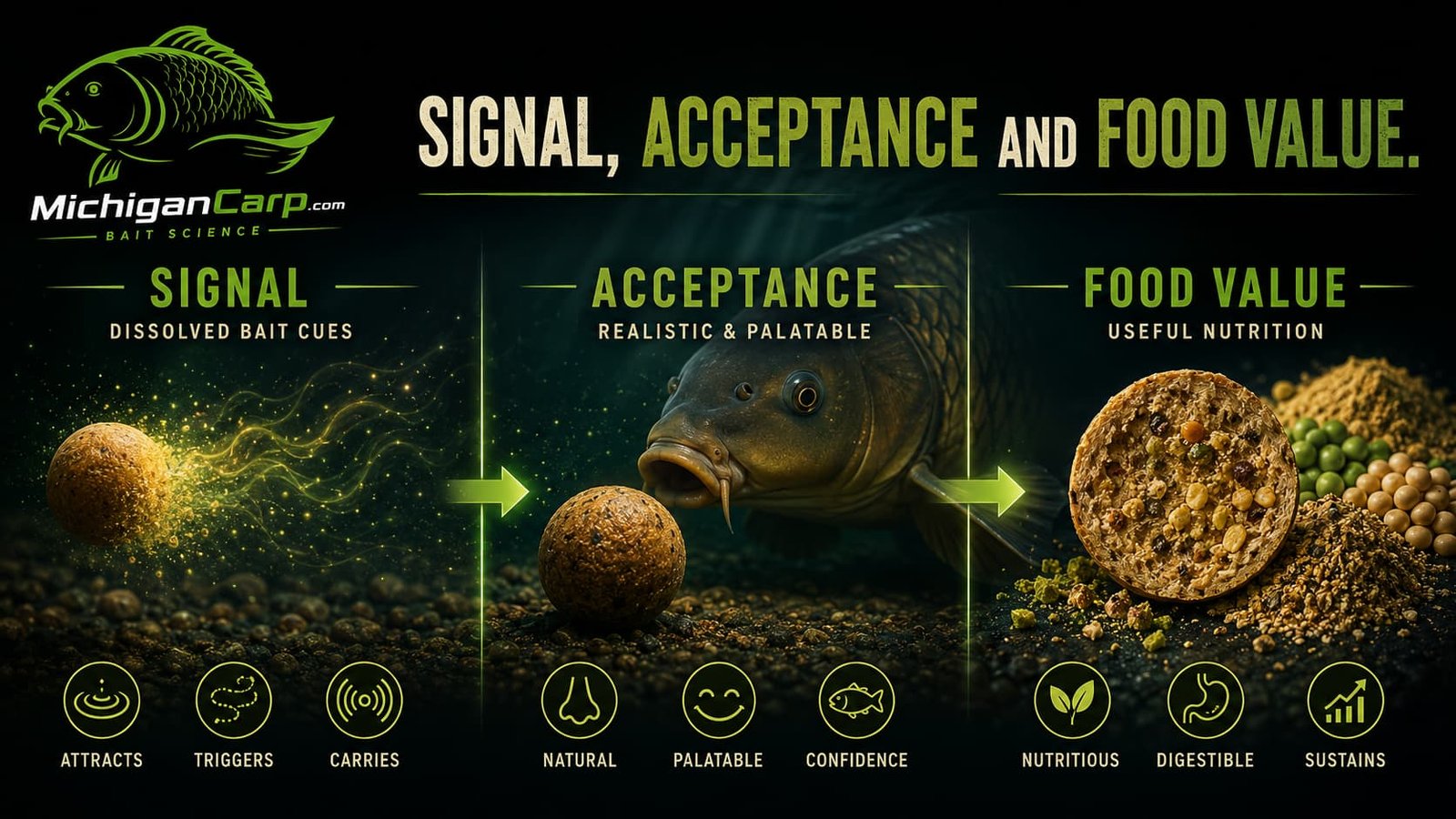
Many bait debates become confused because different stages of feeding are all described as attraction.
A carp first has to encounter information in the water. That is the signal stage. The bait then has to be acceptable when the fish investigates it. That is the acceptance stage. If the bait is eaten, the fish receives whatever usable food value the bait actually contains.
A specialist hookbait may put more emphasis on signal and acceptance than bulk nutrition. A long-term feed bait needs more digestibility, consistency and food value. A strong complete system may use both ideas in different places.
| Stage | Strong bait examples | Common mistake |
|---|---|---|
| Signal | Hydrolysates, yeast extracts, soluble liquids, acids, salts, crumb and chops | Assuming anything soluble is automatically attractive |
| Acceptance | Balanced taste, sensible flavour level, good texture and confident mouthfeel | Making the bait loud but unpleasant or mechanically poor |
| Food value | Digestible protein, usable energy, balanced fats, carbohydrates, minerals and sound ingredients | Chasing crude protein without considering digestibility or balance |
This is why a bait can be very active in water but weak as a food, or very nutritious on paper but too slow for a short fishing window.
What Solubility Really Contributes
Solubility helps determine which bait components can enter the surrounding water and become part of the local bait signal.
Useful water-active material can include free amino acids, small peptide fractions, organic acids, salts, sugars, soluble yeast material, fermentation-derived compounds and soluble fractions of hydrolysates.
But solubility alone does not prove attraction. A compound may dissolve without being a useful feeding cue. A bait may also release visible particles without releasing much meaningful dissolved food signal.
The important bait-design questions are:
| Question | Why it matters |
|---|---|
| What can enter the water? | Only available material can contribute to the surrounding signal. |
| Is it food-related? | Not every soluble material has the same meaning to carp. |
| Can water reach it? | A useful fraction buried in a dense bait may release slowly. |
| Is the dose sensible? | More signal is not automatically better signal. |
| Does it support acceptance? | Signal should lead to investigation and feeding, not rejection. |
This is why I treat soluble ingredients as part of a system rather than magic powders or magic liquids.
What Nutrition Means in a Carp Bait
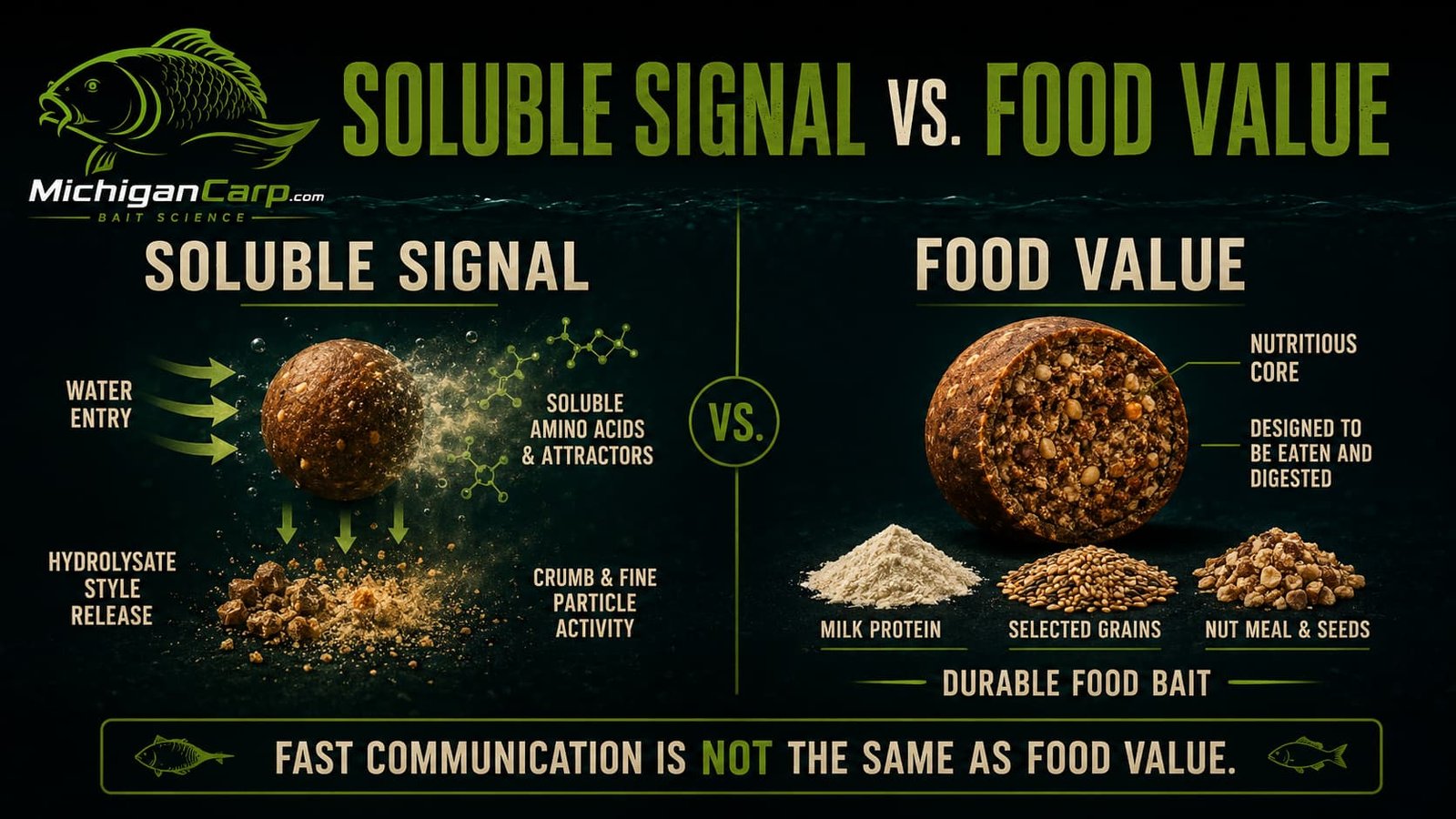
Nutrition in carp bait should mean more than a high crude-protein number.
A sensible food bait considers digestible protein, amino-acid contribution, usable energy, appropriate fat level, carbohydrate role, mineral background, ingredient digestibility, anti-nutritional factors and processing damage.
A bait is not nutritionally superior just because it contains the most expensive protein powder. It is also not automatically poor because it contains cereals, birdfoods, plant proteins, nut meals, seeds or carbohydrate ingredients.
The complete balance matters.
| Nutrition factor | Better question |
|---|---|
| Crude protein | Is the protein useful, digestible and balanced within the complete recipe? |
| Energy | Does the bait provide sensible energy without excessive fat or poor balance? |
| Carbohydrates | Are they providing structure, energy, texture and bait function? |
| Fats | Are total fats appropriate for season, digestibility and bait texture? |
| Processing | Has heat, drying or storage damaged the practical food value or release profile? |
| Cost | Can the bait be used in the quantity the water and session require? |
For the deeper food-value side, read Carp Bait Digestibility. For protein form, read Proteins, Peptides and Hydrolysates in Carp Bait.
Aquaculture Nutrition Helps, but It Is Not a Boilie Recipe
Fish nutrition research is useful because it helps explain protein quality, energy balance, digestibility, amino-acid requirements, lipid use, vitamins, minerals and ingredient limitations.
But an aquaculture production diet and an angling boilie do not have exactly the same job.
A production feed is designed to support growth and feed efficiency under controlled feeding. A carp-angling bait may also need to roll, boil, dry, cast, resist nuisance species, stay on a hair, leak fast enough for a short session, remain stable overnight, and work in small quantities.
| Production feed question | Angling bait question |
|---|---|
| Does it support growth efficiently? | Will carp find, sample and accept it in the fishing situation? |
| Can it be fed repeatedly under controlled conditions? | Will it work in a real lake, river, channel or dam pond? |
| Does it meet nutritional requirements? | Does it also cast, hold together, leak appropriately and fish correctly? |
| Is it efficient as a ration? | Is it practical as bait for the session length and quantity needed? |
Use fish nutrition science for principles. Do not simply copy a feed formula and assume it is automatically the best boilie.
Solubility and Nutrition Are Not Opposites
One weak bait-making habit is treating active bait and nutritional bait as if they are enemies.
A strong bait can use different ingredient fractions for different jobs.
| Ingredient role | Main job | Example use |
|---|---|---|
| Whole proteins | Nutritional backbone and structure | Milk proteins, egg proteins, plant proteins, fishmeal where used |
| Peptide-rich ingredients | Bridge between food value and availability | Protein hydrolysates, enzyme-treated materials, selected extracts |
| Hydrolysates | More soluble protein-derived signal | Glugs, crumb, hookbait coatings, sprays and liquid phase |
| Yeast and fermented liquids | Broad food-like soluble character | Free bait support, crumb treatment and liquid blends |
| Cereals and birdfoods | Structure, texture, energy and bait architecture | Base mix, rolling, open texture and feeding confidence |
| Oils and fats | Energy, mouthfeel and profile | Used carefully after counting built-in fat |
| Salts, acids and sugars | Taste and soluble support | Small functional inclusions, not the whole bait |
This layered view is more useful than trying to make one ingredient do everything.
A milk, nut and seed boilie can have a real food backbone while still using controlled soluble support. A particle bed can provide economical feed while a hookbait and local crumb carry a sharper signal. A PVA stick can create fast local communication while the hookbait remains durable.
Fast Signal Is Not the Same as Food Value
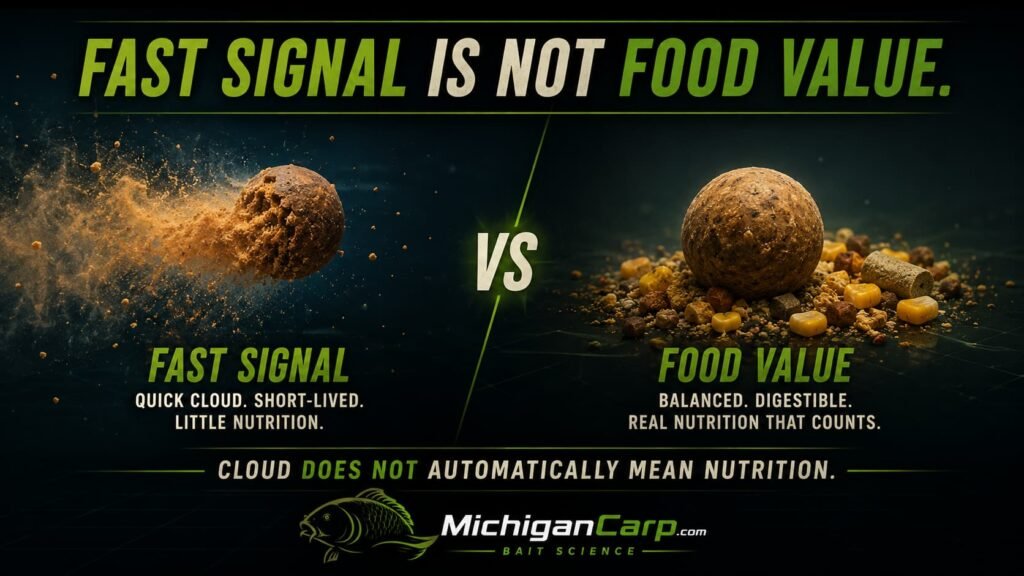
A bait that clouds, fizzes, breaks apart, smells strong or produces visible activity is not automatically a good food bait.
Those effects may be useful. They may help a short trap work quickly. They may create local attention around the rig. But they do not prove strong digestible nutrition.
Equally, a bait with good food ingredients can still be wrong for a short session if it is too dense, over-dried, heavily cooked, low in early soluble material, or used without crumb, chops or targeted treatment.
| Bait type | Strength | Risk |
|---|---|---|
| Very fast-release bait | Can create quick local signal | May lack food value or persistence |
| Very nutritional but closed bait | Can be strong once eaten | May communicate too slowly for short windows |
| Balanced food bait with active support | Combines signal and substance | Requires testing and sensible baiting |
| Sharper hookbait over sensible feed | Efficient use of concentrated ingredients | Must not become overflavoured or unnatural |
The best bait is not automatically the bait that leaks fastest. It is not automatically the bait with the highest protein number either.
The Two-Speed Bait System
One of the most useful practical solutions is a two-speed bait system.
The first speed is early local signal. This can come from crumb, chops, powder coatings, hydrolysates, yeast products, fermented liquids, small particles, PVA mixes, paste wraps or a conditioned hookbait.
The second speed is sustained food value. This comes from digestible boilies, balanced particles, whole food items and ingredients suitable for repeated feeding.
| Layer | Purpose | Typical components |
|---|---|---|
| Early signal layer | Get the rig area communicating quickly | Crumb, chops, hydrolysate, yeast liquid, soluble powder, paste, PVA stick |
| Acceptance layer | Keep fish sampling confidently | Balanced taste, sensible flavour, texture, small food pieces, matching hookbait |
| Food-value layer | Give the swim substance over time | Whole boilies, particles, digestible base bait, larger food items |
This lets the baited area work at more than one speed. It also avoids forcing the hookbait, freebies, particles, crumb and liquids to do the same job.
Hookbait Logic vs Free-Bait Logic
The hookbait and the free bait do not always need identical behaviour.
A hookbait can justify stronger outer treatment, more concentrated food signal, a specialized conditioner, extra hydrolysate, surface powder coating or carefully controlled flavour support. You are treating one bait or a small number of baits, so expensive ingredients can be used efficiently.
Free bait has a different job. It needs to be economical enough for the quantity required, digestible, consistent, seasonally appropriate and capable of sustaining feeding activity.
| Component | Best logic | Common mistake |
|---|---|---|
| Hookbait | Sharper, controlled, durable and positioned | Making it so strong that it becomes suspicious or mechanically poor |
| Loose boilies | Food value, consistency and session timing | Treating every freebie like a specialist hookbait |
| Crumb and chops | Early activity and exposed food material | Using so much that the swim becomes noisy but unfocused |
| Particles | Economical feeding and confidence | Ignoring safe preparation or relying on particles alone for every job |
| Liquids | Placement-specific support | Pouring expensive liquid over everything without a clear reason |
For many Michigan sessions, a sharper point bait over sensible feed is cleaner and more economical than overcomplicating every pound of bait.
Cold Water, Warm Water and Natural Food
Temperature and natural food change the balance.
In cold or cool water, I usually want less bait, better placement and more local communication from the bait I do use. That may mean crumb, chops, soluble liquids, digestible ingredients and carefully treated hookbaits. The answer is not to make the bait nutritionally poor. It is to avoid asking a small amount of hard, closed bait to do a job it is not suited to do.
In warm water or stronger feeding periods, food value can play a larger role because I may be feeding more bait, fishing longer sessions, holding fish on a feeding area and topping up according to activity.
Natural-food-rich waters add another layer. If a lake has snails, mussels, crayfish, insect larvae, weedbed organisms and other natural food, I would not try to beat the lake simply by making the bait louder. I want believable food logic: digestibility, appropriate protein, coherent food signal, controlled soluble material and sensible texture.
| Condition | Signal emphasis | Food-value emphasis |
|---|---|---|
| Cold short session | High but localized | Moderate and digestible |
| Warm feeding period | Moderate to high | High |
| Natural-food-rich lake | Coherent and food-related | High enough to be believable |
| Big water exploration | Targeted around rigs | Economical and practical |
| Repeated prebaiting | Moderate | High, consistent and digestible |
Cost Efficiency Matters on Big Waters
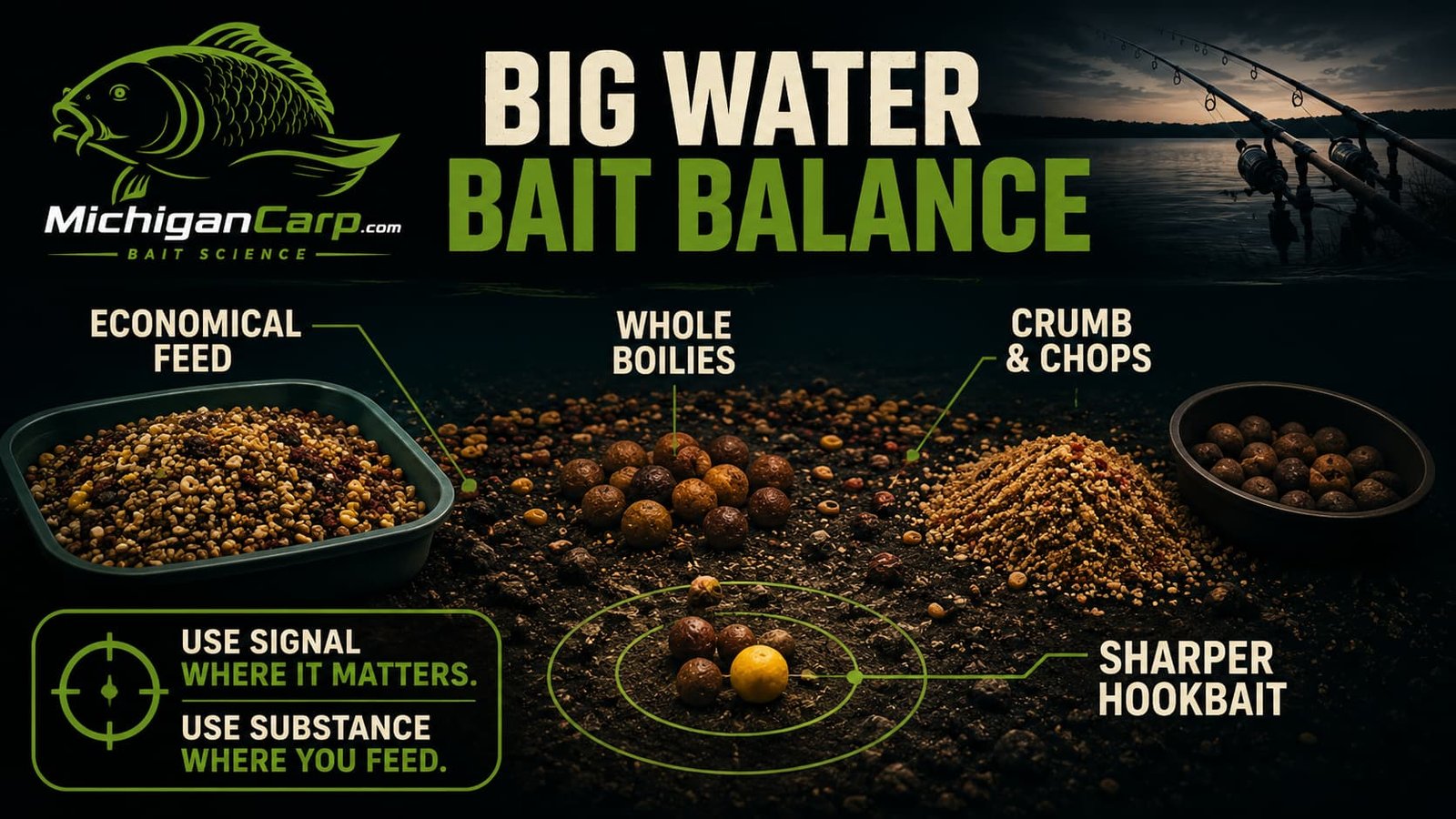
On large Michigan waters, bait strategy has to be practical.
If a session requires a significant amount of feed, it usually makes little sense to treat every pound of bait like a specialist hookbait.
A more efficient structure is often:
| Bait layer | Role |
|---|---|
| Economical prepared particles or feed bait | Create affordable feeding activity and food presence |
| Quality boilies | Add digestible food value and recognizable bait identity |
| Crumb and chops | Increase early local activity around selected rods |
| Targeted hookbait treatment | Sharpen the actual rig zone |
| Controlled top-ups | Respond to fish activity instead of feeding blindly |
This allows expensive ingredients to work where they have the most value.
Four Practical Michigan Bait Systems
| System | Best use | Balance |
|---|---|---|
| Spring day-session trap | Short sessions, cool water, mobile fish | Small amount of digestible free bait, active crumb, chops, light liquid support and a conditioned hookbait |
| Three-day big-lake system | Longer sessions where fish may return repeatedly | Prepared particles, balanced boilies, crumb and chops around selected rods, controlled top-ups |
| Particle feed with point bait | Big water or economical feeding | Particle bed, small boilie crumb, durable hookbait and targeted food-signal treatment near the rig |
| Fall food-bait approach | Feeding periods where carp may respond to substance | Digestible boilie, good protein-energy balance, moderate treatment and consistent feeding |
All four systems use both signal and food value, but they put the emphasis in different places.
A Simple Decision Framework
Before changing a recipe, ask five questions.
| Question | What it tells you |
|---|---|
| How long is the session? | Short sessions need more immediate local activity. |
| How much bait will I use? | Large amounts need to be economical and nutritionally sensible. |
| Are the fish moving or settled? | Moving carp and short windows often need sharper rig-zone signal. |
| Is natural food abundant? | Food-rich waters reward coherent food logic, not random additive overload. |
| What is the hookbait doing differently? | The point bait can be sharper than the bulk feed when useful. |
If the answer to every question is “add more liquid,” the system is probably not being thought through clearly enough.
Common Mistakes
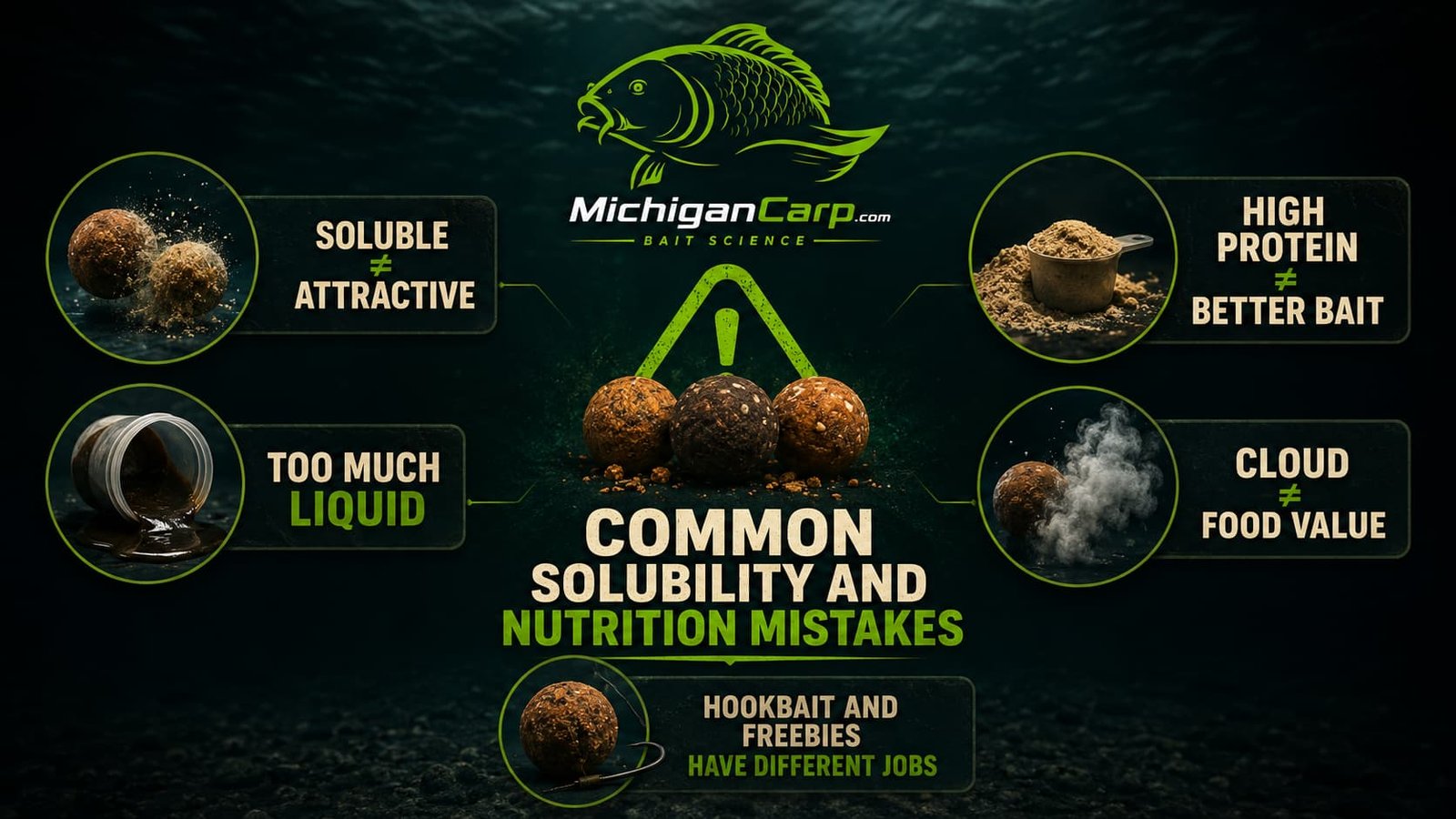
| Mistake | Why it causes problems | Better practice |
|---|---|---|
| Assuming soluble means attractive | Solubility only says material can enter water | Judge the compound and complete bait context |
| Assuming nutritious means effective in every session | A good food bait can be too slow for a short window | Use format, crumb, chops or treatment to adjust timing |
| Chasing crude protein percentage | Protein number alone does not measure quality or digestibility | Balance protein, energy, digestibility and bait function |
| Using specialist liquids across all free bait | Expensive and often unnecessary | Use concentrated ingredients where placement matters |
| Making hookbait and freebies identical | The point bait may need a different job | Use sharper hookbait logic over sensible feed |
| Confusing cloud with food value | Visible activity does not prove nutrition | Separate particle cloud, dissolved signal and food substance |
| Overcomplicating a good formula | Too many additives can muddy the signal | Use fewer ingredients with clearer roles |
Simple Rules for Balancing Signal and Food Value
Separate signal, acceptance and food value. Use fast soluble signal when fishing time is limited, but use digestible food value when feeding is repeated. Let the hookbait be sharper than the bulk feed when useful.
Use hydrolysates and concentrated liquids selectively. Judge protein by quality and digestibility, not percentage alone. Use processing, crumb, chops and bait form to adjust behaviour before rebuilding a successful recipe.
Most importantly, match the bait system to the water, season, session length and fish behaviour.
My Practical View
Solubility and nutrition are not competing bait religions. They are different parts of a complete bait system.
Soluble material helps bait communicate with the surrounding water. Palatability and texture affect what happens when carp investigate and sample the bait. Nutrition and digestibility determine the broader value of what the fish actually consumes.
For much of my Michigan fishing, I prefer a layered approach: sound, economical free bait; some crumb and chops for earlier activity; a properly designed boilie or particle feed component; and a more concentrated signal close to the hookbait.
The best bait is not always the bait that leaks fastest. It is not always the bait with the highest protein number either.
The best bait is the one that balances signal and food value for the water, season, session length and feeding situation in front of you.
FAQ
What is the difference between solubility and nutrition in carp bait?
Solubility concerns the material that can enter or disperse into the surrounding water. Nutrition concerns the food value and digestibility of the bait once eaten.
Can a carp bait be both soluble and nutritious?
Yes. Many strong bait systems combine nutritional whole ingredients with more soluble protein fractions, food liquids, yeast products, crumb, chops or targeted hookbait treatments.
Is a highly soluble bait best for short sessions?
Fast local signal can be useful when fishing time is limited, but the complete bait still needs to be palatable, correctly placed and appropriate for the situation.
Is nutritional bait more important for long sessions?
As session length and repeated feeding increase, digestibility, ingredient quality, consistency and food value usually become more important.
Should hookbaits be more soluble than freebies?
They can be. A targeted hookbait treatment over sensible free bait is often an efficient way to combine sharper local signal with broader feeding value.
Does high protein mean a bait is nutritional?
Not by itself. Protein quality, digestibility, amino-acid contribution, energy balance, processing and the rest of the formula all matter.
Are hydrolysates nutritional or attractive?
They can contribute to both areas depending on the product, but their main practical value in many angling systems is as a more soluble protein-derived food signal used selectively.
Can particles provide nutrition as well as attraction?
Yes, depending on the particle, preparation, quantity and wider baiting system. Particles can form an economical feeding base while boilies and targeted hookbait treatments provide other functions.
Should I make cold-water bait more soluble?
In many short cool-water situations, it makes sense to use bait forms and treatments that communicate effectively in small quantities. That does not require making the base bait nutritionally poor.
What is the best overall approach?
Use a balanced feed bait for substance, faster-release material for early local signal, and more concentrated attraction where it has the most value, usually near the rig or hookbait.
Next Steps
- Carp Bait Digestibility — understand usable food value after bait is eaten.
- Proteins, Peptides and Hydrolysates in Carp Bait — understand protein form, peptides and soluble fractions.
- Carp Bait Solubility and Leakage — understand how food signal leaves bait.
- Why Some Carp Baits Leak Faster Than Others — understand release-rate controls.
- Why Surface Area Matters in Carp Bait — use whole bait, chops, crumb, dust and paste deliberately.
- How to Use Hydrolysates in Carp Bait — use hydrolysates in glugs, hookbaits, crumb and coatings.
- Carp Feeding Attractants Explained — understand attractants without overstating single compounds.
- Do Carp Detect Free Amino Acids the Way Anglers Think? — understand amino-acid signal carefully.
- How to Balance Fat in Boilies — avoid oil and energy-balance mistakes.
- Anti-Nutritional Factors in Carp Bait Ingredients — understand plant-heavy mix limitations.
- What Boiling Does to Carp Bait — understand heat, structure and release.
- Raw vs Processed Ingredients in Carp Bait — understand ingredient form and bait function.
- Bait Science — browse the technical bait library.