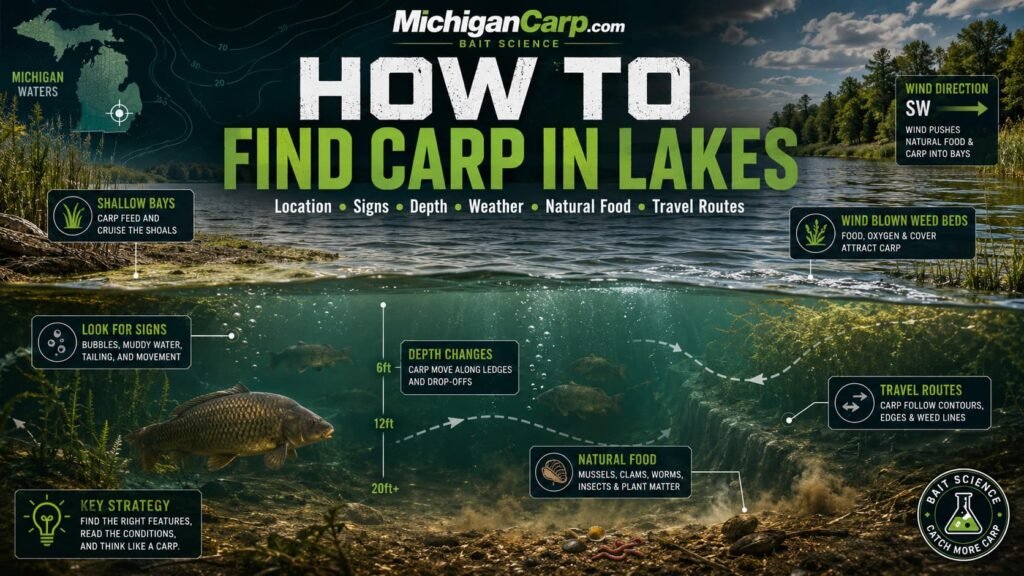
Learning how to find carp in lakes is more important than any bait, rig or flavor.
You can have the best boilie in the world.
You can have perfect particles.
You can have sharp hooks, good alarms, strong line and a neat baiting plan.
But if the carp are not using the water in front of you, the session becomes guesswork.
Carp are not spread evenly around a lake.
They move between food, safety, comfort and travel routes.
They feed on weed edges, mussel beds, snail areas, soft silt, insect-rich bottom, gravel transitions, reed margins, inflows, outflows, shallow warming bays and wind-affected banks.
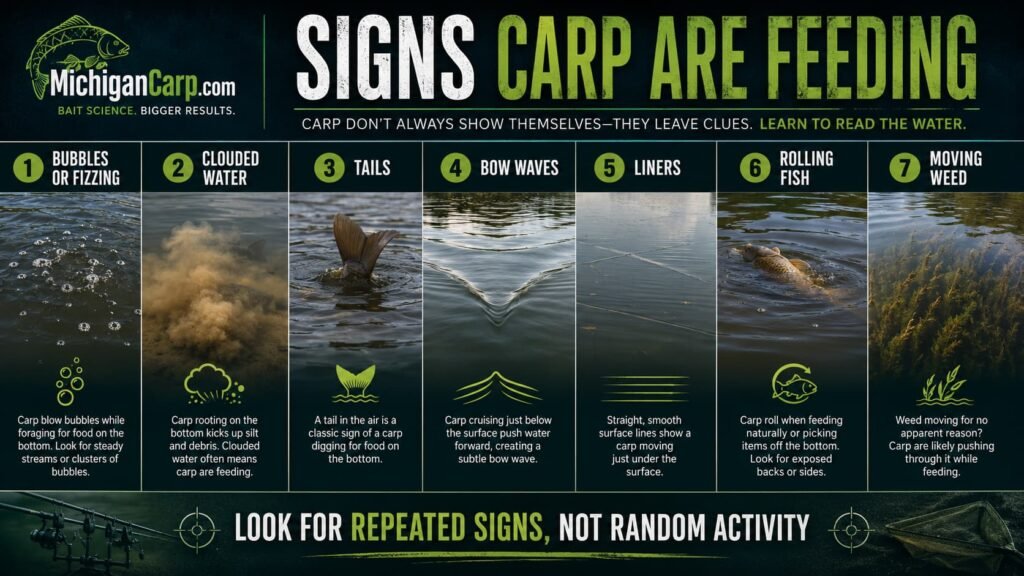
They may show themselves with bubbles, fizzing, tails, clouded water, bow waves, liners, rolling fish or moving weed.
They may also show nothing at all until dawn, dusk or after boat traffic dies down.
The key is learning how to read the lake before you choose the swim.
This guide explains how to find carp in lakes by reading location, signs, depth, weather, wind, natural food, weed beds, silt, gravel, travel routes, seasonal movement, lake maps, bank scouting, boat scouting and bait placement.
For a deeper look at food-rich habitat, read How to Find Natural Carp Feeding Areas in Michigan Lakes.
For large-water strategy, read Finding Carp in Big Michigan Lakes.
For bait choice after you find the fish, read Best Carp Bait for Michigan Lakes.
For the full beginner route, start with Start Here: Carp Fishing in Michigan.
The simple rule is:
LOCATION FIRST.
BAIT SECOND.
CONFIDENCE AFTER THE LAKE GIVES YOU A REASON.
[INSERT THE ACTUAL RANK MATH TABLE OF CONTENTS BLOCK HERE]
Table of Contents
Quick Start: Where to Find Carp in Lakes
Use this table first.
| Lake Feature | Why Carp Use It | What to Look For | Best First Move |
|---|---|---|---|
| Weed beds | Snails, insects, cover, oxygen and patrol edges | Cabbage weed, holes, lanes, outside edges | Fish clean spots and edges |
| Soft silt | Bloodworm, larvae, detritus and natural food | Bubbles, clouded water, soft lead feel | Use balanced hookbaits and light bait |
| Mussel beds | Hard food and clean bottom | Shell fragments, crunchy bottom, clear patches | Use boilies, tiger nuts or wafters |
| Gravel / clay | Clean feeding surface and transition lines | Firm lead drop, color changes, hard/soft edges | Fish the transition, not random open bottom |
| Reed edges | Cover, insects, snails and margin patrol routes | Reed gaps, points, inside corners | Fish quietly with strong tackle |
| Shallow bays | Warmth, food and low-light feeding | Dark bottom, weed, bubbles, birds, sun exposure | Start light and observe |
| Points | Travel markers and wind/depth edges | Point leading to bay, flat or deep water | Spread rods across route and edge |
| Inflows | Oxygen, food and temperature change | Creeks, drains, culverts, moving water | Fish carefully and check access |
| Outflows | Movement, current and funnel points | Channels, dam areas, lake exits | Use strong gear and accurate bait |
| Windward banks | Food, color, oxygen and warmth can move with wind | Steady warm wind hitting habitat | Watch before heavy baiting |
| Drop-offs | Connect shallow food to deeper safety water | Shelves, basin edges, old channels | Fish top, edge and route |
| Quiet pressure zones | Carp avoid disturbance | No-wake areas, low-traffic banks, night routes | Fish dawn, dusk or night |
The best carp locations usually combine several of these features.
A weed edge is better if it has clean holes and deeper water nearby.
A shallow bay is better if it warms quickly and has a route out.
A point is better if it connects food, wind and depth.
A comfortable bank with no features is usually not enough.
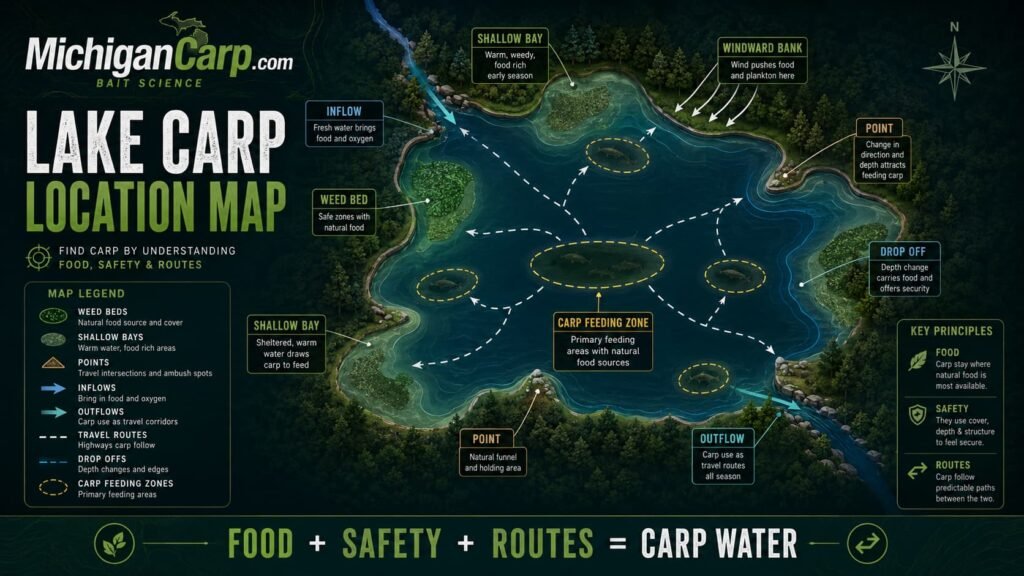
Think Like a Carp Before You Think Like an Angler
Many anglers choose a swim because it is comfortable.
Carp choose areas because they provide food, safety, comfort or movement.
Those are not always the same place.
A good carp location usually answers at least one of these questions:
Where can carp feed?
Where can carp feel safe?
Where can carp travel easily?
Where can carp adjust to temperature, light, wind and pressure?
The more questions a spot answers, the better it becomes.
Food
Carp need food-rich areas.
That may mean:
- weed;
- snails;
- mussels;
- insect larvae;
- bloodworm;
- soft silt;
- detritus;
- seeds;
- crayfish;
- algae;
- plant material;
- human food input around public areas.
Safety
Carp also need safety.
Safety can come from:
- depth;
- weed;
- snags;
- low light;
- distance from pressure;
- boat-free zones;
- reed cover;
- night movement;
- quiet banks.
Comfort
Comfort changes with:
- water temperature;
- oxygen;
- sunlight;
- wind;
- depth;
- season;
- boat traffic;
- weather changes.
Travel Routes
Carp move along routes.
Routes can include:
- weed edges;
- points;
- drop-offs;
- old channels;
- bay mouths;
- reed lines;
- narrows;
- bridge gaps;
- basin edges.
A bait placed on a travel route can catch fish even when they are not feeding heavily.
A bait placed on a natural feeding area can catch fish when they settle and root.
Knowing the difference matters.
Start With Observation
Before casting, watch the water.
This is especially important on a new lake.
Spend time looking for:
- rolling fish;
- bubbling;
- fizzing;
- tails;
- bow waves;
- clouded water;
- moving weed;
- reed movement;
- birds feeding;
- baitfish activity;
- boat pressure;
- wind lines;
- floating debris;
- color changes.
A carp showing once may not mean much.
Carp showing repeatedly in the same zone means more.
Bubbles appearing in one spot every morning means more.
A bay that clouds up at dusk means more.
Repeated signs are better than random signs.
Best Times to Watch
Watch at:
- dawn;
- dusk;
- after dark if legal and safe;
- before boat traffic starts;
- after boat traffic fades;
- after a warm wind;
- before storms;
- during quiet weather windows.
Do not judge a lake only at midday.
Many carp waters look dead at noon and come alive at first light or after sunset.
Signs Carp Are Feeding
Carp feeding signs can be subtle.
You need to separate real signs from random lake activity.
Bubbles and Fizzing
Bubbles can be one of the strongest feeding clues.
Look for bubbles that are:
- repeated;
- clustered;
- moving slowly;
- connected to clouded water;
- appearing over silt, weed edges or shallow flats;
- appearing at the same time on multiple days.
Random gas bubbles can rise from the bottom without carp.
Feeding bubbles often move.
Clouded Water
Clouded water can show carp disturbing silt, clay, marl or soft bottom.
This is especially useful in shallow bays and margins.
Clouding near weed or reeds can be a strong sign.
Tails and Shallow Feeding
Tails, backs and bow waves often show shallow carp.
Do not rush in with heavy bait.
Watch first.
Carp in shallow water can be easy to spook.
Rolling Fish
Rolling carp can show presence.
But rolling does not always mean feeding.
Ask whether the fish are:
- staying in the area;
- moving through;
- rolling over depth change;
- rolling at dawn or dusk;
- showing near food.
Liners
Line bites or liners can tell you carp are moving through the swim.
Repeated liners at similar times may reveal a route.
If you get liners but no bites, the carp may be traveling past your bait rather than stopping to feed.
A future dedicated Signs Carp Are Feeding article should go deeper into this subject.
Find Natural Food Areas
Carp are easier to find when you understand what they are eating.
Natural food zones are the foundation of lake carp fishing.
Common carp feed on a wide range of natural foods, including aquatic insects, larvae, snails, small crustaceans, plant material, detritus and other bottom food. That broad feeding style is why carp use so many different lake features.
Weed Beds
Weed beds can hold:
- snails;
- insects;
- larvae;
- shrimp-like invertebrates;
- oxygen;
- cover;
- shade;
- patrol routes.
The best weed fishing is often on:
- outside edges;
- clear holes;
- inside turns;
- weed points;
- lanes between weed and deeper water.
Do not automatically fish the thickest weed.
Fish the usable edges.
Mussels and Shells
Mussel beds, shell areas and hard bottom can be excellent.
Look for:
- shell fragments;
- crunchy lead feel;
- clear patches;
- gravel;
- riprap;
- hard bottom beside weed or silt.
Use abrasion-resistant tackle around sharp shells.
Soft Silt
Soft silt can hold bloodworm, larvae and natural food.
Good silt often shows:
- bubbles;
- light clouding;
- earthy smell;
- carp activity.
Bad silt may smell foul and bury bait too deeply.
Use balanced hookbaits or wafters when presentation is uncertain.
Gravel, Clay and Transitions
Carp often use hard/soft transitions.
Look for:
- gravel beside silt;
- clay shelves;
- sand-to-silt changes;
- shell-to-silt edges;
- weed beside hard bottom.
Edges are often better than featureless bottom.
For the full natural-food guide, read How to Find Natural Carp Feeding Areas in Michigan Lakes.
Read Depth and Bottom Type
Depth matters because carp use different depths for feeding, travel and safety.
The deepest water is not automatically best.
The shallowest water is not automatically best.
The important thing is how depths connect.
Shallow Water
Shallow water can be excellent when it has:
- warmth;
- food;
- weed;
- silt;
- reeds;
- wind;
- low pressure;
- deeper water nearby.
It is often best early, late, at night or during spring warming periods.
Medium Depth
Medium depth is often overlooked.
It can be a travel zone between shallow food and deep safety water.
On many lakes, medium-depth shelves are more consistent than extreme shallows or deep basins.
Deep Water
Deep water can provide:
- safety;
- temperature stability;
- low-light staging;
- daytime holding areas;
- winter or cold-water comfort.
But deep water needs a reason.
A deep basin with no route, no food and no signs is still poor water.
Bottom Type
Learn the bottom with:
- a lead;
- marker float;
- sonar;
- underwater camera;
- pole;
- visual observation.
You are trying to identify:
- weed;
- clean gravel;
- clay;
- sand;
- soft silt;
- hard silt;
- mussels;
- snags;
- leaves;
- depth changes.
A good carp angler does not just cast.
He learns what the bait lands on.
Use Wind Without Blindly Following It
Wind can help you find carp, but only when it improves the area.
A steady wind can push:
- warm surface water;
- oxygenated water;
- floating food;
- plankton;
- insects;
- debris;
- colored water.
That can make a bank, bay or point more attractive.
Good Wind
Good wind is usually:
- steady;
- not dangerous;
- warmer rather than colder;
- pushing into food-rich habitat;
- creating light color;
- hitting a bay, weed edge, point or reed line.
Bad Wind
Wind can hurt when it is:
- cold;
- too strong;
- making presentation impossible;
- pushing floating weed into the swim;
- hitting featureless sand;
- creating unsafe conditions.
Wind Rule
Do not fish wind by itself.
Fish wind plus food.
A windward bank with weed, silt, mussels, reeds or a bay is interesting.
A windward bank with nothing is still nothing.
For big-water wind strategy, read Finding Carp in Big Michigan Lakes.
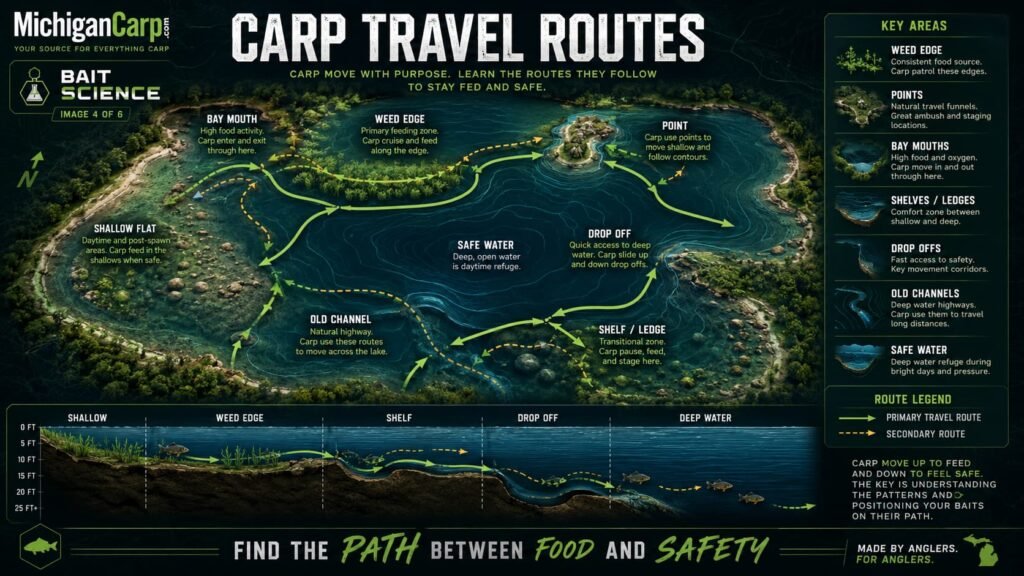
Look for Travel Routes
Carp often move along predictable routes.
These routes connect feeding areas, safety water and comfortable holding areas.
Common Carp Routes
Look for:
- weed edges;
- reed lines;
- points;
- bay mouths;
- shelves;
- drop-offs;
- old riverbeds;
- narrows;
- bridge gaps;
- island edges;
- marina entrances;
- campground shorelines;
- causeways;
- channels.
How to Fish a Route
A travel route may not need heavy bait.
Use:
- accurate single hookbaits;
- small boilie traps;
- light particles;
- small PVA sticks;
- repeatable baiting;
- one rod on the route and one rod on nearby food.
If you get liners but no bites, move one bait slightly off the route toward the likely feeding edge.
Route Rule
A route is a hallway.
A feeding area is a dining room.
Sometimes you fish the hallway.
Sometimes you fish the dining room.
The best swims often give access to both.
Match Season to Location
Carp location changes through the year.
A good spring spot can be poor in midsummer.
A summer night route can be quiet in cold water.
A fall feeding zone may become very specific.
Spring
In spring, look for:
- shallow warming bays;
- dark bottom;
- reed edges;
- early weed;
- soft silt;
- inflows if warmer;
- sun-facing banks;
- shallow flats near deeper water.
Use light baiting.
Spring carp may be present before they are ready for heavy feed.
Summer
In summer, look for:
- weed edges;
- oxygenated areas;
- windward banks;
- night routes;
- deeper water near food;
- shade;
- low-pressure zones;
- no-wake areas;
- quiet dawn and dusk windows.
Boat traffic can change everything.
Fall
In fall, look for:
- mussel beds;
- weed dieback edges;
- remaining green weed;
- gravel/silt transitions;
- deeper bay mouths;
- points near deeper water;
- windward banks.
Carp can feed hard in fall, but the right zone matters.
Cold Water
In cold water, look for:
- deeper stable water;
- soft silt pockets;
- sunny shallow windows;
- quiet routes;
- warm inflows if present;
- areas with low disturbance.
Use small, precise baiting.
For seasonal detail, use Michigan Carp Fishing Seasons.
Bank Scouting System
Bank anglers can find carp effectively if they stop setting up too quickly.
Step 1: Walk Before Fishing
Look for:
- weed;
- reeds;
- bubbles;
- clouded water;
- shell fragments;
- fish movement;
- bird activity;
- wind direction;
- bottom color changes;
- safe landing areas.
Step 2: Watch the Margins
Margins often reveal more than open water.
Look for:
- stirred silt;
- tails;
- bow waves;
- moving reeds;
- feeding bubbles;
- carp cruising under the bank.
Step 3: Use a Lead
A lead can tell you:
- depth;
- weed;
- silt;
- gravel;
- clay;
- mussels;
- clean spots;
- drop-offs.
Step 4: Choose the Zone
Do not choose the easiest peg.
Choose the water that gives carp a reason.
Step 5: Fish Three Questions
With three rods, test:
Rod 1:
natural feeding area

Rod 2:
travel route

Rod 3:
depth or safety edge
Do not cast all three rods into the same guess.
Boat or Kayak Scouting System
A boat or kayak can help you understand a lake faster.
Use it carefully and legally.
What to Scout
Look for:
- weed edges;
- clean holes;
- hard spots;
- mussel beds;
- depth changes;
- silt pockets;
- bay mouths;
- points;
- snag lines;
- boat traffic patterns;
- safe landing areas.
Useful Tools
Use:
- lake maps;
- sonar;
- polarized glasses;
- marker pole;
- lead line;
- underwater camera;
- GPS waypoints.
Do Not Over-Scout the Swim
Do not keep driving over the fish.
Scout quietly.
Mark the spot.
Back off.
Clean, Drain and Dry
When moving between waters, clean boating and gear hygiene matter. Michigan’s invasive species guidance tells boaters and anglers to remove aquatic plants and debris, drain water and clean gear before moving between waters. Use Michigan Invasive Species Prevention: Boaters and Anglers as the official reference.
Use Maps Before You Go
Maps help you shorten the search.
They do not replace scouting, but they help you avoid wasting time.
What to Look For on Maps
Look for:
- shallow bays;
- points;
- narrows;
- drop-offs;
- shelves;
- deep basins;
- inflows;
- outflows;
- creek channels;
- flats;
- public access;
- campgrounds;
- boat launches.
Michigan DNR provides inland lake maps for many Michigan waters through Michigan DNR Inland Lake Maps. Use those maps as a starting point, then confirm the real water when you arrive.
Map Rule
Maps show structure.
They do not show today’s carp.
Use maps to build a plan.
Use observation to choose the swim.
Where to Put Three Rods
Three rods should help you learn the lake.
They should not all be used to repeat one idea.
Basic Three-Rod Layout
Use:
Rod 1:
feeding area

Rod 2:
travel route

Rod 3:
deeper safety edge or backup feature
Example: Shallow Bay
Rod 1:
inside weed edge

Rod 2:
bay mouth

Rod 3:
drop-off outside the bay
Example: Point
Rod 1:
windward side

Rod 2:
tip or shelf edge

Rod 3:
deeper route behind the point
Example: Silt and Gravel
Rod 1:
soft silt feeding area

Rod 2:
hard/soft transition

Rod 3:
clean gravel patch
Example: Reed Edge
Rod 1:
reed gap

Rod 2:
outside reed line

Rod 3:
deeper margin route
If one rod gets liners, one gets bites and one does nothing, the lake is teaching you.
Move intelligently.
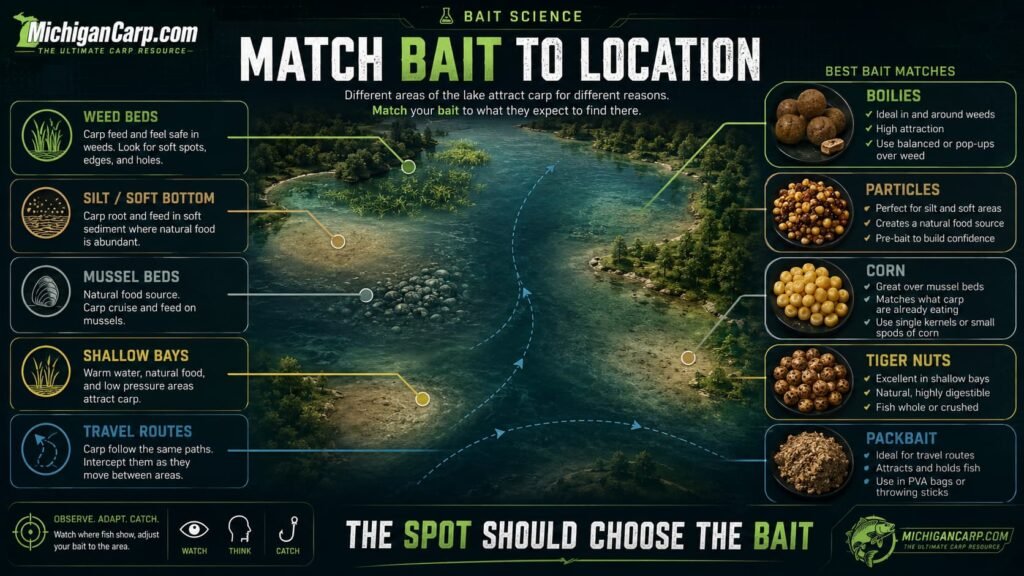
Match Bait to Location
Bait should follow location.
Do not choose bait first and then force it into the wrong bottom type.
Weed Beds
Use:
- tiger nuts;
- maize;
- nut boilies;
- balanced hookbaits;
- PVA sticks;
- small particles.
Mussels and Hard Bottom
Use:
- boilies;
- tiger nuts;
- maize;
- wafters;
- hard hookbaits;
- small crumb.
Soft Silt
Use:
- wafters;
- balanced baits;
- light boilies;
- small PVA bags;
- soluble powders;
- cautious baiting.
Shallow Bays
Use:
- corn;
- maize;
- tiger nuts;
- small boilies;
- light packbait;
- small baiting.
Windward Banks
Use:
- particles;
- packbait;
- boilies;
- crumb;
- accurate but slightly wider baiting.
Travel Routes
Use:
- boilies;
- tiger nuts;
- maize;
- PVA sticks;
- small traps;
- repeatable accuracy.
For bait decisions, read Boilies vs Corn vs Particles for Carp, Particles for Carp Fishing and Packbait for Carp Fishing.
Start With Light Baiting
When finding carp, do not feed heavily too soon.
Heavy baiting makes sense only after you know carp use the area.
Start Light When
Start light when:
- you are new to the lake;
- water is cold;
- carp are showing but not feeding hard;
- the bottom is soft;
- nuisance fish are active;
- birds may clear bait;
- the swim is small;
- you are testing a travel route.
Increase Bait When
Increase bait when:
- carp are feeding repeatedly;
- you are getting liners or bites;
- bait is being eaten;
- the area is large;
- water is warm;
- you are staying multiple days;
- nuisance fish are manageable.
Simple Starting Approach
For a new lake zone:
First few hours:
single hookbaits or very light bait

After signs:
small accurate baiting

After confirmation:
build feed only where carp are using the spot
You are not trying to feed the lake.
You are trying to find the carp.
Common Mistakes When Finding Carp
Mistake 1: Fishing Comfortable Water
Comfortable banks are not always carp banks.
Mistake 2: Ignoring Wind
Wind can quickly narrow a lake, but only when it pushes into habitat.
Mistake 3: Avoiding All Silt
Productive silt can be full of natural food.
Mistake 4: Fishing Thick Weed Instead of Edges
Edges, holes and lanes are usually better than solid weed.
Mistake 5: Choosing Bait Before Location
Bait should fit the spot.
Mistake 6: Overbaiting Too Early
Heavy baiting before confirmation wastes bait and can kill a swim.
Mistake 7: Ignoring Boat Pressure
Boat traffic can shift carp timing and routes.
Mistake 8: Not Using Low-Light Windows
Dawn, dusk and night often reveal the real lake.
Mistake 9: Not Checking the Bottom
You need to know what your bait lands on.
Mistake 10: Not Keeping Notes
Patterns repeat only if you record them.
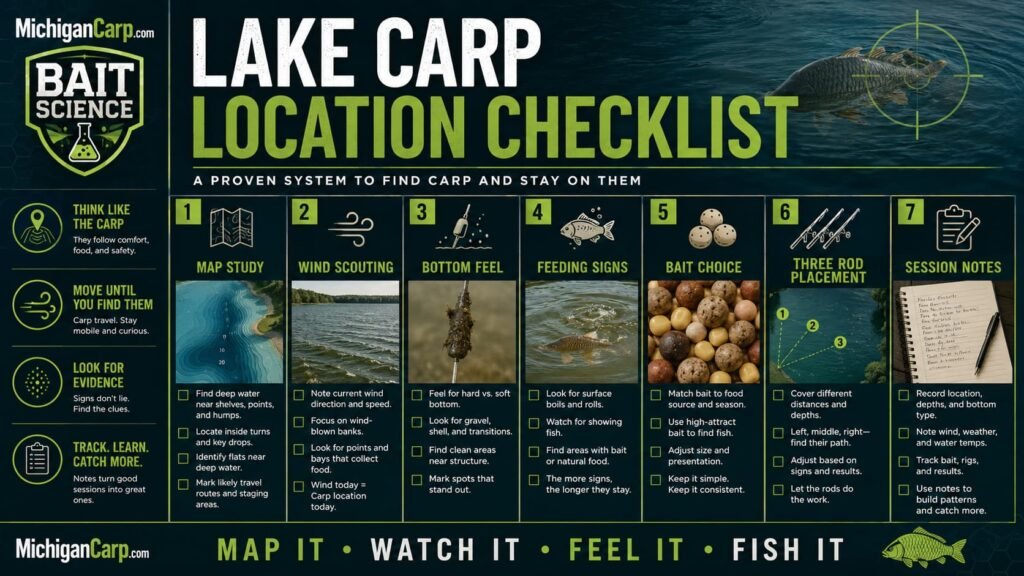
Simple Lake Carp Location Plan
Use this process on any lake.
Step 1: Study the Map
Find:
- bays;
- points;
- narrows;
- shelves;
- inflows;
- outflows;
- public access;
- deep water near shallow flats.
Step 2: Check Wind and Weather
Ask:
Where is the wind improving habitat?
Step 3: Walk or Scout
Look for:
- bubbles;
- weed;
- shells;
- silt;
- reeds;
- clouded water;
- rolling fish;
- safe access.
Step 4: Check the Bottom
Use a lead, sonar, camera or pole.
Know what you are fishing over.
Step 5: Choose a Zone
Choose the area with the best combination of:
food + safety + route + access
Step 6: Fish Three Questions
Use rods to test:
feeding area
travel route
safety edge
Step 7: Bait Lightly First
Increase only after signs.
Step 8: Record Everything
Write down:
- date;
- wind;
- water temperature if known;
- location;
- depth;
- bottom type;
- signs;
- bait;
- rod position;
- bite time;
- boat pressure;
- result.
This is how you build your own carp map.
My Practical View
When I am trying to find carp in a lake, I do not start by thinking about bait.
I start by looking for reasons.
Why would carp be here?
What food is present?
Where is the nearest safety water?
How does the wind affect this bank?
Can carp travel through here naturally?
Is there weed, silt, mussel, gravel, reed or depth change?
Is this a feeding area, a travel route or a holding area?
Can I present a bait properly?
Can I land a fish safely?
Those questions matter more than flavor.
Once the location makes sense, bait choice becomes much easier.
If the spot is weed and snails, I like tiger nuts, maize and nut boilies.
If the spot is mussels or gravel, I like boilies, tiger nuts and hard hookbaits.
If the spot is soft silt, I want balanced presentation and light baiting.
If the spot is a windward bay, I want to observe carefully and feed only when signs justify it.
If the spot is a travel route, I want accuracy and restraint.
The final rule is:
FIND THE REASON CARP USE THE WATER.
THEN PLACE THE RIGHT BAIT ON THE RIGHT PART OF THAT WATER.
FAQ
How do you find carp in lakes?
Find carp by looking for food, safety, comfort and travel routes. Start with weed beds, silt, mussel beds, shallow bays, points, inflows, outflows, windward banks and depth changes.
Where are carp most likely to be in a lake?
Carp are often near weed edges, soft silt, mussel beds, reed margins, shallow warming bays, points, bay mouths, drop-offs and routes between shallow food and deeper water.
What are the best signs of carp feeding?
Good signs include bubbles, fizzing, clouded water, tails, bow waves, moving weed, liners, rolling fish and repeated activity in the same area.
Are bubbles always carp?
No. Some bubbles are natural gas from the bottom. Feeding bubbles are usually repeated, moving, clustered and often linked to clouded water or fish movement.
Do carp feed in shallow water?
Yes. Carp often feed in shallow water, especially in spring, early morning, evening, night and when warm wind pushes into a food-rich bay.
Do carp feed in deep water?
Carp can use deep water for safety and stability, but the best fishing is often where deeper water connects to shallow or medium-depth feeding zones.
Are weed beds good for carp fishing?
Yes. Weed beds can hold snails, insects and cover. Fish the edges, holes and clear lanes rather than the thickest weed.
Is silt good for carp fishing?
Productive silt can be excellent because it holds bloodworm, larvae and natural food. Foul, deep, rotten silt is harder to fish.
Do windward banks hold carp?
Windward banks can hold carp when the wind pushes into useful habitat such as weed, reeds, silt, mussels, gravel or a shallow bay.
What is the best time to find carp?
Dawn, dusk and night are often best, especially on pressured or busy lakes. Spring warming periods and steady warm winds can also reveal carp.
How do I find carp from the bank?
Walk first, watch the water, use polarized glasses, check the bottom with a lead and choose a zone with food, depth, routes and safe landing access.
How do I use three rods to find carp?
Use one rod on a feeding area, one on a travel route and one on a depth or safety edge. Do not cast all three rods to the same guess.
Should I bait heavily when trying to find carp?
No. Start light until you confirm carp are using the area. Increase bait only when signs, liners, bites or bait loss suggest activity.
What bait should I use after finding carp?
Match bait to the location. Use tiger nuts, maize and nut boilies around weed and snails; boilies and hard hookbaits on mussels and gravel; balanced hookbaits over silt.
What is the biggest mistake when trying to find carp?
The biggest mistake is choosing a comfortable swim before understanding why carp would use that water.
Next Steps
Use these supporting guides next:
- How to Find Natural Carp Feeding Areas in Michigan Lakes
- Finding Carp in Big Michigan Lakes
- Best Carp Bait for Michigan Lakes
- Boilies vs Corn vs Particles for Carp
- Particles for Carp Fishing
- Packbait for Carp Fishing
- Tiger Nuts for Carp Fishing
- Corn for Carp in Michigan
- Michigan Carp Fishing Seasons
- Start Here: Carp Fishing in Michigan
- Michigan Carp Guide Library