
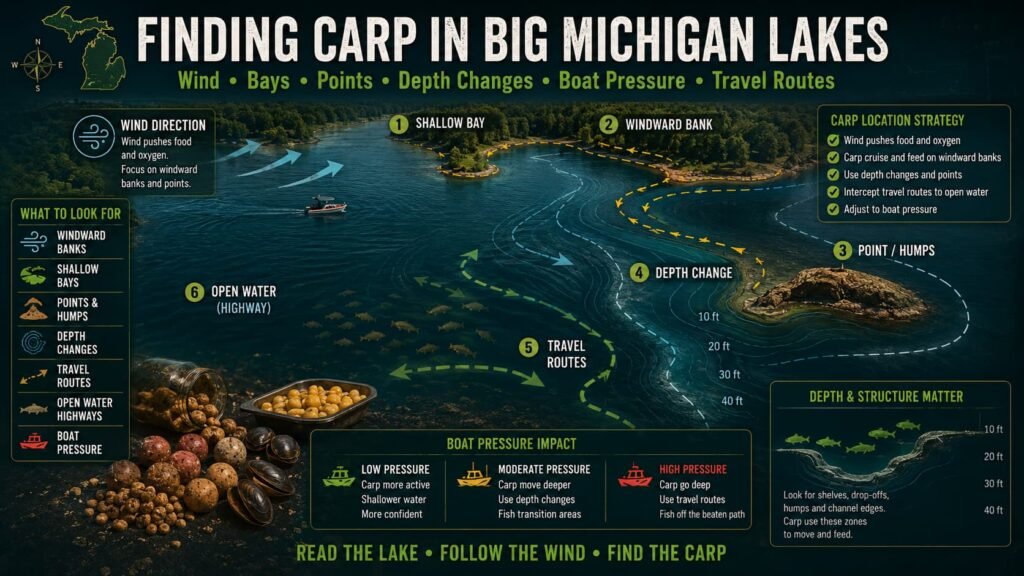
Finding carp in big lakes is one of the hardest parts of Michigan carp fishing.
On a small pond, you can often walk the whole shoreline, watch the margins and build a picture quickly.
On a big Michigan lake, that does not work.
There is too much water.
Too many bays.
Too many weed beds.
Too many points.
Too many boat lanes.
Too many shallow flats.
Too many deep basins.
Too many comfortable-looking swims with no carp in front of them.
That is why big-lake carp fishing has to start with watercraft, not bait.
The goal is not to fish the whole lake.
The goal is to reduce a huge lake into a few realistic carp zones.
Those zones usually combine several things:
FOOD.
WIND.
DEPTH CHANGE.
SAFETY WATER.
ACCESS.
TRAVEL ROUTES.
LOW-LIGHT MOVEMENT.
BOAT-PRESSURE ESCAPE AREAS.
A FISHABLE BANK OR BOAT POSITION.
This article explains how to find carp in big Michigan lakes by reading wind, bays, points, depth changes, shelves, old channels, shallow flats, weed beds, mussel areas, boat pressure, campground banks, marinas, access points, dawn and dusk movement, seasonal changes and realistic three-rod zone selection.
For natural food zones, read How to Find Natural Carp Feeding Areas in Michigan Lakes.
For bait choice after you find the area, read Best Carp Bait for Michigan Lakes.
For boilies, corn and particles, read Boilies vs Corn vs Particles for Carp.
For a broader beginner route, use Start Here: Carp Fishing in Michigan.
Michigan DNR says Michigan has more than 11,000 inland lakes and provides inland lake maps for about 2,700 of them, while also warning that maps may not fully represent current conditions. Use Michigan DNR Inland Lake Maps as a starting point, not as a substitute for scouting.
The simple rule is:
DO NOT TRY TO FISH THE WHOLE LAKE.
BREAK THE LAKE INTO ZONES.
THEN FISH THE BEST ZONE PROPERLY.
Table of Contents
Quick Start: How to Find Carp in Big Lakes
Use this table first.
| Big-Lake Feature | Why It Matters | What to Look For | Best First Move |
|---|---|---|---|
| Windward banks | Wind can move food, color, warmth and oxygen | Steady warm wind pushing into a bay, weedline or point | Watch before baiting heavily |
| Shallow bays | Warm faster and hold food | Dark bottom, weed, reeds, bubbles, bird activity | Fish early, late or at night |
| Points | Natural travel markers | Point leading from deep water to flats or bays | Fish one rod on each side/edge |
| Narrows | Concentrate movement | Channel gaps, bridge areas, lake constrictions | Fish travel routes, not random open water |
| Drop-offs | Connect food and safety | Shelves, old channels, basin edges | Fish the top, bottom or route between |
| Weed beds | Hold snails, insects and cover | Outside edge, holes, clear lanes | Strong tackle and accurate bait |
| Mussel / gravel areas | Hard food and clean presentation | Crunchy bottom, shells, hard lead feel | Boilies, tiger nuts, balanced baits |
| Campground banks | Human activity, access and night movement | Quiet edges, baited margins, pressure changes | Fish low-light windows |
| Marinas / boat areas | Shelter, structure and food | Legal access, quiet corners, weed and shade | Check rules before fishing |
| Boat-pressure escape zones | Carp avoid daytime disturbance | Quiet bays, no-wake areas, night routes | Fish dawn, dusk and night |
| Inflows / outflows | Oxygen, food and movement | Creeks, drains, channels, dam flow | Use strong rigs and accurate bait |
| Public access points | Easy to fish but pressured | Boat launch, fishing pier, campground edge | Look for nearby unfished angles |
The best big-lake spots usually combine several features.
A shallow bay is better if it has weed, wind and deeper water nearby.
A point is better if it leads to a mussel bed or travel route.
A bank is better if carp can reach it from safe water without crossing constant boat traffic.
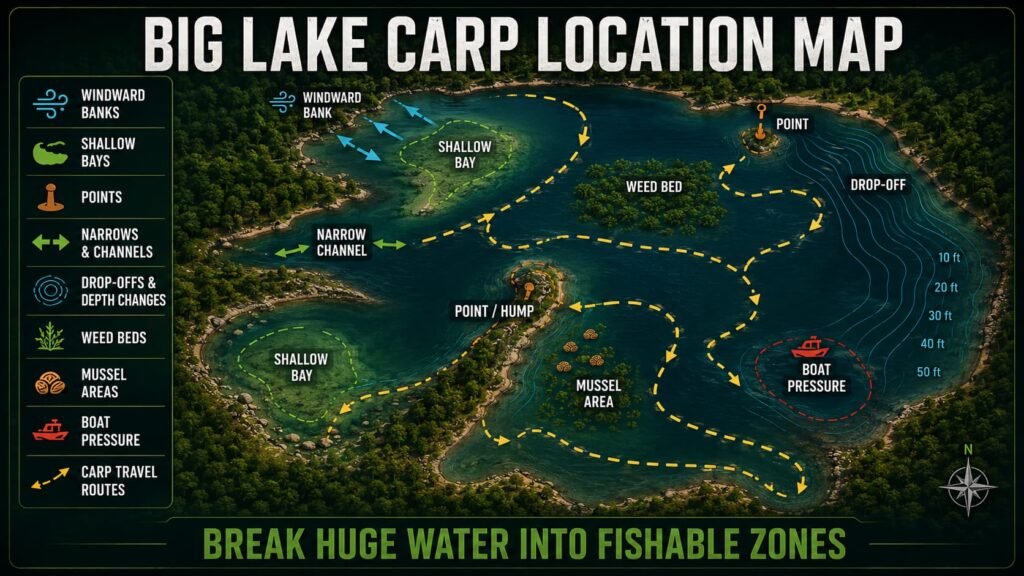
Think in Zones, Not Swims
The biggest mistake on large lakes is choosing a swim before choosing a zone.
A swim is where you sit.
A zone is where carp have a reason to be.
On big lakes, the zone matters more.
A good-looking bank can be dead if it has:
- no food;
- no depth change;
- no travel route;
- too much boat pressure;
- no wind advantage;
- no connection to safe water;
- no low-light movement.
A less comfortable bank can be excellent if it sits on:
- a windward bay;
- a point;
- a weedline;
- a shelf;
- a mussel bed;
- a route from deep water;
- a quiet nighttime feeding area.
The Big-Lake Question
Do not start with:
Where can I set up comfortably?
Start with:
Where does this lake give carp food, safety and movement in the same area?
Then decide whether you can fish it safely and legally.
Break the Lake Into Sections
A big lake becomes easier when you divide it.
Instead of seeing one huge piece of water, break it into:
- north shore;
- south shore;
- east shore;
- west shore;
- shallow bays;
- deep basin;
- weed arms;
- points;
- narrows;
- marinas;
- campgrounds;
- inflows;
- outflows;
- public access areas;
- quiet corners.
Then rank those sections.
First Pass: Eliminate Dead Water
Remove areas that have:
- no access;
- dangerous bank;
- no legal parking;
- impossible boat pressure;
- featureless open water;
- heavy weed with no clear presentation;
- no depth change;
- no signs;
- no reason for carp to visit.
Second Pass: Mark Possible Carp Zones
Keep areas that have:
- food;
- wind;
- depth change;
- cover;
- routes;
- visible signs;
- quieter periods;
- bank or boat access;
- safe fish landing options.
Third Pass: Pick One or Two Zones
Do not try to fish every possibility.
Choose one main zone and one backup zone.
That is enough for a serious session.
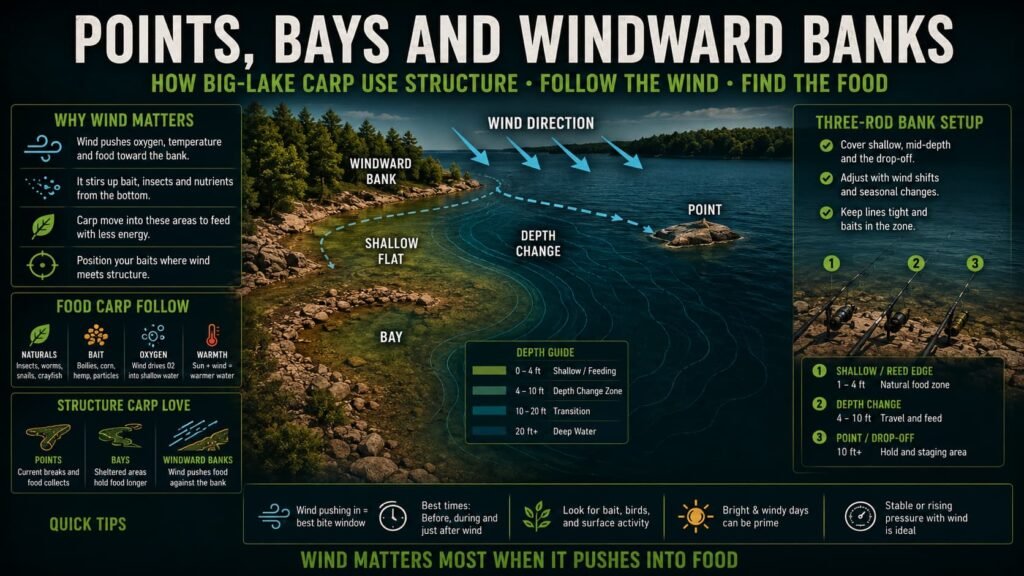
Use Wind Direction Properly
Wind is one of the strongest clues on big lakes.
A steady wind can push warmer surface water, floating food, suspended particles, color and oxygen into one side of the lake.
But wind is not magic.
A windward bank only matters if it pushes into useful habitat.
Good Windward Banks
A windward bank is more promising when it hits:
- a shallow bay;
- a weedline;
- a reed edge;
- a mussel bed;
- a gravel shelf;
- a warm flat;
- an inflow;
- a point;
- a bank with low boat pressure.
Poor Windward Banks
A windward bank may be poor if it hits:
- sterile sand;
- no depth change;
- unfishable waves;
- heavy boat lanes;
- floating weed;
- dangerous conditions;
- cold water after a sharp weather change.
Warm Wind vs Cold Wind
A warm wind can switch on shallow areas.
A cold wind can push carp off exposed banks, especially in spring or fall.
Do not treat all wind the same.
Ask:
Is this wind improving the bank or making it worse?
Practical Wind Rule
Wind matters most when it pushes into food.
A windward desert is still a desert.
For natural food interpretation, use How to Find Natural Carp Feeding Areas in Michigan Lakes.
Shallow Bays
Shallow bays are some of the most important areas on large Michigan lakes.
They are especially important in spring, early summer and during low-light periods.
A shallow bay can offer:
- warmth;
- weed;
- insects;
- snails;
- silt;
- reeds;
- shelter from waves;
- night feeding;
- spawning-area movement;
- calmer water;
- food accumulation.
Best Shallow Bays
The best shallow bays usually have:
- sun exposure;
- dark bottom;
- weed growth;
- reed edges;
- soft silt pockets;
- nearby deeper water;
- a clear route in and out;
- low boat pressure at key times;
- wind pushing in or across.
Poor Shallow Bays
A shallow bay may be poor if it has:
- no weed;
- no food;
- heavy swimmer traffic;
- heavy jet-ski pressure;
- no deeper escape route;
- clear sterile sand;
- constant disturbance.
When to Fish Bays
Try shallow bays:
- early morning;
- evening;
- night;
- after several warm days;
- with a steady warm wind;
- before heavy boat traffic starts;
- after boat traffic dies down.
Bait Approach
Start light.
Use:
- corn;
- maize;
- tiger nuts;
- small boilies;
- light packbait;
- PVA sticks;
- small crumb traps.
Do not dump heavy bait into a shallow bay until carp activity confirms it.
Points and Promontories
Points are major big-lake features.
They create edges, wind breaks, depth changes and travel markers.
Carp may move around points when traveling between bays, flats and deeper water.
Best Points
Good points often have:
- weed on one side;
- deeper water on the tip;
- gravel or shell on the edge;
- silt pockets nearby;
- wind hitting one side;
- a route into a bay;
- a drop-off close by.
How to Fish a Point
A simple three-rod layout:
Rod 1:
upwind side or food side

Rod 2:
tip or shelf edge

Rod 3:
downwind travel side or deeper route
Do not automatically cast straight out.
The best spot may be along the side of the point, not off the end.
Bait Approach
Use:
- boilies;
- tiger nuts;
- maize;
- crumb;
- small particle traps;
- packbait if bottom allows.
A point is a good place to bait lightly and repeatedly because fish may pass through at different times.
Narrows, Channels and Necked-Down Water
Narrows are powerful big-lake features because they concentrate movement.
Carp moving from one basin, bay or arm to another may pass through the same narrowed area repeatedly.
Good Narrows
Look for:
- bridge areas;
- culverts;
- channel gaps;
- island gaps;
- marina entrances;
- campground channels;
- old river channels;
- narrow necks between basins.
Why They Work
Narrows can act like funnels.
They make a huge lake smaller.
Even if carp are not feeding hard, a bait placed on a route can get picked up by moving fish.
Bait Approach
Use:
- boilies;
- maize;
- tiger nuts;
- PVA sticks;
- small packbait;
- strong hookbaits.
Do not overbait a narrow travel route at first.
A route is not always a dining room.
Sometimes it is a hallway.
Depth Changes, Shelves and Drop-Offs
Depth change matters because it connects feeding water to safety water.
Carp may feed shallow but retreat deeper.
They may hold deeper during daylight and move up at night.
They may travel along the edge rather than across open flats.
Key Depth Features
Look for:
- shelves;
- drop-offs;
- old creek channels;
- basin edges;
- humps;
- bars;
- saddles;
- shallow flats beside deep water;
- bay mouths;
- ledges near weed.
Where to Place Baits
Test:
one rod on top of the shelf
one rod on the slope or edge
one rod at the base or travel line
Let liners, shows and bites tell you which level carp are using.
Do Not Obsess Over Deep Water
The deepest water is not automatically best.
Carp usually need a reason to be there.
The strongest zone is often where deep safety water connects to shallow or medium-depth food.
Old Riverbeds and Basin Edges
Many dammed or large inland waters have old channels, basin edges or historic drainage lines.
These features can become carp highways.
Why Old Channels Matter
Old channels can provide:
- depth;
- travel route;
- softer bottom;
- food collection;
- edge habitat;
- shelter from bright light;
- connection between basins.
How to Find Them
Use:
- lake maps;
- sonar;
- depth changes;
- old contour lines;
- DNR maps;
- boat scouting;
- bank casting with a lead.
Michigan DNR inland lake maps are useful for identifying contours, but DNR notes the maps may not fully represent current conditions. Michigan DNR Inland Lake Maps
Bait Approach
Old channels are often route features.
Use:
- accurate boilies;
- small particle traps;
- PVA sticks;
- strong hookbaits;
- crumb lines only if you know fish are feeding.
Weed Beds and Weedlines
Weed is often the difference between dead water and carp water.
On big lakes, weed beds can be huge, so the key is not just finding weed.
The key is finding the right part of the weed.
Best Weedline Features
Look for:
- outside edges;
- clear holes;
- inside turns;
- weed points;
- weed close to deeper water;
- weed beside gravel;
- weed beside silt;
- reed and weed combinations;
- boat lanes cutting weed edges.
Boat Pressure and Weed
During busy summer days, carp may use weed for cover.
They may feed around the edges early, late or at night.
A weed edge that looks dead at noon may come alive after the lake quiets down.
Bait Approach
Use:
- strong tackle;
- safe lead systems;
- boilies;
- tiger nuts;
- maize;
- small PVA traps;
- balanced hookbaits.
For weed, mussels, silt and natural food, read How to Find Natural Carp Feeding Areas in Michigan Lakes.
Mussel Beds, Gravel and Hard Spots
Hard areas are important on big lakes because they give carp clean feeding spots and natural food.
Mussel beds, gravel strips, shell areas and clay patches can all be useful.
How to Find Hard Areas
Look for:
- shell fragments;
- crunchy lead feel;
- clear patches;
- gravel points;
- hard bars;
- marina rock;
- riprap;
- shoreline shell deposits;
- sonar hardness changes.
Best Hard Spots
The best hard spot is usually not random.
It is better when it sits:
- beside weed;
- beside silt;
- near a route;
- on a point;
- at a bay mouth;
- near deeper water;
- in a windward area.
Bait Approach
Use:
- boilies;
- tiger nuts;
- maize;
- balanced hookbaits;
- wafters;
- small crumb;
- light particle baiting.
Hard spots can be excellent, but they can also be obvious to other anglers.
Accuracy matters.
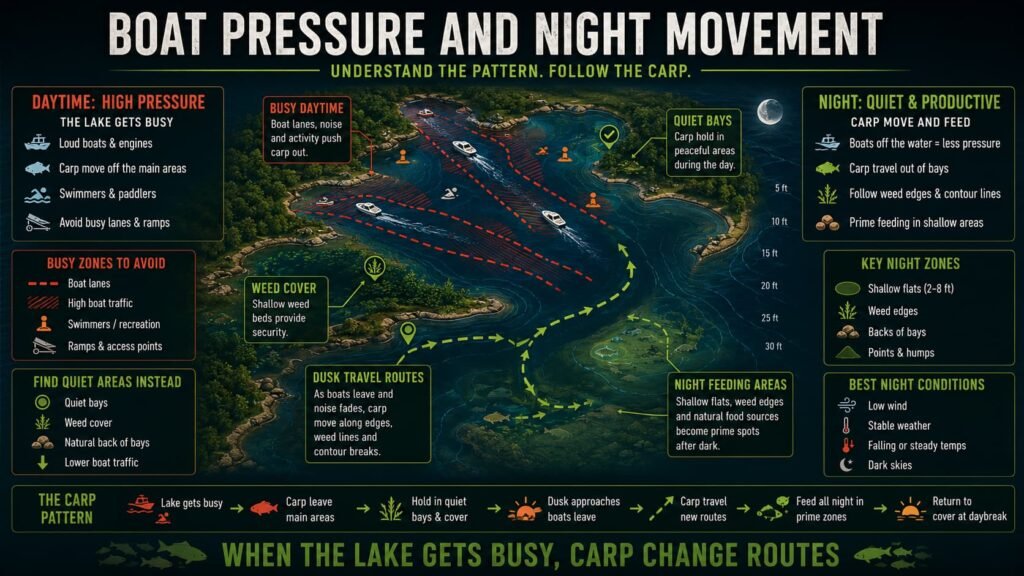
Boat Pressure, Swimmers and Summer Traffic
Big Michigan lakes can change completely once boat traffic starts.
A lake that looks perfect at sunrise can become difficult by noon.
Boat pressure can push carp:
- away from open shallows;
- into weed;
- into quiet bays;
- into deeper water;
- onto nighttime routes;
- around no-wake zones;
- into areas with less disturbance.
Michigan DNR’s boating information includes boating access resources and local watercraft controls, which are useful when checking ramps, parking, restrictions and public access before planning a session. Michigan Boating
Pressure Zones
Heavy-pressure areas include:
- boat launches;
- swimming beaches;
- jet-ski lanes;
- sandbars;
- party coves;
- marinas;
- busy campground frontage;
- popular public piers.
These areas can still hold carp.
But timing matters.
Best Times Around Boat Pressure
Try:
- dawn;
- dusk;
- night;
- weekdays;
- poor boating weather;
- shoulder seasons;
- after storms;
- early spring;
- fall;
- no-wake hours or no-wake zones where applicable.
Practical Rule
Do not judge a big lake only at midday in July.
Watch it early, late and after the boats leave.
Campgrounds, Marinas and Human Activity
Carp often learn to use human-influenced areas.
That does not mean every campground or marina is good.
But these areas can concentrate:
- food scraps;
- shelter;
- shade;
- weed edges;
- rock;
- docks;
- boat lanes;
- baited margins;
- night movement;
- low-pressure windows.
Campground Banks
Campground banks can be productive because they often give:
- legal access;
- long shoreline;
- night fishing options where permitted;
- consistent human activity;
- bait and food input;
- quiet windows after dark.
But they can also have:
- swimmers;
- dogs;
- boats;
- noise;
- shallow featureless margins.
Marinas
Marinas can hold carp around:
- shade;
- algae growth;
- dock posts;
- mussels;
- rock;
- quiet corners;
- boat slips;
- deeper dredged water.
Always check rules.
Many marinas are private or restricted.
Practical Rule
Human activity can create opportunity, but legal access and fish safety come first.
Dawn, Dusk and Night Movement
Big-lake carp often become easier to locate when the lake quiets down.
Dawn, dusk and night can reveal movement that is hidden during the day.
What Changes at Low Light
At low light:
- boat pressure drops;
- shallow areas become safer;
- carp move closer to margins;
- bubbles are easier to notice;
- rolling fish may show;
- liners become meaningful;
- travel routes become clearer.
Best Low-Light Areas
Look at:
- bay mouths;
- weed edges;
- reed lines;
- campground margins;
- points;
- narrows;
- shallow flats;
- mussel beds;
- channels into bays.
Three-Rod Night Layout
A sensible night layout:
Rod 1:
natural feeding edge

Rod 2:
travel route

Rod 3:
slightly deeper safety edge
Do not cast all three rods into the same guess.
Use the rods to learn.
Spring Big-Lake Location
Spring is about warmth, food and movement.
Carp are often drawn to areas that warm first.
Spring Features
Look for:
- shallow bays;
- dark bottom;
- reed edges;
- fresh weed;
- inflows if warmer;
- sun-facing banks;
- sheltered corners;
- soft silt;
- nearby deeper water.
Spring Baiting
Use light baiting.
Good options:
- corn;
- maize;
- tiger nuts;
- small boilies;
- light packbait;
- PVA sticks;
- crumb.
For seasonal bait strategy, use Spring Particles for Carp.
Summer Big-Lake Location
Summer is complicated because food is abundant but pressure is high.
Carp may feed well, but not always where anglers expect.
Summer Features
Look for:
- weed edges;
- windward banks;
- oxygenated areas;
- night routes;
- deeper water near food;
- quiet bays;
- no-wake zones;
- areas away from swimmers and jet skis.
Summer Timing
Best windows are often:
- early morning;
- evening;
- night;
- cloudy windy days;
- after storms;
- weekdays.
Summer Baiting
Summer can support more bait, but only where carp are actually feeding.
Use:
- particles;
- boilies;
- packbait;
- maize;
- tiger nuts;
- crumb.
Do not assume warm water means heavy bait everywhere.
Fall Big-Lake Location
Fall can be excellent on big lakes.
Natural food changes, weed starts to die back, boat pressure drops and carp may feed strongly before cold water.
Fall Features
Look for:
- weed dieback edges;
- remaining green weed;
- mussel beds;
- gravel/silt transitions;
- deeper bay mouths;
- windward banks;
- points near deeper water;
- old channels.
Fall Baiting
Use more food if carp are feeding consistently.
Good options:
- boilies;
- maize;
- tiger nuts;
- packbait;
- crumb;
- milk/nut boilies;
- savory baits.
Fall is a good time to fish big-water features properly because the lake is often quieter.
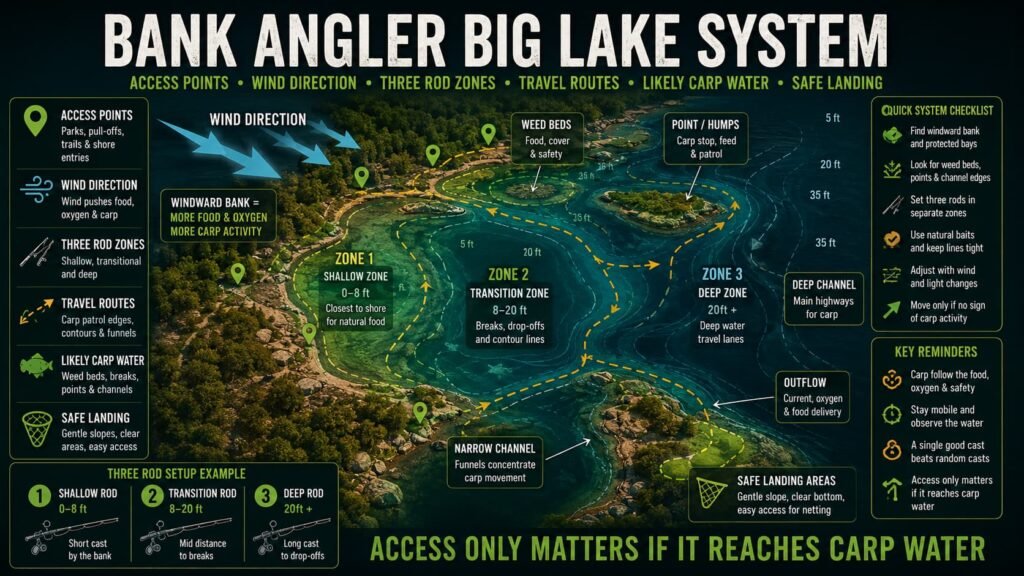
Bank Fishing Big Lakes
Bank anglers can still fish big lakes effectively.
The key is choosing bank access that reaches real carp water.
Good Bank Access
Look for:
- points;
- campground banks;
- public parks;
- causeways;
- bridges;
- channels;
- bay mouths;
- deeper water close to shore;
- weed edges within range;
- legal night access;
- safe landing room.
Poor Bank Access
Avoid banks that offer:
- comfort but no features;
- shallow sterile sand;
- constant swimmers;
- no safe landing;
- no nearby depth change;
- no signs;
- no way to fish the wind.
Bank Angler System
Use this process:
1. Pick a lake section, not just a swim.
2. Check wind and access.
3. Use maps before arriving.
4. Walk the bank before setting up.
5. Look for signs at dawn and dusk.
6. Fish one feeding zone, one route and one safety edge.
7. Keep notes.
This is the useful part to merge from the old bank-angler post.
Boat and Kayak Scouting
A boat, kayak or small craft can make big lakes much easier to understand.
But it should be used carefully.
What to Scout
Use a boat or kayak to find:
- weed edges;
- hard spots;
- mussel beds;
- depth changes;
- silt pockets;
- bay mouths;
- points;
- channels;
- safe landing areas;
- snag lines;
- boat traffic patterns.
Useful Tools
Use:
- sonar;
- lake maps;
- polarized glasses;
- marker pole;
- lead line;
- underwater camera;
- GPS waypoints.
Do Not Overdo It
Do not keep driving over the area you intend to fish.
Scout quietly.
Mark the zone.
Then back off.
Clean, Drain and Dry
Michigan invasive-species guidance says boaters must remove aquatic plants from watercraft, equipment and trailers before placing them into Michigan waters, and must drain water before transporting watercraft over land. Use Michigan Invasive Species Prevention: Boaters and Anglers before moving boats, nets, mats, buckets or wet gear between lakes.
Choosing a Three-Rod Area
A good three-rod area is not three rods cast randomly.
Each rod should answer a question.
Simple Three-Rod Layout
Use:
Rod 1:
natural feeding area

Rod 2:
travel route

Rod 3:
deeper safety edge or secondary feature
Example Layout: Windward Bay
Rod 1:
inside weed edge

Rod 2:
bay mouth route

Rod 3:
drop-off outside the bay
Example Layout: Point
Rod 1:
windward side of point

Rod 2:
tip or shelf edge

Rod 3:
deeper route behind the point
Example Layout: Mussel / Gravel Area
Rod 1:
clean hard spot

Rod 2:
hard/soft transition

Rod 3:
route from deeper water
Practical Rule
Do not use three rods to repeat the same mistake.
Use three rods to learn how carp are using the zone.
Matching Bait to Big-Lake Location
Bait choice should follow location.
Windward Shallow Bay
Use:
- maize;
- corn;
- tiger nuts;
- small boilies;
- light packbait;
- crumb.
Weedline
Use:
- tiger nuts;
- nut boilies;
- maize;
- balanced hookbaits;
- PVA sticks;
- strong tackle.
Mussel Bed / Gravel
Use:
- boilies;
- tiger nuts;
- hard hookbaits;
- wafters;
- small crumb;
- light particles.
Soft Silt
Use:
- wafters;
- balanced baits;
- light boilies;
- small PVA bags;
- soluble hookbait coatings;
- cautious baiting.
Narrows / Travel Route
Use:
- boilies;
- maize;
- tiger nuts;
- PVA sticks;
- small baiting;
- repeatable accuracy.
Campground / Public Bank
Use:
- particles;
- packbait;
- boilies;
- corn;
- small accurate traps;
- low-light timing.
For bait selection, use Best Carp Bait for Michigan Lakes, Particles for Carp Fishing and Packbait for Carp Fishing.
Prebaiting Big Lakes
Prebaiting can help on big lakes, but only if the area is right.
Do not use bait to create carp where carp do not want to be.
Use bait to encourage carp to stop where they already pass or feed.
When Prebaiting Makes Sense
Prebait when:
- carp already visit the area;
- you have seen signs;
- the spot has food or a route;
- nuisance fish are manageable;
- birds are not clearing bait;
- you can repeat accurately;
- you have a multi-day plan.
When Not to Prebait
Do not prebait heavily when:
- you have no signs;
- the spot is random;
- boat pressure is extreme;
- bait will be stolen by birds;
- the bottom is wrong;
- you cannot fish the spot later.
Simple Prebait Plan
For a new big-lake zone:
Day 1:
small test bait

Day 2:
repeat if signs or bait loss confirm activity

Day 3:
increase only if carp are using the zone
Heavy baiting should be earned by evidence.
Common Big-Lake Mistakes
Mistake 1: Fishing Too Much Water
Big lakes punish vague fishing.
Pick a zone.
Mistake 2: Choosing Access Before Location
A comfortable bank is not always a carp bank.
Mistake 3: Ignoring Boat Pressure
Summer boat traffic can completely change carp movement.
Mistake 4: Fishing the Middle of Nowhere
Open water needs a reason.
Find routes, shelves, points or food.
Mistake 5: Overbaiting Too Soon
Do not feed heavily before you know carp use the area.
Mistake 6: Ignoring Wind
Wind can help narrow the lake quickly.
Mistake 7: Ignoring Night Movement
Big-lake carp may become much easier after dark.
Mistake 8: Treating Maps as Perfect
Maps are starting points. Scout the real water.
Mistake 9: Casting All Rods to One Guess
Use rods to test the zone.
Mistake 10: Not Keeping Notes
Big-lake patterns repeat, but only if you record them.
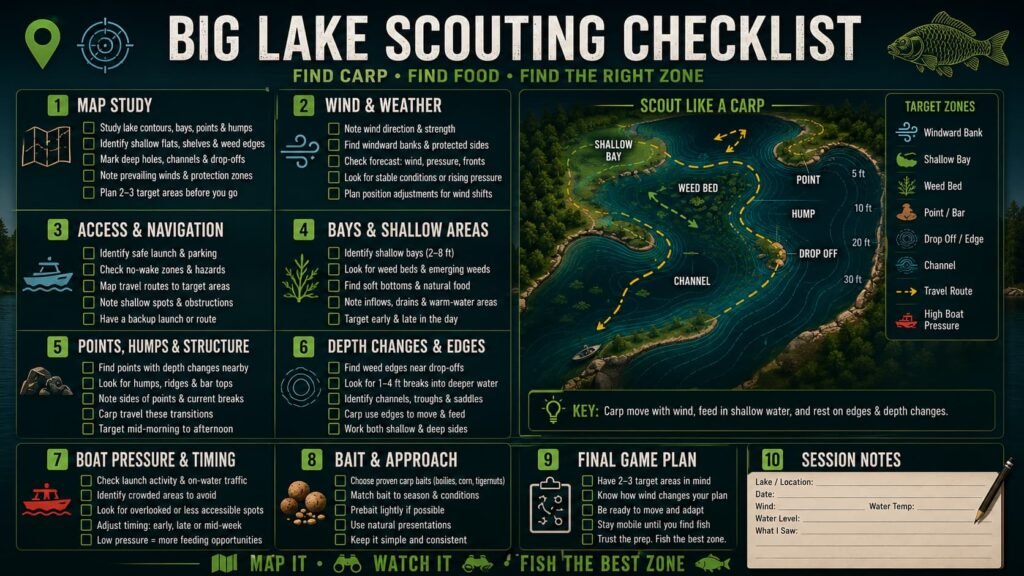
Simple Big-Lake Scouting Plan
Use this before a serious session.
Step 1: Study the Map
Find:
- bays;
- points;
- narrows;
- deep basins;
- shallow flats;
- inflows;
- outflows;
- old channels;
- public access.
Step 2: Check Wind
Ask:
Where will the wind push food, warmth and color?
Step 3: Check Access
Ask:
Can I fish and land carp safely and legally?
Step 4: Identify Natural Food
Look for:
- weed;
- mussels;
- silt;
- gravel;
- insects;
- reeds;
- shell fragments.
Step 5: Identify Travel Routes
Find:
- bay mouths;
- points;
- drop-offs;
- narrows;
- channel edges.
Step 6: Watch at Low Light
Observe:
- dawn;
- dusk;
- night;
- after boat traffic drops.
Step 7: Fish Three Different Questions
Use rods to test:
feeding area
travel route
safety edge
Step 8: Record Results
Write down:
- date;
- wind direction;
- water temperature if known;
- boat traffic;
- signs;
- bottom type;
- bait;
- rod position;
- bite time;
- liners;
- fish landed;
- lost fish;
- changes.
This turns big-water fishing from guessing into learning.
Practical Field Example
A good big-lake carp zone might look like this:
A large shallow bay warms quickly after three sunny days.
A west wind pushes into the mouth of the bay.
The back of the bay has weed and soft silt.
One side has reeds.
The mouth of the bay drops from 5 feet into 12 feet.
There are shell fragments on the harder edge.
Boat traffic is heavy at midday but quiet at dawn and after dark.
That zone gives you:
- warmth;
- food;
- weed;
- silt;
- shell;
- depth change;
- wind;
- a route;
- low-light opportunity;
- a realistic three-rod layout.
A sensible setup would be:
Rod 1:
weed/silt feeding edge

Rod 2:
hard shell transition at bay mouth

Rod 3:
deeper route outside the bay
Start with light bait.
Watch for liners.
Adjust after the first night.
That is much better than casting three rods into open water just because the lake is big.
My Practical View
Big Michigan lakes can be intimidating, but they become manageable when you stop trying to fish everything.
I want a section of lake that gives me several reasons to believe carp pass through or feed there.
The best zones usually connect:
shallow food
wind
depth change
safe water
low-light movement
legal access
I pay close attention to wind, but I do not fish wind blindly.
I like shallow bays, but only if they connect to deeper water.
I like points, but only if they sit on a route.
I like mussel beds and weedlines, but only if I can present bait safely.
I like campground banks and public access areas, but timing matters because boat pressure can change everything.
For big-lake carp fishing, bait is the second decision.
Location is the first.
The final rule is:
BREAK THE LAKE INTO ZONES.
FIND FOOD, WIND, DEPTH AND ROUTES.
WATCH LOW-LIGHT MOVEMENT.
FISH THREE DIFFERENT QUESTIONS.
LET THE CARP TELL YOU WHICH PART OF THE ZONE MATTERS.
FAQ
How do you find carp in big lakes?
Break the lake into zones, then look for windward banks, shallow bays, points, narrows, depth changes, weed beds, mussel areas, travel routes and low-light feeding signs.
Where do carp go in big Michigan lakes?
Carp often use shallow bays, weedlines, mussel beds, silt pockets, points, bay mouths, old channels, campground banks and routes between food and deeper safety water.
Are windward banks good for carp?
Windward banks can be excellent when the wind pushes into real habitat such as weed, reeds, mussels, silt, gravel or a shallow bay. Wind alone is not enough.
Are shallow bays good for carp fishing?
Yes. Shallow bays can be excellent, especially in spring, early summer, low light and after warm winds, if they contain food and have deeper water nearby.
Do carp use points in lakes?
Yes. Points can act as travel markers and feeding edges, especially when they connect shallow food with deeper water.
How does boat pressure affect carp?
Boat pressure can push carp away from open shallows and into weed, deeper water, quiet bays, no-wake areas or nighttime feeding routes.
What is the best time to find carp on big lakes?
Dawn, dusk and night are often best, especially in summer when boat traffic is heavy.
Should I fish deep or shallow for carp in big lakes?
Fish the connection between shallow food and deeper safety water. The best zone is often a shelf, drop-off, bay mouth or route, not simply the deepest or shallowest water.
Can bank anglers catch carp on big lakes?
Yes. Bank anglers can do very well if they choose access that reaches points, bay mouths, weed edges, channels, depth changes or low-light travel routes.
Should I prebait big lakes?
Prebait only after you identify a zone carp already use. Do not use bait to fix dead water.
What bait should I use on big lakes?
Match bait to the zone. Use particles and packbait in shallow feeding areas, boilies and tiger nuts on hard spots or mussels, and balanced hookbaits over silt.
What is the biggest mistake when finding carp in big lakes?
The biggest mistake is choosing a comfortable swim before identifying food, wind, depth change, boat pressure and travel routes.
Next Steps
Use these supporting guides next:
- How to Find Natural Carp Feeding Areas in Michigan Lakes
- Best Carp Bait for Michigan Lakes
- Boilies vs Corn vs Particles for Carp
- Particles for Carp Fishing
- Packbait for Carp Fishing
- Tiger Nuts for Carp Fishing
- Corn for Carp in Michigan
- How to Find Carp in Lakes
- Michigan Carp Fishing Seasons
- Start Here: Carp Fishing in Michigan
- Michigan Carp Guide Library