

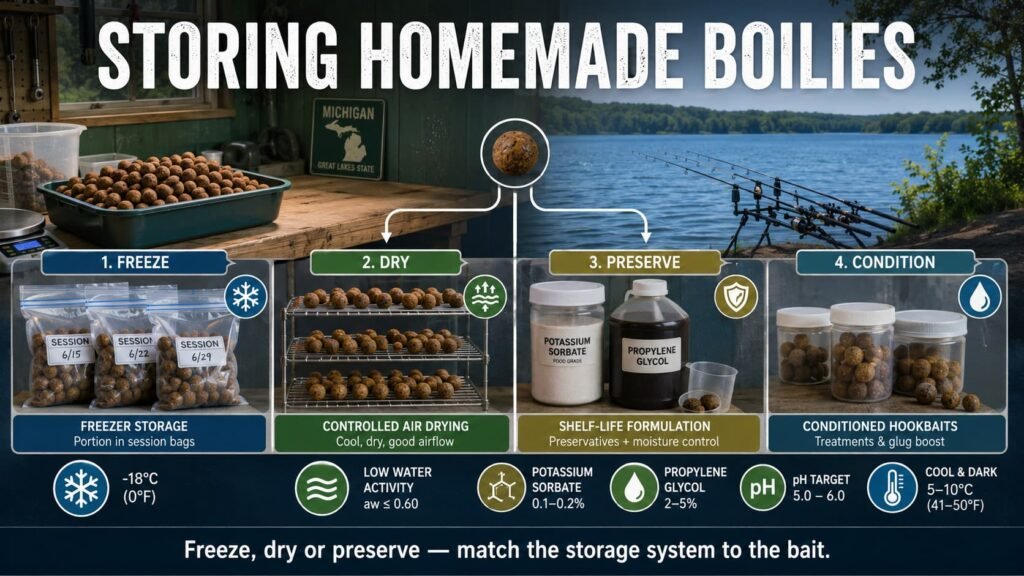
How to Store Boilies: Freezer Bait, Air Drying and Shelf Life
Learning how to store boilies properly is not simply a choice between putting them in the freezer or leaving them in a plastic tub.
There are several different storage systems, and they should not be confused.
A homemade freezer bait, an air-dried boilie, a deliberately preserved shelf-life bait and a heavily conditioned hookbait can all contain similar ingredients while requiring very different storage decisions.
The biggest mistake is treating storage as something that begins after the bait is finished.
Storage stability is influenced by the complete bait-making process:
ingredient quality, cooking, cooling, drying, available moisture, preservative system, pH, liquid treatments, packaging and temperature all matter.
The correct question is therefore not:
Should I freeze or air dry my boilies?
The better question is:
What storage system was this bait actually designed for?
This guide explains the difference between freezer bait, air-dried bait and true shelf-life bait, then looks at freezing, thawing, water activity, preservatives, propylene glycol, potassium sorbate, glugged bait, specialist hookbaits and session storage.
For practical production before storage, read How to Boil and Dry Boilies Properly.
For the effect of heat on the ingredients themselves, read What Boiling and Heat Really Do to Carp Bait Ingredients.
For checking whether storage has changed the finished bait, use How to Test Boilies Before Fishing.
Quick Answer
The best boilie storage method depends on how the bait was formulated, how much available moisture remains, how it will be transported and how quickly it will be used.
My practical approach is simple.
For ordinary homemade boilies without a deliberately designed and tested shelf-life system, I prefer freezing in session-sized portions.
For short-term use, controlled air drying and cool storage can be practical.
For genuine long-term room-temperature storage, I would design the preservation system from the start rather than trying to turn a normal fresh bait into shelf-life bait after cooking.
For specialist hookbaits, I treat storage separately because the quantities are smaller and durability, buoyancy and conditioning requirements are different.
The central rule is:
Do not call a bait shelf stable simply because it feels dry, contains some preservative or has been soaked in propylene glycol.
Freezer Bait, Air-Dried Bait and Shelf-Life Bait Are Different
These terms are often used loosely, which creates unnecessary confusion.
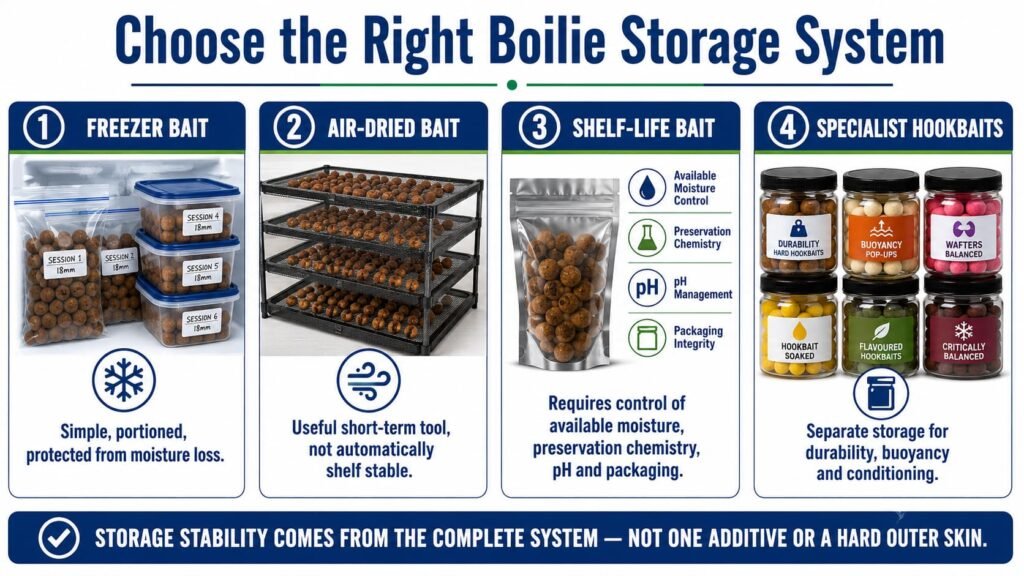
Freezer bait
A freezer bait is normally made, cooked, cooled, dried enough for handling and then frozen for storage.
The freezer is doing most of the preservation work.
The bait does not need to be dried to extreme hardness, and it does not need to depend entirely on a room-temperature preservative system.
This is one reason I recommend freezing as the default starting point for many homemade bait makers.
It is straightforward, easy to portion and removes the pressure to guess whether a moist homemade bait will remain stable for months in a tub.
Air-dried bait
Air drying removes moisture from the bait and changes its physical state.
Depending on the degree of drying and storage conditions, this can improve short- or medium-term keeping quality.
But the phrase air dried does not automatically mean shelf stable.
A bait can feel extremely hard outside while retaining a different moisture state in the center.
Storage stability also depends on the environment after drying.
A bait exposed to humid air can take moisture back up again.
Preserved shelf-life bait
A true shelf-life system is designed to remain stable under its intended room-temperature storage conditions.
That may involve several controls working together, including:
- drying
- reduced available moisture
- humectants
- salt or sugar contributions
- pH adjustment where appropriate
- antimicrobial preservatives
- controlled packaging
- appropriate storage temperature
The important idea is that shelf life is a property of the complete system.
It is not the name of one additive.
The Real Storage Problems
Boilie storage is often discussed only in terms of mold.
Mold is important, but it is not the only possible form of deterioration.
During storage, bait may change through several routes.
Microbial spoilage
Yeasts, molds and bacteria have different growth requirements and tolerances.
The preservation system should therefore not be imagined as one universal switch that either kills everything or does nothing.
Oxidation
Ingredients rich in unsaturated fats can deteriorate oxidatively during storage.
That makes ingredient freshness, oxygen exposure, temperature and total lipid system relevant, especially in nut-, seed- and oil-rich baits.
Read Oils, Fats and Energy in Carp Bait for the wider lipid discussion.
Moisture migration
Water can move within the bait and between the bait and its environment.
This may change:
- surface hardness
- core texture
- stickiness
- mold risk
- rehydration behaviour
Physical change
Freezing, thawing, extended drying and heavy liquid conditioning can all change how the finished bait handles and behaves in water.
That is why stored bait should be tested again rather than assumed to behave exactly like the fresh production batch.
Moisture Content and Water Activity Are Not the Same Thing
This is the most important technical distinction in shelf-life bait.
Moisture content describes how much total water is present.
Water activity concerns how available that water is within the product system.
Those are related, but they are not interchangeable.
Two baits can contain similar total moisture while behaving differently microbiologically because the water is associated differently with proteins, carbohydrates, salts, sugars and humectants.
This is why:
The bait feels dry
is not a scientific measurement of shelf stability.
It is also why simply comparing two recipes by moisture percentage does not tell the whole storage story.
What this means for homemade bait makers
Without measuring water activity or using a validated, repeatable formula and process, I would be cautious about making precise claims such as:
This bait will last six months at room temperature.
There are too many interacting variables.
For a home bait maker, the safer practical approach is:
freeze ordinary fresh bait; deliberately formulate shelf-life bait; and test stored batches rather than relying on feel alone.
Freezing: What It Does Well
Freezing is extremely useful because it gives the home bait maker a simple way to store batches without needing to force every recipe into a low-moisture shelf-life format.
For my own style of fishing, this is particularly useful where I want:
- multiple flavour variations
- different boilie sizes
- session-sized bait packs
- special particles or boilie combinations
- consistent batches made in advance
But freezing should not be turned into another bait myth.
Frozen bait is not automatically superior underwater to every shelf-life bait.
Storage method and fishing performance are different questions.
A well-designed shelf-life bait can be highly effective, and a badly designed freezer bait can still be nutritionally weak, mechanically poor or unsuitable for the session.
How I Would Freeze Homemade Boilies
After cooking, allow the boilies to cool and complete the drying period needed for the intended bait.
Do not package them warm.
Once ready for storage, divide the bait into quantities that match how you actually fish.
For example, instead of freezing one large bag that must be repeatedly opened and thawed, I prefer separate packs for:
- short sessions
- three-day sessions
- five-day sessions
- special hookbait or flavour variations
Label each pack with:
- bait name
- size
- production date
- flavour variation
- any special post-treatment
That sounds basic, but after several months a freezer full of brown and orange boilies becomes surprisingly difficult to identify by memory.
Packaging Freezer Bait
For frozen storage, I want packaging that limits unwanted moisture loss and protects the bait from the freezer environment.
Freezer-quality bags or suitable sealed containers are more useful here than breathable mesh.
This illustrates an important storage principle:
The correct container depends on the stage of the bait.
While bait is still drying, airflow may be desirable.
During frozen storage, a moisture barrier is more useful.
After thawing on the bank, another approach may be appropriate again.
There is no universal rule that boilies should always be kept in breathable bags or always kept in airtight tubs.
Thawing Boilies Properly
Thawing creates one of the most common practical problems: condensation.
A cold bag moved into warm humid air can collect moisture.
If thawed bait remains sealed, warm and wet for long periods, you have created a very different storage condition from the freezer.
My preference is to thaw only the amount needed and then manage it according to the session.
Depending on conditions, that may mean:
- cool controlled thawing
- spreading bait so condensation can escape
- moving thawed bait into appropriate session storage
- keeping reserve bait cold
For a long trip, I would rather thaw in stages than expose the full bait supply to warm conditions on day one.
Repeated Freeze-Thaw Cycles
I would design portion sizes so repeated thawing and refreezing is unnecessary.
The main reason is process control.
Each cycle can involve:
- temperature change
- condensation
- handling
- time spent warm
- possible physical changes
That does not mean one controlled refreeze magically destroys a boilie.
It means repeated cycling is an unnecessary variable that is easily avoided by better portioning.
Air Drying: What It Can and Cannot Do
Air drying is useful.
It can:
- remove moisture
- increase firmness
- change water uptake later
- extend practical keeping time
- improve handling during travel
But air drying should not be treated as a universal preservation guarantee.
The result depends on:
- bait diameter
- recipe structure
- starting moisture
- air movement
- temperature
- relative humidity
- drying duration
A 24 mm dense milk-protein bait and a small open birdfood bait should not be assumed to dry identically.
The Problem with Over-Drying
More drying is not automatically better.
If a bait becomes harder and drier than the fishing situation requires, the result may change:
- hydration time
- surface softening
- water entry
- physical texture
For a specialist long-life hookbait, extra hardness may be useful.
For a short spring session, maximum dryness may not be the job you need.
This is why I would treat storage and fishing performance as one design process rather than two unrelated jobs.
Read Why Some Carp Baits Leak Faster Than Others.
True Shelf-Life Bait Uses Multiple Controls
The strongest way to understand shelf-life boilies is through the idea of multiple controls working together.
Depending on the formula, those controls may include:
- moderate drying
- reduced available moisture
- humectants
- preservatives
- pH management
- good hygiene
- controlled packaging
- cool storage
One control does not necessarily replace all the others.
For example, adding potassium sorbate does not mean the bait can be packaged warm and wet indefinitely.
Likewise, adding propylene glycol does not prove the final bait has a stable water activity.
The complete formula matters.
Potassium Sorbate in Homemade Boilies
Potassium sorbate is commonly discussed in homemade shelf-life bait because sorbate systems are particularly associated with control of yeast and mold.
But it should not be treated as magic powder.
Its performance depends on the chemical environment of the complete bait, including pH.
This means I would avoid copying one dosage blindly from:
- another angler
- a different recipe
- a commercial food formula
- an unrelated preservative product
A high-milk, high-protein boilie and a more acidic fruit-based formula are not necessarily the same preservation environment.
The important principle is:
preservatives belong inside a formulation system, not as an afterthought added to a recipe that was never designed for room-temperature storage.
Why pH Matters
pH can influence preservation chemistry.
That does not mean there is one magical pH number that makes a boilie attractive or automatically shelf stable.
It means that the effectiveness of some preservation systems changes with acidity.
This is particularly relevant when using acid-sensitive preservative systems.
For the wider bait chemistry discussion, read How pH Changes Carp Bait Performance.
My practical rule is:
Do not acidify bait blindly to chase preservation or attraction. Know what role the acid is performing.
Propylene Glycol: What It Really Does
Propylene glycol can have several useful formulation roles.
It can act as:
- a humectant
- a liquid carrier
- a solvent or vehicle for suitable ingredients
- part of a broader moisture-control system
That makes it useful in some:
- shelf-life boilies
- hookbait conditioners
- flavour systems
- post-cooking treatments
But the correct conclusion is not:
PG preserves boilies, therefore any bait containing PG is shelf stable.
The real effect depends on:
- inclusion level
- total water in the system
- other humectants
- salt and sugar contributions
- pH
- preservatives
- drying
- packaging
For me, PG is best thought of as a formulation tool, not a complete preservation strategy by itself.
Salt, Sugar and Water-Binding Ingredients
Salt and sugars can influence water availability, but again the complete formula matters.
A few grams of sugar added mainly for taste should not automatically be described as a preservation system.
Similarly, salt may contribute to:
- taste
- ionic character
- formula balance
- water-activity control at meaningful concentrations
Those are different possible roles.
For the bait-science side, read Sugars, Sweeteners and Carbohydrates in Carp Bait.
Glugged Boilies Are a Separate Storage Question
One of the weakest pieces of boilie storage advice is:
Once the bait is dry, add liquid and it will still store the same way.
That should not be assumed.
A post-treatment can change:
- surface moisture
- total mass
- available water
- softness
- packaging behaviour
But different glugs should not be grouped together.
Light surface conditioning
A small controlled treatment that is absorbed and then allowed to equilibrate can behave differently from bait left sitting in free liquid.
Water-rich soaking
A highly aqueous treatment can return significant moisture to a previously dried bait.
I would not assume that the original storage stability remains unchanged.
PG-rich conditioner
A conditioner based heavily around a humectant and carrier system may behave differently from a water-rich soak.
That does not remove the need to test the finished treated bait.
Hydrolysate-heavy treatment
Hydrolysates and other food liquids may contribute useful soluble food fractions, but the storage system should be considered separately from the attraction objective.
A strong food liquid is not automatically a preservative.
My Approach to Glugged Freezer Bait
For glugged session packs, I prefer a simple, controlled system.
I make the bait, dry it to the intended condition, apply the treatment deliberately, allow the bait to take up and distribute the liquid, then freeze in session-sized quantities where that is the chosen storage system.
This is much more controlled than repeatedly opening one large tub, adding more liquid, taking some bait out, warming the rest and then storing it again.
For every treatment system, I would test:
- bait weight before conditioning
- weight after conditioning
- surface condition
- softening after storage
- water behaviour after thawing
The How to Test Boilies Before Fishing guide explains how to make these comparisons.
Hookbait Storage Is Different from Freebait Storage
I would not automatically ask specialist hookbaits and feeding boilies to use the same storage method.
Feeding boilies
The main concerns may be:
- batch economy
- food value
- consistent session portions
- appropriate water entry
- practical travel storage
Specialist hookbaits
The main concerns may include:
- mechanical durability
- hair or bait-screw security
- buoyancy stability
- long conditioning periods
- small-batch storage
A small pot of specialist hookbaits can justify a more controlled, expensive or heavily conditioned storage system than 20 pounds of feeding bait.
Pop-Ups and Wafters Need Retesting After Storage
Buoyancy should not be assumed to remain unchanged forever.
After long storage or conditioning, test the bait on the actual rig system.
Check:
- initial buoyancy
- four-hour presentation
- eight-hour presentation
- 12- or 24-hour performance where relevant
Use the actual:
- hook
- swivel
- bait screw or floss
- rig ring
- putty
A hookbait only needs to behave correctly as part of the finished rig system.
Breathable Bags vs Airtight Containers
Neither is always right.
Use airflow when:
The bait is still intentionally drying and needs moisture to leave.
Use a moisture barrier when:
The bait has reached its intended state and you do not want uncontrolled moisture exchange with humid or very dry air.
Use freezer-quality packaging when:
The bait is going into long-term frozen storage and you want to reduce dehydration and environmental exposure.
The common mistake is using one storage container for every stage because it is convenient.
Packaging should match the storage job.
Summer Heat and Transport
Michigan summer sessions create very different bait-storage conditions from a cool spring weekend.
A parked vehicle, closed trailer or bait bucket in direct sun can become a much harsher environment than the bait experiences at home.
For multi-day summer trips, I prefer to separate bait into:
active-use bait — the smaller amount currently being used;
reserve bait — kept cooler and protected from repeated heat exposure.
This prevents the entire bait supply from warming and cooling every time you need a few more handfuls.
Three- to Five-Day Michigan Sessions
For my own style of fishing, storage needs to be practical rather than theoretical.
On a three-day session, I would normally take bait in separate daily or logical session portions.
On a five-day trip, I would be even more careful about keeping reserve bait separate from working bait.
A practical system might use:
| Bait Type | Storage Approach |
|---|---|
| Reserve freezer boilies | Keep cold until needed |
| Working boilies | Cool, shaded session storage |
| Specialist hookbaits | Separate sealed treatment pots |
| Prepared wet particles | Managed separately from dry boilies |
| Crumb or dry method mix | Keep dry until required |
The goal is to avoid turning every bait type into one large warm, damp bucket system.
Warning Signs That Stored Bait Has Failed
Stored bait should be inspected rather than trusted blindly because a date on the label says it should still be good.
Visible mold
For homemade bait, I would discard visibly moldy bait rather than trying to scrape or wash the surface and continue feeding it.
Unexpected gas production or swelling containers
This suggests biological activity or other instability and deserves investigation.
Unexpected souring
Intentional fermentation is different from uncontrolled change in a stored boilie.
Do not call every sour smell “fermentation.”
Rancid or paint-like odor
In fat-rich bait, an unpleasant oxidative smell may indicate deteriorating lipid quality.
Major texture change
If a previously stable bait becomes sticky, wet, unusually brittle or internally soft, investigate the storage system before using the batch.
How Long Do Homemade Boilies Last?
There is no honest universal answer.
The storage life of a homemade bait depends on:
- formula
- cooking
- cooling
- drying
- water activity
- preservatives
- pH
- packaging
- storage temperature
- post-treatment
I would therefore avoid publishing claims such as:
All air-dried boilies last three months.
or:
Any bait with potassium sorbate lasts six months.
Those statements ignore the formula and process.
A Practical Storage Decision Table
| Situation | My Preferred Starting Approach |
|---|---|
| First homemade boilie batches | Freeze in session-sized portions |
| Bait for a session within a few days | Controlled drying and cool storage |
| Long-term room-temperature bait | Design a complete shelf-life system |
| Heavy water-rich glug treatment | Assume storage behaviour has changed and retest |
| Glugged freezer session packs | Condition consistently, portion and freeze |
| Specialist long-life hookbaits | Separate formulation and storage strategy |
| Five-day summer trip | Separate working bait from protected reserve bait |
Retest Bait After Storage
This is where storage connects directly with bait science.
A newly made bait and a six-month-old stored bait should not simply be assumed to behave identically.
Retest samples for:
- starting weight
- hardness
- surface condition
- water uptake
- softening
- cracking
- physical breakdown
- hookbait durability
- buoyancy where relevant
You are not trying to prove attraction in a jar.
You are checking whether storage changed the physical bait.
My Storage System for Different Bait Jobs
Regular feeding boilies
For ordinary homemade feeding bait, I prefer session-portioned freezer storage unless I have a specific reason to create shelf-life bait.
It is simple and easy to manage.
Travel bait
For trips where refrigeration is difficult, a deliberately designed shelf-life system has obvious practical value.
Convenience is a legitimate bait-design requirement.
Conditioned hookbaits
I keep these separately in small controlled batches.
The storage method depends on the conditioner, water content and hookbait formulation.
Experimental bait
For testing new treatments, I always keep an untreated control where possible.
That allows me to see whether storage or conditioning changed the bait.
Common Storage Mistakes
Calling heavily air-dried bait shelf life
Drying can improve keeping quality, but hardness alone does not prove room-temperature stability.
Sealing warm bait
Allow the bait to cool before final packaging.
Using preservative without considering the complete formula
Preservatives work inside chemical systems, not in isolation.
Assuming PG solves everything
Propylene glycol is useful, but its presence alone does not prove shelf stability.
Ignoring pH
Some preservative systems perform differently depending on acidity.
Using one giant freezer bag
Session-sized portions reduce repeated handling and cycling.
Heavily glugging bait and assuming storage remains unchanged
Every substantial post-treatment deserves a new storage decision.
Keeping all session bait in the same warm bucket
Protect reserve bait separately.
Testing fresh bait but never stored bait
Retest the product you actually fish with.
Simple Rules for Storing Homemade Boilies
- Separate freezer bait, air-dried bait and shelf-life bait as different systems.
- Do not confuse hardness with shelf stability.
- Understand that moisture content and water activity are different.
- Freeze ordinary homemade bait when a shelf-life system has not been deliberately designed.
- Use session-sized freezer portions.
- Match packaging to the stage of the bait.
- Use preservatives as part of the complete formula.
- Consider pH where the preservation chemistry requires it.
- Treat propylene glycol as a formulation tool, not magic insurance.
- Reconsider storage after heavy liquid treatment.
- Store specialist hookbaits separately when their job is different.
- Retest bait after extended storage.
Final Verdict
There is no single best storage method for every boilie.
Freezing is simple, practical and extremely useful for homemade bait.
Air drying is an important processing and short-term storage tool.
True shelf-life bait requires more deliberate formulation thinking.
The important lesson is to stop treating:
frozen
air dried
and
shelf stable
as interchangeable terms.
A good storage system considers:
water availability → preservation chemistry → pH → drying → packaging → temperature → post-treatment → intended fishing use.
For my own fishing, I would keep the approach practical.
Freeze ordinary feeding bait in sensible session portions.
Design shelf-life bait deliberately when travel and convenience justify it.
Keep specialist hookbaits in their own controlled system.
And after long storage, test the bait that will actually go into the lake.
My final rule is:
Choose the storage system when you design the bait—not when the finished boilies are already sitting on the drying rack.
FAQ
What is the best way to store homemade boilies?
For ordinary homemade boilies without a deliberately designed shelf-life system, freezing in session-sized portions is the simplest starting approach.
Are air-dried boilies shelf life?
Not automatically. Air drying can improve keeping quality, but true shelf stability depends on the complete formula, available moisture, preservation system, packaging and storage conditions.
What is water activity?
Water activity describes the availability of water within a product system. It is different from simply measuring total moisture content.
Does potassium sorbate preserve boilies?
It can be part of a preservative system, particularly for controlling yeast and mold, but its effectiveness depends on the complete formulation and chemical conditions including pH.
Does propylene glycol make boilies shelf stable?
Not automatically. Propylene glycol can act as a humectant, carrier and solvent, but shelf stability still depends on the complete bait system.
Can I freeze glugged boilies?
Yes, and session-portioned conditioned freezer bait can be a practical system. The bait should still be tested after treatment and storage because conditioning can change physical behavior.
Should I refreeze thawed boilies?
It is better to portion bait so repeated thawing and refreezing is unnecessary. Good portioning gives better process control.
How long do frozen boilies last?
There is no universal number for every recipe and packaging system. Long frozen storage is practical, but bait should be well packaged, labeled and inspected and tested after extended storage.
Can I store boilies in airtight tubs?
It depends on the stage of the bait. Bait still being dried needs moisture to escape, while a finished stable bait may benefit from protection against environmental moisture exchange.
Should hookbaits and freebait be stored the same way?
Not necessarily. Specialist hookbaits may have different requirements for durability, buoyancy and conditioning and are often better stored separately.
Do glugs reduce shelf life?
They can change storage behavior, especially when the treatment adds substantial available water. Water-rich soaks and humectant-rich conditioners should not automatically be treated as equivalent.
How should I store boilies on a five-day summer trip?
Separate working bait from reserve bait. Keep reserve bait cooler and protected, and expose only the amount currently needed to repeated session heat and handling.
Should stored boilies be tested again before fishing?
Yes. Check physical condition, water uptake, softening, breakdown and hookbait performance after extended storage or heavy conditioning treatments.
Next Articles
Read these next to understand how storage connects with production, preservation, leakage and bait testing:
- How to Boil and Dry Boilies Properly
- What Boiling and Heat Really Do to Carp Bait Ingredients
- How to Test Boilies Before Fishing
- Why Some Carp Baits Leak Faster Than Others
- The Science of Carp Bait Solubility and Leakage
- How pH Changes Carp Bait Performance
- Oils, Fats and Energy in Carp Bait
- Sugars, Sweeteners and Carbohydrates in Carp Bait
- Bait Science