

Freezing, drying and rehydration of boilies are not neutral steps that happen after bait making is finished.
They become part of the bait-making process.
A boilie that has been cooked, cooled and frozen has a different handling history from the same bait that has been heavily air-dried, repeatedly thawed or soaked in liquid.
Those differences can affect:
- surface firmness;
- internal moisture distribution;
- durability;
- cracking and brittleness;
- water uptake;
- hookbait attachment;
- buoyancy;
- and the rate at which water can enter the finished bait.
That does not mean every frozen boilie becomes softer.
It does not mean every dried boilie becomes more attractive.
And it certainly does not mean a glug automatically penetrates to the centre of a 24 mm bait.
The result depends on the complete system: formula, diameter, cooking, drying, storage, packaging, temperature and subsequent treatment.
My practical rule is:
Handling history changes the bait. Whether that change is useful depends on the job the bait needs to perform.
For actual storage choices, use How to Store Homemade Boilies.
For cooking and initial drying, use How to Boil and Dry Boilies Properly.
For the underlying movement of soluble material after immersion, use Carp Bait Solubility and Leakage.
Table of Contents
Quick Start: Choose the Treatment by the Job
Freezing, drying and rehydrating solve different problems.
None is automatically the best treatment.
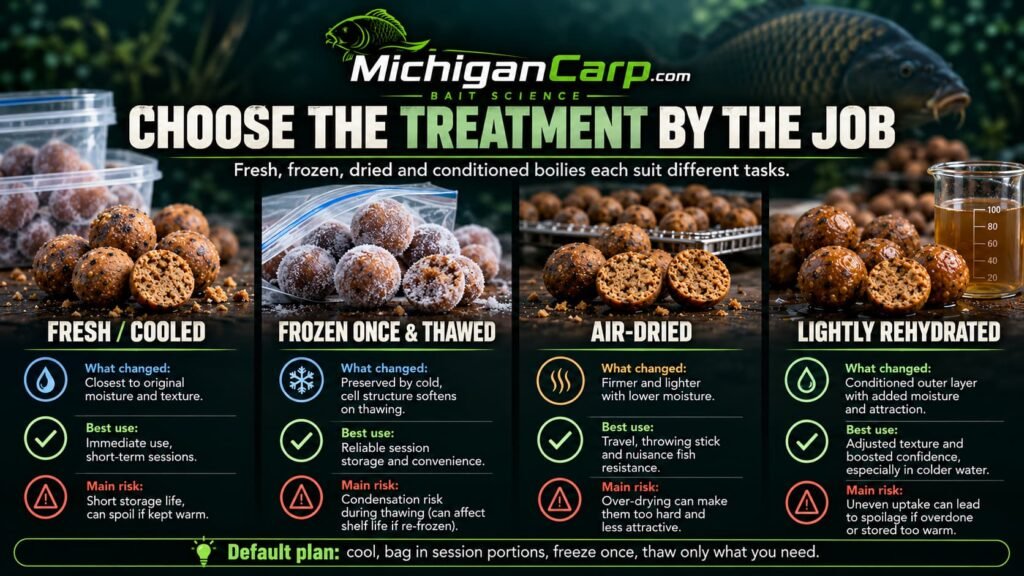
| Bait condition | Main change | Useful job | Main risk |
|---|---|---|---|
| Fresh / cooled | Closest to original cooked condition | Immediate use and comparison control | Short storage window |
| Frozen once and thawed | Preserved at low temperature; moisture may redistribute | Normal homemade-bait storage | Condensation and poor thawing control |
| Air-dried | Lower moisture and usually greater firmness | Travel, throwing sticks and nuisance resistance | Over-drying and brittleness |
| Lightly conditioned | Measured liquid returned to the surface | Adjust texture or add surface signal | Uneven uptake and storage problems |
| Repeated freeze-thaw | Repeated water and temperature movement | No routine advantage | Increasing inconsistency |
| Over-dried / over-soaked | Treatment dominates the original bait design | Experimental control only | Poor texture and unpredictable performance |
For most homemade freezer bait, my default system is straightforward:
Cool → surface-dry → portion → freeze once → thaw only what is required.
Then modify only the portion that needs a different job.
That is more controllable than treating the entire supply identically.
What Freezing and Thawing Really Do
Freezing is one of the most useful preservation methods available to the home bait maker.
Low temperature greatly slows microbial activity and many reactions that reduce food quality.
It does not sterilize the bait.
The USDA guidance on freezing makes the distinction clearly: microorganisms may become inactive while frozen and become active again after thawing.
For boilie making, the practical lesson is simple.
Freezing buys storage time. It does not make careless handling irrelevant.
Water Does Not Simply Stop Moving Forever
As temperature falls, some of the water inside the boilie becomes ice.
Water associated with proteins, starches, sugars, salts and other components does not necessarily behave exactly like freer water in pores and channels.
As ice forms, the remaining unfrozen phase may become more concentrated.
Research on frozen dough and starch/protein food systems shows that freezing and thawing can redistribute water and alter matrix structure.
See Effects of Freezing Rate on Starch Gel Structure and Frozen Dough Water Redistribution and Structure.
A boilie is not bread dough.
Those studies therefore do not tell us exactly how much a particular carp bait changes.
They do support the more restrained conclusion:
freezing preserves the bait, but it should not be described as a complete structural pause.
Packaging Matters
Air exposure encourages freezer burn and surface dehydration.
For boilies, that may appear as:
- pale dry patches;
- unusually tough outer areas;
- freezer odour;
- inconsistent rehydration;
- or surface cracking.
Use appropriately sized freezer bags.
Push excess air out.
Freeze the bags reasonably flat rather than packing a large warm mass into one deep container.
Session-sized portions also reduce the amount of bait that must be thawed each time.
What Happens During Thawing?
When frozen bait warms, ice melts and water begins redistributing through the matrix.
Moisture inside the bag can come from more than one source.
Some may have moved out of the boilie.
Some may contain dissolved bait material.
Some can simply be condensation produced as cold surfaces meet warmer humid air.
That is why liquid in the bottom of a thawing bag should not automatically be described as a concentrated attractor.
If the bait is clean and smells normal, that liquid can be mixed back through the same session portion if desired.
But it may also make the bait wetter than intended.
If the bait smells sour, stale, rancid or otherwise wrong, adding the liquid back is not the answer.
Reject the questionable portion.
Why Repeated Freeze-Thaw Cycles Are a Poor Default
One controlled freeze and thaw is normal freezer-bait practice.
Repeated cycling is different.
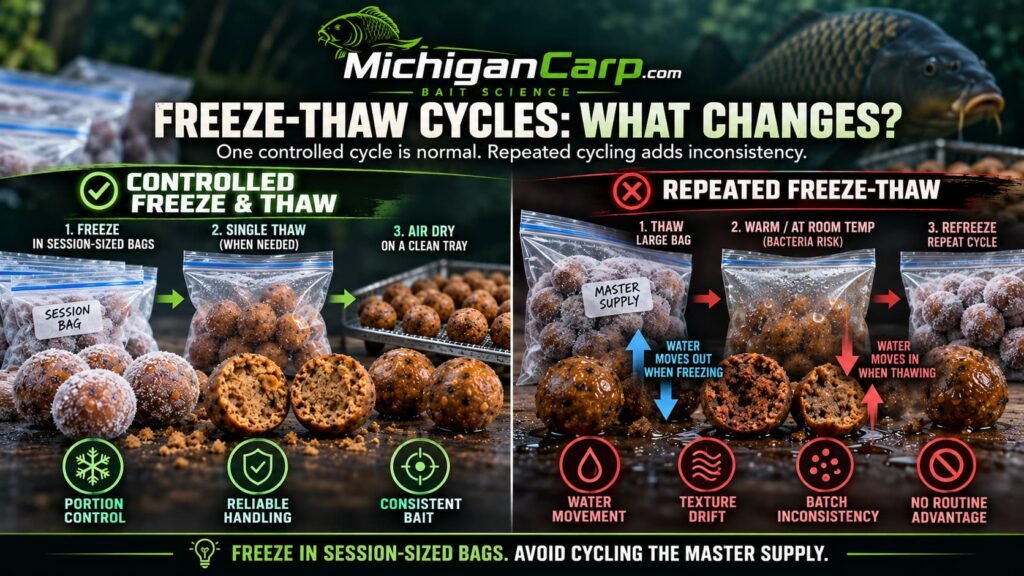
The problem normally begins with one oversized bag.
You thaw it.
Use half.
The remainder warms on the bank.
Then it goes back into the freezer.
The same process may happen again on the next trip.
Every cycle provides another opportunity for:
- water redistribution;
- condensation;
- structural change;
- temperature exposure;
- surface softening;
- cracking;
- and batch-to-batch inconsistency.
The exact effect is formula dependent.
A repeatedly cycled boilie is not guaranteed to become softer.
It is not guaranteed to become more porous.
It may become softer, harder, more brittle, more fractured or simply less consistent.
That uncertainty is the problem.
If you want to deliberately change a bait, there are better tools:
- controlled additional drying;
- light conditioning;
- crumb;
- paste;
- chops;
- a softer free bait;
- or a deliberately tougher hookbait.
Those treatments can be measured.
Repeated uncontrolled freeze-thaw cycling is much harder to interpret.
Portion Control Solves Most of the Problem
For three- to five-day sessions, I prefer separate frozen portions.
For example:
- Day 1 bag;
- Day 2 bag;
- Day 3 bag;
- reserve bag;
- separate dedicated hookbait tub.
Only thaw what is likely to be used.
A small spare frozen bag is better than repeatedly thawing the master supply.
What Air-Drying Really Changes
Air-drying removes moisture.
That sounds simple, but the finished result depends on much more than elapsed time.
Drying rate depends on:
- temperature;
- relative humidity;
- airflow;
- bait diameter;
- tray depth;
- formula;
- fat level;
- soluble ingredients;
- and the amount of water present when drying begins.
That is why instructions such as “dry for three days” should be treated as process notes rather than universal specifications.
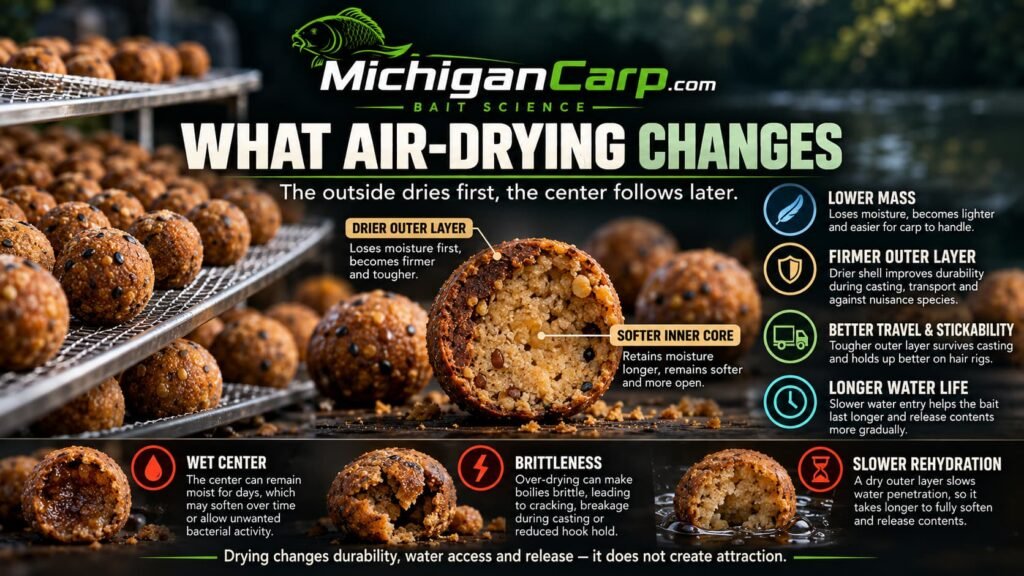
The Outside Dries First
Water leaves the exposed surface first.
Moisture deeper inside the boilie then has to migrate toward that drier region before it can escape.
This produces a moisture gradient.
In a 20–24 mm boilie, the outside may feel hard while the centre remains considerably softer and wetter.
That is particularly important with mixes containing substantial levels of:
- milk proteins;
- sugars;
- humectants;
- fats;
- fine binders;
- and dense protein ingredients.
Cutting representative boilies through the centre tells you far more than squeezing the outside.
For practical drying checks, use How to Tell When Boilies Are Dry Enough.
Drying Increases Durability
As water is lost, the bait normally becomes firmer.
That can be useful.
Additional drying may improve:
- throwing-stick durability;
- transport;
- baiting by hand or catapult;
- resistance to panfish;
- resistance to crayfish;
- hookbait attachment;
- and overnight rig life.
But there is a point beyond which additional drying stops being helpful.
Over-drying may produce:
- brittle skins;
- cracking;
- difficult needling;
- slow water uptake;
- internal checking;
- or a boilie that is mechanically harder than the fishing situation requires.
For the broader texture discussion, use How Bait Texture Affects Carp Feeding Confidence.
Drying Does Not Manufacture Attraction
This is an important distinction.
Removing water can increase the concentration of non-volatile solids per gram of dried bait.
It does not create new amino acids, sugars, salts or nucleotides.
Nor is there a universal rule that says a dried boilie remains “closed” for a period and then suddenly releases a stronger signal.
Drying can sometimes slow initial water entry because the outer layer has become more resistant.
What drying definitely changes is the relationship between:
durability → water access → hydration → release.
Whether that improves the bait depends on the fishing situation.
See Why Some Carp Baits Leak Faster Than Others for the more detailed leakage discussion.
Hardness, Moisture and Water Activity Are Different
This distinction is critical when discussing dried boilies.
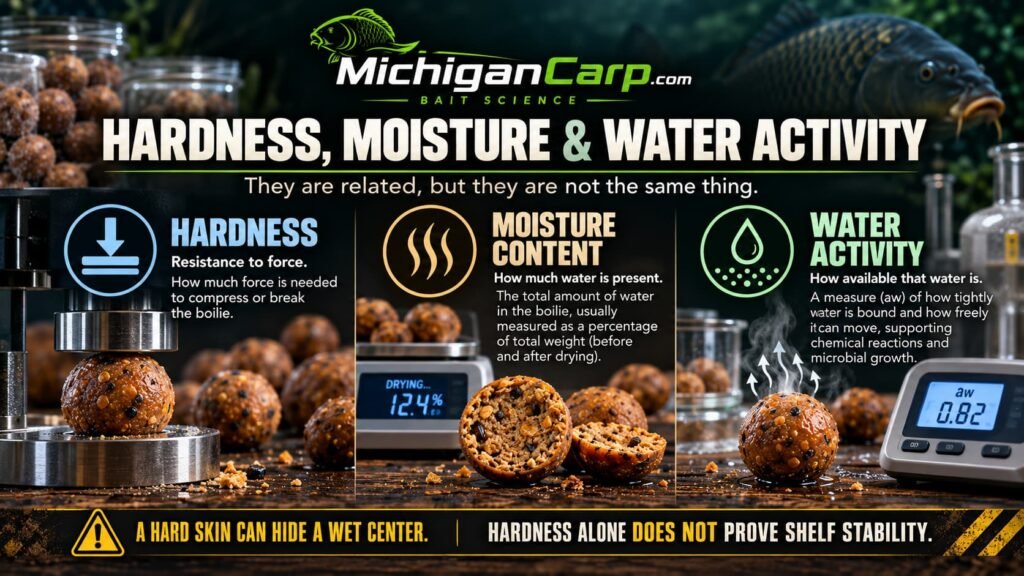
| Measurement | What it describes | What it does NOT prove |
|---|---|---|
| Hardness | Resistance to force | Moisture content or shelf stability |
| Moisture content | Amount of water present | How available the water is |
| Water activity | Availability of water in the finished product | Texture or attraction |
A hard boilie can still contain significant moisture.
A hard outer shell can hide a much wetter centre.
Likewise, a flexible bait containing glycerin, propylene glycol, sugars or water-binding ingredients may contain water without behaving like an untreated wet bait.
The FDA water-activity guidance explains why total moisture and water availability are different concepts.
For homemade freezer bait, this distinction does not need to become complicated.
You do not need to prove room-temperature shelf stability if the bait is going into the freezer.
Cool it.
Allow excess surface moisture to escape.
Freeze it.
For any bait intended to sit at ambient temperature for extended periods, hardness alone is not validation.
That requires a complete preservation system involving formulation, moisture, available water, pH where relevant, preservatives, packaging and retained-sample testing.
For practical drying and storage decisions, use How to Tell When Boilies Are Dry Enough and How to Store Homemade Boilies.
Rehydrating and Conditioning Dried Boilies
Rehydration means adding water back to something that has lost water.
Anglers often use the term more loosely for almost any liquid treatment.
Those are not necessarily the same thing.
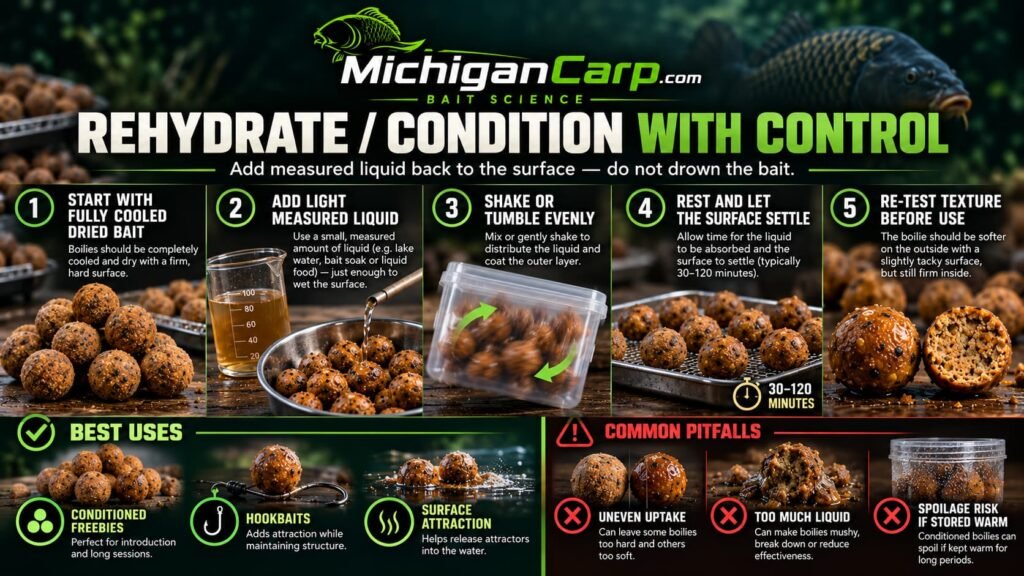
A water-based liquid food can contribute to actual hydration.
A hydrolysate solution may add water and dissolved material.
An oil-rich liquid may primarily coat the outside.
A viscous glycol/glycerin treatment may behave differently again.
The important question is not simply:
How much liquid will the bait absorb?
It is:
What do I want the treatment to change?
How Liquid Enters a Dried Bait
Several mechanisms may operate together:
- surface wetting;
- capillary movement;
- diffusion;
- hydration of proteins, starches and fibres;
- penetration through cracks and connected pores.
Uptake is normally fastest at the surface.
The centre of a large or densely cooked boilie may change much more slowly.
A glossy exterior therefore does not prove that liquid has reached the centre.
If penetration matters, weigh samples before and after treatment and cut representative boilies open.
Light Conditioning Is Usually Easier to Control
I prefer to give a liquid treatment a defined job.
For example:
- soften an overly dry outer skin;
- create a tacky surface for powder coating;
- add a soluble outer food signal;
- carry a measured flavour package;
- condition a hookbait for a specific session.
A practical controlled method is:
- Start with completely cooled bait.
- Measure the bait weight.
- Measure the liquid.
- Apply a small quantity.
- Shake or tumble until evenly coated.
- Allow the bait to rest.
- Retest the texture and attachment.
- Add more only if the first treatment justifies it.
Do not pour liquid into a tub until the boilies are swimming and call that precision.
Over-Soaking Creates New Problems
Too much liquid can:
- soften attachment points;
- weaken bait screws;
- alter a wafter’s balance;
- reduce pop-up buoyancy;
- make free bait sticky;
- increase storage risk;
- and change the bait more than intended.
A boilie being capable of absorbing a liquid does not mean that absorbing the maximum possible quantity improves it.
For the practical treatment workflow, use How to Prepare Boilies for Carp Fishing.
For carrier choice, see Propylene Glycol vs Glycerin in Carp Bait.
Match the Treatment to the Fishing Session
There is no reason every boilie from a batch has to receive the same treatment.
That is one of the most useful practical lessons.
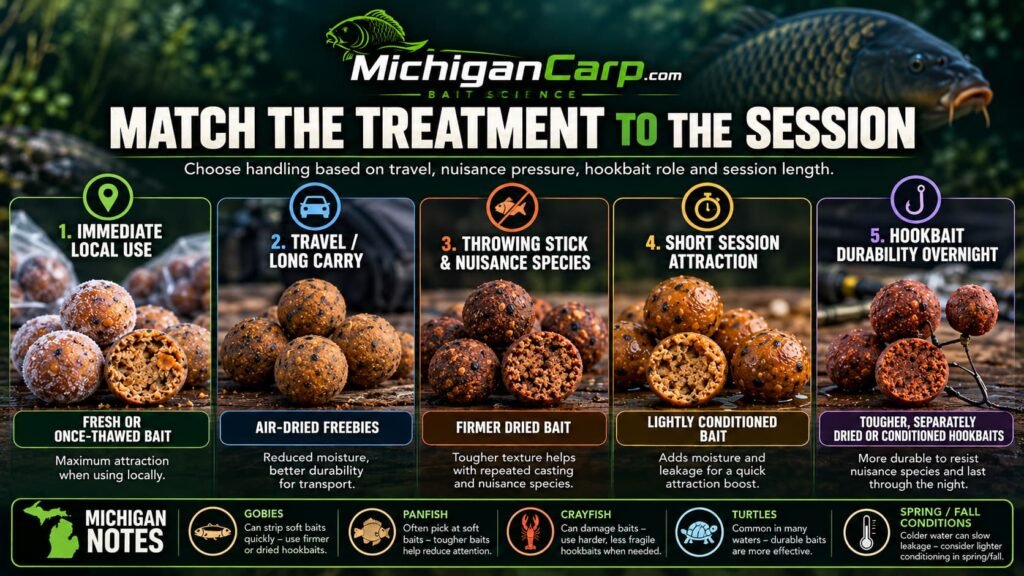
| Situation | Starting approach | Reason |
|---|---|---|
| Immediate local fishing | Fresh or once-thawed bait | Minimal extra processing |
| Long travel / boat-in session | Session-portioned frozen bait | Better control and convenience |
| Throwing-stick work | Additional measured drying | Improved mechanical strength |
| Heavy panfish or crayfish | Firmer free bait plus tougher hookbait | Resistance where needed |
| Short cold-water session | Once-thawed free bait with optional light treatment | Avoid unnecessarily slow, hard bait |
| Overnight hookbait | Dedicated tougher hookbait | Attachment and nuisance resistance |
| Multi-day trip | Separate daily freezer portions | Avoid repeated cycling |
Michigan Spring and Fall
Cold water can slow many physical processes, including hydration and diffusion.
That means a heavily dried 24 mm boilie may remain firm for considerably longer in cold spring water than it does in midsummer.
In cold conditions I generally prefer:
- normal freezer free bait;
- crumb or chops for fast local signal;
- light surface conditioning where useful;
- and tougher bait only where the hookbait actually needs it.
I would not automatically make all free bait harder simply because the water is cold.
Summer Sessions
Warm water can accelerate water uptake and physical breakdown.
Warm bankside temperatures also make storage control more important.
Additional drying may help durability.
It does not replace sensible storage.
Keep thawed bait shaded and cool.
Do not leave milk-, nut- and egg-based bait cooking in a hot vehicle.
Three- to Five-Day Sessions
For the longer sessions I fish in Michigan, portion control is more useful than repeatedly treating the same bulk supply.
My preferred structure is:
- frozen daily free-bait portions;
- one reserve frozen portion;
- dedicated tougher hookbaits;
- small treatment quantities mixed only as needed.
If I condition a batch on the bank, it becomes that session’s conditioned bait.
I do not pour unused wet bait back into the untouched master supply.
A Simple Controlled Comparison
If you want to know what freezing, drying or rehydrating actually does to your own boilie, compare matched samples.
Do not rely on general bait-making folklore.
Take boilies from the same batch.
Keep:
- formula;
- diameter;
- boiling time;
- initial drying;
- and ingredient package
the same.
Then create four groups:
| Group | Treatment |
|---|---|
| Control | Normal fresh/cooled or standard once-thawed bait |
| Frozen | Frozen in a session portion and thawed once |
| Dried | Given a defined additional drying period |
| Dried + conditioned | Same dried bait plus a measured liquid treatment |
Record the starting weight of each group.
Cut representative samples.
Photograph the centre.
Check:
- surface firmness;
- centre firmness;
- cracking;
- skin thickness;
- smell;
- attachment strength.
Then immerse matched samples at the temperature you expect to fish.
Useful test points include:
1 hour → 6 hours → 12 hours → 24 hours
where those times are relevant to the intended session.
At each point compare:
- mass change;
- diameter;
- surface texture;
- centre texture;
- cracking;
- erosion;
- attachment;
- breakdown.
If testing wafters or pop-ups, use the exact rig.
Do not infer buoyancy from an untreated bait after treating another one with liquid.
For the complete testing system, use How to Test Boilies Before Fishing.
Common Handling Mistakes
Most problems are created by uncontrolled treatment rather than by freezing, drying or conditioning themselves.
| Mistake | Why it causes trouble | Better approach |
|---|---|---|
| Freezing warm bait | Traps moisture and encourages clumping | Cool and surface-dry first |
| One huge freezer bag | Encourages repeated thawing | Freeze session portions |
| Assuming thaw-bag liquid is pure attractor | Some may be condensation | Judge the complete bait condition |
| Judging dryness by hardness | Hard skin can hide wet centre | Cut samples and track mass |
| Calling hard bait shelf-life bait | Hardness does not prove stability | Freeze unless preservation is validated |
| Pouring on unmeasured glug | Eliminates repeatability | Weigh or measure treatments |
| Drying all bait like hookbait | Free bait may become unnecessarily hard | Separate the two jobs |
| Treating without a control | You cannot tell what changed | Keep matched untreated samples |
| Repeated refreezing | Adds uncontrolled cycling | Use smaller frozen portions |
| Treating the master supply | One error affects everything | Treat only the amount required |
The objective is not to avoid changing bait.
The objective is to change it deliberately.
FAQ
Does freezing ruin boilies?
No. Freezing is one of the most useful preservation methods for homemade boilies. It can change water distribution and physical structure, but that is very different from saying it ruins the bait.
Should boilies be dried before freezing?
They should be completely cool and sufficiently surface-dry that steam, condensation and obvious external wetness are not trapped in the bag. They do not need to be dried extremely hard before freezing.
How long should boilies dry before freezing?
There is no universal time. Twelve to twenty-four hours may be a practical starting range for many freezer baits, but diameter, formula, humidity and airflow matter. Judge the bait rather than the clock alone.
Can thawed boilies be refrozen?
They can physically be frozen again, but repeated freeze-thaw cycling adds another variable and may reduce consistency. Session-sized portions are the better routine system.
Is liquid in a thawing bag concentrated attractor?
Not necessarily. It may contain material released from the bait, but some moisture may also be condensation. Do not assume all bag liquid is valuable bait extract.
Are hard air-dried boilies shelf stable?
Not automatically. Hardness and shelf stability are different things. A hard outer layer may still surround a moist centre.
Do dried boilies become more attractive after rehydration?
Not automatically. Conditioning changes surface moisture and may add soluble ingredients, but the result depends on the liquid, bait matrix, temperature and treatment time.
Can glugging alter a wafter or pop-up?
Yes. Added liquid increases mass and can soften the structure. This can change buoyancy and attachment, so always soak-test the finished treated hookbait.
Should free bait and hookbaits be dried the same amount?
Not necessarily. Free bait generally needs to remain food-like and functional. Hookbaits may require greater durability and attachment strength.
What is the best way to freeze homemade boilies?
Cool them, allow excess surface moisture to escape, divide them into useful session-sized portions, remove excess air from the packaging and freeze them promptly.
Next Steps
Use How to Store Homemade Boilies for freezer, dried and preserved storage decisions.
Use How to Boil and Dry Boilies Properly for the production process before storage.
Read How Bait Texture Affects Carp Feeding Confidence for the difference between firmness, toughness and brittleness.
How to Tell When Boilies Are Dry Enough covers practical drying checks, internal condition and storage readiness.
How to Store Homemade Boilies covers freezer, dried and preserved storage decisions, including the difference between a bait feeling dry and actually being suitable for storage.
Use Why Some Carp Baits Leak Faster Than Others for structure and leakage.
Use How to Prepare Boilies for Carp Fishing for glugs, sprays and hookbait conditioning.
Use How to Test Boilies Before Fishing for controlled immersion testing.
Return to Bait Science for the technical library or Boilie School for the complete boilie-making route.