

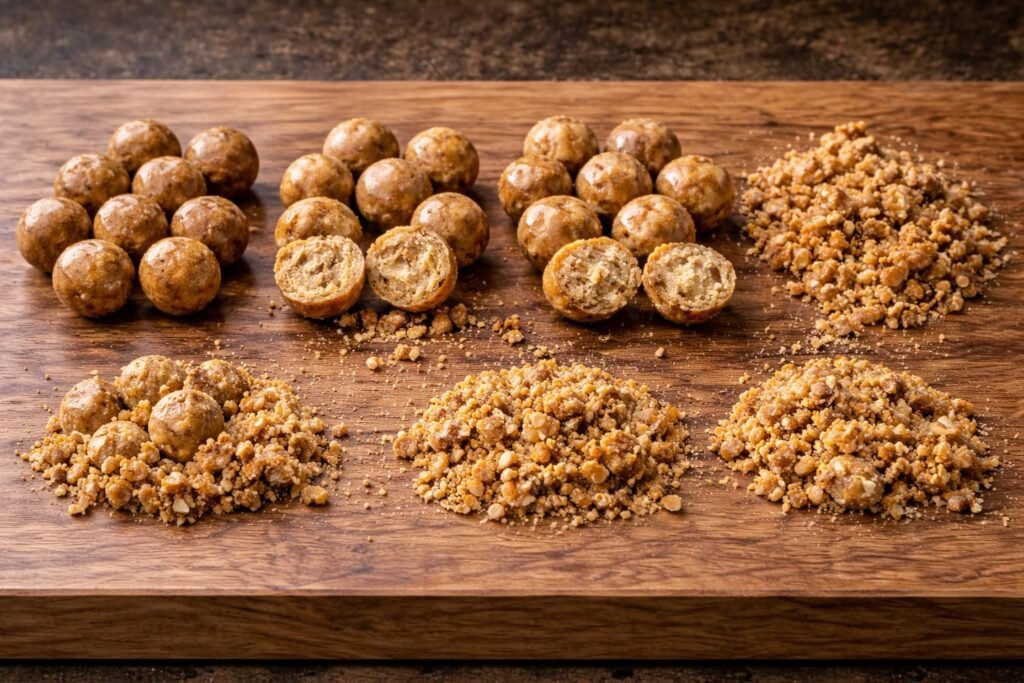
Every bait has a lifespan once it hits the water.This article will explain why some carp baits break down faster than others.
Some hold together for a day or more. Some soften steadily over a session. Some leak hard for an hour and then seem to die. Some collapse much faster than you expected.
None of that is random.
Breakdown rate is controlled by the bait’s structure, binders, solubility, drying level, and how easily water can get in once the bait lands.
That is why two baits made from very different ingredients can behave completely differently, even if they look similar in the hand.
This page is about what actually controls breakdown: binders, starches, egg, milk proteins, soluble ingredients, drying, and bait format. It is the practical partner to Osmosis, Water Movement, and Bait Breakdown, which explains the physical side. This page explains the ingredients and construction choices that make those physics play out differently from bait to bait.
Quick Start
- Breakdown rate is controlled mainly by structure, not just by flavour or protein level
- Egg, starch, and gluten are the main structural binders in many boilies
- More soluble ingredients usually mean faster leak-off and faster loss of mass
- More drying usually means a slower start and a longer-lasting bait
- Smaller baits, chopped baits, crumb, and paste all break down much faster than whole boilies
- Warm water speeds up breakdown; cold water slows it down
- A bait that breaks down quickly is not always better
- A bait that lasts forever is not always better either
What Actually Holds a Bait Together
A bait stays intact because it has a structural skeleton.
That skeleton is usually built from a combination of:
- egg protein
- starch
- gluten
- certain milk proteins
- the physical packing of the dry ingredients
The stronger that structure, the slower the bait usually breaks down.
The more open, porous, or soluble the structure, the faster it usually gives up water, solubles, and physical integrity.
Egg Protein: The Main Binder
Egg is still the most common binder in boilies for a reason.
When the bait is boiled, the egg proteins denature and set. That creates a network that locks the rest of the ingredients together.
More egg usually means:
- tougher skin
- stronger structure
- more casting durability
- slower breakdown
- a more rubbery finish if pushed too far
Less egg usually means:
- a looser bait
- more porosity
- quicker water ingress
- faster softening
- less durability
This is one of the first places to look when a bait is breaking down too quickly or, on the other side, becoming too hard and too sealed.
Starch: The Quiet Structural Workhorse
A lot of boilie structure comes from starch.
Starch-based ingredients include things like:
- semolina
- maize flour
- rice flour
- potato products
- some biscuit and cereal meals
When boiled, these starches absorb water and gelatinise. That helps glue the bait together.
But not all starches behave the same way.
Semolina
Semolina is a strong all-round structural ingredient.
It tends to give a durable, balanced boilie with a good middle-ground breakdown rate.
Maize flour or polenta
These can make a bait slightly more brittle or crumbly depending on the rest of the mix.
Rice flour
Usually gives a smoother, finer, quicker-opening structure.
Potato-based starches
These tend to absorb water strongly and can help produce a softer, more porous breakdown.
So when anglers talk about a bait being “too stiff” or “too open,” starch choice is often part of the answer.
Wheat Gluten: Small Amount, Big Effect
Wheat gluten is one of the strongest structural additions you can use.
It forms elastic strands when hydrated and worked through the mix. In bait terms, it makes the final boilie:
- tougher
- more resilient
- more resistant to casting damage
- slower to take on water
- slower to break down
That can be useful on:
- nuisance-fish waters
- long sessions
- hard-cast situations
- rivers or flowing water
But there is a trade-off.
Too much gluten can seal a bait up and make it overly tough. You gain structure, but you lose some of the bait’s ability to open and speak.
Milk Proteins and Structure
Milk proteins can affect breakdown rate in very different ways.
Caseins
Caseins usually strengthen structure and slow things down.
They tend to help produce:
- smoother baits
- harder finished texture
- more food-source character
- slower breakdown
Whey proteins
Whey proteins do the opposite.
They tend to make the bait:
- more soluble
- more active
- more open
- more likely to soften faster
Caseinates
Caseinates sit in the middle in a very useful way, especially when buoyancy or hookbait function matters.
The practical point is simple:
milk proteins are not just there for food value — they also change how the bait physically behaves in water.
The Soluble vs Insoluble Balance
This is the most important breakdown concept of all.
Every bait contains a balance of:
- ingredients that stay in place and hold structure
- ingredients that dissolve and leave
If the bait contains too much soluble material, it may:
- leak fast
- soften too quickly
- lose mass quickly
- collapse when the soluble fraction washes out
If the bait contains too little soluble material, it may:
- stay hard
- hold shape
- resist breakdown
- say very little in the water
That is why breakdown rate is not really about one ingredient.
It is about the balance between the bait’s structural skeleton and its wash-out fraction.
Drying Changes Everything
Drying has a huge effect on how long a bait lasts.
A freshly finished bait still holds more internal moisture.
An air-dried bait is more concentrated, harder on the outside, and slower to take water back in.
That means drying usually gives you:
- a harder skin
- slower initial wake-up
- better durability
- longer bait life in water
But again, the trade-off matters.
A heavily dried bait may last far longer, but it may also take longer to start speaking properly.
That is why very hard campaign bait can be excellent over time but poor in short day sessions if it is left untreated.
Whole Baits, Chops, Crumb, and Paste
Physical format is one of the biggest practical levers you have.
Whole boilies
These break down the slowest because the skin is intact and the surface area is relatively low.
Chopped boilies
These break down much faster because the inner structure is exposed.
Crumb
This is one of the fastest ways to release signal. The structure is already broken and surface area is huge.
Paste
Paste has no boiled skin at all, so it is one of the fastest breakdown formats available.
That is why you often see the best practical baiting built in layers:
- whole boilies for duration
- chops for medium-speed leakage
- crumb or paste for immediate signal
For the physical side of that, read Osmosis, Water Movement, and Bait Breakdown.
Temperature Multiplies Everything
Warm water speeds up breakdown.
Cold water slows it down.
That affects:
- water ingress
- soluble release
- softening
- bacterial activity
- general bait behaviour
So the same boilie can act like two completely different baits depending on season.
This is one reason anglers so often misjudge bait:
they test it once in summer, then assume it behaves the same in spring.
It does not.
What This Means in Practice
A bait that breaks down quickly is useful when you want:
- short-session response
- immediate attraction
- faster signal
- more local activity
A bait that breaks down slowly is useful when you want:
- longer bait life
- slower food release
- nuisance resistance
- longer campaigns
- sustained presence
The skill is not finding one “perfect” breakdown rate.
It is matching the breakdown rate to the job.
Michigan Notes
Michigan makes this especially important because water temperature changes so much through the year.
In spring and late autumn, a bait that is too hard and too tight can stay too quiet for too long. That is where:
- smaller sizes
- shorter boil times
- more open mixes
- chopped bait
- crumb
- treated hookbaits
often make more sense.
In summer, especially on longer sessions or waters with nuisance fish, stronger baits and slower breakdown often come back into their own.
On big Michigan waters, it is often better to use a layered baiting approach:
- fast signal for the early phase
- slower bait for the longer phase
- hookbait refreshed as needed
That gives you much better coverage than asking one bait form to do everything.
Common Mistakes
- using the same bait format in all conditions
- blaming fast breakdown on one ingredient instead of the whole structure
- over-drying and then expecting instant leakage
- overusing gluten and sealing the bait
- ignoring water temperature
- assuming longer-lasting always means better
- assuming quicker breakdown always means better
FAQ
What controls breakdown rate most?
Usually the balance between structure and solubility, shaped by binders, boil time, drying, and bait format.
Why do some boilies soften quickly?
Because water gets in fast and the soluble fraction starts leaving early.
Why do some boilies stay hard too long?
Usually too much structure, too much drying, too much egg, too much gluten, or too little soluble content.
Does chopping bait really make that much difference?
Yes. It increases surface area and bypasses the skin.
Is there an ideal breakdown rate?
Only for the job in front of you. A day session and a two-night campaign do not need the same bait behaviour.
Does warm water really speed it up that much?
Yes. It changes leakage, hydration, and physical softening far more than many anglers realise.
Next Steps
Read these next: