

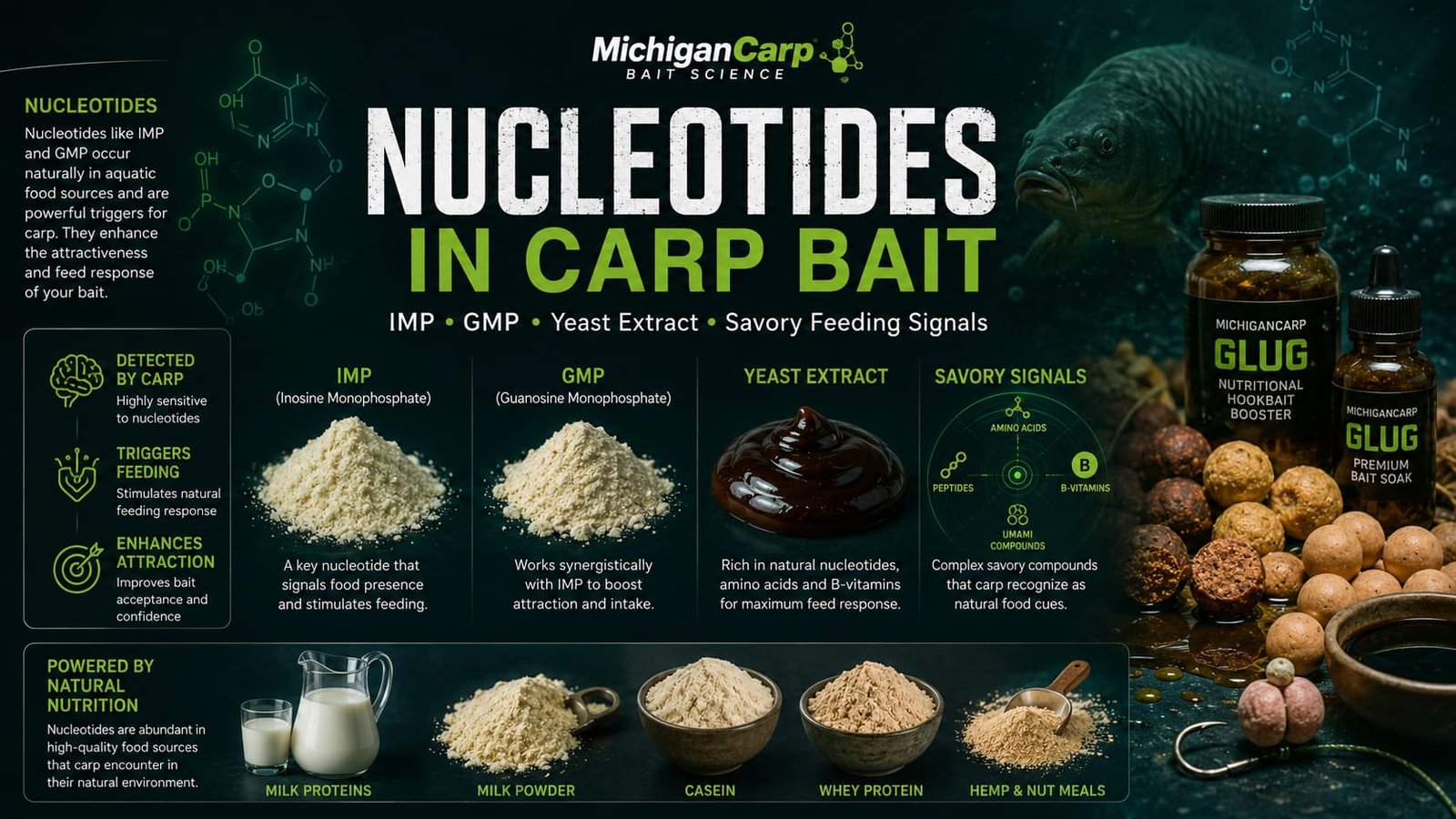
Nucleotides in carp bait are not talked about as often as amino acids, hydrolysates, betaine or liver, but they sit right in the middle of serious bait science.
If amino acids help explain part of the protein food signal, nucleotides help explain part of the savory food signal.
That is why bait makers talk about:
IMP.
GMP.
YEAST EXTRACT.
UMAMI.
SAVORY FEEDING SIGNALS.
NUCLEOTIDE-RICH FOOD INGREDIENTS.
LIVER, YEAST AND HYDROLYSATE SYSTEMS.
But nucleotides are easy to misunderstand.
They are not magic.
They are not a replacement for good bait.
They should not be poured into every mix at high levels.
They are powerful because they usually work at low levels, especially when they support real food ingredients such as yeast extract, liver hydrolysate, hydrolyzed whey, fish hydrolysate, milk proteins, birdfood, nut meals and boilie crumb.
This article explains nucleotides in carp bait, including IMP, GMP, yeast extract, savory feeding signals, how nucleotides differ from amino acids and betaine, practical inclusion rates, milk/nut boilies, hookbaits, glugs, sprays, powder coatings, packbait, particles, cold-water use, warm-water use and USA sourcing.
For the amino-acid side of bait attraction, read Amino Acids in Carp Bait.
For betaine, read Betaine in Carp Bait.
For yeast, CSL and fermented liquids, read Yeast and Fermented Additives in Carp Bait.
For hydrolysates, read How to Use Hydrolysates in Carp Bait.
The simple rule is:
NUCLEOTIDES ARE LOW-LEVEL SAVORY SUPPORT ADDITIVES.
USE THEM WITH FOOD SIGNALS, NOT INSTEAD OF FOOD SIGNALS.
Table of Contents
Quick Start: How to Use Nucleotides in Carp Bait
Use this table first.
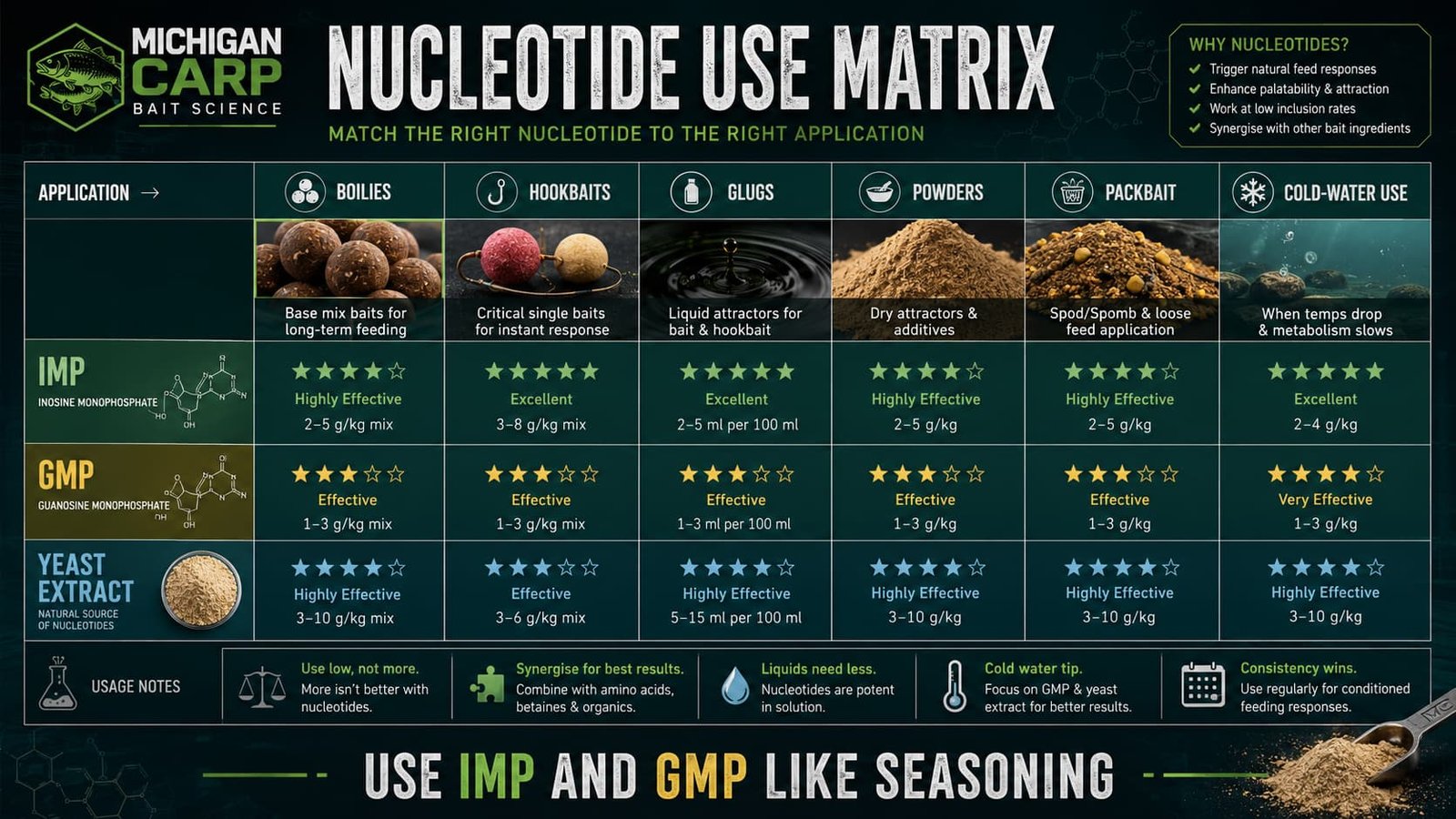
| Use | Best Ingredient | Starting Level | Main Benefit | Main Warning |
|---|---|---|---|---|
| Boilie base mix | IMP/GMP powder, yeast extract | 1–5 g/kg dry mix | Savory support and low-level palatability signal | Easy to overdo |
| Milk/nut boilies | IMP/GMP with whey, yeast and beef liver | 1–3 g/kg dry mix | Adds savory depth without fishmeal identity | Keep the bait creamy/nutty |
| Fishmeal boilies | IMP/GMP with fish hydrolysate and liver | 2–5 g/kg dry mix | Supports strong savory bait profile | Do not stack every additive high |
| Hookbaits | IMP/GMP, yeast extract, hydrolysates | 3–8 g/kg hookbait mix | Stronger hookbait identity | Test taste, buoyancy and soak time |
| Glugs / sprays | Dissolved IMP/GMP in liquid carrier | 0.5–3 g per 100 ml | Low-level savory signal | Avoid harsh, salty liquids |
| Powder coating | IMP/GMP in food dust | 1–5% of dust blend | Fast outer savory signal | Do not use straight heavy nucleotide powder |
| Packbait / method | Yeast extract, IMP/GMP, crumb | 1–3 g/kg dry carrier | Adds food signal to carrier bait | Packbait mechanics still matter |
| Particles | Yeast/CSL plus low IMP/GMP | 0.5–2 g/kg prepared particles | Finishing signal | Safe particle prep comes first |
| Cold water | Low-level IMP/GMP dust or spray | Low end of range | Signal without heavy feed | Avoid overpowering the trap |
| Warm water | Moderate use in food bait | Middle of range | Supports richer feeding situations | Watch spoilage in wet mixes |
For most homemade boilies, a sensible starting range is:
1–3 g total IMP/GMP per 1 kg dry mix
For stronger hookbaits:
3–8 g total IMP/GMP per 1 kg hookbait mix
For powder coatings:
1–5 g total IMP/GMP per 100 g dust blend
Do not start high.
Nucleotides are precision additives, not bulk ingredients.
What Are Nucleotides?
Nucleotides are small biological molecules involved in many life-supporting pathways.
They are also the building blocks of nucleic acids.
For background on the fish-nutrition side, Li and Gatlin’s review of nucleotide nutrition in fish is a useful starting point, especially because it treats nucleotides as a developing aquaculture nutrition subject rather than a magic bait trigger.
In aquaculture feed research, dietary nucleotides have received attention because they may support growth, stress tolerance, immunity, intestinal function and feed palatability depending on species, diet and conditions. A major review on nucleotide nutrition in fish reported that dietary nucleotides may improve early growth, larval quality, intestinal structure, stress tolerance and immune responses in some fish studies. Nucleotide Nutrition in Fish: Current Knowledge and Future Applications.
For carp bait, the practical focus is narrower.
We are mostly interested in nucleotides because some of them can support savory taste and feed-attraction systems.
The two most important names for bait makers are:
IMP
and:
GMP
These are usually discussed as savory or umami-style compounds.
They are not the same as amino acids.
They are not the same as betaine.
They are their own low-level support category.
IMP and GMP Explained
IMP
IMP means inosine monophosphate.
In bait and food contexts, anglers and ingredient suppliers often see it as:
- IMP;
- 5′-IMP;
- inosine monophosphate;
- disodium inosinate;
- disodium 5′-inosinate.
Disodium inosinate is recognized in U.S. food regulations as a flavoring adjuvant. eCFR 21 CFR 172.535 — Disodium Inosinate.
GMP
GMP means guanosine monophosphate.
In bait and food contexts, it may appear as:
- GMP;
- 5′-GMP;
- guanosine monophosphate;
- disodium guanylate;
- disodium 5′-guanylate.
Disodium guanylate is recognized in U.S. food regulations as a flavor enhancer in foods when used at levels reasonably required for the intended effect. eCFR 21 CFR 172.530 — Disodium Guanylate.
A useful overview is the University of Florida review, A Review of Feed Attractants as a Guide for Aquaculture Operations, which explains how feed attractants can target fish smell and taste systems while also warning that responses can be species-specific.
Older FAO training material on feeding stimulants for fish also discusses inosine and inosine-5-monophosphate in relation to feeding responses in some species, which helps explain why IMP became part of fish-feed attractant discussions.
Why They Matter in Bait
IMP and GMP matter because they can contribute to savory taste systems.
A 2025 aquaculture study on juvenile Chinese mitten crab described IMP and GMP as potent umami substances and palatability enhancers in aquatic feeds. Dietary Nucleotides Improve Growth of Juvenile Eriocheir sinensis.
That does not prove that every carp bait needs IMP and GMP.
It does support the bait-making logic behind low-level savory nucleotide use.
Nucleotides vs Amino Acids
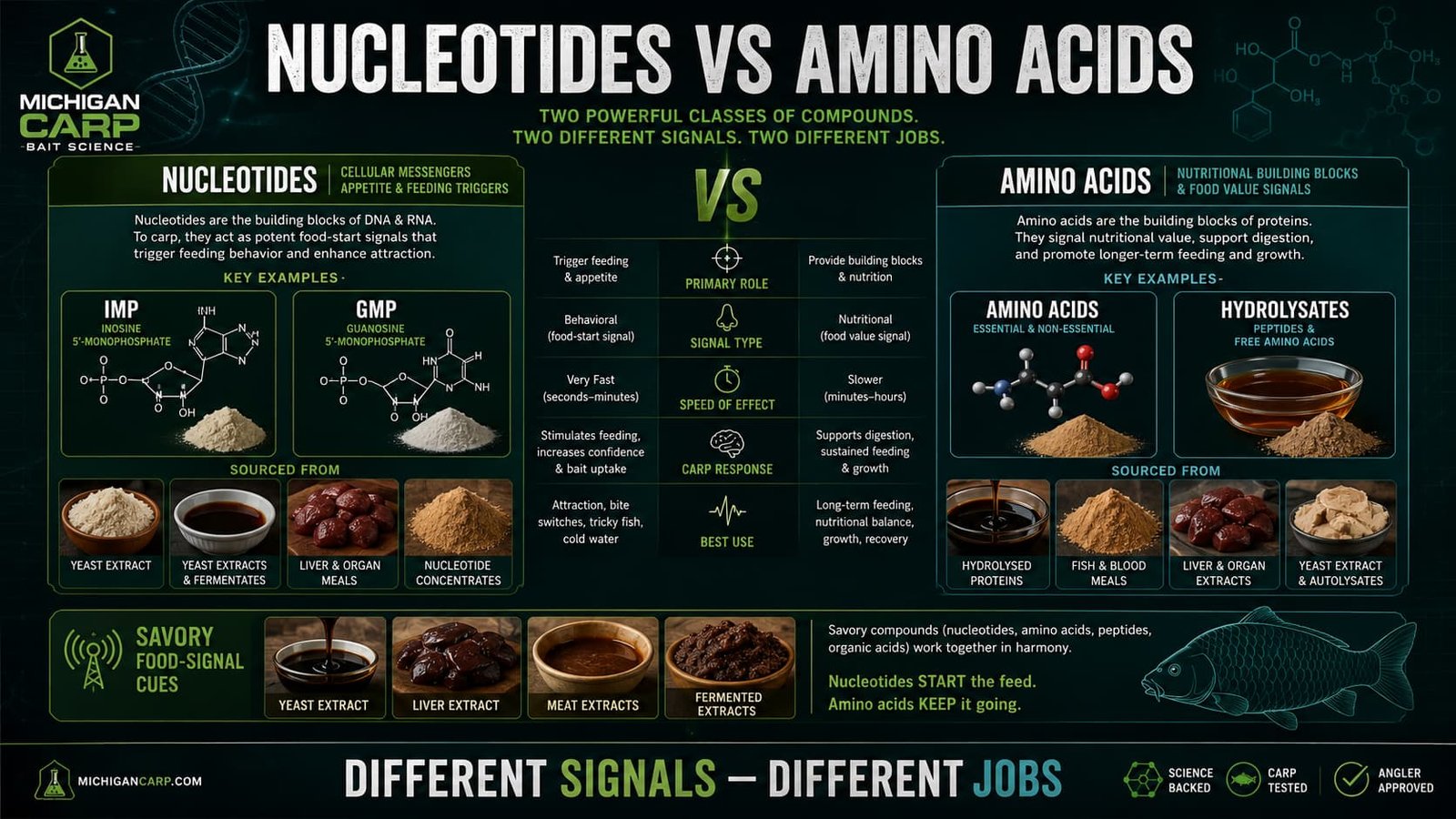
Nucleotides and amino acids are often discussed together, but they are not the same thing.
Amino Acids
Amino acids are the building blocks of proteins.
They are connected to:
- protein digestion;
- food value;
- hydrolysates;
- liver;
- whey;
- yeast;
- fish solubles;
- taste response;
- bait acceptance.
For the full amino acid guide, read Amino Acids in Carp Bait.
Nucleotides
Nucleotides are different molecules.
In bait making, they are usually used for:
- savory support;
- umami-style signal;
- palatability support;
- yeast-extract-style bait identity;
- low-level hookbait strengthening;
- support beside amino acids and hydrolysates.
Practical Difference
Use amino acids and hydrolysates for protein-food signal.
Use nucleotides for savory food-signal support.
Use both carefully if the bait needs it.
Do not turn every bait into a laboratory additive blend.
Nucleotides vs Betaine
Betaine is another small, powerful bait additive.
But it is not a nucleotide.
Betaine
Betaine is often discussed as:
- a feed attractant;
- a palatability support;
- an osmolyte;
- a methyl donor;
- a small soluble additive.
For the full guide, read Betaine in Carp Bait.
Nucleotides
Nucleotides are usually discussed more around:
- savory taste;
- yeast extract;
- IMP;
- GMP;
- umami-style support;
- low-level palatability.
Practical Difference
Betaine can support amino-rich food signals.
IMP and GMP can support savory food signals.
Both should be used low.
Neither should carry the bait alone.
A bait with betaine, IMP, GMP, yeast extract, liver hydrolysate and amino acids can become too strong quickly if each is pushed hard.
Why Yeast Extract Matters
Yeast extract is one of the most practical ways bait makers encounter nucleotide-style savory signal.
Yeast products can contain nucleotides, nucleic acids, amino acids, peptides, minerals and B-vitamin background depending on the product and processing. A 2023 study on yeast-extracted nucleotides and nucleic acids in European sea bass describes nucleotides and nucleic acids as functional ingredients with potential for low-fishmeal aquafeeds. Yeast-Extracted Nucleotides and Nucleic Acids as Functional Ingredients.
This is why yeast extract belongs in this article even though the full yeast guide is separate.
Yeast Extract Can Add
Yeast extract can add:
- savory depth;
- umami-style profile;
- soluble compounds;
- nucleotide-style background;
- amino acid background;
- feed-style smell;
- glug value;
- hookbait strength.
Practical Use
Use yeast extract in:
- milk/nut boilies;
- birdfood boilies;
- fishmeal boilies;
- hookbaits;
- glugs;
- powder coatings;
- packbait;
- method mix.
Warning
Yeast extract is strong.
It may be salty.
It may dominate a bait quickly.
Use it as a concentrate, not as a bulk ingredient.
For the full yeast article, read Yeast and Fermented Additives in Carp Bait.
Are Nucleotides Proven Carp Feeding Triggers?
This needs an honest answer.
There is useful aquaculture evidence that nucleotides can support palatability, feed intake or performance in some aquatic species.
The University of Florida feed-attractant review notes that nucleotides and nucleosides are used as feed attractants, and that IMP has shown strong results as a feed attractant for carnivorous fishes, while GMP, AMP, ADP, UMP and inosine have also been used. University of Florida Feed Attractants Review.
Older mariculture feed-stimulant work also discusses inosine and inosine 5′-monophosphate as specific feeding stimulants in species such as turbot and yellowtail, which shows why IMP became important in fish-feed attractant discussions. FAO Feeding Stimulants for Fish.
But that does not mean IMP and GMP are automatically proven carp triggers in every bait situation.
Species matter.
Concentration matters.
Background bait matters.
Water temperature matters.
Feeding state matters.
A carp boilie is not the same as a complete aquaculture feed pellet in a controlled trial.
Honest Practical Position
The honest position is:
- nucleotides are credible bait-support additives;
- IMP and GMP are worth understanding;
- yeast extract is a practical nucleotide-style ingredient;
- very low levels are usually enough;
- they probably work best with amino-rich and savory ingredients;
- they should not replace real food bait.
Why Very Low Levels Are Enough
Nucleotides are used for signal and palatability support, not bulk nutrition in a boilie.
That means the levels should be small.
High levels can make bait:
- salty;
- harsh;
- artificial;
- expensive;
- unbalanced;
- additive-heavy;
- less clean.
The food regulation language for disodium guanylate and disodium inosinate is useful as a mindset: these compounds are flavor enhancers or adjuvants, not bulk food ingredients. eCFR 21 CFR 172.530 — Disodium Guanylate and eCFR 21 CFR 172.535 — Disodium Inosinate.
For bait making, that translates well.
Use IMP and GMP like seasoning, not flour.
Practical Inclusion Rates for IMP and GMP
Use these as starting points.
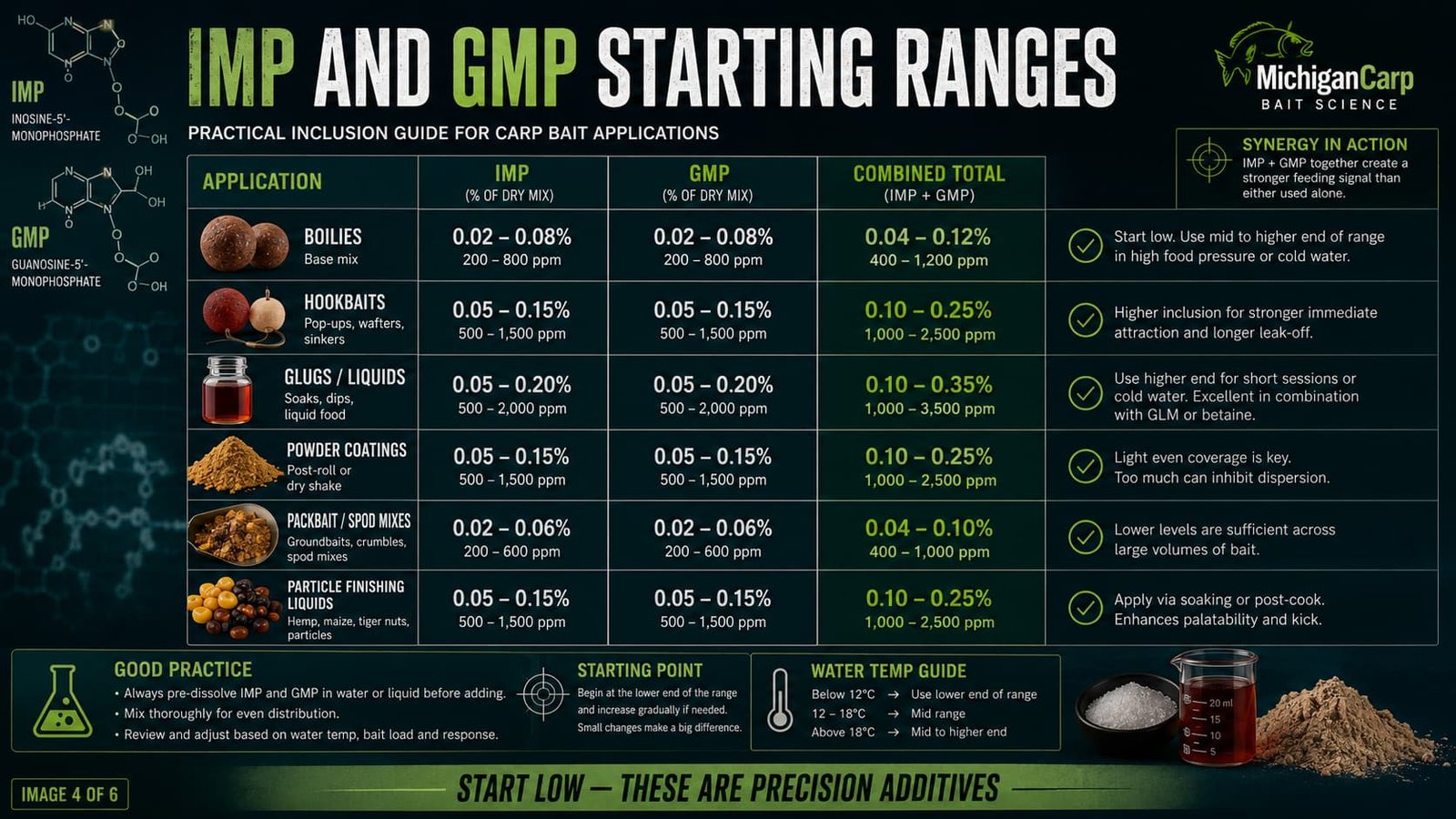
| Use | Starting Range |
|---|---|
| Subtle boilie support | 1–2 g total IMP/GMP per kg dry mix |
| General boilie use | 1–3 g total per kg dry mix |
| Stronger savory boilie | 3–5 g total per kg dry mix |
| Hookbait mix | 3–8 g total per kg hookbait mix |
| Glug / spray | 0.5–3 g per 100 ml liquid |
| Powder coating | 1–5 g per 100 g dust blend |
| Packbait dry carrier | 1–3 g per kg dry carrier |
| Particle finishing liquid | 0.5–2 g per kg prepared particles |
Practical Ratio
A simple practical ratio is:
50% IMP + 50% GMP
or:
60% IMP + 40% GMP
There is no need to overcomplicate the ratio at first.
The more important decision is the total level and the bait it is supporting.
My Own Starting Point
For most milk/nut or birdfood boilies, I would start around:
2 g total IMP/GMP per 1 kg dry mix
For stronger hookbaits:
5 g total IMP/GMP per 1 kg hookbait mix
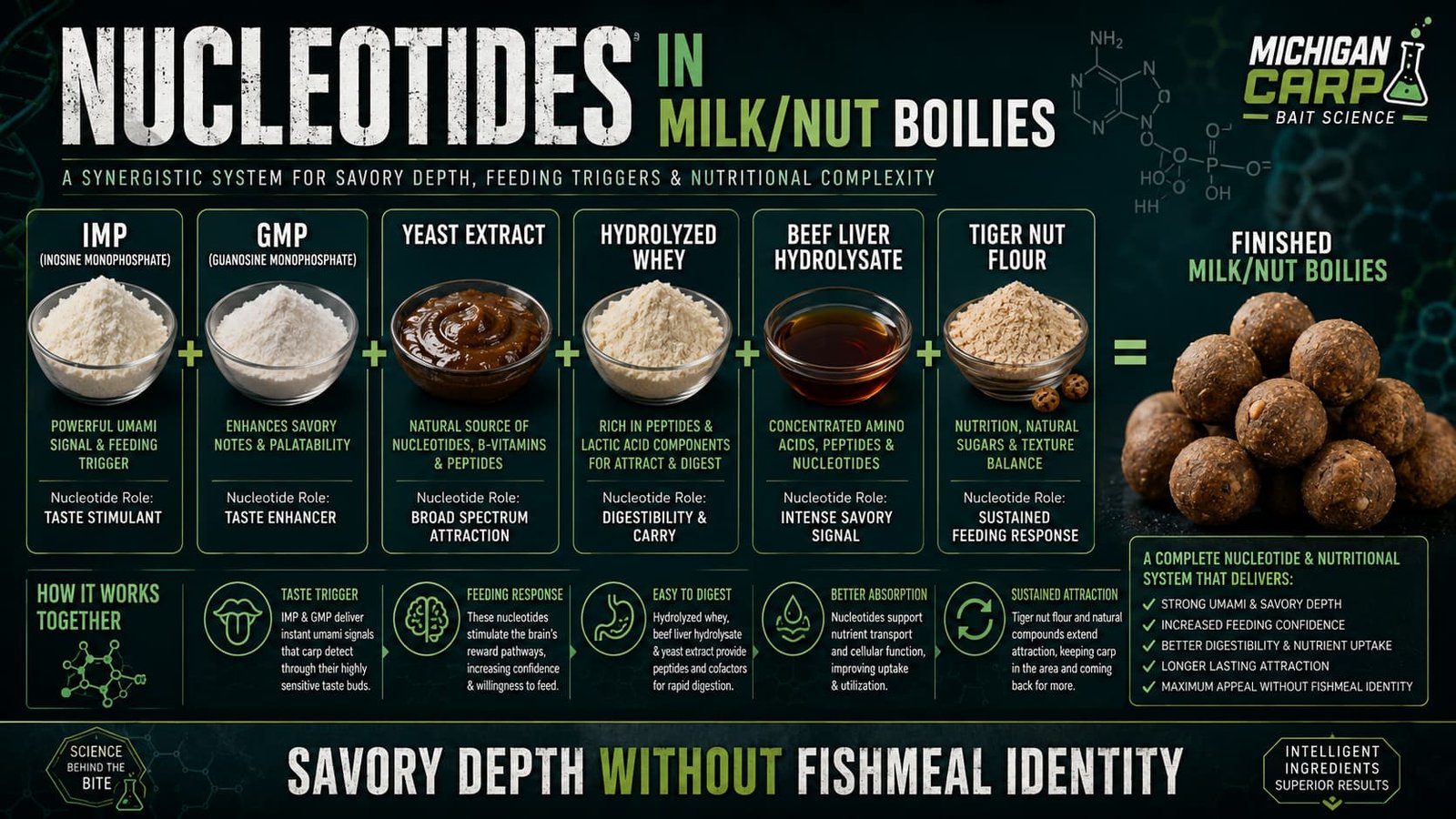
Then test.
IMP and GMP in Milk/Nut Boilies
This is one of the most interesting uses for nucleotides.
A milk/nut bait can be creamy, sweet, nutty and nutritious, but it sometimes benefits from a low-level savory backbone.
That is where IMP, GMP and yeast extract can help.
Good Pairings
Use IMP/GMP with:
- hydrolyzed whey;
- beef liver hydrolysate;
- brewer’s yeast;
- yeast extract;
- WPC80;
- skimmed milk powder;
- tiger nut flour;
- peanut protein;
- birdfood;
- betaine at low level.
Practical Milk/Nut Nucleotide Package
For 1 kg dry mix:
20 g hydrolyzed whey powder
20–30 g brewer’s yeast
10 g beef liver powder or liver hydrolysate powder
2 g anhydrous betaine
2 g total IMP/GMP
This is a strong but controlled soluble-support package.
It should be built into the recipe, not dumped on top of an already complete bait.
Liquid Side Support
For 1 kg dry mix:
15–25 ml liquid yeast
10–20 ml tiger nut extract
5–15 ml beef liver hydrolysate
2 g total IMP/GMP in dry mix
What to Avoid
Avoid:
- high IMP/GMP;
- high yeast extract;
- high liver hydrolysate;
- high betaine;
- high sweetener;
- too much oil.
A milk/nut bait should still taste like milk/nut food bait.
It should not taste like additive soup.
IMP and GMP in Fishmeal Boilies
Fishmeal boilies already contain strong savory food signals.
IMP and GMP can support that profile, but they can also push it too far.
Good Pairings
Use IMP/GMP with:
- fishmeal;
- predigested fishmeal;
- fish hydrolysate;
- liver hydrolysate;
- yeast extract;
- krill;
- squid;
- spices;
- betaine.
Starting Direction
For 1 kg dry mix:
20 g fish hydrolysate powder
10 g liver hydrolysate powder
5–10 g yeast extract
2–4 g betaine
2–4 g total IMP/GMP
This is already strong.
Do not push every savory ingredient to maximum.
Warning
Fishmeal bait can become too intense.
A bait with fish hydrolysate, liver hydrolysate, yeast extract, IMP, GMP, betaine, spice and oil can be powerful, but also harsh.
The bait still has to be eaten.
IMP and GMP in Birdfood Boilies
Birdfood boilies are good carriers for low-level nucleotide support because their texture helps release soluble ingredients.
Good Pairings
Use IMP/GMP with:
- brewer’s yeast;
- yeast extract;
- hydrolyzed whey;
- liver powder;
- birdfood;
- milk powder;
- boilie crumb;
- betaine.
Practical Birdfood Nucleotide Package
For 1 kg dry mix:
40 g brewer’s yeast
10 g yeast extract or autolyzed yeast
10 g hydrolyzed whey
1–3 g total IMP/GMP
This adds savory depth without overwhelming the open birdfood structure.
Warning
Do not make an open birdfood bait sticky and heavy with too much liquid yeast, CSL or strong savory concentrate.
The texture is part of the bait’s strength.
Nucleotides in Hookbaits
Hookbaits are one of the best places to test nucleotides.
A hookbait can be stronger than the free bait because it has a different job.
Best Hookbait Uses
Use IMP/GMP in:
- hard bottom bait hookbaits;
- corkball paste;
- wafters;
- pop-ups;
- dips;
- sprays;
- powder coatings;
- paste wraps;
- single hookbait traps.
Hookbait Starting Level
For 1 kg hookbait mix:
3–8 g total IMP/GMP
For very strong specialist tests:
8–10 g per kg can be tested, but should not be the default
Wafters
Use caution with liquid conditioners.
The nucleotide powder is not usually the issue.
The carrier liquid is the issue.
Test wafters with the actual hook after soaking.
Pop-Ups
Use low levels and test buoyancy after treatment.
A pop-up that smells excellent but stops popping up is a failed hookbait.
Nucleotide Glugs, Sprays and Soaks
IMP and GMP can be dissolved into bait liquids, but the carrier matters.
Simple Savory Nucleotide Spray
For 100 ml:
50 ml food-grade propylene glycol
30 ml food-grade glycerin
10 ml liquid yeast
5 ml beef liver hydrolysate
1 g IMP
1 g GMP
Top up to 100 ml with more PG or glycerin if needed.
Use lightly.
Milk/Nut Nucleotide Glug
For 250 ml:
90 ml food-grade propylene glycol
60 ml food-grade glycerin
40 ml tiger nut extract
30 ml liquid yeast
20 ml beef liver hydrolysate or hydrolyzed whey liquid
2 g total IMP/GMP
Use lightly on hookbaits or thawed freezer bait.
Same-Session Soluble Glug
For 1 kg boilies:
20 ml liquid yeast
10 ml beef liver hydrolysate
10 ml hydrolyzed whey liquid
1 g IMP
1 g GMP
Use same day or keep cool.
Warning
IMP and GMP do not make a wet glug shelf-stable.
If the glug contains water-rich liver, yeast, whey or CSL, treat the bait as short-term prepared bait.
For storage, read How to Store Homemade Boilies.
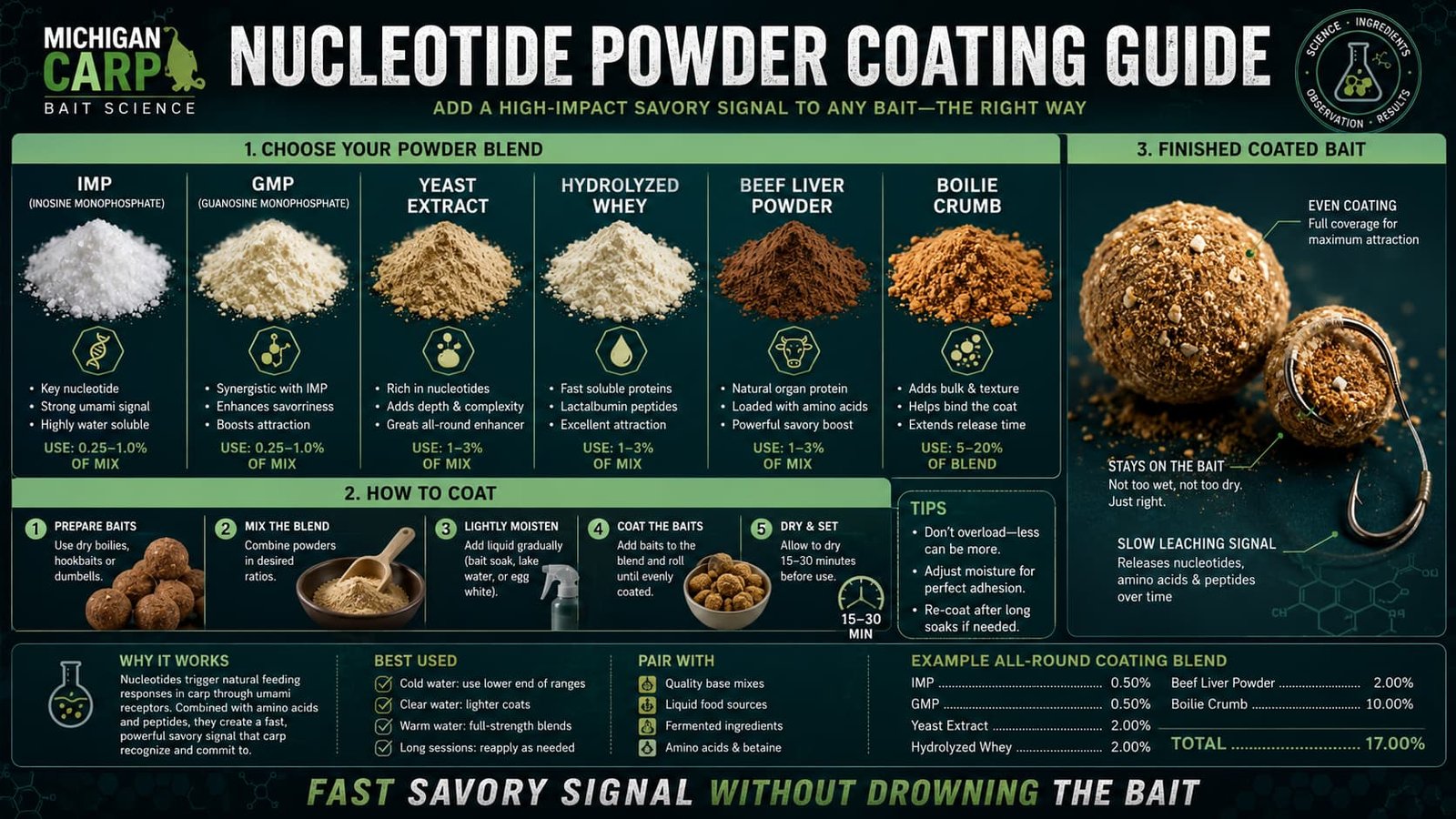
Nucleotide Powder Coatings
Powder coatings are one of the cleanest ways to use IMP and GMP.
They create a fast outer savory signal without drowning the bait.
100 g Milk/Nut Nucleotide Dust
30 g hydrolyzed whey powder
25 g fine boilie crumb
20 g brewer’s yeast
10 g beef liver powder
5 g tiger nut flour
5 g betaine
2.5 g IMP
2.5 g GMP
Total:
100 g
100 g Savory Nucleotide Dust
35 g fine boilie crumb
20 g beef liver powder
15 g brewer’s yeast
10 g hydrolyzed whey
5 g yeast extract
5 g fish hydrolysate or liver hydrolysate powder
5 g betaine
2.5 g IMP
2.5 g GMP
Total:
100 g
How to Use
- Lightly spray boilies or hookbaits.
- Add a small amount of dust.
- Shake gently.
- Let the coating settle.
- Repeat only if needed.
- Use soon or keep cool depending on moisture.
Practical Rule
Do not roll hookbaits in straight IMP and GMP.
Use nucleotides as part of a food dust.
Nucleotides With Amino Acids
Nucleotides often make the most sense beside amino-rich ingredients.
That fits the broader feed-attractant logic because feed response is usually not driven by one molecule alone.
The University of Florida review discusses nucleotides and amino acids as feed-attractant classes in aquaculture and notes that feed attractants work through chemical cues affecting olfactory and gustatory systems. University of Florida Feed Attractants Review.
Good Pairings
Use IMP/GMP with:
- L-proline;
- L-alanine;
- glycine;
- amino acid blends;
- hydrolyzed whey;
- beef liver hydrolysate;
- fish hydrolysate;
- yeast extract;
- betaine.
Practical Starting Pairing
For 1 kg dry mix:
2 g total IMP/GMP
2–4 g total individual amino acids
1.5–3 g betaine
20–40 g hydrolysate/yeast/liver support
This is already a serious signal package.
Do not stack higher without testing.
Nucleotides With Betaine
Nucleotides and betaine can work together, but they can also be overdone together.
Practical Use
For most boilies:
1–3 g total IMP/GMP
1.5–3 g betaine
per 1 kg dry mix is enough to test.
For hookbaits:
3–8 g total IMP/GMP
3–8 g betaine
per 1 kg hookbait mix can be tested carefully.
Warning
Do not assume two powerful small additives need high levels together.
The more concentrated the package, the more carefully it should be tested.
Nucleotides in Packbait and Method Mix
Nucleotides can be useful in packbait and method mix, but they should not replace basic mechanics.
Packbait still has to:
- bind;
- cast;
- sink;
- break down;
- release food particles;
- support the hookbait.
100 g Nucleotide Packbait Add-On
35 g fine boilie crumb
25 g brewer’s yeast
20 g hydrolyzed whey or milk powder
10 g beef liver powder
5 g betaine
2.5 g IMP
2.5 g GMP
Total:
100 g
Add this to dry packbait or method mix.
Same-Session Liquid Add-On
20 ml liquid yeast
10 ml beef liver hydrolysate
10 ml molasses
1 g IMP
1 g GMP
Use in the wetting liquid for same-session bait.
For full packbait design, read Packbait for Carp Fishing.
Nucleotides With Particles
Nucleotides can be used with particles, but safe particle preparation comes first.
Do not use IMP, GMP, yeast extract or CSL to cover badly prepared maize, tiger nuts, peanuts or hemp.
With Maize or Corn
Good additions:
- CSL;
- liquid yeast;
- molasses;
- boilie crumb;
- 0.5–1 g total IMP/GMP per kg prepared particles.
With Tiger Nuts
Good additions:
- tiger nut extract;
- liquid yeast;
- milk/nut boilie crumb;
- beef liver hydrolysate at low level;
- 0.5–1 g total IMP/GMP per kg prepared tigers.
With Hemp
Good additions:
- liquid yeast;
- savory hydrolysate;
- boilie crumb;
- light hemp oil only when suitable;
- 0.5–1 g total IMP/GMP per kg prepared hemp mix.
Practical Rule
Add nucleotide-style liquids after particles are soaked, boiled and cooled.
Use them as finishing liquids, not as a substitute for proper particle prep.
For particle safety, read How to Prepare Particles for Carp Fishing and Particles for Carp Fishing.
Cold-Water Nucleotide Use
Cold water is one of the best places to test low-level nucleotide use.
When carp are feeding less, small high-signal traps can make more sense than heavy baiting.
Good Cold-Water Sources
Use:
- yeast extract at low level;
- IMP/GMP powder in dusts;
- hydrolyzed whey;
- beef liver hydrolysate;
- liquid yeast;
- amino powder coatings;
- small crumb traps;
- low-level betaine.
Cold-Water Starting Direction
For 1 kg dry mix:
1–2 g total IMP/GMP
1–2 g betaine
10–20 g hydrolyzed whey
5–10 g beef liver powder
10–20 g brewer’s yeast
For hookbait dust:
1–3 g total IMP/GMP per 100 g dust
Avoid
Avoid:
- heavy oils;
- high salt;
- strong sour glugs;
- large baiting quantities;
- harsh additive stacking;
- over-soaked wafters.
Cold-water nucleotide use should be precise.
Warm-Water Nucleotide Use
Warm water gives you more room to use food bait and richer savory systems.
Good Warm-Water Uses
Use nucleotides in:
- milk/nut boilies;
- fishmeal boilies;
- yeast/liver glugs;
- method mix;
- packbait;
- particles;
- hookbait conditioners.
Warm-Water Starting Direction
For 1 kg dry mix:
2–5 g total IMP/GMP
2–5 g betaine
20–60 g hydrolysate/yeast/liver support
This is already a strong support package.
Warning
Warm weather increases spoilage risk.
Water-rich glugs with yeast, liver, whey, CSL or dairy liquids should be kept cool and used sensibly.
Nucleotides and Shelf-Life Baits
IMP and GMP powders are easy to include in a dry mix.
The storage issue usually comes from the liquid system around them.
Safer Shelf-Life Use
Use:
- dry IMP/GMP powder;
- low-level yeast extract powder;
- dry hydrolysate powders;
- stable carrier liquids;
- proper preservative system;
- proper drying and storage testing.
Riskier Shelf-Life Use
Be careful with:
- water-rich nucleotide glugs;
- dissolved IMP/GMP in water;
- liquid yeast;
- CSL;
- homemade fermented liquids;
- post-boil wet soaks;
- warm storage.
Practical Rule
Dry nucleotide inclusion is simple.
Wet nucleotide glugs are storage-dependent.
Do not confuse the two.
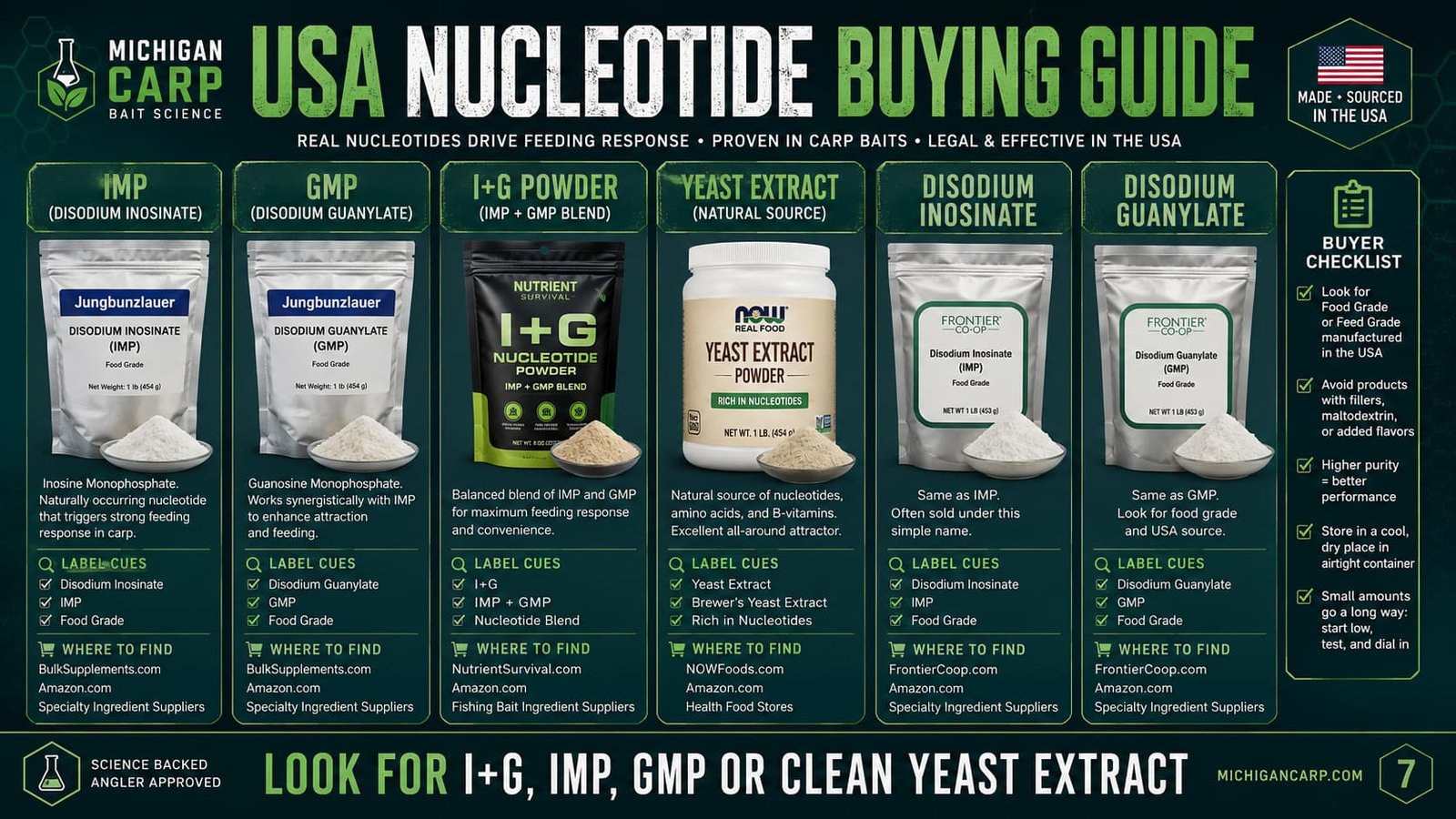
USA Buying Guide for IMP, GMP and Yeast Extract
Nucleotide ingredients are available in the USA, but they are not always sold under bait names.
Search For
Look for:
- IMP;
- GMP;
- 5′-IMP;
- 5′-GMP;
- disodium inosinate;
- disodium guanylate;
- disodium 5′-ribonucleotides;
- I+G powder;
- IMP/GMP blend;
- yeast extract powder;
- autolyzed yeast extract;
- savory yeast extract;
- food-grade flavor enhancer powder.
Best Practical Choice
For most home bait makers, the easiest practical option is:
I+G powder
or:
disodium inosinate + disodium guanylate blend
This is often sold as a savory food flavor enhancer.
Read the Label
Check:
- IMP content;
- GMP content;
- carrier;
- salt content;
- MSG added or not;
- yeast extract added or not;
- anti-caking agents;
- flavorings;
- purity;
- intended use;
- serving/use guidance;
- storage instructions.
Yeast Extract as a Practical Option
If pure IMP/GMP sourcing is difficult, yeast extract is often easier.
It does not give the same precise control as pure IMP/GMP powder, but it can provide a practical savory nucleotide-style background along with amino and peptide-type food signals.
Avoid
Avoid:
- flavored snack seasoning blends;
- products with onion/garlic-heavy seasoning unless intended;
- spicy soup powders;
- products with unknown flavor systems;
- high-salt blends used blindly;
- industrial chemical sources;
- anything not suitable around bait or water.
Use clean, simple labels.
Common Nucleotide Mistakes
Mistake 1: Using Too Much
IMP and GMP are strong.
Use them like seasoning.
Mistake 2: Treating Nucleotides as Magic
They support bait.
They do not replace good food ingredients or watercraft.
Mistake 3: Confusing Yeast Extract With Brewer’s Yeast
Yeast extract is stronger and more soluble than ordinary brewer’s yeast.
Mistake 4: Stacking Too Many Savory Additives
High yeast extract, high liver, high fish hydrolysate, high betaine and high IMP/GMP can become harsh.
Mistake 5: Ignoring Salt
Many IMP/GMP products are sodium salts or mixed with salty carriers.
Mistake 6: Using Snack Seasonings Blindly
Flavor enhancer blends may contain ingredients you do not want in bait.
Mistake 7: Drowning Wafters and Pop-Ups
The carrier liquid can change buoyancy.
Mistake 8: Not Testing in Water
Soak testing shows leakage, harshness, softness and buoyancy changes.
Mistake 9: Ignoring Storage
Wet glugs with yeast, liver or CSL can spoil if stored warm.
Mistake 10: Forgetting the Bait’s Identity
A milk/nut bait should still be milk/nut.
A fruit/cream bait should not accidentally become savory soup.
Simple Nucleotide Test Plan
Before changing a main bait, test small.
Step 1: Choose One Delivery Method
Pick one:
- dry base mix inclusion;
- hookbait mix;
- powder coating;
- spray;
- glug;
- packbait add-on.
Step 2: Make Three Levels
For free bait:
Low: 1 g total IMP/GMP per kg
Medium: 3 g total per kg
High: 5 g total per kg
For hookbaits:
Low: 3 g total per kg
Medium: 5 g total per kg
High: 8 g total per kg
For powder dust:
Low: 1 g per 100 g dust
Medium: 3 g per 100 g dust
High: 5 g per 100 g dust
Step 3: Keep Everything Else the Same
Do not change:
- flavor;
- betaine;
- amino acids;
- liver;
- yeast;
- hydrolysate;
- boil time;
- drying time.
Step 4: Boil, Dry and Soak Test
Check after:
- 1 hour;
- 6 hours;
- 12 hours;
- 24 hours.
Step 5: Judge Properly
Look for:
- smell;
- savory balance;
- harshness;
- saltiness;
- leakage;
- softness;
- cracking;
- buoyancy;
- hookbait durability;
- storage behavior;
- fishing results.
Step 6: Record Results
Write down:
- product used;
- IMP/GMP ratio if known;
- level;
- supplier;
- bait recipe;
- boil time;
- drying time;
- soak test result;
- fishing result.
Without notes, nucleotide testing becomes guesswork.
My Practical View
Nucleotides are worth using, but they should be treated as fine-tuning ingredients.
For MichiganCarp-style bait making, I like them most in controlled savory support packages.
That means using low levels of IMP/GMP beside:
- hydrolyzed whey;
- beef liver hydrolysate;
- brewer’s yeast;
- yeast extract;
- liquid yeast;
- milk proteins;
- tiger nut flour;
- peanut protein;
- boilie crumb;
- betaine at sensible levels.
In my own bait thinking, IMP/GMP make most sense in milk/nut baits when I want a savory layer without turning the bait into a fishmeal bait.
They also make sense in hookbaits, powder coatings and short-session traps.
But I would not use them heavily.
I would not build a whole bait around them.
The bait should still be food first.
The final rule is:
USE IMP AND GMP LIKE SEASONING.
PAIR THEM WITH YEAST, LIVER, WHEY AND REAL FOOD INGREDIENTS.
START LOW.
TEST IN WATER.
DO NOT LET SAVORY ADDITIVES BURY THE BAIT.
FAQ
Are nucleotides good in carp bait?
Yes. Nucleotides can be useful in carp bait as low-level savory support additives, especially when paired with yeast extract, liver hydrolysate, hydrolyzed whey, amino acids and betaine.
What are IMP and GMP in carp bait?
IMP is inosine monophosphate and GMP is guanosine monophosphate. In bait making, they are used as savory or umami-style support additives.
Are IMP and GMP feeding triggers?
They are better described as savory palatability-support additives. Aquaculture research supports nucleotide use in some feed-attractant and palatability contexts, but they should not be treated as magic carp triggers.
How much IMP and GMP should I use in boilies?
A practical starting point is 1–3 g total IMP/GMP per 1 kg dry mix. Stronger hookbait mixes may use 3–8 g per kg.
What is I+G powder?
I+G usually refers to a blend of disodium inosinate and disodium guanylate, often used as a savory food flavor enhancer.
Is yeast extract a nucleotide ingredient?
Yeast extract can contain nucleotide-style savory compounds along with amino acids, peptides and minerals depending on the product. It is one of the most practical bait sources of savory nucleotide-style signal.
Are nucleotides the same as amino acids?
No. Amino acids are protein building blocks. Nucleotides are different molecules and are usually used in bait for savory palatability support.
Are nucleotides the same as betaine?
No. Betaine is a different small soluble additive. It can pair well with nucleotides, but it is not a nucleotide.
Can I use IMP/GMP in milk/nut boilies?
Yes. Low-level IMP/GMP can work well in milk/nut boilies when paired with hydrolyzed whey, yeast, beef liver hydrolysate and betaine.
Can I use IMP/GMP in fishmeal boilies?
Yes. IMP/GMP can support savory fishmeal boilies, but they should be used carefully because fishmeal baits can become harsh if overloaded.
Can nucleotides be used in hookbaits?
Yes. Hookbaits are one of the best places to test IMP/GMP, especially in hard bottom baits, sprays, dips, powder coatings and paste wraps.
Can I add IMP/GMP to glugs?
Yes. IMP/GMP can be dissolved into glugs and sprays, but the liquid carrier affects storage, PVA safety and bait texture.
Are IMP and GMP PVA-safe?
Dry IMP/GMP powder is suitable in dry PVA mixes. Liquids containing dissolved IMP/GMP may or may not be PVA-safe depending on the carrier, so test your own PVA.
Where can I buy IMP and GMP in the USA?
Search for IMP, GMP, disodium inosinate, disodium guanylate, I+G powder, disodium 5′-ribonucleotides and yeast extract powder.
What is the biggest mistake with nucleotides in carp bait?
The biggest mistake is using too much and expecting IMP/GMP to carry the bait by themselves.
Next Steps
Use these supporting guides next:
- Amino Acids in Carp Bait
- Betaine in Carp Bait
- Yeast and Fermented Additives in Carp Bait
- How to Use Hydrolysates in Carp Bait
- Liver Hydrolysate for Carp Bait
- Milk Proteins in Carp Bait
- Milk Powders in Boilie Making
- How to Formulate a Milk, Nut and Birdfood Boilie Base Mix
- How to Prepare Boilies for Carp Fishing
- Packbait for Carp Fishing
- Particles for Carp Fishing
- The Bait Shed
- Boilie School
- Michigan Carp Guide Library