

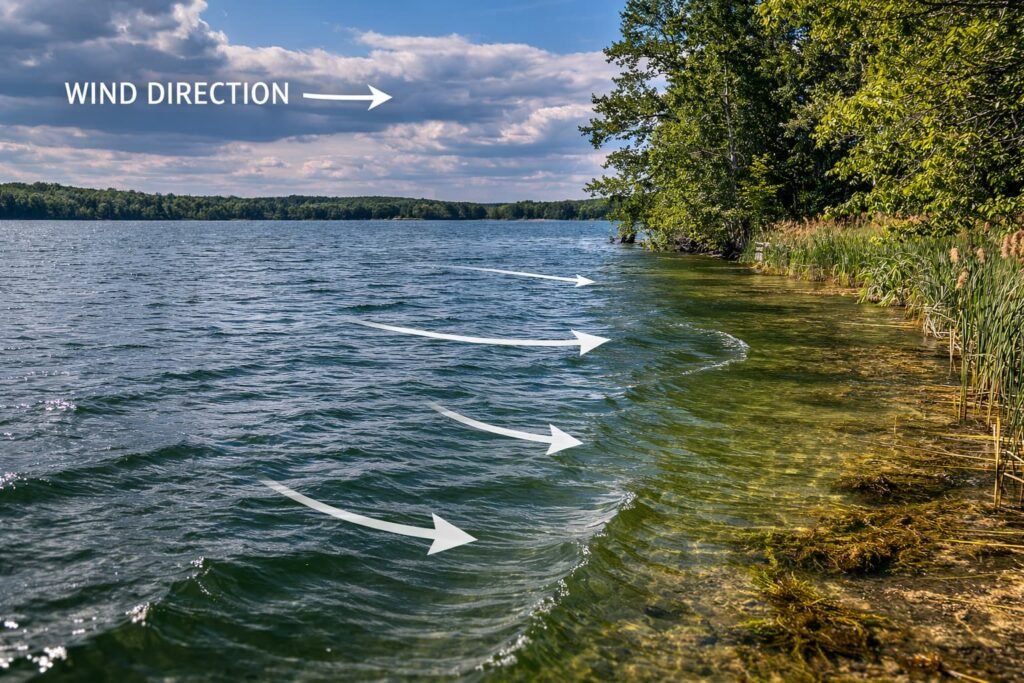
Water movement changes everything.
It changes where food collects, where oxygen improves, where warmth builds or gets stripped away, where fish feel safe, and where they are willing to feed. That is why so many carp anglers pay attention to the wind. Not because wind is some magic charm, but because moving water reshapes the lake in ways that matter to carp.
The mistake comes when anglers simplify it too much. They hear “fish the windward bank” and treat it like a rule that works every time. Sometimes that is the right call. Sometimes it is exactly the wrong one. The real job is understanding what the wind is actually doing to the water in front of you.
Once you understand that, wind, waves, and current stop being guesswork and start becoming one of the best location tools you have.
This page works best alongside Carp Water Temperature Guide for Michigan Lakes, Seasonal Carp Movement in Michigan, and How to Find Carp in Big Lakes.
Quick Start
- wind does more than move the surface — it moves food, oxygen, temperature, and confidence
- the windward bank is often good, but not always
- new wind and long-established wind can create very different fishing situations
- waves matter because they disturb margins, push food, and create undertow
- current from inflows, outflows, channels, and necked-down water can position carp very predictably
- the best bank is usually the one where moving water improves the lake, not just the one taking the strongest hit
Why Water Movement Matters So Much
Carp do not just respond to places. They respond to conditions inside those places.
That is why a bank can look identical on two different days and fish completely differently. Once the water moves, the zone changes with it.
Wind, waves, and current can change:
- oxygen levels
- food concentration
- water clarity
- temperature distribution
- fish confidence
- the routes carp use to patrol and feed
That is a lot of power from one factor, which is why anglers who learn to read water movement properly often seem to “find fish faster.”
What Wind Actually Does To A Lake
The simple version is that wind pushes surface water.
The more useful version is that wind also pushes the things riding in that water and changes the conditions underneath it. Food can drift. Small natural life can gather. Oxygen can improve. Slight warmth can collect in the right situation, or get blown out of the wrong one. Wave action can disturb shallow margins and make them more attractive to feeding carp.
So when anglers say “the wind is on that bank,” what they should really be asking is:
- what is the wind pushing there?
- what is it improving?
- what is it ruining?
- what kind of carp water is it creating?
New Wind vs Established Wind
This is one of the most useful distinctions most anglers do not think about enough.
New wind
A new wind can wake an area up quickly, especially if it starts pushing into useful water and fish respond to the change. But on some waters, a sudden new wind has not yet had long enough to really build food and confidence into the bank.
Established wind
A wind that has been pushing steadily for a while can be much more powerful. It has had time to move food, improve the zone, and give fish a reason to keep checking that bank. On many waters, an established wind is where the real edge appears.
This is why “there is a wind on it” is not enough on its own. The duration matters, not just the direction.
The Windward Bank — When It Is Good
The windward bank is often good for very logical reasons.
It may offer:
- pushed food
- better oxygen
- more active shallow water
- disturbed margins that help feeding
- patrol routes fish can work along naturally
On big lakes especially, the windward side can become a very real area of interest because the fish have a reason to visit it repeatedly, not just randomly.
This is why wind often shows up so heavily in big-lake carp watercraft. It is not just about casting into the chop. It is about recognising that the lake is being re-arranged.
When The Windward Bank Is The Wrong Choice
This matters just as much.
The windward bank is not automatically the right bank if the wind is making the water worse instead of better.
Examples include:
- a cold wind crashing into a shallow bank and stripping comfort from it
- too much colour and disturbance turning the area ugly rather than lively
- a bank with no sensible access, no nearby depth, and no real route value
- excessive boat traffic or pressure on the obvious windward side
A lot of anglers lose fish by following the wind blindly instead of asking what the wind is actually doing to that bank.
Wave Action — More Important Than People Think
Waves do more than make the water look lively.
They disturb shallow edges, move debris, shift small food items, stir up soft margins, and can create a feeling of active water that carp often respond to. On many waters, wave action is part of what makes a windward margin so attractive.
That does not mean all rough water is good. It means wave action has to be read in context.
Some of the best carp water is not the wildest water. It is the water with enough movement to improve the zone without turning it into chaos.
Undertow — The Bit Many Anglers Miss
When wind pushes surface water one way, undertow can move below it in a different way. This matters because food and fine particles do not all stay on the surface. Some get moved along edges, bars, slopes, and margins underneath the obvious drift.
That means a fishable line may not always be right on the most obvious surface hit. Sometimes the better area is slightly off the face of the wind where undertow, depth, and feeding shape up more cleanly.
This is one reason some anglers catch off the “wrong” bank near a strong wind and think the wind theory is nonsense. Usually, the water is still moving in their favour — just less obviously.
Current Matters Too, Not Just Wind
Current can come from more than big rivers.
On carp waters, useful current can be created by:
- creek mouths
- inflows and outflows
- channels between lake sections
- narrow necks in big waters
- boat channels and marinas
- water being pushed through structure by persistent wind
Anywhere water is moving through a tighter space, carp often have a reason to pay attention. Food gets delivered. Routes become more defined. The lake becomes easier to read.
Inflow Water — When It Is Valuable
Inflow areas can be excellent because they can bring in:
- oxygen
- temperature change
- food items
- natural scent and movement
That said, inflow water is not always good just because it exists. Muddy runoff, very cold fresh input, or highly pressured obvious inflows can still fish poorly. Again, the theme is the same: do not worship the feature. Read what it is actually doing.
How Wind Positions Carp On Big Lakes
On big water, wind becomes even more important because it helps cut the lake down into smaller, more readable sections.
Instead of treating the whole lake as one giant puzzle, you can start by asking:
- which banks are getting improved water?
- where will food be pushed?
- which side now offers better patrol routes?
- where does the windward water meet useful depth change or cover?
That is why this page should be used alongside Finding Carp in Big Lakes (Michigan Strategy Guide) and Finding Carp in Big Michigan Lakes: A Bank Angler System.
Seasonal Differences In Wind Effect
Spring
In spring, wind can be brilliant or terrible depending on what it does to temperature. A mild helpful wind pushing into a useful bay can be excellent. A cold harsh wind stripping heat from shallow water can ruin what looked like a great bank the day before.
Summer
In summer, wind often improves oxygen, moves food, and creates more active water. Windward banks can be very strong, especially where they combine with weed edges, shelves, or patrol routes.
Fall
In fall, wind can again become very powerful, but only when it helps rather than damages the comfort of the area. Stable food-rich movement lines often matter more than simply chasing the roughest bank.
That is why water movement always has to be read through the seasonal lens. Use this page with Seasonal Carp Movement in Michigan rather than treating wind as an isolated topic.
How Wind Behaves Differently on Small Lakes vs Big Open Lakes
One mistake anglers make is assuming wind behaves the same on every water. It does not.
On a small lake, wind often has a quicker and more obvious effect. It can push food, colour, surface warmth, and active water into one bank fast enough that the change becomes fishable within a short session. Smaller lakes usually react faster because there is less water volume to move and fewer large open-water buffers between one bank and the next.
On a big open lake, the effect is often broader, slower, and more structural. Wind may still improve a bank, but it often matters most where that movement meets something useful — a bar, shelf, channel edge, point, bay mouth, weedline, or shallow-to-deep access route. Big-lake wind is less about “fish the roughest bank” and more about “fish the part of the lake where moving water now creates a proper route or feeding zone.”
On smaller lakes, wind often does these things faster
- pushes food and floating debris into one end or one bank
- creates colour and margin disturbance quickly
- warms or chills a shallow corner more obviously
- turns one side into the clear short-term hotspot
That is why on smaller waters, a fresh helpful wind can sometimes make a bank worth trying almost immediately.
On bigger open lakes, wind usually matters more when it combines with features
- points and inside turns
- bars and drop-offs
- channel lips and bay mouths
- weed edges and patrol lines
- narrow sections where water movement gets concentrated
On these waters, the best result often comes not from the hardest-hit bank itself, but from the area where that moving water now meets structure, safety, and access.
The practical takeaway
On a small lake, wind can create a quicker, more obvious “go there now” signal.
On a big open lake, wind is usually better treated as a water-movement clue that helps you narrow the lake down into the right zones. The wind still matters just as much — it just needs reading with more patience and more structure in mind.
How Bank Anglers Should Use This
For a bank angler, wind and current are not just theory. They help you choose where to start.
On arrival, ask:
- which side is getting improved water?
- which side has useful depth and access behind that movement?
- where is food likely collecting?
- where does wind meet weed, reed, bars, points, or shelves?
- is this a feeding bank or just a noisy bank?
That last question matters. A “lively” bank is not automatically a good carp bank. You want the bank where movement creates feeding opportunity, not just surface drama.
Wind and Baiting
Water movement also changes how baiting should be handled.
On a strong moving bank, bait may spread differently, food signals may drift more, and fish may move through an area with more pace than they would on quiet water. That means a tight little feeding patch can behave differently under movement than it would in flat calm water.
This is one reason campaign baiting works best when you fully understand the route and the bank. The natural extension of this page is Prebaiting Big Lakes: The 4-Week Blueprint.
Michigan Notes
Michigan waters often exaggerate the effect of water movement. Big inland lakes, open shorelines, shallow bays, connecting water, and weather swings can all make wind one of the strongest location tools on the lake.
But they also make mistakes more obvious. A cold north wind can kill a shallow bank that looked perfect the day before. Strong open-water chop can create brilliant feeding water on one lake and overdo it completely on another. The lake type matters. The season matters. The trend matters.
That is why copying “always fish the wind” is too crude for Michigan. Use the principle, but read the actual result on your water.
Common Mistakes
- blindly fishing the windward bank every time
- focusing on surface chop instead of what the water underneath is doing
- ignoring undertow and subsurface movement
- assuming inflow or current is automatically good
- failing to connect wind with season and temperature
- choosing the noisiest bank rather than the most useful bank
FAQ
Should I always fish the windward bank for carp?
No. It is often the right place to start, but only when the wind is improving the bank rather than damaging it.
Does wind make carp feed?
Not by magic. What wind does is improve conditions in certain areas by moving food, oxygen, and active water into them.
What about flat calm water?
Calm water can still be good, especially if it holds stable comfort, natural food, and confident fish. Wind is powerful, but it is not the only answer.
Is current useful on stillwaters?
Yes. Even on lakes, current from inflows, outflows, channels, and necked-down sections can position carp predictably.
What should I read next?
Go next to How to Find Carp in Big Lakes, then Finding Carp in Big Lakes (Michigan Strategy Guide), then Prebaiting Big Lakes: The 4-Week Blueprint.