

One of the best habits in bait making is testing your boilies before you fish with them.
Too many anglers make bait, bag it, and take it straight to the lake without really checking how it behaves.
That is how you end up fishing with bait that is too hard, too soft, too dead, too active, or simply wrong for the job.
This guide shows you how to test boilies properly before fishing, so you know what the bait is actually doing rather than what you hope it is doing.
If your bait is already giving you trouble, start here:
Boilie Problems: Real Causes and Fixes That Actually Work
Quick Start
Before fishing any new batch, check:
- firmness in the hand
- smell and feel
- how it breaks down in water
- how quickly it takes water on
- whether it stays suitable for the session length
You do not need a laboratory.
You just need a simple, practical testing habit.
Why Testing Matters
A boilie can look fine in the bag and still behave badly in the water.
That is because what matters most is not just:
- how it rolled
- how it dried
- how it stores
It is how it reacts once it is in the lake.
Testing helps you check:
- structure
- leakage
- stability
- suitability for the job
Step 1: Check It Dry in the Hand
Before any water test, handle the bait properly.
Check:
- how firm it feels
- whether it is too brittle
- whether it feels dead and over-dry
- whether it seems too soft for the session
This first check tells you a lot.
A bait that already feels wrong dry often behaves worse once it hits the water.
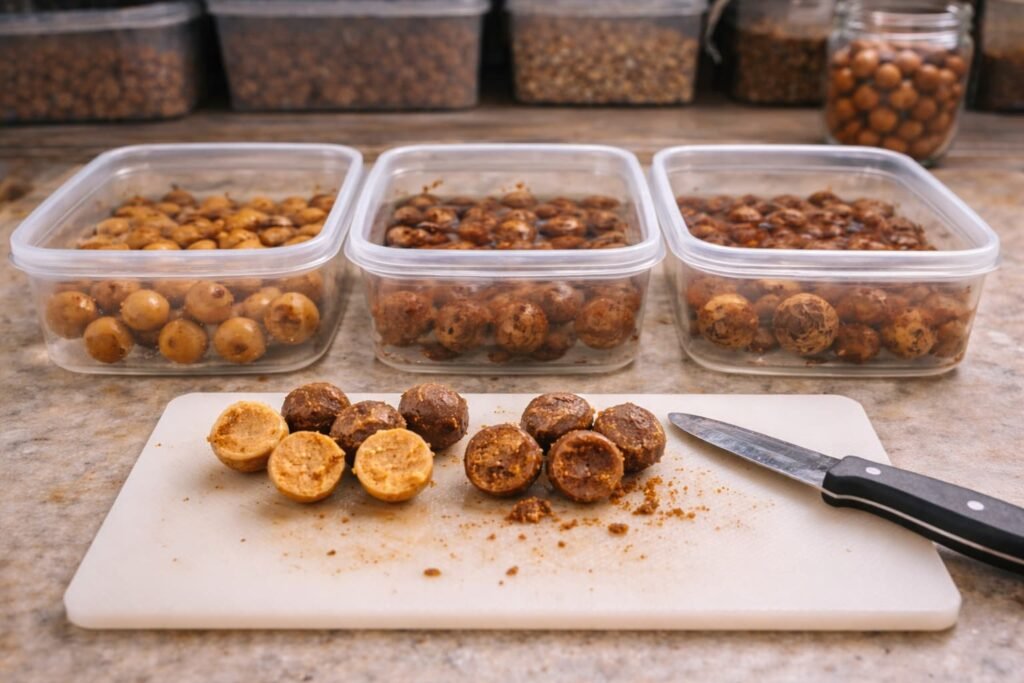
Step 2: Cut One Open
Cut a few boilies open and look at the inside.
Check:
- even internal texture
- any hollow middle
- overly dry center
- overly wet center
This helps you spot:
- poor mixing
- poor rolling
- undercooking
- bad drying balance
Step 3: Do a Simple Water Breakdown Test
Put a few boilies in clean water and leave them for a set time.
A simple test pattern is:
- 1 hour
- 4 hours
- 8 hours
- 24 hours
Check:
- how quickly they soften
- whether they hold shape
- whether they crack
- whether they go mushy
- whether they still feel too hard
Step 4: Check Water Uptake
A good boilie should let water in so signals can move out.
What you are looking for is not instant collapse and not total deadness.
You want:
- controlled softening
- steady waking up
- proper exchange without failure
If the bait stays like a stone, that is a problem.
If it collapses too fast, that is also a problem.
Step 5: Check Leakage and Activity
Watch the bait in water and look for signs of life.
You are not just looking for dramatic cloud.
You are looking for:
- surface change
- gradual softening
- proper water exchange
- active feel without breakdown failure
For more on this, read:
Why Some Carp Baits Leak Faster Than Others
Step 6: Match the Test to the Session
Not every bait should behave the same way.
Short session bait
You can accept a more active, softer bait that wakes up quickly.
Longer session bait
You may want more hold and a slower breakdown.
Hookbait testing
Hookbaits should also be checked for:
- durability
- hair presentation
- whether they stay fit for the intended time in the water
Step 7: Test a Few, Not Just One
Do not judge the whole batch on one bait.
Test several.
This helps you spot:
- consistency
- poor rolling
- uneven cooking
- uneven drying
Step 8: Recheck After Storage
Stored bait should be tested again before use, especially if it has been:
- frozen
- dried further in the bag
- sitting as shelf life bait for a while
Storage can change how a boilie behaves.
For that side of things, read:
How to Store Boilies (Freezer vs Shelf Life)
What a Good Test Result Looks Like
A good test boilie usually shows:
- proper firmness at the start
- no major cracking or collapse
- steady water uptake
- controlled softening
- enough structure for the job
- enough activity to feel alive
That is what you are after.
Not the hardest bait.
Not the softest bait.
The right bait for the job.
Common Testing Mistakes
- testing only one bait
- only checking the outside
- assuming dry feel tells the full story
- not testing stored bait again
- expecting every bait to behave the same
- confusing fast breakdown with better attraction
Michigan Notes
On Michigan waters, session length, water temperature, and nuisance species all affect what “right” looks like.
A bait that is ideal for a short spring overnighter may not be right for a longer summer session.
That is why testing matters so much. It helps you match the bait to the actual job rather than fishing blind.
FAQ
How long should I test boilies in water for?
Long enough to match the kind of session you are planning. A short test at 1 hour tells you one thing. A 24-hour test tells you another.
Should I cut every batch open?
Yes, or at least a few from each batch. It is one of the easiest ways to spot internal problems.
What if the bait stays very hard in water?
That usually means it is taking on water too slowly and may be too dry or too sealed.
What if the bait goes soft too quickly?
That usually means weak structure, too much solubility, or a bait better suited to shorter sessions.
Can I test hookbaits the same way?
Yes, but also check how they sit on the hair and how long they stay usable.
Next Steps
To complete the full boilie process, read: