

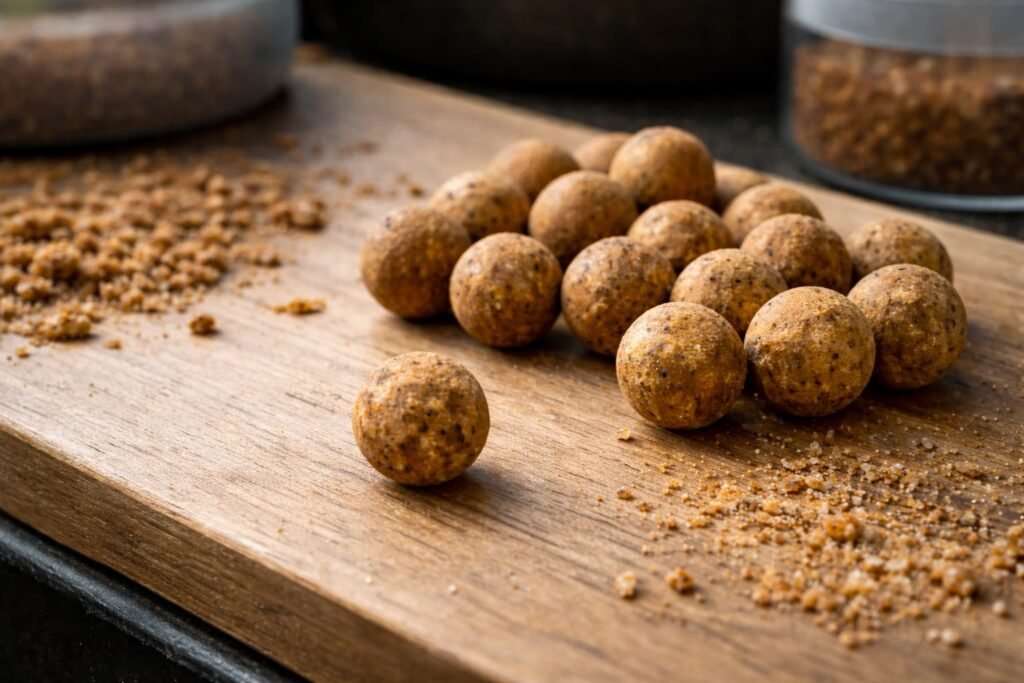
A lot of anglers use the same bait for both jobs and never stop to think about it.
A freebait goes in the swim. A hookbait goes on the rig. Same bag, same tub, same recipe, same look, same everything.
That works often enough.
But it is not the same job.
A freebait is there to be eaten as part of a feeding pattern. A hookbait is there to be the one bait the fish picks up with the hook attached. That means the job is different, the risk is different, and the way you prepare the bait should often be different too.
This page explains what what makes a hookbait different from a freebait, what changes and why.
For the practical bait-prep side, read The Bait Shed. For the treatment side, read How to Treat Boilies for Carp (Step-by-Step).
Quick Start
- A freebait’s job is to feed fish confidently and keep them in the swim
- A hookbait’s job is to get picked up with the hook attached
- Freebaits can be more about volume, consistency, and food value
- Hookbaits can be more about signal, durability, balance, and presentation
- The chemistry does not always need to be identical
- A hookbait usually works best when it is at least slightly better than the surrounding feed
- Better does not always mean brighter or stronger — often it means simply better prepared
- Matching the freebait is still a very strong default, but matching alone is not the whole answer
The Jobs Are Different
This is the main point.
A freebait is food.
A hookbait is food with a trap attached.
That means a freebait needs to:
- feed fish confidently
- fit the overall baiting picture
- be affordable enough to use in quantity
- create repeated feeding without looking odd
- hold fish in the area
A hookbait needs to:
- get picked up first, or at least early
- survive the cast
- survive the session
- still release signal after hours in the water
- sit correctly on the rig
- behave naturally when mouthed
That is already a completely different job description.
What Makes a Good Freebait
A good freebait is normally:
- consistent
- sensible in cost
- good enough nutritionally to build confidence
- durable enough for the session
- not over-engineered
You usually need a lot more of it than the hookbait, so cost and repeatability matter.
That is why freebaits usually make most sense as the more practical, volume-friendly version of the bait.
They do not need to be weak.
They just do not need to be the most enhanced bait in the swim.
What Makes a Great Hookbait
A hookbait is where you earn the extra detail.
Enhanced attraction
A hookbait should usually have a little more signal than the feed around it.
That can come from:
- glugging
- soaking
- dusting
- liquid food treatment
- paste wrapping
- a slightly more active outer layer
The key word is slightly.
A hookbait that is completely different from the freebait carpet can become suspicious. A hookbait that is just a bit better often gets picked up first.
Durability
A hookbait has to last.
It may need to sit in the water for hours while still:
- staying on the hair
- keeping shape
- retaining some signal
- surviving nuisance fish
- not becoming waterlogged and useless
This is why a hookbait often needs more thought than a freebait, even when it starts from the same base bait.
Presentation
A hookbait is part of a rig, not just part of a baiting spread.
That means it has to work with:
- the hook
- the hair
- the bottom type
- the buoyancy
- the mechanics of the take
A perfectly flavoured bait that sits wrong on the rig can still cost you fish.
Matching vs Mismatching
This is where a lot of anglers overcomplicate things.
Matching
Matching the freebait is still the safest and most consistent approach.
That means matching:
- size
- colour
- general smell
- general bait identity
This works because the hookbait blends into the feeding pattern rather than shouting that it is different.
Mismatching
A mismatch can work, but it needs a reason.
That reason might be:
- visibility over dark bottom
- buoyancy over silt or weed
- a softer texture than the freebait
- a stronger treated outer layer
- deliberate selectivity against nuisance fish
The mistake is mismatching without purpose.
A bright, hard, loud hookbait over a subtle freebait carpet is not automatically clever. It is just different.
Why Hookbait Texture Matters
This part gets missed constantly.
A hookbait is not only judged by taste.
It is judged by feel.
That means:
- skin
- softness
- balance
- yield
- hardness
- how naturally it moves in the mouth
all matter.
A very hard hookbait over softer freebait can be a mechanical giveaway. A hookbait that feels a bit more food-like often gets held slightly longer.
And a slightly longer hold often means a much better chance of the hook doing its job.
For more on that, read How to Test Boilies Before Fishing.
Why Hookbait Preparation Matters More Than Most Anglers Think
The best hookbait is often not a different bait.
It is the same bait, prepared better.
That might mean:
- selecting the best-shaped baits from the batch
- drying them a little longer
- soaking them properly
- glugging them for 24–48 hours
- adding a paste wrap
- using a matching wafter instead of a heavy bottom bait
- making sure the hookbait still feels food-like after treatment
That approach usually beats random gimmicks.
What This Means on the Bank
A freebait should do the feeding job.
A hookbait should do the conversion job.
That means the freebait keeps fish eating with confidence, while the hookbait is the one bait in the spread most likely to be picked up and pricked cleanly.
So the real question is not:
“Should my hookbait be the same?”
The real question is:
“Should my hookbait be prepared in the same way for the same job?”
Usually the answer is no.
Michigan Notes
On pressured Michigan waters, a matching hookbait with slightly enhanced attraction is usually a better route than a wildly different visual bait.
The fish still feed confidently on familiar-looking bait, but a hookbait with better treatment, better balance, or slightly softer texture often gets eaten first.
On less-pressured Michigan waters, you can get away with a lot more. Fish are feeding more openly, and the difference between hookbait and freebait becomes less critical.
In Michigan spring and cold-water fishing, smaller, softer, more active hookbaits usually make more sense than big hard ones.
That is one reason a treated 12–15mm hookbait often feels more effective than a standard 20mm bait in cold water.
Common Mistakes
- using freebaits and hookbaits exactly the same with no thought
- over-enhancing the hookbait until it feels too different
- ignoring hookbait durability
- focusing on flavour but not presentation
- matching colour but not texture
- forgetting that the hookbait only has one job: get picked up cleanly
FAQ
Can I use the same bait for hookbaits and freebaits?
Yes. It can work very well. But the hookbait is usually better when it is prepared more carefully.
Does a hookbait need to be stronger than the freebait?
Usually slightly, yes. Not necessarily louder in every way, but slightly more effective.
Should a hookbait always match the feed?
Usually that is the safest starting point. Deliberate mismatching can work when there is a clear reason.
Does hookbait texture matter?
Yes. A bait that feels better in the mouth often gets held longer and eaten more confidently.
Is a special shop-bought hookbait always better?
Not always. A well-prepared, well-treated bait from your own batch can be every bit as good.
Next Steps
Read these next: